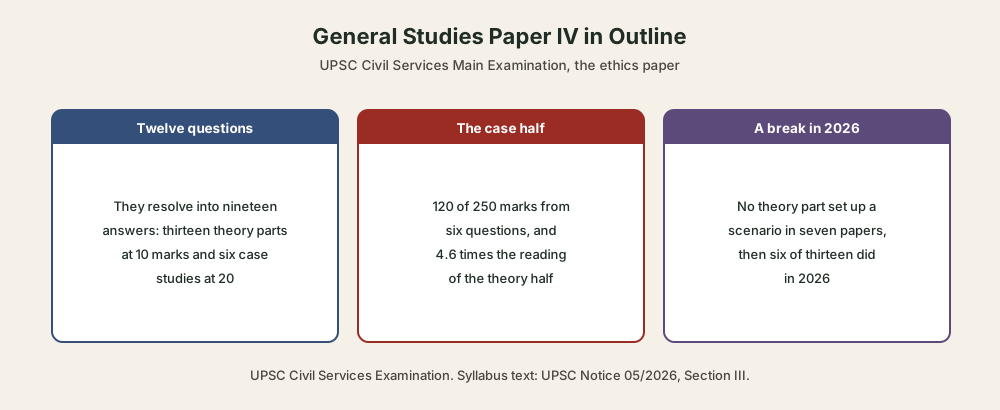
The UPSC GS 4 syllabus covers ethics and human interface, attitude, aptitude and foundational values, emotional intelligence, moral thinkers, public service values and probity in governance, with case studies on all of them. The paper prints twelve questions that become 19 answers for 250 marks in three hours. This guide reproduces the official syllabus and shows what the ethics paper has actually asked in 152 answers between 2019 and 2026.
What Is GS Paper 4 in UPSC? Marks, Questions and Word Limits
GS Paper 4 at a Glance: 250 Marks, 19 Answers, Three Hours
General Studies Paper IV is the ethics paper of the UPSC Mains. Its full title is Ethics, Integrity and Aptitude, and it is the last of the four General Studies papers, written on the second day. This page reproduces the official UPSC GS 4 syllabus and then shows what the paper has actually asked. The table gives the whole paper in one view.
| Point | Figure |
|---|---|
| Total marks | 250, the same as each of the other three General Studies papers |
| Share of the written Mains | 14.3 per cent of the 1,750 marks |
| Time | Three hours |
| Questions printed | Twelve, in two sections |
| Answers a candidate writes | 19 |
| Section A: Theory | 13 parts, each 10 marks and 150 words (130 marks) |
| Section B: Case studies | Six cases, each 20 marks and 250 words (120 marks) |
The 250 marks count for exactly as much as history, polity or economy. They are 14.3 per cent of the 1,750 marks of the written Mains; the final ranking then adds a 275-mark Personality Test, for 2,025 in all. Nothing in the scheme treats this as a lesser paper, even though it is written last.
How Many Questions in GS Paper 4 Mains? Twelve Questions, Nineteen Answers
The paper prints twelve questions in two sections, and a candidate writes 19 answers. Section A has six theory questions, most of them split into parts that are answered and marked separately, which makes 13 theory answers. Section B has six case studies. Every count on this page is of answers, because the answer is what a candidate actually writes.
The marks and word limits follow the same split. Each theory part carries 10 marks with a limit of 150 words, and each case study carries 20 marks with a limit of 250 words. The theory parts add up to 130 marks and the case studies to 120, which together make the full 250. Both figures are printed on the question paper against each part.
Why Method Matters More Than Reading in the UPSC Ethics Paper
This paper differs from the other three General Studies papers in one important way: it tests no specialist knowledge. In history or economy, a topic you have not read becomes a question you cannot attempt. In ethics you will understand almost every question, so what separates a strong answer from a weak one is method.
- Reading: How carefully you read the question and notice what it actually asks.
- Structure: How you organise the answer inside the word limit.
- Position: Whether you take a clear position and hold it to the last line.
A candidate who has not practised rarely leaves an ethics question blank. They write a loose answer to a question they understood perfectly well, and timed practice fixes exactly that weakness.
The Official UPSC GS 4 Syllabus: Ethics, Integrity and Aptitude
The Ethics Integrity and Aptitude Syllabus as the Commission Prints It
The ethics integrity and aptitude syllabus below is reproduced word for word from Examination Notice 05/2026, Section III. Read the opening paragraph with care. It is not a preamble; it is the instruction that the rest of the paper follows, and it names the case study method before the topics.
- Ethics and Human Interface: Essence, determinants and consequences of Ethics in-human actions; dimensions of ethics; ethics - in private and public relationships. Human Values - lessons from the lives and teachings of great leaders, reformers and administrators; role of family society and educational institutions in inculcating values.
- Attitude: Content, structure, function; its influence and relation with thought and behaviour; moral and political attitudes; social influence and persuasion.
- Aptitude and foundational values for Civil Service, integrity, impartiality and non-partisanship, objectivity, dedication to public service, empathy, tolerance and compassion towards the weaker-sections.
- Emotional intelligence-concepts, and their utilities and application in administration and governance.
- Contributions of moral thinkers and philosophers from India and world.
- Public/Civil service values and Ethics in Public administration: Status and problems; ethical concerns and dilemmas in government and private institutions; laws, rules, regulations and conscience as sources of ethical guidance; accountability and ethical governance; strengthening of ethical and moral values in governance; ethical issues in international relations and funding; corporate governance.
- Probity in Governance: Concept of public service; Philosophical basis of governance and probity; Information sharing and transparency in government, Right to Information, Codes of Ethics, Codes of Conduct, Citizen's Charters, Work culture, Quality of service delivery, Utilization of public funds, challenges of corruption.
- Case Studies on above issues.
There is no separate UPSC GS 4 syllabus PDF. The syllabus is part of the examination notice, which the Commission publishes as a PDF each year (the current notice), and the Civil Services Examination Rules that carry the same scheme are notified in the Gazette of India.
Case Studies Are Written Into the Syllabus
Most syllabus lines name a subject. This syllabus also names a method: questions may utilise the case study approach. The Commission has told candidates in advance how it intends to test them, and has then given the method its own clause at the end of the list.
That is why the case half is not an add-on to this paper. It is the paper's declared instrument, and it carries 120 of 250 marks. How those marks and the reading behind them fall is the subject of the case study section below.
GS 4 Syllabus Decoded: Which Clauses the Paper Actually Asks
Theory Questions by Syllabus Clause, 2019 to 2026
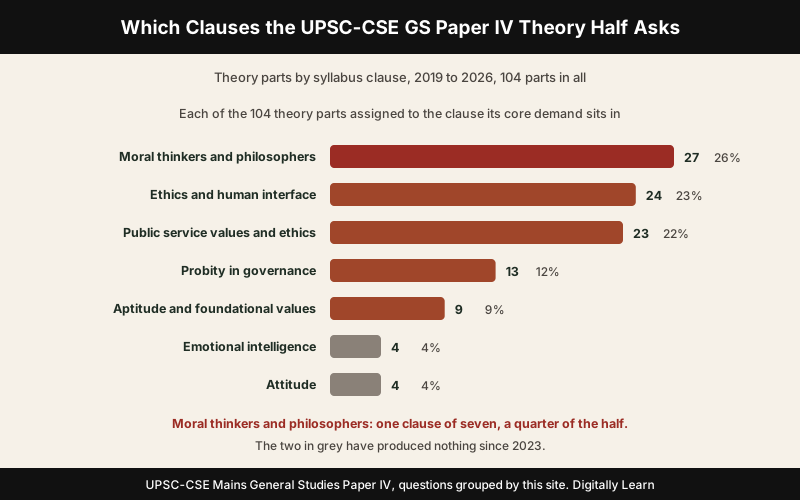
The seven topic clauses of the syllabus are not asked equally. Each of the 104 theory questions set between 2019 and 2026 was read and assigned to the clause its core demand sits in, and the table shows the result. Case studies are left out here because the syllabus gives them a clause of their own; they are a format rather than a topic, and they are analysed separately below.
| Clause | Theory questions | Share | 2019 to 2022 | 2023 to 2026 |
|---|---|---|---|---|
| Moral thinkers and philosophers | 27 | 26% | 13 | 14 |
| Ethics and human interface | 24 | 23% | 11 | 13 |
| Public service values and ethics in administration | 23 | 22% | 7 | 16 |
| Probity in governance | 13 | 12% | 9 | 4 |
| Aptitude and foundational values | 9 | 9% | 5 | 4 |
| Emotional intelligence | 4 | 4% | 3 | 1 |
| Attitude | 4 | 4% | 4 | 0 |
Moral Thinkers: One Syllabus Line, a Quarter of the Theory Questions
Moral thinkers and philosophers is one line of the seven, and it produces 27 of the 104 theory questions, 26 per cent. It has appeared in every paper since 2019, never fewer than two times in a paper. This fits another pattern of the paper: 36 of the 104 theory questions are built around a quotation, and a quotation is usually a thinker speaking.
Attitude and Emotional Intelligence: Two Clauses Rarely Asked Since 2023
The syllabus names attitude and emotional intelligence as separate clauses, yet together they account for only 8 of the 104 theory questions, 8 per cent. Attitude was last asked in 2022 and emotional intelligence in 2023, so the last three papers have carried neither.
Public Service Values: The Clause That Is Growing
Public service values and ethics in administration has gone from 7 questions across 2019 to 2022 to 16 across 2023 to 2026, and it led the last two papers outright at 5 apiece. It is also the widest clause in the notice, running from status and problems through ethical dilemmas in government and private institutions to accountability, international relations and corporate governance. A paper drifting towards it is drifting towards applied administrative ethics and away from abstract theory.
| Year | Theory parts | Case studies | Parts carrying a quotation | Situational parts |
|---|---|---|---|---|
| 2019 | 13 | 6 | 5 | 0 |
| 2020 | 13 | 6 | 4 | 0 |
| 2021 | 13 | 6 | 5 | 0 |
| 2022 | 13 | 6 | 2 | 0 |
| 2023 | 13 | 6 | 5 | 0 |
| 2024 | 13 | 6 | 7 | 0 |
| 2025 | 13 | 6 | 7 | 0 |
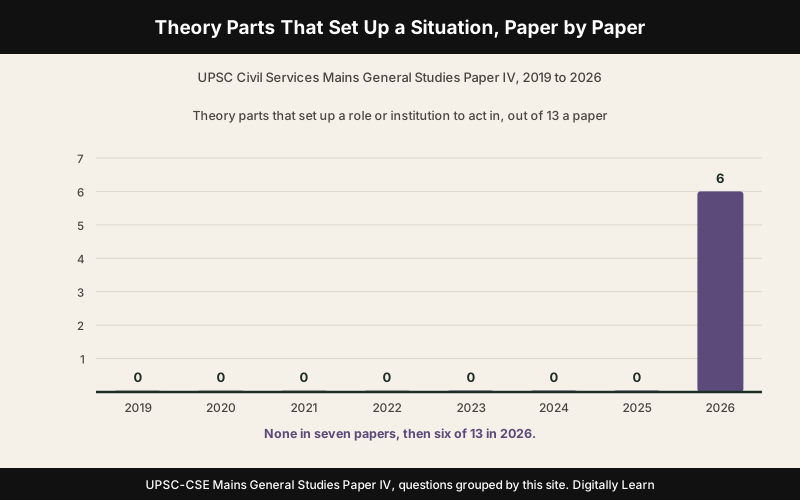
| 2026 | 13 | 6 | 1 | 6 |
GS 4 Case Study: Half the Marks, Most of the Reading
Why Are Case Studies Important in GS Paper 4?
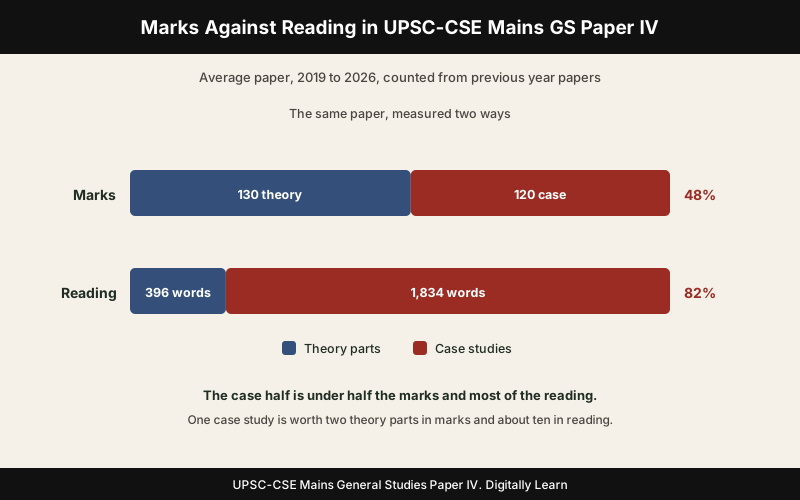
Case studies are important because they carry 120 of the 250 marks and about 82 per cent of the reading in the paper, so they decide how the three hours are spent. On marks alone the paper looks evenly balanced, with theory slightly ahead, and many candidates divide their preparation and their time roughly in half. The question papers show why that is a mistake.
| Point | Section A: Theory | Section B: Case studies |
|---|---|---|
| Answers | 13 | 6 |
| Marks | 130 (52 per cent) | 120 (48 per cent) |
| Words to read | 396 | 1,834 |
The six case studies together run to about 1,834 words in an average paper, while all 13 theory questions together run to 396. Put another way, a single case study is roughly ten times as long as a theory question but carries only two times the marks.
Planning the Three Hours Around Section B
Dividing the time equally among 19 answers gives about 9 minutes each. An equal split ignores the fact that Section B needs close to 1,834 words of reading before any writing can begin, so the plan has to lean towards the case studies.
- Time split: Give the theory section somewhat less than half of the three hours and the case studies somewhat more.
- Reading load: Count reading time as part of what each case study costs; it is writing time already spent.
- Preparation: Practise case studies against the clock first. Most candidates leave them for last, after the theory, which is the wrong order for this paper.
Six Settings That Keep Returning in UPSC GS 4 Case Studies
The 48 case studies set since 2019 return to a small number of settings, grouped here by the words each case uses. A case can sit in two settings at once, a border district with a health crisis being both, so the counts do not add up to 48.
| Setting | Case studies | Share |
|---|---|---|
| Border, policing and security | 14 of 48 | 29% |
| Health and medical ethics | 13 of 48 | 27% |
| Environment and clearances | 10 of 48 | 21% |
| Welfare delivery | 8 of 48 | 17% |
| Disaster and relief | 5 of 48 | 10% |
| Procurement and contracts | 4 of 48 | 8% |
Border, policing and security leads at 14 of 48, and the top three settings between them touch most of the section. None of it is exotic. A candidate who has read GS Paper 2 and GS Paper 3 already knows the institutions these cases run on.
Decide as the Officer, or Judge the Officer: Two Kinds of Case
Ten of the 48 case studies address the candidate directly: you are the municipal commissioner, you are heading the rescue operation, you are the district magistrate who has rushed to the spot. The other 38 describe someone else and ask what should be done about them. The difference changes the answer.
- Second person: The case wants a decision, written in the first person and owned.
- Third person: The case wants an evaluation of the official described. An answer that slips into what I would have done has changed the question.
Neither 2025 nor 2026 used the second person at all, so the recent drift is towards judging another official rather than being one.
Cases Set Outside Government, and What a Case Does Not Ask For
A quiet assumption in most preparation is that every case study is an administrative one. Eight of 48 are not: a marketing vice president at a multinational, the chairman of a missiles company, a biotechnology scientist, a chief executive weighing a product that is legal abroad and harmful at home. These cases test the same reasoning, and they deny a candidate the usual escape route of quoting a service rule.
Underneath the settings the structure repeats. Nearly every case sets a duty against a relationship, or a rule against a consequence: an officer who is right and a superior who is senior, a procedure that is lawful and an outcome that is unjust. Reading five cases for their structure teaches more than reading twenty for their subject, because the subject is the part that will be new on the day.
Quotations and Thinkers in the Ethics Paper
One Theory Question in Three Is a Quotation
36 of the 104 theory questions set since 2019 carry a quoted passage, 35 per cent. In several of them the question is the quotation and nothing else: a line from Thiruvalluvar or William James, printed alone, with a word limit under it. That is a different task from answering a posed question. There is no directive verb telling the candidate what to do, so the first decision, what the line means, is already part of the answer.
How to Answer a Bare Quotation in 150 Words
The structure that works is short and always the same, which is why it can be rehearsed until it costs no thinking time on the day.
- Interpret: Say what the line claims, in your own words, in one or two sentences.
- Take a stand: Agree, qualify or disagree, and say so plainly rather than circling.
- Apply: Bring it to administration, because that is the paper this is.
- Close: End with one sentence that answers the line rather than summarising the essay.
Which Thinkers Are Asked: Fourteen Names in Eight Papers
The syllabus clause reads contributions of moral thinkers and philosophers from India and world. In practice the paper leans Indian: across 8 papers it has named Indian figures 18 times and figures from elsewhere 6 times. Every name it has used is in the table.
| Name | Mentions | India or world |
|---|---|---|
| Vivekananda | 5 | India |
| Gandhi | 5 | India |
| Kalam | 2 | India |
| Nehru | 1 | India |
| Buddha | 1 | India |
| Patel | 1 | India |
| Thiruvalluvar | 1 | India |
| Mahavir | 1 | India |
| Ambedkar | 1 | India |
| Socrates | 2 | World |
| Kant | 1 | World |
| Clausewitz | 1 | World |
| William James | 1 | World |
| Shakespeare | 1 | World |
The list is 14 names long over 8 papers, which makes the reading finite. Vivekananda and Gandhi lead it, and a candidate who knows those two properly is better placed than one who has skimmed twenty.
GS Paper 4 PYQ Analysis: What Changed in 2026
Situational Theory Questions: Seven Papers at Zero, Then Six
A theory question is situational when it puts a specific person in a specific circumstance and asks what should be done, rather than asking about a concept, a quotation or a general claim. That is the working test used on this page; the Commission does not classify its questions.
Every paper from 2019 to 2025 produced no situational theory question at all. Theory questions asked about concepts, unpacked quotations or tested a general claim, and the scenarios stayed in Section B where the syllabus puts them. The 2026 paper then ran six of its 13. That is not a rise; it is a break.
The Six 2026 Questions in Full
All six are printed in full rather than summarised, so that you can judge the classification yourself. Each puts a named actor in a circumstance and asks what should follow, and none can be answered by defining a term, which is what separates them from the other seven theory questions of the same paper.
| Number | The question as printed |
|---|---|
| Q1 | Owing to paucity of time, a university professor generates a Ph.D. evaluation report using Artificial Intelligence and submits it with some modifications. Discuss this from the perspective of accountability and integrity. |
| Q2 | A business house is working on a project that could displace a forest community from their habitat. As the administrative officer of that district, what ethical challenges are you likely to face? |
| Q3 | An endangered tribe has developed a severe skeletal deformity. A university research has identified a mineral supplement as possible remedy, though clinical trials are yet to be conducted. Should the District Magistrate (DM) use this research on the tribe? Discuss from the perspective of medical and administrative ethics. |
| Q8 | Citing the serious adverse effects of long-term medication, a doctor convinces the family of a female patient for surgery. This led the patient to reluctantly consent for the surgery, though her original choice was to opt for medication. Explain the concepts of paternalism and beneficence by analysing the doctor's action. |
| Q10 | Usually schools, working in remote areas, do not fully comply with government regulations. However, if the rules are enforced strictly, it would lead to most schools closing down How should an administrator strike a balance between enforcement of rules and educational rights of children? |
| Q12 | On the request of his Personal Assistant (PA), the District Magistrate (DM) stops the transfer of a schoolteacher who takes private tuition for his daughter diagnosed with learning disability. In this context; discuss the aspects of empathy versus compliance with rules_ |
What One Paper Does and Does Not Prove
One paper is one observation, not a trend. The 2025 paper ran none, and so did the six before it, so nothing here establishes that 2026 is the new shape of the paper rather than an experiment. What it does establish is that the Commission is willing to ask a scenario outside Section B, and a candidate who has only rehearsed abstract theory answers is not ready for that.
Directive Words and Word Limits in GS Paper 4
The Directives This Paper Uses
Discuss is the commonest directive, at 23 of the 104 theory questions, followed by examine at 11 and explain at 9. Critically appears 7 times, always attached to another verb rather than standing alone. The table lists every directive the paper has used, and the verb sets the shape of the answer: discuss wants both sides, examine wants causes and effects, justify wants a position and its defence.
| Directive | Questions containing it |
|---|---|
| Discuss | 23 |
| Examine | 11 |
| Explain | 9 |
| Critically | 7 |
| Justify | 6 |
| Suggest | 5 |
| Illustrate | 3 |
| Comment | 2 |
| Evaluate | 2 |
| Analyse | 2 |
| Elaborate | 1 |
What 150 Words and 250 Words Each Have Room For
Each word limit fits a fixed number of moves, and the commonest way to lose marks in either half is to spend the space on something else.
| Answer | Room for | Commonest waste |
|---|---|---|
| Theory, 150 words | A position, a reason and an application: three moves, and the limit will not hold a fourth | Defining a word the examiner also knows |
| Case study, 250 words | Stakeholders, the options actually available, a decision, and the defence of that decision: four moves | Listing the options and stopping |
An ethics answer that spends thirty words defining integrity has spent a fifth of its space agreeing with the question. A case answer that lists options and stops has described a dilemma rather than resolved one, and the fourth move, the defence of the decision, is the one most often dropped.
How to Prepare the UPSC Ethics Paper
Rehearse Case Studies Against a Clock
The constraint in this paper is reading speed under pressure, not ethical reasoning. Practising six full case studies to time teaches more than reading forty-eight of them without writing.
- Write at least one full case answer a week to the 250-word limit, by hand, timed.
- Read the case once for the facts and once for who stands to lose, then start writing.
- Decide before you write, because an answer that decides in its last sentence reads as one that could not.
- Treat the 150-word theory questions as compressed cases, since the recent papers increasingly are.
Keep the Stock of Thinkers Small
The paper has named 14 figures in 8 years and leans heavily Indian. A candidate who can apply Vivekananda, Gandhi and three others is better placed than one carrying a list of twenty names and no positions. The Study Library keeps these thinkers under the subjects they belong to rather than under an ethics heading, because a thinker is easier to find under their own subject than under the abstraction they might illustrate.
Do Not Prepare Ethics as a Theory Subject
There is a large market in ethics terminology, and the paper asks for almost none of it. The marks are for judgement applied to a situation, and terminology is at best the shortest way to name the judgement. A candidate who can name six schools of moral philosophy and cannot decide what a district magistrate should do on Tuesday morning has prepared the wrong paper.
Where GS Paper 2, GS Paper 3 and the Essay Help
The other papers feed this one unevenly, and it helps to know which reading transfers.
- GS Paper 2: Supplies the institutional detail a case study assumes: who can transfer whom, what a charter commits to, where an appeal goes.
- GS Paper 3: Supplies the environment, procurement and security settings that recur in the case studies.
- GS Paper 1: Supplies less, though its modern history covers several of the Indian figures this paper names.
- The Essay paper: Supplies the most transferable thing of all, the habit of taking a position and defending it at length.
Common Questions About the UPSC GS 4 Syllabus
What is GS Paper 4 in UPSC?
GS Paper 4 is the Ethics, Integrity and Aptitude paper of the UPSC Civil Services Mains. It carries 250 marks in three hours, tests judgement rather than specialist knowledge, and is the only General Studies paper whose syllabus names the case study method as a way of testing.
How many questions are there in UPSC Mains GS Paper 4?
The Commission prints twelve questions in two sections. They resolve into 19 answers: 13 theory parts at 10 marks with a 150-word limit, and six case studies at 20 marks with 250 words, for 250 marks in three hours.
How many marks are the case studies in GS Paper 4?
120 of 250, which is 48 per cent, from six questions. They also carry about 82 per cent of the reading in the paper, which matters more for planning than the marks do.
What is the word limit in the UPSC ethics paper?
150 words for each theory question and 250 words for each case study. Both are printed on the question paper against the part, along with the marks it carries.
Which thinkers are asked in UPSC GS Paper 4?
Across 2019 to 2026 the paper named 14 figures, 9 of them Indian and 5 from elsewhere, 18 mentions against 6. Vivekananda and Gandhi appear most often. The full list is on this page.
Is GS Paper 4 easier than the other General Studies papers?
It assumes no specialist knowledge, which is not the same as being easier. Because nobody arrives with an advantage in material, the marks separate on method, and method is the thing candidates practise least.
Official Sources
- Union Public Service Commission: Examination Notice No. 05/2026-CSE, Civil Services Examination 2026
- Union Public Service Commission: Civil Services Examination 2025, minimum qualifying marks
- Union Public Service Commission: Programme of Examinations and Recruitment Tests 2027
- Union Public Service Commission: 74th Annual Report 2023-24 (Appendix 9, profile of candidates, Civil Services Examination 2022)
- Union Public Service Commission: online registration and application portal
- Department of Personnel and Training: Gazette notifications (the Civil Services Examination Rules are notified here each year)
- Gazette of India: the Civil Services Examination Rules, which set the scheme of the examination, are notified here each year
- National Council of Educational Research and Training: school textbooks, the base reading for the thinkers this paper names
- Wikipedia: Civil Services Examination
Editorial Disclaimer
The syllabus on this page is reproduced from the Commission's current examination notice. Counting answers, classifying a theory question as situational and grouping case studies by setting are this site's own analysis and are not published by the Commission. The notice in the Gazette of India is the final authority.