Skip to content

UPSC previous year questions · Mains 2026

UPSC Mains 2026 Question Paper with Model Answer Frameworks

The UPSC Mains 2026 question paper for the Essay and General Studies Papers I to IV, with a model answer framework for every one of the 87 questions: what the question asks, how to open, the points to cover and a balanced conclusion. The questions are also in Hindi. Practise against UPSC's time per answer, check your answer point by point, or save the papers as a PDF.

87questions and topicsEssay 8, GS I to III 20 each, GS IV 19
1,250marks across five papers250 marks and three hours each
21-23 Augexam held, 2026Essay first, then GS I to IV
87answer frameworkseach with a writing timer
Updated 25 September 2026Questions: official UPSC papersAnswer frameworks: Digitally Learn
Mains:2026Prelims:20262025

The five papers

UPSC Mains 2026 Question Papers: Essay and GS Papers 1 to 4

21 August 2026

UPSC Mains 2026 Essay Paper

8 topics in two sections; write 2 essays of 1,000 to 1,200 words

Section A: 4 topics; Section B: 4 topics

22 August 2026

UPSC Mains 2026 GS Paper 1

20 questions: history, art and culture, geography, society

Geography (8), Indian Society (6), Art and Culture (2), Modern History (2), Post-Independence India (2)

22 August 2026

UPSC Mains 2026 GS Paper 2

20 questions: polity, governance, social justice, international relations

Polity (9), Social Justice (4), International Relations (4), Governance (3)

23 August 2026

UPSC Mains 2026 GS Paper 3

20 questions: economy, agriculture, science, environment, security

Economy (4), Agriculture (4), Science and Technology (4), Internal Security (4), Disaster Management (2), Environment (2)

23 August 2026

UPSC Mains 2026 GS Paper 4 (Ethics)

12 questions: 13 short parts and 6 case studies

Ethics: Concepts and Thinkers (13), Ethics: Case Studies (6)

Paper analysis

UPSC Mains 2026 Paper Analysis: Themes and Question Types

The 2026 papers leaned heavily on recent events and on questions with several parts. Many GS answers had to combine a concept, a current development and a judgement in 150 or 250 words.

  • Current developments inside static topics. GS II asked about the 2026 amendment to the Transgender Persons Act, the Election Commission's revision of electoral rolls and the Governor's assent to Bills; GS III asked about the Digital Rupee, Mission Drishti, the Kalpakkam fast breeder reactor and the amended IT Rules.
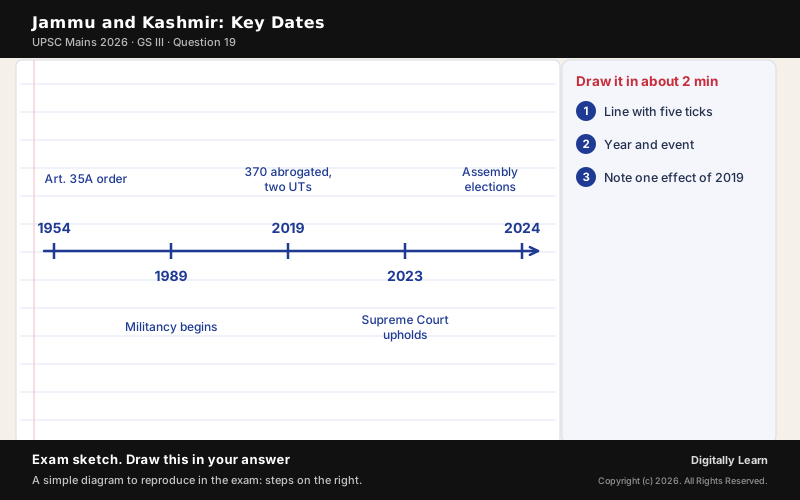
  • Multi-part questions. Several GS III questions had three or four demands in one, such as the Jammu and Kashmir question on separatism, government action and Articles 370 and 35A, which reward a planned structure more than length.
  • Polity dominated GS II. Nine of the twenty GS II questions were on polity, from the Speaker and anti-defection to separation of powers and judicial legislation.
  • Geography carried GS I. Eight GS I questions were on geography, from the Fujiwhara effect and local winds to the shift of trade towards the Indo-Pacific; society had six.
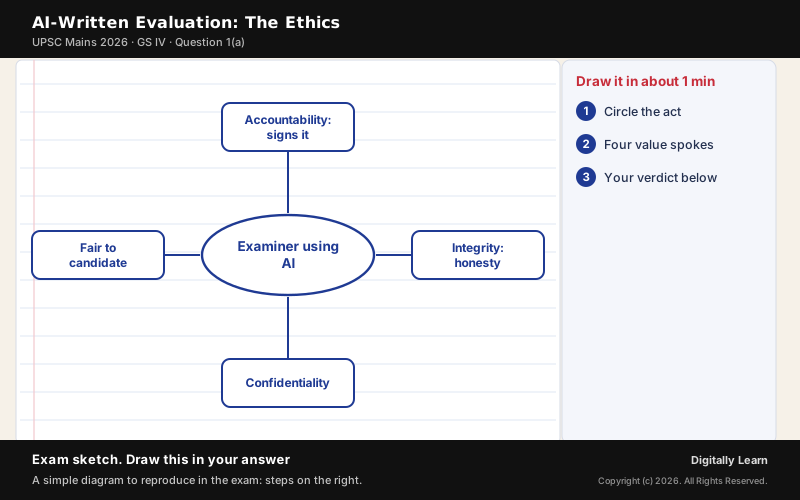
  • Technology in ethics. GS IV asked about an AI-written PhD evaluation and AI-driven predictive policing, alongside classic dilemmas of consent, corruption and welfare delivery.
  • Abstract essays. All eight essay topics were philosophical statements, such as oxymorons, gratitude and leadership, with no direct policy topic.

Questions by paper and topic

PaperTopics (number of questions)
EssayEssay: Section A 4, Essay: Section B 4
GS IGeography 8, Indian Society 6, Art and Culture 2, Modern History 2, Post-Independence India 2
GS IIPolity 9, Social Justice 4, International Relations 4, Governance 3
GS IIIEconomy 4, Agriculture 4, Science and Technology 4, Internal Security 4, Disaster Management 2, Environment 2
GS IVEthics: Concepts and Thinkers 13, Ethics: Case Studies 6
Why this mattersBecause so many questions tied a static topic to a 2026 event, preparation that links the standard syllabus to the year's news paid off. Each framework below shows that link and points to the article that teaches the topic.

Read, write and check

All UPSC Mains 2026 Questions with Model Answer Frameworks

Pick a paper and a topic, read each question with its answer framework, or start the timer on any question and write your answer first. The timed writing mode sets UPSC's time per answer and lets you check your answer against the framework, point by point.

UPSC Mains 2026 Essay Paper: All Eight Topics

Essay Q1Essay: Section A

Oxymorons reflect the ironies of life.

125 marks1,000 to 1,200 words87 min 30 s

How to write this answer

For the essay: Plan for five minutes: an opening anecdote, five dimensions, a counter-view, and a conclusion that returns to the topic.

For this question: Write down five dimensions and a counter-view on the rough page before you start.

See the answer frameworkWhat to write, point by point
What the topic means

An oxymoron joins opposites ('bitter-sweet', 'deafening silence'). The topic asks you to show that life itself is full of such contradictions, and that seeing them clearly is a kind of wisdom.

An opening idea

Open with a familiar oxymoron from daily life, such as the 'bitter-sweet' moment when a parent sends a child away to study, and ask why the phrase feels true.

How to build the essay

Thesis

  • Life's deepest truths often hold two opposites at once; ironies are not errors in life but part of its texture.

Dimensions to develop

  • Personal: success that brings loneliness; freedom that brings anxiety; the 'wise fool' who knows he knows nothing (Socrates).
  • Social: connected yet lonely in the age of social media; affluent but anxious societies.
  • Economic and technological: labour-saving machines that leave people busier; abundance of food alongside hunger.
  • Political: 'cruel kindness' of paternal rulers; peace kept by nuclear deterrence, the 'balance of terror'.
  • Environmental: development that destroys the resources development needs.
  • Indian thought: detached attachment (nishkama karma in the Gita); strength through non-violence in Gandhi.

The counter-view

  • Not every contradiction is a deep truth; some are simply injustice or hypocrisy dressed up as irony, and need correction rather than acceptance.
A conclusion that returns to the topic

Close by showing that accepting life's ironies builds humility and balance, while refusing to excuse avoidable wrongs as mere irony.

Draw this in the exam (about 5 min)
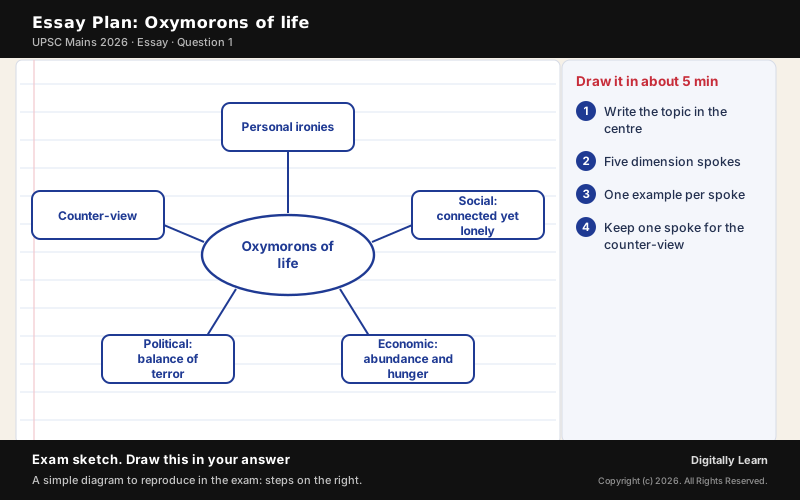
Exam sketch: Essay Plan: Oxymorons of life
  1. Write the topic in the centre
  2. Five dimension spokes
  3. One example per spoke
  4. Keep one spoke for the counter-view

Study the topic: UPSC Essay Paper: Pattern, Marking and How to Write
Essay Q2Essay: Section A

A grateful mind is very beautiful.

125 marks1,000 to 1,200 words87 min 30 s

How to write this answer

For the essay: Plan for five minutes: an opening anecdote, five dimensions, a counter-view, and a conclusion that returns to the topic.

For this question: Write down five dimensions and a counter-view on the rough page before you start.

See the answer frameworkWhat to write, point by point
What the topic means

Gratitude is recognising the good one has received from others, nature and life. The topic claims gratitude makes a mind 'beautiful': calmer, kinder and more humble.

An opening idea

Open with a small scene: a student thanking a teacher years later, and what that single act does to both of them.

How to build the essay

Thesis

  • Gratitude turns attention from what is missing to what is given; this changes character, relationships and even societies.

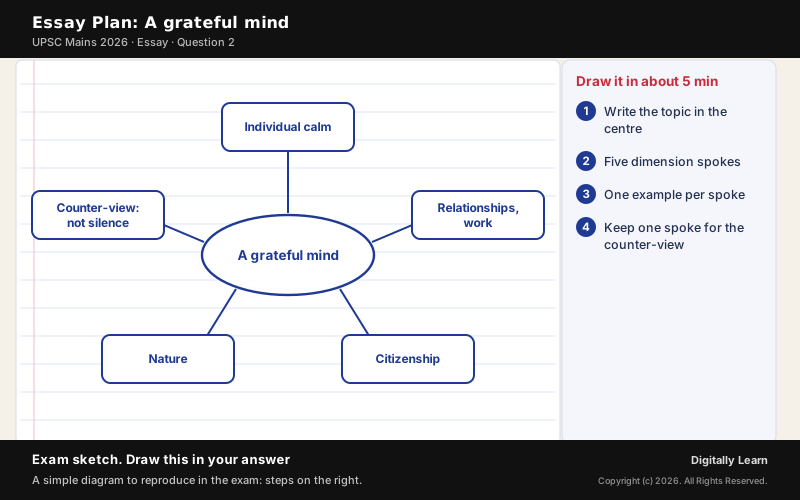
Dimensions to develop

  • Individual: gratitude reduces envy and anxiety, builds resilience and contentment.
  • Relationships and workplace: appreciation motivates, builds trust and cooperation.
  • Society and citizenship: gratitude to farmers, soldiers, sanitation workers and taxpayers breeds civic responsibility.
  • Nature: gratitude to the earth underpins sustainable living (the Indian idea of the earth as mother, prithvi).
  • Traditions: Indian and world traditions of thanksgiving, guru-dakshina, prayers of thanks.
  • Leadership and public service: leaders who acknowledge their teams and citizens earn loyalty.

The counter-view

  • Gratitude can be misused to demand silence ('be grateful for what you get') from the oppressed; gratitude must not replace justice.
A conclusion that returns to the topic

End by returning to the opening scene: a grateful mind sees life as a web of gifts, which makes it generous in return.

Draw this in the exam (about 5 min)

Exam sketch: Essay Plan: A grateful mind
  1. Write the topic in the centre
  2. Five dimension spokes
  3. One example per spoke
  4. Keep one spoke for the counter-view

Study the topic: UPSC Essay Paper: Pattern, Marking and How to Write
Essay Q3Essay: Section A

A thorn is a changed bud.

125 marks1,000 to 1,200 words87 min 30 s

How to write this answer

For the essay: Plan for five minutes: an opening anecdote, five dimensions, a counter-view, and a conclusion that returns to the topic.

For this question: Write down five dimensions and a counter-view on the rough page before you start.

See the answer frameworkWhat to write, point by point
What the topic means

A thorn is a modified bud: the same growth that could have become a flower becomes a defence. The topic invites you to write about how hardship, pain or hostility is often potential that took another form, and can be changed back.

An opening idea

Open with the botanical fact (thorns in plants like the bougainvillea are modified shoots) and turn it into a question about people and societies.

How to build the essay

Thesis

  • What hurts us, or makes others hostile, is often the same energy as what could have flourished; circumstances decide which it becomes.

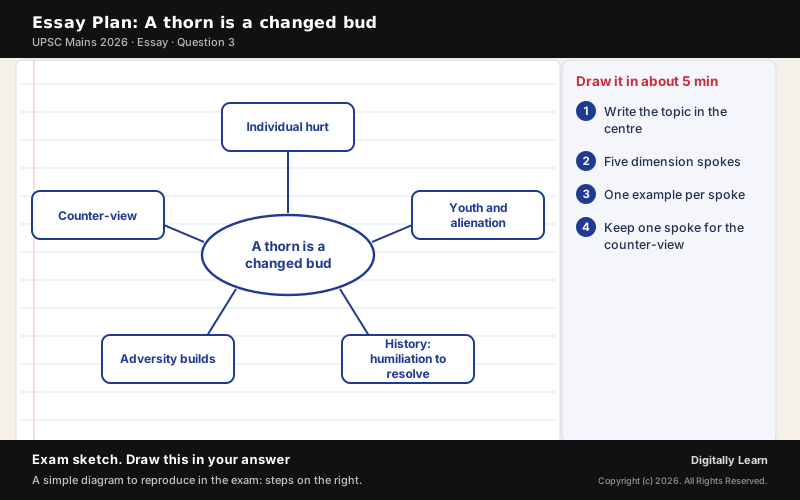
Dimensions to develop

  • Individual: a child's anger born of neglect; talent turned to crime for lack of opportunity.
  • Society: youth alienation turning to militancy where hope is missing; rehabilitation and surrender schemes turning 'thorns' back into 'buds'.
  • History: colonial humiliation that produced the national movement's resolve.
  • Nature and science: adaptation as survival; defences that become strengths.
  • Personal growth: adversity that builds character (resilience, empathy).

The counter-view

  • Not every thorn can become a flower again; some harm must be restrained, and romanticising suffering can excuse neglect.
A conclusion that returns to the topic

Conclude that societies should look beneath the thorn to the bud it was, and create the conditions in which potential blooms rather than hardens.

Draw this in the exam (about 5 min)

Exam sketch: Essay Plan: A thorn is a changed bud
  1. Write the topic in the centre
  2. Five dimension spokes
  3. One example per spoke
  4. Keep one spoke for the counter-view

Study the topic: UPSC Essay Paper: Pattern, Marking and How to Write
Essay Q4Essay: Section A

When two elephants fight, it is the grass that gets trampled.

125 marks1,000 to 1,200 words87 min 30 s

How to write this answer

For the essay: Plan for five minutes: an opening anecdote, five dimensions, a counter-view, and a conclusion that returns to the topic.

For this question: Write down five dimensions and a counter-view on the rough page before you start.

See the answer frameworkWhat to write, point by point
What the topic means

The proverb says that when the powerful clash, the weak suffer most. Write about conflicts between big powers, institutions or interests, and their cost to ordinary people, then what can protect the 'grass'.

An opening idea

Open with a real image: families in a war zone, or farmers hit by a trade war between two large economies they have never dealt with.

How to build the essay

Thesis

  • In every conflict of giants, the costs fall hardest on those who had no say in starting it.

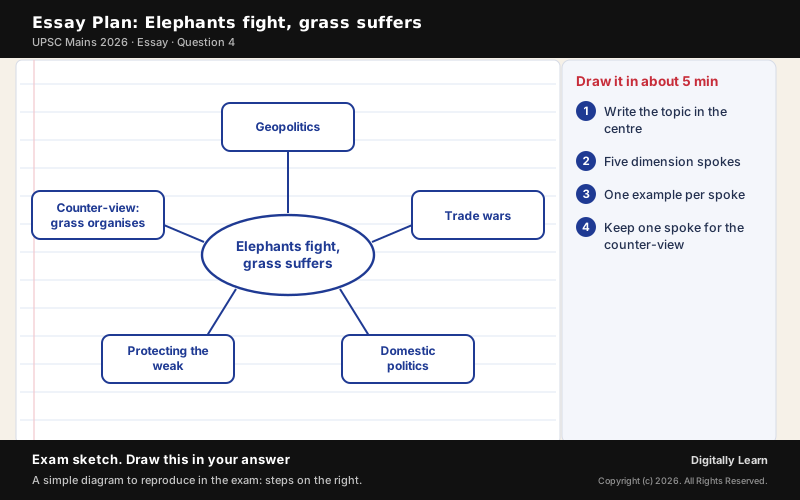
Dimensions to develop

  • Geopolitics: great-power rivalry and proxy wars; small states forced to choose sides; refugees.
  • Economy: trade wars, sanctions and oil shocks raising prices for the poor; supply-chain disruptions.
  • Domestic politics: centre-state or party battles that stall welfare and development.
  • Business and society: corporate battles harming workers and consumers; family disputes harming children.
  • Environment: rivalry over resources damaging commons.

Protecting the grass

  • International law and institutions; non-alignment and strategic autonomy (India's approach); social safety nets; mediation and dialogue.

The counter-view

  • Sometimes the 'grass' is not passive: collective action, democracy and alliances of small states can check the elephants.
A conclusion that returns to the topic

End on responsibility: the powerful must count the cost to the weak, and the weak must organise so they are not merely trampled.

Draw this in the exam (about 5 min)

Exam sketch: Essay Plan: Elephants fight, grass suffers
  1. Write the topic in the centre
  2. Five dimension spokes
  3. One example per spoke
  4. Keep one spoke for the counter-view

Study the topic: UPSC Essay Paper: Pattern, Marking and How to Write
Essay Q5Essay: Section B

Nature is the symbol of the spirit.

125 marks1,000 to 1,200 words87 min 30 s

How to write this answer

For the essay: Plan for five minutes: an opening anecdote, five dimensions, a counter-view, and a conclusion that returns to the topic.

For this question: Write down five dimensions and a counter-view on the rough page before you start.
See the answer frameworkWhat to write, point by point
What the topic means

The idea echoes Ralph Waldo Emerson's essay Nature (1836), the founding text of Transcendentalism: nature is not only matter but an expression of spirit, a mirror of higher truths. Write about nature as a source of meaning, morality and renewal.
An opening idea

Open with the experience most people have had: standing before mountains, the sea or a night sky, and feeling something larger than oneself.

How to build the essay

Thesis

  • Nature carries meaning beyond its uses; recognising that meaning is the basis of both inner peace and environmental ethics.

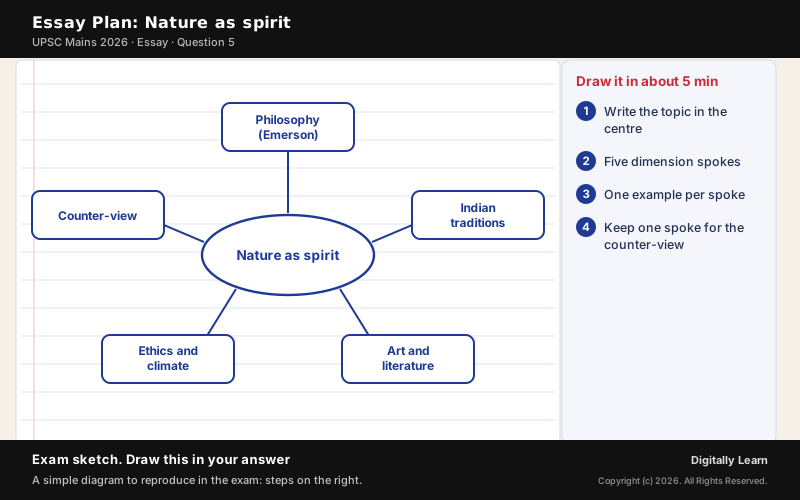
Dimensions to develop

  • Philosophy and religion: Transcendentalism; the Upanishadic idea of one reality in all; sacred groves, rivers and mountains in Indian culture.
  • Art and literature: Tagore, Wordsworth, the Chipko songs.
  • Psychology: nature as healing (attention, calm, wellbeing).
  • Ethics and environment: if nature is sacred, exploitation is desecration; Gandhi's 'the earth provides enough for every man's need'.
  • Contemporary: climate change as a spiritual as well as scientific crisis; Mission LiFE and mindful consumption.

The counter-view

  • Treating nature only as a symbol can make us romantic and unscientific; conservation also needs law, science and economics.
A conclusion that returns to the topic

Conclude that seeing nature as spirit gives us the reverence, and science gives us the method, to protect it.

Draw this in the exam (about 5 min)

Exam sketch: Essay Plan: Nature as spirit
  1. Write the topic in the centre
  2. Five dimension spokes
  3. One example per spoke
  4. Keep one spoke for the counter-view

Study the topic: Mission LiFE: Lifestyle for Environment

Sources: Nature (essay) (Wikipedia)

Essay Q6Essay: Section B

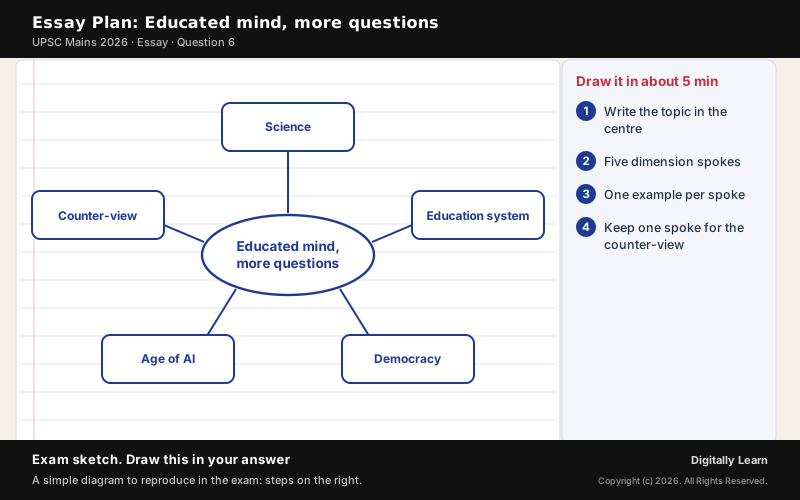
A well-educated mind will always have more questions than answers.

125 marks1,000 to 1,200 words87 min 30 s

How to write this answer
For the essay: Plan for five minutes: an opening anecdote, five dimensions, a counter-view, and a conclusion that returns to the topic.

For this question: Write down five dimensions and a counter-view on the rough page before you start.
See the answer frameworkWhat to write, point by point
What the topic means

Real education does not end in certainty; it opens new questions. The topic contrasts learning as collecting answers with learning as the habit of inquiry.

An opening idea

Open with Socrates' claim that he was wise only in knowing that he knew nothing, or with a scientist whose discovery raised more questions than it settled.

How to build the essay

Thesis

  • An educated mind is marked by curiosity, humility and critical thinking, not by a stock of fixed answers.

Dimensions to develop

  • Science: every answer (Newton, Einstein, the genome) opens new frontiers.
  • Education system: rote learning and exam culture produce answers without questions; NEP 2020's emphasis on critical thinking and inquiry.
  • Democracy: questioning citizens hold power accountable; the Indian tradition of shastrarth (debate) and the Upanishadic question-answer dialogue.
  • Ethics and personal life: humility, open-mindedness, tolerance of other views.
  • Age of AI and information: when answers are cheap, good questions become the scarce skill.

The counter-view

  • Endless questioning without conclusions can lead to paralysis or cynicism; education must also teach how to judge and act.
A conclusion that returns to the topic

Conclude that the aim of education is not to end curiosity but to discipline it: to ask better questions and act wisely despite uncertainty.

Draw this in the exam (about 5 min)

Exam sketch: Essay Plan: Educated mind, more questions
  1. Write the topic in the centre
  2. Five dimension spokes
  3. One example per spoke
  4. Keep one spoke for the counter-view

Study the topic: National Education Policy 2020

Essay Q7Essay: Section B

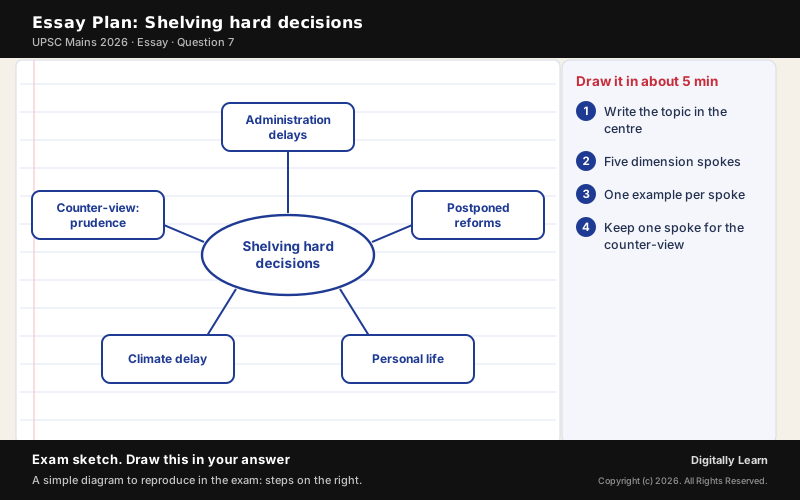
Shelving hard decisions is the least ethical course.

125 marks1,000 to 1,200 words87 min 30 s

How to write this answer

For the essay: Plan for five minutes: an opening anecdote, five dimensions, a counter-view, and a conclusion that returns to the topic.

For this question: Write down five dimensions and a counter-view on the rough page before you start.
See the answer frameworkWhat to write, point by point
What the topic means

Avoiding a hard decision may look like caution, but the topic argues it is the least ethical choice, because inaction also has consequences and shifts the burden to others.

An opening idea

Open with a scene of a file left pending for years while the person it concerns waits: a pension, a land record, a medical approval.

How to build the essay

Thesis

  • Indecision is itself a decision, usually in favour of the status quo and against those who need change.

Dimensions to develop

  • Administration: 'policy paralysis', fear of vigilance, files passed upwards; the cost to citizens of delay.
  • Governance and politics: postponed reforms (police, judiciary, climate) whose costs grow each year.
  • Personal and professional: avoiding difficult conversations or choices harms relationships and careers.
  • Moral philosophy: acts and omissions; the Gita's call to action (Arjuna's dilemma); Dante's warning about neutrality in moral crises.
  • Climate change as the clearest case: delay makes every future option more expensive.

The counter-view

  • Some decisions need time, evidence and consultation; prudence is not the same as shelving. The line is whether delay serves the decision or the decision-maker.
A conclusion that returns to the topic

Conclude that ethical leadership means deciding with the best available judgement and owning the outcome; protecting honest decisions (for example against harassment for bona fide errors) encourages this.

Draw this in the exam (about 5 min)

Exam sketch: Essay Plan: Shelving hard decisions
  1. Write the topic in the centre
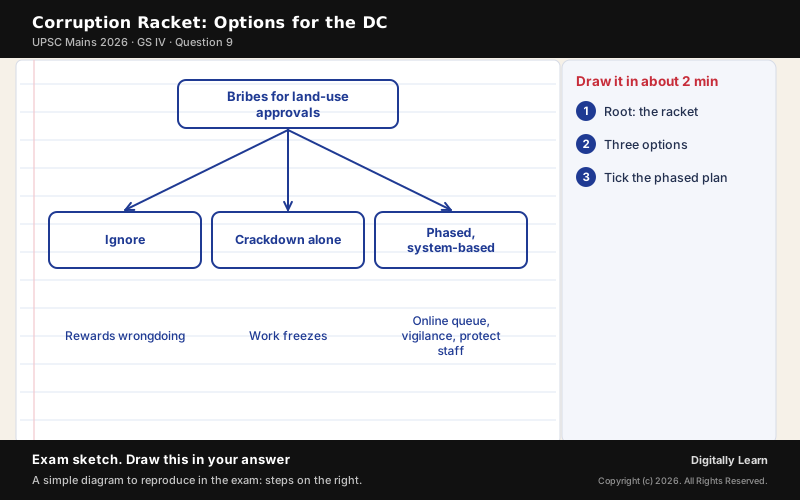
  2. Five dimension spokes
  3. One example per spoke
  4. Keep one spoke for the counter-view

Study the topic: UPSC GS 4 Syllabus: Ethics, Integrity and Aptitude

Essay Q8Essay: Section B

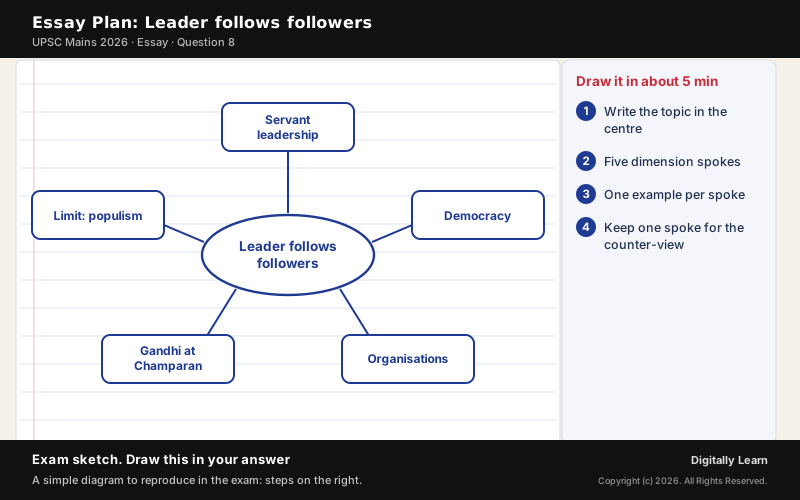
A good leader is one who follows the followers.

125 marks1,000 to 1,200 words87 min 30 s

How to write this answer
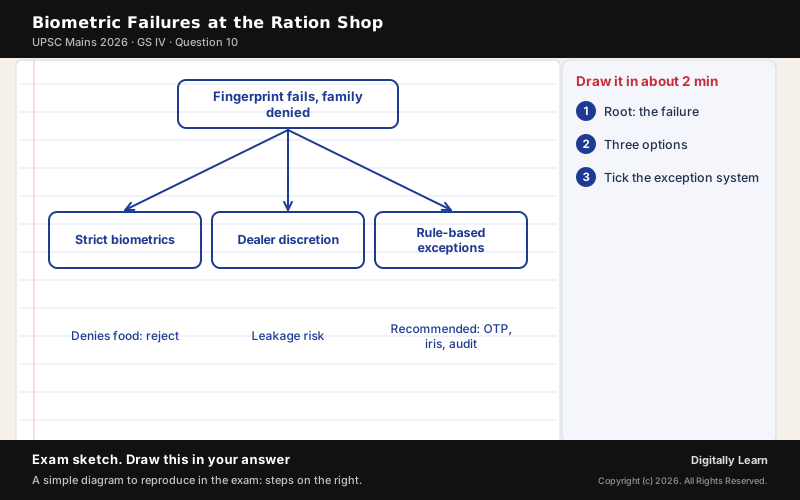
For the essay: Plan for five minutes: an opening anecdote, five dimensions, a counter-view, and a conclusion that returns to the topic.

For this question: Write down five dimensions and a counter-view on the rough page before you start.
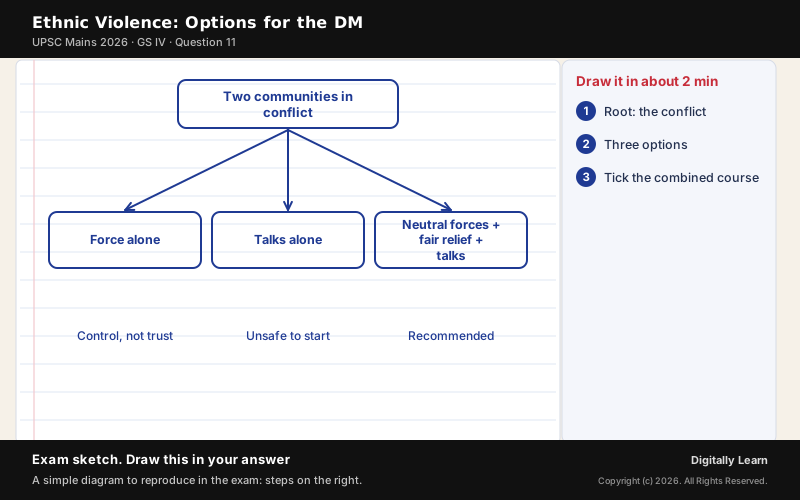
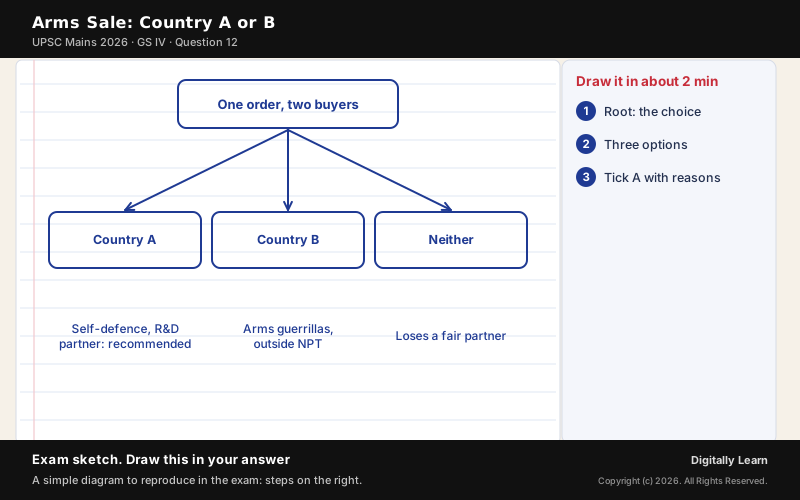
See the answer frameworkWhat to write, point by point
What the topic means

A leader who 'follows the followers' listens to people, serves their needs and reflects their aspirations. The topic invites a discussion of servant leadership and its limits.

An opening idea

Open with the image of a leader walking behind the group, like a shepherd, or with Gandhi, who learned from peasants at Champaran before leading them.

How to build the essay

Thesis

  • Good leadership begins with listening; but it must also lead people towards what is right, even when it is not yet popular.

Dimensions to develop

  • Servant leadership: the idea popularised by Robert Greenleaf in 1970 that the leader serves first.
  • Democracy: leaders draw legitimacy from people's will; participatory governance (gram sabhas, consultations).
  • Organisations: leaders who empower teams get better results and innovation.
  • Indian examples: Gandhi's mass contact, community-led movements, and field officers who build trust.

The limit of following

  • Leaders who only follow can become populists; sometimes leadership means persuading people against prejudice (Ambedkar against caste, reformers against sati).
  • The balance: listen to people's needs, lead on values.
A conclusion that returns to the topic

Conclude that the best leader follows the followers' needs and leads their values: close enough to hear them, far enough ahead to show the way.

Draw this in the exam (about 5 min)

Exam sketch: Essay Plan: Leader follows followers
  1. Write the topic in the centre
  2. Five dimension spokes
  3. One example per spoke
  4. Keep one spoke for the counter-view

Study the topic: The Gandhian Era: Historiography, Analysis and the Verdict

Sources: Servant leadership (Wikipedia)

UPSC Mains 2026 GS Paper 1 Questions

GS I Q1Art and Culture

Analyze the importance of Ashokan inscriptions for reconstructing Mauryan history.

10 marks150 words8 min 45 s

How to write this answer

  • Analyse Break the topic into its parts and explain how they connect.

For Art and Culture: Name monuments, rulers and places; a labelled sketch of a temple plan or a site map adds marks.

For this question: Mention the Kalinga war in Rock Edict XIII and the Lumbini tax cut to one-eighth; they show edicts giving hard facts, not only moral advice.

See the answer frameworkWhat to write, point by point
What the question asks

Analyse how far the inscriptions of Ashoka help us rebuild Mauryan history, and where they fall short. The word 'importance' asks for their value first, then a short note on their limits.

A strong opening

Ashoka's edicts are the earliest deciphered written records of Indian rulers. Found from Kandahar in Afghanistan to Karnataka, they let the emperor speak in his own words, which no earlier Indian ruler does.

Points to cover

Extent of the empire

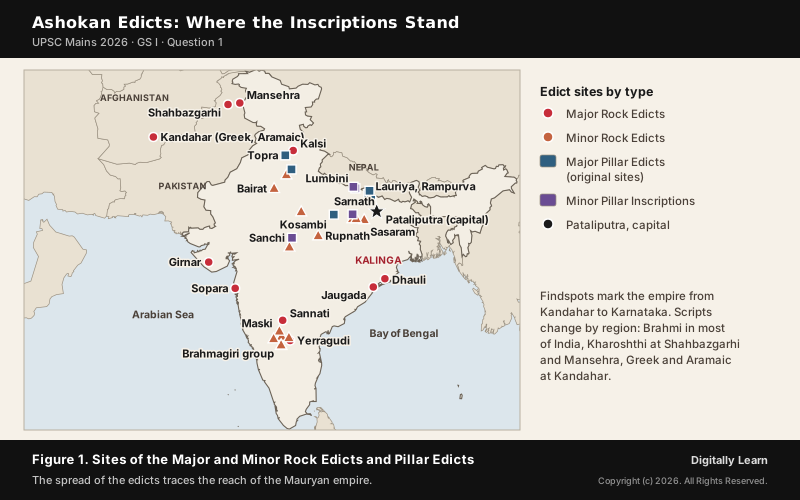
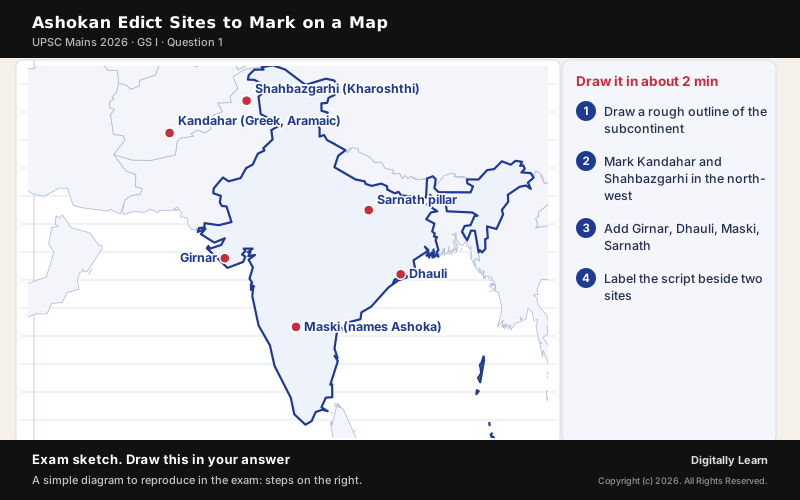
  • The findspots of the Major and Minor Rock Edicts and the Pillar Edicts (Kandahar, Shahbazgarhi, Girnar, Dhauli, Jaugada, Maski, Brahmagiri) mark the reach of Mauryan power.
  • Scripts and languages vary by region: Prakrit in Brahmi over most of India, Kharoshthi in the northwest, Greek and Aramaic at Kandahar, which shows an administration that spoke to each province in its own idiom.

Political events and foreign relations

  • Rock Edict XIII records the Kalinga war, the death and deportation of lakhs of people, and Ashoka's remorse.
  • Rock Edicts II and XIII name the Hellenistic king Antiochus and the southern Chola, Pandya, Satiyaputra and Keralaputra peoples, as neighbours outside the empire.

Administration and policy

  • Officials such as the dhamma mahamattas, rajukas and yuktas appear by name, with their duties.
  • The Lumbini (Rummindei) pillar says Ashoka exempted the village from taxes and cut its share of the produce to one-eighth: a direct record of revenue policy.
  • Welfare measures (medical care for people and animals, wells and shade trees on roads) show a paternal idea of kingship.

Dhamma and society

  • The edicts explain dhamma as tolerance, respect for elders and teachers, and restraint in killing animals, and describe Ashoka's tours to spread it.

Limits of the evidence

  • They are royal statements, so they present the ruler as he wished to be seen.
  • They say little on the economy, the army or the reigns of Chandragupta and Bindusara; the Arthashastra, Megasthenes' account (through later Greek writers) and archaeology fill those gaps.
  • The name 'Ashoka' appears only in a few minor edicts such as Maski; most call him Devanampiya Piyadasi, and the link was made only after James Prinsep read the Brahmi script in the 1830s.
Map of the Indian subcontinent showing the sites of Ashoka's Major Rock Edicts, Minor Rock Edicts, Major Pillar Edicts and minor pillar inscriptions, with Pataliputra
A diagram like this earns marks. Tap to open it full size.
A balanced conclusion

The edicts turned Ashoka from a name in Buddhist legend into a documented ruler. Read with texts and archaeology, they remain the backbone of Mauryan history.

Draw this in the exam (about 2 min)

Exam sketch: Ashokan Edict Sites to Mark on a Map
  1. Draw a rough outline of the subcontinent
  2. Mark Kandahar and Shahbazgarhi in the north-west
  3. Add Girnar, Dhauli, Maski, Sarnath
  4. Label the script beside two sites

Study the topic: Edicts of Ashoka: Major and Minor Rock Edicts, Pillar Edicts and Their Sites · Ashoka, the Kalinga War and the Policy of Dhamma

Sources: Edicts of Ashoka (Wikipedia); Lumbini pillar inscription (Wikipedia); Kalinga War (Wikipedia)

GS I Q2Modern History

Discuss the impact of Macaulay's Minute on colonial administration and education in India.

10 marks150 words8 min 45 s

How to write this answer

  • Discuss Cover the main aspects, with arguments on more than one side.

For Modern History: Dates, names and sequence matter: a short timeline shows command of the period.

For this question: Quote the "Indian in blood and colour" line: it is the Minute's aim in its own words.

See the answer frameworkWhat to write, point by point
What the question asks

Discuss what Macaulay's Minute of 1835 changed in two areas: education and colonial administration. Give both sides of its legacy.

A strong opening

Thomas Babington Macaulay's 'Minute upon Indian Education' (1835) settled the long quarrel between the Orientalists and the Anglicists in favour of English. Governor-General William Bentinck's English Education Act followed the same year.

Points to cover

What the Minute argued

  • Government funds should support Western learning taught in English rather than Sanskrit and Arabic learning.
  • It aimed to create 'a class of persons, Indian in blood and colour, but English in tastes, in opinions, in morals, and in intellect', who would act as interpreters between the rulers and the ruled.
  • Education would 'filter down' from this class to the masses (the downward filtration idea).

Impact on education

  • English became the medium of higher education; the universities of Calcutta, Bombay and Madras followed in 1857 after Wood's Despatch of 1854.
  • Mass and vernacular education was neglected, which kept literacy low for a century.
  • Indian knowledge traditions lost state support and prestige.

Impact on administration

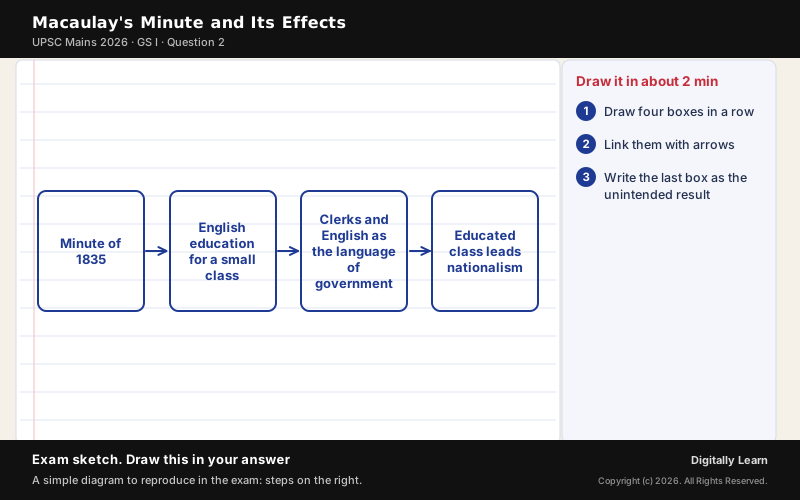
  • English replaced Persian as the language of government business, and English-educated Indians filled the clerical and lower judicial posts the Company needed.
  • Macaulay also chaired the 1854 committee that recommended open competitive examinations for the Indian Civil Service.

The unintended outcome

  • The English-educated middle class read Mill, Burke and the history of liberty, and used those ideas to demand representation: early Congress leaders came from this class.
  • English gave educated Indians from different regions a common language for national politics.
A balanced conclusion

The Minute served colonial convenience and belittled Indian learning, yet the class it created became the leadership of Indian nationalism.

Draw this in the exam (about 2 min)

Exam sketch: Macaulay's Minute and Its Effects
  1. Draw four boxes in a row
  2. Link them with arrows
  3. Write the last box as the unintended result

Study the topic: Education and the Press under Colonial Rule in Modern India

Sources: English Education Act 1835 (Wikipedia); Wood's despatch (Wikipedia); Macaulayism (Wikipedia); Indian Civil Service (British India) (Wikipedia)

GS I Q3Modern History

The significance of the Gandhian movements lay in the masses they mobilized. Elucidate.

10 marks150 words8 min 45 s

How to write this answer

  • Elucidate Explain clearly with examples, so the point becomes plain.

For Modern History: Dates, names and sequence matter: a short timeline shows command of the period.

For this question: Name the social group each movement brought in (peasants, women, students); that is the heart of "masses mobilised".

See the answer frameworkWhat to write, point by point
What the question asks

Elucidate means explain with evidence. Show how Gandhi's movements drew in groups that earlier politics had not reached, and why that mass base was their main significance.

A strong opening

Before 1917 the national movement was led by educated professionals and drew limited popular support. Gandhi's satyagrahas brought peasants, workers, women, students and traders into politics on a scale no earlier leader had managed.

Points to cover

Local struggles as the base, 1917 to 1918

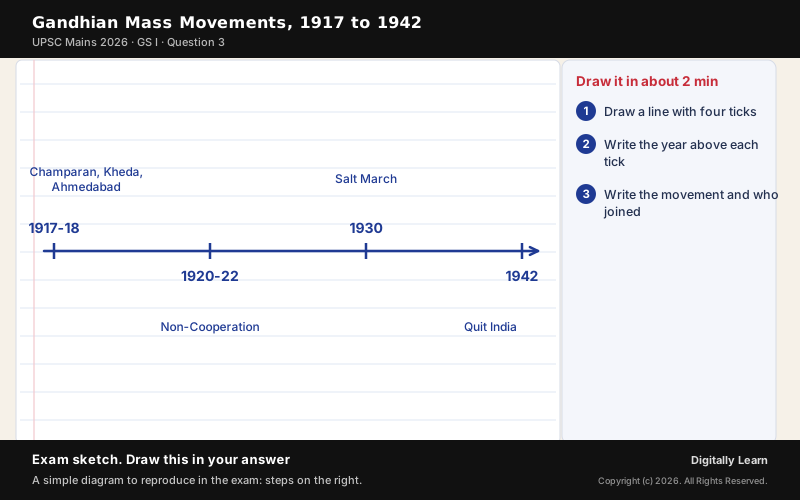
  • Champaran (indigo cultivators), Kheda (peasants seeking revenue remission) and the Ahmedabad mill strike tested satyagraha on real grievances.

Non-Cooperation, 1920 to 1922

  • Joined with the Khilafat cause, it united Hindus and Muslims; students left government schools, lawyers boycotted courts, foreign cloth was burnt.
  • The Nagpur session of 1920 reorganised the Congress: provincial committees on linguistic lines and a membership fee of four annas made it a mass party.

Civil Disobedience, 1930 to 1934

  • The Salt March (12 March to 6 April 1930) chose a grievance every household shared. Women took part in large numbers, picketing liquor and cloth shops; forest satyagrahas and no-revenue campaigns spread in the countryside.

Quit India, 1942

  • With leaders arrested, the call of 'Do or Die' produced a leaderless upsurge of students, peasants and parallel governments, as in Satara, Ballia and Tamluk.

Significance beyond the numbers

  • Mass participation was held together by method: non-violence allowed ordinary people to join without arms, and the constructive programme (khadi, Hindu-Muslim unity, removal of untouchability) kept them engaged between campaigns.
  • Limits: Muslim participation fell after 1922, Dalit politics under Ambedkar developed separately, and Gandhi withdrew movements (after Chauri Chaura) when they turned violent.
A balanced conclusion

By turning nationalism from a petition-writing elite into a people's struggle, Gandhian movements gave the Congress the legitimacy to claim it spoke for India.

Draw this in the exam (about 2 min)

Exam sketch: Gandhian Mass Movements, 1917 to 1942
  1. Draw a line with four ticks
  2. Write the year above each tick
  3. Write the movement and who joined

Study the topic: The Gandhian Era: Historiography, Analysis and the Verdict · The Non-Cooperation Movement: Programme, Spread and Chauri Chaura (1920-1922) · The Quit India Movement of 1942

Sources: Salt March (Wikipedia); Non-cooperation movement, 1919 to 1922 (Wikipedia); A Brief History of Modern India, National Movement 1919-1939; Quit India Movement (Wikipedia)

GS I Q4Geography

What is the Fujiwhara effect? Explain its impact on the movement and intensity of tropical cyclones.

10 marks150 words8 min 45 s

How to write this answer

  • Define Open with a precise definition before anything else.
  • Explain Say what it is and why or how it happens, step by step.

For Geography: Draw a map or labelled diagram, and give one Indian and one world example.

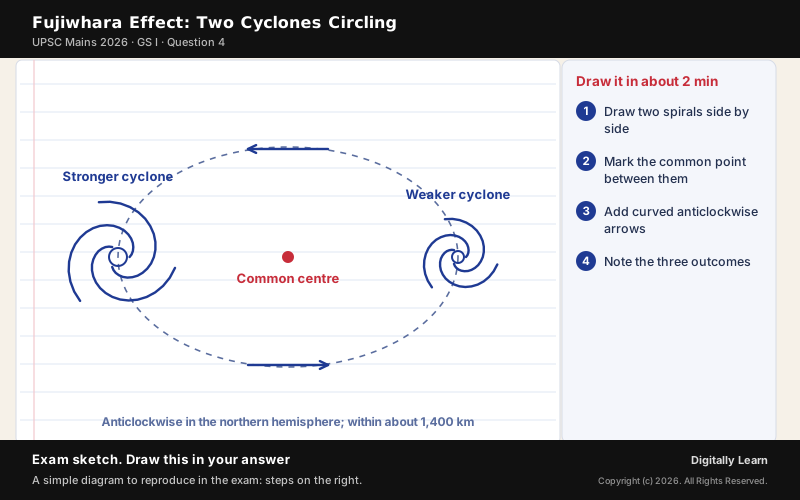
For this question: A two-spiral sketch with anticlockwise arrows answers half the question by itself.

See the answer frameworkWhat to write, point by point
What the question asks

Two parts: define the Fujiwhara effect, then explain how it changes a cyclone's track and its strength. A labelled sketch earns marks here.

A strong opening

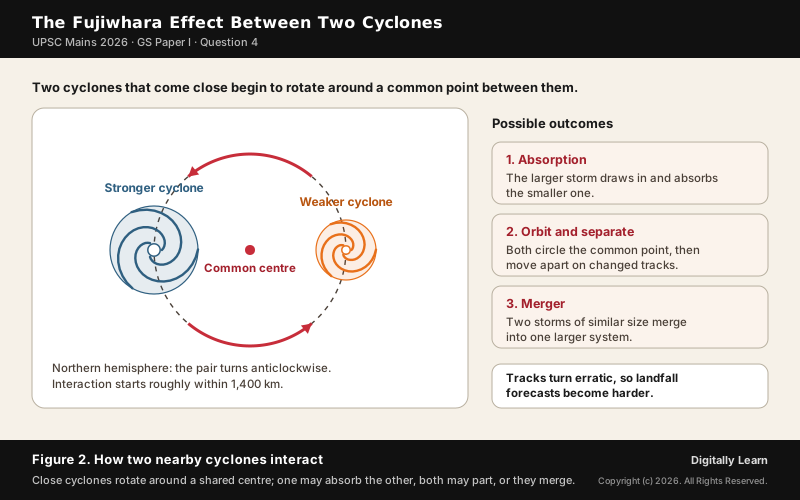
The Fujiwhara effect is the interaction of two cyclonic storms that come close enough to rotate around a common point between them. It is named after the Japanese meteorologist Sakuhei Fujiwhara, who described it in the 1920s.

Points to cover

How it works

  • When two cyclones come within roughly 1,400 km of each other, their circulations begin to orbit a shared centre, anticlockwise in the northern hemisphere.
  • If one storm is much stronger, the smaller one is drawn around it and may be absorbed; if the two are similar, both orbit the common point.

Impact on movement

  • Tracks become erratic: storms loop, stall, speed up or change direction, which makes landfall forecasts less reliable.
  • Outcomes range from one storm absorbing the other, to both orbiting and then separating, to a merger into a single system.

Impact on intensity

  • The larger storm's outflow can shear and weaken the smaller one.
  • A merger can sometimes feed a larger, longer-lived system, while interaction can also disrupt both and weaken them.

Examples

  • Typhoons Parma and Melor in the western Pacific in 2009 and Hurricanes Hilary and Irwin in the eastern Pacific in 2017 showed this interaction.
Diagram of the Fujiwhara effect: a stronger and a weaker cyclone rotating anticlockwise around a common centre, with three possible outcomes: absorption, orbit and separation, and merger
A diagram like this earns marks. Tap to open it full size.
A balanced conclusion

Because it can turn a forecast track sharply, the effect matters for early warning and evacuation planning in cyclone-prone coasts such as India's.

Draw this in the exam (about 2 min)

Exam sketch: Fujiwhara Effect: Two Cyclones Circling
  1. Draw two spirals side by side
  2. Mark the common point between them
  3. Add curved anticlockwise arrows
  4. Note the three outcomes

Study the topic: Tropical Cyclones in the Indian Ocean Part 5: Life Cycle from Disturbance to Dissipation · Tropical Cyclones in the Indian Ocean Part 11: Cyclone Forecasting and Monitoring

Sources: Fujiwhara effect (Wikipedia)

GS I Q5Geography

"Tundra regions are ecologically fragile but economically important." Examine this statement critically.

10 marks150 words8 min 45 s

How to write this answer

  • Critically examine Look at both sides with evidence, then give a reasoned judgement.

For Geography: Draw a map or labelled diagram, and give one Indian and one world example.

For this question: Pair each fragility point with an economic one (permafrost thaw vs pipelines) to keep the "critically" balance.

See the answer frameworkWhat to write, point by point
What the question asks

Examine critically: show both halves of the statement (fragility and economic value), then judge how they can be balanced.

A strong opening

The tundra is the treeless zone of the Arctic and of high mountains, where the subsoil stays frozen as permafrost and the growing season is very short.

Points to cover

Why the tundra is fragile

  • A short growing season and cold soils mean slow plant growth and slow decomposition, so damaged vegetation takes decades to recover.
  • Food chains are simple and species are few, so the loss of one link spreads quickly.
  • Thawing permafrost makes the ground sink and buildings, pipelines and roads crack; the Arctic is warming several times faster than the global average.
  • Permafrost soils hold very large stores of organic carbon that thawing can release as carbon dioxide and methane, feeding further warming.

Why it is economically important

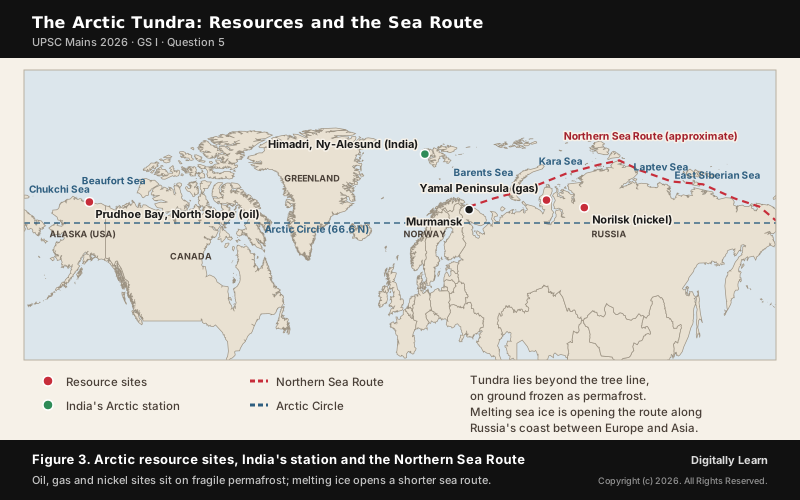
  • Oil and gas (the Yamal peninsula, Alaska's North Slope), nickel and other minerals (Norilsk), and fisheries in adjoining seas.
  • Melting sea ice is opening the Northern Sea Route, a shorter shipping lane between Europe and Asia.
  • Reindeer herding and hunting support indigenous peoples such as the Sami and Nenets.

The tension between the two

  • Extraction adds to the warming that destabilises the ground it depends on: the 2020 Norilsk fuel spill was linked to a storage tank failing on thawing permafrost.

India's stake

  • India has run the Himadri research station at Ny-Alesund, Svalbard, since 2008 and released its Arctic Policy in 2022; Arctic change affects the monsoon and sea level.
Map of the Arctic showing the Arctic Circle, the Yamal gas fields, Norilsk, Prudhoe Bay, India's Himadri station at Ny-Alesund, the Arctic seas and the Northern Sea Route
A diagram like this earns marks. Tap to open it full size.
A balanced conclusion

Use of the tundra has to be paced by its fragility: strict environmental rules for extraction, monitoring of permafrost and a voice for indigenous communities.

Draw this in the exam (about 2 min)

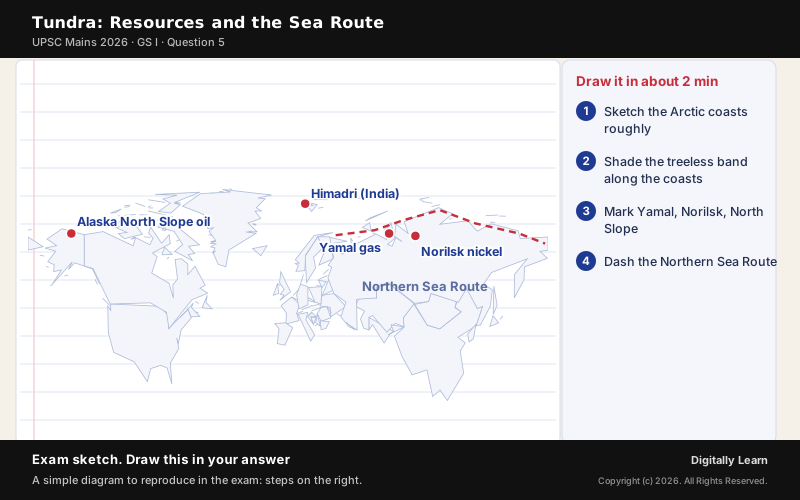
Exam sketch: Tundra: Resources and the Sea Route
  1. Sketch the Arctic coasts roughly
  2. Shade the treeless band along the coasts
  3. Mark Yamal, Norilsk, North Slope
  4. Dash the Northern Sea Route

Study the topic: Climate Part 2: Pressure, Winds, Jet Streams, and Oceanic Phenomena

Sources: Tundra (Wikipedia); Norilsk diesel oil spill (Wikipedia); Himadri Station (Wikipedia); Arctic amplification (Wikipedia)

GS I Q6Geography

Discuss the role of aeolian processes in desertification and land degradation.

10 marks150 words8 min 45 s

How to write this answer

  • Discuss Cover the main aspects, with arguments on more than one side.

For Geography: Draw a map or labelled diagram, and give one Indian and one world example.

For this question: Use the three technical terms (deflation, saltation, abrasion) correctly; examiners look for them.

See the answer frameworkWhat to write, point by point
What the question asks

Discuss the part wind plays in degrading dryland soils: the processes, how they turn land into desert, and what can be done.

A strong opening

Aeolian processes are the work of wind: eroding, carrying and depositing sediment. In dry areas with thin vegetation they are among the main drivers of desertification.

Points to cover

Erosion by wind

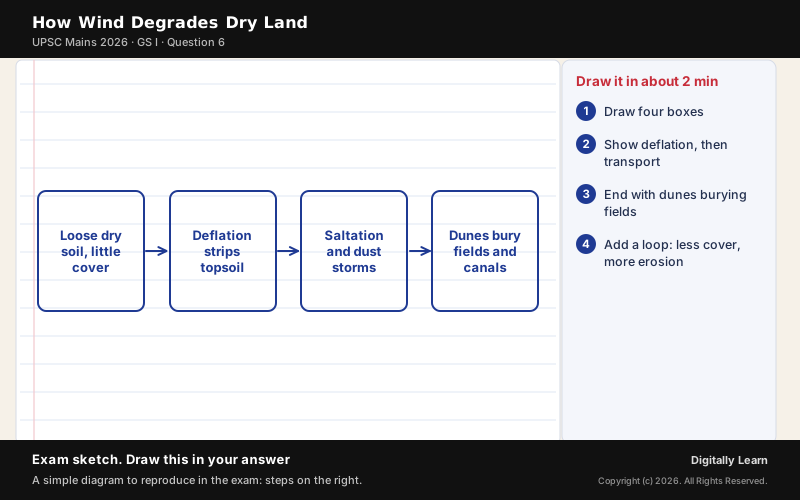
  • Deflation lifts loose fine particles, stripping the fertile, organic-rich topsoil and leaving hollows and stony desert pavement.
  • Abrasion: wind-borne sand scours rocks and crops, shaping ventifacts and yardangs and damaging young plants.

Transport

  • Particles move by suspension (dust carried far, as in pre-monsoon dust storms over north-west India), saltation (sand grains bouncing near the ground, the bulk of transport) and surface creep.

Deposition

  • Advancing dunes (barchans, seif and parabolic dunes) and sand sheets bury fields, roads, settlements and canals, as along stretches of the Indira Gandhi Canal in Rajasthan.

The feedback that causes desertification

  • Overgrazing, clearing of shrubs and dry-land ploughing expose soil; wind removes it; poorer soil supports less cover; erosion speeds up.
  • ISRO's Desertification and Land Degradation Atlas estimates 97.84 million hectares of India's land as degraded in 2018-19; in the dry west, wind is a leading agent.

Remedies

  • Shelterbelts and windbreaks, dune fixing with grasses and shrubs, strip cropping and mulching, and controlled grazing.
  • India's target under the UN Convention to Combat Desertification is to restore 26 million hectares of degraded land by 2030.
A balanced conclusion

Wind is the agent but human pressure is the trigger; protecting vegetation cover is the cheapest defence against aeolian desertification.

Draw this in the exam (about 2 min)

Exam sketch: How Wind Degrades Dry Land
  1. Draw four boxes
  2. Show deflation, then transport
  3. End with dunes burying fields
  4. Add a loop: less cover, more erosion

Study the topic: Soils Part 5: Arid Soil in India (Desert Soil) · Hot Deserts of the World: Why They Form at 20 to 30 Degrees Latitude

Sources: Aeolian processes (Wikipedia); PIB: Land degradation and desertification (Desertification and Land Degradation Atlas); PIB: India will restore 26 million hectares of degraded land by 2030

GS I Q7Geography

"Water resources are both an asset and a source of conflict in South Asia." Examine this statement giving examples.

10 marks150 words8 min 45 s

How to write this answer

  • Examine Probe the issue in depth: causes, evidence and consequences.

For Geography: Draw a map or labelled diagram, and give one Indian and one world example.

For this question: Give one treaty and one dispute per river system; a rough map ties them together.

See the answer frameworkWhat to write, point by point
What the question asks

Examine both sides of South Asia's shared rivers (as a resource and as a cause of disputes) and support each point with a named river or treaty.

A strong opening

Most of South Asia's great rivers (the Indus, Ganga and Brahmaputra) cross borders, so the water that sustains its farms, cities and power stations is also a constant subject of negotiation.

Points to cover

Water as an asset

  • Irrigation: the Indus and Ganga plains feed a large share of the region's people.
  • Hydropower: Bhutan's projects (Chukha, Tala, Mangdechhu) sell electricity to India and are the largest source of Bhutan's revenue.
  • Cooperation treaties: the Indus Waters Treaty (1960), the Ganges Water Treaty with Bangladesh (1996, for 30 years) and the Mahakali Treaty with Nepal (1996).
  • Navigation: the India-Bangladesh inland water protocol routes cargo on shared rivers.

Water as a source of conflict

  • India placed the Indus Waters Treaty in abeyance in April 2025 after the Pahalgam attack; earlier disputes over the Kishenganga and Ratle projects went to a neutral expert and a Court of Arbitration.
  • The Teesta sharing agreement with Bangladesh has remained unsigned since 2011.
  • China's hydropower building on the Yarlung Tsangpo, including a very large project in its lower reaches, worries India and Bangladesh downstream.
  • The Ganges Water Treaty falls due for renewal in 2026, which makes the lean-season Farakka flows a live issue.

Why disputes persist

  • Upstream-downstream asymmetry, lean-season scarcity, climate change affecting glacier-fed flows, and mistrust over data sharing.
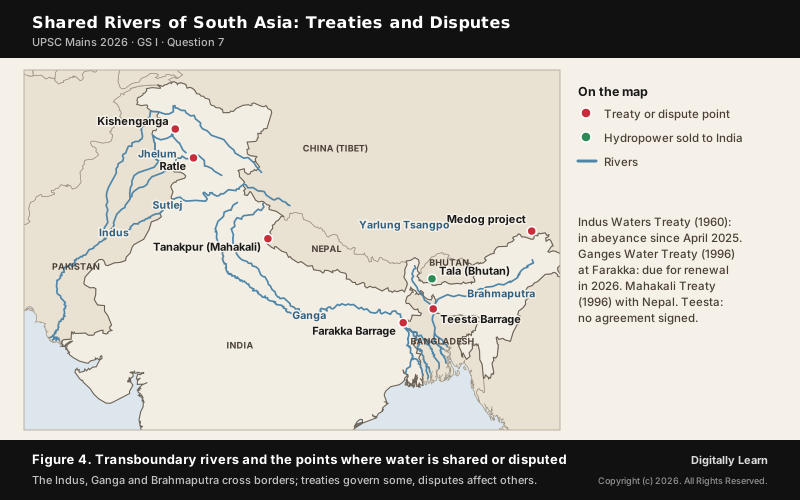
Map of South Asia showing the Indus, Ganga and Brahmaputra river systems with Kishenganga, Ratle, Tanakpur, Farakka, the Teesta barrage, the Medog project and Tala in Bhutan
A diagram like this earns marks. Tap to open it full size.
A balanced conclusion

Basin-level cooperation, timely flood data sharing and joint projects can turn shared rivers from a source of friction into a basis of regional integration.

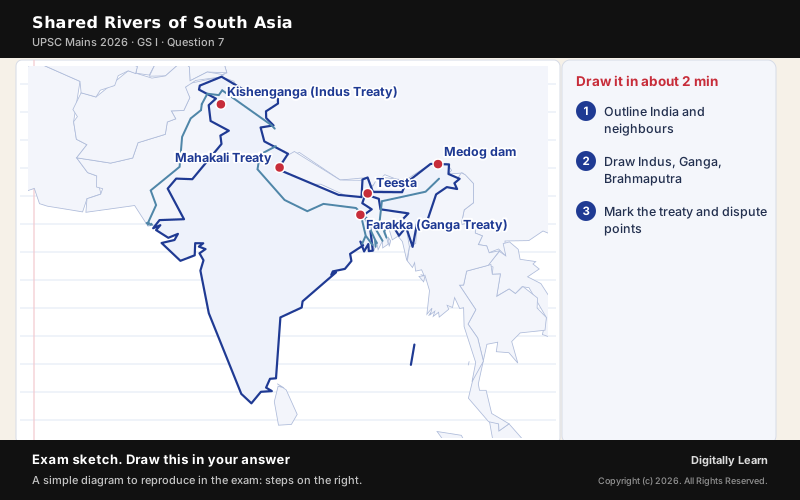
Draw this in the exam (about 2 min)

Exam sketch: Shared Rivers of South Asia
  1. Outline India and neighbours
  2. Draw Indus, Ganga, Brahmaputra
  3. Mark the treaty and dispute points

Study the topic: India Rejects the Court of Arbitration Award on the Indus Waters Treaty · Indian Drainage System Part 6: Indus River and the Indus Waters Treaty

Sources: Indus Waters Treaty (Wikipedia); Ganges Water Treaty (Wikipedia); Mahakali Treaty (Wikipedia); Teesta River water dispute (Wikipedia); Medog Hydropower Station (Wikipedia)

GS I Q8Indian Society

Unity in diversity remains the defining feature of Indian society despite the challenges from communalism and regionalism. Comment.

10 marks150 words8 min 45 s

How to write this answer

  • Comment Give your opinion on the statement, backed by reasons and evidence.

For Indian Society: Use examples from daily life and survey data (Census, NFHS), and end with constitutional values.

For this question: Take a clear stand ("unity has held because India accommodates difference") before the challenges.

See the answer frameworkWhat to write, point by point
What the question asks

Comment asks for your view with reasons. Agree or qualify the claim: show the diversity, the bonds that hold it together, the pressure from communalism and regionalism, and why unity has held.

A strong opening

India holds many religions, hundreds of languages (22 of them in the Eighth Schedule) and distinct regional cultures within one democratic state. That unity has survived repeated communal and regional strains.

Points to cover

Forms of diversity

  • Religious, linguistic, ethnic, caste and regional diversity, with distinct food, dress and festivals.

What binds the country

  • The Constitution: common citizenship, fundamental rights, secularism and a federal structure with a strong centre.
  • Shared cultural traditions: pilgrimage circuits from Char Dham to Rameswaram, the Bhakti and Sufi saints, festivals celebrated across communities.
  • A national economy and labour migration, the armed forces, cinema and sport.
  • Linguistic states gave regional identities a home within the Union instead of against it.

Challenges

  • Communalism: riots, the use of religion in politics, polarising misinformation on social media.
  • Regionalism: 'sons of the soil' movements against migrants, inter-state river disputes, demands for new states, and secessionist insurgencies in the past.

Why unity has held

  • Accommodation: the reorganisation of states, the Sixth Schedule, special provisions under Article 371, and coalition politics that give regions a voice at the centre.
  • Programmes such as Ek Bharat Shreshtha Bharat pair states for cultural exchange.
A balanced conclusion

Unity in diversity remains India's defining feature because the system accommodates difference rather than suppressing it; that accommodation has to be renewed against each new strain.

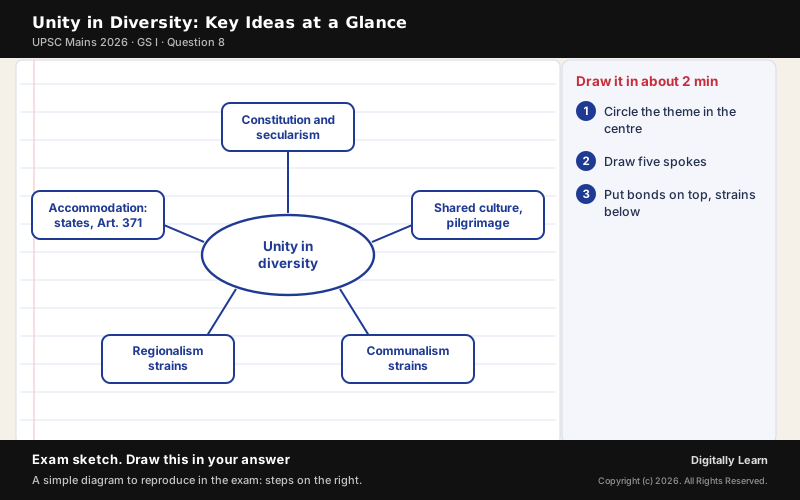
Draw this in the exam (about 2 min)

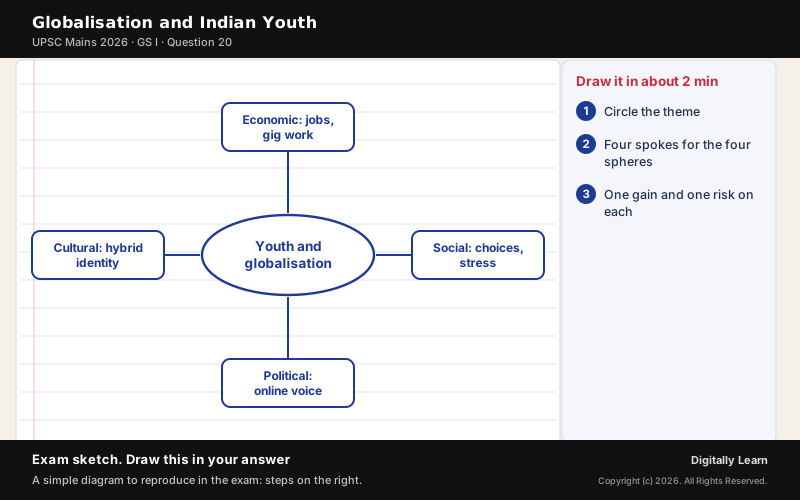
Exam sketch: Unity in Diversity: Key Ideas at a Glance
  1. Circle the theme in the centre
  2. Draw five spokes
  3. Put bonds on top, strains below

Study the topic: Salient Features of Indian Society: Unity in Diversity, Caste, Tribe, Family · Communalism in India: Meaning, Stages, Causes, Communal Violence and Secularism · Regionalism, Separatism and Insurgency

Sources: Eighth Schedule to the Constitution of India (Wikipedia); PIB: Ek Bharat Shreshtha Bharat programme

GS I Q9Indian Society

How do you understand disability? Substantiate the need for inclusive policy framework in India in this regard.

10 marks150 words8 min 45 s

How to write this answer

  • Define Open with your definition and the ways of looking at it.
  • Substantiate Back each claim with evidence: data, a law, a case or an example.

For Indian Society: Use examples from daily life and survey data (Census, NFHS), and end with constitutional values.

For this question: Start from the social model, then show the RPwD Act 2016 moving India towards rights.

See the answer frameworkWhat to write, point by point
What the question asks

Two parts: explain how disability is understood (the models), then argue why India needs an inclusive policy framework and what it should contain.

A strong opening

Disability is no longer seen only as a medical condition of the individual. The social and rights-based view holds that people are disabled mainly by barriers in buildings, attitudes and systems.

Points to cover

Understanding disability

  • Medical model: disability as an impairment to be treated or cured.
  • Social model: the barriers in society, not the impairment, cause exclusion.
  • Rights-based model: persons with disabilities are rights holders; this is the basis of the UN Convention on the Rights of Persons with Disabilities (2006), which India ratified in 2007.

Why an inclusive framework is needed

  • Census 2011 counted 26.8 million (about 2.68 crore) persons with disabilities, and the figure is widely thought to be an undercount.
  • They face lower school enrolment, low employment and poor access to buildings, transport and digital services.

The framework India has

  • The Rights of Persons with Disabilities Act, 2016 raised recognised disabilities from 7 to 21, and reserved 4 per cent of government posts and 5 per cent of higher-education seats for persons with benchmark disabilities.
  • The Accessible India Campaign (Sugamya Bharat Abhiyan, 2015) and the Unique Disability ID card.

Gaps and measures

  • Updated data, enforceable accessibility standards, inclusive schools and teacher training, workplace accommodation, and disability-inclusive disaster planning.
A balanced conclusion

Inclusion treats persons with disabilities as participants rather than recipients of charity, which is what the Constitution's promise of equality demands.

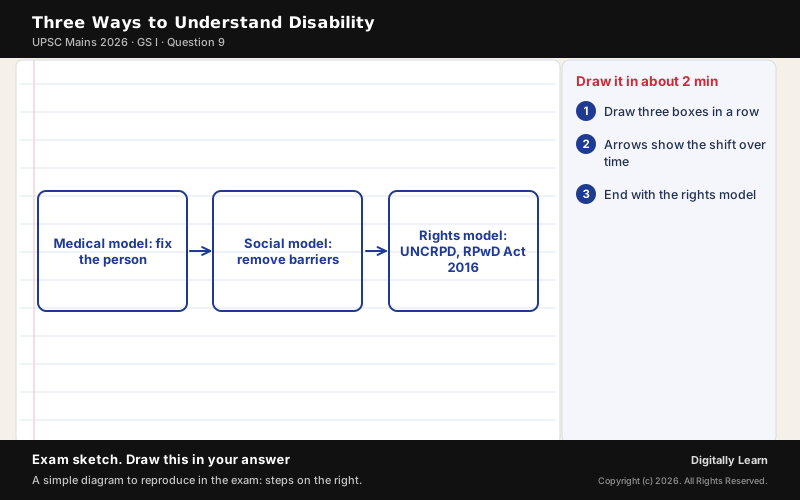
Draw this in the exam (about 2 min)

Exam sketch: Three Ways to Understand Disability
  1. Draw three boxes in a row
  2. Arrows show the shift over time
  3. End with the rights model

Sources: PIB: Rights of Persons with Disabilities Bill 2016 passed by Parliament; PIB: Empowering disabled persons (Parliament question); Disability in India (Wikipedia); Accessible India Campaign (Wikipedia); Convention on the Rights of Persons with Disabilities (Wikipedia)

GS I Q10Indian Society

Do you think digital technology promotes social empowerment? Explain with examples.

10 marks150 words8 min 45 s

How to write this answer

  • Your view Take a clear position in the first line, then support it.
  • Explain Say what it is and why or how it happens, step by step.

For Indian Society: Use examples from daily life and survey data (Census, NFHS), and end with constitutional values.

For this question: Answer "Do you think" directly in your first line: yes, but unevenly.

See the answer frameworkWhat to write, point by point
What the question asks

Give your view with examples. The balanced answer: digital technology does empower, but unevenly, and it can also exclude.

A strong opening

Social empowerment means that groups who were left out (the poor, women, rural people, marginalised castes and tribes) gain voice, access and control over their lives. Digital technology has widened that access, but not for everyone.

Points to cover

How it empowers

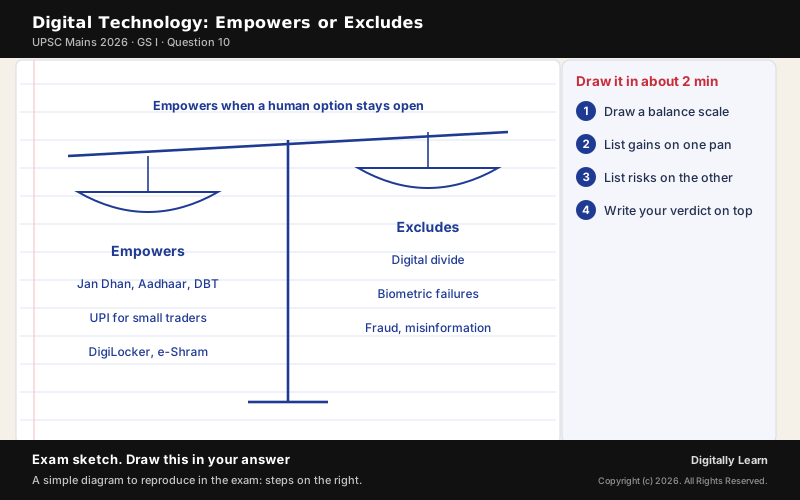
  • Financial inclusion: Jan Dhan accounts, Aadhaar and mobile phones together enable direct benefit transfers into the beneficiary's account, cutting out middlemen.
  • Payments: UPI lets street vendors and small traders take digital payments.
  • Services: DigiLocker, e-Shram registration for unorganised workers, telemedicine and online land records reduce dependence on intermediaries.
  • Voice: self-help groups sell online, and citizens use social media and grievance portals to hold officials to account.

Where it falls short

  • The digital divide by gender, income, region and age limits who benefits.
  • Biometric failures and poor connectivity can shut the weakest out of rations and pensions.
  • Online harassment, fraud and misinformation hit first-time users hardest.

What makes it empowering

  • Digital literacy (PMGDISHA), rural broadband (BharatNet), offline options for every essential service, and local-language interfaces.
A balanced conclusion

Digital technology empowers when it adds choices to people's lives; it disempowers when it becomes the only door. Policy has to keep a human alternative open.

Draw this in the exam (about 2 min)

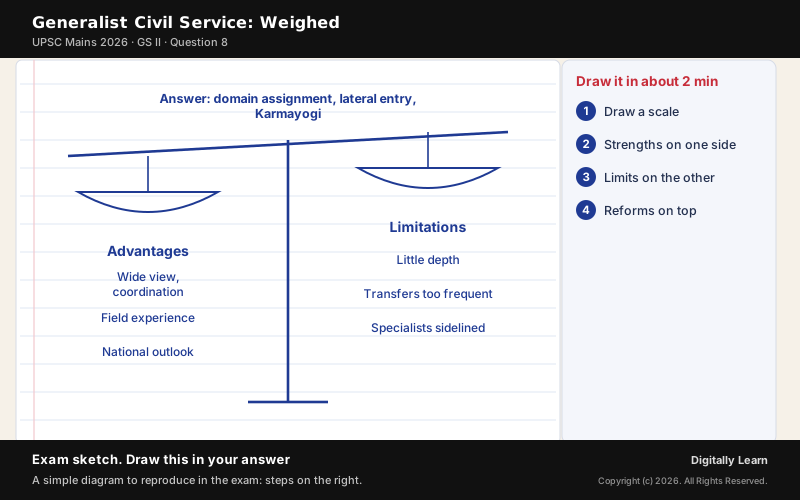
Exam sketch: Digital Technology: Empowers or Excludes
  1. Draw a balance scale
  2. List gains on one pan
  3. List risks on the other
  4. Write your verdict on top

Study the topic: Digital India Programme: E-Governance and the Citizen Platforms · Pradhan Mantri Jan Dhan Yojana: Financial Inclusion · e-Shram: The Unorganised Workers Database

Sources: Pradhan Mantri Jan Dhan Yojana (Wikipedia); Unified Payments Interface (Wikipedia)

GS I Q11Art and Culture

Vijayanagara architecture exemplifies the amalgamation of past traditions with contemporary practices. Elucidate with examples.

15 marks250 words8 min 45 s

How to write this answer

  • Elucidate Explain clearly with examples, so the point becomes plain.

For Art and Culture: Name monuments, rulers and places; a labelled sketch of a temple plan or a site map adds marks.

For this question: Name at least four monuments (Virupaksha, Vitthala, Hazara Rama, Lotus Mahal); "with examples" demands them.

See the answer frameworkWhat to write, point by point
What the question asks

Elucidate with examples: show what Vijayanagara builders took from earlier traditions and what they added, naming specific structures.

A strong opening

The builders of Vijayanagara (1336 to 1565) worked in the Dravida tradition of the Cholas, Pandyas, Chalukyas and Hoysalas, but enlarged it and mixed in forms from the neighbouring Deccan Sultanates.

Points to cover

Continuity with earlier traditions

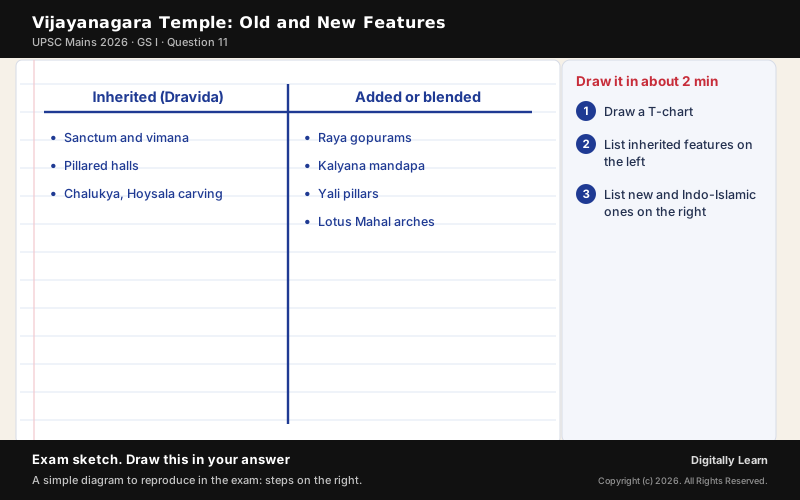
  • Temples follow the Dravida plan: a sanctum with a pyramidal vimana, pillared halls and enclosure walls, as in the Virupaksha temple at Hampi, whose core predates the empire.
  • Stone carving drew on Chalukyan and Hoysala skill in pillars and friezes.

New features of the period

  • Raya gopurams: very tall gateways that dominated the skyline and dwarfed the central shrine, signalling royal authority.
  • Kalyana mandapas (halls for the ritual marriage of deities) and hundred-pillared halls.
  • Pillars carved with rearing horses and composite yali figures; the Vitthala temple's stone chariot and its 'musical' pillars.
  • The Hazara Rama temple's walls carry the Ramayana story in relief, a royal chapel linked to the state's rituals.

Blending with contemporary Indo-Islamic practice

  • The Lotus Mahal and the elephant stables use arches, domes and vaults of the Deccan Sultanate style.
  • Water works: tanks, aqueducts and the Kamalapura tank, fed from the Tungabhadra, served both city and fields.
A balanced conclusion

Vijayanagara architecture is a synthesis rather than a revival, which is why Hampi was inscribed as a UNESCO World Heritage Site in 1986.

Draw this in the exam (about 2 min)

Exam sketch: Vijayanagara Temple: Old and New Features
  1. Draw a T-chart
  2. List inherited features on the left
  3. List new and Indo-Islamic ones on the right

Study the topic: The Art and Architecture of Vijayanagara: Hampi

Sources: Vijayanagara architecture (Wikipedia); Group of Monuments at Hampi (Wikipedia); Group of Monuments at Hampi: Vitthala temple (Wikipedia)

GS I Q12Post-Independence India

Linguistic reorganization of Indian States was driven by popular pressure from below. Comment.

15 marks250 words8 min 45 s

How to write this answer

  • Comment Give your opinion on the statement, backed by reasons and evidence.

For Post-Independence India: Anchor each point in a year and a named event, commission or law.

For this question: Show both sides: pressure from below (Sriramulu, Samyukta Maharashtra) and control from above (Dar, JVP, SRC).

See the answer frameworkWhat to write, point by point
What the question asks

Comment on the claim: agree that popular movements forced reorganisation, but show the role of Congress's earlier commitment and the centre's control over the outcome.

A strong opening

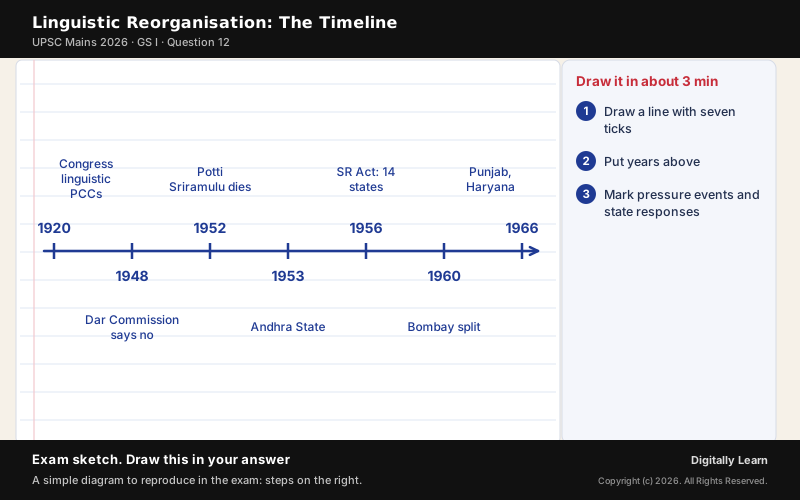
The Congress had organised its own provincial committees on linguistic lines since its Nagpur session in 1920, yet after Partition its leaders feared that linguistic states would divide the country.

Points to cover

Initial reluctance from above

  • The Dar Commission (1948) advised against linguistic states, and the JVP Committee (Jawaharlal Nehru, Vallabhbhai Patel, Pattabhi Sitaramayya) in 1949 recommended postponing them.

Pressure from below

  • Potti Sriramulu's fast for a Telugu state ended in his death on 15 December 1952; the unrest that followed led to Andhra State on 1 October 1953.
  • The Samyukta Maharashtra and Mahagujarat movements, with mass protests and police firing in Bombay, led to the split of Bombay State in 1960.
  • The Punjabi Suba movement produced Punjab and Haryana in 1966.

The role of the state

  • The centre channelled the demand through the States Reorganisation Commission (Fazl Ali, Kunzru, Panikkar); the States Reorganisation Act, 1956 created 14 states and 6 union territories.
  • It weighed administrative and security factors and refused some demands for years.

Outcome

  • Linguistic states widened political participation in regional languages and, contrary to early fears, strengthened national unity.
A balanced conclusion

Reorganisation was driven from below but negotiated from above: popular movements set the pace, and the Union shaped the map.

Draw this in the exam (about 3 min)

Exam sketch: Linguistic Reorganisation: The Timeline
  1. Draw a line with seven ticks
  2. Put years above
  3. Mark pressure events and state responses

Study the topic: Linguistic Reorganisation of States: From Andhra 1953 to 1956

Sources: States Reorganisation Act, 1956 (Wikipedia); Potti Sriramulu (Wikipedia); Andhra State (Wikipedia); Samyukta Maharashtra Movement (Wikipedia); Punjabi Suba movement (Wikipedia); Dar Commission (Wikipedia)

GS I Q13Post-Independence India

The model of planned economy was adopted in India to address the regional imbalances left behind by colonial rule. Comment.

15 marks250 words8 min 45 s

How to write this answer

  • Comment Give your opinion on the statement, backed by reasons and evidence.

For Post-Independence India: Anchor each point in a year and a named event, commission or law.

For this question: Name the steel plants and the freight equalisation policy: one supports the claim, the other qualifies it.

See the answer frameworkWhat to write, point by point
What the question asks

Comment: judge whether reducing colonial regional imbalance was a real aim of planning, how far it was pursued, and what the results were.

A strong opening

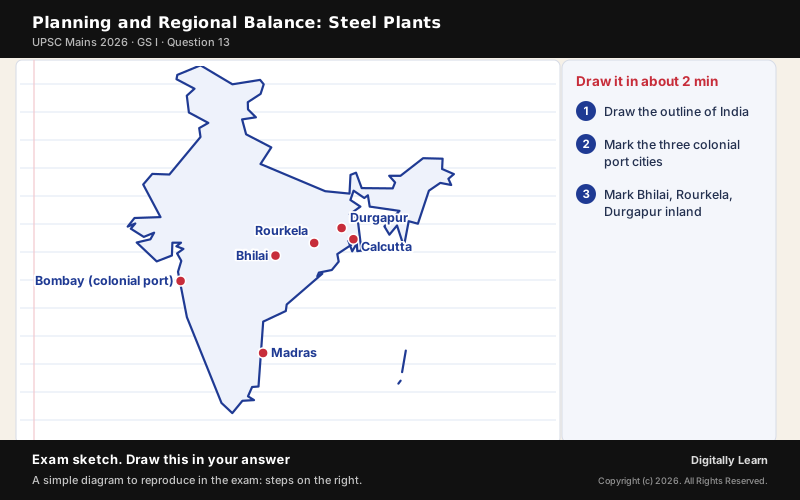
Colonial rule left industry clustered around the port cities of Bombay, Calcutta and Madras, and a hinterland of stagnant agriculture. Independent India's planners inherited a map of deep regional inequality.

Points to cover

Balanced regional development as a stated aim

  • The Planning Commission was set up on 15 March 1950; the Industrial Policy Resolution of 1956 named the reduction of regional disparities as an aim of industrial location.
  • Public sector steel plants at Bhilai, Rourkela and Durgapur were placed in backward, mineral-rich areas.

Tools used

  • Industrial licensing to steer the location of new units, and backward-area programmes such as the Drought Prone Areas Programme and hill-area plans.
  • The Gadgil formula (1969) for plan transfers to states gave weight to population, per capita income and backwardness.

But other aims came first

  • The Second Plan's Mahalanobis model put rapid heavy industrialisation, self-reliance and growth ahead of regional equity.
  • The freight equalisation policy (1952) evened out the price of coal and steel across India, which took away the natural advantage of the mineral-rich eastern states.

Results

  • Disparities between states persisted and in some ways widened; the Green Revolution favoured already irrigated regions such as Punjab and Haryana.
A balanced conclusion

Regional balance was one aim of planning, not the reason it was adopted; the plans reduced some colonial imbalances but created new ones, and the Planning Commission gave way to NITI Aayog in 2015.

Draw this in the exam (about 2 min)

Exam sketch: Planning and Regional Balance: Steel Plants
  1. Draw the outline of India
  2. Mark the three colonial port cities
  3. Mark Bhilai, Rourkela, Durgapur inland

Study the topic: Planning in India: The Five-Year Plan Era

Sources: Planning Commission (India) (Wikipedia); Freight equalisation policy (Wikipedia); Gadgil formula (Wikipedia); Industrial Policy Resolution of 1956 (Wikipedia); Bhilai Steel Plant (Wikipedia)

GS I Q14Geography

Compare the Loo, Chinook and Foehn winds with respect to their regions of prevalence, their nature and climatic impacts.

15 marks250 words8 min 45 s

How to write this answer

  • Compare Set out similarities and differences on the same heads.

For Geography: Draw a map or labelled diagram, and give one Indian and one world example.

For this question: A three-column table (region, nature, impact) is the fastest way to "compare" three winds.

See the answer frameworkWhat to write, point by point
What the question asks

A direct comparison on three heads: where each wind blows, what kind of wind it is, and what it does to climate and life. A table is the clearest way to present it, followed by a sketch of the foehn mechanism.

A strong opening

All three are local winds, but they arise differently. The Loo is a hot, dry land wind of the Indian summer; the Chinook and Foehn are warm, dry winds that descend the leeward side of mountains.

FeatureLooChinookFoehn
RegionPlains of north and north-west India and PakistanEastern (leeward) slopes of the Rocky Mountains, in the USA and CanadaNorthern (leeward) valleys of the Alps, in Switzerland and Austria
SeasonAfternoons of May and June, before the monsoonMainly winter and early springMainly autumn, winter and spring
NatureHot, dry, dusty westerly wind over heated landWarm, dry wind warming as it descendsWarm, dry wind warming as it descends
TemperatureOften 45 °C or moreCan raise temperatures by tens of degrees within hoursSharp rise in temperature, sharp fall in humidity
ImpactsHeatstroke, crop stress, water shortage, dustMelts snow ('snow eater'), exposes pasture for grazingMelts snow, ripens grapes, raises avalanche and fire risk
Points to cover

The mechanism of the foehn-type winds

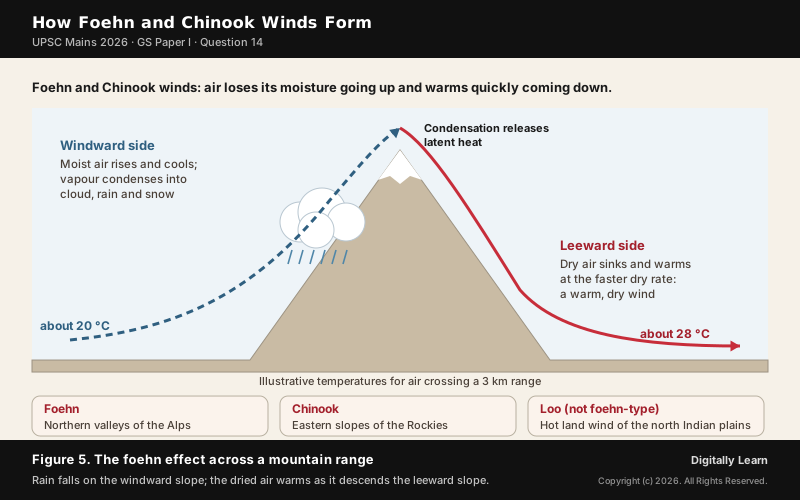
  • Moist air is forced up the windward slope, cools, and drops rain or snow; the condensation releases latent heat.
  • The now drier air descends the leeward slope and warms at the faster dry rate, so it arrives warmer and drier than it started.

Why the Loo is different

  • The Loo is not a descending wind: it takes its heat from the scorching land of the Thar and the northern plains under clear summer skies.
Cross-section of a mountain showing moist air rising and cooling with rain on the windward side and dry air descending and warming on the leeward side, the mechanism of the Foehn of the Alps and the Chinook of the Rockies, contrasted with the Loo
A diagram like this earns marks. Tap to open it full size.
A balanced conclusion

The Chinook and Foehn are the same process on two continents; the Loo is a heat-wave wind. Rising heat extremes make the Loo a growing public-health concern.

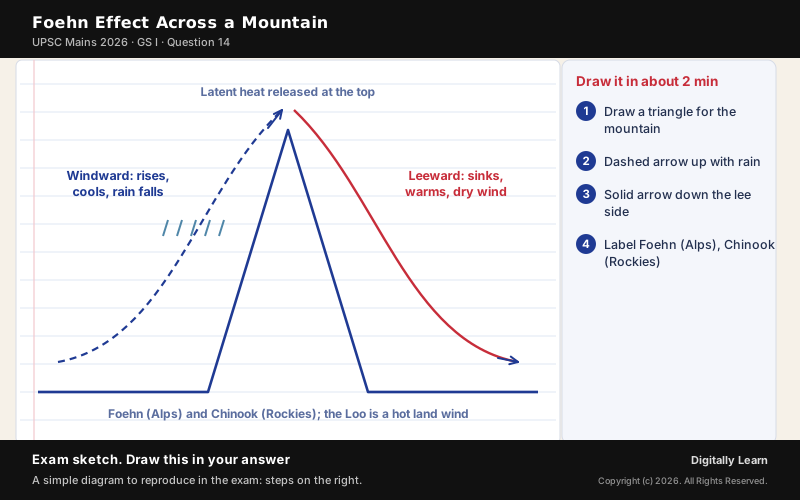
Draw this in the exam (about 2 min)

Exam sketch: Foehn Effect Across a Mountain
  1. Draw a triangle for the mountain
  2. Dashed arrow up with rain
  3. Solid arrow down the lee side
  4. Label Foehn (Alps), Chinook (Rockies)

Study the topic: Climate Part 5: Rainfall, Temperature, Pressure-Wind, Local Weather

Sources: Foehn wind (Wikipedia); Chinook wind (Wikipedia); Loo (wind) (Wikipedia)

GS I Q15Geography

Analyze the role of satellite-based technologies in achieving climate-smart agriculture and food security in India.

15 marks250 words8 min 45 s

How to write this answer

  • Analyse Break the topic into its parts and explain how they connect.

For Geography: Draw a map or labelled diagram, and give one Indian and one world example.

For this question: Name specific programmes (FASAL, YES-TECH, NISAR) rather than "satellites help farming".

See the answer frameworkWhat to write, point by point
What the question asks

Analyse means break the topic into parts and judge them. Show which satellite technologies are used, how each supports climate-smart farming and food security, and their limits.

A strong opening

Climate-smart agriculture aims to raise productivity, help farmers adapt to climate change and cut emissions. Satellites supply the information on weather, crops, soil and water that this needs at a national scale.

Points to cover

Crop estimation and planning

  • The FASAL programme and the Mahalanobis National Crop Forecast Centre use remote sensing to forecast the output of major crops before harvest, helping food stocks and trade decisions.

Weather and drought

  • INSAT-3D and 3DR weather satellites support monsoon and cyclone forecasts; satellite vegetation indices feed drought assessment.

Insurance and relief

  • Under PMFBY, technology-based yield estimation (YES-TECH) and the WINDS weather network speed up and settle claims more fairly.

Soil, water and precision farming

  • Radar satellites such as EOS-04 and NISAR can see through cloud during the monsoon and track soil moisture, crop growth and flooding.
  • Satellite maps guide watershed planning, groundwater recharge sites and fertiliser use; NavIC positioning supports precision machinery.

Digital public infrastructure

  • The Digital Agriculture Mission links satellite data with farmer registries (AgriStack) and a Krishi Decision Support System.

Limits

  • Small fragmented plots are hard to resolve, ground-truthing is costly, and data often does not reach the farmer in usable form or language.
A balanced conclusion

Satellites make climate-smart agriculture measurable at scale; their value to food security depends on turning the data into timely, local advice for small farmers.

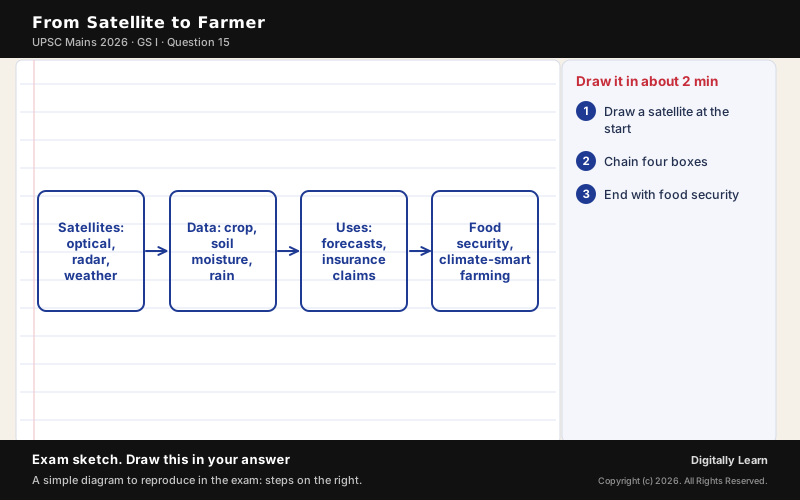
Draw this in the exam (about 2 min)

Exam sketch: From Satellite to Farmer
  1. Draw a satellite at the start
  2. Chain four boxes
  3. End with food security

Study the topic: NISAR: The NASA-ISRO Radar Satellite · Green Revolution Part 8: Climate-Smart and Climate-Resilient Agriculture · Green Revolution Part 9: Precision Agriculture, Digital Agriculture

Sources: NISAR (Wikipedia); Mahalanobis National Crop Forecast Centre

GS I Q16Geography

"The centre of global trade is gradually shifting from the Atlantic region to the Indo-Pacific region." Examine this statement.

15 marks250 words8 min 45 s

How to write this answer

  • Examine Probe the issue in depth: causes, evidence and consequences.

For Geography: Draw a map or labelled diagram, and give one Indian and one world example.

For this question: Use "gradually" from the statement: show the shift is real but incomplete.

See the answer frameworkWhat to write, point by point
What the question asks

Examine the statement: show the evidence that trade has moved towards the Indo-Pacific, the evidence that the Atlantic still matters, and what this means for India.

A strong opening

For most of the modern era, world trade was centred on the Atlantic, linking Europe and North America. Since the 1990s the growth of China, Japan, South Korea, the ASEAN economies and India has pulled the centre of gravity east.

Points to cover

Evidence of the shift

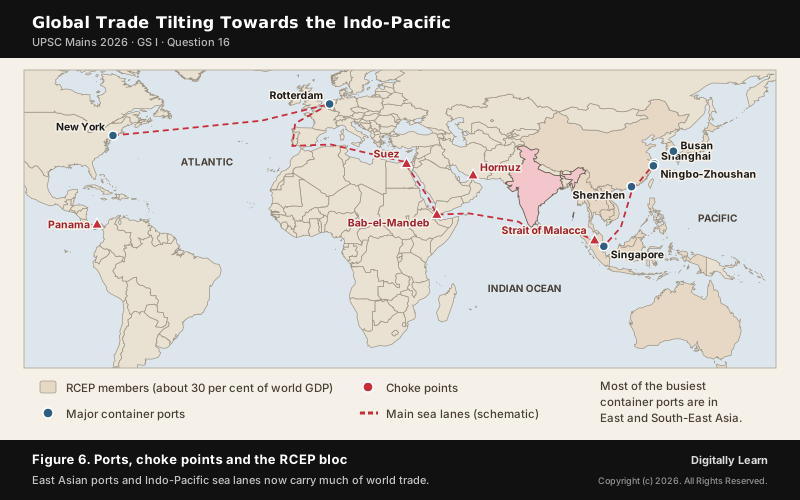
  • Most of the world's busiest container ports (Shanghai, Singapore, Ningbo-Zhoushan, Shenzhen, Busan) are in Asia.
  • The Regional Comprehensive Economic Partnership, in force since 2022, covers about 30 per cent of world GDP; the Indo-Pacific Economic Framework was launched in 2022.
  • The Strait of Malacca is among the busiest sea lanes on earth, carrying much of East Asia's energy and trade.
  • Manufacturing supply chains are spreading from China to Vietnam, India and others ('China plus one').

Why 'gradually' is the right word

  • Transatlantic trade and investment remain the deepest in the world, and financial centres and many technology standards are still Atlantic.
  • Security risks in the South China Sea and at choke points like the Red Sea can interrupt the shift.

What it means for India

  • Opportunity: port-led growth under Sagarmala, a trans-shipment hub at Galathea Bay in Great Nicobar, the IMEC corridor, and the Indo-Pacific Oceans Initiative.
  • Need: stronger manufacturing and logistics, and a navy able to secure sea lanes (SAGAR, now MAHASAGAR).
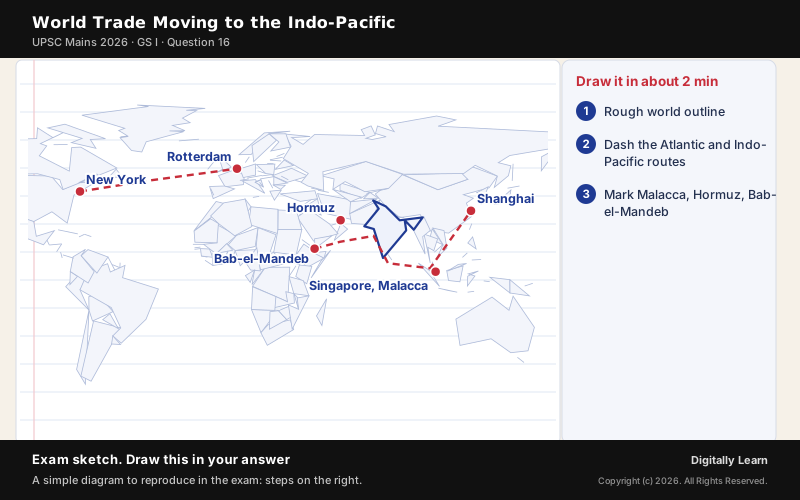
World map showing RCEP member countries, major container ports including Shanghai, Singapore, Ningbo-Zhoushan, Shenzhen, Busan and Rotterdam, choke points Malacca, Hormuz, Bab-el-Mandeb, Suez and Panama, and the main sea lanes
A diagram like this earns marks. Tap to open it full size.
A balanced conclusion

The shift is real but incomplete; the Indo-Pacific is becoming the main arena of trade and of competition over it, and India's place depends on its ports, manufacturing and maritime security.

Draw this in the exam (about 2 min)

Exam sketch: World Trade Moving to the Indo-Pacific
  1. Rough world outline
  2. Dash the Atlantic and Indo-Pacific routes
  3. Mark Malacca, Hormuz, Bab-el-Mandeb

Study the topic: The Quad: Members, Evolution and India's Indo-Pacific Role · India-Middle East-Europe Economic Corridor (IMEC) · Sagarmala: Port-Led Development and the Blue Economy

Sources: Regional Comprehensive Economic Partnership (Wikipedia); List of busiest container ports (Wikipedia); Indo-Pacific Economic Framework (Wikipedia); Strait of Malacca (Wikipedia); Great Nicobar Island Development Project (Wikipedia)

GS I Q17Geography

Analyze the major drivers of human-induced land-use changes in India and their geographical consequences.

15 marks250 words8 min 45 s

How to write this answer

  • Analyse Break the topic into its parts and explain how they connect.

For Geography: Draw a map or labelled diagram, and give one Indian and one world example.

For this question: Keep drivers and consequences as two clear blocks; the question asks for both.

See the answer frameworkWhat to write, point by point
What the question asks

Analyse the main human causes of land-use change in India and their geographical effects, with Indian examples for both.

A strong opening

Land use describes what people do with land: farming, forests, settlements, industry, mining, water bodies. In India the pressure of a large population and fast growth is changing that pattern quickly.

Points to cover

Drivers

  • Agricultural expansion and intensification, including irrigation that turns drylands into year-round cropland.
  • Urbanisation: cities spread over farmland, wetlands and lakes on their edges.
  • Infrastructure: highways, railways, industrial corridors, airports and dams.
  • Mining of coal, iron ore and bauxite, mostly in forested tribal regions of central and eastern India.
  • Diversion of forest land for projects; shifting cultivation with shorter cycles in the north-east; tourism and road building in the Himalaya.

Geographical consequences

  • Forest loss and fragmentation, with more human-wildlife conflict.
  • Loss of wetlands and floodplains, which worsens urban floods (Chennai, 2015).
  • Soil erosion and land degradation: ISRO's atlas puts 97.84 million hectares under degradation in 2018-19.
  • Groundwater depletion, urban heat islands and changed local climate.
  • Slope instability and land subsidence in hill towns such as Joshimath.

Managing the change

  • Land-use planning with zoning, protection of wetlands and floodplains, compensatory afforestation that restores real forest, and watershed management.
A balanced conclusion

Land-use change is unavoidable in a developing country; the task is to steer it so that growth does not destroy the soil, water and forests it depends on.

Draw this in the exam (about 2 min)

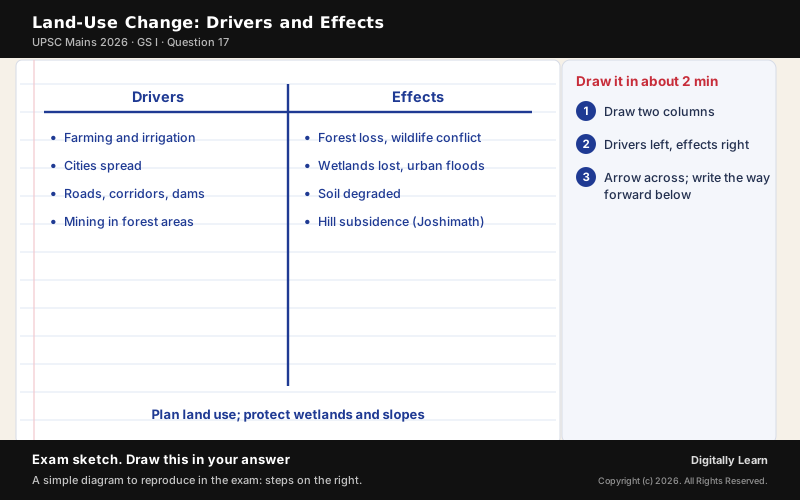
Exam sketch: Land-Use Change: Drivers and Effects
  1. Draw two columns
  2. Drivers left, effects right
  3. Arrow across; write the way forward below

Study the topic: Agriculture Part 1: Foundation, Land Use, and Physical Determinants · Urbanisation in India: Meaning, Trends, Causes, Problems · India State of Forest Report (ISFR) 2023

Sources: PIB: Land degradation and desertification (Desertification and Land Degradation Atlas); 2015 South Indian floods (Wikipedia); Joshimath (Wikipedia)

GS I Q18Indian Society

Is caste disappearing in urban India? Illustrate your answer with examples.

15 marks250 words8 min 45 s

How to write this answer

  • Illustrate Make each point concrete with a named example.

For Indian Society: Use examples from daily life and survey data (Census, NFHS), and end with constitutional values.

For this question: Say "changing form, not disappearing" early, then illustrate both sides.

See the answer frameworkWhat to write, point by point
What the question asks

A direct question: answer it early ('caste is changing form in cities, not disappearing'), then illustrate both the weakening and the persistence with examples.

A strong opening

The city was expected to dissolve caste: anonymity, mixed neighbourhoods, new occupations and education would make birth matter less. Caste has changed in urban India, but it has not gone away.

Points to cover

Signs of weakening

  • Rules of purity and pollution in eating, touching and sharing space have weakened in offices, trains and restaurants.
  • Occupation is less tied to caste; education and salaried jobs allow mobility.
  • Inter-caste marriages, though still a small share, are more common in cities.

Signs of persistence

  • Most marriages are still arranged within caste; matrimonial listings are sorted by caste.
  • Discrimination in renting homes and in hiring, and residential clustering by caste in many cities.
  • Sanitation and sewer work is still done overwhelmingly by Dalits, despite the Prohibition of Employment as Manual Scavengers Act, 2013.
  • Caste associations, caste-based politics and caste discrimination on campuses.

A change of form

  • Caste has moved from a ritual hierarchy to an identity and interest group used for networks, politics and claims on the state; the caste count in the next census reflects that.
A balanced conclusion

Caste in urban India is less visible but still decides whom people marry, where they live and who cleans the sewers. Laws, education and social reform have to keep working on what remains.

Draw this in the exam (about 2 min)

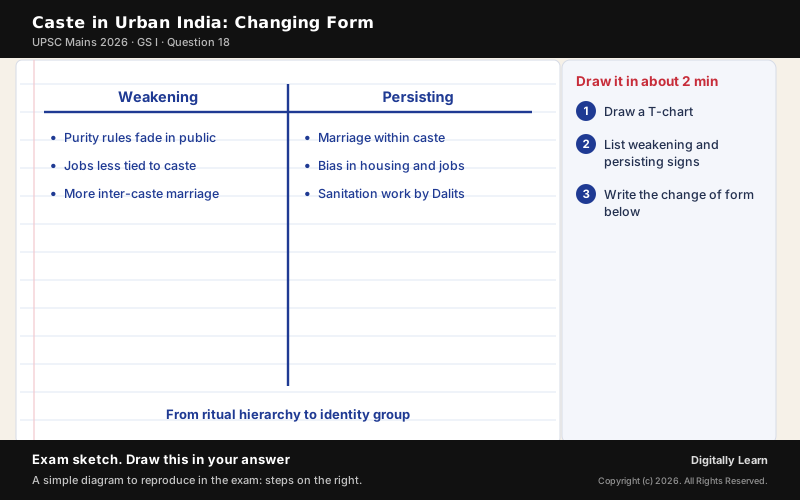
Exam sketch: Caste in Urban India: Changing Form
  1. Draw a T-chart
  2. List weakening and persisting signs
  3. Write the change of form below

Study the topic: Salient Features of Indian Society: Unity in Diversity, Caste, Tribe, Family · Caste Enumeration in the Census 2027 · Urbanisation in India: Meaning, Trends, Causes, Problems

Sources: Caste system in India (Wikipedia); Manual scavenging (Wikipedia)

GS I Q19Indian Society

Critically examine the challenges of demographic transition in contemporary India.

15 marks250 words8 min 45 s

How to write this answer

  • Critically examine Look at both sides with evidence, then give a reasoned judgement.

For Indian Society: Use examples from daily life and survey data (Census, NFHS), and end with constitutional values.

For this question: Quote TFR 2.0 (NFHS-5 and NFHS-6) and name the north-south divergence.

See the answer frameworkWhat to write, point by point
What the question asks

Critically examine: explain the stage India has reached in its demographic transition, the challenges it brings, the regional differences, and what can be done.

A strong opening

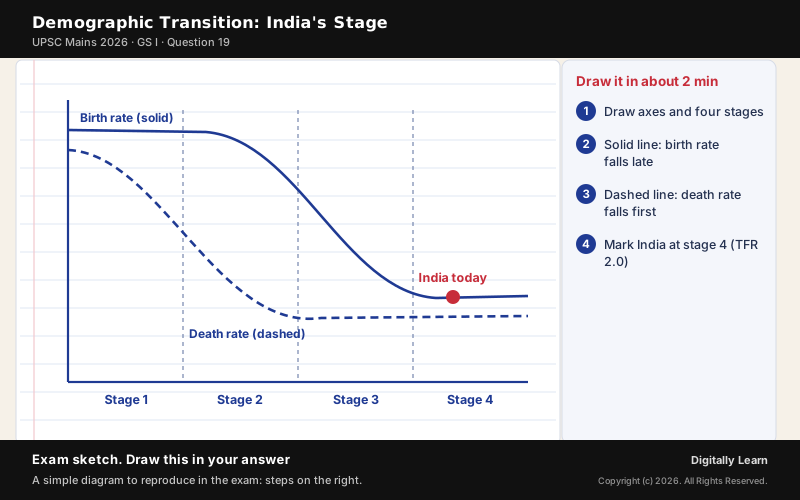
The demographic transition is the move from high birth and death rates to low ones. India is now in its late stage: fertility has fallen to around replacement level, so the working-age bulge is at its peak and ageing has begun.

Points to cover

Where India stands

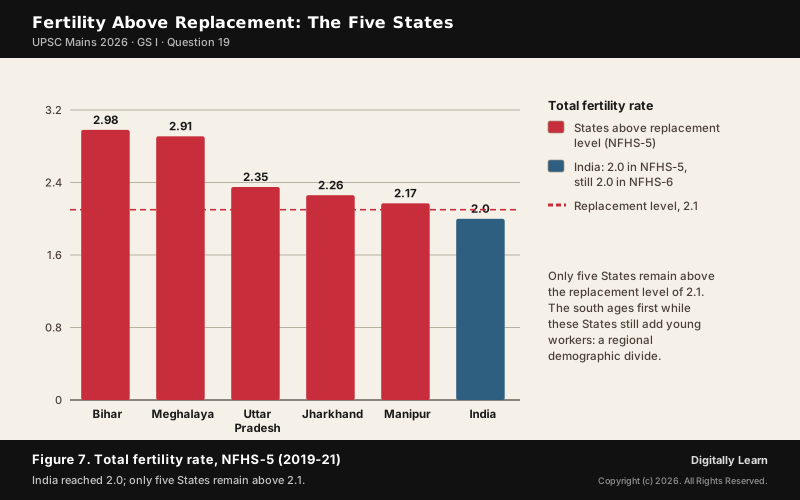
  • The total fertility rate fell from 2.2 to 2.0 between NFHS-4 and NFHS-5 (2019-21), below the replacement level of 2.1, and NFHS-6 finds it still at 2.0.
  • The working-age population is at its largest share, which is the window of the demographic dividend.

Challenges

  • Jobs and skills: the dividend pays only if young people find productive work; female labour-force participation is still low.
  • Ageing: the share of people aged 60 and above is rising, with weak pension coverage and a heavy care burden on families, mostly women.
  • Regional divergence: the southern states and Punjab have fertility well below replacement while Bihar, Uttar Pradesh and Meghalaya remain above it, so the south ages first while the north has more young workers.
  • Politics and finance: the freeze on seat allocation in Parliament runs until after the first census taken after 2026, and population weights in Finance Commission transfers are contested.
  • Migration from young to ageing states, and urban pressure.

Measures

  • Skilling and labour-intensive manufacturing, childcare and safety to raise women's work, a universal old-age pension and geriatric care, and fair rules for delimitation and fiscal transfers.
Bar chart of total fertility rate in NFHS-5: Bihar 2.98, Meghalaya 2.91, Uttar Pradesh 2.35, Jharkhand 2.26, Manipur 2.17 and India 2.0, against the replacement level of 2.1
A diagram like this earns marks. Tap to open it full size.
A balanced conclusion

Low fertility is a success of development, but the dividend has a closing date; India has to create jobs for the young now and build care for the old before the population ages.

Draw this in the exam (about 2 min)

Exam sketch: Demographic Transition: India's Stage
  1. Draw axes and four stages
  2. Solid line: birth rate falls late
  3. Dashed line: death rate falls first
  4. Mark India at stage 4 (TFR 2.0)

Study the topic: High-Level Committee on Demographic Change in India 2026 · NFHS-6: National Family Health Survey 2023-24 · SRS Statistical Report 2024

Sources: Demographic transition (Wikipedia); PIB: NFHS-5 national report released; PIB: Union Health Ministry releases NFHS-6; Delimitation Commission of India (Wikipedia)

GS I Q20Indian Society

Evaluate the impact of globalization on Indian youths with reference to social, political, economic and cultural spheres.

15 marks250 words8 min 45 s

How to write this answer

  • Evaluate Judge the worth or impact, positives and negatives, and conclude.

For Indian Society: Use examples from daily life and survey data (Census, NFHS), and end with constitutional values.

For this question: Cover all four spheres by name; missing one loses marks on a listed-demand question.

See the answer frameworkWhat to write, point by point
What the question asks

Evaluate means judge the net effect. Cover all four spheres named (social, political, economic, cultural), with positives and negatives in each.

A strong opening

India has one of the largest youth populations in the world, and it came of age after the 1991 reforms opened the economy. Globalisation has shaped how this generation works, lives, votes and sees itself.

Points to cover

Economic

  • New jobs in IT, services, global capability centres and start-ups; access to global education and remittance-earning work abroad.
  • But also insecure work in the gig economy, skills that lag behind demand, and competition from automation.

Social

  • More nuclear families, later marriage, greater choice for young women in education and work.
  • Rising consumerism, pressure to match global lifestyles, and mental-health strain and screen addiction.

Political

  • Social media gives youth a voice on issues from corruption to the environment and has changed campaigning.
  • It also spreads polarising misinformation and can reduce politics to online outrage.

Cultural

  • Hybrid cultures: global music, food and streaming alongside Indian forms; Indian cuisine, yoga and cinema travel abroad.
  • Worries about loss of regional languages and traditions, answered in part by a revival of interest in local identity.
A balanced conclusion

Globalisation has widened the opportunities of Indian youth more than it has narrowed them, but its gains depend on skills, stable jobs and a confident cultural identity.

Draw this in the exam (about 2 min)

Exam sketch: Globalisation and Indian Youth
  1. Circle the theme
  2. Four spokes for the four spheres
  3. One gain and one risk on each

Study the topic: Startup India: The Entrepreneurship Ecosystem · Skill India Mission: PMKVY and Vocational Training

Sources: Economic liberalisation in India (Wikipedia); Gig worker (Wikipedia)

UPSC Mains 2026 GS Paper 2 Questions

GS II Q1Polity

Right to privacy relating to self-identity is very dear to every human being and well protected under Article 21 of the Constitution. In this context, examine the effect of the amendment in 2026, to the Transgender Persons (Protection of Rights) Act, 2019.

10 marks150 words8 min 45 s

How to write this answer

  • Examine Probe the issue in depth: causes, evidence and consequences.

For Polity: Quote Articles, landmark cases and committees by name; end with a balanced way forward.

For this question: Link the amendment to Puttaswamy's proportionality test; that is the "examine the effect" core.

See the answer frameworkWhat to write, point by point
What the question asks

Two steps: set out the constitutional basis (privacy and self-identity under Article 21), then examine what the 2026 amendment changes and whether it fits that basis.

A strong opening

In NALSA v Union of India (2014) the Supreme Court held that the right to self-identify one's gender is part of personal liberty and dignity; in Puttaswamy (2017) a nine-judge bench recognised privacy as a fundamental right under Article 21.

Points to cover

The 2019 Act

  • It recognised a transgender person's right to a self-perceived gender identity and let the District Magistrate issue a certificate of identity on application.

What the 2026 amendment does

  • Passed by Parliament on 24 and 25 March 2026, with assent on 30 March 2026, it removes the right to self-perceived identity.
  • It narrows the definition to socio-cultural identities (such as kinner, hijra, aravani, jogta) and intersex persons.
  • Medical boards at the State or UT level must verify an applicant before the District Magistrate issues a certificate.
  • Hospitals must report gender-affirming surgery to the authorities; new offences cover forcing or inducing a person to present a transgender identity.

Effect on rights

  • Mandatory medical scrutiny intrudes into bodily and decisional privacy, which Puttaswamy protects, and sits uneasily with NALSA's self-identification principle.
  • Trans men, trans women and non-binary persons outside the listed identities may lose legal recognition and access to welfare.
  • The government's case: verification stops misuse and targets benefits at genuine beneficiaries. Any restriction must still pass Puttaswamy's test of legality, legitimate aim and proportionality.
A balanced conclusion

Preventing misuse is a legitimate aim, but a proportionate law would verify through less intrusive means and keep self-identity at its core; the amendment's validity will turn on that test.

Draw this in the exam (about 2 min)

Exam sketch: Gender Identity Law: The Timeline
  1. Draw a line with four ticks
  2. Write the year and ruling or law
  3. Circle 2026 and note the change

Sources: Transgender Persons (Protection of Rights) Amendment Act, 2026 (Wikipedia); National Legal Services Authority v. Union of India (Wikipedia); Puttaswamy v. Union of India (Wikipedia)

GS II Q2Social Justice

"Women as a class neither belong to a minority group nor are they regarded as forming a backward class." In the light of this statement, discuss the evolution of women's reservation from local bodies to Parliament.

10 marks150 words8 min 45 s

How to write this answer

  • Discuss Cover the main aspects, with arguments on more than one side.

For Social Justice: Cite the Act, the scheme and one data point on the group affected.

For this question: Explain why women are not a minority or backward class, then trace 1992, 2023 and the 2026 delay.

See the answer frameworkWhat to write, point by point
What the question asks

Use the quoted idea (women are neither a minority nor a backward class, yet are under-represented) to explain why reservation for women needed its own route, and trace that route from panchayats to Parliament.

A strong opening

Women are half the population, so reservation for them cannot rest on the minority or backward-class logic of other quotas. It rests instead on their persistent under-representation in elected bodies.

Points to cover

Local bodies first

  • The 73rd and 74th Amendments (1992) reserved one-third of seats and chairperson posts in panchayats and municipalities for women (Articles 243D and 243T); many States have since raised this to 50 per cent.
  • This created lakhs of elected women representatives, though the 'sarpanch pati' problem of proxy rule persists.

The long road to Parliament

  • Bills were introduced from 1996 onwards; the 2010 Bill passed the Rajya Sabha but lapsed in the Lok Sabha.
  • The Constitution (106th Amendment) Act, 2023, the Nari Shakti Vandan Adhiniyam, reserves one-third of seats in the Lok Sabha, State Assemblies and the Delhi Assembly, including within SC and ST seats, for 15 years.

The catch: timing

  • The quota takes effect only after delimitation based on the first census after the Act. In April 2026 the Constitution (131st Amendment) Bill, which sought to enable delimitation and bring the quota into force, was defeated in the Lok Sabha for want of the special majority.
  • Other debates: no sub-quota for OBC women, no reservation in the Rajya Sabha and Legislative Councils, and rotation of seats weakening constituency nursing.
A balanced conclusion

The principle is settled; the delay is political and procedural. Linking the quota to a fresh delimitation has kept a constitutional promise waiting.

Draw this in the exam (about 2 min)

Exam sketch: Women's Reservation: From Panchayat to Parliament
  1. Draw a staircase of four steps
  2. Write the year on each step
  3. Note why the last step is pending

Study the topic: Women's Reservation Act: The 106th Amendment Explained · Constitution (131st Amendment) Bill Negatived

Sources: Women's Reservation Bill (Wikipedia); Constitution (131st Amendment) Bill, 2026 (Wikipedia)

GS II Q3Polity

Examine whether the constitutional office of the Lok Sabha Speaker has become vulnerable to partisan politics under the current anti-defection regime. What institutional changes are required to ensure the neutrality of the Lok Sabha Speaker in managing a polarised House?

10 marks150 words8 min 45 s

How to write this answer

  • Examine Probe the issue in depth: causes, evidence and consequences.

For Polity: Quote Articles, landmark cases and committees by name; end with a balanced way forward.

For this question: Cite Kihoto Hollohan and the Keisham three-month direction; both are standard for this topic.

See the answer frameworkWhat to write, point by point
What the question asks

Two parts: examine whether the Speaker's role under the anti-defection law has made the office partisan, then suggest institutional reforms.

A strong opening

The Speaker is meant to be the neutral guardian of the House. The Tenth Schedule, added by the 52nd Amendment in 1985, also made the Speaker the judge of whether members of their own and rival parties should be disqualified.

Points to cover

Why the office looks vulnerable

  • The Speaker is elected from the ruling party and usually returns to party politics, so rulings on defection can be read as partisan.
  • Delay has been used as a weapon: petitions against defectors who strengthen the ruling side have been left pending for years.
  • In Kihoto Hollohan (1992) the Supreme Court upheld the Speaker's role but made decisions open to judicial review; in Keisham Meghachandra Singh (2020) it said petitions should ordinarily be decided within three months and asked Parliament to consider an independent tribunal.

Reforms

  • Move disqualification decisions to an independent body, such as the President or Governor acting on the Election Commission's advice (as the Dinesh Goswami Committee and Law Commission suggested), or a tribunal.
  • Fix a statutory time limit for deciding petitions.
  • Follow the British convention: a Speaker who resigns from the party and is returned unopposed.
  • Limit the whip to votes of confidence and money bills so members can speak freely on other matters.
A balanced conclusion

The Speaker's authority depends on being seen as above party; taking the defection jury out of the chair would protect both the office and the law.

Draw this in the exam (about 2 min)

Exam sketch: Anti-Defection: Who Decides
  1. Four boxes in a row
  2. Arrows from petition to review
  3. Last box: the reform

Study the topic: Anti-Defection Law: The Tenth Schedule Explained

Sources: Anti-defection law (India) (Wikipedia); Supreme Court: Keisham Meghachandra Singh v Speaker, Manipur (21 January 2020)

GS II Q4Polity

Is the right to vote a fundamental right? Discuss the position of the Election Commission of India while undertaking the revision of electoral rolls. Can it also examine the question of citizenship of voters?

10 marks150 words8 min 45 s

How to write this answer

  • Discuss Cover the main aspects, with arguments on more than one side.
  • Examine Probe the issue in depth: causes, evidence and consequences.

For Polity: Quote Articles, landmark cases and committees by name; end with a balanced way forward.

For this question: Answer the three questions in order, one short paragraph each, and cite Article 326.

See the answer frameworkWhat to write, point by point
What the question asks

Three short answers in one: the legal status of the right to vote, the Election Commission's power to revise rolls, and whether that power extends to citizenship.

A strong opening

The right to vote is not a fundamental right in India. It is a constitutional right under Article 326 (adult suffrage), exercised as a statutory right under the Representation of the People Acts.

Points to cover

Status of the right

  • Courts have described it as a statutory right (N.P. Ponnuswami, Jyoti Basu); in Anoop Baranwal (2023) the Court spoke of it as more than a mere statutory right, but it is not listed in Part III.

The Election Commission and revision of rolls

  • Article 324 vests superintendence of the preparation of electoral rolls in the Commission; Section 21 of the Representation of the People Act, 1950 provides for intensive or summary revision.
  • On 27 May 2026, in Association for Democratic Reforms v Election Commission of India, the Supreme Court upheld the Special Intensive Revision as traceable to Section 21(3) of the RP Act read with Article 324, and as proportionate, with safeguards against arbitrary exclusion.

Can it decide citizenship?

  • Only citizens can be enrolled (Article 326), so the Court held that the Commission may make a limited enquiry into citizenship to satisfy itself that a person is eligible for the roll.
  • That enquiry is not a determination of citizenship in the strict sense: its effect is confined to the electoral roll, it does not take away anyone's claim to citizenship, and where the Commission is not satisfied it must refer the person to the competent authority under the Citizenship Act.
A balanced conclusion

Clean rolls are essential, but exclusion must follow notice, a hearing and appeal, so that no eligible voter loses the franchise through a paperwork gap.

Draw this in the exam (about 2 min)

Exam sketch: Voter Rolls and Citizenship: Two Lanes
  1. Draw two lanes
  2. ECI powers on the left
  3. Citizenship on the right

Study the topic: Supreme Court Upholds the ECI's Special Intensive Revision of Electoral Rolls

Sources: Supreme Court: ADR v Election Commission of India, judgment of 27 May 2026 (2026 INSC 564)

GS II Q5Polity

Do constitutional bodies like the National Commission for Scheduled Castes (NCSC) and the National Commission for Scheduled Tribes (NCST) possess adequate enforcement powers to secure substantive social equality? Suggest measures to enhance their institutional effectiveness.

10 marks150 words8 min 45 s

How to write this answer

  • Suggest End with practical, specific measures, not general wishes.

For Polity: Quote Articles, landmark cases and committees by name; end with a balanced way forward.

For this question: Separate "powers they have" from "powers they lack" before suggesting reforms.

See the answer frameworkWhat to write, point by point
What the question asks

Judge whether the NCSC and NCST have enough power to secure real equality, then suggest measures. A clear answer: they have strong investigative powers but no power to enforce.

A strong opening

The National Commission for Scheduled Castes (Article 338) and the National Commission for Scheduled Tribes (Article 338A, created by the 89th Amendment in 2003) are constitutional watchdogs for the rights of SCs and STs.

Points to cover

Powers they hold

  • They investigate and monitor safeguards, inquire into complaints, and while doing so have the powers of a civil court: summoning persons, requiring documents, receiving evidence on affidavit.
  • They report to the President, and the reports are laid before Parliament; the Union and States must consult them on major policy matters affecting these groups.

Why this falls short

  • Their recommendations are advisory; no one is bound to act on them.
  • Reports are often laid late, with thin action-taken memoranda.
  • Staff shortages, vacancies in membership, and dependence on the ministries they oversee.
  • Atrocity cases still show low conviction rates, and discrimination in jobs, housing and education persists.

Measures

  • Time-bound, reasoned action-taken reports on each recommendation; independent budgets and staff; regional offices; power to seek compliance reports and to approach courts; and data-sharing with police and NCRB.
A balanced conclusion

The commissions can expose injustice but cannot compel a remedy; giving their findings binding follow-up is the step from formal to substantive equality.

Draw this in the exam (about 2 min)

Exam sketch: NCSC and NCST: Powers Held and Missing
  1. Draw a T-chart
  2. Powers on the left
  3. Gaps on the right; add one reform

Study the topic: Reservation in India · Social Justice: Caste, Reservation and the Dalit Movement

Sources: National Commission for Scheduled Castes (Wikipedia); National Commission for Scheduled Tribes (Wikipedia)

GS II Q6Social Justice

Does India's tribal development policy reflect the aspirations for a socially grounded and equity-based governance? Justify your answer.

10 marks150 words8 min 45 s

How to write this answer

  • Justify Give reasons and evidence that support the position asked for.

For Social Justice: Cite the Act, the scheme and one data point on the group affected.

For this question: Justify with one success (FRA, PESA) and one gap (consent bypassed).

See the answer frameworkWhat to write, point by point
What the question asks

Justify your view: judge whether tribal development policy has respected tribal voice and equity, with evidence on both sides.

A strong opening

India's tribal policy began with Nehru's Panchsheel for tribal areas (1958), which promised development along the lines of tribal genius, without imposing outside ways. The record since has mixed real protections with persistent dispossession.

Points to cover

Where policy reflects these aspirations

  • The Fifth and Sixth Schedules give special administration and autonomous councils.
  • PESA, 1996 makes the gram sabha central to decisions on land, minor forest produce and local resources in Fifth Schedule areas.
  • The Forest Rights Act, 2006 recognises individual and community forest rights.
  • The Tribal Sub-Plan, now the Development Action Plan for STs, earmarks funds; PM-JANMAN targets particularly vulnerable tribal groups.

Where it falls short

  • PESA rules are yet to be framed or fully applied in several States, and gram sabha consent is often bypassed for mines and dams.
  • Many forest-rights claims have been rejected, and displacement by projects has hit tribal people hardest.
  • Health, nutrition and education indicators for STs remain well behind the national average.

What would make it equity-based

  • Real gram sabha consent, faster forest-rights recognition, benefit sharing from minerals (the District Mineral Foundations), and education in tribal languages.
A balanced conclusion

The laws already express a socially grounded vision; the gap is in implementation and in who decides. Governance becomes equitable when tribal communities hold the decision, not only the benefit.

Draw this in the exam (about 2 min)

Exam sketch: Tribal Policy: Instruments and Gaps
  1. Draw two columns
  2. Laws on the left
  3. Gaps on the right

Study the topic: PM-JANMAN: Welfare of Particularly Vulnerable Tribal Groups

Sources: Panchayats (Extension to Scheduled Areas) Act, 1996 (Wikipedia); Forest Rights Act, 2006 (Wikipedia); Panchsheel (tribal policy): Verrier Elwin (Wikipedia)

GS II Q7Social Justice

Malnutrition in India is not merely a public health concern; it is also a challenge of social equity, human development and effective welfare governance. Discuss.

10 marks150 words8 min 45 s

How to write this answer

  • Discuss Cover the main aspects, with arguments on more than one side.

For Social Justice: Cite the Act, the scheme and one data point on the group affected.

For this question: Use one NFHS figure and cover all four lenses named in the question.

See the answer frameworkWhat to write, point by point
What the question asks

Discuss malnutrition on four planes named in the question: public health, social equity, human development and welfare governance.

A strong opening

Malnutrition covers undernutrition (stunting, wasting, underweight), micronutrient deficiency such as anaemia, and the rising problem of obesity. It is shaped as much by poverty, gender and caste as by food.

Points to cover

A public-health issue

  • NFHS-6 (2023-24) shows child stunting down to 29.3 per cent from 35.5 per cent in NFHS-5, but anaemia among women and children remains widespread.

A question of social equity

  • Rates are higher among SC and ST households, the poorest wealth quintile and children of mothers with little schooling; women often eat last and least.

A human-development challenge

  • Stunting in the first 1,000 days affects cognition, schooling and adult earnings, reducing the demographic dividend.

A test of welfare governance

  • Programmes exist: POSHAN Abhiyaan, the ICDS and Anganwadis, PM POSHAN school meals, fortified rice through the PDS, and the Poshan Tracker.
  • Gaps: convergence between health, nutrition, water and sanitation departments, Anganwadi infrastructure, and data quality.
Bar chart comparing NFHS-5 and NFHS-6: stunting 35.5 to 29.3 per cent, underweight 32.1 to 31.8 per cent, severe wasting 7.7 to 5.2 per cent
A diagram like this earns marks. Tap to open it full size.
A balanced conclusion

Nutrition improves fastest when food, health, sanitation and women's education move together; treating it as a rights and equity issue, not only a scheme target, is the key.

Draw this in the exam (about 2 min)

Exam sketch: Child Stunting: NFHS-5 to NFHS-6
  1. Draw two bars
  2. Label 35.5 and 29.3 per cent
  3. Add one line on equity

Study the topic: POSHAN Abhiyaan: The National Nutrition Mission · NFHS-6 (2023-24): Findings and Significance · ICDS and Anganwadi: Child Development

Sources: Malnutrition in India (Wikipedia); PIB: Union Health Ministry releases NFHS-6 (29 May 2026)

GS II Q8Governance

Analyse the advantages and limitations of the generalist structure of the Indian Civil Services in contemporary governance.

10 marks150 words8 min 45 s

How to write this answer

  • Analyse Break the topic into its parts and explain how they connect.

For Governance: Name the law, scheme or commission, add one example of good practice, and close with reforms.

For this question: Name the Second ARC's domain-assignment idea in your reforms.

See the answer frameworkWhat to write, point by point
What the question asks

Analyse both the strengths and the weaknesses of the generalist civil service model, and end with reforms.

A strong opening

India's higher civil services, led by the IAS, follow a generalist model inherited from the British: officers move across sectors every few years rather than specialising in one field.

Points to cover

Advantages

  • A wide view across departments helps coordination, which district administration and crisis management need.
  • Field experience gives officers a grasp of ground realities that specialists may lack.
  • Mobility across States and the centre builds a national outlook and administrative uniformity.

Limitations

  • Governance today needs expertise in areas like finance, technology, climate and health; frequent transfers prevent depth.
  • Generalists dominate senior posts even in technical ministries, which can demoralise specialist services.
  • Rule-bound caution and weak performance appraisal slow innovation.

Reforms under way and suggested

  • Domain assignment after an initial period (the Second Administrative Reforms Commission's recommendation), mid-career training, and lateral entry of specialists at joint secretary level.
  • Mission Karmayogi's competency-based capacity building, and stable tenures.
A balanced conclusion

The answer is not to discard the generalist but to build specialisation on top of the field experience: a 'generalist-specialist' officer.

Draw this in the exam (about 2 min)

Exam sketch: Generalist Civil Service: Weighed
  1. Draw a scale
  2. Strengths on one side
  3. Limits on the other
  4. Reforms on top

Study the topic: Mission Karmayogi: Civil Services Capacity Building

Sources: Indian Administrative Service (Wikipedia); Administrative Reforms Commission (Wikipedia); PIB: Cabinet approves Mission Karmayogi (NPCSCB)

GS II Q9International Relations

"IPMDA (Indo-Pacific Partnership for Maritime Domain Awareness) bridges the gap between India's SAGAR (Security and Growth for All in the Region) vision and the Quad's collective Indo-Pacific strategy." Make a critical assessment of the statement focusing on IPMDA.

10 marks150 words8 min 45 s

How to write this answer

  • Critical assessment Judge how far the claim holds, with strengths, limits and a verdict.

For International Relations: A small map helps; state India's interest plainly and name agreements and groupings.

For this question: Explain what IPMDA does (tracking dark vessels) before assessing it.

See the answer frameworkWhat to write, point by point
What the question asks

Critically assess the claim that IPMDA links India's SAGAR vision with the Quad's Indo-Pacific agenda: explain IPMDA, show where it fits SAGAR, and note its limits.

A strong opening

The Indo-Pacific Partnership for Maritime Domain Awareness (IPMDA) was launched by the Quad at its Tokyo summit in 2022. It gives partner countries near real-time data on activity at sea, including 'dark' vessels that switch off their transponders.

Points to cover

What IPMDA does

  • Uses commercial satellite radio-frequency data to track shipping, helping small states watch their Exclusive Economic Zones.
  • Aimed at illegal fishing, smuggling, piracy, and humanitarian and disaster response.
  • Links regional fusion centres, including India's Information Fusion Centre for the Indian Ocean Region in Gurugram.

How it bridges SAGAR and the Quad

  • SAGAR (Security and Growth for All in the Region, 2015), extended as MAHASAGAR in 2025, commits India to be a security provider for Indian Ocean neighbours; IPMDA gives it tools to share.
  • It lets the Quad offer a public good rather than a military bloc, which is easier for Indian Ocean states to accept.

Limits

  • Awareness is not enforcement: small states lack patrol ships to act on what they see.
  • Uneven data sharing, and concern among some states about being drawn into great-power rivalry with China.
  • Coverage has so far focused more on the Pacific Islands and South-East Asia than on the western Indian Ocean.
Map of the Indian Ocean showing the Information Fusion Centre at Gurugram, Mauritius, Seychelles, Maldives, Sri Lanka, Madagascar, Great Nicobar and the choke points of Hormuz, Bab-el-Mandeb and Malacca
A diagram like this earns marks. Tap to open it full size.
A balanced conclusion

IPMDA does bridge the two frameworks, but its value to SAGAR depends on India pairing data with capacity building: ships, training and hydrography for its neighbours.

Draw this in the exam (about 2 min)

Exam sketch: IPMDA and SAGAR in the Indian Ocean
  1. Sketch India and the ocean
  2. Mark Gurugram fusion centre
  3. Mark partner islands
  4. Arrows: data shared outward

Study the topic: The Quad: Members, Evolution and India's Role · Ninth Indian Ocean Conference, Mauritius 2026

Sources: Quadrilateral Security Dialogue (Wikipedia); Information Fusion Centre for the Indian Ocean Region (Wikipedia); PIB: PM's press statement, India-Mauritius (March 2025)

GS II Q10International Relations

"BRICS acts as a powerful counterweight in global governance, actively amplifying the voice and influence of the Global South." Explain the role of BRICS in projecting itself as an alternative to other groupings.

10 marks150 words8 min 45 s

How to write this answer

  • Explain Say what it is and why or how it happens, step by step.

For International Relations: A small map helps; state India's interest plainly and name agreements and groupings.

For this question: Name the New Development Bank and the expansion; then give the limits.

See the answer frameworkWhat to write, point by point
What the question asks

Explain how BRICS presents itself as an alternative to Western-led groupings, with its institutions and its limits.

A strong opening

BRICS began as Brazil, Russia, India and China; South Africa joined in 2010. After enlargement in 2024 and 2025, official BRICS and Government of India material counts eleven members, including Saudi Arabia, which has not formally confirmed that it joined. India holds the chair in 2026.

Points to cover

How it projects an alternative

  • Institutions: the New Development Bank (Shanghai) and the Contingent Reserve Arrangement, alternatives to World Bank and IMF lending.
  • Agenda: reform of the UN Security Council, IMF quotas and the WTO; a larger voice for developing countries.
  • Expansion: Egypt, Ethiopia, Iran and the UAE joined in 2024 and Indonesia in 2025 (Saudi Arabia was invited in 2023 and is listed as a member, though it has not formally confirmed), widening its Global South base.
  • Payments: talk of trade in local currencies to reduce dependence on the dollar.

Limits

  • Members disagree deeply, notably India and China on the border and on Chinese dominance.
  • It has no common position on Russia's war or on sanctions, and its declarations are broad.
  • India opposes turning BRICS into an anti-Western or de-dollarisation bloc, preferring 'reformed multilateralism'.

India's approach as chair

  • India uses BRICS to amplify the Global South while also working with the Quad and G7, a multi-alignment strategy.
World map of the ten BRICS members coloured by year of joining: Brazil, Russia, India and China; South Africa in 2010; Egypt, Ethiopia, Iran and the UAE in 2024; Indonesia in 2025; with the New Development Bank in Shanghai
A diagram like this earns marks. Tap to open it full size.
A balanced conclusion

BRICS is less a counterweight than a pressure group for a fairer order; its influence depends on turning its size into concrete institutions without becoming a China-led bloc.

Draw this in the exam (about 2 min)

Exam sketch: BRICS Members on the World Map
  1. Rough world outline
  2. Mark the five founders
  3. Add the five new members
  4. Note: New Development Bank

Study the topic: BRICS Foreign Ministers' Meeting 2026: India's Chairship

Sources: BRICS (Wikipedia); BRICS (Wikipedia): status of Saudi Arabia and the 2026 presidency

GS II Q11Polity

Discuss the position of the Governor in the federal polity of India. What is the nature of his power while giving assent to a bill passed by the State Legislature? Is he bound by the aid and advice of his Council of Ministers in all his functions?

15 marks250 words8 min 45 s

How to write this answer

  • Discuss Cover the main aspects, with arguments on more than one side.
  • Define Open with a precise definition before anything else.

For Polity: Quote Articles, landmark cases and committees by name; end with a balanced way forward.

For this question: Use the three Article 200 options and the 2025 Presidential Reference opinion.

See the answer frameworkWhat to write, point by point
What the question asks

Three parts: the Governor's place in the federal polity, the nature of the assent power under Article 200, and whether the Governor is bound by ministerial advice in all functions.

A strong opening

The Governor is the constitutional head of the State, appointed by the President and holding office during the President's pleasure. The office is meant to link the Union and the State, but has become a point of friction in opposition-ruled States.

Points to cover

Position in the federal polity

  • Acts on the advice of the State Council of Ministers in most matters (Article 163), like the President at the centre.
  • Also an agent of the Union: reports under Article 356, reservation of Bills for the President.
  • Sarkaria and Punchhi Commissions urged neutral appointees and consultation with the Chief Minister.

Assent to Bills (Article 200)

  • Options: assent, withhold assent and return the Bill for reconsideration (not a Money Bill), or reserve it for the President. If the legislature passes it again, the Governor cannot withhold assent.
  • In State of Tamil Nadu v Governor of Tamil Nadu (April 2025) the Court set timelines and deemed ten pending Bills to have received assent.
  • On a Presidential Reference, a five-judge bench advised on 20 November 2025 that courts cannot fix rigid timelines or declare 'deemed assent', but the Governor cannot sit on Bills indefinitely: withholding must be joined to returning the Bill, and prolonged inaction can be examined by courts.

Is the Governor always bound by advice?

  • No. The Constitution gives discretion in some matters: reserving certain Bills, reporting under Article 356, special responsibilities under Articles 371 to 371J, Sixth Schedule functions, and appointing a Chief Minister when no party has a majority.
  • In Shamsher Singh (1974) and Nabam Rebia (2016) the Court held that discretion is narrow and must not override the elected government.
A balanced conclusion

The Governor works best as a constitutional sentinel, not a political agent; timely action on Bills and restraint in discretion are what cooperative federalism asks of the office.

Draw this in the exam (about 2 min)

Exam sketch: Article 200: What a Governor Can Do
  1. Box for the Bill at the top
  2. Three branches below
  3. Add: act within reasonable time

Study the topic: Powers of the Governor: Executive, Legislative, Ordinance, Assent and Discretion · Governor of a State: Appointment, Tenure, Removal

Sources: In re: Assent, Withholding or Reservation of Bills (Wikipedia); State of Tamil Nadu v. Governor of Tamil Nadu (Wikipedia); Nabam Rebia (Wikipedia)

GS II Q12Polity

What is meant by judicial legislation? In this context, discuss the verdicts of the apex court allowing "passive euthanasia" and a "living will".

15 marks250 words8 min 45 s

How to write this answer

  • Define Open with a precise definition before anything else.
  • Discuss Cover the main aspects, with arguments on more than one side.

For Polity: Quote Articles, landmark cases and committees by name; end with a balanced way forward.

For this question: Define judicial legislation first, then use Common Cause (2018) as the core example.

See the answer frameworkWhat to write, point by point
What the question asks

Define judicial legislation (the courts filling gaps in law), then use the euthanasia judgments as the example and judge whether the Court overstepped.

A strong opening

Judicial legislation refers to courts laying down binding rules where the legislature has not acted, usually through Articles 32, 141 and 142. It fills gaps but raises questions about the separation of powers.

Points to cover

The euthanasia rulings

  • Aruna Shanbaug (2011): the Court rejected the plea for that patient but allowed passive euthanasia in principle, with High Court approval.
  • Common Cause (2018): a five-judge bench held that the right to die with dignity is part of Article 21, recognised living wills (advance directives) and laid down detailed procedure.
  • In 2023 the Court simplified that procedure, replacing the magistrate's role with hospital medical boards and time limits.
  • Harish Rana (11 March 2026): the first order allowing withdrawal of life support for a named patient, treating artificial nutrition as medical treatment that can be withdrawn.

Why this counts as judicial legislation

  • There is still no parliamentary law on euthanasia or advance directives; the procedure itself comes from the judgments.

Justified or overreach?

  • For: Article 21 rights needed protection and Parliament had not legislated; the guidelines are interim until it does.
  • Against: complex ethical and medical rules are better set by an elected legislature after public debate.
A balanced conclusion

Judicial guidelines are a bridge, not a substitute; a comprehensive law on end-of-life care would give doctors and families clearer, democratically settled rules.

Draw this in the exam (about 2 min)

Exam sketch: Euthanasia Law Made by Courts
  1. Line with four ticks
  2. Year and case at each
  3. Note: no law by Parliament yet

Sources: Euthanasia in India (Wikipedia); Aruna Shanbaug case (Wikipedia); Harish Rana v. Union of India (Wikipedia)

GS II Q13Polity

How far has the Indian federal framework been successful in accommodating regional and cultural diversities? Highlight the role of asymmetric federalism and suggest measures to make dispute resolution mechanisms more effective.

15 marks250 words8 min 45 s

How to write this answer

  • How far Answer with a measured extent: to a large extent, partly, or little, with reasons.
  • Highlight Bring out the key points clearly, ideally as short numbered points.
  • Suggest End with practical, specific measures, not general wishes.

For Polity: Quote Articles, landmark cases and committees by name; end with a balanced way forward.

For this question: Name Article 371, the Sixth Schedule and the Inter-State Council (Article 263).

See the answer frameworkWhat to write, point by point
What the question asks

Three parts: judge how well Indian federalism has accommodated diversity, explain asymmetric federalism's role, and suggest better dispute resolution.

A strong opening

India was designed as a 'Union of States' with a strong centre, but it has accommodated linguistic, ethnic and regional diversity by giving different regions different arrangements.

Points to cover

Accommodation that has worked

  • Linguistic States after 1956 and new States such as Jharkhand, Chhattisgarh, Uttarakhand (2000) and Telangana (2014).
  • The Sixth Schedule's autonomous district councils in the north-east; Fifth Schedule protection in tribal areas.
  • Official-language flexibility and the Eighth Schedule.

Asymmetric federalism

  • Article 371 to 371J give special provisions to States such as Nagaland and Mizoram (customary law and land), Sikkim and others.
  • Different arrangements for Union Territories, including Delhi and Puducherry with legislatures; Jammu and Kashmir's special status under Article 370 ended in 2019.
  • This flexibility has helped settle insurgencies (the Mizo Accord, 1986).

Where it strains

  • Inter-State river disputes that drag for decades, border disputes (Assam-Mizoram), friction over Governors, fiscal devolution and GST compensation.

Better dispute resolution

  • Make the Inter-State Council (Article 263) meet regularly, as the Punchhi Commission urged.
  • A permanent water disputes tribunal with time limits; the GST Council's own dispute mechanism; zonal councils used for real bargaining.
A balanced conclusion

Indian federalism has held diversity together through flexibility; making its dispute forums regular and time-bound would add trust to that flexibility.

Draw this in the exam (about 2 min)

Exam sketch: Asymmetric Federalism: The Tools
  1. Circle the theme
  2. Five spokes for the tools
  3. Add one dispute forum

Study the topic: Federal Features of the Indian Constitution · Sixteenth Finance Commission: The 2026-31 Award

Sources: Inter-State Council (Wikipedia); Mizo Peace Accord (Wikipedia)

GS II Q14Polity

Examine how the separation of powers is practised in India compared to the rigid presidential model of the United States of America. In this context, compare the actual authority of the Indian Prime Minister with that of the President of the USA.

15 marks250 words8 min 45 s

How to write this answer

  • Examine Probe the issue in depth: causes, evidence and consequences.
  • Compare Set out similarities and differences on the same heads.

For Polity: Quote Articles, landmark cases and committees by name; end with a balanced way forward.

For this question: A comparison table of the two systems saves words and scores well.

See the answer frameworkWhat to write, point by point
What the question asks

Two comparisons: separation of powers in India versus the US presidential system, then the real power of India's Prime Minister versus the US President.

A strong opening

The US Constitution separates legislature, executive and judiciary sharply, with checks and balances. India follows the parliamentary model, where the executive comes from and answers to the legislature, so the separation is functional rather than rigid.

Points to cover

Separation of powers compared

  • USA: the President is elected separately for a fixed four-year term, cannot sit in or dissolve Congress, and needs the Senate to confirm appointments and ratify treaties.
  • India: ministers must be members of Parliament, the government survives only with the Lok Sabha's confidence, and the executive also makes delegated legislation and ordinances.
  • Indian courts protect the separation through judicial review and the basic structure (Kesavananda Bharati, 1973), though executive and legislature overlap by design.

The Prime Minister and the US President

  • The US President is head of state and government with a fixed term, but faces a Congress that may be controlled by the other party, and vetoes can be overridden.
  • The Indian Prime Minister leads the majority in the Lok Sabha, so with a stable majority can pass laws, control the agenda and choose the timing of elections; but can be removed by a no-confidence vote and depends on party and coalition support.
  • In practice a Prime Minister with a clear majority can wield more legislative power than a US President facing a divided Congress, while a coalition Prime Minister can be weaker.
A balanced conclusion

India chose accountability over rigidity: the executive is stronger inside Parliament but can be removed by it, whereas the US executive is secure in office yet checked at every step.

Draw this in the exam (about 2 min)

Exam sketch: India and USA: Separation of Powers
  1. Draw a T-chart
  2. India on the left
  3. USA on the right; compare PM and President

Study the topic: Prime Minister of India: Appointment, Powers and Role · Union Council of Ministers, Cabinet and Collective Responsibility

Sources: Separation of powers (Wikipedia); President of the United States (Wikipedia); Kesavananda Bharati v. State of Kerala (Wikipedia)

GS II Q15Polity

To what extent do pressure groups, social movements and corporate lobbies deepen pluralistic democracy in India by representing excluded interests? Analyse whether the growing convergence of corporate wealth and political power poses a threat to the autonomy of formal democratic institutions.

15 marks250 words8 min 45 s

How to write this answer

  • To what extent Answer with a measured extent, backed by evidence on both sides.
  • Analyse Break the topic into its parts and explain how they connect.

For Polity: Quote Articles, landmark cases and committees by name; end with a balanced way forward.

For this question: Give one movement that deepened democracy (RTI) and one risk (opaque funding).

See the answer frameworkWhat to write, point by point
What the question asks

Two parts: how far pressure groups, movements and lobbies deepen pluralist democracy by voicing excluded interests, and whether the money-power link threatens democratic institutions.

A strong opening

In a pluralist democracy, organised groups carry people's interests to government between elections. In India these range from farmers' unions and trade unions to social movements and industry chambers.

Points to cover

How they deepen democracy

  • Social movements have won rights for the excluded: the Right to Information movement (MKSS) led to the RTI Act, 2005; the Narmada Bachao Andolan put displacement and rehabilitation on the agenda; Dalit, tribal and women's movements shaped laws.
  • Farmers' unions forced the repeal of the three farm laws in 2021.
  • Business associations like CII and FICCI bring expertise into policy.

Limits of their inclusiveness

  • The best-organised interests gain most; the poorest and most scattered groups (informal workers, migrants) remain weakly represented.

The corporate wealth and power problem

  • Opaque political funding: the Supreme Court struck down electoral bonds in February 2024 (ADR v Union of India) because anonymity violated voters' right to information.
  • Risks: policy capture, crony capitalism, influence over media, and the 'revolving door' between regulators and industry.

Safeguards

  • Transparent political funding, a lobbying disclosure law, independent regulators, cooling-off rules for officials, and strong institutions such as the CAG, Election Commission and courts.
A balanced conclusion

Organised voices strengthen democracy when access is open to all; when wealth buys disproportionate access, transparency rules are what keep pluralism from turning into plutocracy.

Draw this in the exam (about 2 min)

Exam sketch: Interest Groups and Democracy
  1. Draw a scale
  2. Gains on one side
  3. Risks on the other
  4. Your answer on top

Study the topic: Right to Information (RTI) Act, 2005

Sources: Electoral bond (Wikipedia); Mazdoor Kisan Shakti Sangathan (Wikipedia); Indian farmers' protest of 2020 and 2021 (Wikipedia)

GS II Q16Governance

"Transparency and accountability in governance are not about controlling corruption but about creating the trust of stakeholders in the policy process by following the Rule of Law and Participatory Governance." Comment.

15 marks250 words8 min 45 s

How to write this answer

  • Comment Give your opinion on the statement, backed by reasons and evidence.

For Governance: Name the law, scheme or commission, add one example of good practice, and close with reforms.

For this question: Agree with the statement and show how participation builds trust.

See the answer frameworkWhat to write, point by point
What the question asks

Comment on the claim that transparency and accountability are mainly about building trust in policy through rule of law and participation, not only about fighting corruption.

A strong opening

Transparency means that information about decisions is open; accountability means that those who decide must answer for the results. Both reduce corruption, but their deeper purpose is legitimacy: people accept policies they can see and influence.

Points to cover

Beyond anti-corruption

  • Open information lets citizens understand why a policy was chosen, which builds acceptance even when they disagree.
  • Predictable rules (rule of law) give investors and citizens confidence that decisions will not be arbitrary.

Participation as the missing link

  • Social audits (first mandated under the rural employment guarantee), gram sabhas, public hearings for environmental clearances, and pre-legislative consultation.
  • Citizen charters and grievance redress (CPGRAMS) turn transparency into responsiveness.

Tools India uses

  • RTI Act, 2005; the Lokpal; e-procurement; direct benefit transfer; dashboards for schemes; proactive disclosure under Section 4 of the RTI Act.

Gaps

  • Pending RTI appeals and vacancies in information commissions; limited use of pre-legislative consultation; weak follow-up of social audit findings.
A balanced conclusion

The statement is right: controlling corruption is a result, but the aim is trust. Governance earns trust when people can see, question and shape what is decided for them.

Draw this in the exam (about 2 min)

Exam sketch: Transparency to Trust: The Cycle
  1. Draw four boxes in a circle
  2. Arrows clockwise
  3. Write rule of law in the centre

Study the topic: Right to Information (RTI) Act, 2005 · Digital India Programme: E-Governance and the Citizen Platforms

Sources: Right to Information Act, 2005 (Wikipedia); Social audit (Wikipedia)

GS II Q17Governance

Can the constitutional mandate of rights-based welfare be effectively realised in the context of non-integrated governance and minimal public investment? Examine.

15 marks250 words8 min 45 s

How to write this answer

  • Examine Probe the issue in depth: causes, evidence and consequences.

For Governance: Name the law, scheme or commission, add one example of good practice, and close with reforms.

For this question: Say "only partly" up front and name the fixes: convergence, funds, frontline capacity.

See the answer frameworkWhat to write, point by point
What the question asks

Examine whether welfare rights promised by the Constitution can be delivered when departments work in silos and public spending is low. The expected answer: only partly, with reforms needed.

A strong opening

Rights-based welfare turns benefits into legal entitlements: the rights to education (Article 21A), food (National Food Security Act, 2013) and work (the rural employment guarantee). A right, however, is only as good as the system that delivers it.

Points to cover

Why delivery suffers

  • Non-integrated governance: nutrition depends on health, water, sanitation and women's welfare, handled by separate ministries with separate data.
  • Low public investment: India's public spending on health is low by international standards, and schools and Anganwadis often lack staff and buildings.
  • Centrally sponsored schemes with rigid designs, delayed fund release and weak local capacity.

What has worked despite this

  • Legal entitlements have given citizens a basis to claim: the right-to-food case law, social audits, grievance systems.
  • Technology such as direct benefit transfers improved reach and cut leakage.
  • The rural employment guarantee was revamped in 2025 (the VB-G RAM G Act), raising the guaranteed days from 100 to 125.

Making rights real

  • Convergence at the district and panchayat level, pooled funds, adequate budgets for frontline workers, and outcome-based monitoring.
A balanced conclusion

Rights on paper need institutions on the ground; without integration and investment, entitlements become targets rather than guarantees.

Draw this in the exam (about 2 min)

Exam sketch: Welfare Rights: Where the Chain Breaks
  1. Four boxes in a chain
  2. Mark two weak links
  3. Write the fix below each

Study the topic: VB-G RAM G Act, 2025: The Statute That Replaced MGNREGA · Directive Principles of State Policy

Sources: National Food Security Act, 2013 (Wikipedia); PIB: VB-G RAM G Act to come into force from 1 July 2026

GS II Q18Social Justice

Should education be treated primarily as a welfare obligation of the state or as a strategic investment for building a globally competitive, knowledge-driven nation? Critically evaluate.

15 marks250 words8 min 45 s

How to write this answer

  • Critically evaluate Weigh merits and demerits, then state your verdict and why.

For Social Justice: Cite the Act, the scheme and one data point on the group affected.

For this question: Refuse the false choice: education is welfare and investment together.

See the answer frameworkWhat to write, point by point
What the question asks

Critically evaluate a false choice: education is both a welfare obligation and a strategic investment. Show both views and how they can be combined.

A strong opening

The Constitution treats education as a right: Article 21A, added by the 86th Amendment (2002), makes free and compulsory education a fundamental right for children aged 6 to 14. Economists treat it as the main investment in human capital.

Points to cover

Education as a welfare obligation

  • Equal opportunity for the poor, girls, SCs, STs and minorities; the RTE Act, 2009 and the 25 per cent quota in private schools.
  • Foundational literacy and numeracy for every child as the base of citizenship.

Education as a strategic investment

  • A knowledge economy needs research, higher education and skills; India's spending on research is low as a share of GDP.
  • NEP 2020 sets a goal of 6 per cent of GDP for public spending on education and 50 per cent gross enrolment in higher education by 2035.

Why the two need each other

  • Without equity, strategic investment benefits a narrow elite and wastes talent; without quality and research, welfare schooling does not produce employable graduates.
  • Learning outcomes (as shown by national surveys) lag enrolment, which is a problem for both goals.
A balanced conclusion

Education is best seen as welfare that is also investment: universal quality schooling is the foundation on which a competitive knowledge economy is built.

Draw this in the exam (about 2 min)

Exam sketch: Education: Welfare and Investment
  1. Draw two circles overlapping
  2. Welfare left, investment right
  3. Write the common ground in the middle

Study the topic: National Education Policy 2020: India's Education Reform Explained

Sources: Right of Children to Free and Compulsory Education Act, 2009 (Wikipedia); National Education Policy 2020 (Wikipedia); PIB: 50% GER by 2035

GS II Q19International Relations

"India's global diaspora acts as a living bridge, as a critical economic factor and knowledge network in transforming cultural heritage into geopolitical influence and strategic leverage worldwide." Critically examine this statement.

15 marks250 words8 min 45 s

How to write this answer

  • Critically examine Look at both sides with evidence, then give a reasoned judgement.

For International Relations: A small map helps; state India's interest plainly and name agreements and groupings.

For this question: Cover all three roles in the statement and add the limits (Gulf workers).

See the answer frameworkWhat to write, point by point
What the question asks

Critically examine the diaspora's three roles named in the statement (living bridge, economic factor, knowledge network) and whether it truly converts culture into influence.

A strong opening

India has the world's largest diaspora, with a presence from the Gulf to North America. It links India to the world through money, skills, culture and politics.

Points to cover

A living bridge

  • Cultural presence (festivals, yoga, cuisine, cinema) and political weight in host countries, including Indian-origin leaders in several governments.
  • Pravasi Bharatiya Divas, the OCI card and diaspora outreach during leaders' visits.

An economic factor

  • India is the largest recipient of remittances in the world, a steady source of foreign exchange.
  • Diaspora investment and entrepreneurship, especially in technology.

A knowledge network

  • Diaspora scientists, engineers and executives link India to global technology and research; returning talent seeds start-ups.

Limits

  • Influence is uneven: Gulf workers, the largest group, have little political voice and face poor labour conditions.
  • Diaspora politics can import domestic divisions, and separatist groups abroad can strain relations (as with Canada).
  • Brain drain and the vulnerability of workers in crises (evacuations from Ukraine, Sudan and West Asia).
A balanced conclusion

The diaspora is a real strategic asset, but it becomes leverage only when India protects its workers abroad and engages it as a partner rather than an audience.

Draw this in the exam (about 2 min)

Exam sketch: The Indian Diaspora: Three Roles
  1. Circle the theme
  2. Three role spokes
  3. One spoke for limits

Sources: Indian diaspora (Wikipedia); Remittances to India (Wikipedia: Remittances to India); Overseas Citizenship of India (Wikipedia)

GS II Q20International Relations

"China's Belt and Road Initiative (BRI) has transformed South Asia from a regional space into a theatre of great power competition." Analyse the strategic implications of the BRI for India's security and regional influence in South Asia.

15 marks250 words8 min 45 s

How to write this answer

  • Analyse Break the topic into its parts and explain how they connect.

For International Relations: A small map helps; state India's interest plainly and name agreements and groupings.

For this question: Name CPEC, Gwadar and Hambantota, then India's alternatives.

See the answer frameworkWhat to write, point by point
What the question asks

Analyse the strategic implications of China's Belt and Road Initiative for India in South Asia: security, economic and diplomatic, and how India has responded.

A strong opening

The Belt and Road Initiative (BRI), launched by China in 2013, finances ports, roads, railways and power plants across Asia and beyond. In South Asia it has drawn India's neighbours into China's economic orbit.

Points to cover

Security implications

  • The China-Pakistan Economic Corridor passes through Gilgit-Baltistan, territory India claims, which is why India has refused to join the BRI.
  • Ports such as Gwadar (Pakistan) and Hambantota (Sri Lanka, leased to a Chinese firm for 99 years in 2017) raise fears of dual-use naval access, the 'string of pearls'.
  • Chinese research and survey vessels visiting Sri Lankan and Maldivian ports.

Economic and influence implications

  • Neighbours gain infrastructure but also debt: Sri Lanka's 2022 crisis sharpened the debate on 'debt traps'.
  • Nepal, Bangladesh and the Maldives have used Chinese offers to bargain with India.

India's response

  • Neighbourhood First: lines of credit, grants and quick crisis support (about 4 billion dollars to Sri Lanka in 2022).
  • Alternatives: Chabahar port, the India-Middle East-Europe Economic Corridor, BBIN connectivity, and Quad infrastructure and maritime cooperation.
  • Principles: India insists that connectivity must respect sovereignty, be transparent and be financially sustainable.
Map of South Asia showing the China-Pakistan Economic Corridor from Kashgar through the Khunjerab Pass and Gilgit to Gwadar, Hambantota and Colombo in Sri Lanka, and India's Chabahar port in Iran
A diagram like this earns marks. Tap to open it full size.
A balanced conclusion

The BRI has made South Asia contested space; India's influence depends less on matching China's money than on delivering projects faster and being the first responder its neighbours trust.

Draw this in the exam (about 2 min)

Exam sketch: BRI in South Asia and India's Response
  1. Outline India and neighbours
  2. Dash CPEC through Gilgit-Baltistan
  3. Mark Gwadar, Hambantota, Chabahar

Study the topic: India-Middle East-Europe Economic Corridor (IMEC)

Sources: Belt and Road Initiative (Wikipedia); China-Pakistan Economic Corridor (Wikipedia); Hambantota International Port (Wikipedia)

UPSC Mains 2026 GS Paper 3 Questions

GS III Q1Economy

What do you mean by Digital Rupee? In this context, explain the working and progress of India's Central Bank Digital Currency (CBDC).

10 marks150 words8 min 45 s

How to write this answer

  • Define Open with a precise definition before anything else.
  • Explain Say what it is and why or how it happens, step by step.

For Economy: Use current data and scheme names; a simple flowchart of cause and effect works well.

For this question: Define, then explain the two-tier model, then give the pilot progress since 2022.

See the answer frameworkWhat to write, point by point
What the question asks

Define the Digital Rupee, then explain how India's CBDC works (its design) and how far it has progressed.

A strong opening

The Digital Rupee (e-Rupee) is India's Central Bank Digital Currency: legal tender issued by the Reserve Bank of India in digital form, a direct liability of the RBI like a banknote.

Points to cover

How it differs from what we already use

  • UPI moves money held as bank deposits; the e-Rupee is central-bank money itself, held in a wallet.
  • Unlike private cryptocurrencies, it is legal tender with a stable value backed by the RBI.

How it works

  • Two forms: wholesale (e₹-W) for settlement between banks and institutions, and retail (e₹-R) for people and merchants.
  • Two-tier model: the RBI issues it and banks distribute it through their wallets, so the RBI does not deal with the public directly.
  • Token-based retail design, with features being tested such as offline payments and programmability (money that can be used only for a set purpose, useful for subsidies).

Progress

  • Pilots began in 2022: wholesale in November and retail in December, starting in a few cities and banks and widening since.
  • The retail wallet has been made interoperable with UPI QR codes so merchants can accept it easily.

Benefits and concerns

  • Benefits: lower cash-management costs, faster and cheaper settlement, possible use in cross-border payments, and a sovereign alternative to private crypto.
  • Concerns: privacy, risk of deposits moving out of banks in a crisis, and low adoption while UPI is free and familiar.
A balanced conclusion

The e-Rupee is less about replacing UPI than about modernising money itself; its success depends on a clear use case such as programmable subsidies or cross-border payments.

Draw this in the exam (about 2 min)

Exam sketch: Digital Rupee: Two-Tier Model
  1. Three boxes top to bottom or in a row
  2. Arrows from RBI to users
  3. Note: wholesale and retail forms

Study the topic: India's Digital Rupee (e-Rupee): The RBI's CBDC

Sources: Digital rupee (Wikipedia); RBI: Concept Note on Central Bank Digital Currency

GS III Q2Economy

Examine the view that financial inclusion is an integral part of social and economic inclusion in a country like India. Also throw light on the usefulness of the R.B.I.'s Financial Inclusion Index.

10 marks150 words8 min 45 s

How to write this answer

  • Examine Probe the issue in depth: causes, evidence and consequences.

For Economy: Use current data and scheme names; a simple flowchart of cause and effect works well.

For this question: Quote the index's three parts and weights (35, 45, 20).

See the answer frameworkWhat to write, point by point
What the question asks

Two parts: examine why financial inclusion is part of wider social and economic inclusion, then explain the RBI's Financial Inclusion Index and its usefulness.

A strong opening

Financial inclusion means that every household and small business has affordable access to savings, credit, insurance, pensions and payments. Without it, the poor stay outside the formal economy and dependent on moneylenders.

Points to cover

Why it is integral to inclusion

  • Economic: credit for farmers and micro-enterprises, savings that smooth income shocks, insurance against illness and crop loss.
  • Social: direct benefit transfers reach women and marginalised groups in their own accounts, which raises women's say in household decisions.
  • Accounts under Jan Dhan, Aadhaar and mobile phones together (the JAM trinity) made targeted welfare possible.

The RBI's Financial Inclusion Index

  • Published annually by the RBI since 2021, on a scale of 0 to 100.
  • Three sub-indices with weights of 35 (access), 45 (usage) and 20 (quality) per cent; quality covers financial literacy, consumer protection and inequality.
  • The index rose to 67.0 for March 2025.

Why the index is useful

  • It measures use and quality, not only the number of accounts, which exposes dormant accounts and weak literacy.
  • It helps target policy by region and product and tracks progress over time.

Limits

  • It is a national index without State-level detail, and it relies on supply-side data from institutions more than surveys of users.
Bar chart of the RBI Financial Inclusion Index, 64.2 in March 2024 and 67.0 in March 2025, with weights of 35 per cent for access, 45 for usage and 20 for quality
A diagram like this earns marks. Tap to open it full size.
A balanced conclusion

Inclusion is complete only when accounts are used and people are protected; the index is useful precisely because it measures that.

Draw this in the exam (about 2 min)

Exam sketch: Financial Inclusion Index: The Weights
  1. Draw three bars
  2. Label 35, 45, 20
  3. Note: index 67.0 in March 2025

Study the topic: Pradhan Mantri Jan Dhan Yojana: Financial Inclusion

Sources: PIB: Financial Inclusion Index rises to 67 in 2025

GS III Q3Agriculture

Describe the various Technology Missions initiated in Indian agriculture and examine their role in food security.

10 marks150 words8 min 45 s

How to write this answer

  • Describe Give the main features in an orderly account.
  • Examine Probe the issue in depth: causes, evidence and consequences.

For Agriculture: Name missions and schemes, give one figure, and link to farmer income and food security.

For this question: Link each mission to one food-security outcome.

See the answer frameworkWhat to write, point by point
What the question asks

Describe the main technology missions in Indian agriculture, then examine what each has done for food security.

A strong opening

Technology missions are time-bound programmes that bring research, inputs, extension and markets together to lift output of a particular crop or sector. They were used first in the 1980s when India faced rising edible-oil imports.

Points to cover

Key missions

  • Technology Mission on Oilseeds: drove the 'Yellow Revolution' of the 1990s, when India came close to self-sufficiency in edible oils, helped by price support and import curbs.
  • National Food Security Mission (2007): higher rice, wheat, pulses and coarse-grain yields in lagging districts.
  • Mission for Integrated Development of Horticulture (2014), and the National Mission on Edible Oils (Oilseeds) approved in 2024.

Role in food security

  • Availability: higher production of staples and pulses.
  • Nutrition: pulses, oilseeds and horticulture diversify diets.
  • Stability: reduced dependence on imports of edible oil and pulses.

Shortcomings

  • Edible-oil imports remain large; gains faded when price support and procurement did not follow; missions favoured irrigated areas.
A balanced conclusion

Technology missions work when they combine seed, extension, price support and processing; used that way they remain the fastest route to self-reliance in deficit crops.

Draw this in the exam (about 2 min)

Exam sketch: Technology Missions in Agriculture
  1. Line with four ticks
  2. Mission name at each
  3. One food-security gain each

Study the topic: Green Revolution Part 4: Institutional Scaffolding and Regional Impact

Sources: PIB: National Mission on Edible Oils; Indian Economy, Agriculture and Food Management; PIB: Implementation of Mission for Integrated Development of Horticulture; PIB: Cabinet approves NMEO-Oilseeds

GS III Q4Agriculture

Explain the factors responsible for inefficiency of agri-produce marketing. How e-commerce helps to reduce inefficiency of agri-produce marketing? Explain.

10 marks150 words8 min 45 s

How to write this answer

  • Explain Say what it is and why or how it happens, step by step.

For Agriculture: Name missions and schemes, give one figure, and link to farmer income and food security.

For this question: Name e-NAM and FPOs; show the shorter chain.

See the answer frameworkWhat to write, point by point
What the question asks

Two parts: explain why agri-produce marketing is inefficient, then how e-commerce can reduce that inefficiency.

A strong opening

Farmers in India typically receive a small share of the price consumers pay, especially for fruit and vegetables. The gap arises from a long chain of intermediaries, weak infrastructure and fragmented markets.

Points to cover

Causes of inefficiency

  • Too few regulated markets (APMC mandis) for the area they serve, and long distances to them.
  • Many layers of commission agents and traders, with market fees and delayed payment.
  • Lack of grading, storage and cold chains, so perishables must be sold at once, often in distress.
  • Poor price information and small marketable surpluses per farmer.

How e-commerce helps

  • e-NAM, launched in April 2016, links mandis on one online platform for transparent bidding and online payment.
  • Farmer Producer Organisations can sell in bulk to retailers, processors and online buyers, bypassing layers.
  • Private agri-tech platforms offer price discovery, logistics and input supply; the ONDC network opens markets to small sellers.

Limits

  • Inter-mandi trade on e-NAM is still small; quality assaying, logistics and digital literacy lag; trust and dispute resolution are weak.
A balanced conclusion

E-commerce can shorten the chain, but only with the physical base it depends on: grading, storage, transport and strong farmer collectives.

Draw this in the exam (about 2 min)

Exam sketch: Farm Produce: Long Chain vs Short Chain
  1. Two columns
  2. Long chain left
  3. Short chain right

Study the topic: eNAM: The National Agriculture Market

Sources: National Agriculture Market (Wikipedia); National Agriculture Market (Wikipedia)

GS III Q5Science and Technology

Explain by giving two examples, how biotechnology has helped the Indian farmers in processing their perishable crops.

10 marks150 words8 min 45 s

How to write this answer

  • Explain Say what it is and why or how it happens, step by step.

For Science and Technology: Explain how it works (a small diagram), then applications for India and concerns.

For this question: Give exactly two examples, as asked, before any extra points.

See the answer frameworkWhat to write, point by point
What the question asks

Explain with exactly two examples how biotechnology helps farmers process perishable crops and reduce losses.

A strong opening

Fruits, vegetables and milk spoil quickly, and a large share is lost between farm and plate. Biotechnology uses living organisms, their enzymes and genes to process and preserve such produce.

Points to cover

Example 1: enzymes in fruit processing

  • Enzymes such as pectinases break down pectin, raising juice yield and clarifying juice, so surplus fruit can be turned into juice, pulp and concentrate.
  • This lets farmers and small processors sell produce that would otherwise rot in a glut season.

Example 2: fermentation and bio-preservation

  • Controlled fermentation with lactic acid bacteria turns vegetables and milk into longer-lasting products such as pickles, curd and cheese.
  • Natural antimicrobials such as nisin, produced by bacteria, extend the shelf life of processed foods.

Other uses

  • Tissue-culture planting material and improved varieties with better keeping quality; biological control of post-harvest fungi.

Enablers

  • Micro food-processing units under PMFME, farmer producer organisations and cold chains help farmers capture this value.
A balanced conclusion

Biotechnology turns perishability from a loss into an opportunity for value addition, which raises farm incomes.

Draw this in the exam (about 2 min)

Exam sketch: Biotechnology in Processing Perishables
  1. Four boxes in a row
  2. Middle box: the biotech step
  3. End with farmer income

Study the topic: PMFME: Micro Food Processing Enterprises

Sources: Pectinase (Wikipedia); Nisin (Wikipedia); Lactic acid fermentation (Wikipedia)

GS III Q6Science and Technology

Distinguish between a Fast Breeder Reactor (FBR) and a thermal nuclear reactor. In the context of first indigenously developed prototype FBR at Kalpakkam, explain the term 'criticality'. What are its implications for clean energy future of our country?

10 marks150 words8 min 45 s

How to write this answer

  • Distinguish Set out the differences point by point, ideally in a table.
  • Explain Say what it is and why or how it happens, step by step.

For Science and Technology: Explain how it works (a small diagram), then applications for India and concerns.

For this question: A three-row table (neutrons, fuel, coolant) handles "distinguish" cleanly.

See the answer frameworkWhat to write, point by point
What the question asks

Three parts: distinguish a fast breeder reactor from a thermal reactor, explain 'criticality' using the Kalpakkam PFBR, and state what it means for clean energy.

A strong opening

India's 500 MWe Prototype Fast Breeder Reactor at Kalpakkam, built by BHAVINI, attained first criticality on 6 April 2026, taking India into the second stage of Homi Bhabha's three-stage nuclear programme.

FeatureThermal reactorFast breeder reactor
NeutronsSlowed down by a moderator (heavy water or light water)Fast neutrons, no moderator
FuelNatural or enriched uraniumMixed plutonium-uranium oxide
CoolantWaterLiquid sodium
Fuel balanceConsumes more fissile material than it makesBreeds more fissile material than it consumes
Points to cover

What criticality means

  • A reactor is critical when each fission, on average, causes exactly one more fission, so the chain reaction sustains itself at a steady rate.
  • First criticality is the first time this happens; power is then raised in steps to full output.

Why it matters for clean energy

  • A blanket of uranium-238 around the core is converted into plutonium-239, multiplying the energy from India's limited uranium.
  • Later breeders can use a thorium blanket to produce uranium-233, the fuel of the third stage; India holds large thorium reserves.
  • Nuclear power is low-carbon and runs round the clock, supporting the goal of net-zero emissions by 2070.

Challenges

  • Sodium reacts violently with water and air, so safety systems are demanding; the project took two decades and ran over cost.
A balanced conclusion

The PFBR's criticality is the bridge from uranium to thorium; its safe, reliable operation will decide how fast India's nuclear programme can scale.

Draw this in the exam (about 2 min)

Exam sketch: India's Three-Stage Nuclear Programme
  1. Three boxes in a row
  2. Arrow: plutonium from stage 1
  3. Arrow: uranium-233 from thorium

Study the topic: PFBR Kalpakkam Attains First Criticality · Small Modular Reactors and the Bharat Small Reactor

Sources: PIB: 500 MWe Prototype Fast Breeder Reactor achieves first criticality; PIB: PFBR first criticality a significant milestone (Dr Jitendra Singh); Prototype Fast Breeder Reactor (Wikipedia); India's three-stage nuclear power programme (Wikipedia)

GS III Q7Disaster Management

Discuss how the contradiction between 'rapid infrastructure development' and 'disaster-risk reduction' in ecologically-sensitive areas of India can be managed, with suitable examples.

10 marks150 words8 min 45 s

How to write this answer

  • Discuss Cover the main aspects, with arguments on more than one side.

For Disaster Management: Use the disaster cycle, a real Indian case, and the NDMA framework.

For this question: Use two or three Indian case sites and end with risk-informed planning.

See the answer frameworkWhat to write, point by point
What the question asks

Discuss how to reconcile fast infrastructure growth with disaster-risk reduction in fragile regions like the Himalaya, the Western Ghats and the coasts, using examples.

A strong opening

Roads, dams, tunnels and towns bring connectivity and jobs to remote, ecologically sensitive regions, but built carelessly they multiply the risk of landslides, floods and subsidence.

Points to cover

Where the contradiction shows

  • Joshimath's land subsidence (2023) in a town grown on old landslide debris.
  • The Wayanad landslides (2024) in the Western Ghats after extreme rain on disturbed slopes.
  • The Sikkim glacial lake outburst flood (2023) that destroyed the Teesta-III dam.
  • Road widening on steep Himalayan slopes that sets off repeated slides.

How to manage it

  • Risk-informed planning: hazard and landslide zonation, carrying-capacity studies for hill towns, and eco-sensitive zones in the Western Ghats.
  • Better engineering: slope stabilisation, drainage, tunnels in place of cuttings where rock allows, and design for extreme rainfall.
  • Strong environmental assessment that looks at the combined effect of many projects in one valley.
  • Early warning (glacial lakes, rainfall-triggered landslides) and insurance.
  • The Sendai Framework and India's leadership of the Coalition for Disaster Resilient Infrastructure (CDRI) make resilience a condition of investment.
Map of India highlighting Uttarakhand, Sikkim and Kerala with Joshimath subsidence, the South Lhonak glacial lake outburst flood and Teesta III dam, and the Wayanad landslides, over the Himalayan and Western Ghats States
A diagram like this earns marks. Tap to open it full size.
A balanced conclusion

Development and safety are not opposites; infrastructure that is built for the hazard lasts longer and costs less over its life.

Draw this in the exam (about 2 min)

Exam sketch: Fragile Zones: Disasters to Cite
  1. Outline India
  2. Mark three case sites
  3. Write the lesson beside each

Study the topic: Glacial Lake Outburst Floods (GLOF): The 2023 Sikkim Disaster · Western Ghats Ecologically Sensitive Areas

Sources: Joshimath (Wikipedia); 2024 Wayanad landslides (Wikipedia); 2023 Sikkim floods (Wikipedia); Coalition for Disaster Resilient Infrastructure (Wikipedia)

GS III Q8Environment

Discuss the aim and goals of Kunming-Montreal global biodiversity framework. Mention India's commitments and initiatives to achieve the goals and targets of this framework giving suitable examples.

10 marks150 words8 min 45 s

How to write this answer

  • Discuss Cover the main aspects, with arguments on more than one side.

For Environment: Name the convention or law and its targets, with an Indian example.

For this question: Mention "30 by 30" and India's 23 national targets.

See the answer frameworkWhat to write, point by point
What the question asks

Two parts: the aims and goals of the Kunming-Montreal Global Biodiversity Framework, and India's commitments and initiatives with examples.

A strong opening

The Kunming-Montreal Global Biodiversity Framework was adopted at the fifteenth Conference of the Parties to the Convention on Biological Diversity in December 2022. Its vision is to live in harmony with nature by 2050.

Points to cover

Goals and targets

  • Four long-term goals for 2050 (healthy ecosystems and species, sustainable use, fair sharing of benefits from genetic resources, and adequate finance and means) and 23 targets for 2030.
  • The best known is '30 by 30': conserve 30 per cent of land and of oceans by 2030 and restore 30 per cent of degraded ecosystems.
  • Other targets: halve the introduction of invasive species, cut pollution and harmful subsidies, and mobilise finance for developing countries.

India's commitments

  • India updated its National Biodiversity Strategy and Action Plan with 23 national targets aligned to the framework.

India's initiatives

  • Protected areas and reintroduction: Project Tiger, Project Cheetah, and the International Big Cat Alliance.
  • Wetlands: Ramsar sites expanded rapidly; mangroves under MISHTI; restoration under the Green India Mission.
  • Benefit sharing and community rights through the Biological Diversity Act and People's Biodiversity Registers; Mission LiFE for sustainable consumption.
A balanced conclusion

India's challenge is to reach 30 by 30 without displacing forest communities; recognising community-conserved areas is the way to meet both goals.

Draw this in the exam (about 2 min)

Exam sketch: Kunming-Montreal Framework in Brief
  1. Circle the framework
  2. Four spokes
  3. Underline 30 by 30

Study the topic: Biodiversity Part 8: Biodiversity Conservation in India · Ramsar Sites in India: Wetlands Conservation · Biological Diversity Act, NBA and Benefit Sharing

Sources: Kunming-Montreal Global Biodiversity Framework (Wikipedia); PIB: India launches updated NBSAP at COP16

GS III Q9Internal Security

Explain how fake news and disinformation pose threat to Internal Security and Public Order in Indian context? In this regard, discuss salient features of amendments in respect of Information Technology (Intermediatory Guidelines and Digital Media Ethics Code) Rules 2021.

10 marks150 words8 min 45 s

How to write this answer

  • Explain Say what it is and why or how it happens, step by step.
  • Discuss Cover the main aspects, with arguments on more than one side.

For Internal Security: Name laws, agencies and a recent case; balance security with rights.

For this question: Separate the threat part from the IT Rules part; the 2026 labelling rule is the newest point.

See the answer frameworkWhat to write, point by point
What the question asks

Two parts: how fake news and disinformation threaten internal security and public order, then the key features of the amendments to the IT (Intermediary Guidelines) Rules, 2021.

A strong opening

Disinformation is false information spread deliberately; fake news includes rumours shared without intent. In a society with deep social faultlines and cheap mobile data, both can turn quickly into violence.

Points to cover

Threats to internal security

  • Communal violence and mob lynching set off by rumours on messaging apps.
  • Hostile foreign actors and extremist groups using deepfakes and propaganda to spread fear or radicalise.
  • Panic during disasters, pandemics and military crises; erosion of trust in elections and institutions.

The 2021 Rules and later amendments

  • 2021: due diligence, a grievance officer, and extra duties for significant social media intermediaries, including identifying the first originator of a message on court or government order.
  • 2022: Grievance Appellate Committees let users appeal platform decisions.
  • 2023: a government fact-check unit was added, but the Bombay High Court struck it down in 2024.
  • 2025: only a senior officer (Joint Secretary level, or DIG for police) can issue a takedown intimation, which must be reasoned.
  • 2026: synthetically generated content must be clearly labelled and carry provenance metadata; takedown on actual knowledge within three hours.

Concerns

  • Free speech and over-removal, weakening of encryption, and the lack of an independent review body.
A balanced conclusion

Regulation has to be matched by media literacy and fast, credible fact-checking; the aim is to curb harm without chilling legitimate speech.

Draw this in the exam (about 2 min)

Exam sketch: IT Rules: How They Changed
  1. Line with five ticks
  2. Year and change at each
  3. Circle the 2026 rules

Study the topic: CERT-In and India's Cybersecurity Framework

Sources: IT (Intermediary Guidelines and Digital Media Ethics Code) Rules, 2021 as updated on 10.02.2026 (MeitY); PIB: Amendments to Rule 3(1)(d) of the IT Rules, 2021; Kunal Kamra v. Union of India (Wikipedia)

GS III Q10Internal Security

Ladakh is strategically located between China and Pakistan. As a measure to win hearts and minds of locals, discuss the Border Area Development Programmes (BADP) by the Central Government and civic actions by the Army. Also discuss demand of promulgation of provision of the Sixth Schedule of constitution for Ladakh.

10 marks150 words8 min 45 s

How to write this answer

  • Discuss Cover the main aspects, with arguments on more than one side.

For Internal Security: Name laws, agencies and a recent case; balance security with rights.

For this question: Cover all three parts: BADP (now Vibrant Villages), Army civic action, and the Sixth Schedule demand.

See the answer frameworkWhat to write, point by point
What the question asks

Three parts: the Border Area Development Programme and the Army's civic action in Ladakh as ways to win hearts and minds, then the demand for Sixth Schedule status.

A strong opening

Ladakh borders China and Pakistan, is thinly populated and depends on its people as the first line of watch along the frontier. Their loyalty and wellbeing are therefore a security asset.

Points to cover

Border Area Development Programme and Vibrant Villages

  • BADP has funded roads, schools, health centres, water and livelihoods in villages within 10 km of the international border; it is now in its sunset phase.
  • Its successor, the Vibrant Villages Programme (approved in February 2023), develops northern border villages, reframed as India's 'first villages', to stop out-migration; a second phase (2025) covers other land borders.

Army civic action

  • Operation Sadbhavana runs schools, hostels, medical camps and skill training in Ladakh and Jammu and Kashmir.
  • Road building by the Border Roads Organisation also connects remote hamlets.

The Sixth Schedule demand

  • Since becoming a Union Territory without a legislature in 2019, groups in Leh and Kargil have sought statehood and Sixth Schedule protection, as over 90 per cent of the population is tribal.
  • They fear loss of land, jobs and cultural identity, and want safeguards for the fragile environment.
  • The Union has offered protections under Article 371-type provisions and domicile rules for jobs; talks have continued amid protests.
A balanced conclusion

Development schemes win goodwill, but lasting trust needs a political settlement that gives Ladakhis a say over their land and future.

Draw this in the exam (about 2 min)

Exam sketch: Ladakh: Borders and Settlements
  1. Rough outline of Ladakh
  2. Mark Leh and Kargil
  3. Write China east, Pakistan west

Study the topic: Vibrant Villages Programme: Border Development

Sources: PIB: Vibrant Villages Programme launched at Kibithoo; Operation Sadbhavana (Wikipedia); Ladakh (Wikipedia); PIB: Border Area Development Programme (1 April 2026)

GS III Q11Economy

Explain the key challenges for India's energy security. What measures do you suggest for ensuring energy security along with economic growth and sustainability?

15 marks250 words8 min 45 s

How to write this answer

  • Explain Say what it is and why or how it happens, step by step.
  • Suggest End with practical, specific measures, not general wishes.

For Economy: Use current data and scheme names; a simple flowchart of cause and effect works well.

For this question: Pair every challenge with a matching measure.

See the answer frameworkWhat to write, point by point
What the question asks

Two parts: the challenges to India's energy security, and measures that secure energy while keeping growth and sustainability.

A strong opening

Energy security means reliable, affordable and sustainable access to energy. India, the world's third-largest energy consumer, imports most of its crude oil and much of its gas, which exposes it to price shocks and supply disruptions.

Points to cover

Challenges

  • Import dependence: most of India's crude oil and a large share of its gas are imported, much of it through the Strait of Hormuz.
  • Price volatility and geopolitical risk, from West Asian conflicts to sanctions on suppliers.
  • Heavy reliance on coal for power, which conflicts with climate goals; financially weak electricity distribution companies.
  • Critical minerals for batteries and solar panels are concentrated in a few countries, especially China.

Measures

  • Diversify suppliers and build strategic petroleum reserves.
  • Scale renewables toward 500 GW of non-fossil capacity by 2030, with storage and green hydrogen.
  • Nuclear power (the PFBR and small modular reactors), ethanol blending, and energy efficiency.
  • A critical minerals mission and overseas mining partnerships; grid upgrades and distribution reform.
A balanced conclusion

For India, energy security and climate action point the same way: the more domestic clean energy it builds, the less it depends on imports.

Draw this in the exam (about 2 min)

Exam sketch: Energy Security: Risks and Remedies
  1. Two columns
  2. Risks left
  3. Remedies right

Study the topic: Strait of Hormuz and India's Energy Security · National Green Hydrogen Mission · India's Critical Minerals Strategy

Sources: Energy in India (Wikipedia); PIB: Steps to reduce import dependency on crude oil; Strategic Petroleum Reserve (India) (Wikipedia); PIB: towards 500 GW of non-fossil capacity by 2030

GS III Q12Economy

How are startups in India promoting entrepreneurship, innovation and employment? Discuss the global and domestic challenges in their working and suggest suitable measures to overcome these challenges.

15 marks250 words8 min 45 s

How to write this answer

  • Discuss Cover the main aspects, with arguments on more than one side.
  • Suggest End with practical, specific measures, not general wishes.

For Economy: Use current data and scheme names; a simple flowchart of cause and effect works well.

For this question: Cover the three demands: contribution, challenges (global and domestic), measures.

See the answer frameworkWhat to write, point by point
What the question asks

Three parts: how start-ups promote entrepreneurship, innovation and jobs; the global and domestic challenges; and measures to overcome them.

A strong opening

India has one of the world's largest start-up ecosystems. Startup India, launched in 2016 and run by DPIIT, recognises start-ups and gives them tax, compliance and funding support.

Points to cover

Contribution

  • Entrepreneurship: founders from smaller cities and more women-led ventures.
  • Innovation: fintech (UPI-based payments), health-tech, agri-tech, space-tech and deep tech.
  • Employment: direct jobs and indirect work in logistics and gig platforms.

Global challenges

  • Funding winters when global interest rates rise; dependence on foreign venture capital; competition from global platforms.

Domestic challenges

  • Regulatory uncertainty, slow contract enforcement and insolvency; limited late-stage domestic capital.
  • Low spending on research and weak links between universities and industry; concentration in Bengaluru, Delhi NCR and Mumbai.

Measures

  • Fund of Funds through SIDBI, the Seed Fund and Credit Guarantee schemes; abolition of the angel tax.
  • Deep-tech funds, public procurement from start-ups, regulatory sandboxes, and incubators in tier-2 and tier-3 cities.
A balanced conclusion

Start-ups can turn India's demographic dividend into an innovation dividend if capital, regulation and research ties keep pace.

Draw this in the exam (about 2 min)

Exam sketch: Start-up Journey and Support
  1. Four boxes
  2. Stage name in each
  3. Support scheme under each

Study the topic: Startup India: The Entrepreneurship Ecosystem

Sources: Startup India (Wikipedia); PIB factsheet: India's Startup Revolution; PIB: Budget 2024-25 ends Angel Tax

GS III Q13Agriculture

How Indian agriculture has been transformed from food scarcity to food surplus level? Explain the various government policies implemented for diversification of Indian agriculture.

15 marks250 words8 min 45 s

How to write this answer

  • Explain Say what it is and why or how it happens, step by step.

For Agriculture: Name missions and schemes, give one figure, and link to farmer income and food security.

For this question: Name the Green Revolution and then the diversification policies (MIDH, millets, fisheries).

See the answer frameworkWhat to write, point by point
What the question asks

Two parts: explain how India moved from food scarcity to surplus, then the government policies for diversifying agriculture.

A strong opening

In the 1960s India lived 'ship to mouth' on imported food aid. Today it produces a surplus of rice and wheat, runs the world's largest food distribution system and exports grain.

Points to cover

From scarcity to surplus

  • The Green Revolution from the mid-1960s: high-yielding wheat and rice seed, irrigation, fertiliser and credit.
  • Institutions: minimum support prices and procurement by the Food Corporation of India, agricultural universities and extension.
  • Later growth in dairy (Operation Flood), horticulture, poultry and fisheries.

Why diversification is now needed

  • Rice-wheat monoculture has depleted groundwater in Punjab and Haryana, degraded soil and caused stubble burning.
  • Diets need pulses, oilseeds, fruit, vegetables and protein; farmers need higher-value crops.

Diversification policies

  • Crop diversification programmes in the Green Revolution states; the Mission for Integrated Development of Horticulture.
  • National Food Security Mission for pulses and coarse grains, and missions for edible oils and pulses.
  • Promotion of millets (Shree Anna) after the International Year of Millets 2023.
  • Allied sectors: PMMSY for fisheries, animal husbandry funds, and support for natural farming.
A balanced conclusion

The first revolution was about quantity; the next must be about diversity, nutrition and sustainability, with price and procurement support following the new crops.

Draw this in the exam (about 2 min)

Exam sketch: From Scarcity to Surplus to Diversity
  1. Four boxes in a row
  2. Arrows forward
  3. Last box: diversification

Study the topic: Green Revolution Part 4: Institutional Scaffolding and Regional Impact · White Revolution Part 2: Operation Flood · PMMSY: The Blue Revolution in Fisheries

Sources: Green Revolution in India (Wikipedia); International Year of Millets (Wikipedia); Operation Flood (Wikipedia)

GS III Q14Agriculture

Discuss the different types of subsidies and supports provided by the Government of India to agricultural sector. Examine the related issues pertaining to Agreement on Agriculture of World Trade Organisation (WTO).

15 marks250 words8 min 45 s

How to write this answer

  • Discuss Cover the main aspects, with arguments on more than one side.
  • Examine Probe the issue in depth: causes, evidence and consequences.

For Agriculture: Name missions and schemes, give one figure, and link to farmer income and food security.

For this question: Name the three WTO boxes and the peace clause.

See the answer frameworkWhat to write, point by point
What the question asks

Two parts: classify India's farm subsidies and supports, then examine the issues they raise under the WTO Agreement on Agriculture.

A strong opening

India supports farmers through input subsidies, price support and direct transfers. The WTO's Agreement on Agriculture (1995) classifies such support into boxes according to how much it distorts trade.

Points to cover

Types of support

  • Input subsidies: fertiliser, power, irrigation water, seed and credit (interest subvention).
  • Price support: minimum support prices with procurement for public stocks.
  • Direct income support: PM-KISAN; crop insurance under PMFBY.
  • Infrastructure and research: irrigation, storage, extension.

The WTO boxes

  • Amber box: trade-distorting support, capped at a de minimis level of 10 per cent of the value of production for developing countries.
  • Blue box: payments linked to production limits; Green box: minimally distorting support such as research and income support not tied to output.
  • Special and differential treatment exempts input subsidies to low-income, resource-poor farmers.

Issues for India

  • Market price support for public stockholding is calculated against a 1986-88 external reference price, which inflates India's measured support.
  • The 2013 Bali 'peace clause' protects public stockholding for food security from challenge until a permanent solution; India has invoked it for rice.
  • Developed countries shift large support into the green box while questioning India's MSP.
A balanced conclusion

India's case is that feeding its poor is not trade distortion; a permanent solution on public stockholding and an updated reference price are its key demands.

Draw this in the exam (about 2 min)

Exam sketch: WTO Boxes of Farm Support
  1. Three boxes
  2. Colour or label each
  3. Place MSP in amber, PM-KISAN in green

Study the topic: PM-KISAN: Income Support for Farmers · PM-AASHA: Minimum Support Price

Sources: Agreement on Agriculture (Wikipedia); Indian Economy, WTO and agriculture; Bali Package (Wikipedia)

GS III Q15Science and Technology

Mention salient features of 'Mission Drishti'. Discuss the imaging techniques used in the satellite launched on 3rd May 2026. Why it is being considered world's first satellite of its kind?

15 marks250 words8 min 45 s

How to write this answer

  • Discuss Cover the main aspects, with arguments on more than one side.

For Science and Technology: Explain how it works (a small diagram), then applications for India and concerns.

For this question: Explain why combining optical and radar on one satellite is new.

See the answer frameworkWhat to write, point by point
What the question asks

Three parts: the salient features of Mission Drishti, the imaging techniques on the satellite launched on 3 May 2026, and why it is called the first of its kind.

A strong opening

Mission Drishti is the first satellite of a planned Earth-observation constellation by GalaxEye, a Bengaluru start-up. It was launched on 3 May 2026 on a Falcon 9 rocket from California.

Points to cover

Salient features

  • About 190 kg, the largest Earth-observation satellite built by a private Indian company.
  • Built and authorised under India's opened-up space sector (the Indian Space Policy 2023 and IN-SPACe).
  • Planned as a constellation to give frequent revisits.

Imaging techniques

  • Optical (electro-optical and multispectral) imaging records reflected sunlight in several bands, giving images that are easy to read but need daylight and clear skies.
  • Synthetic Aperture Radar sends its own microwave pulses, so it images through cloud, smoke and darkness; its images are harder to interpret.
  • Drishti carries both on one platform and fuses them, giving clear images in all weather, day and night.

Why it is the first of its kind

  • It is described as the world's first 'OptoSAR' satellite: earlier missions carried the two sensors on separate satellites, which cannot view the same spot at the same moment.

Uses

  • Monsoon-season crop and flood mapping, disaster response, border and maritime surveillance, and infrastructure monitoring.
A balanced conclusion

Drishti shows what India's private space sector can now build; its all-weather data is especially valuable in a cloudy monsoon country.

Draw this in the exam (about 2 min)

Exam sketch: Optical, Radar and OptoSAR
  1. Two columns
  2. Strengths and limits of each
  3. Write OptoSAR below

Study the topic: IN-SPACe: Private Space Sector Reform · NISAR: The NASA-ISRO Radar Satellite

Sources: All India Radio: GalaxEye launches Mission Drishti (3 May 2026); PIB: PM congratulates GalaxEye on Mission Drishti; Synthetic-aperture radar (Wikipedia)

GS III Q16Science and Technology

What is agentic Artificial Intelligence (AI)? Explain its working. Describe its applications with suitable examples. Discuss the advantages, risks and challenges associated with agentic AI systems.

15 marks250 words8 min 45 s

How to write this answer

  • Define Open with a precise definition before anything else.
  • Explain Say what it is and why or how it happens, step by step.
  • Describe Give the main features in an orderly account.

For Science and Technology: Explain how it works (a small diagram), then applications for India and concerns.

For this question: Answer all four parts: definition, working, applications, and risks.

See the answer frameworkWhat to write, point by point
What the question asks

Four parts in one: define agentic AI, explain how it works, give applications with examples, and weigh its advantages, risks and challenges.

A strong opening

Agentic AI refers to AI systems that pursue a goal on their own: they plan the steps, use tools, act, check the results and adjust, with limited human direction. A chatbot answers a question; an agent completes a task.

Points to cover

How it works

  • A large language model acts as the reasoning core, breaking a goal into steps.
  • It calls tools (search, code, databases, software applications) and keeps memory of what it has done.
  • A feedback loop lets it observe the outcome and re-plan; several agents can work together.

Applications

  • Customer service agents that resolve a complaint end to end; software agents that write and test code.
  • Governance: processing applications, answering citizens in their language, and flagging fraud.
  • Health, agriculture and research: scheduling, advisories, literature review and experiment planning.

Advantages

  • Automates multi-step work, operates round the clock, and can serve people at scale in many languages.

Risks and challenges

  • Errors compound across steps; 'hallucinated' facts can lead to wrong actions.
  • Security: agents with access to systems can be misled by malicious inputs; data privacy.
  • Accountability: who is responsible when an agent acts wrongly; job displacement; energy use.

Governance

  • Human oversight for high-stakes actions, audit logs, testing standards and clear liability; India's AI governance guidelines and the IndiaAI Mission.
A balanced conclusion

Agentic AI can multiply what small teams and governments achieve, provided humans stay accountable for what agents do.

Draw this in the exam (about 2 min)

Exam sketch: How an AI Agent Works
  1. Four boxes in a circle
  2. Arrows clockwise
  3. Re-plan in the centre

Study the topic: IndiaAI Mission: Compute and Foundation Models

Sources: Agentic AI (Wikipedia); Intelligent agent (Wikipedia)

GS III Q17Environment

What are the challenges to solid waste management in India? Discuss the governmental policy framework on solid waste management. Discuss the success/failure cases of Delhi and Indore cities highlighting the salient feature of their solid waste management initiatives.

15 marks250 words8 min 45 s

How to write this answer

  • Discuss Cover the main aspects, with arguments on more than one side.

For Environment: Name the convention or law and its targets, with an Indian example.

For this question: Give Indore's and Delhi's specific features, as the question asks.

See the answer frameworkWhat to write, point by point
What the question asks

Three parts: challenges of solid waste management, the policy framework, and a comparison of Delhi and Indore.

A strong opening

Indian cities generate large volumes of municipal solid waste, much of it still dumped in open landfills. The difference between cities that manage it and those that do not is mostly governance and citizen behaviour, not technology.

Points to cover

Challenges

  • Little segregation at source, so mixed waste cannot be recycled or composted.
  • Legacy landfills that catch fire and leach into groundwater; informal waste pickers without protection.
  • Weak finances of urban local bodies and low user charges; plastic and e-waste.

Policy framework

  • Solid Waste Management Rules: the 2026 Rules make four-stream segregation at source mandatory from 1 April 2026 and restrict landfills to inert waste.
  • Extended Producer Responsibility for plastic packaging, e-waste and batteries; Swachh Bharat Mission (Urban) 2.0 aims at garbage-free cities and clearing legacy dumps.

Indore: the success case

  • Door-to-door collection of segregated waste, a large biomethane (bio-CNG) plant for wet waste, cleared its legacy dump, and strong citizen participation; it has topped the Swachh Survekshan cleanliness ranking repeatedly.

Delhi: the struggle

  • Three legacy landfills (Ghazipur, Bhalswa, Okhla) that have repeatedly caught fire; limited segregation; reliance on waste-to-energy plants burning mixed waste.
A balanced conclusion

Indore shows that segregation, decentralised processing and public ownership work; Delhi shows the cost of relying on dumps. The 2026 Rules push every city towards the Indore model.

Draw this in the exam (about 2 min)

Exam sketch: Solid Waste: Indore and Delhi
  1. Two columns
  2. Indore left, Delhi right
  3. Rule of 2026 below

Study the topic: Solid Waste Management Rules 2026 · Swachh Bharat Mission: Sanitation

Sources: PIB: New Solid Waste Management Rules notified, in force from 1 April 2026; Indore (Wikipedia); Ghazipur landfill (Wikipedia); Bhalswa landfill (Wikipedia)

GS III Q18Disaster Management

"Community participation is the cornerstone of effective disaster management". Analyse this statement with suitable examples from India. Also discuss the challenges to community participation and measures to strengthen it.

15 marks250 words8 min 45 s

How to write this answer

  • Analyse Break the topic into its parts and explain how they connect.
  • Discuss Cover the main aspects, with arguments on more than one side.

For Disaster Management: Use the disaster cycle, a real Indian case, and the NDMA framework.

For this question: Use Odisha's 1999 and 2013 contrast as the central example.

See the answer frameworkWhat to write, point by point
What the question asks

Three parts: analyse why community participation is central to disaster management with Indian examples, the challenges to it, and measures to strengthen it.

A strong opening

In any disaster the first responders are neighbours, not agencies. Communities that know the risks and have a plan save the most lives in the first hours.

Points to cover

Indian examples

  • Odisha: the 1999 super cyclone killed nearly 10,000 people (9,887 by the official count); after community shelters, volunteers and evacuation drills, Cyclone Phailin (2013) killed a few dozen despite similar strength.
  • Kerala floods (2018): fishermen used their boats to rescue tens of thousands.
  • Aapda Mitra trains community volunteers in disaster response; Odisha's coastal villages have been recognised as 'Tsunami Ready' by UNESCO's IOC.

Challenges

  • Top-down planning that treats people as beneficiaries, not partners.
  • Poverty and the exclusion of women, the disabled and the elderly from planning.
  • Weak local funds and capacity; volunteer fatigue after the crisis passes.

Measures

  • Community-based disaster risk management in village and ward disaster plans (as the Disaster Management Act, 2005 envisages).
  • Train and insure volunteers; include women's self-help groups; use local knowledge.
  • Funds for panchayats and urban local bodies, and regular drills with early-warning links.
A balanced conclusion

Odisha's experience shows that preparedness built with communities turns catastrophes into manageable events; that model needs to become national practice.

Draw this in the exam (about 2 min)

Exam sketch: Disaster Cycle and the Community
  1. Four boxes in a circle
  2. Arrows clockwise
  3. Community in the centre

Study the topic: Tropical Cyclones Part 10: Indian Cyclone Case Studies · Tropical Cyclones Part 11: Cyclone Forecasting, Monitoring and Evacuation

Sources: 1999 Odisha cyclone (Wikipedia); Cyclone Phailin (Wikipedia); 2018 Kerala floods (Wikipedia); PIB: Community participation in disaster management

GS III Q19Internal Security

Separatist movements have been one of the major factors contributing to militancy and instability in Jammu & Kashmir (J & K). Bring out actions taken by the Government to bring J & K into national mainstream. Discuss pre and post abrogation status of Articles 370 and 35A. Also bring out positive impacts of abrogation of both articles in mainstreaming the state.

15 marks250 words8 min 45 s

How to write this answer

  • Bring out Present the key points clearly and in order.
  • Discuss Cover the main aspects, with arguments on more than one side.

For Internal Security: Name laws, agencies and a recent case; balance security with rights.

For this question: Answer all four demands in order; the pre- and post-abrogation status of 370 and 35A is often skipped.

See the answer frameworkWhat to write, point by point
What the question asks

Four parts: separatism as a driver of militancy in J&K, the government's actions to mainstream the region, the status of Articles 370 and 35A before and after abrogation, and the positive effects claimed.

A strong opening

Separatist movements in Jammu and Kashmir, fuelled by support from across the border, drove the armed militancy that began around 1989. The State's special constitutional status was seen by some as a barrier to integration.

Points to cover

Before 2019

  • Article 370 limited Parliament's power to legislate for the State to matters agreed with its government; the State had its own constitution and flag.
  • Article 35A (added by a 1954 Presidential Order) let the State define 'permanent residents' and reserve land ownership and State jobs for them.

After 5 August 2019

  • A Presidential Order applied the whole Constitution to J&K, making Article 35A inoperative; the Jammu and Kashmir Reorganisation Act, 2019 created two Union Territories: Jammu and Kashmir (with a legislature) and Ladakh (without).
  • On 11 December 2023 the Supreme Court upheld the abrogation and directed elections; Assembly elections were held in 2024.

Government actions to mainstream

  • Central laws and schemes extended in full; domicile rules; investment and tourism promotion; local body and Assembly elections.
  • Counter-terror operations, action against terror financing, and outreach to youth through sport and skills.

Positive effects claimed

  • A fall in stone pelting and terror incidents, record tourist arrivals, higher voter turnout, and rights for groups earlier left out, such as West Pakistan refugees and Valmikis.
  • Continuing concerns: restoration of statehood, local employment, and attacks by terrorists on minorities and migrant workers.
A balanced conclusion

Constitutional integration is complete; emotional integration depends on restoring statehood, jobs for youth and sustained democratic participation.

Draw this in the exam (about 2 min)

Exam sketch: Jammu and Kashmir: Key Dates
  1. Line with five ticks
  2. Year and event
  3. Note one effect of 2019

Sources: Revocation of the special status of Jammu and Kashmir (Wikipedia); Article 35A of the Constitution of India (Wikipedia); Jammu and Kashmir Reorganisation Act, 2019 (Wikipedia)

GS III Q20Internal Security

Discuss counterfeit currency and money laundering as major sources of terror funding in India. State the actions being taken at International level to check these menaces. Highlight the role of Financial Action Task Force (FATF) and methods of compliance by its member states in preventing terror funding.

15 marks250 words8 min 45 s

How to write this answer

  • Discuss Cover the main aspects, with arguments on more than one side.
  • Highlight Bring out the key points clearly, ideally as short numbered points.

For Internal Security: Name laws, agencies and a recent case; balance security with rights.

For this question: Name the FATF, its 40 recommendations and India's 2024 evaluation.

See the answer frameworkWhat to write, point by point
What the question asks

Three parts: counterfeit currency and money laundering as sources of terror funding, international action, and the Financial Action Task Force's role and methods of compliance.

A strong opening

Terrorism needs money for recruitment, weapons and propaganda. In India, fake currency notes and laundered funds have been among its main sources.

Points to cover

Counterfeit currency

  • High-quality fake notes printed abroad and pushed through porous borders fund terror and damage the economy; investigated by the NIA under the UAPA.

Money laundering

  • Hawala, trade-based laundering (over- and under-invoicing), shell companies, charities and, increasingly, crypto-assets move terror funds.
  • India's legal tools: the Prevention of Money Laundering Act, 2002, the UAPA, the Financial Intelligence Unit-India and the Enforcement Directorate.

International action

  • UN Security Council resolutions (1373 after 9/11) and the 1999 International Convention for the Suppression of the Financing of Terrorism.
  • India hosted the 'No Money for Terror' ministerial conference (2022); intelligence sharing through the Egmont Group of financial intelligence units.

The FATF and compliance

  • An inter-governmental body founded in 1989 that sets 40 recommendations on money laundering and terror financing.
  • Mutual evaluations peer-review each country; 'grey list' (increased monitoring) and 'black list' (call for action) put pressure on non-compliant states, as with Pakistan's grey-listing until 2022.
  • Compliance means risk assessment, customer due diligence, beneficial-ownership registers, suspicious transaction reports and effective prosecution; India's 2024 evaluation placed it in 'regular follow-up'.
A balanced conclusion

Choking terror finance needs both domestic enforcement and global peer pressure; FATF has made compliance a matter of every country's financial reputation.

Draw this in the exam (about 2 min)

Exam sketch: Terror Financing and the Response
  1. Two columns
  2. How money moves
  3. Who stops it

Study the topic: Left-Wing Extremism: The Decline of Naxalism

Sources: Financial Action Task Force (Wikipedia); Prevention of Money Laundering Act, 2002 (Wikipedia); PIB: FATF adopts Mutual Evaluation Report of India (June 2024); United Nations Security Council Resolution 1373 (Wikipedia)

UPSC Mains 2026 GS Paper 4 Ethics Questions and Case Studies

GS IV Q1(a)Ethics: Concepts and Thinkers

Owing to paucity of time, a university professor generates a Ph.D. evaluation report using Artificial Intelligence and submits it with some modifications. Discuss this from the perspective of accountability and integrity.

10 marks150 words9 min 13 s

How to write this answer

  • Discuss Cover the main aspects, with arguments on more than one side.

For Ethics: Concepts and Thinkers: Define the concepts, name a thinker, and give a short administrative example.

For this question: Keep accountability and integrity as two named sections.

See the answer frameworkWhat to write, point by point
What the question asks

Analyse the professor's act through two lenses the question names: accountability (who answers for the report) and integrity (honesty about how it was made).

A strong opening

A PhD evaluation is a judgement entrusted to a named expert because of that person's own knowledge. Using AI to produce it, even with some edits, changes who actually made the judgement.

Points to cover

Accountability

  • The examiner signs the report and remains answerable for every judgement in it; AI cannot be held responsible for an unfair or wrong assessment.
  • The candidate's career depends on it, so an evaluation that is not the examiner's own considered view fails the duty of care.

Integrity

  • Presenting AI-generated text as one's own is a form of misrepresentation, the same wrong universities punish in students.
  • Uploading an unpublished thesis to an AI tool may breach confidentiality and the candidate's intellectual property.
  • AI may produce plausible but wrong comments, so the report may not reflect the thesis at all.

What would have been ethical

  • Declining the assignment or asking for more time; or using AI only for limited help (language, checking references) with disclosure to the university, while forming the judgement personally.
A balanced conclusion

Lack of time explains the lapse but does not excuse it; the principle is simple: the expert whose name is on a judgement must be its author.

Draw this in the exam (about 1 min)

Exam sketch: AI-Written Evaluation: The Ethics
  1. Circle the act
  2. Four value spokes
  3. Your verdict below

Study the topic: UPSC GS 4 Syllabus: Ethics, Integrity and Aptitude

Sources: Academic integrity (Wikipedia)

GS IV Q1(b)Ethics: Concepts and Thinkers

A business house is working on a project that could displace a forest community from their habitat. As the administrative officer of that district, what ethical challenges are you likely to face?

10 marks150 words9 min 13 s

How to write this answer

  • Identify Name each ethical issue and the value at stake in it.

For Ethics: Concepts and Thinkers: Define the concepts, name a thinker, and give a short administrative example.

For this question: List the challenges as numbered points, each naming the value at stake.

See the answer frameworkWhat to write, point by point
What the question asks

Identify the ethical challenges an administrator faces when a private project threatens to displace a forest community.

A strong opening

The officer stands between a legitimate economic project and a community whose home, livelihood and culture depend on the forest. The law gives that community rights, and the officer's job is to see that they are respected.

Points to cover

Ethical challenges

  • Development versus rights: jobs and revenue against the community's right to life, livelihood and culture (Article 21).
  • Consent: under the Forest Rights Act, 2006 and PESA, forest land cannot be diverted without settling rights and taking the gram sabha's consent; pressure may exist to bypass this.
  • Power imbalance and informed choice: the community may lack information, legal help or a voice.
  • Political and corporate pressure on the officer, and the risk of conflict of interest.
  • Fair compensation and rehabilitation under the Right to Fair Compensation Act, 2013, and the loss of intangible heritage that money cannot replace.
  • Intergenerational justice and the environment: loss of forest affects future generations.

How the officer should act

  • Insist on due process: recognition of forest rights, genuine gram sabha consent, social and environmental impact assessment.
  • Transparent dialogue with the community and the company; explore alternatives that reduce displacement; ensure rehabilitation before relocation.
A balanced conclusion

The officer's duty is not to stop or push the project but to make sure that if it proceeds, it does so with the community's free and informed consent and a fair share of its benefits.

Draw this in the exam (about 1 min)

Exam sketch: Displacement Case: Challenges
  1. Officer in the centre
  2. Stakeholder spokes
  3. Mark the conflict

Study the topic: PM-JANMAN: Welfare of Particularly Vulnerable Tribal Groups

Sources: Forest Rights Act, 2006 (Wikipedia); Right to Fair Compensation and Transparency in Land Acquisition, Rehabilitation and Resettlement Act, 2013 (Wikipedia)

GS IV Q2(a)Ethics: Concepts and Thinkers

An endangered tribe has developed a severe skeletal deformity. A university research has identified a mineral supplement as a possible remedy, though clinical trials are yet to be conducted. Should the District Magistrate (DM) use this research on the tribe? Discuss from the perspective of medical and administrative ethics.

10 marks150 words9 min 13 s

How to write this answer

  • Discuss Cover the main aspects, with arguments on more than one side.

For Ethics: Concepts and Thinkers: Define the concepts, name a thinker, and give a short administrative example.

For this question: Give a clear answer to "Should the DM use this research?" and then the reasons.

See the answer frameworkWhat to write, point by point
What the question asks

Decide whether the DM should give an untested supplement to a vulnerable tribe, reasoning from medical ethics and administrative ethics.

A strong opening

The DM faces suffering that demands action and a remedy that has not been proven safe. Acting on an untested supplement would make an endangered tribe the subjects of an experiment without the protections of a trial.

Points to cover

Medical ethics

  • Non-maleficence: an untested mineral dose can cause harm (toxicity, interactions).
  • Informed consent: members of a vulnerable, possibly isolated tribe may not be able to give truly informed consent.
  • Research on humans must follow approved protocols: ethics committee review, regulatory approval and informed consent, as the ICMR's national ethical guidelines and the Declaration of Helsinki require.

Administrative ethics

  • The DM has no authority to approve medical interventions; doing so exceeds the mandate and bypasses the health system.
  • Duty of care and accountability: if harm follows, the state is responsible.
  • Protecting the tribe's culture and autonomy, especially for particularly vulnerable groups.

What the DM should do

  • Not use the research directly. Instead, bring in the health department and experts to investigate the cause (diet, water, genetics).
  • Provide proven care now (nutrition, medical treatment); and support a properly approved, community-consented clinical trial through ICMR if the supplement is promising.
A balanced conclusion

Compassion drives the DM to act, but ethics decides how: through proven care now and approved research, never by experimenting on the vulnerable.

Draw this in the exam (about 1 min)

Exam sketch: Untested Supplement: The Decision
  1. Root: the dilemma
  2. Three options
  3. Tick the recommended one

Sources: Declaration of Helsinki (Wikipedia); ICMR National Ethical Guidelines for Biomedical and Health Research

GS IV Q2(b)Ethics: Concepts and Thinkers

Discuss how national security can be balanced with concerns of human rights.

10 marks150 words9 min 13 s

How to write this answer

  • Discuss Cover the main aspects, with arguments on more than one side.

For Ethics: Concepts and Thinkers: Define the concepts, name a thinker, and give a short administrative example.

For this question: Use the legality, necessity, proportionality test as your frame.

See the answer frameworkWhat to write, point by point
What the question asks

Discuss how the state can protect national security without sacrificing human rights, with principles and examples.

A strong opening

Security and rights are not opposites: people need safety to enjoy their rights, and rights keep security forces legitimate. The conflict arises in how the state secures itself.

Points to cover

Where they collide

  • Special laws such as the UAPA and the Armed Forces (Special Powers) Act give wide powers of arrest, detention and use of force.
  • Surveillance and internet shutdowns affect privacy and speech.
  • Long pre-trial detention and allegations of excesses in conflict areas.

Principles for balance

  • Legality, legitimate aim and proportionality, the test the Supreme Court set in Puttaswamy for any restriction on privacy.
  • Necessity and the least restrictive means; time limits and periodic review of special laws.
  • Accountability: judicial oversight, human rights commissions, and inquiry into excesses.

Examples

  • The Justice Jeevan Reddy committee (2005) recommended repealing AFSPA; the Act has since been withdrawn from many areas as violence declined.
A balanced conclusion

A state that protects rights while fighting threats wins the trust that is itself a security asset; measures that alienate citizens create the insecurity they aim to prevent.

Draw this in the exam (about 1 min)

Exam sketch: Security and Rights: Balance
  1. Draw a scale
  2. Security and rights
  3. Write the test on top

Study the topic: Left-Wing Extremism: The Decline of Naxalism

Sources: Puttaswamy v. Union of India (Wikipedia); Armed Forces (Special Powers) Act (Wikipedia)

GS IV Q3(a)Ethics: Concepts and Thinkers

Dr. B. R. Ambedkar had cautioned that employing civil disobedience within a constitutional democracy equates to endorsing 'anarchy'. How should modern democracies navigate the ethical dilemmas posed by civil disobedience movements that aim to promote social justice against policies that may raise genuine concerns?

10 marks150 words9 min 13 s

How to write this answer

  • How should Propose a reasoned approach built on principles, with an example.

For Ethics: Concepts and Thinkers: Define the concepts, name a thinker, and give a short administrative example.

For this question: Begin with Ambedkar's "grammar of anarchy" and end with a balanced position.

See the answer frameworkWhat to write, point by point
What the question asks

Use Ambedkar's warning as the starting point and explain how a constitutional democracy should respond to civil disobedience that seeks justice.

A strong opening

In his last speech to the Constituent Assembly on 25 November 1949, Ambedkar said that once constitutional methods are open, civil disobedience, non-cooperation and satyagraha are 'nothing but the grammar of anarchy'.

Points to cover

Why Ambedkar warned against it

  • In a democracy, laws come from elected representatives and can be changed through courts, elections and petitions; breaking them undermines the rule of law on which rights depend.

Why civil disobedience still has moral force

  • Thoreau, Gandhi and Martin Luther King saw peaceful law-breaking, with willingness to accept punishment, as an appeal to the conscience of the majority.
  • Constitutional channels can be slow or closed to marginalised groups; protest can bring injustice to public attention.

How democracies should navigate the dilemma

  • Protect the right to peaceful protest and dissent (Article 19) generously; distinguish non-violent protest from violence and coercion.
  • Respond with dialogue and responsiveness rather than force; strengthen institutions (courts, commissions, legislatures) so grievances are heard.
  • Protesters in turn should exhaust lawful remedies, stay non-violent, and respect others' rights (no indefinite blocking of public roads, as courts have noted).
A balanced conclusion

Ambedkar's warning and the civil disobedience tradition meet in one point: a democracy that listens early leaves little ground for disobedience.

Draw this in the exam (about 1 min)

Exam sketch: Civil Disobedience in a Democracy
  1. Draw a scale
  2. Two views
  3. Balanced answer on top

Study the topic: Dr B.R. Ambedkar: Architect of the Constitution

Sources: Constituent Assembly Debates, 25 November 1949 (extract, Ambedkar University Delhi); Civil disobedience (Wikipedia)

GS IV Q3(b)Ethics: Concepts and Thinkers

In what ways can an Indian Administrative Officer apply Gandhi's notion of 'trusteeship' to ensure fairness in governance?

10 marks150 words9 min 13 s

How to write this answer

  • In what ways List practical ways, each with a short example.

For Ethics: Concepts and Thinkers: Define the concepts, name a thinker, and give a short administrative example.

For this question: Give practical examples of trusteeship in an officer's work.

See the answer frameworkWhat to write, point by point
What the question asks

Explain Gandhi's idea of trusteeship and show concrete ways an administrator can apply it to make governance fair.

A strong opening

Gandhi's trusteeship holds that those who hold wealth or power are trustees, not owners: they may keep what they reasonably need and must use the rest for the welfare of society.

Points to cover

Applying it in administration

  • Public office as a trust: power and public funds are held for citizens, so the officer spends them as carefully as a trustee spends a ward's money.
  • Preference for the weakest: Gandhi's talisman of recalling the face of the poorest person when deciding a policy.
  • Resources as a common trust: fair allocation of land, water and forests, with community participation (gram sabhas, forest rights).
  • Corporate social responsibility and District Mineral Foundations as practical trusteeship of private and mineral wealth.
  • Personal conduct: simple living, no misuse of perquisites, transparency about assets.

Limits

  • Trusteeship relies on voluntary goodness; fair governance also needs law, audit and accountability to back it.
A balanced conclusion

An administrator who sees authority as a trust rather than a privilege brings Gandhi's idea into daily governance.

Draw this in the exam (about 1 min)

Exam sketch: Trusteeship in Administration
  1. Circle the idea
  2. Four practice spokes
  3. One example each

Study the topic: The Constructive Programme and Gandhian Economic Thought

Sources: Trusteeship (Gandhism) (Wikipedia)

GS IV Q3(c)Ethics: Concepts and Thinkers

Shakespeare in Henry IV says, "The arms are fair when the intent of bearing them is just". What ethical implications does this have in governance?

10 marks150 words9 min 13 s

How to write this answer

  • Identify Name each ethical issue and the value at stake in it.

For Ethics: Concepts and Thinkers: Define the concepts, name a thinker, and give a short administrative example.

For this question: Show that intent alone is not enough: add legality and proportionality.

See the answer frameworkWhat to write, point by point
What the question asks

Interpret Shakespeare's line (the justice of using force depends on the intention behind it) and draw out its implications for governance.

A strong opening

In Henry IV, the rebels claim their arms are fair because their cause is just. The line raises an old question: can a good intention make the use of force right?

Points to cover

What the line affirms

  • Right intention matters: force used for protection, justice or defence differs morally from force used for conquest or revenge. This is one condition of just war theory.

What it leaves out

  • Intention alone is not enough: just war theory also asks for legitimate authority, last resort, proportionality and protection of non-combatants.
  • Everyone claims a just intent, including rebels and oppressive rulers; means must also be just, as Gandhi insisted.

Implications for governance

  • Use of force by the state (police action, military operations) must be lawful, necessary, proportionate and accountable, not just well-meant.
  • Coercive powers (demolitions, detentions, internet shutdowns) must be tested on means and outcomes, not only on declared purpose.
  • Intent also matters positively: officers who act in good faith within the law deserve protection.
A balanced conclusion

Just intent is necessary but not sufficient; governance must also answer for the means it chooses and the harm it causes.

Draw this in the exam (about 1 min)

Exam sketch: Just Intent Is Not Enough
  1. Four boxes
  2. Tests for any use of force
  3. Governance example below

Sources: Just war theory (Wikipedia)

GS IV Q4(a)Ethics: Concepts and Thinkers

Citing the serious adverse effects of long-term medication, a doctor convinces the family of a female patient for surgery. This led the patient to reluctantly consent for the surgery, though her original choice was to opt for medication. Explain the concepts of paternalism and beneficence by analysing the doctor's action.

10 marks150 words9 min 13 s

How to write this answer

  • Explain Say what it is and why or how it happens, step by step.

For Ethics: Concepts and Thinkers: Define the concepts, name a thinker, and give a short administrative example.

For this question: Define both terms before analysing the doctor's action.

See the answer frameworkWhat to write, point by point
What the question asks

Define paternalism and beneficence, then analyse the doctor's action using both, and judge it.

A strong opening

Beneficence is the duty to act for the patient's good. Paternalism is overriding a person's own choice for what one believes is their good. Medical ethics balances both against respect for autonomy.

Points to cover

Beneficence in the doctor's action

  • The doctor sought to spare the patient the serious side effects of long-term medication: a genuine aim of doing good.

Paternalism in the doctor's action

  • The doctor persuaded the family rather than the patient, whose own choice was medication; her consent was reluctant.
  • This substitutes the doctor's and family's judgement for the patient's, which is paternalism, and it treats an adult woman's decision as secondary to her family's.

Judging it

  • Informed consent requires that the patient herself understands the options, risks and benefits, and chooses freely; consent given under pressure is weak.
  • The better course: explain the facts fully to the patient, respect her decision if it is informed, and involve the family only as she wishes.
A balanced conclusion

Doing good for a patient must include letting her decide; beneficence without respect for autonomy slides into paternalism.

Draw this in the exam (about 1 min)

Exam sketch: Beneficence vs Paternalism
  1. Two circles
  2. Overlap: informed consent
  3. Paternalism: overriding her

Sources: Principlism (Wikipedia); Paternalism (Wikipedia); Informed consent (Wikipedia)

GS IV Q4(b)Ethics: Concepts and Thinkers

Efficiency is doing things right, while effectiveness is doing the right thing. How do you strike a balance between the two to enhance productivity?

10 marks150 words9 min 13 s

How to write this answer

  • Balance Show what pulls each way and how you would reconcile them in practice.

For Ethics: Concepts and Thinkers: Define the concepts, name a thinker, and give a short administrative example.

For this question: Give one example where efficiency and effectiveness pull apart.

See the answer frameworkWhat to write, point by point
What the question asks

Explain the difference between efficiency and effectiveness and how a manager or administrator balances them to raise productivity.

A strong opening

Efficiency is about doing things with the least waste of time and resources; effectiveness is about choosing the goals that matter and achieving them. An office can be efficient at the wrong task.

Points to cover

Why both matter

  • Effectiveness without efficiency wastes public money; efficiency without effectiveness produces outputs no one needs (files cleared, targets met, problems unsolved).

How to balance them

  • Start with outcomes: define what success looks like for citizens (children learning, not only schools built), then design efficient processes to reach it.
  • Measure outcomes as well as outputs; use technology to cut routine work so staff can focus on judgement.
  • Delegate and empower frontline staff; review processes regularly; seek citizen feedback.

Example

  • A health programme that counts vaccines delivered (efficiency) and also tracks coverage and disease reduction (effectiveness) serves citizens better than either alone.
A balanced conclusion

Productivity in public service is the right outcome delivered at the least cost: effectiveness sets the direction, efficiency sets the pace.

Draw this in the exam (about 1 min)

Exam sketch: Efficiency and Effectiveness
  1. Two circles
  2. One idea in each
  3. Productivity in the overlap
GS IV Q5(a)Ethics: Concepts and Thinkers

Usually schools, working in remote areas, do not fully comply with government regulations. However, if the rules are enforced strictly, it would lead to most schools closing down. How should an administrator strike a balance between enforcement of rules and educational rights of children?

10 marks150 words9 min 13 s

How to write this answer

  • How should Propose a reasoned approach built on principles, with an example.
  • Balance Show what pulls each way and how you would reconcile them in practice.

For Ethics: Concepts and Thinkers: Define the concepts, name a thinker, and give a short administrative example.

For this question: Recommend a middle path: enforce safety strictly, give time for the rest.

See the answer frameworkWhat to write, point by point
What the question asks

Resolve the conflict between enforcing school regulations and protecting children's right to education in remote areas.

A strong opening

The Right of Children to Free and Compulsory Education Act, 2009 sets norms for schools (teachers, classrooms, facilities), and unrecognised schools not meeting them can be closed. Strict closure in remote areas could leave children with no school at all.

Points to cover

The conflict

  • Rules exist to protect children: safety, qualified teachers, basic facilities.
  • But closing schools would defeat the very right the rules serve, especially for girls and poor children who cannot travel far.

How to strike a balance

  • Prioritise non-negotiables (safety of buildings, child protection, sanitation) and enforce these strictly.
  • Give time-bound improvement plans for other norms, with support: grants, teacher training, sharing of facilities between schools.
  • Ensure an alternative before any closure: a nearby government school, transport, or residential options.
  • Use community and school management committees to monitor progress; review whether norms suit remote contexts.
A balanced conclusion

Rules are a means to children's education, not an end; the administrator should enforce them in a way that raises standards without shutting doors.

Draw this in the exam (about 1 min)

Exam sketch: School Rules vs Right to Learn
  1. Root: the dilemma
  2. Three options
  3. Tick the middle path

Study the topic: National Education Policy 2020

Sources: Right of Children to Free and Compulsory Education Act, 2009 (Wikipedia)

GS IV Q5(b)Ethics: Concepts and Thinkers

In international relations, ethical considerations are often subjugated to the strategic interests of nation-states. Discuss this from an ethical perspective.

10 marks150 words9 min 13 s

How to write this answer

  • Discuss Cover the main aspects, with arguments on more than one side.

For Ethics: Concepts and Thinkers: Define the concepts, name a thinker, and give a short administrative example.

For this question: Contrast realism with an ethical view and give an Indian example.

See the answer frameworkWhat to write, point by point
What the question asks

Discuss, from an ethical perspective, the view that nations put strategic interest above ethics in international relations.

A strong opening

Realist thinkers from Kautilya to Morgenthau hold that states act for power and security, and that morality has little place in foreign policy. Ethical approaches argue that nations too are bound by duties.

Points to cover

Evidence for the claim

  • Arms sales to repressive regimes, silence on rights violations by partners, and vetoes that block action on atrocities.
  • Climate negotiations where the richest resist fair burden-sharing.

The ethical view

  • Kantian ethics: states should not treat other peoples merely as means.
  • International law, human rights treaties and the 'responsibility to protect' express shared moral duties.
  • Long-term interest often coincides with ethics: trust, soft power and stable rules benefit all.

India's approach

  • Panchsheel and non-alignment linked principle with interest; Vaccine Maitri and disaster relief show ethical outreach that also built influence.
A balanced conclusion

Ethics cannot replace interest in foreign policy, but it can shape it: a nation that pursues its interests within moral limits earns the trust that is itself strategic.

Draw this in the exam (about 1 min)

Exam sketch: Ethics and Interest Abroad
  1. Draw a scale
  2. Interest vs ethics
  3. Synthesis on top

Sources: Realism (international relations) (Wikipedia); Vaccine Maitri (Wikipedia); Panchsheel (Wikipedia)

GS IV Q6(a)Ethics: Concepts and Thinkers

On the request of his Personal Assistant (PA), the District Magistrate (DM) stops the transfer of a schoolteacher who takes private tuition for his daughter diagnosed with learning disability. In this context, discuss the aspects of empathy versus compliance with rules.

10 marks150 words9 min 13 s

How to write this answer

  • Discuss Cover the main aspects, with arguments on more than one side.

For Ethics: Concepts and Thinkers: Define the concepts, name a thinker, and give a short administrative example.

For this question: Name the conflict of interest plainly.

See the answer frameworkWhat to write, point by point
What the question asks

Discuss empathy versus compliance with rules in the DM's decision, and what the DM should have done.

A strong opening

The DM stopped a transfer because the teacher tutors the PA's daughter, who has a learning disability. The decision may feel compassionate, but it was made for a personal connection, not a public reason.

Points to cover

Where empathy is misplaced

  • The benefit goes to a staff member's family through personal access to the DM: this is favouritism and a conflict of interest.
  • Other teachers and families without such access are treated unequally; transfer policy loses credibility.
  • The teacher's private tuition may itself breach service rules.

Where empathy has a place

  • A child with a learning disability has genuine needs, and public policy does recognise hardship cases.

The right approach

  • Apply rules impartially; if there is a genuine hardship, let it go through the transfer policy's formal exemption process, recorded and applied equally to all.
  • Help the family find support through inclusive-education resources and special educators, not by bending a transfer.
A balanced conclusion

Empathy in public office must be institutional, applied to all who are in similar need, not personal, extended to those who have the officer's ear.

Draw this in the exam (about 1 min)

Exam sketch: Empathy or Favouritism?
  1. Root: the request
  2. Three options
  3. Tick the fair route
GS IV Q6(b)Ethics: Concepts and Thinkers

Some moral philosophers argue that spending some of your resources, without significantly affecting your financial stability, to help other people who badly suffer is our moral duty and not merely a matter of charity. Justify this claim by explaining the distinction between duty and charity.

10 marks150 words9 min 13 s

How to write this answer

  • Justify Give reasons and evidence that support the position asked for.

For Ethics: Concepts and Thinkers: Define the concepts, name a thinker, and give a short administrative example.

For this question: Use Singer's drowning-child example to show the duty.

See the answer frameworkWhat to write, point by point
What the question asks

Justify the claim that helping those who badly suffer, at little cost to oneself, is a duty and not only charity, by explaining the difference between the two.

A strong opening

The argument is Peter Singer's, from his 1972 essay 'Famine, Affluence, and Morality': if we can prevent something very bad without sacrificing anything of comparable moral importance, we ought to do it.

Points to cover

Duty and charity

  • Charity is praiseworthy but optional: doing it is good, not doing it is not wrong.
  • Duty is obligatory: failing to do it is wrong. Singer argues that helping the badly suffering falls in this second category.

Why it is a duty

  • Singer's drowning-child example: anyone who could save a child drowning in a shallow pond at the cost of muddy clothes must do so; distance does not change the moral logic.
  • Human dignity and equal moral worth; the fact that our wealth partly depends on unequal global systems.
  • Indian traditions echo this: daan and seva as dharma, Gandhi's trusteeship, and zakat as an obligation.

Objections

  • Too demanding; responsibility lies with governments; aid can create dependency. The answer is that the duty is limited to what does not significantly affect one's own stability, as the question states.
A balanced conclusion

Once suffering is known and help is within reach, turning away is a moral failure, not a neutral choice; that is what makes help a duty.

Draw this in the exam (about 1 min)

Exam sketch: Duty and Charity
  1. Two columns
  2. Charity vs duty
  3. Singer's example

Sources: Famine, Affluence, and Morality (Wikipedia)

GS IV Q7Ethics: Case Studies

Lata, a mother of two children, was admitted to a hospital for acute abdominal pain. Her sister-in-law, Sujatha, accompanied her. Dr. Mansi examined Lata and recommended a diagnostic laparoscopy. Lata's consent was taken to conduct the medical procedure under general anesthesia. During the laparoscopy, Dr. Mansi's team discovered a tumor in Lata's uterus. A closer examination suggested that the tumor could be malignant. One option before Dr. Mansi was to extract a sample for biopsy. In that case, if the tumor was malignant, Lata would have to undergo another surgery for removal of the uterus. An alternative was to remove the uterus immediately. Dr. Mansi had to take a quick decision. As Lata was under general anesthesia, Dr. Mansi explained the situation to Sujatha. Sujatha agreed with Dr. Mansi's recommendations for a hysterectomy, wherein Lata's uterus would be removed to avoid the risk and pain of undergoing another surgery. Dr. Mansi removed Lata's uterus after receiving Sujatha's consent in writing. Lata was informed of this the next day. She was very upset and felt betrayed as she had not consented to the removal of her uterus. Lata complained to the police who tried to convince her that Dr. Mansi had acted with good intention to help a patient. Sujatha was of the same opinion, however Lata was not convinced and decided to approach the court.

  • (a) Discuss the ethical issues involved in this case.
  • (b) Discuss the moral conduct of the doctor in this situation.

20 marks250 words9 min 13 s

How to write this answer

  • Discuss Cover the main aspects, with arguments on more than one side.

For Ethics: Case Studies: List stakeholders and issues, weigh two or three options, and recommend one with reasons.

For this question: Consent is the centre: a diagnostic consent is not consent for removing an organ.

See the answer frameworkWhat to write, point by point
What the question asks

(a) Identify the ethical issues; (b) evaluate the doctor's moral conduct. The central issue is consent: Lata agreed to a diagnostic procedure, not to losing her uterus.

A strong opening

Dr Mansi faced a genuine medical dilemma during surgery, and acted, in her view, to spare Lata a second operation. But she removed an organ without the consent of the only person entitled to give it.

Points to cover

(a) Ethical issues

  • Informed consent and autonomy: consent for diagnosis is not consent for a major, irreversible surgery.
  • Proxy consent: a sister-in-law has no right to consent for a competent adult; consent should have waited until Lata could decide.
  • Beneficence versus autonomy: the aim was Lata's good, but the choice was hers.
  • Bodily integrity and reproductive rights: removing the uterus ends her ability to bear children; a woman's body is not a family decision.
  • Emergency exception: the delay (biopsy, then a second surgery if needed) did not threaten her life, so no emergency justified immediate removal.
  • Institutional issue: the police tried to talk her out of a complaint instead of registering it.

(b) The doctor's conduct

  • Good intention and professional judgement, but a clear failure of the duty to obtain the patient's own consent.
  • The right course: take a biopsy, close, explain the findings to Lata and let her decide, even if that meant a second surgery.
  • It may also amount to medical negligence and a violation of bodily integrity, as courts have held in similar cases where consent for a diagnostic procedure was treated as consent for further surgery.
A balanced conclusion

Good intentions do not replace consent. In medicine, respect for the patient's right to decide about her own body is part of doing good, not an obstacle to it.

Draw this in the exam (about 2 min)

Exam sketch: Consent in Surgery: The Case
  1. Root: the finding
  2. Three options
  3. Tick the one that respects consent

Sources: Informed consent (Wikipedia); Principlism (Wikipedia)

GS IV Q8Ethics: Case Studies

Ravi is a senior police officer with vast experience in riot control and cyber-policing. Since one year, he has been the Superintendent of Police (SP) of a district with a history of frequent rioting. Last year, Ravi had sought installation of an AI enabled software for predictive policing. This system has been operational for approximately six months. This new system employs advanced algorithms for capturing the biometric data of persons in a crowd and swiftly relating it to a data library. This has enabled the police to identify the persons involved in various crimes. The system has identified an immigrant and low-income neighbourhood as a centre for gang violence and drug trafficking. Aided by this AI analysis, the local police has focused its patrolling, preventive detentions and establishing checkposts. Consequently, public order and law enforcement has visibly improved. Last week, some community leaders, civil rights lawyers and human rights activists visited Ravi's office. They submitted a memorandum that the new system is faulty as it is based on incorrect historical data caused by social biases and discriminatory policing. The memorandum also alleges that the increased surveillance has created a climate of tension amongst residents. This feeling is aggravated by the fact that the residents are not aware of the data noted against their names.

  • (a) What are the ethical issues including biases involved in the use of AI in data-driven policing?
  • (b) Place yourself in Ravi's role and discuss the alternatives available. Justify the action that optimises compliance with ethics.

20 marks250 words9 min 13 s

How to write this answer

  • Discuss Cover the main aspects, with arguments on more than one side.
  • Justify Give reasons and evidence that support the position asked for.

For Ethics: Case Studies: List stakeholders and issues, weigh two or three options, and recommend one with reasons.

For this question: Name algorithmic bias and the feedback loop in part (a).

See the answer frameworkWhat to write, point by point
What the question asks

(a) The ethical issues, including bias, in AI-driven policing; (b) Ravi's options, and the one that best satisfies ethics, with justification.

A strong opening

Predictive policing has reduced crime in Ravi's district, but a tool trained on past policing data can repeat the biases of that policing, and it is now concentrating surveillance on a poor, immigrant neighbourhood.

Points to cover

(a) Ethical issues

  • Algorithmic bias: historical data reflects past over-policing of certain communities, so the model flags them again, a feedback loop.
  • Discrimination and equality before law (Articles 14 and 15): a whole neighbourhood is treated as suspect.
  • Privacy and consent: mass biometric capture in crowds without a clear legal basis; residents do not know what data is held on them. Puttaswamy requires legality, necessity and proportionality.
  • Transparency and accountability: a 'black box' cannot be questioned; who answers for wrong identifications?
  • Community trust: fear and alienation can make policing harder in the long run.

(b) Options

  • Continue as is: order has improved, but bias and rights violations continue. Rejected.
  • Scrap the system: removes bias but loses genuine gains. Too blunt.
  • Reform and continue (recommended): independent audit of the data and model for bias; stop preventive detentions based only on AI flags and require human review with evidence; limit biometric capture to what the law permits; tell residents what data is held and let them seek correction; involve community leaders in a policing committee.

Justification

  • It keeps the public-safety benefit while restoring fairness, legality and trust; it follows the principle that technology assists judgement but does not replace it.
A balanced conclusion

Ravi should treat the memorandum as an early warning: fair policing is effective policing, and AI must be made accountable before it is trusted.

Draw this in the exam (about 2 min)

Exam sketch: AI Policing: Options for the SP
  1. Root: the problem
  2. Three options
  3. Tick the reform option

Study the topic: DPDP Act 2023 and DPDP Rules 2025

Sources: Predictive policing (Wikipedia); Puttaswamy v. Union of India (Wikipedia)

GS IV Q9Ethics: Case Studies

Seema is a senior bureaucrat with a reputation of honesty and professional efficiency. She has recently been posted as the District Collector (DC) to Surinder Nagar, where a large industrial area is being established. The new industrial area had caused many farmers to submit applications for change of land use (CLU) to convert their farmlands into residential areas. There is an unusually large backlog of these applications awaiting processing. Seema noticed that some applications had been approved selectively with no visible chronological pattern. The case files showed a few complaints of some approvals being subject to receipt of large bribes from the applicants. On further fact-finding, Seema realized that a small group of touts was controlling this illegal activity through some subordinate officials in the Collectorate. This had created a fear in the other employees who were reluctant to process any application. The resultant backlog has been piling up thereby hindering local economic progress and causing public dissatisfaction. Seema was faced with a major moral and administrative challenge of dismantling this corruption network without hampering daily administrative operations. An aggressive internal investigation would result in institutional resistance and, possibly, a backlash from labour unions. Conversely, ignoring this situation would encourage the wrongdoers and unnecessarily continue this avoidable harassment to the populace.

  • (a) What are the ethical issues involved in this case?
  • (b) Discuss the options open to Seema. Identify the recommended option and justify it.

20 marks250 words9 min 13 s

How to write this answer

  • Discuss Cover the main aspects, with arguments on more than one side.
  • Justify Give reasons and evidence that support the position asked for.

For Ethics: Case Studies: List stakeholders and issues, weigh two or three options, and recommend one with reasons.

For this question: Recommend a phased, system-based plan and say why it avoids both extremes.

See the answer frameworkWhat to write, point by point
What the question asks

(a) The ethical issues; (b) Seema's options, the recommended one and why. She must break a corruption racket without stalling the office.

A strong opening

In Surinder Nagar, change-of-land-use approvals are being sold through touts and a few insiders, while honest staff are too afraid to work. The victims are farmers waiting for decisions and the local economy.

Points to cover

(a) Ethical issues

  • Corruption and abuse of office; unfairness to applicants who follow the rules.
  • Fear and a toxic work culture that punishes honesty.
  • Seema's duty of integrity versus the risk of disruption and backlash.
  • Delay itself is injustice: backlog harms citizens and the economy.

(b) Options

  • Ignore it: keeps peace but rewards wrongdoing. Unethical.
  • An aggressive crackdown alone: sends a signal but may freeze work and provoke resistance.
  • A phased, system-based approach (recommended):

The recommended plan

  • Immediately: process all applications in strict first-come order through an online, time-stamped system with public status tracking; set time limits for each stage.
  • Quietly gather evidence and refer the touts and complicit officials to the vigilance authorities and police under the Prevention of Corruption Act, 1988; transfer them away from the CLU desk.
  • Protect and reassure honest staff; rotate duties; hold open grievance hearings (a 'CLU camp') to clear the backlog.
  • Communicate openly with employees and unions that the aim is to protect honest workers, not to target the staff as a whole.
A balanced conclusion

By removing discretion and opacity, Seema can make corruption hard and honesty safe, cleaning the system without stopping it.

Draw this in the exam (about 2 min)

Exam sketch: Corruption Racket: Options for the DC
  1. Root: the racket
  2. Three options
  3. Tick the phased plan

Study the topic: Right to Information (RTI) Act, 2005

Sources: Prevention of Corruption Act, 1988 (Wikipedia)

GS IV Q10Ethics: Case Studies

Vikas is a government officer with over a decade of service in public administration. He has recently moved as the District Collector (DC) of Nainipura, a remote hilly district bordering a forest. Due to Nainipura's low levels of economic development, one of his major duties is to ensure proper functioning of the public distribution system (PDS) amongst the economically weaker sections (EWS). During his on-site visits, Vikas was apprised of a typical administrative challenge in operating the PDS. To prevent leakages, all distributors were required to carry out real-time biometric identification of the beneficiaries, whose fingerprints were tallied with identity card records. This was creating problems as the operating system sometimes rejected fingerprint matching in the cases of growing children, manual labourers and senior citizens. The problem was further compounded in periods of low WiFi connectivity. The distributors, in such cases, resorted to personal discretion when they could identify the recipient. Vikas had to address this problem on priority. Strictly adhering to government regulations would ensure fiscal probity but would greatly trouble the proposed beneficiary, i.e., EWS. It may even impinge on their fundamental right to life as per Article 21 of the Constitution. Conversely, leaving the resolution solely to the discretion of the distributors could lead to misuse and leakages.

  • (a) What are the options open to Vikas? How should he balance fiscal probity with empathy towards the designated beneficiaries?
  • (b) Discuss the ethics of using technology as a gatekeeper for welfare schemes.

20 marks250 words9 min 13 s

How to write this answer

  • How should Propose a reasoned approach built on principles, with an example.
  • Discuss Cover the main aspects, with arguments on more than one side.

For Ethics: Case Studies: List stakeholders and issues, weigh two or three options, and recommend one with reasons.

For this question: Propose rule-based exceptions with audit: probity and empathy together.

See the answer frameworkWhat to write, point by point
What the question asks

(a) Vikas's options and how to balance fiscal probity with empathy; (b) the ethics of technology as a gatekeeper for welfare.

A strong opening

Biometric checks at ration shops were meant to stop leakage, but fingerprints fail for children, labourers and the elderly, and the network fails in the hills. When the machine says no, a hungry family goes home empty-handed.

Points to cover

(a) Options

  • Enforce biometrics strictly: fiscal probity, but denial of food, which the right to life under Article 21 protects. Unacceptable.
  • Leave it to dealers' discretion: humane in the short term, but opens the door to leakage.
  • A rule-based exception system (recommended): allow alternatives such as iris scan, OTP to a registered mobile, or a nominee; an offline mode that records transactions for later verification; exception registers countersigned by a local official and audited; and a rule that no eligible family is denied rations for authentication failure.

Balancing probity and empathy

  • Monitor exceptions for patterns (a shop with many overrides is inspected); social audits by the gram sabha; grievance redress within days.
  • Fix the root causes: better connectivity, periodic biometric updates for children and the elderly.

(b) Technology as gatekeeper

  • Technology can cut leakage and duplicate or fake beneficiaries.
  • But it shifts the burden of the system's failure onto the poorest; exclusion errors are invisible in dashboards.
  • Ethical design means technology should enable entitlements, not decide them: human override, offline options, and accountability for wrongful denial.
A balanced conclusion

Fiscal probity protects public money; empathy protects the purpose of that money. A good system does both by making exceptions accountable rather than impossible.

Draw this in the exam (about 2 min)

Exam sketch: Biometric Failures at the Ration Shop
  1. Root: the failure
  2. Three options
  3. Tick the exception system

Study the topic: ICDS and Anganwadi

Sources: Aadhaar (Wikipedia); National Food Security Act, 2013 (Wikipedia)

GS IV Q11Ethics: Case Studies

Rajapuram is a border district. Jhara and Biru, its two major communities are in continual conflict with each other. The social fabric is fractured and demands mending. Ethnic tensions between the two communities have erupted into violence resulting in a large number of deaths. The stated causes are conflicting land claims, uneven resource allocation and inadequate political representation in government bodies. Separate relief camps had to be created for the two communities. The situation is volatile and appears to be getting out of control. Rajan has been appointed the District Magistrate (DM) of Rajapuram and tasked to quickly get the situation under control. His immediate tasks include restoring administrative authority, reopening the highway and initiating peace talks. On taking over his appointment, Rajan realized that the inter-community rivalry had even seeped into the local administration and police. With functional neutrality being the immediate casualty, it had made both communities distrustful of the government. The neighbouring country could utilize the opportunity to spur insurgent activity and further aggravate the situation. Rajan favoured a controlled approach starting with opening the highway to restore food and medical supplies. He toyed with the idea of requisitioning CRPF units to help restore administrative control.

  • (a) Discuss the ethical issues that need to be addressed in this case.
  • (b) What are the options open to Rajan? Which option would ensure protection of his non-partisan image without compromising ethics?

20 marks250 words9 min 13 s

How to write this answer

  • Discuss Cover the main aspects, with arguments on more than one side.

For Ethics: Case Studies: List stakeholders and issues, weigh two or three options, and recommend one with reasons.

For this question: Stress visible neutrality: equal relief and fair registration of cases.

See the answer frameworkWhat to write, point by point
What the question asks

(a) The ethical issues; (b) Rajan's options and the one that keeps him non-partisan without compromising ethics.

A strong opening

Rajapuram is in the grip of ethnic violence, with deaths, segregated relief camps and even the police divided along community lines. Rajan must restore order and trust at the same time.

Points to cover

(a) Ethical issues

  • Protection of life and dignity for both communities; neutrality of the state when its own staff are partisan.
  • Use of force versus dialogue; the legitimacy of central forces.
  • Justice for victims and rehabilitation in the camps; the root causes (land, resources, representation).
  • National security: a hostile neighbour could exploit the unrest.

(b) Options

  • Heavy force alone: quick control but may deepen alienation.
  • Negotiations alone: needed but impossible without security.
  • A combined, neutral approach (recommended):

The recommended course

  • Requisition neutral central forces such as the CRPF to secure the highway and buffer zones; reopen supplies of food and medicine first.
  • Reassign or replace officials who have taken sides; form mixed teams; register every case impartially.
  • Visible fairness: equal relief standards in both camps, public information to counter rumours.
  • Start peace talks through respected elders and civil society from both sides; set up a commission on land claims and resource allocation.
A balanced conclusion

Rajan's neutrality will be judged by deeds: equal protection, equal relief and an honest process on the grievances that caused the conflict.

Draw this in the exam (about 2 min)

Exam sketch: Ethnic Violence: Options for the DM
  1. Root: the conflict
  2. Three options
  3. Tick the combined course

Study the topic: Regionalism, Separatism and Insurgency

Sources: Central Reserve Police Force (Wikipedia)

GS IV Q12Ethics: Case Studies

Ajit has been recently promoted as the Head of the Department of Weapon Sales (DWS) in the Ministry of Defence Production (MDP). His charter of duties includes international sales of weapons produced domestically by MDP. In two recent wars, MDP weapons have performed admirably, resulting in many countries showing interest in buying them, particularly long-range artillery and missiles. Country A and country B have asked for these weapons. However, production constraints restrict DWS to accept only one purchase order. Country A is a developing nation with a sound technology base. MDP is planning R&D collaboration with it for the next generation of weapons. It is not part of any security alliance and needs weapons for protection from a troublesome neighbour. It seeks large acquisition on a long-term loan. Country B is also a developing nation. Military strength is its priority, with the military budget often ingressing into allocations for human resources and infrastructure development. It is in security alliance with a superpower who has a large military base there and periodically allots it financial grants. It is a member of an economic bloc with which the government is currently negotiating a free trade agreement. It is not a signatory of NPT but possesses smaller nuclear weapons and delivery systems. It supports some guerrilla forces abroad. It has sought a smaller acquisition and is prepared to make some advance payment. It is currently negotiating arms purchases from another nation too. Ajit discussed this case with his counterparts in the related departments. Therein, the significant economic benefits, employment generation and stronger diplomatic relations arising from this sale were highlighted. It was also emphasized that refusing the deal could result in country B purchasing weapons from some other supplier. Ajit was aware that in arms sales, due diligence at each stage was pivotal to ensure conformity to national policy and international treaties.

  • (a) Discuss the options available to Ajit. Which option should he select and why?
  • (b) How can Ajit balance nation's economic and strategic interests with ethical considerations?

20 marks250 words9 min 13 s

How to write this answer

  • Discuss Cover the main aspects, with arguments on more than one side.

For Ethics: Case Studies: List stakeholders and issues, weigh two or three options, and recommend one with reasons.

For this question: Choose one country clearly and give end-use reasons.

See the answer frameworkWhat to write, point by point
What the question asks

(a) Ajit's options and the one he should choose; (b) how to balance economic and strategic interest with ethics in arms sales.

A strong opening

Ajit can fill only one order. Country A is a developing nation seeking weapons for self-defence and offers a technology partnership; Country B pays in advance and brings trade and diplomatic benefits, but diverts spending from its people, supports guerrilla forces abroad and holds nuclear weapons outside the NPT.

Points to cover

(a) Options

  • Sell to B: immediate money, a trade deal and diplomatic gain; but risk that the weapons fuel conflict abroad, reputational damage, and conflict with India's commitment to responsible export controls.
  • Sell to A (recommended): legitimate self-defence need, a long-term strategic and technology partnership; the cost is a long-term loan and some fiscal risk.
  • Sell to neither: avoids risk but loses a legitimate strategic partnership.

Why A

  • End use: weapons for defence against a neighbour, with no record of arming non-state groups, carry far lower risk of misuse.
  • Due diligence under India's export control system (SCOMET) and its commitments as a member of the Missile Technology Control Regime and the Wassenaar Arrangement weigh against B.
  • The argument 'someone else will sell anyway' does not transfer moral responsibility.

(b) Balancing interests and ethics

  • Clear export criteria (end-user certificates, human rights and conflict risk), inter-ministerial review, and transparency to Parliament.
  • Pursue economic goals with B through other trade, not arms that may be misused.
A balanced conclusion

Arms exports serve national interest only when they do not create the insecurity they are meant to prevent; due diligence is where ethics and strategy meet.

Draw this in the exam (about 2 min)

Exam sketch: Arms Sale: Country A or B
  1. Root: the choice
  2. Three options
  3. Tick A with reasons

Study the topic: India's Defence Exports Record 2025-26

Sources: Missile Technology Control Regime (Wikipedia); Wassenaar Arrangement (Wikipedia); Arms Trade Treaty (Wikipedia)

Exam pattern

How Many Questions Are There in UPSC Mains GS Papers and the Essay

UPSC Mains has nine papers. The Essay and the four General Studies papers carry 250 marks each and count for the merit list along with the two optional papers; the two language papers only need to be qualified. All answers are written in the question-cum-answer booklet: UPSC Mains is not MCQ based.

PaperQuestionsMarks and word limitsTime
Essay (Paper I)8 topics in Sections A and B; write 2, one from each125 marks each; 1,000 to 1,200 words each3 hours
GS Paper I20 questions10 of 10 marks (150 words) and 10 of 15 marks (250 words); 250 marks3 hours
GS Paper II20 questions10 of 10 marks (150 words) and 10 of 15 marks (250 words); 250 marks3 hours
GS Paper III20 questions10 of 10 marks (150 words) and 10 of 15 marks (250 words); 250 marks3 hours
GS Paper IV (Ethics)12 questions: 6 in Section A (13 parts), 6 case studies in Section BParts of 10 marks (150 words); case studies of 20 marks (250 words); 250 marks3 hours

This pattern is as printed in the official UPSC Mains 2026 question papers. The suggested times on this page keep 5 minutes of each paper for reading through and share the rest equally among the answers: 8 min 45 s per answer in GS I to III, 9 min 13 s in GS IV, and 87 min 30 s per essay.

Coming next

Coming Next: Every UPSC Mains Paper Since 2014, and Prelims 2027

ALL MAINS YEARS

Mains papers since 2014

Every earlier Mains paper, year by year, with the same answer frameworks and writing timer, gathered on one page for UPSC Mains previous year questions.

PRELIMS 2027 · 23 MAY 2027

Answer key on exam day

Our answer key with an explanation for all 100 questions goes live as soon as the paper is out, and switches to UPSC's provisional key when it is published.

MAINS 2027 · FROM 20 AUGUST 2027

Mains 2027 papers

Each Mains 2027 paper follows within days of the exam, question by question, with an answer framework for every question.

Dates: UPSC Annual Calendar 2027.

Questions students ask

UPSC Mains 2026 Question Paper: Common Questions

When was UPSC Mains 2026 held?

The Civil Services (Main) Examination 2026 began with the Essay paper on 21 August 2026, followed by GS Papers I and II on 22 August and GS Papers III and IV on 23 August. The language and optional papers followed on 29 and 30 August.

How many questions are asked in UPSC Mains GS papers?

GS Papers I, II and III each have 20 compulsory questions: ten of 10 marks with a 150-word limit and ten of 15 marks with a 250-word limit, for 250 marks in three hours. GS Paper IV has 12 questions, including six case studies of 20 marks.

What is the Essay paper in UPSC Mains?

It is Paper I of the Main examination, worth 250 marks. Candidates write two essays of about 1,000 to 1,200 words, choosing one topic from each of two sections of four topics, in three hours.

Does UPSC publish answers for the Mains paper?

No. UPSC publishes the Mains question papers but not model answers. The answer frameworks on this page are written by Digitally Learn to show what each question asks and the points a good answer covers.

Is UPSC Mains MCQ based?

No. Every Mains paper is descriptive: answers are written by hand within a word limit, and examiners mark the content, structure and clarity of each answer.

Where can I download the UPSC Mains 2026 question paper PDF?

The official papers are linked in the section below, straight from upsc.gov.in. This page also offers a single PDF of all five papers, a PDF of the answer frameworks, a practice answer booklet for each paper with ruled space for handwritten answers, and a booklet of all 87 exam diagrams.

From UPSC

Official UPSC Mains 2026 Question Papers

UPSC publishes the question papers but not model answers for the Mains examination. The answer frameworks on this page are written by Digitally Learn.

Every UPSC previous year question, explained

Prelims GS from 2016, CSAT from 2018 and Mains from 2014 can already be practised here, and answers and answer frameworks are being added year by year. Leave your email and we will send each new year as it goes live, with a PDF.

Questions are reproduced from the official question papers published by the Union Public Service Commission. UPSC does not publish model answers for the Main examination; the answer frameworks are written by Digitally Learn and are its copyright. upsc.gov.in