


Overview
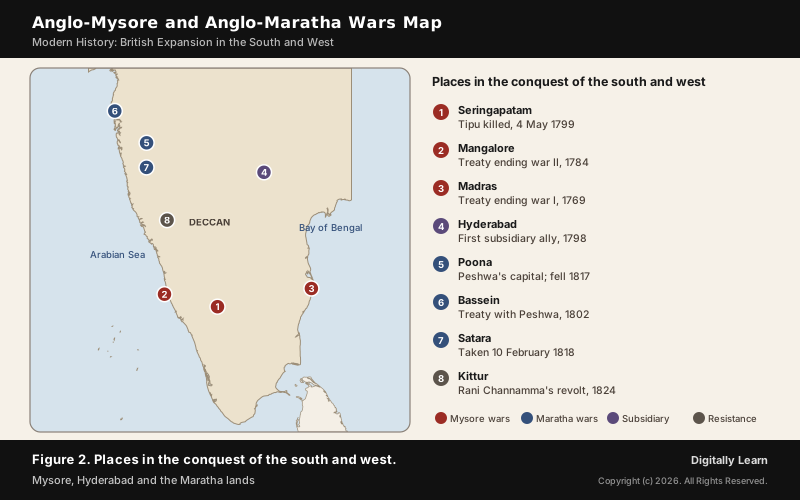
The Subsidiary Alliance was the system, given its fullest form by Lord Wellesley (Governor-General, 1798 to 1805), under which an Indian ruler accepted Company troops, paid for them in money or territory, kept no army of his own and let the Company conduct his foreign relations. Together with four Anglo-Mysore Wars (1767 to 1799) and three Anglo-Maratha Wars (1775 to 1819), it made the East India Company the paramount power south of the Vindhyas.
British Expansion After Buxar: From Ring Fence to Subsidiary Alliance
How the Company Expanded: Residents and the Ring Fence Policy
The East India Company rarely launched a direct attack on an unknown territory. It first used political, economic and diplomatic methods to extend its influence, and annexed a kingdom only afterwards. After the Battle of Buxar (1764) it placed Residents, political or commercial agents, in Indian states. Through them Company officials began to interfere in who succeeded to the throne and who held office.
From 1765 to 1813 the Company followed the policy of the ring fence: it defended its neighbours' frontiers in order to safeguard its own territories. Wellesley's Subsidiary Alliance was an extension of the ring fence. It sought to reduce the Indian states to a position of dependence on the British Government.
What Is the Subsidiary Alliance? Lord Wellesley's System and Its Terms
The Subsidiary Alliance was introduced by Lord Wellesley, Governor-General from 1798 to 1805, who gave it its systematic form. An Indian ruler who signed such an alliance received the Company's protection against external attack. In return he gave up much of his sovereignty. The idea was first tried in the Carnatic by the Frenchman Dupleix, before the British adopted and expanded it.
- Troops: The ruler had to maintain the Company’s army at or near his capital.
- Payment: He paid money or ceded territory for the upkeep of these subsidiary forces; if he failed to pay, part of his territory was taken as a penalty.
- No army of his own: He was forbidden to maintain an independent standing army.
- Foreign relations: He accepted the British as the supreme power in external affairs and kept a British Resident at his capital.
- No other Europeans: He expelled all other Europeans from his service.
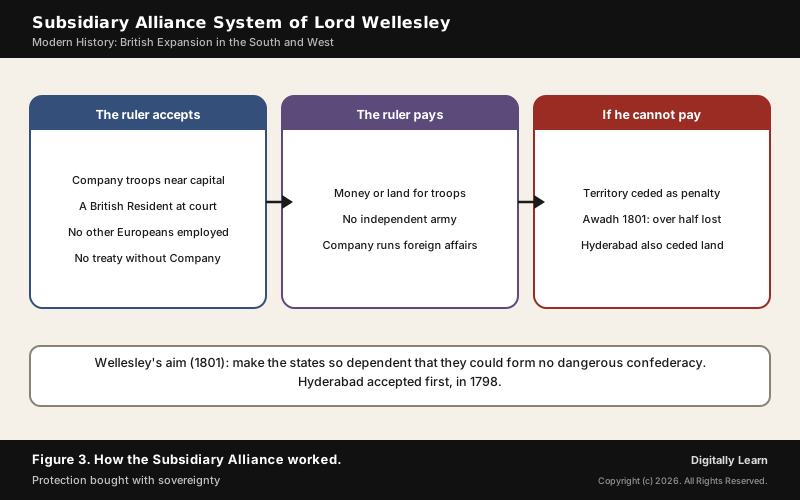
Wellesley stated his aim in a dispatch of 4 February 1801: to place the states in such dependence on British power that they could not form any confederacy hazardous to the British empire.
States Under the Subsidiary Alliance and Its Effects on Indian Rulers
The Nizam of Hyderabad was the first ruler to accept a well-defined subsidiary alliance, in 1798. Mysore was reduced to a subsidiary state after Tipu Sultan's defeat in 1799, and the Peshwa signed one at Bassein in 1802. Wellesley also took over the administration of Tanjore (1799), Surat (1800) and the Carnatic (1801).
| State | Year | What happened |
|---|---|---|
| Hyderabad | 1798 | First well-defined subsidiary alliance; later ceded territory |
| Mysore | 1799 | Imposed after Tipu's death; Wodeyars restored |
| Awadh | 1801 | Nawab forced to give over half his territory for failing to pay |
| Peshwa | 1802 | Treaty of Bassein |
| Bhonsle, Scindia | 1803, 1804 | During the Second Anglo-Maratha War |
| Holkar of Indore | 1818 | Last major Maratha chief to accept |
Awadh shows what the alliance did to a state over time. Under its terms of 1801 the Nawab had to disband his military force, let British troops be posted in the kingdom and follow the advice of the Resident. Deprived of his army, he grew dependent on the British to keep order and could no longer control rebellious chiefs and taluqdars. Lord Dalhousie called Awadh 'a cherry that will drop into our mouth one day' in 1851, and it was annexed in 1856.
Anglo-Mysore Wars, 1767 to 1799
Rise of Mysore Under Haidar Ali and Tipu Sultan
Mysore grew strong under Haidar Ali, who ruled from 1761 to 1782, and his son Tipu Sultan, who ruled from 1782 to 1799. Haidar became the kingdom's commander by force in 1761, displacing the Wodeyar dynasty, whose capital had been Srirangapatna since Raja Wodeyar took it in 1610.
- Coastal trade: Mysore controlled the profitable trade of the Malabar coast, where the Company bought pepper and cardamom.
- Embargo, 1785: Tipu stopped the export of sandalwood, pepper and cardamom through his ports and barred local merchants from trading with the Company.
- The French: Tipu built close ties with the French in India and modernised his army with their help.
Tipu was also a reforming ruler. He introduced a new coinage system, a new calendar and a new land revenue system, which started the growth of Mysore's silk industry. He was a pioneer of rocket artillery, using iron-cased Mysorean rockets at Pollilur and in the siege of Srirangapatna, and in 1786 he planned a navy with dockyards at Jamalabad and Majidabad. The tiger was his emblem, which is why he is remembered as the 'Tiger of Mysore'.
The British saw Haidar and Tipu as ambitious and dangerous rulers who had to be crushed. Four wars followed, in 1767 to 1769, 1780 to 1784, 1790 to 1792 and 1799, and only the last brought the Company a final victory.
First and Second Anglo-Mysore Wars: Treaties of Madras and Mangalore
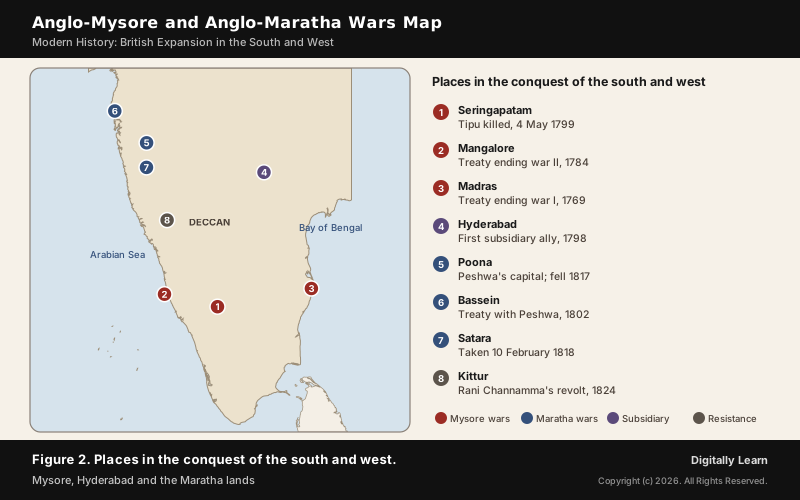
In the First Anglo-Mysore War (1767 to 1769) Haidar Ali faced a Bombay army from the west and a Madras army from the north-east, while the British briefly won over the Nizam. Even so, Haidar came close to capturing Madras. The Madras government sued for peace, and the Treaty of Madras of 29 March 1769 restored conquests and bound the British to help Haidar if his neighbours attacked him. Haidar felt the treaty was broken when no help came during his war with the Marathas in 1771.
That grievance fed the Second Anglo-Mysore War (1780 to 1784), which began after the British seized the French port of Mahe in 1779. Haidar led 80,000 to 90,000 men into the Carnatic in 1780. Tipu crushed William Baillie at Pollilur in September 1780, the Company's worst defeat in India to that date, while Sir Eyre Coote defeated Haidar at Porto Novo. Tipu fought on after his father's death in 1782.
Third and Fourth Anglo-Mysore Wars and the Fall of Seringapatam
The Third Anglo-Mysore War began in late 1789 when Tipu attacked Travancore, a Company ally. Lord Cornwallis, with the Marathas and the Nizam of Hyderabad, besieged Seringapatam in February 1792. By the Treaty of Seringapatam of 18 March 1792 Mysore ceded about half its territory: the Peshwa took lands up to the Tungabhadra, the Nizam the land from the Krishna to the Penner, and the Company much of Malabar. Two of Tipu's sons were held as hostages until he paid a war indemnity of three crores and thirty lakh rupees.
The Fourth Anglo-Mysore War (1799) came as Wellesley moved to stop any alliance between Tipu and France, after Napoleon's landing in Egypt in 1798. Tipu was killed defending his capital Seringapatam on 4 May 1799. Mysore was placed under the Wodeyars, a subsidiary alliance was imposed, and Coimbatore and Dakshina Kannada went to the British. Tipu's heir, Fateh Ali, was sent into exile, and Krishnaraja Wodeyar III ruled from 1799 to 1831 under British protection.
| War | Years | Ended by | Result |
|---|---|---|---|
| First | 1767 to 1769 | Treaty of Madras, 1769 | Haidar nearly took Madras; conquests restored |
| Second | 1780 to 1784 | Treaty of Mangalore, 1784 | Pollilur 1780; position before the war restored |
| Third | 1790 to 1792 | Treaty of Seringapatam, 1792 | Mysore lost about half its territory |
| Fourth | 1799 | Fall of Seringapatam | Tipu killed; Wodeyars restored under a subsidiary alliance |
Anglo-Maratha Wars, 1775 to 1819
Maratha Confederacy and the First Anglo-Maratha War
After their defeat at the Third Battle of Panipat in 1761, the Marathas were divided into states under chiefs of the Sindhia, Holkar, Gaikwad and Bhonsle dynasties. A Peshwa at Pune held them together as a confederacy. Mahadji Sindhia and Nana Phadnis were its leading soldiers and statesmen in the late eighteenth century.
The First Anglo-Maratha War (1775 to 1782) began when the Bombay government backed Raghunathrao, who had lost his claim to be Peshwa, by the Treaty of Surat of 6 March 1775. The price was the cession of Salsette and Bassein to the British. The fighting was largely inconclusive, because the Company could not decisively defeat the highly mobile Marathas.
- Treaty of Salbai, 17 May 1782: Signed between Warren Hastings’s government and Mahadji Shinde, who was made its guarantor.
- Terms: The Company kept Salsette, pensioned off Raghunathrao and recognised Madhavrao II as Peshwa.
- Outcome of the war: There was no clear victor, and twenty years of peace followed.
Treaty of Bassein and the Second Anglo-Maratha War
After Nana Phadnis died in March 1800, the confederacy split. Yashwantrao Holkar defeated the combined forces of the Peshwa Baji Rao II and Shinde at Hadapsar near Poona in October 1802, and Baji Rao fled to the British. By the Treaty of Bassein of 31 December 1802 he bought his safety and his position at the cost of his independence. He was restored as Peshwa under Company protection on 13 May 1803, a British client ruler.
- Subsidiary force: About 6,000 Company troops were stationed permanently with the Peshwa.
- Payment by the Peshwa: Territory yielding 2.6 million rupees a year was ceded for their upkeep.
- No treaty or war: The Peshwa could make neither without consulting the Company, and had to exclude all Europeans from his service.
The Scindia and Bhonsle chiefs rejected the treaty, and the Second Anglo-Maratha War (1803 to 1805) followed. Arthur Wellesley fought in the Deccan while Gerard Lake took the Doab and Delhi. The Company gained Orissa and the territories north of the Yamuna, including Agra and Delhi.
Third Anglo-Maratha War and the End of the Peshwas
The Third Anglo-Maratha War (1817 to 1819) began with Lord Hastings's campaign against the Pindaris, raiders of central India. The Peshwa, the Bhonsle of Nagpur and Holkar of Indore rose to recover what Bassein had taken, while pressure and diplomacy kept Daulatrao Scindia neutral.
- Poona: Surrendered on 17 November 1817 after the battle of Khadki; a Company force held off the Peshwa’s army at Koregaon on 1 January 1818.
- Nagpur: The Bhonsle was defeated at Sitabuldi.
- Holkar: Defeated on 21 December 1817; signed the Treaty of Mandeswar on 6 January 1818.
- Satara: The seat of Maratha power fell on 10 February 1818; the last Poona forts surrendered in May.
- The Peshwa: Baji Rao II surrendered to Sir John Malcolm and was sent to Bithur near Kanpur with a pension.
Most of the Peshwa's lands became part of the Bombay Presidency, created in 1818, and Mountstuart Elphinstone was named sole Commissioner to settle them. The Company now controlled the territories south of the Vindhyas. The Maharaja of Satara was restored to his territory as a princely state, which Dalhousie later annexed in 1848 under the doctrine of lapse.
Paramountcy and the Reasons for the Company's Success
Lord Hastings, Paramountcy and Resistance at Kittur
Under Lord Hastings (Governor-General, 1813 to 1823) a new policy of paramountcy began. The Company claimed that its authority was supreme, greater than that of any Indian state, and that it could annex or threaten to annex any kingdom to protect its interests.
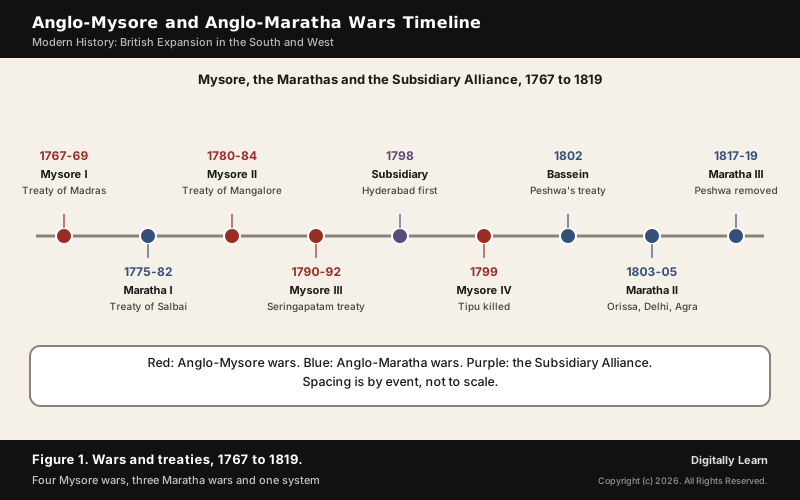
The claim did not go unchallenged. When the British tried to annex the small state of Kittur, Rani Channamma took up arms and won a victory over the British on 23 October 1824; in that first battle the Collector and political agent, St. John Thackeray, was killed by Kittur's forces. She was later arrested in 1824 and died in prison in 1829. Rayanna, a chowkidar of Sangoli, carried on the resistance until he was hanged in 1830.
The revolt at Kittur is still remembered as Kittur Vijayotsava. For its 200th anniversary the Department of Posts released a commemorative stamp on 23 October 2024 at the Kittur Fort premises.
After the Marathas, the Company's expansion moved on to Burma (the First Burmese War, 1824 to 1826), Afghanistan (1838 to 1842), Sind (1843) and Punjab, annexed in 1849.
Why the Company's Armies Won Against Indian Rulers
The Company's army was a sepoy army of Indian recruits, and the great majority of its soldiers were raised, trained, paid and commanded by the Company. Crown troops sent from Britain strengthened them in some wars. The Company's advantage lay less in numbers than in money, organisation and diplomacy.
- Revenue: The Diwani of Bengal from 1765 let the Company pay its troops from Indian revenue.
- A professional army: It recruited peasants and trained them as professional sepoys, subject to European-style training, drill and discipline.
- Divided opponents: The Marathas and the Nizam fought with the Company against Tipu in 1792, and Holkar’s war on the Peshwa drove Baji Rao to Bassein in 1802.
- Diplomacy: Pressure and diplomacy kept Scindia, the fourth major Maratha chief, neutral in 1817.
- Disarming allies: Subsidiary alliances stripped rulers of their own armies and placed Residents at their courts.
Previous Year UPSC-CSE Questions
Previous Year UPSC-CSE Questions By the end you will be able to draft model answers for the following UPSC questions. Each question carries a collapsible framework showing how to approach it in the exam.
- UPSC Mains 2022 GS-IWhy did the armies of the British East India Company – mostly comprising of Indian soldiers – win consistently against the more numerous and better equipped armies of the then Indian rulers? Give reasons.
Answer outline: how to structure the answer
What the question asks, the main arguments, relevant examples and the direction of the conclusion. This is not a full model answer.
Introduction: Most of the Company's soldiers were Indians, yet between 1767 and 1819 it defeated Mysore and the Marathas.
Body (sub-themes to develop):
- Finance: Bengal's revenue after 1765 paid for regular troops.
- Organisation: professional infantry under European-style drill and discipline.
- Divided rivals: the Nizam and the Marathas against Tipu in 1792; Holkar against the Peshwa in 1802.
- Diplomacy: Scindia kept neutral in 1817.
- Subsidiary Alliance: allies disarmed and watched by Residents.
Conclusion: Conclude that the Company won by money, organisation and diplomacy more than by numbers.
- UPSC Prelims 2018 Prelims-GSWhich one of the following statements does not apply to the system of Subsidiary Alliance introduced by Lord Wellesley ?
How to approach this Prelims question
Approach: Tick off the aims the system clearly had, then pick the remaining one.
Trap to watch: The subsidy was payment for troops, which the key does not treat as the aim of a fixed income.
Key facts to recall:
- (a) Large standing army at others' expense: applies. Rulers accepted and paid for Company troops.
- (b) Safety from the Napoleonic danger: applies. The alliances kept the French out in those years.
- (c) A fixed income for the Company: does not apply, so this is the option to choose. The system was about troops, control and paramountcy, not a fixed revenue.
- (d) British paramountcy over the Indian states: applies. Rulers gave up their armies and foreign relations to the Company.
Answer signal: Securing a fixed income was not an aim of the system, so the answer is option (c).
- UPSC Prelims 1999 Prelims-GSMatch List I with List II and select the correct answer using the codes given below the Lists: List I (Year)
- I. 1775
- II. 1780
- III. 1824
- IV. 1838 List II (Event) A) First Anglo-Burmese War B) First Anglo-Afghan War C) First Anglo-Maratha War D) Second Anglo-Mysore War
How to approach this Prelims question
Approach: Fix the two wars this page covers first, then the other two.
Trap to watch: 1775 is Maratha, 1780 is Mysore; do not swap them.
Key facts to recall:
- (a) I-D, II-C, III-B, IV-A: wrong. 1775 was the First Anglo-Maratha War, not the Second Anglo-Mysore War.
- (b) I-D, II-C, III-A, IV-B: wrong. It swaps 1775 and 1780.
- (c) I-C, II-D, III-A, IV-B: right. 1775 First Anglo-Maratha War, 1780 Second Anglo-Mysore War, 1824 First Anglo-Burmese War, 1838 First Anglo-Afghan War.
- (d) I-C, II-D, III-B, IV-A: wrong. 1824 was the Burmese war and 1838 the Afghan war, not the other way round.
Answer signal: The years match the Maratha, Mysore, Burmese and Afghan wars in that order, so the answer is option (c).
Sources and Further Reading
- NCERT: Our Pasts III (Class VIII), From Trade to Territory
- Maharashtra State Gazetteers: Poona District, The Maratha Period
- Maharashtra State Gazetteers: Poona District, The British Period
- Mandya District Administration: History of Mandya (Srirangapatna and the Wodeyars)
- PIB (Department of Posts): Commemorative stamp for 200 years of Kittur Vijayotsava, 2024
- Wikipedia: Subsidiary alliance
- Wikipedia: Anglo-Mysore wars
- Wikipedia: Second Anglo-Mysore War
- Wikipedia: Fourth Anglo-Mysore War
- Wikipedia: First Anglo-Maratha War
- Wikipedia: Second Anglo-Maratha War
- Wikipedia: Third Anglo-Maratha War
- Wikipedia: Treaty of Bassein (1802)
- Wikipedia: Treaty of Salbai
- Wikipedia: Treaty of Seringapatam
- Wikipedia: Tipu Sultan
- NCERT: Themes in Indian History Part III (Class XII), Rebels and the Raj (Awadh and the Subsidiary Alliance)
- PIB: Rani Chennamma of Kitturu (Heroes of Freedom Struggle), 2016
- UPSC: Previous year question papers
Editorial Disclaimer
This article explains the Subsidiary Alliance and the Anglo-Mysore and Anglo-Maratha Wars for UPSC preparation. Dates, figures and attributions reflect the cited sources.