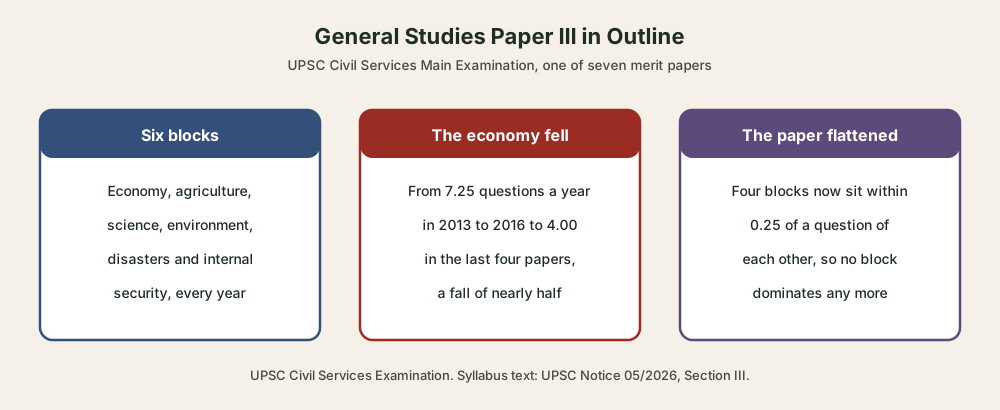
The GS 3 syllabus of UPSC Mains covers the Indian economy, agriculture and food, science and technology, environment, disaster management and internal security in twenty topics. GS Paper 3 asks twenty compulsory questions for 250 marks in three hours. This guide gives the full syllabus and the subject-wise weightage of 285 questions from 2013 to 2026.
What Is GS Paper 3 in UPSC Mains? Pattern and Marks
GS Paper 3 at a Glance: 20 Questions, 250 Marks, Three Hours
General Studies Paper III, usually called GS 3 or GS3, is the paper on technology, economic development, biodiversity, environment, security and disaster management. In the notice's own numbering it is Paper IV of the Main Examination, because the Essay is Paper I and the four General Studies papers follow as Papers II to V. This page gives the full UPSC GS 3 syllabus and shows how much each part of it is actually asked.
- Questions: Twenty, all compulsory.
- Marks and words: Questions 1 to 10 carry 10 marks each with a 150-word limit; questions 11 to 20 carry 15 marks each with a 250-word limit.
- Total: 250 marks in three hours, one of the seven papers that count for the rank.
- Timing: About nine minutes an answer, including the time to read the question.
The Official GS Paper 3 Syllabus in Full
Twenty Syllabus Topics and the Six Subjects They Form
The notice sets out the GS 3 syllabus as twenty topics, reproduced below in its own words. There is no separate syllabus PDF for this paper; the text sits in Examination Notice 05/2026, Section III, which is itself a PDF.
- Indian Economy and issues relating to planning, mobilization, of resources, growth, development and employment.
- Inclusive growth and issues arising from it.
- Government Budgeting.
- Major crops-cropping patterns in various parts of the country, - different types of irrigation and irrigation systems storage, transport and marketing of agricultural produce and issues and related constraints; e-technology in the aid of farmers.
- Issues related to direct and indirect farm subsidies and minimum support prices; Public Distribution System- objectives, functioning, limitations, revamping; issues of buffer stocks and food security; Technology missions; economics of animal-rearing.
- Food processing and related industries in India- scope' and significance, location, upstream and downstream requirements, supply chain management.
- Land reforms in India.
- Effects of liberalization on the economy, changes in industrial policy and their effects on industrial growth.
- Infrastructure: Energy, Ports, Roads, Airports, Railways etc.
- Investment models.
- Science and Technology- developments and their applications and effects in everyday life.
- Achievements of Indians in science & technology; indigenization of technology and developing new technology.
- Awareness in the fields of IT, Space, Computers, robotics, nano-technology, bio-technology and issues relating to intellectual property rights.
- Conservation, environmental pollution and degradation, environmental impact assessment.
- Disaster and disaster management.
- Linkages between development and spread of extremism.
- Role of external state and non-state actors in creating challenges to internal security.
- Challenges to internal security through communication networks, role of media and social networking sites in internal security challenges, basics of cyber security; money-laundering and its prevention.
- Security challenges and their management in border areas - linkages of organized crime with terrorism.
- Various Security forces and agencies and their mandate.
The twenty topics fall into six subjects, and the rest of this page follows them:
- Indian economy: Topics 1 to 3 and 8 to 10 (six topics).
- Agriculture and food: Topics 4 to 7 (four topics).
- Science and technology: Topics 11 to 13 (three topics).
- Environment: Topic 14 (one topic).
- Disaster management: Topic 15 (one topic).
- Internal security: Topics 16 to 20 (five topics).
GS 3 Syllabus Weightage: What Previous Year Questions Show
Questions by Subject, 2013 to 2026
All 285 questions of the 14 GS Paper 3 papers from 2013 to 2026 are sorted here by subject, one subject per question. Every subject has appeared in every paper. The table gives each subject's total and how its yearly average moved between the first four papers (2013 to 2016) and the last four (2023 to 2026).
| Subject | Questions (share) | A year, then to now |
|---|---|---|
| Economy (6 of 20 topics) | 73 (26%) | 7.25 to 4.00 |
| Internal security (5 of 20 topics) | 57 (20%) | 4.50 to 3.75 |
| Agriculture and food (4 of 20 topics) | 54 (19%) | 3.50 to 3.75 |
| Science and technology (3 of 20 topics) | 48 (17%) | 3.25 to 4.00 |
| Environment (1 of 20 topics) | 33 (12%) | 1.50 to 3.00 |
| Disaster management (1 of 20 topics) | 20 (7%) | 1.25 to 1.50 |
The Economy's Share Has Nearly Halved Since 2013
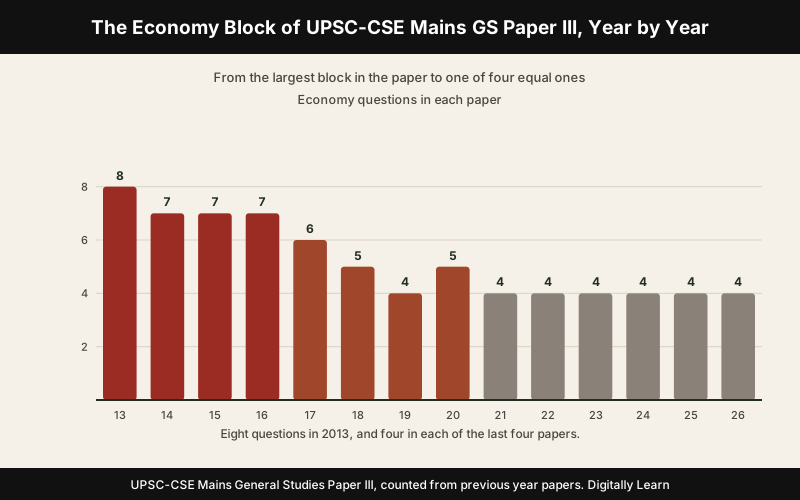
The Indian economy is still the largest subject over the whole period, with 73 questions. But it has shrunk: from 7.25 questions a year in 2013 to 2016 to 4.00 in the last four papers, which asked exactly four each. Its six topics are unchanged, so the reading load has stayed the same while the return on it has fallen.
Four Subjects Now Share GS Paper 3 Almost Equally
As the economy fell, other subjects rose. In the last four papers the economy, science and technology, internal security and agriculture each averaged between 3.75 and 4.00 questions a year. The gap between the largest and smallest subject fell from 6.00 questions a year to 2.50.
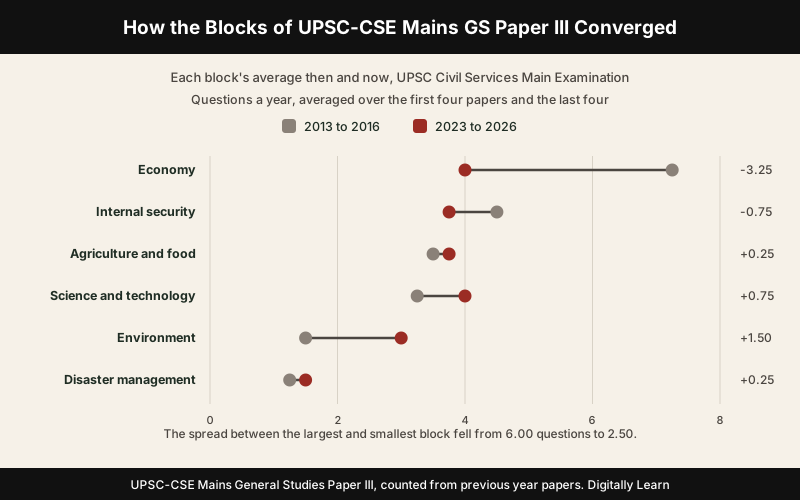
A paper with four equal subjects rewards breadth. There is no longer one dominant subject to concentrate on, and skipping any of the four costs about four questions, a fifth of the paper.
Environment: One Syllabus Topic, Over a Tenth of the Paper
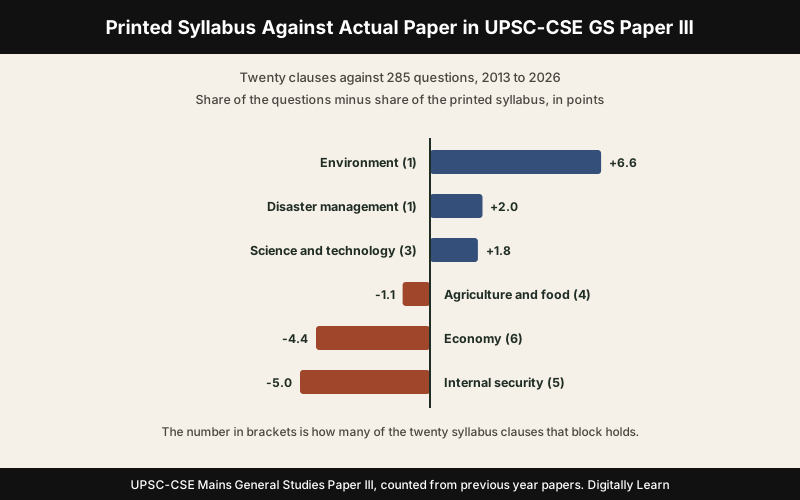
The environment topic is one of twenty, yet it has produced 33 questions, 11.6 per cent of the paper, and has doubled from 1.50 a year to 3.00. Disaster management, also a single topic, has asked one or two questions in every paper without exception.
GS Paper 3 Syllabus Subject by Subject
Indian Economy: Growth, Budgeting, Liberalisation and Infrastructure
The economy's six topics cover planning and the mobilisation of resources, growth, development and employment; inclusive growth; government budgeting; the effects of liberalisation and industrial policy; infrastructure (energy, ports, roads, airports, railways); and investment models. Recent questions are specific: they name a scheme, an index or an instrument and ask how it works and what it achieves.
Build the base from NCERT economics and the Economic Survey, and then read current policy for the schemes and indices that questions now name. The economy topics also meet GS Paper 2 wherever a question turns to how the Union and the states share money.
Agriculture and Food: Crops, Subsidies, Food Processing and Land Reforms
Agriculture's four topics are cropping patterns, irrigation, storage, transport and marketing of produce; farm subsidies, minimum support prices, the public distribution system, buffer stocks and food security, technology missions and animal rearing; food processing and its supply chains; and land reforms. The subject is steady: exactly four questions in eleven of the fourteen papers.
Food processing and supply chain management are easy to leave out, yet both appeared in 2025. The World Trade Organization angle on subsidies, asked in 2026, links this subject to international agreements.
Science and Technology: Applications, Indigenisation and New Fields
The three science topics ask for developments and their applications in everyday life; achievements of Indians and the indigenisation of technology; and awareness in IT, space, computers, robotics, nanotechnology, biotechnology and intellectual property rights. The subject has risen from 3.25 questions a year to 4.00.
Questions ask what a technology is, how it works and what it means for India, often in one question. A catalogue of the year's launches is not enough; each item needs the mechanism and the application.
Environment and Disaster Management: Two One-Line Topics
The environment topic reads: conservation, environmental pollution and degradation, environmental impact assessment. Recent papers have ranged across climate commitments, biodiversity frameworks, groundwater and waste. Disaster management is five words, disaster and disaster management, and its questions tend to fall into two halves: the institutions that manage disasters, and the hazards themselves.
Prepare both halves of disaster management: the national framework and authorities, and what specific hazards do and what reduces their damage. Environment questions reward India-specific examples of both success and failure.
Internal Security: Extremism, Cyber Security, Borders and Security Forces
The five security topics cover the link between development and extremism; external state and non-state actors; communication networks, media, social networking, cyber security and money laundering; border areas and the link between organised crime and terrorism; and the security forces and agencies with their mandates. The subject has held close to four questions a year.
Region-specific questions recur: Jammu and Kashmir, Ladakh and the North-East all appeared in the last two papers. The topic on forces and agencies rewards precise knowledge of which force does what. For the sea, see the guide to maritime security and piracy, which covers the 2025 question on maritime and coastal security.
How GS 3 Questions Are Framed
Directive Words and What Each Word Limit Allows
Discuss is the commonest instruction, in 91 of the 285 questions, followed by explain (40), examine (21) and suggest (18). Suggest is the mark of this paper: it appears 18 times here against 13 in GS Paper 2 and 2 in GS Paper 1, and it asks for a remedy, not just a diagnosis.
| Directive | Questions containing it |
|---|---|
| Discuss | 91 |
| Explain | 40 |
| Examine | 21 |
| Suggest | 18 |
| Critically | 15 |
| Comment | 10 |
| Elaborate | 9 |
| Analyse | 8 |
- 150 words (10 marks): An opening line, three developed points and a close. An economy or security question usually wants a mechanism, a consequence and a measure.
- 250 words (15 marks): Room to explain the mechanism rather than assert it, and to add a way forward.
- Many questions have two parts: Explain what something is, then discuss its effects or suggest measures. Answer both parts, in order.
How to Prepare for GS Paper 3
Preparing the Six Subjects in Proportion
The question papers point to a clear plan. Treat GS 3 as a paper of four equal subjects with two smaller ones, not as an economy paper.
- Give four subjects equal time: The economy, agriculture, science and technology, and internal security each return about four questions a paper.
- Give environment more than its one line: It produces 12 per cent of the questions and is still rising.
- Keep disaster management small but never empty: It has asked at least one question in every paper.
- Read science for applications: Know what each technology does and why it matters for India.
Where Current Affairs Matter Most in GS 3
Three subjects renew themselves every year: the economy through the budget and new schemes, science and technology through new missions and devices, and environment through climate talks and new frameworks. Agriculture and internal security change more slowly, so a settled base from textbooks and reports carries most of their questions.
The Study Library is organised by these subjects, and the other Mains papers feed this one: GS Paper 2 for institutions and Centre-state finance, GS Paper 4 for the ethics of administration, and the Essay paper for writing at length.
Common Questions About the UPSC GS 3 Syllabus
What is the syllabus of GS Paper 3 in UPSC Mains?
The GS3 syllabus has twenty topics in six subjects: the Indian economy, agriculture and food, science and technology, environment, disaster management and internal security. The full text is in the Commission's examination notice and is reproduced on this page.
How many questions come in UPSC Mains GS Paper 3?
Twenty, all compulsory: ten of 10 marks with a 150-word limit and ten of 15 marks with a 250-word limit, for 250 marks in three hours.
Which subject has the most weightage in GS 3?
Over 2013 to 2026 the economy has the most, 73 of 285 questions. In the last four papers, though, the economy, science and technology, internal security and agriculture each averaged about four questions a year, so no subject dominates.
Is there a GS 3 syllabus PDF?
Not as a separate file. The syllabus is part of the Commission's examination notice, which is published as a PDF each year; the 2026 notice is linked in the sources below.
Official Sources
- Union Public Service Commission: Examination Notice No. 05/2026-CSE, Civil Services Examination 2026
- Union Public Service Commission: Civil Services (Main) Examination 2026, General Studies Paper III question paper
- Union Public Service Commission: Civil Services (Main) Examination 2025, General Studies Paper III question paper
- Union Public Service Commission: previous years' question papers
- Union Public Service Commission: Civil Services Examination 2025, minimum qualifying marks
- Ministry of Statistics and Programme Implementation: national accounts and economic statistics
- Ministry of Agriculture and Farmers Welfare
- Ministry of Environment, Forest and Climate Change
- National Disaster Management Authority: guidelines and plans
- Union Public Service Commission: online registration and application portal
- National Council of Educational Research and Training: Class XI and XII textbooks in economics, geography and science
- Wikipedia: Civil Services Examination
Editorial Disclaimer
The syllabus is reproduced from the current examination notice of the Commission, with its dashes replaced by commas for readability. Sorting past questions by subject is Digitally Learn's own reading and is not published by the Commission. The notice in the Gazette of India is the final authority.