


Overview
The advent of Europeans in India is the arrival of the Portuguese, Dutch, English, Danes and French as sea-borne traders, beginning when Vasco da Gama landed near Calicut on 20 May 1498 by the new sea route round Africa. Each power came through a chartered trading company or a crown-backed viceroyalty, built fortified trading posts on the coast, fought the others for the spice and textile trade, and was drawn into Indian politics. In the end the English East India Company was the only one that turned its trading posts into a territorial empire.
Why Europeans Came to India: Spices, Textiles and the Sea Route
Spice Trade, Constantinople and the Search for a Sea Route
Europe wanted what India made and grew. Indian spices, cotton, ivory, gems, sandalwood, teakwood and wootz steel were sought after in the Mediterranean world, and historical estimates suggest India produced at least one-fourth of the world's GDP until the sixteenth century. European travellers from the sixteenth century onward described the country as flourishing, with varied farming, skilled manufacture and wide trading networks. That wealth made India an attractive target.
The route those goods took to Europe was controlled by others. From the eighth to the fifteenth century the maritime republics of Italy, Venice among them, held a monopoly on European trade with the Middle East, and the spice trade made these city-states extremely wealthy. In 1453 Constantinople fell to the Ottoman Turks, who now controlled the overland route. European states with Atlantic coasts, above all Portugal, therefore looked for a way to the Indies by sea. Bartolomeu Dias reached the Cape of Good Hope in May 1488, and the Treaty of Tordesillas of 7 June 1494 divided newly discovered lands outside Europe between Portugal and Castile.
Four motives pushed the European powers outward. Political competition produced a race for territory and influence. New lands offered resources, markets, trade routes and plunder. Converting local people to Christianity was another strong motive. A smaller one was scientific curiosity about the planet's geography and natural history.
Chartered Companies and Armed Trade
Apart from the Portuguese crown, which ran its own viceroyalty, the Europeans came through chartered companies. The English East India Company received its charter from Queen Elizabeth I on 31 December 1600, with a monopoly on English trade east of the Cape of Good Hope and west of the Straits of Magellan for fifteen years. The Dutch East India Company (VOC) was established on 20 March 1602 by the States General of the Netherlands, which merged existing companies and gave it a 21-year monopoly of trade in Asia.
The VOC was one of the world's first joint-stock companies: Any citizen could buy its shares. The English charter gave the company special powers, including the power to raise a private army, and the companies fortified their posts. English traders frequently fought their Dutch and Portuguese counterparts in the Indian Ocean. Trade and war went together.
Portuguese in India: Estado da India, Goa and the Cartaz System
Vasco da Gama, Cabral and the Zamorin of Calicut
Vasco da Gama left Lisbon on 8 July 1497 with four ships and 170 men. He sailed round the Cape of Good Hope and across the Indian Ocean from Malindi in Kenya, and landed at Kappad near Kozhikode (Calicut) on 20 May 1498. The Zamorin, the ruler of Calicut, welcomed the newcomers at first, since his court was used to foreign visitors. But the Portuguese soon tried to push the established Muslim traders out and take the commerce for themselves. On a second voyage four years later, Gama seized, tortured and killed Indian merchants and bombarded Calicut from the sea.
Pedro Alvares Cabral reached Calicut on 13 September 1500 and set up a factory. When he seized a ship belonging to a resident of the city in a dispute with the Zamorin, the people of Calicut attacked the factory, and Cabral bombarded the city in return. He then sailed to Cochin, a state that was nominally a vassal of Calicut and eager for independence, and loaded his ships with spices there. This split between Calicut and Cochin gave the Portuguese their first Indian ally. The Raja of Cochin invited them to establish their headquarters there. When the Zamorin invaded Cochin in reply, the Portuguese devastated the lands of Calicut and crippled its trade.
Almeida, Albuquerque and the Estado da India
In 1505 King Manuel I of Portugal made Francisco de Almeida the first viceroy of the Estado da India, the Portuguese State of India. Almeida was to build four forts on the south-western coast, at Anjediva Island, Cannanore, Cochin and Quilon, and he strengthened Fort Manuel at Cochin.
The test of Portuguese sea power came at the Battle of Diu on 3 February 1509. Almeida's fleet defeated a joint fleet of the Sultan of Gujarat, the Mamluk Sultanate of Egypt and the Zamorin of Calicut near the port of Diu. The victory gave Portugal hegemony in the Indian Ocean.
Afonso de Albuquerque served as viceroy from 1509 to 1515 and turned the sea power into territory. He captured Goa from the Sultanate of Bijapur in 1510, relying on surprise and on information from Timoji, a privateer in the service of Vijayanagara, and he took Malacca in 1511. Goa became the main anchorage for Portuguese fleets, and the capital of the viceroyalty moved there from Cochin in 1530.
Goa and the Northern Province: Bassein, Diu and Daman
Gujarat gave the Portuguese their second base. The Mughal emperor Humayun pressed Gujarat from the 1530s, and Sultan Bahadur Shah turned to the Portuguese for help. On 23 December 1534, on board the galleon St. Mattheus, he signed the Treaty of Bassein. By its terms the Portuguese gained Bassein (Vasai) with its territories, islands and seas, and Bahadur Shah gave leave to build a factory at Diu. The Portuguese built a fort there instead in 1535. Bahadur Shah regained Gujarat in 1536, but in 1537 he was killed by the Portuguese on board a ship.
Bassein, Salsette and the seven islands of Bombay came to the Portuguese under the treaty of 1534, and Diu in 1535. With Daman to the north and Chaul to the south, these holdings formed the Northern Province of Portuguese India, a strip along the west coast. Bombay, which the Portuguese called Bom Bahia, stayed Portuguese until it passed to Charles II of England in 1661 as part of the dowry of Catherine of Braganza.
Portuguese Rule in Goa: Casados, Inquisition, Printing and New Crops
Goa under the Portuguese became a colony and not only a trading post. Albuquerque encouraged his soldiers to settle and marry local women. These casados, the "married men", formed the largest Portuguese community at Goa, about 2,000 families. Albuquerque left most local customs alone but abolished the practice of sati.
Religious policy was harsher. The Jesuit Francis Xavier asked the Portuguese king for an Inquisition at Goa, and it was established in 1560. It persecuted Hindus, Muslims, Jews and Christian converts suspected of keeping their old faiths, and it was accompanied by forced conversions and the destruction of Hindu temples; it was abolished only in 1812.
NCERT gives 1560 for the start of the Goa Inquisition and 1812 for its abolition; other accounts give 1561 for the start and 1774 for a temporary abolition.
The Portuguese also moved plants across the oceans. The Portuguese took the pineapple from Brazil and introduced it into India by 1550. Chilli peppers and potatoes from South America reached Indian kitchens through the Portuguese, and Portuguese explorers spread the cashew to India after meeting it in the sixteenth century. These are part of the Columbian exchange, the transfer of crops and animals between the Old and New Worlds.
Goa also gave India its first printing press, installed in 1556 at Saint Paul's College by Joao de Bustamante. It printed religious literature, first in Portuguese and later in Tamil, and it led to European-style type that could print Indian scripts.
Cartaz System, Indian Resistance and Decline of the Portuguese
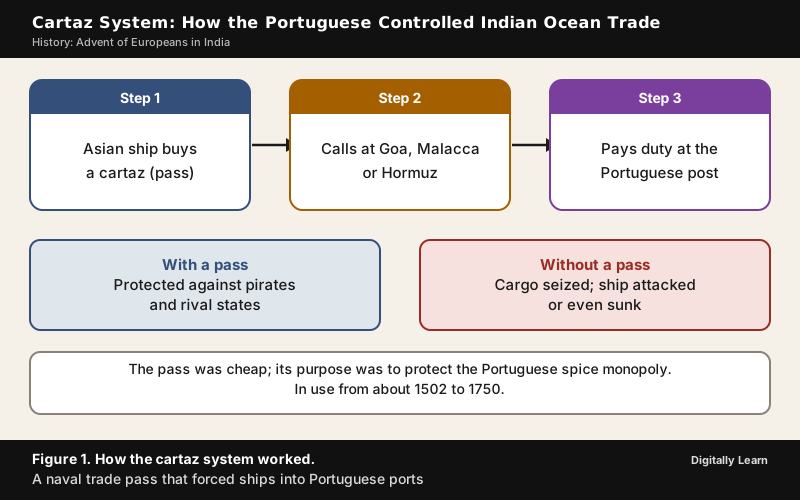
Portuguese power rested on the sea. Under the cartaz system, in use from about 1502 to 1750, an Asian ship needed a Portuguese naval trade pass to sail in the Indian Ocean; the name comes from the Portuguese word for letters. The cartaz was cheap, and it protected a ship against pirates and rival states. Its real purpose was to make merchants pay duty at Portuguese trading posts at Goa, Malacca and Hormuz, and so to protect the Portuguese monopoly of the spice trade. A ship without a pass could lose its cargo, be attacked and even be sunk, and the pass later became an important source of crown income.
Indians resisted. Rani Abbakka I of Ullal in southern Karnataka formed alliances with neighbouring kingdoms and repeatedly beat off Portuguese attempts to take her port in the later sixteenth century; her successor Rani Abbakka II is reported to have set Portuguese ships on fire with fireballs made from coconut shells. The Marakkars, the naval leaders of Calicut, used daring sea tactics against Portuguese shipping. In 1599 the Zamorin turned to the Portuguese against Kunhali Marakkar IV, who was surrendered, taken to Goa and executed, which weakened the resistance. In the eighteenth century the Maratha admiral Kanhoji Angre challenged the cartaz by demanding passes from the Europeans themselves.
Decline came from four directions at once.
- Rivals at sea: In the Battle of Swally on 29 and 30 November 1612, four English galleons beat four Portuguese galleons and 26 barks off Surat.
- The Dutch: They took Ceylon in 1656 and the Portuguese forts on the Malabar coast five years later, and signed a peace treaty with Portugal in 1663.
- Loss of trade share: Portugal's share of the pepper trade fell behind that of the Dutch VOC and the English company.
- Maratha pressure: Most of the Northern Province, including Thana, Bassein and Chaul, was lost after the Maratha conquest of Bassein in 1739.
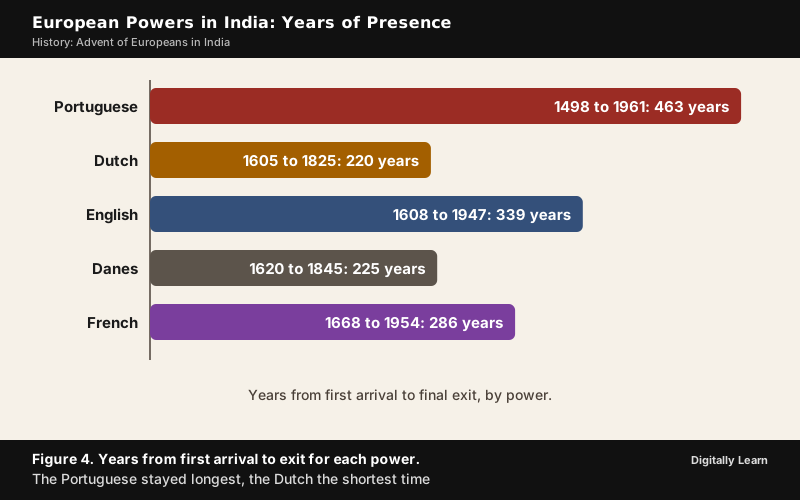
Goa, Daman and Diu stayed Portuguese until December 1961, when India took them in Operation Vijay, a 36-hour air, sea and land operation that ended 451 years of Portuguese rule. After the Carnation Revolution of 1974 the new Portuguese government recognised Indian sovereignty.
Dutch in India: The VOC on the Coromandel Coast
The VOC, Joint-Stock Capital and the Spice Trade
The VOC came to India for textiles. Indian cloth was what the Dutch exchanged for the spices of the East Indies, so their first Indian posts were on the Coromandel coast, where cotton cloth was woven. Dutch presence in India lasted from 1605 to 1825. Dutch India was divided into the governorates of Ceylon and Coromandel, the commandment of Malabar and the directorates of Bengal and Surat; there was never one political authority over all of it.
The Dutch treated India mainly as a supplier. Besides textiles they traded precious stones, indigo and silk across the peninsula, saltpetre and opium in Bengal and pepper on the Malabar coast. Indian slaves were also exported to the Spice Islands and the Cape Colony; between 1621 and 1665 the Dutch deployed 131 slave ships to carry 38,441 Indians captured on the Coromandel coast from Pulicat to be sold as slaves in Batavia.
Dutch Factories: Pulicat, Masulipatnam, Malabar and Bengal
- Masulipatnam and Nagapattinam: The first Dutch post in India was set up at Masulipatnam (Machilipatnam) in 1605, and the Dutch later added Nagapattinam. In 1658 they moved to evict the Portuguese from Nagapattinam, and the town and its villages were handed over to them on 30 December 1676 under an agreement with Ekoji, the first Maratha king of Tanjore; the British took it in 1781. The headquarters of Dutch Coromandel moved to Nagapattinam in 1690.
- Pulicat: In 1608, in the reign of Venkata II of Vijayanagara, the Dutch East India Company was given permission to build a fort and trade there. They built Fort Geldria, from which they came to dominate the textile trade, and the Portuguese failed to retake the place in 1614, 1623 and 1633. From 1616 to 1690 Pulicat was the headquarters of Dutch Coromandel. A gunpowder factory was set up in the 1620s and the first VOC mint in India in 1615.
- Surat and Bengal: Dutch Surat dates from 1616, when Pieter van den Broecke set up the post, and Dutch Bengal from 1627, with its first factory at Pipili in Odisha. In 1635 a settlement was made at Chinsurah on the Hooghly to trade in opium, salt, muslin and spices.
- Malabar: Between 1658 and 1663 the Dutch conquered Portuguese posts on the Malabar coast, and Cochin passed to them on 7 January 1663. The Kingdom of Cochin was a Dutch ally.
Dutch Decline: Amboyna, Colachel, Chinsurah and Exit
The Dutch put the spice islands first. The English company suffered a major setback in 1623 when its factory at Amboyna in the Moluccas was attacked by the Dutch, and it then turned to Bengal. On the Coromandel coast the Dutch were weakened further by the conquest of the region by Golconda forces under Mir Jumla.
Two defeats ended Dutch ambitions in India.
- Colachel, 10 August 1741: King Marthanda Varma of Travancore defeated the VOC forces led by Admiral Eustachius De Lannoy. It was a rare instance of an Asian power repelling a European force.
- Chinsurah (Biderra), 25 November 1759: The Nawab of Bengal, Mir Jafar, invited a Dutch force up the Hooghly to expel the English. Forces of the English company under Francis Forde defeated it at Chinsurah, fifty kilometres from Calcutta, a day after English company ships had beaten the Dutch ships.
Dutch Coromandel and Dutch Bengal passed to Britain under the Anglo-Dutch Treaty of 1824, and all transfers were to take place on 1 March 1825. By the middle of 1825 the Dutch had lost their last trading posts in India.
English East India Company: Charter, Factories and Farmans
Charter of 1600, First English Factories, Swally and Thomas Roe
The English company's ships docked at Surat in 1608, and William Hawkins visited Jahangir's court in 1609. The company opened a factory at Masulipatnam on the Andhra coast in 1611, and its first permanent factory was founded at Surat in 1613. In 1609 James I renewed its charter for an indefinite period. By 1647 it had 23 factories and settlements in India and 90 employees. In 1708 the original company merged with a rival to form the United Company of Merchants of England Trading to the East Indies.
The company won a naval victory over the Portuguese at Swally, near Surat, on 29 and 30 November 1612. Surat was then the principal port of the Mughals. Having shown it could beat the Portuguese at sea, the company wanted a commercial treaty with the emperor.
In 1615 James I sent Sir Thomas Roe as envoy to Jahangir (r. 1605 to 1627) to arrange a commercial treaty giving the company exclusive rights to reside and establish factories in Surat and other areas. Roe stayed at the Mughal court until 1619 and secured trading rights at Surat and other places.
Madras, Bombay and Calcutta: The Three Presidency Towns
- Madras: On 22 August 1639 Francis Day obtained from Damarla Venkatadri Nayaka a three-mile-long strip of coast with a fishing village called Madraspatnam, with the deed of the Vijayanagara king Peda Venkata Raya. Fort St George, completed on 23 April 1644 at a cost of 3,000 pounds, was the first English fortress in India.
- Bombay: Charles II acquired Bombay on 11 May 1661 as part of Catherine of Braganza's dowry and leased it to the company by royal charter of 27 March 1668. In 1687 the company moved its presidency from Surat to Bombay, making it the capital.
- Calcutta: On 24 August 1690 Job Charnock returned to set up headquarters at the place he called Calcutta, after the company received Aurangzeb's permission in March 1690 to re-establish a factory in Bengal.
The three bases grew into the Madras, Bombay and Bengal presidencies. Around 1670 Charles II gave the company, by a series of five acts, the right to acquire territory on its own, to mint money, to command fortresses and troops, to form alliances and to make war and peace.
The company tried force against the Mughals once, in the Anglo-Mughal War of 1686 to 1690, and lost. Aurangzeb seized the company's factories, and it was fined 1,50,000 rupees. It got its privileges back only after an apology.
Farmans, Dastaks and the Farrukhsiyar Grant of 1717
A farman is a royal order of a Mughal emperor, and the company's right to trade came from such orders. In 1634 Shah Jahan extended hospitality to English traders in Bengal, the richest region of the empire, and in 1717 Farrukhsiyar issued a farman giving the company the right to reside and trade in the empire. The company could trade freely except for a yearly payment of 3,000 rupees, and customs duties were completely waived for the English in Bengal. The company was also allowed to issue dastaks, passes for the movement of goods.
The privilege belonged to the company, not to its servants. The officials misused dastaks for private trade, which angered Alivardi Khan, the Nawab of Bengal, and led to future conflicts between the nawabs and the English.
French in India and the Danes: The Last European Companies
French East India Company: Colbert, Surat and Pondicherry
The French East India Company was formed under Cardinal Richelieu in 1642 and reconstructed under Jean-Baptiste Colbert in 1664. An expedition under Francois Caron reached Surat in 1668 and set up the first French factory in India, and another factory followed at Masulipatnam in 1669. In 1672 the French captured Fort Saint Thomas but were driven out by the Dutch after a long siege.
- Pondicherry: In 1673 the French acquired the area from the qiladar (fort commander) of Valikondapuram under the Sultan of Bijapur, and in 1674 the company set up its trading centre there. Francois Martin, its first governor, began building the town in 1674 and made a fishing village a flourishing port.
- Chandernagore: The French settlement was founded in 1692 with the permission of Nawab Shaista Khan, the Mughal governor of Bengal.
- Mahe, Yanam and Karaikal: The French acquired Mahe in the 1720s, Yanam in 1731 and Karaikal in 1738.
- Setback: The Dutch captured Pondicherry in 1693 and returned it to France by the Treaty of Ryswick in 1699.
French territories outlasted French power. Pondicherry, Karaikal, Yanam and Mahe remained French until 1954, when they were transferred to India de facto, and the union became legal (de jure) in 1962. Chandernagore had already joined India in 1950.
Dupleix and the Carnatic Wars (1746 to 1763)
Joseph Francois Dupleix became governor general of all French establishments in India in 1742. He saw the constant succession disputes among Indian princes as a chance to advance French interests, and he built an army of Indian soldiers, called sepoys, trained as infantry. He also pioneered the strategy of indirect rule through puppet Indian rulers installed through interventions in local succession disputes. Both methods were later used by the British.
The Carnatic Wars were fought between the French and the British companies in the Carnatic region of the Coromandel coast, from 1746 to 1763.
- First Carnatic War (1746 to 1748): The French captured Madras on 21 September 1746. The Treaty of Aix-la-Chapelle of 1748 gave Madras back to the British in exchange for the French fortress of Louisbourg in North America. Robert Clive was taken prisoner at Madras but escaped.
- Second Carnatic War (1749 to 1754): The French backed Chanda Sahib and Muzaffar Jung and the British backed Muhammad Ali and Nasir Jung. In 1751 Clive led the capture and then the defence of Arcot with 200 soldiers and 300 sepoys. The Treaty of Pondicherry of 1754 recognised Muhammad Ali as Nawab of the Carnatic. Dupleix was replaced by Charles Godeheu and later died in poverty in France.
- Third Carnatic War (1757 to 1763): It came with the Seven Years' War in Europe. The British captured Chandernagore in 1757; Sir Eyre Coote defeated the French under the Comte de Lally at Wandiwash in 1760; and Pondicherry fell to the British in 1761.
The Treaty of Paris of 1763 returned Pondicherry and Chandernagore to France and allowed the French to keep trading posts, but forbade French traders from administering them. In 1769 the French East India Company, unable to support itself financially, was abolished by the French Crown.
NCERT dates the Carnatic Wars from 1746 to 1763; other accounts begin the series in 1740, with the War of the Austrian Succession.

Danish Settlements and the Ostend and Swedish Companies
King Christian IV of Denmark-Norway chartered a Danish East India Company on 17 March 1616, because Danish merchants envied Dutch and English success. Its first expedition sailed in 1618 under Admiral Ove Gjedde. Raghunatha Nayak of Tanjore granted the Danes the village of Tranquebar (Tharangambadi), on the Coromandel coast of present-day Tamil Nadu, the right to build a stone house that became Fort Dansborg, and permission to levy taxes; the treaty was signed on 20 November 1620. The New Jerusalem Church at Tranquebar was built in 1718.
Serampore on the Hooghly was Danish (as Frederiksnagore) from 1755 to 1845. The Danes secured a parwana (permit) from Nawab Alivardi Khan in 1755 and acquired the villages of Sripur, Akna and Serampore. Denmark sold Frederiksnagore (Serampore) to the British on 11 October 1845 and its other mainland settlements on 7 November 1845; on 16 October 1868 it sold its rights to the Nicobar Islands to Britain.
Two smaller companies reached for the same trade. The Ostend Company was set up in 1722 in the Austrian Netherlands and held two factories, at Covelong on the Coromandel coast and Banquibazar in Bengal. It was closed in 1731 after British diplomatic pressure on Austria and was wound up in 1737. The Swedish East India Company was established in 1731 at Gothenburg to trade with India, China and the Far East.
European Trading Companies Compared: Why the English Prevailed
European Settlements in India at a Glance
| Power | Company or form | First Indian base | What it wanted | End in India |
|---|---|---|---|---|
| Portuguese | Estado da India (crown viceroyalty) | Calicut, Cochin, then Goa (1510) | Control of sea lanes, pepper and spices, conversion | 1961 |
| Dutch | VOC (1602) | Pulicat and Masulipatnam | Textiles to pay for spices | 1825 |
| English | East India Company (1600) | Surat (1613) | Cotton, silk, saltpetre, indigo, opium, tea | Company rule to 1858; British rule to 1947 |
| Danes | Danish East India Company (1616) | Tranquebar (1620) | Trade, outposts on the coast | 1845 |
| French | French East India Company (1664) | Surat (1668), Pondicherry (1674) | Trade, later a French political sphere | 1954 (de facto) |

The Hooghly river shows the whole story in one place. Portuguese, Dutch, French, Danes and English all set up trading posts, called kuthis, in the same district: Chinsurah was Dutch, Serampore Danish and Chandernagore French, while Calcutta, a few kilometres away, became the capital of British India.
Why the English Prevailed: Sea Power, Bases, Bengal and the Sepoy Army
No single cause decided the contest; several advantages added up.
- Naval power at the right moment: The English beat the Portuguese at Swally in 1612, and the Dutch turned to the spice islands after Amboyna.
- Fortified bases on both coasts: Fort St George (1644), Bombay with its own charter powers (1668) and Calcutta (1690) gave the company secure ports.
- Trade and revenue of Bengal: Duty-free trade under the 1717 farman and the wealth won at Plassey paid for the war with the French, who were defeated at Wandiwash in 1760; in 1765 the company gained the right to collect the revenue of Bengal, Bihar and Odisha.
- Rivals' weaknesses: The Dutch concentrated on the East Indies, and the French company faced financial problems and was abolished in 1769.
- Divisions among Indian rulers: At Plassey in 1757 Robert Clive conspired with Mir Jafar, the Nawab's commander, who stood aside with the majority of the Nawab's army. This was the "divide and rule" strategy. Company agents offered military support to some rulers against their rivals and played on succession disputes.
- A disciplined sepoy army: In 1757 Clive proposed sepoy battalions for Bengal, with Indian soldiers armed, dressed and trained like British soldiers and commanded by British officers; Madras followed with six battalions in 1759 and Bombay in 1767. The model came from Dupleix. By 1824 the three presidency armies totalled about 2,00,000 men.
- Subsidiary alliances: Under a subsidiary alliance a ruler paid for British troops, kept a British Resident at his court and conducted foreign relations through the British. Hyderabad entered such an alliance in 1798, a system described as an empire on the cheap.
Numbers did not decide these battles. At Wandiwash in 1760 the French had about 300 European cavalry, 2,250 European infantry, 1,300 sepoys, 3,000 Marathas and 16 guns, while the British had about 1,900 European infantry, 2,100 sepoys and 26 guns, and the British had the revenue of Bengal behind them.
Previous Year UPSC‑CSE Questions
Each Prelims question is explained option by option, and each Mains question comes with an answer outline.
- UPSC Prelims 2023Who among the following rulers of medieval Gujarat surrendered Diu to Portuguese?
How to approach this Prelims question
Approach: Find the Gujarat ruler who signed away Diu by treaty. Bahadur Shah, pressed by Humayun, signed the Treaty of Bassein on 23 December 1534 and gave leave to build a factory at Diu; the Portuguese built a fort there in 1535. The 1509 Battle of Diu was a sea battle against the joint fleet, not a handover.
Trap to watch: Choosing Mahmud Begarha, who ruled when the Portuguese first fought off Diu, is the mistake; the handover came in 1534.
Why each option is right or wrong:
- (a) Ahmad Shah: Wrong. He ruled from 1411 to 1442 and founded Ahmedabad, long before the Portuguese reached India.
- (b) Mahmud Begarha: Wrong. He ruled from 1459 to 1511, before the Treaty of Bassein of 1534.
- (c) Bahadur Shah: Correct. He signed the Treaty of Bassein and allowed the Portuguese at Diu.
- (d) Muhammad Shah: Wrong. Muhammad Shah II ruled Gujarat after Ahmad Shah I and before Mahmud Begarha, decades before the Portuguese reached India.
Answer: (c) Bahadur Shah. Bahadur Shah's 1534 treaty is the surrender of Diu.
- UPSC Prelims 2022With reference to Indian history, consider the following statements :
- The Dutch established their factories/warehouses on the east coast on lands granted to them by Gajapati rulers.
- Alfonso de Albuquerque captured Goa from the Bijapur Sultanate.
- The English East India Company established a factory at Madras on a plot of land leased from a representative of the Vijayanagara empire.
Which of the statements given above are correct ?
How to approach this Prelims question
Approach: Check who granted each piece of land.
- Statement 1: The Dutch east-coast base at Pulicat came with the permission given in 1608 in the reign of Venkata II of Vijayanagara, and not from the Gajapati rulers of Odisha, so statement 1 is wrong.
- Statement 2: Albuquerque captured Goa from the Sultanate of Bijapur in 1510, so it is right.
- Statement 3: Francis Day obtained the Madras land in 1639 from Damarla Venkatadri Nayaka, with the deed of the Vijayanagara king Peda Venkata Raya, so it is right.
Trap to watch: Accepting statement 1 because the Gajapatis ruled the eastern coast is the mistake; Pulicat came under Vijayanagara.
Why each option is right or wrong:
- (a) 1 and 2 only: Wrong. Statement 1 is wrong, because Pulicat came from Vijayanagara.
- (b) 2 and 3 only: Correct. Goa came from Bijapur, and Madras from a Vijayanagara representative.
- (c) 1 and 3 only: Wrong. Statement 1 is wrong.
- (d) 1, 2 and 3: Wrong. Statement 1 is wrong.
Answer: (b) 2 and 3 only. Goa came from Bijapur and Madras from a Vijayanagara representative, while the Dutch grant did not come from the Gajapatis.
- UPSC Prelims 2018The staple commodities of export by the English East India Company from Bengal in the middle of the 18th century were
How to approach this Prelims question
Approach: Match each option with what the English company bought in Bengal. Its staple exports from Bengal were cotton cloth, silk, saltpetre and opium.
Trap to watch: Choosing (c) because tea and spices were company goods is the mistake; Bengal's staples were cloth, silk, saltpetre and opium.
Why each option is right or wrong:
- (a) Raw cotton, oil-seeds and opium: Wrong. The company exported cotton cloth, not raw cotton, and oil-seeds were not a staple.
- (b) Sugar, salt, zinc and lead: Wrong. None of these was a staple export of the company from Bengal.
- (c) Copper, silver, gold, spices and tea: Wrong. Metals, spices and tea were not what the company took from Bengal.
- (d) Cotton, silk, saltpetre and opium: Correct. These were the company's staple exports from Bengal.
Answer: (d) Cotton, silk, saltpetre and opium. Cotton cloth, silk, saltpetre and opium were Bengal's staples for the company.
- UPSC Prelims 2009With whose permission did the English set up their first factory in Surat?
How to approach this Prelims question
Approach: Place the Surat factory in the reign in which it was founded. The English company's ships docked at Surat in 1608 and its first permanent factory was founded there in 1613, in Jahangir's reign (1605 to 1627). In 1615 Sir Thomas Roe was sent to Jahangir to secure exclusive rights to reside and establish factories at Surat and other areas, and he stayed until 1619.
Trap to watch: Choosing Akbar because the company was chartered in his lifetime is the mistake; the factory came in Jahangir's reign.
Why each option is right or wrong:
- (a) Akbar: Wrong. Jahangir ruled from 1605, three years before the company's ships reached Surat in 1608.
- (b) Jahangir: Correct. The Surat factory of 1613 and Roe's embassy fall in his reign.
- (c) Shahjahan: Wrong. He extended hospitality to English traders in Bengal in 1634, after the Surat factory existed.
- (d) Aurangzeb: Wrong. His dealings with the company were the war of 1686 to 1690 and his permission in March 1690 to re-establish a factory in Bengal.
Answer: (b) Jahangir. The Surat factory of 1613 and Roe's embassy of 1615 to 1619 fall in Jahangir's reign.
- UPSC Prelims 2007Who among the following Europeans were the last to come to pre-independence India as traders?
How to approach this Prelims question
Approach: Arrange the powers by their first Indian posts: Portuguese 1498, Dutch 1605, English 1608, Danes 1620 and French 1668. The French company, reconstructed in 1664, sent Caron to Surat in 1668.
Trap to watch: Choosing the Dutch, whose company was chartered after the English one, is the mistake; the French arrived last, in 1668.
Why each option is right or wrong:
- (a) Dutch: Wrong. Their Indian presence began in 1605.
- (b) English: Wrong. Their ships reached Surat in 1608 and their charter dates from 1600.
- (c) French: Correct. Their first Indian factory was set up at Surat in 1668.
- (d) Portuguese: Wrong. They were first, with Vasco da Gama in 1498.
Answer: (c) French. The French company's first factory, at Surat in 1668, came last.
- UPSC Prelims 2003In India, among the following locations, the Dutch established their earliest factory at
How to approach this Prelims question
Approach: Date each of the four places and pick the earliest. The first Dutch post, in 1605, was at Masulipatnam on the Coromandel coast, which is not among the options; Pulicat followed in 1608 with permission from Vijayanagara. Dutch Surat dates from 1616, Dutch Cochin from 1663, and the Bengal posts from 1627 and 1635.
Trap to watch: Choosing Surat, the best-known Mughal port, is the mistake; the Dutch began on the Coromandel coast.
Why each option is right or wrong:
- (a) Surat: Wrong. The Dutch post at Surat dates from 1616.
- (b) Pullicat: Correct. Of the four places, Pulicat (1608) was the earliest Dutch base.
- (c) Cochin: Wrong. The Dutch took Cochin from the Portuguese on 7 January 1663.
- (d) Cassimbazar: Wrong. Dutch Bengal begins with the factory at Pipili in 1627 and the settlement at Chinsurah in 1635, later than the Coromandel posts.
Answer: (b) Pullicat. Pulicat came in 1608, before Surat, Cochin or the Bengal posts.
- UPSC Prelims 1996"You might see a few curious Danes around, but that is because …… used to be Danish outpost. This quaint town with its fort and a beautiful church, the New Jerusalem, empty streets and deserted beach front is a quaint gem." The place referred to in this quotation lies on the
How to approach this Prelims question
Approach: Identify the town from its clues, a Danish outpost with a fort and the New Jerusalem Church. The Danes got the village of Tranquebar (Tharangambadi) on the Coromandel coast from Raghunatha Nayak of Tanjore and built Fort Dansborg there; the New Jerusalem Church was built there in 1718. Tharangambadi is in Tamil Nadu.
Trap to watch: Choosing the Goa or Kerala coast, both linked with Europeans, is the mistake; the Danes were at Tranquebar.
Why each option is right or wrong:
- (a) Tamil Nadu coast: Correct. Tranquebar and Fort Dansborg are in Tamil Nadu.
- (b) Kerala coast: Wrong. The town with Fort Dansborg and the New Jerusalem Church is Tranquebar, which lies in Tamil Nadu.
- (c) Karnataka coast: Wrong. Tranquebar is not on this coast.
- (d) Goa coast: Wrong. Goa was Portuguese, not Danish.
Answer: (a) Tamil Nadu coast. Tranquebar, the Danish outpost with Fort Dansborg, is on the Tamil Nadu coast.
- UPSC Mains 2022 GS‑IWhy did the armies of the British East India Company – mostly comprising of Indian soldiers – win consistently against the more numerous and better equipped armies of the then Indian rulers? Give reasons.
Answer outline
The outline sets out what the question asks, the main arguments, relevant examples and the direction of the conclusion; it is not a full model answer.
Introduction: By 1824 the presidency armies numbered about 2,00,000 men, mostly sepoys under European officers.
Body (sub-themes to develop):
- Discipline: Sepoys armed, dressed and drilled like British soldiers, a model taken from Dupleix and adopted by Clive from 1757.
- Divisions among Indian rulers: Mir Jafar at Plassey; playing on succession disputes.
- Finance: Bengal's revenue after Plassey, and subsidiary alliances that made rulers pay for British troops.
- Sea power and bases: Fort St George, Bombay and Calcutta, supplied by sea.
Conclusion: Numbers did not decide the battles, as Wandiwash and Arcot show; organisation, money and the disunity of rulers did.
Sources
- NCERT: Exploring Society: India and Beyond (Class VIII, Book 1), Chapter 4, The Colonial Era in India
- NCERT: Exploring Society: India and Beyond (Class VIII, Book 1), Chapter 3, The Rise of the Marathas
- NCERT: Themes in Indian History II (Class XII), Chapter 7, An Imperial Capital: Vijayanagara
- Government of Kerala (Kozhikode district): History
- Government of West Bengal (Hooghly district): History
- Government of Puducherry: History
- Government of Tamil Nadu (Nagapattinam district): History
- Government of Tamil Nadu (Chennai district): History
- Government of Maharashtra (Mumbai City district): History
- Wikipedia: Afonso de Albuquerque
- Wikipedia: Age of Discovery
- Wikipedia: Ahmad Shah I
- Wikipedia: Anglo-Mughal War (1686–1690)
- Wikipedia: Annexation of Goa
- Wikipedia: Bahadur Shah of Gujarat
- Wikipedia: Bartolomeu Dias
- Wikipedia: Battle of Chinsurah
- Wikipedia: Battle of Colachel
- Wikipedia: Battle of Diu (1509)
- Wikipedia: Battle of Plassey
- Wikipedia: Battle of Swally
- Wikipedia: Battle of Wandiwash
- Wikipedia: Bombay Presidency
- Wikipedia: Carnatic Wars
- Wikipedia: Cartaz
- Wikipedia: Cashew
- Wikipedia: Columbian exchange
- Wikipedia: Danish India
- Wikipedia: Dutch Bengal
- Wikipedia: Dutch Coromandel
- Wikipedia: Dutch East India Company
- Wikipedia: Dutch India
- Wikipedia: Dutch Malabar
- Wikipedia: Dutch Suratte
- Wikipedia: East India Company
- Wikipedia: Farrukhsiyar
- Wikipedia: Fort St. George, Chennai
- Wikipedia: Francisco de Almeida
- Wikipedia: French India
- Wikipedia: Goa Inquisition
- Wikipedia: History of Chennai
- Wikipedia: History of Puducherry
- Wikipedia: Jahangir
- Wikipedia: Job Charnock
- Wikipedia: Joseph François Dupleix
- Wikipedia: Mahmud Begada
- Wikipedia: Ostend Company
- Wikipedia: Pedro Álvares Cabral
- Wikipedia: Pineapple
- Wikipedia: Portuguese India
- Wikipedia: Presidency armies
- Wikipedia: Pulicat
- Wikipedia: Serampore
- Wikipedia: Siege of Arcot
- Wikipedia: Spice trade
- Wikipedia: Swedish East India Company
- Wikipedia: Tharangambadi
- Wikipedia: Thomas Roe
- Wikipedia: Treaty of Tordesillas
- Wikipedia: Vasco da Gama
- Wikipedia: Vijayanagara Empire
- UPSC: Civil Services Examination question papers
Editorial Disclaimer
This article draws on the NCERT history textbooks, district and state government histories and the other sources listed under Sources. Where accounts give different dates, NCERT's are used.
See more of our UPSC articles in Google Search
Add to Preferred Sources