


Overview
Between 1746 and 1765 the English East India Company changed from a company of traders into a ruling power. In the south it fought the French East India Company in the three Carnatic Wars (1746 to 1763), a series of conflicts on the Coromandel coast in which the two companies, often backing rival Indian claimants, fought for supremacy. In Bengal it defeated Nawab Siraj-ud‑Daulah at the Battle of Plassey in 1757, defeated the allied armies of the Mughal emperor, the Nawab of Awadh and Mir Qasim, the deposed Nawab of Bengal, at the Battle of Buxar in 1764, and in 1765 received the Diwani, the right to collect the revenue of Bengal, Bihar and Orissa (now Odisha). By then the French were confined to a few trading posts, and the revenue of one of India's richest regions had passed to the Company.
Causes of the Carnatic Wars: The Anglo-French Rivalry in the South
The Carnatic, the Nizam and the Nawab of Arcot
The Carnatic was the lowland tract of south-eastern India between the central plateau and the Bay of Bengal. It was ruled by the Nawab of Arcot, who was the deputy of the Nizam of Hyderabad. After the death of Aurangzeb in 1707, central control over the Mughal provinces weakened, and Nizam-ul‑Mulk made Hyderabad an independent kingdom.
Two succession disputes opened the region to outside powers. In the Carnatic, the death of Nawab Dost Ali Khan set his son-in-law Chanda Sahib against Muhammad Ali, the son of a later Nawab, Anwaruddin Khan. In Hyderabad, the death of Nizam-ul‑Mulk in 1748 set his son Nasir Jung against his grandson Muzaffar Jung. The English and the French companies, whose chief settlements on this coast were Madras and Pondicherry, took opposite sides in both disputes.
The European background mattered as much as the Indian one. Britain and France fought the War of the Austrian Succession and then the Seven Years' War, and each European war set the two companies against each other in India. NCERT dates the Carnatic Wars from 1746 to 1763; other accounts begin the series in 1740.
Dupleix, the Sepoy Army and Indirect Rule
Joseph François Dupleix was Governor-General of French India from 1742 to 1754 and the chief author of French ambitions in the Carnatic. He saw the constant succession disputes among Indian princes as a chance to advance French interests. He trained Indian soldiers in European military techniques, creating disciplined infantry known as sepoys, and he developed indirect rule through puppet Indian rulers installed by intervening in local succession disputes.
Both methods outlived him. The English adopted them and used them with greater success. Robert Clive's expedition to Arcot in 1751 ultimately enabled the English to use indirect rule through puppet rulers, a method Clive later applied in Bengal.
Dupleix's own career ended in failure. In 1754 the French government, anxious to make peace, sent Charles Godeheu to replace him. Dupleix sailed for France in October 1754, having spent his private fortune on his policy, and died in obscurity on 10 November 1763.
The Three Carnatic Wars: Battles and Treaties from 1746 to 1763
First Carnatic War: Madras, Adyar and the Treaty of Aix-la-Chapelle
The First Carnatic War (1746 to 1748) was the Indian side of the War of the Austrian Succession, which Britain had joined against France in 1744. In September 1746 a French naval squadron under La Bourdonnais laid siege to Madras, which surrendered on 21 September. La Bourdonnais had agreed that the English could ransom the town back for a cash payment, but Dupleix rejected that agreement once La Bourdonnais had left India.
The war then drew in an Indian ruler. Anwaruddin Khan, the Nawab of Arcot and an ally of the English, sent an army of 10,000 under his son Mahfuz Khan to take Madras from the French. At the Battle of Adyar on 24 October 1746, about 350 French and 700 French-trained Indian troops under Louis Paradis broke the Nawab's line with disciplined firing and a bayonet charge. A small European-led force had defeated an Indian army many times its size.
The war ended with the war in Europe. An English siege of Pondicherry under Admiral Boscawen was lifted with the monsoon rains of October 1748, and under the Treaty of Aix-la-Chapelle of 1748 Madras was returned to the English in exchange for the fortress of Louisbourg in North America, which the British had captured. Robert Clive, then a young Company clerk, was taken prisoner at Madras but escaped; the war was his first military experience.
Second Carnatic War: Ambur, Arcot and the Treaty of Pondicherry
The Second Carnatic War (1749 to 1754) was fought while Britain and France were at peace in Europe, as a proxy war between their companies. The French backed Chanda Sahib for the Carnatic and Muzaffar Jung for Hyderabad; the English backed Muhammad Ali and Nasir Jung.
The French side won the first round. At the Battle of Ambur on 3 August 1749, the forces of Muzaffar Jung and Chanda Sahib, aided by disciplined French infantry under de Bussy, defeated and killed Anwaruddin Khan. Chanda Sahib became Nawab of the Carnatic, and Muhammad Ali fled south to Trichinopoly. In Hyderabad, after Nasir Jung's death, Muzaffar Jung took control but was soon killed, and Salabat Jung became Nizam. De Bussy, who helped Salabat Jung secure his place as Subahdar of the Deccan, stayed in Hyderabad with French troops, and in 1753 Salabat Jung granted the French the parganas of Chicacole, Ellore and Rajahmundry, among others, in the Northern Circars for the upkeep of those troops.
The English answer came at Arcot. In 1751, while Chanda Sahib and a French force besieged Muhammad Ali in Trichinopoly, Robert Clive marched from Madras with 200 British soldiers and 300 sepoys and seized Arcot, Chanda Sahib's capital, to force him to divert troops from Trichinopoly. Clive then held the fort through the siege of Arcot (23 September to 14 November 1751) until the besiegers withdrew.
With further English successes at Conjeeveram and Trichinopoly, the war ended in the Treaty of Pondicherry of 1754, which recognised Muhammad Ali as Nawab of the Carnatic. Godeheu, who had replaced Dupleix, made the settlement, and the English candidate held the throne of Arcot.
Third Carnatic War: Wandiwash, Pondicherry and the Treaty of Paris
The Third Carnatic War (1757 to 1763) was the Indian part of the Seven Years' War, which broke out in Europe in 1756. It spread to Bengal, where the English captured the French settlement of Chandernagore in 1757, but it was decided in the south.
The French commander, the Comte de Lally, reached Pondicherry in April 1758 and within six weeks had pushed the English back from the coast to Madras. He lacked naval support, and he had to abandon his siege of Madras when an English fleet arrived. In the north, Clive sent Colonel Francis Forde from Bengal to the northern districts of Madras, where Forde won the Battle of Condore in 1758, and in 1759 the English defeated a larger French garrison at Masulipatam and secured the Northern Circars.
The decisive battle was fought at Wandiwash (today Vandavasi in Tamil Nadu, also written Wandawash) in 1760. Sir Eyre Coote defeated Lally's army, which was short of both naval support and funds. The French were then confined to Pondicherry, which surrendered to the English on 22 January 1761 after a defence of eight months. The English razed the town, and it lay in ruins for four years before it was returned to France in 1765. Lally was later tried in France and beheaded in 1766.
The Treaty of Paris, signed on 10 February 1763, ended the Seven Years' War. It returned Pondicherry and Chandernagore to France and allowed the French to keep trading posts in India, but forbade French traders from administering them. France also recognised British clients as the rulers of key Indian states and pledged not to send troops to Bengal.
| War | Years | European war behind it | Indian dispute | Main events | Treaty |
|---|---|---|---|---|---|
| First Carnatic War | 1746‑1748 | War of the Austrian Succession | None at first; the Nawab of Arcot then sent an army against the French | French capture of Madras (1746); Battle of Adyar (1746) | Treaty of Aix-la-Chapelle (1748): Madras returned to the English for Louisbourg |
| Second Carnatic War | 1749‑1754 | None, as Britain and France were at peace | Chanda Sahib against Muhammad Ali in the Carnatic; Muzaffar Jung against Nasir Jung in Hyderabad | Battle of Ambur (1749); siege of Arcot (1751) | Treaty of Pondicherry (1754): Muhammad Ali recognised as Nawab |
| Third Carnatic War | 1757‑1763 | Seven Years' War | None; the companies fought each other directly | Capture of Chandernagore (1757); Masulipatam (1759); Battle of Wandiwash (1760); fall of Pondicherry (1761) | Treaty of Paris (1763): French posts returned, but not to be administered by the French |

Why the English Won Over the French in the Carnatic
Sea Power, Bases and the Revenue of Bengal
The English owed their victory over the French to several advantages at once.
- Command of the sea: The English could bring a fleet to the Coromandel coast when it was needed, while the French had none at the decisive moments. An English fleet ended Lally's siege of Madras, and no French fleet supported him at Wandiwash.
- Money: After Plassey the English held the revenue of Bengal and used it to raise their military strength, while the French company was short of funds throughout the Third Carnatic War. With Bengal's revenue and the Northern Circars in hand, the English were well equipped to face the French at Wandiwash.
- Bases on both coasts and in Bengal: The English held three main stations, Fort St George at Madras, Fort William at Calcutta and Bombay Castle in western India. The French had two important stations, Pondicherry on the Carnatic coast and Chandernagore in Bengal, and they lost Chandernagore in 1757.
Leadership, Policy and Numbers at Wandiwash
Leadership and policy also favoured the English. The French government wanted peace and replaced Dupleix in 1754, and after his recall the French company refused to repay what he had spent on its wars. On the English side, commanders acted boldly on their own judgement: Clive struck at Arcot instead of attacking the stronger Franco-Indian force at Trichinopoly, and after taking Chandernagore in 1757 he ignored his orders to return to Madras and stayed in Bengal.
Numbers did not decide the result. At Wandiwash the French had about 300 European cavalry, 2,250 European infantry, 1,300 sepoys, 3,000 Marathas and 16 guns, while the English had about 80 European horse, 250 Indian horse, 1,900 European infantry, 2,100 sepoys and 26 guns. The English won with fewer men but more guns, and with the revenue of Bengal behind them.
| Factor | English East India Company | French East India Company |
|---|---|---|
| Sea power | Fleet that ended Lally's siege of Madras | No naval support for Lally at Madras or Wandiwash |
| Finance | Revenue of Bengal after 1757 | Short of funds throughout the Third Carnatic War |
| Main stations | Madras, Calcutta and Bombay | Pondicherry and Chandernagore (lost in 1757) |
| Leadership | Clive at Arcot and Plassey; Coote at Wandiwash | Dupleix replaced in 1754; Lally without a fleet |
Bengal Before Plassey: Alivardi Khan, the Farman of 1717 and Dastaks
Alivardi Khan and the Nawabs of Bengal
The Bengal Subah was the largest province of the Mughal Empire, and by the 1740s it was in practice an independent state under its Nawab, ruled from Murshidabad. Alivardi Khan, the fourth Nawab, ruled from 1740 to 1756. He took power by defeating Nawab Sarfaraz Khan at the Battle of Giria in 1740, and he faced frequent Maratha raids under Raghuji Bhonsle, which ended in 1751 with the surrender of Orissa in a peace settlement.
Alivardi kept the European companies under close control. He knew of the proxy war in the south, where the English and the French were using Indian princes against each other, and he did not wish such a contest in his own province. During the Maratha invasions he allowed the Europeans to strengthen their fortifications, and the English dug the Maratha Ditch around Calcutta, but he collected large sums from them for his wars and prevented any fighting among them in his territory.
Alivardi died on 9 April 1756, and his grandson Siraj-ud‑Daulah, then 23 years old, succeeded him.
The Farman of 1717 and the Abuse of Dastaks
A farman was a royal order of the Mughal emperor. In 1717 the emperor Farrukhsiyar issued a farman that gave the English East India Company the right to reside and trade in the Mughal Empire. The Company could trade freely in return for a yearly payment of 3,000 rupees, it could carry on duty-free trade in Bengal, and it could issue dastaks, passes for the movement of its goods.
The privilege belonged to the Company's own trade, but its officials misused dastaks for their private trade. The English also gave passes to Indian traders so that they could trade free of customs. They gave protection to subjects of the Nawab, and they levied large duties on goods coming into their own districts. Each of these practices reduced the Nawab's revenue, and the misuse of dastaks angered Alivardi Khan and led to the later conflicts between the Nawabs and the English.
Siraj-ud‑Daulah, the Fall of Calcutta and the Black Hole Controversy
Causes of the Battle of Plassey: Fortification, Trade and Refuge
Siraj-ud‑Daulah came to the throne in April 1756 with three complaints against the English:
- Fortification without permission: As war with France approached, the English strengthened the fortifications of Fort William in Calcutta without informing him or seeking his approval. When he ordered both companies to stop, the French complied, but the English continued.
- Abuse of trade privileges: The English grossly abused the trade privileges granted by the Mughal rulers, which caused a heavy loss of customs duties to his government.
- Refuge to his officers: The English gave shelter to officers who had fled his authority, among them Krishnadas, son of Rajballav, who had fled Dhaka after misappropriating government funds.
The Nawab then acted. With a detachment of 3,000 men he surrounded the English fort and factory at Cossimbazar and took several English officials prisoner. He marched on Calcutta, whose defences were weak; his force occupied the city on 16 June 1756, and Fort William surrendered after a brief siege on 20 June.
The Black Hole Controversy and the Recapture of Calcutta
The prisoners taken at Calcutta were confined overnight in a small guardroom of Fort William known as the Black Hole, which measured about 14 by 18 feet (4.3 m by 5.5 m). According to John Zephaniah Holwell, a Company official who was among the prisoners, 146 people were shut in on the night of 20 June 1756, and only about 23 came out alive the next morning; the rest died of suffocation and heat exhaustion.
Historians have questioned these figures. Stanley Wolpert estimated that 64 people were imprisoned and 21 survived, and the many non-combatants in the captured fort make any precise count impossible. Responsibility is also disputed: Holwell blamed the resentment of the junior officers who guarded the prisoners, and Wolpert held that Siraj-ud‑Daulah neither ordered the imprisonment nor was told of it. The British later raised a monument to the victims in Calcutta, and in July 1940 nationalists had it removed from Dalhousie Square.
The Company answered from Madras. News of the fall of Calcutta reached Madras on 16 August 1756, and an expedition under Colonel Robert Clive and Admiral Charles Watson recaptured Calcutta on 2 January 1757. By the Treaty of Alinagar of 9 February 1757 the Nawab agreed to restore the Company's factories and former privileges and to allow the fortification of Calcutta. In March Clive captured the French settlement of Chandernagore, which infuriated the Nawab.
The Battle of Plassey, 1757: Clive, Mir Jafar and the Conspiracy
The Conspiracy at Murshidabad and the Battle at Palashi
The Battle of Plassey was fought between the English East India Company under Robert Clive and the army of Nawab Siraj-ud‑Daulah, with a small French contingent on the Nawab's side. Before a shot was fired, Clive had joined a conspiracy at the Nawab's court. Mir Jafar, the army chief whom Siraj-ud‑Daulah had demoted, was promised the throne in return for his betrayal; the other conspirators included Rai Durlabh, Yar Lutuf Khan, the merchant Omichund and the banking house of the Jagat Seths. A Company committee approved the alliance by 1 May 1757, and Mir Jafar signed the treaty on 4 June.
The battle took place on 23 June 1757 at Palashi (Plassey as the British spelt it), on the banks of the Hooghly, about 150 kilometres north of present-day Kolkata and south of the Nawab's capital, Murshidabad. Siraj-ud‑Daulah's army numbered about 50,000 soldiers, including the troops of the conspirators; Clive had about 3,000. Part of the Nawab's strength had earlier been committed against an Afghan invasion under Ahmad Shah Abdali.
The outcome turned on what did not happen. Mir Jafar, Rai Durlabh and Yar Lutuf Khan assembled their troops near the field but made no move to join the battle. A heavy rainstorm soaked the Nawab's gunpowder, while the English had covered their ammunition with tarpaulins, and the Nawab's loyal general Mir Madan Khan was mortally wounded leading a cavalry charge. Siraj-ud‑Daulah then fled to Murshidabad, and his army broke up. He was captured at Rajmahal and killed on the orders of Miran, Mir Jafar's son, in July 1757.

Results of the Battle of Plassey: A Puppet Nawab and the Wealth of Bengal
Plassey was a political turning point more than a military feat. Clive placed Mir Jafar on the throne at Murshidabad and saluted him as Nawab of Bengal, Bihar and Orissa, but the new Nawab owed his position to the Company. By positioning itself as a kingmaker, the Company gained control, step by step, over ever larger territories.
The treaty with Mir Jafar transferred land, trade rights and money:
- Territory: The Company received all the land within the Maratha Ditch around Calcutta and 600 yards (550 m) beyond it, and the zamindari of all the land between Calcutta and the sea.
- Trade: The farman of 1717 was confirmed, so the duty-free trade that had caused the quarrel continued.
- Money: Restitution and donations to the navy, the army and the Company committee came to 2.2 crore rupees.
- Personal fortunes: Clive returned to England in 1760 with a vast personal fortune and was later made an Irish peer as Baron Clive of Plassey.
The French ceased to be a significant force in Bengal, and the wealth of Bengal began to flow to Britain. The US historian Brooks Adams wrote in 1895: "Very soon after [the Battle of] Plassey, the Bengal plunder began to arrive in London". In India the name Mir Jafar remains a synonym for a traitor.
Mir Jafar, Mir Qasim and the Causes of the Battle of Buxar
Mir Jafar, the Dutch and the Battle of Chinsurah
Mir Jafar soon failed to satisfy the Company's demands, and by 1759 he felt that he could no longer tolerate his position as its subordinate. In 1759 he invited the Dutch East India Company to bring troops into Bengal to help him expel the English. A Dutch force came up the Hooghly, but on 25 November 1759 an English force under Colonel Francis Forde defeated it at the Battle of Chinsurah (also called the Battle of Biderra), near the Dutch settlement of Chinsurah. The English were now the dominant European power in Bengal.
The Company then replaced its own Nawab. Henry Vansittart, a Company official, proposed that Mir Jafar's son-in-law, Mir Qasim (also written Mir Kasim), act as deputy subahdar of Bengal, and in October 1760 the Company forced Mir Jafar to abdicate in his favour. On his accession Mir Qasim rewarded the Company with lavish gifts and granted it the right to collect the revenue of the districts of Burdwan, Midnapore and Chittagong.
Mir Qasim's Reforms and the Dastak Dispute
Mir Qasim, Nawab from 1760 to 1763, proved an effective and popular ruler. As his disputes with the Company grew, he moved his capital from Murshidabad to Munger in present-day Bihar, raised a new army and paid for it by streamlining the collection of taxes.
The quarrel that led to war was over the dastak. The Company held that its dastaks, the passes allowed by the farman of 1717, let it trade without paying taxes, while local merchants paid up to 40 per cent of their revenue in tax, and it objected to a 9 per cent duty that Mir Qasim imposed on all foreign traders. When the English refused to pay, Mir Qasim abolished the taxes on local traders as well. This removed the advantage the English traders had enjoyed, and hostilities followed.
In 1763 Mir Qasim's forces attacked the Company's offices at Patna and killed 45 Europeans, including the Company's Resident. The Company restored Mir Jafar as Nawab in the same year, and Mir Qasim allied with Shuja-ud‑Daula, the Nawab of Awadh, and Shah Alam II, the Mughal emperor, against the Company.
The Battle of Buxar, 1764, and the Treaty of Allahabad, 1765
The Battle of Buxar: The Company Against the Allied Armies
The Battle of Buxar was fought on 22 and 23 October 1764 between the East India Company's army under Major Hector Munro and the combined armies of the Mughal emperor Shah Alam II and his allies: Mir Qasim, Shuja-ud‑Daula of Awadh and Maharaja Balwant Singh of Benares. It was fought at Buxar, a fortified town in Bihar on the banks of the Ganga, about 130 kilometres west of Patna. The fighting took place on the ground of Katkauli, about 6 kilometres from the town, where a stone memorial raised by the British still stands.
The Company's army numbered 7,072 men, about 1,800 British regulars and 5,300 sepoys, against allied armies estimated at over 40,000. The Company's lines formed within 20 minutes of the first allied advance at daybreak and turned it back, and by midday the battle was over. The allies had no single command: Shuja-ud‑Daula, retreating west across the Karmanasa River, destroyed the bridge of boats behind him and abandoned the emperor and some of his own troops, and Mir Qasim fled. Shah Alam II chose to negotiate with the victors, and Shuja-ud‑Daula eventually surrendered.
Buxar was a different kind of victory from Plassey. At Plassey the Company had won through a conspiracy against one Nawab; at Buxar it defeated the deposed Nawab of Bengal, the Nawab of Awadh and the Mughal emperor together in open battle.
| Feature | Battle of Plassey | Battle of Buxar |
|---|---|---|
| Date | 23 June 1757 | 22‑23 October 1764 |
| Place | Palashi, on the Hooghly, south of Murshidabad | Buxar, on the Ganga, west of Patna |
| Company commander | Robert Clive | Hector Munro |
| Opponents | Siraj-ud‑Daulah, with a small French contingent | Shah Alam II, Mir Qasim, Shuja-ud‑Daula and Balwant Singh |
| Company force | About 3,000 | 7,072 |
| Opposing force | About 50,000 | Over 40,000 |
| How it was won | Conspiracy: Mir Jafar's troops stood aside | Open battle against an alliance that broke apart |
| Result | Mir Jafar made Nawab and the Company kingmaker | Treaty of Allahabad (1765) and the Diwani |
Treaty of Allahabad, 1765: The Terms With Shah Alam II and Awadh
Clive returned to Bengal in May 1765 with the powers of Governor and Commander-in-Chief and settled the peace. The Treaty of Allahabad, signed in August 1765 between Shah Alam II and Clive, had terms for the emperor and terms for the Nawab of Awadh.
The emperor's terms were these:
- Diwani: Shah Alam II granted the Company the Diwani of Bengal, Bihar and Orissa, the right to collect the revenue of the three provinces on the emperor's behalf.
- Tribute: In return the Company paid the emperor an annual tribute of 26 lakh rupees and secured for him the districts of Kora and Allahabad, where he kept his court.
The Nawab of Awadh's terms were these:
- Territory: Awadh was returned to Shuja-ud‑Daula, but Allahabad and Kora were taken from him.
- Indemnity: Shuja-ud‑Daula paid 50 lakh rupees to the Company as a war indemnity.
- Alliance: The Company promised to support the Nawab against outside attack, provided he paid for the troops sent to his aid, an arrangement that made him dependent on the Company.
The emperor, who had fought the Company at Buxar, now lived on its tribute. He resided in the fort of Allahabad for six years and returned to Delhi only in January 1772, under the protection of the Maratha chief Mahadaji Scindia.
Diwani, Dual Government and the Bengal Famine of 1770
Diwani and Nizamat: Clive's Dual Government, 1765 to 1772
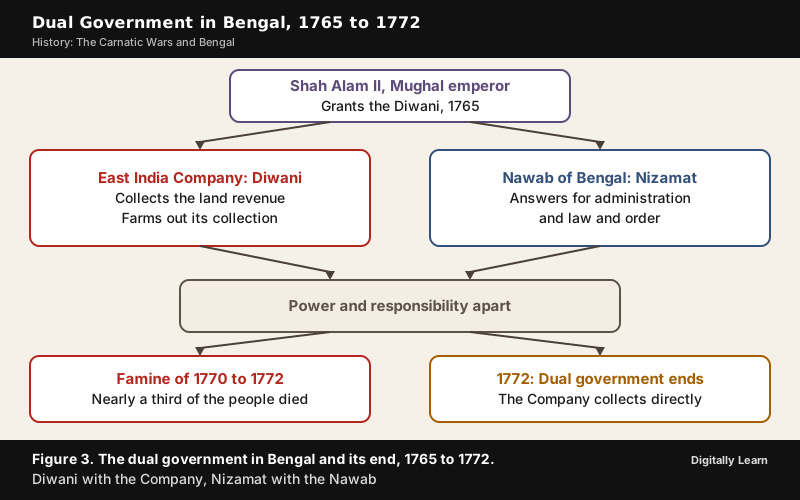
The Mughal government of a province had two branches. The Diwani was the right to collect the revenue of the province; the Nizamat covered civil administration and law and order. After 1765 the Company held the Diwani, while the Nawab of Bengal, Najmuddin Ali Khan from 1765, kept the Nizamat. This arrangement, made by Clive, is known as the dual government, because two authorities shared the government of one province. Murshidabad, the Nawab's capital, remained for some time the seat of administration.
Under it the Company answered only for revenue, while administration and law and order were left to the Nawab, so power and responsibility lay in different hands. The Company was also short of trained administrators who knew local custom and law, so it farmed out the collection of revenue, and its servants enriched themselves through private trade.
Clive left India for the last time in 1767. In 1772 the Company, under Warren Hastings, who was appointed Governor of Bengal that year, ended the dual government. It took over the collection of revenue directly, set up a Board of Revenue with offices in Calcutta and Patna, and moved the Mughal revenue records from Murshidabad to Calcutta. The Regulating Act of 1773 then made the Governor of Bengal the Governor-General of Bengal, and Hastings was the first to hold that office.
The Bengal Famine of 1770 and the End of Dual Government
The famine of 1770 to 1772 was the first great famine in Bengal under the Company. It followed two years of crop failure, and the Company's harsh revenue targets turned that failure into a catastrophe, because farmers had to pay a high rate of cash taxes on the produce of their lands whatever the harvest. Nearly one-third of the population of Bengal died, an estimated 10 million people. The Company even increased the land tax during the famine.
Other causes deepened the famine. Grain merchants stopped giving advances to peasants, the Company bought a large share of the rice for its army, and the Company's servants and their Indian agents (gomasthas) created local monopolies of grain. W.W. Hunter, a British official writing a century later, recorded that "All through the stifling summer of 1770 the people went on dying." NCERT dates the famine from 1770 to 1772; other accounts place it in 1769 and 1770 and give death estimates of between 7 million and 10 million.
The famine had lasting results:
- Administrative: It hastened the end of the dual government, and the Company soon became the sole administrator of Bengal.
- Economic: The loss to cultivation was estimated at a third of the total, and a large share of the dead were spinners and weavers with no reserves of food.
- Social: The Sannyasi (or Sannyasi-Fakir) Rebellion began in Bengal after the famine, and a century later the famine became the subject of Bankim Chandra Chatterjee's novel Anandamath.
Significance of the Carnatic Wars and the Conquest of Bengal
Why the Company's Armies Won Against Larger Indian Armies
From Adyar in 1746 to Buxar in 1764, small European-led armies made up mostly of Indian sepoys defeated Indian armies many times their size. At Plassey about 3,000 men faced about 50,000, and at Buxar 7,072 faced over 40,000. Several reasons explain these victories.
- Drill and discipline: In 1757 Clive began raising sepoy battalions for Bengal, Indian soldiers armed, dressed and trained like British soldiers and commanded by British officers, on the model first created by Dupleix. At Adyar disciplined firing and a bayonet charge broke the Nawab's line, and at Ambur disciplined infantry reversed the course of the battle.
- Regular pay and supply: The Company's sepoys were usually paid regularly, received regular rations, and drew weapons, clothing and ammunition from a central store, whereas the soldiers of local kings were often paid in arrears. Before Plassey, Siraj-ud‑Daulah's troops refused to leave Murshidabad until their arrears of pay were released, and the delay brought them to the field only on 21 June.
- Unity of command: Each Company army had one commander, Clive at Plassey and Munro at Buxar. The Indian side was often a coalition of rulers with different aims, and at Buxar Shuja-ud‑Daula destroyed the bridge of boats behind him and left the emperor to the victors.
- Preparation in the field: Small details counted, as when the English kept their powder dry under tarpaulins at Plassey while the Nawab's powder was soaked and his rate of fire slackened.
- Money and sea power: The English fleet relieved Madras in the Third Carnatic War, and the revenue of Bengal paid for the Company's wars after 1757.
- Diplomacy and Indian divisions: The Company offered military support to some rulers against their rivals and played on succession disputes, the policy of divide and rule. At Plassey the decisive weapon was Mir Jafar's betrayal.
The Indian armies were larger and sometimes well armed, as at Plassey, where French artillerymen directed field pieces for the Nawab, but numbers and arms could not make up for divided command, uncertain pay and betrayal. What decided these wars was the ability to organise, pay and hold an army together.
Bengal as the Base of British Expansion in India
The conquest of Bengal gave the Company the money and the base for its later conquests. Clive described Bengal as "the paradise of the earth", and the Company's agents extracted the maximum revenue from it while investing little in governance or development. Bengal's revenue had already helped to defeat the French in the south, and in the following decades Indians were charged even for the cost of the colonial power's wars.
The conquest also showed how British rule began. It was not a single invasion but a gradual takeover, disguised as commercial enterprise, in which a trading company captured an existing state's revenue and offices by working through Indian rulers (Mir Jafar, Mir Qasim and a dependent emperor) before ruling in its own name. In Britain the Regulating Act of 1773 was the first step taken by the British Parliament to regulate and control the affairs of a company that had become a government.
| Year | Event |
|---|---|
| 1717 | Farman of Farrukhsiyar grants duty-free trade in Bengal |
| 1746 | French capture Madras; Battle of Adyar |
| 1748 | Treaty of Aix-la-Chapelle |
| 1749 | Battle of Ambur |
| 1751 | Clive seizes and holds Arcot |
| 1754 | Treaty of Pondicherry; Dupleix replaced |
| 1756 | Siraj-ud‑Daulah captures Calcutta; Black Hole incident |
| 1757 | Battle of Plassey; Mir Jafar made Nawab |
| 1759 | Battle of Chinsurah against the Dutch |
| 1760 | Battle of Wandiwash; Mir Qasim made Nawab |
| 1761 | Pondicherry surrenders to the English |
| 1763 | Treaty of Paris; Mir Qasim driven out; Mir Jafar restored |
| 1764 | Battle of Buxar |
| 1765 | Treaty of Allahabad; Diwani of Bengal, Bihar and Orissa |
| 1770 | Famine in Bengal (1770 to 1772) |
| 1772 | Dual government ends; the Company collects revenue directly |
Previous Year UPSC‑CSE Questions
Each Prelims question is explained option by option, and each Mains question comes with an answer outline.
- UPSC Prelims 2007Consider the following statements:
- Robert Clive was the first Governor-General of Bengal.
- William Bentinck was the first Governor-General of India.
Which of the statements given above is/are correct?
How to approach this Prelims question
Approach: Separate the office of Governor from the office of Governor-General and check when each office was created.
- Statement 1: Clive was Governor of Bengal after Plassey and again from 1765 to 1767, but the Regulating Act of 1773 first designated the Governor of Bengal as Governor-General of Bengal, and Warren Hastings was the first to hold the office, so the statement is wrong.
- Statement 2: The Charter Act of 1833 replaced the Governor-General of Fort William with the Governor-General of India, and William Bentinck was the first official Governor-General of British India, so the statement is right.
Trap to watch: Clive founded British power in Bengal and was its Governor, so his name feels right for statement 1, but the office of Governor-General did not exist in his time.
Why each option is right or wrong:
- (a) 1 only: Wrong. Statement 1 is false, because Warren Hastings was the first Governor-General of Bengal.
- (b) 2 only: Correct. Bentinck became the first Governor-General of India under the Charter Act of 1833.
- (c) Both 1 and 2: Wrong. Clive was only Governor of Bengal.
- (d) Neither 1 nor 2: Wrong. Statement 2 is accurate.
Answer: (b) 2 only. Bentinck was the first Governor-General of India, and the first Governor-General of Bengal was Warren Hastings, not Clive.
- UPSC Prelims 2005Which one of the following is the correct chronological order of the battles fought in India in the 18th Century?
How to approach this Prelims question
Approach: Date each battle and then arrange the years. Ambur was fought on 3 August 1749, the first major battle of the Second Carnatic War; Plassey on 23 June 1757; Wandawash (Wandiwash) in 1760, in the Third Carnatic War; and Buxar in October 1764. The order is therefore 1749, 1757, 1760 and 1764.
Trap to watch: Wandiwash is often placed before Plassey because the Carnatic Wars are taught first and Wandiwash is remembered as a Carnatic battle, but Plassey (1757) came three years before Wandiwash (1760).
Why each option is right or wrong:
- (a) Battle of Wandawash - Battle of Buxar - Battle of Ambur - Battle of Plassey: Wrong. Ambur (1749) was the earliest of the four, not the third.
- (b) Battle of Ambur - Battle of Plassey - Battle of Wandawash - Battle of Buxar: Correct. The years run 1749, 1757, 1760 and 1764.
- (c) Battle of Wandawash - Battle of Plassey - Battle of Ambur - Battle of Buxar: Wrong. Wandiwash (1760) came after both Ambur and Plassey.
- (d) Battle of Ambur - Battle of Buxar - Battle of Wandawash - Battle of Plassey: Wrong. Plassey (1757) came before Wandiwash (1760) and Buxar (1764).
Answer: (b) Battle of Ambur - Battle of Plassey - Battle of Wandawash - Battle of Buxar. Ambur was fought in 1749, Plassey in 1757, Wandiwash in 1760 and Buxar in 1764.
- UPSC Prelims 2004Consider the following statements:
- In the Third Battle of Panipat, Ahmed Shah Abdali defeated Ibrahim Lodi.
- Tipu Sultan was killed in the Third Anglo-Mysore War.
- Mir Jafar entered in a conspiracy with the English for the defeat of Nawab Siraj-ud‑daulah in the Battle of Plassey.
Which of these statements given above is/are correct?
How to approach this Prelims question
Approach: Test each statement against the battle or war it names.
- Statement 1: The Third Battle of Panipat in 1761 was fought between Ahmad Shah Abdali and the Marathas; Ibrahim Lodi was defeated by Babur at the First Battle of Panipat in 1526, so the statement is wrong.
- Statement 2: Tipu Sultan was killed at Seringapatam in 1799, in the Fourth Anglo-Mysore War, so the statement is wrong.
- Statement 3: Clive conspired with Mir Jafar, the Nawab's commander, whose troops stood aside at Plassey in 1757, so the statement is right.
Trap to watch: Both wrong statements attach a real person to the wrong battle or war: Ibrahim Lodi fell to Babur at the First Battle of Panipat, not to Abdali at the Third, and Tipu died in the Fourth Anglo-Mysore War, not the Third, so a student who recognises only the names marks them true.
Why each option is right or wrong:
- (a) 1, 2 and 3: Wrong. Statement 1 gives Abdali the wrong opponent at Panipat, and statement 2 names the wrong war.
- (b) 3 only: Correct. Only the Mir Jafar conspiracy at Plassey is accurate.
- (c) 2 and 3: Wrong. Tipu died in the Fourth Anglo-Mysore War of 1799, not the Third.
- (d) None: Wrong. Statement 3 is accurate, since Mir Jafar's troops stood aside at Plassey under his agreement with Clive.
Answer: (b) 3 only. Mir Jafar conspired with the English at Plassey, while Abdali fought the Marathas at Panipat in 1761 and Tipu died in the Fourth Anglo-Mysore War.
- UPSC Prelims 1996Who among the following was the first European to initiate the policy of taking part in the quarrels of Indian princes with a view to acquire territories?
How to approach this Prelims question
Approach: Ask who first used the succession quarrels of Indian princes to gain territory, and place each person in time. Dupleix, Governor-General of French India from 1742 to 1754, installed puppet rulers by intervening in succession disputes in the Carnatic and Hyderabad in the 1740s and 1750s. The English took over the method later, beginning with Clive's expedition to Arcot in 1751 and his alliance with Mir Jafar at Plassey in 1757. Albuquerque was a Portuguese commander of the early sixteenth century who conquered by direct force, and Warren Hastings was appointed Governor of Bengal only in 1772.
Trap to watch: Students pick Clive because Plassey is the best-known case of a European making a ruler, but Clive copied a method that Dupleix had already used.
Why each option is right or wrong:
- (a) Clive: Wrong. He applied the method at Plassey in 1757, after Dupleix had used it in the Carnatic.
- (b) Dupleix: Correct. He began the policy of installing friendly claimants by taking part in succession disputes in the 1740s.
- (c) Albuquerque: Wrong. The Portuguese governor of the early sixteenth century won Goa by direct conquest in 1510, not through the quarrels of Indian princes.
- (d) Warren Hastings: Wrong. He was appointed Governor of Bengal in 1772, long after Dupleix was replaced in 1754.
Answer: (b) Dupleix. Dupleix first intervened in the succession quarrels of the Carnatic and Hyderabad to win territory and influence for the French.
- UPSC Mains 2022 GS‑IWhy did the armies of the British East India Company – mostly comprising of Indian soldiers – win consistently against the more numerous and better equipped armies of the then Indian rulers? Give reasons.
Answer outline
The outline sets out what the question asks, the main arguments, relevant examples and the direction of the conclusion; it is not a full model answer.
Introduction: The East India Company's armies, mostly made up of Indian sepoys, defeated larger Indian armies from the Carnatic Wars onwards; at Buxar in 1764, 7,072 Company troops defeated allied armies of over 40,000.
Body (sub-themes to develop):
- Drill and discipline: Sepoy battalions armed, dressed and trained like British soldiers under British officers, on the model first created by Dupleix; disciplined fire decided Adyar and Ambur.
- Regular pay and supply: Company sepoys were usually paid regularly and supplied centrally with rations, arms and clothing, while the soldiers of Indian rulers were often paid in arrears, as Siraj-ud‑Daulah's army was before Plassey.
- Unity of command: One commander led each Company army, while Indian coalitions broke apart, as at Buxar when Shuja-ud‑Daula abandoned the emperor.
- Money and sea power: The fleet and, after 1757, the revenue of Bengal supplied the Company's wars, as at Madras and Wandiwash.
- Diplomacy and divisions: Alliances with rival claimants and the betrayal of Mir Jafar at Plassey turned Indian divisions against Indian rulers.
Conclusion: Organisation, pay, money and the divisions of Indian rulers, more than numbers or equipment, explain why the Company's smaller armies won.
Sources
- NCERT: Class 8 Exploring Society: India and Beyond Book 1, Chapter 4
- Wikipedia: Carnatic wars
- Wikipedia: Joseph François Dupleix
- Wikipedia: Battle of Adyar
- Wikipedia: Treaty of Aix-la-Chapelle (1748)
- Wikipedia: Battle of Ambur
- Wikipedia: Siege of Arcot
- Wikipedia: Marquis de Bussy-Castelnau
- Wikipedia: Thomas Arthur, comte de Lally
- Wikipedia: Battle of Wandiwash
- Wikipedia: Treaty of Paris (1763)
- Wikipedia: Alivardi Khan
- Wikipedia: Farrukhsiyar
- Wikipedia: Siraj ud‑Daulah
- Wikipedia: Black Hole of Calcutta
- Wikipedia: Battle of Plassey
- Wikipedia: Robert Clive
- Wikipedia: Mir Jafar
- Wikipedia: Battle of Chinsurah
- Wikipedia: Mir Qasim
- Wikipedia: Battle of Buxar
- Wikipedia: Treaty of Allahabad
- Wikipedia: Shah Alam II
- Wikipedia: Great Bengal famine of 1770
- Wikipedia: Company rule in India
- Wikipedia: Warren Hastings
- Wikipedia: Regulating Act 1773
- Wikipedia: Governor-General of India
- Wikipedia: Presidency armies
- Wikipedia: Sepoy
- Wikipedia: First Battle of Panipat
- Wikipedia: Fourth Anglo-Mysore War
- Wikipedia: Afonso de Albuquerque
- Government of Puducherry: History of Puducherry
- Government of Bihar (Buxar district): History
- Government of West Bengal (Murshidabad district): History
- UPSC: Civil Services Examination question papers
Editorial Disclaimer
This article draws on the current NCERT history textbook and the other sources listed. Where accounts give different dates, NCERT's are used.
See more of our UPSC articles in Google Search
Add to Preferred Sources