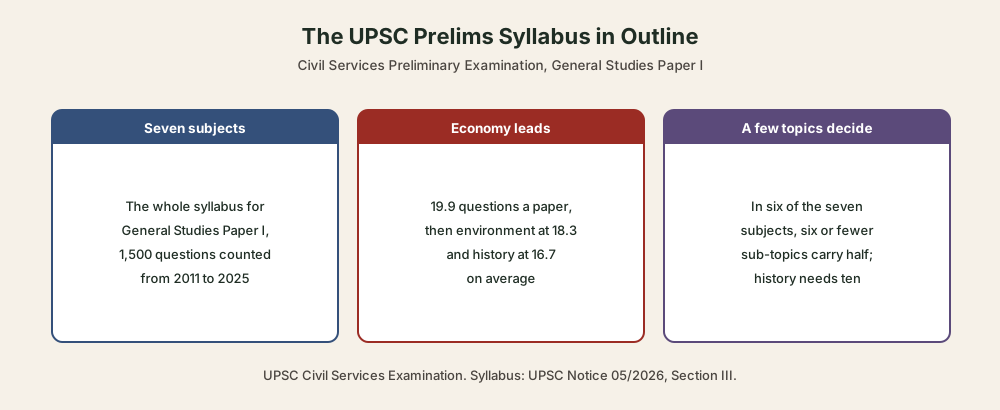
The UPSC Prelims syllabus for General Studies Paper I has seven subjects: current events, history, geography, polity, economic and social development, environment and general science. This guide gives the full syllabus, the weightage of each subject from 1,500 questions of 2011 to 2025, and the most important topics in each.
What Is the UPSC Prelims? Two Papers and One Merit Paper
UPSC Prelims Pattern: General Studies Paper I, CSAT and the Cut-Off
The UPSC Prelims is the first stage of the Civil Services Examination, a screening test of two objective papers of 200 marks each, two hours each. General Studies Paper I is the merit paper: its marks decide who reaches the Mains. This page gives the full UPSC Prelims syllabus for that paper and shows how much each subject is actually asked.
- General Studies Paper I: One hundred questions for 200 marks in two hours; its marks set the cut-off.
- General Studies Paper II (CSAT): Qualifying only, at 33 per cent; see the CSAT syllabus guide.
- Negative marking: One-third of a question's marks is deducted for each wrong answer, in both papers.
- Who goes through: About twelve to thirteen times the number of vacancies are admitted to the Mains, on General Studies Paper I marks, from those who clear CSAT.
- Final merit: Prelims marks are not counted in the final ranking; they only decide who writes the Mains.
The UPSC Prelims Syllabus 2026 in Full
Seven Subjects of General Studies Paper I
The Prelims syllabus for General Studies Paper I is seven short entries in Examination Notice 05/2026, Section III, reproduced below in its own words. There is no separate syllabus PDF; the notice itself is the PDF.
- Current events of national and international importance.
- History of India and Indian National Movement.
- Indian and World Geography-Physical, Social, Economic Geography of India and the World.
- Indian Polity and Governance-Constitution, Political System, Panchayati Raj, Public Policy, Rights Issues, etc.
- Economic and Social Development-Sustainable Development, Poverty, Inclusion, Demographics, Social Sector Initiatives, etc.
- General issues on Environmental ecology, Bio-diversity and Climate Change - that do not require subject specialization.
- General Science.
Short as it is, the list covers a wide field: six of the seven subjects have been asked in every paper since 2011, current events missing only 2013 as counted here, and each one breaks down into many sub-topics. Across 2011 to 2025 the questions fall into 173 sub-topics in all, but a few in each subject carry most of the weight, which is what the sections below show.
UPSC Prelims Subjects Ranked by Weightage
Questions by Subject, 2011 to 2025
All 1,500 questions of the fifteen General Studies Paper I papers from 2011 to 2025 are sorted here by subject. Economic and social development leads with 299, followed closely by environment (274) and history (250). The last column compares the average a year in 2011 to 2015 with 2021 to 2025.
| Subject | Questions (share) | A year, then to now |
|---|---|---|
| Economic and social development | 299 (20%) | 19.0 to 17.0 |
| Environment, biodiversity and climate change | 274 (18%) | 20.2 to 16.6 |
| History of India and the national movement | 250 (17%) | 17.4 to 15.0 |
| Indian polity and governance | 216 (14%) | 13.8 to 15.2 |
| General science | 205 (14%) | 13.8 to 13.6 |
| Indian and world geography | 168 (11%) | 12.6 to 13.6 |
| Current events | 82 (5%) | 3.2 to 8.0 |
Which Prelims Subjects Are Rising and Which Are Easing
Comparing the first five papers of the period with the last five shows gentle shifts rather than upheavals. Polity has risen from 13.8 to 15.2 questions a paper and geography from 12.6 to 13.6, while environment has eased from 20.2 to 16.6 and economy from 19.0 to 17.0. General science has held steady.
Current Events: Small by Count but Growing
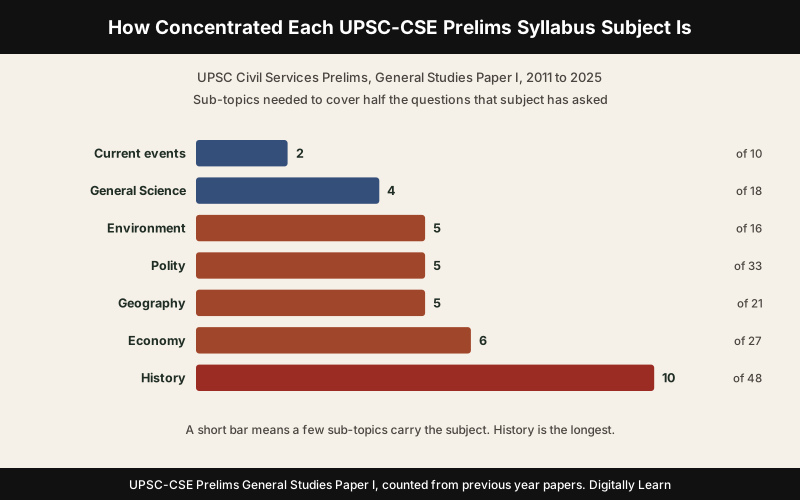
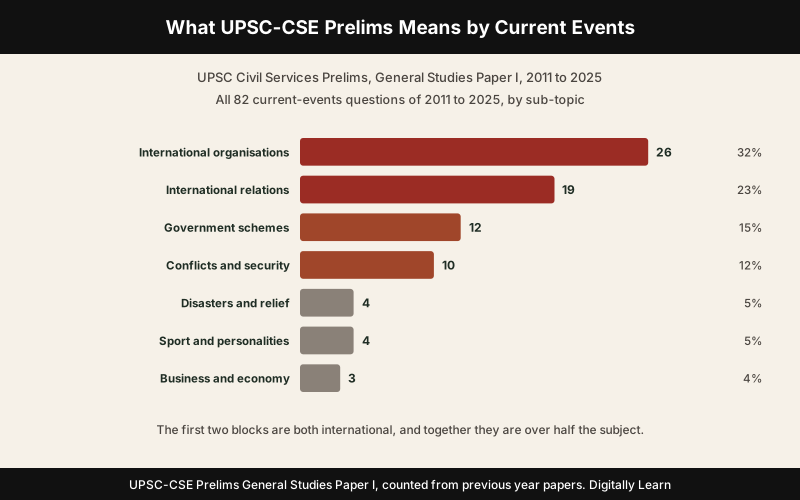
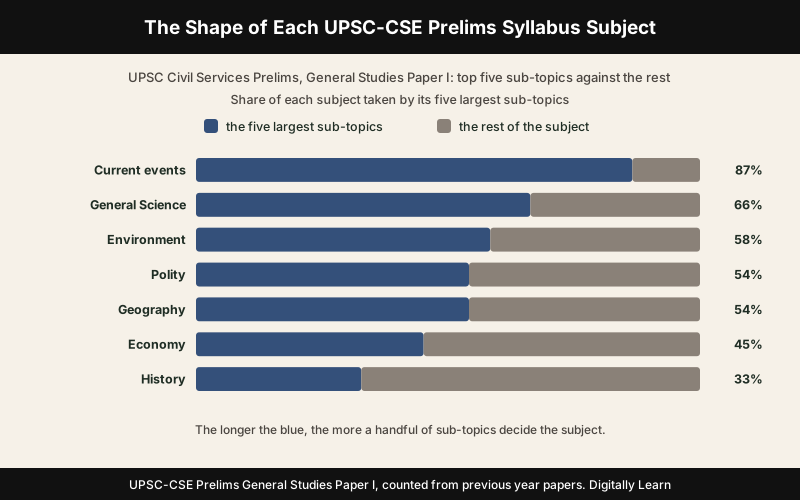
Questions tagged as current events have risen from 3.2 a year in 2011 to 2015 to 8.0 in 2021 to 2025, and average 5.5 a paper over the whole period. Two of its 10 sub-topics carry half of its 82 questions. International organisations and international relations lead, so current affairs preparation for Prelims is largely international.
Important Topics for UPSC Prelims in Each Subject
Economy and Environment: The Two Largest Subjects
Economic and social development averages 19.9 questions a paper. Six of its 27 sub-topics carry half of its 299 questions. It has eased from 19.0 questions a paper in 2011 to 2015 to 17.0 in 2021 to 2025. The largest are:
- Agriculture and Rural Development: 33 questions
- Human Development, Poverty and Employment Schemes: 30 questions
- Fiscal Policy and Budget: 26 questions
- Banking and Financial Sector: 23 questions
- External Sector and Balance of Payments: 23 questions
- Infrastructure and Industry: 23 questions
Environment, biodiversity and climate change averages 18.3. Five of its 16 sub-topics carry half of its 274 questions. It has eased from 20.2 questions a paper in 2011 to 2015 to 16.6 in 2021 to 2025. The largest are:
- Ecosystems and Ecology Concepts: 36 questions
- Biodiversity and Conservation: 33 questions
- Pollution and Waste Management: 31 questions
- Protected Areas and Wildlife: 31 questions
- International Environmental Treaties and Summits: 29 questions
- Climate Change and Greenhouse Gases: 26 questions
History and Polity: Broad Syllabus, Steady Questions
History averages 16.7 questions a paper and is the most spread out: ten of its 48 sub-topics carry half of its 250 questions. It has eased from 17.4 questions a paper in 2011 to 2015 to 15.0 in 2021 to 2025. The largest are:
- Philosophy and Religion: 19 questions
- Gandhian Mass Movements (1915-1942): 18 questions
- Constitutional Developments and British Plans (1909-1947): 17 questions
- Architecture and World Heritage: 15 questions
- British Administration and Economic Policies: 13 questions
- Early Nationalism and Indian National Congress (1885-1915): 12 questions
Indian polity and governance averages 14.4. Five of its 33 sub-topics carry half of its 216 questions. It has risen from 13.8 questions a paper in 2011 to 2015 to 15.2 in 2021 to 2025. The largest are:
- Parliament and State Legislatures: 40 questions
- Constitutional Framework and Development: 27 questions
- Judiciary: 19 questions
- Union and State Executive: 19 questions
- Constitutional and Statutory Bodies: 12 questions
- Federalism and Centre-State Relations: 11 questions
Geography and General Science: Concepts With Current Examples
The geography subject averages 11.2 questions a paper. Five of its 21 sub-topics carry half of its 168 questions. It has risen from 12.6 questions a paper in 2011 to 2015 to 13.6 in 2021 to 2025. The largest are:
- Atmosphere and Climatology: 30 questions
- Indian Agriculture and Land Use: 20 questions
- Indian Physical Geography: 15 questions
- Indian Rivers and Water Resources: 14 questions
- World Political Geography and Borders: 12 questions
The general science subject averages 13.7, and is the most concentrated subject after current events. Four of its 18 sub-topics carry half of its 205 questions. It has eased from 13.8 questions a paper in 2011 to 2015 to 13.6 in 2021 to 2025. The largest are:
- Computer and Information Technology: 35 questions
- Biotechnology and Genetics: 27 questions
- Health and Diseases: 26 questions
- Energy and Environment: 25 questions
- Space Technology and Astronomy: 23 questions
How to Prepare for UPSC Prelims Using the Syllabus
Reading Order, Sources and Practice
The weightage points to a plan that covers every subject but spends time where the questions are.
- Build the base from NCERT: School textbooks for history, geography, polity, economy and science cover the concepts most questions rest on.
- Add current affairs through the subjects: Read the news for its economy, environment, polity and science angle, not as a separate subject.
- Prioritise the large sub-topics: Use the lists above to give the few big sub-topics in each subject the most revision time.
- Practise with previous questions: Past papers show how each sub-topic is asked, and timed practice builds the accuracy that negative marking demands.
- Do not neglect CSAT: It is qualifying only, but failing it ends the attempt.
Standard sources for each subject, as a starting point:
- History: NCERT history texts for Classes VI to XII, with a focus on art and culture and the national movement.
- Geography: NCERT Class XI Fundamentals of Physical Geography and India: Physical Environment, Class XII India: People and Economy, and an atlas.
- Polity: NCERT Class XI Indian Constitution at Work, and the text of the Constitution for key Articles.
- Economy: NCERT Class XI Indian Economic Development, then the Union Budget and the Economic Survey for current figures.
- Environment and science: NCERT science and biology texts for concepts, with current reports and news for new developments.
Our Prelims test series follows the exact Prelims pattern, with sectional tests by subject, and the Study Library is organised by the same seven subjects. The Mains syllabus and the full scheme are in the complete UPSC syllabus guide.
Common Questions About the UPSC Prelims Syllabus
What is the UPSC Prelims syllabus?
General Studies Paper I covers seven subjects: current events, history of India and the national movement, Indian and world geography, Indian polity and governance, economic and social development, environment, biodiversity and climate change, and general science. CSAT, the second paper, has its own syllabus.
How many subjects are there in UPSC Prelims?
Seven in General Studies Paper I, as listed in the notice, plus the CSAT paper, which tests comprehension, reasoning and basic maths.
Which subject has the most weightage in UPSC Prelims?
Economic and social development, with 299 of 1,500 questions from 2011 to 2025, followed by environment with 274 and history with 250.
Is there a UPSC Prelims syllabus PDF?
Not as a separate file. The syllabus is part of the Commission's examination notice, which is published as a PDF each year; the 2026 notice is linked in the sources below.
When will the UPSC Prelims 2027 notice come out?
The Commission's 2027 calendar lists the notification for 13 January 2027 and the Prelims for 23 May 2027, with the dates liable to change. The syllabus for 2027 will be printed in that notice.
Official Sources
- Union Public Service Commission: Examination Notice No. 05/2026-CSE, Civil Services Examination 2026
- Union Public Service Commission: previous years' question papers
- Union Public Service Commission: Programme of Examinations and Recruitment Tests 2027
- National Council of Educational Research and Training: school textbooks, the standard reading for several Prelims subjects
- Legislative Department, Ministry of Law and Justice: The Constitution of India
- Union Public Service Commission: Civil Services Examination 2025, minimum qualifying marks
- Union Public Service Commission: online registration and application portal
- Department of Personnel and Training: Gazette notifications (the Civil Services Examination Rules are notified here each year)
- Wikipedia: Civil Services Examination
Editorial Disclaimer
The syllabus and the rules of the Preliminary Examination are taken from the current examination notice of the Commission, and the dates from its calendar. Sorting past questions by subject and sub-topic is Digitally Learn's own reading. The notice in the Gazette of India is the final authority.