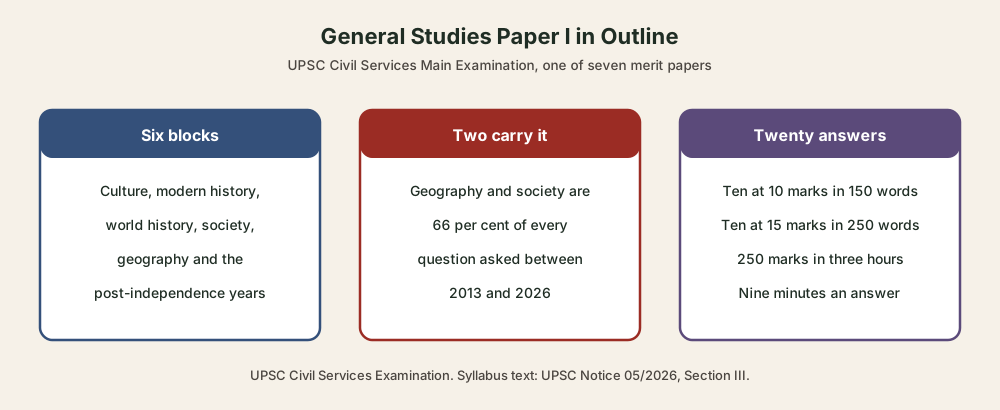
The GS 1 syllabus of UPSC Mains covers Indian culture, modern and world history, post-independence India, Indian society and geography in twelve topics. GS Paper 1 asks twenty compulsory questions for 250 marks in three hours. This guide gives the full syllabus and the subject-wise weightage of 294 questions from 2013 to 2026.
What Is GS Paper 1 in UPSC Mains? Pattern and Marks
GS Paper 1 at a Glance: 20 Questions, 250 Marks, Three Hours
General Studies Paper I, usually called GS 1 or GS1, is the paper on Indian heritage and culture, the history and geography of the world, and society. In the notice's own numbering it is Paper II of the Main Examination, because the Essay is Paper I. This page gives the full UPSC GS 1 syllabus, the General Studies Paper 1 syllabus as the notice prints it, and shows how much each part is actually asked.
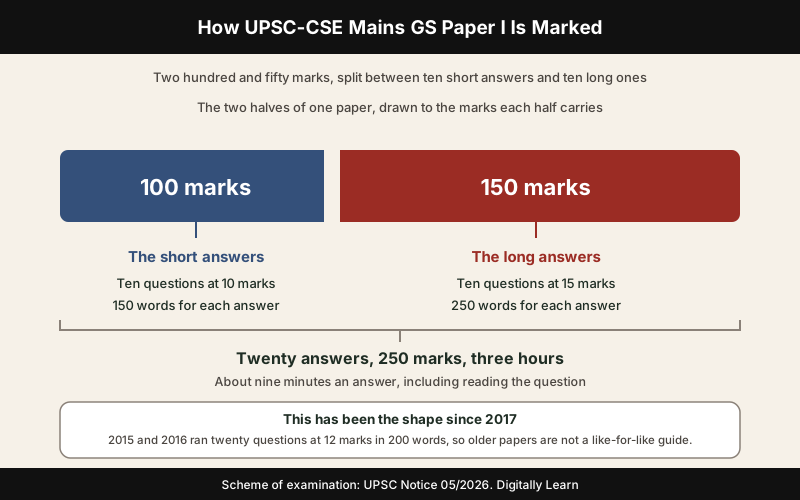
- Questions: Twenty, all compulsory.
- Marks and words: Questions 1 to 10 carry 10 marks each with a 150-word limit; questions 11 to 20 carry 15 marks each with a 250-word limit.
- Total: 250 marks in three hours, one of the seven papers that count for the rank.
- Since 2017: The paper has kept this shape; in 2015 and 2016 it asked twenty questions of 12.5 marks and 200 words each, and in 2013 and 2014 it printed 29 and 25 questions.
The Official GS Paper 1 Syllabus in Full
Twelve Syllabus Topics and the Six Subjects They Form
The notice sets out the GS 1 syllabus as twelve topics, reproduced below in its own words. There is no separate syllabus PDF for this paper; the text sits in Examination Notice 05/2026, Section III, which is itself a PDF.
- Indian culture will cover the salient aspects of Art Forms, literature and Architecture from ancient to modern times.
- Modern Indian history from about the middle of the eighteenth century until the present- significant events, personalities, issues.
- The Freedom Struggle: Its various stages and important contributors/contributions from different parts of the country.
- Post-independence consolidation and reorganization within the country.
- History of the world will include events from 18th century such as industrial revolution, world wars, redrawal of national boundaries, colonization, decolonization, political philosophies like communism, capitalism, socialism etc.: their forms and effect on the society.
- Salient features of Indian Society, Diversity of India.
- Role of women and women's organization, population and associated issues, poverty and developmental issues, urbanization, their problems and their remedies.
- Effects of globalization on Indian society.
- Social empowerment, communalism, regionalism & secularism.
- Salient features of world's physical geography.
- Distribution of key natural resources across the world (including South Asia and the Indian sub- continent); factors responsible for the location of primary, secondary, and tertiary sector industries in various parts of the world (including India).
- Important Geophysical phenomena such as earthquakes, Tsunami, Volcanic activity, cyclone etc., geographical features and their location-changes in critical geographical features (including water-bodies and ice-caps) and in flora and fauna and the effects of such changes.
The twelve topics fall into six subjects, and the rest of this page follows them:
- Indian culture: Topic 1 (art forms, literature and architecture).
- Modern Indian history: Topics 2 and 3 (from the mid-eighteenth century, and the freedom struggle).
- Post-independence India: Topic 4 (consolidation and reorganisation).
- World history: Topic 5 (from the eighteenth century).
- Indian society: Topics 6 to 9.
- Geography: Topics 10 to 12 (physical geography, resources and industry location, geophysical phenomena).
GS 1 Syllabus Weightage: What Previous Year Questions Show
Questions by Subject, 2013 to 2026
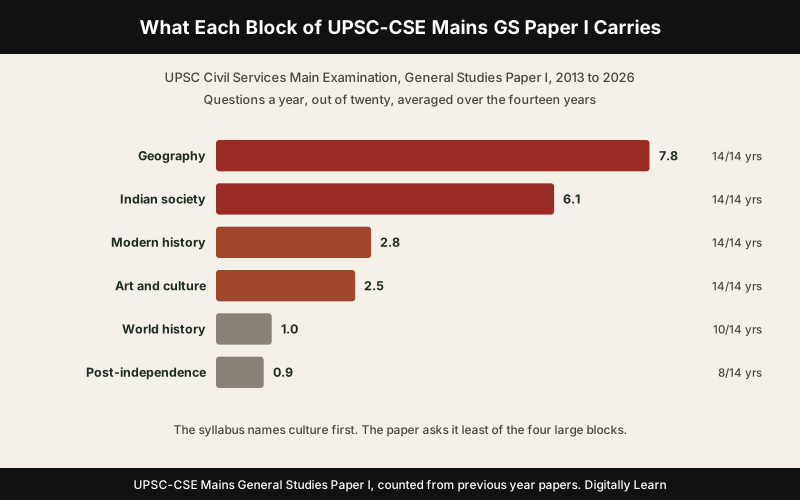
All 294 questions of the 14 GS Paper 1 papers from 2013 to 2026 are sorted here by subject, one subject per question. Geography and Indian society together have produced 194 of them, 66 per cent, about two-thirds of the paper. On average a paper asks 7.8 on geography, 6.1 on Indian society, 2.8 on modern Indian history, 2.5 on Indian culture, 1.0 on world history and 0.9 on post-independence India.
| Subject | Questions (share) | A year, then to now |
|---|---|---|
| Geography (3 of 12 topics) | 109 (37%) | 8.50 to 7.00 |
| Indian society (4 of 12 topics) | 85 (29%) | 5.25 to 7.00 |
| Modern Indian history (2 of 12 topics) | 39 (13%) | 3.50 to 1.75 |
| Indian culture (1 of 12 topics) | 35 (12%) | 2.75 to 2.75 |
| World history (1 of 12 topics) | 14 (5%) | 2.00 to 0.75 |
| Post-independence India (1 of 12 topics) | 12 (4%) | 1.50 to 0.75 |
Geography and Indian Society: Two-Thirds of GS Paper 1
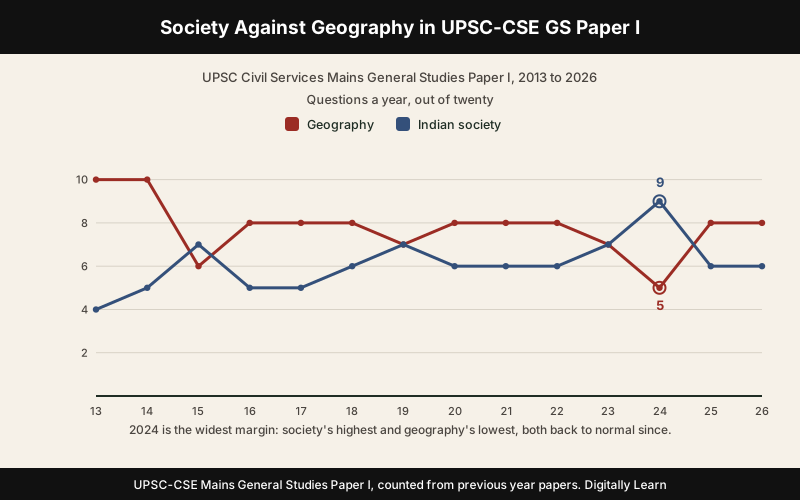
The geography block is the largest subject, at 7.8 questions a paper, and has asked the most in every paper except 2015 and 2024, when Indian society asked more, and 2019 and 2023, when the two were level. Society has grown from 5.25 questions a year in the first four papers to 7.00 in the last four, while geography eased from 8.50 to 7.00; in the last two papers geography was back in front at eight questions to six.
History in GS Paper 1: Modern History Halved, World History Rare
Modern Indian history has fallen from 3.50 questions a paper in 2013 to 2016 to 1.75 in the last four, and has not asked three since 2021. World history has asked no question in four of the fourteen papers, and post-independence India only 12 in all. Indian culture has held steady at about 2.5 a paper.
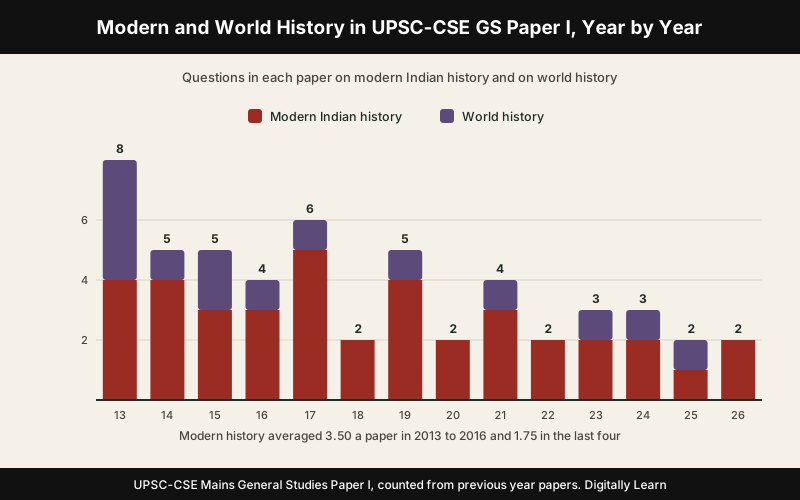
GS Paper 1 Syllabus Subject by Subject
Geography: Physical Geography, Resources and Geophysical Phenomena
The three geography topics are the salient features of the world's physical geography; the distribution of key natural resources and the factors behind where industries are located, in the world and in India; and geophysical phenomena such as earthquakes, tsunamis, volcanoes and cyclones, with changes in critical geographical features. Recent questions mix physical processes with their human effects.
- Physical processes: Winds, cyclones, tectonics, tsunamis and landforms, each with its mechanism.
- Resources and industry: Where oil, minerals and energy are found and why industries locate where they do.
- Change and hazard: Climate change, sea level rise, land-use change and desertification, with Indian examples.
Build the base from NCERT's Class XI and XII geography texts and an atlas; a sketch map in an answer often earns more than a paragraph.
Indian Society: Diversity, Women, Population, Globalisation and Social Empowerment
The four society topics cover the salient features of Indian society and its diversity; the role of women, population, poverty and urbanisation; the effects of globalisation; and social empowerment, communalism, regionalism and secularism. Questions ask for a view on a live social change, supported by examples.
- Caste, tribe and identity: How caste and tribal life are changing, in cities and through displacement.
- Population and cities: Demographic transition, urban poverty and smart cities.
- Globalisation: Its effects on youth, consumption and culture.
- Empowerment: Women, disability and digital inclusion, against communalism and regionalism.
NCERT's Class XI and XII sociology texts give the concepts; current data from the Census and national surveys give the examples that make an answer specific.
Modern Indian History and the Freedom Struggle
The two modern history topics run from about the middle of the eighteenth century to the present, with the freedom struggle, its stages and its contributors from different parts of the country. Recent questions ask about the effect of a policy, a movement or a reformer rather than a narrative of events.
- Colonial policies and their effects: Education, administration and the economy, such as Macaulay's Minute (asked in 2026).
- Mass movements: Each Gandhian movement with the people it mobilised (asked in 2026).
- Social reformers: Reformers and the classes their work reached, such as Jotirao Phule (asked in 2025).
- Regional contributions: The syllabus names contributors from different parts of the country, so prepare the movement beyond its best-known centres.
Prepare each phase of the national movement with its social base and its leaders, and the major colonial policies with their effects. One or two questions a paper means depth on the main themes, not a full chronology.
Indian Culture, World History and Post-Independence India
The Indian culture topic covers art forms, literature and architecture from ancient to modern times, and has asked two or three questions most years. World history covers events from the eighteenth century, such as the industrial revolution, the world wars, colonisation and decolonisation, and political philosophies. Post-independence India covers consolidation and reorganisation after 1947.
- Ancient India: Harappan architecture (asked in 2025) and the Ashokan inscriptions as a historical source (asked in 2026).
- Medieval India: Vijayanagara architecture (asked in 2026), Chandella sculpture and Akbar's religious syncretism (asked in 2025).
- World history: Revolutions, the world wars, colonisation and decolonisation, and political ideas; the French Revolution was asked in 2025.
- Post-independence India: Integration of the states, linguistic reorganisation and planning (asked in 2025 and 2026).
For culture, prepare the main schools of architecture and sculpture with one example each. World history and post-independence India each appear about once a paper, so a compact set of notes on the main themes is enough.
How GS 1 Questions Are Framed
Directive Words and What Each Word Limit Allows
Discuss is the commonest instruction, in 66 of the 294 questions, followed by explain (30), examine (19) and comment (17). Six questions carry two directive words, so read each question for every task it sets.
| Directive | Questions containing it |
|---|---|
| Discuss | 66 |
| Explain | 30 |
| Examine | 19 |
| Comment | 17 |
| Elaborate | 9 |
| Evaluate | 9 |
| Analyse | 5 |
| Assess | 5 |
- 150 words (10 marks): An opening line, three developed points and a close; a geography answer often gains from a small diagram or map.
- 250 words (15 marks): Room for causes, effects and examples from more than one region or period.
- Examples: Many society and geography questions ask for examples, often from India; one specific example beats three general ones.
How to Prepare for GS Paper 1
Preparing the Six Subjects in Proportion
The question papers point to a plan that differs from the order of the syllabus.
- Geography first: The largest subject in most papers; physical processes, resources and hazards with maps.
- Indian society next: About six or seven questions a paper; concepts plus current examples.
- Culture steadily: Two or three questions a paper; architecture, sculpture and literature with examples.
- Modern history in depth, not in length: One or two questions a paper now; themes, not chronology.
- World history and post-independence India compactly: About one question each a paper.
Where GS 1 Links to Prelims and the Other Papers
The same subjects appear in the Prelims syllabus, so NCERT reading does double duty, but Mains asks for argument and examples rather than facts. The Study Library is organised by these subjects, and the other Mains papers feed this one: GS Paper 2 for the constitutional side of society, GS Paper 3 for environment and disasters, and the Essay paper for writing at length.
Common Questions About the UPSC GS 1 Syllabus
What is the syllabus of GS Paper 1 in UPSC Mains?
The GS1 syllabus has twelve topics in six subjects: Indian culture, modern Indian history, post-independence India, world history, Indian society and geography. The full text is in the Commission's examination notice and is reproduced on this page.
How many questions come in UPSC Mains GS Paper 1?
Twenty, all compulsory: ten of 10 marks with a 150-word limit and ten of 15 marks with a 250-word limit, for 250 marks in three hours.
Which subject has the most weightage in GS 1?
Geography, with 109 of 294 questions from 2013 to 2026, followed by Indian society with 85. Together they are about two-thirds of the paper.
Is there a GS 1 syllabus PDF?
Not as a separate file. The syllabus is part of the Commission's examination notice, which is published as a PDF each year; the 2026 notice is linked in the sources below.
Official Sources
- Union Public Service Commission: Examination Notice No. 05/2026-CSE, Civil Services Examination 2026
- Union Public Service Commission: Civil Services (Main) Examination 2026, General Studies Paper I question paper
- Union Public Service Commission: Civil Services (Main) Examination 2025, General Studies Paper I question paper
- Union Public Service Commission: previous years' question papers
- National Council of Educational Research and Training: school textbooks, the base reading for several blocks of this paper
- Office of the Registrar General and Census Commissioner, India: Census of India
- Union Public Service Commission: Civil Services Examination 2025, minimum qualifying marks
- Union Public Service Commission: online registration and application portal
- Department of Personnel and Training: Gazette notifications (the Civil Services Examination Rules are notified here each year)
- Wikipedia: Civil Services Examination
Editorial Disclaimer
The syllabus is reproduced from the current examination notice of the Commission, with its dashes replaced by commas for readability. Sorting past questions by subject is Digitally Learn's own reading and is not published by the Commission. The notice in the Gazette of India is the final authority.