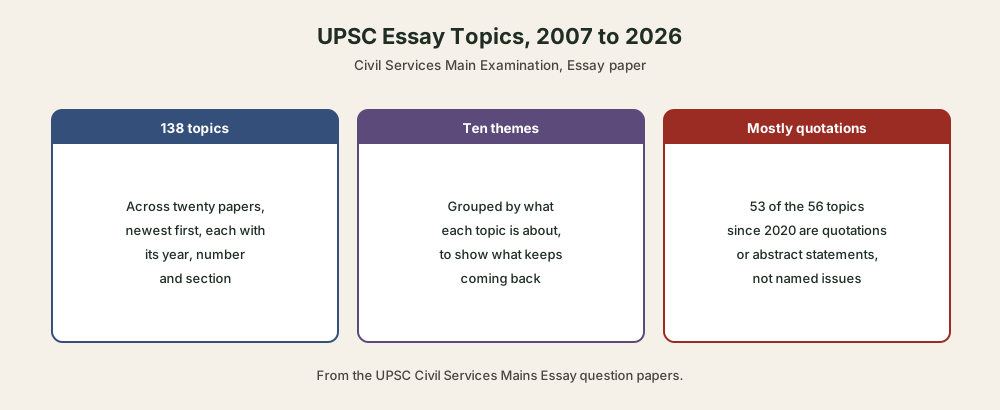
This is the UPSC essay topics previous years list: all 138 topics set in the Civil Services Main Examination from 2007 to 2026, newest first, with the year, question number and section of each, grouped by theme, with an explanation of how the topics have changed.
What the UPSC Essay Paper Asks: Topics, Sections and Marks
How Many Essay Topics UPSC Sets and How Many You Write
The lists of UPSC essay topics below run newest paper first, because the recent papers are closest to the one you will sit. Each line gives the year, the question number and, from 2014, the section the topic appeared in.
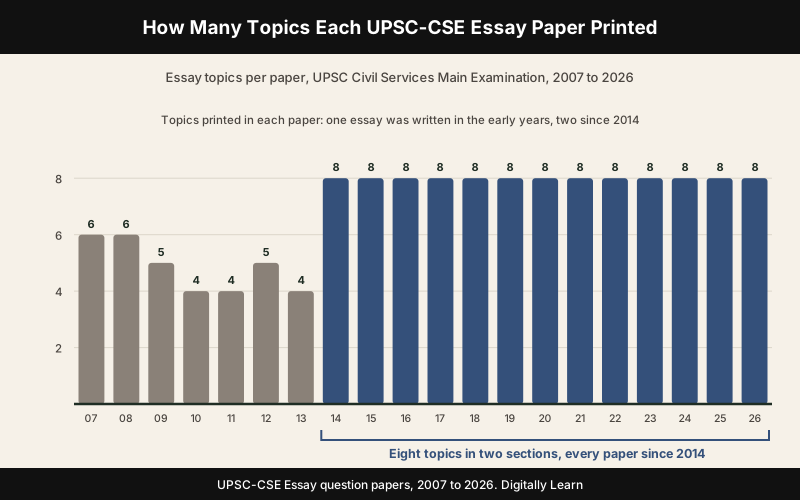
Since 2014 every Essay paper has printed eight topics in two sections of four, and you write one essay from each section. Each essay carries 125 marks, so the paper is worth 250, and the 2026 paper asked for about 1,000 to 1,200 words for each essay. Before 2014 the paper printed four to six topics with no sections, and candidates wrote a single essay.
How UPSC Essay Topics Have Changed Since 2007
Essay topics come in two kinds. An issue-based topic names something you can read about: a policy, an institution, a sector, a technology, a social group or a live public issue, such as "Food security - legislation and implementation" (2012). A quotation-style topic is a proverb, a quotation or an abstract statement with nothing named in it, such as "A thorn is a changed bud" (2026).
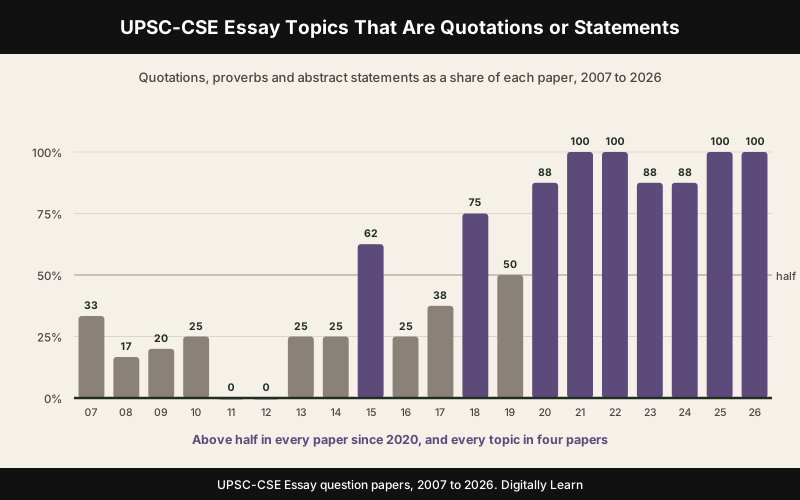
The balance between the two has reversed. Up to 2015, 13 of 50 topics were quotation-style. Since 2020 it is 53 of 56, and in four papers (2021, 2022, 2025 and 2026) every topic was of that kind. Only three recent topics named an issue:
- 2020, Q8 (Section B): Technology as the silent factor in international relations.
- 2023, Q5 (Section B): Girls are weighed down by restrictions, boys with demands - two equally harmful disciplines.
- 2024, Q5 (Section B): Social media is Triggering 'Fear of Missing Out' amongst the youth, precipitating depression and loneliness.
UPSC Essay Topics 2020 to 2026: The Recent Papers
UPSC Essay Topics 2025 and 2026
The two latest papers are the best guide to what you will face. All sixteen of their topics are quotation-style, and they range widely: war and peace, gratitude, leadership, nature and the lessons of experience. The 2026 paper is listed first.
- 2026, Q1 (Section A): Oxymorons reflect the ironies of life.
- 2026, Q2 (Section A): A grateful mind is very beautiful.
- 2026, Q3 (Section A): A thorn is a changed bud.
- 2026, Q4 (Section A): When two elephants fight, it is the grass that gets trampled.
- 2026, Q5 (Section B): Nature is the symbol of the spirit.
- 2026, Q6 (Section B): A well-educated mind will always have more questions than answers.
- 2026, Q7 (Section B): Shelving hard decisions is the least ethical course.
- 2026, Q8 (Section B): A good leader is one who follows the followers.
- 2025, Q1 (Section A): Truth knows no color.
- 2025, Q2 (Section A): The supreme art of war is to subdue the enemy without fighting.
- 2025, Q3 (Section A): Thought finds a world and creates one also.
- 2025, Q4 (Section A): Best lessons are learnt through bitter experiences.
- 2025, Q5 (Section B): Muddy water is best cleared by leaving it alone.
- 2025, Q6 (Section B): The years teach much which the days never know.
- 2025, Q7 (Section B): It is best to see life as a journey, not as a destination.
- 2025, Q8 (Section B): Contentment is natural wealth; luxury is artificial poverty.
UPSC Essay Topics 2020 to 2024
These five papers set the pattern that the latest two continued. Of their forty topics, 37 are quotation-style, and the three exceptions (listed above) are social or technological issues. Several topics return to the same images, such as ships and forests, which the section on themes below takes up.
- 2024, Q1 (Section A): Forests precede civilizations and deserts follow them.
- 2024, Q2 (Section A): The Empires of the future will be the empires of the mind.
- 2024, Q3 (Section A): There is no path to happiness; Happiness is the path.
- 2024, Q4 (Section A): The doubter is a true man of Science.
- 2024, Q5 (Section B): Social media is Triggering 'Fear of Missing Out' amongst the youth, precipitating depression and loneliness.
- 2024, Q6 (Section B): Nearly all men can stand adversity, but to test the character, give him power.
- 2024, Q7 (Section B): All ideas having large consequences are always simple.
- 2024, Q8 (Section B): The cost of being wrong is less than the cost of doing nothing.
- 2023, Q1 (Section A): Thinking is like a game, it does not begin unless there is an opposite team.
- 2023, Q2 (Section A): Visionary decision-making happens at the intersection of intuition and logic.
- 2023, Q3 (Section A): Not all who wander are lost.
- 2023, Q4 (Section A): Inspiration for creativity springs from the effort to look for the magical in the mundane.
- 2023, Q5 (Section B): Girls are weighed down by restrictions, boys with demands - two equally harmful disciplines.
- 2023, Q6 (Section B): Mathematics is the music of reason.
- 2023, Q7 (Section B): A society that has more justice is a society that needs less charity.
- 2023, Q8 (Section B): Education is what remains after one has forgotten what one has learned in school.
- 2022, Q1 (Section A): Forests are the best case studies for economic excellence.
- 2022, Q2 (Section A): Poets are the unacknowledged legislators of the world.
- 2022, Q3 (Section A): History is a series of victories won by the scientific man over the romantic man.
- 2022, Q4 (Section A): A ship in harbour is safe, but that is not what ship is for.
- 2022, Q5 (Section B): The time to repair the roof is when the sun is shining.
- 2022, Q6 (Section B): You cannot step twice in the same river.
- 2022, Q7 (Section B): A smile is the chosen vehicle for all ambiguities.
- 2022, Q8 (Section B): Just because you have a choice, it does not mean that any of them has to be right.
- 2021, Q1 (Section A): The process of self-discovery has now been technologically outsourced.
- 2021, Q2 (Section A): Your perception of me is a reflection of you; my reaction to you in an awareness of me.
- 2021, Q3 (Section A): Philosophy of wantlessness is Utopian, while materialism is a chimera.
- 2021, Q4 (Section A): The real is rational and the rational is real.
- 2021, Q5 (Section B): Hand that rocks the cradle rules the world.
- 2021, Q6 (Section B): What is research, but a blind date with knowledge!
- 2021, Q7 (Section B): History repeats itself, first as a tragedy, second as a farce.
- 2021, Q8 (Section B): There are better practices to 'best practices'.
- 2020, Q1 (Section A): Life is a long journey between human being and being humane.
- 2020, Q2 (Section A): Mindful manifesto is the catalyst to a tranquil self.
- 2020, Q3 (Section A): Ships do not sink because of water around them, ships sink because of water that gets into them.
- 2020, Q4 (Section A): Simplicity is the ultimate sophistication.
- 2020, Q5 (Section B): Culture is what we are, civilization is what we have.
- 2020, Q6 (Section B): There can be no social justice without economic prosperity but economic prosperity without social justice is meaningless.
- 2020, Q7 (Section B): Patriarchy is the least noticed yet the most significant structure of social inequality.
- 2020, Q8 (Section B): Technology as the silent factor in international relations.
UPSC Essay Topics 2014 to 2019: Eight Topics in Two Sections
Essay Topics 2014 to 2019, Year by Year
From 2014 the paper took its present shape of eight topics in two sections. These six papers are the turning point: 22 of their 48 topics are quotation-style, and issue-based topics on federalism, the digital economy, border disputes and climate change still appeared. The quotation-style share first passed half in 2015, dipped again, and has stayed above half since 2020.
- 2019, Q1 (Section A): Wisdom finds truth.
- 2019, Q2 (Section A): Values are not what humanity is, but what humanity ought to be.
- 2019, Q3 (Section A): Best for an individual is not necessarily best for the society.
- 2019, Q4 (Section A): Courage to accept and dedication to improve are two keys to success.
- 2019, Q5 (Section B): South-Asian societies are woven not around the state, but around their plural cultures and plural identities.
- 2019, Q6 (Section B): Neglect of primary health care and education in India are reasons for its backwardness.
- 2019, Q7 (Section B): Biased media is a real threat to Indian democracy.
- 2019, Q8 (Section B): Rise of Artificial Intelligence: the threat of jobless future or better job opportunities through reskilling and upskilling.
- 2018, Q1 (Section A): Alternative technologies for a climate change resilient India.
- 2018, Q2 (Section A): A good life is one inspired by love and guided by knowledge.
- 2018, Q3 (Section A): Poverty anywhere is a threat to prosperity everywhere.
- 2018, Q4 (Section A): Management of Indian border disputes - a complex task.
- 2018, Q5 (Section B): Customary morality cannot be a guide to modern life.
- 2018, Q6 (Section B): 'The past' is a permanent dimension of human consciousness and values.
- 2018, Q7 (Section B): A people that values its privileges above its principles loses both.
- 2018, Q8 (Section B): Reality does not conform to the ideal, but confirms it.
- 2017, Q1 (Section A): Farming has lost the ability to be a source of substance for majority of farmers in India.
- 2017, Q2 (Section A): Impact of new economic measures on fiscal ties between the union and states in India.
- 2017, Q3 (Section A): Destiny of a nation is shaped in its classrooms.
- 2017, Q4 (Section A): Has the non alignment movement lost its relevance in a multi-polar world?
- 2017, Q5 (Section B): Joy is simplest form of gratitude.
- 2017, Q6 (Section B): Fulfillment of new woman in India is a myth.
- 2017, Q7 (Section B): We may brave human laws but cannot resist natural laws.
- 2017, Q8 (Section B): Social media is inherently a selfish medium.
- 2016, Q1 (Section A): If development is not engendered, it is endangered.
- 2016, Q2 (Section A): Need brings greed, if greed increases it spoils breed.
- 2016, Q3 (Section A): Water disputes between States in federal India.
- 2016, Q4 (Section A): Innovation is the key determinant of economic growth and social welfare.
- 2016, Q5 (Section B): Cooperative federalism: Myth or reality.
- 2016, Q6 (Section B): Cyberspace and Internet: Blessing or curse to the human civilization in the long run.
- 2016, Q7 (Section B): Near jobless growth in India: An anomaly or an outcome of economic reforms.
- 2016, Q8 (Section B): Digital Economy: A leveller or a source of economic inequality.
- 2015, Q1 (Section A): Lending hands to someone is better than giving a dole.
- 2015, Q2 (Section A): Quick but steady wins the race.
- 2015, Q3 (Section A): Character of an institution is reflected in its leader.
- 2015, Q4 (Section A): Education without values, as useful as it is, seems rather to make a man more clever devil.
- 2015, Q5 (Section B): Technology cannot replace manpower.
- 2015, Q6 (Section B): Crisis faced in India - moral or economic.
- 2015, Q7 (Section B): Dreams which should not let India sleep.
- 2015, Q8 (Section B): Can capitalism bring inclusive growth?
- 2014, Q1 (Section A): With greater power comes greater responsibility.
- 2014, Q2 (Section A): Is the growing level of competition good for the youth?
- 2014, Q3 (Section A): Are the standardized tests good measure of academic ability or progress?
- 2014, Q4 (Section A): Words are sharper than the two-edged sword.
- 2014, Q5 (Section B): Was it the policy paralysis or the paralysis of implementation which slowed the growth of our country?
- 2014, Q6 (Section B): Is sting operation an invasion on privacy?
- 2014, Q7 (Section B): Fifty Golds in Olympics: Can this be a reality for India?
- 2014, Q8 (Section B): Tourism: Can this be the next big thing for India?
UPSC Essay Topics 2007 to 2013: The One-Essay Paper
Essay Topics 2007 to 2013, Year by Year
These papers printed four to six topics and asked for one essay. Most read like General Studies questions: 28 of the 34 topics named an issue such as Panchayati Raj, special economic zones, food security or foreign investment in retail. They are useful today mainly as a source of examples, because the paper no longer asks this way.
- 2013, Q1: Be the change you want to see in others - Gandhi ji.
- 2013, Q2: Is the Colonial mentality hindering India's success?
- 2013, Q3: GDP (Gross Domestic Product) along with GDH (Gross Domestic Happiness) would be the right indices for judging the well-being of a country.
- 2013, Q4: Science and Technology are the panaceas for the growth and security of the nation.
- 2012, Q1: Indian women in international sports.
- 2012, Q2: Cultivation of organic foods.
- 2012, Q3: Foreign Direct Investment in retail - boon or bane?
- 2012, Q4: How effective are our systems and institutions in dealing with disasters?
- 2012, Q5: Food security - legislation and implementation.
- 2011, Q1: Creation of smaller states and the consequent administrative, economic and developmental implications.
- 2011, Q2: Does Indian cinema shape our popular culture or merely reflect it?
- 2011, Q3: Credit-based higher education system - status, opportunities, and challenges.
- 2011, Q4: In the Indian context, both human intelligence and technical intelligence are crucial in combating terrorism.
- 2010, Q1: Geography may remain the same; history need not.
- 2010, Q2: Should a moratorium be imposed on all fresh mining in tribal areas of the country?
- 2010, Q3: Preparedness of our society for India's global leadership role.
- 2010, Q4: From traditional Indian philanthropy to the Gates-Buffett model - a natural progression or a paradigm shift?
- 2009, Q1: Are our traditional handicrafts doomed to a slow death?
- 2009, Q2: Are we a 'Soft' state?
- 2009, Q3: The focus of health care is increasingly getting skewed towards the 'haves' of our society.
- 2009, Q4: 'Good Fences make good neighbors'
- 2009, Q5: 'Globalisation' vs. 'Nationalism'
- 2008, Q1: Role of the media in good governance.
- 2008, Q2: National identity and patriotism.
- 2008, Q3: Special Economic Zones: Boon or Bane.
- 2008, Q4: Discipline means success, anarchy means ruin.
- 2008, Q5: Urbanization and its hazards.
- 2008, Q6: Is an egalitarian society possible by educating the masses?
- 2007, Q1: Independent thinking should be encouraged right from the childhood.
- 2007, Q2: Evaluation of the Panchayati Raj System in India from the point of view of eradication of power to people.
- 2007, Q3: Attitude makes habit, habit makes character and character makes a man.
- 2007, Q4: Is Autonomy the best answer to combat balkanization?
- 2007, Q5: How has satellite television brought about cultural change in Indian mindsets?
- 2007, Q6: BPO boom in India.
Important Essay Topics for UPSC: The Themes That Recur
Ten Themes Across 138 UPSC Essay Topics
Grouping every topic under the theme its wording is about shows what the paper keeps returning to. Knowledge, thinking and education is the largest theme, with 22 topics. The sharpest change is in economy and development: 17 topics before 2020, and only 1 since. Topics about life, happiness and the self moved the other way, from 4 to 14.
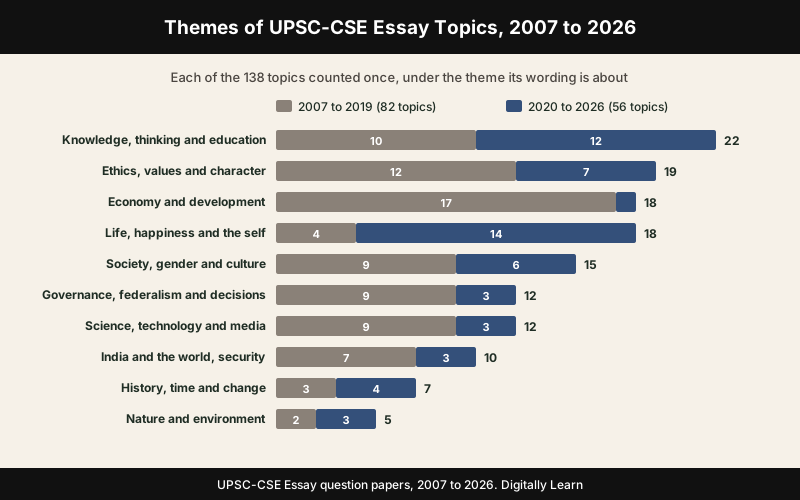
- Knowledge, thinking and education: 22 topics, 10 before 2020 and 12 since; most recently "A well-educated mind will always have more questions than answers" (2026).
- Ethics, values and character: 19 topics, 12 before 2020 and 7 since; most recently "Shelving hard decisions is the least ethical course" (2026).
- Economy and development: 18 topics, 17 before 2020 and 1 since; most recently "There can be no social justice without economic prosperity but economic prosperity without social justice is meaningless" (2020).
- Life, happiness and the self: 18 topics, 4 before 2020 and 14 since; most recently "A thorn is a changed bud" (2026).
- Society, gender and culture: 15 topics, 9 before 2020 and 6 since; most recently "A society that has more justice is a society that needs less charity" (2023).
- Governance, federalism and decisions: 12 topics, 9 before 2020 and 3 since; most recently "A good leader is one who follows the followers" (2026).
- Science, technology and media: 12 topics, 9 before 2020 and 3 since; most recently "Social media is Triggering 'Fear of Missing Out' amongst the youth, precipitating depression and loneliness" (2024).
- India and the world, security: 10 topics, 7 before 2020 and 3 since; most recently "When two elephants fight, it is the grass that gets trampled" (2026).
- History, time and change: 7 topics, 3 before 2020 and 4 since; most recently "The years teach much which the days never know" (2025).
- Nature and environment: 5 topics, 2 before 2020 and 3 since; most recently "Nature is the symbol of the spirit" (2026).
Do UPSC Essay Topics Repeat?
No topic has been set twice: all 138 topics from 2007 to 2026 are different. Themes and even images do repeat, which is why older papers are still worth reading.
- Forests: "Forests are the best case studies for economic excellence" (2022) and "Forests precede civilizations and deserts follow them" (2024).
- Ships: "Ships do not sink because of water around them, ships sink because of water that gets into them" (2020) and "A ship in harbour is safe, but that is not what ship is for" (2022).
- Social media: "Social media is inherently a selfish medium" (2017) and "Social media is Triggering 'Fear of Missing Out' amongst the youth, precipitating depression and loneliness" (2024).
- History: "Geography may remain the same; history need not" (2010), "History repeats itself, first as a tragedy, second as a farce" (2021) and "History is a series of victories won by the scientific man over the romantic man" (2022).
- Learning and education: "Education without values, as useful as it is, seems rather to make a man more clever devil" (2015), "Destiny of a nation is shaped in its classrooms" (2017), "Education is what remains after one has forgotten what one has learned in school" (2023) and "A well-educated mind will always have more questions than answers" (2026).
How to Use Previous Years' Essay Topics for Practice
Choosing Essay Topics for UPSC Practice
Previous years' topics are the best practice material you have, provided you use them the way the exam does. The recent papers matter most, because the papers before 2014 asked for one essay on a named issue, a task the exam no longer sets.
- Start with the recent papers: Take topics from 2020 to 2026, which match the current mix of topics.
- Practise in pairs: Write one essay from Section A and one from Section B in a single three-hour sitting, as the exam requires.
- Decode the line first: Before writing, restate the quotation as a plain question, and note where it holds and where it fails.
- Collect examples by theme: Keep examples from history, science, governance, society and daily life under the ten themes above.
- Mine the older topics: Issue-based topics from 2007 to 2019 are good prompts for gathering facts and examples on policy and society.
For the marks, the official syllabus wording and how the paper is assessed, read the UPSC Essay paper guide. The GS Paper 4 guide is useful too, since ethics topics are one of the largest groups here, and the complete UPSC syllabus guide shows where the Essay sits among the nine Mains papers.
Common Questions About UPSC Essay Topics
How many essay topics are given in UPSC Mains?
Eight. Since 2014, the UPSC Mains essay topics have come in two sections of four, and you write one essay from each section, each worth 125 marks. Before 2014 the paper printed four to six topics and asked for one essay.
What essay topics were asked in UPSC 2026?
Eight quotation-style topics, including "A thorn is a changed bud", "When two elephants fight, it is the grass that gets trampled" and "A good leader is one who follows the followers". All eight are listed in the section on the 2025 and 2026 papers above.
Do UPSC essay topics repeat?
No topic has been repeated in the 138 topics set from 2007 to 2026. Themes do recur, such as education, forests, history and social media, so practising by theme is more useful than trying to predict topics.
Which essay topics should I practise first?
The recent ones, from 2020 to 2026. They match the current paper, in which almost every topic is a quotation or an abstract statement, and practising them in pairs builds the timing the exam needs.
What is the word limit for the UPSC essay?
The 2026 question paper asked for about 1,000 to 1,200 words for each essay. You write two essays in three hours.
Official Sources
- Union Public Service Commission: Civil Services (Main) Examination 2026, Essay question paper
- Union Public Service Commission: Civil Services (Main) Examination 2025, Essay question paper
- Union Public Service Commission: previous years' question papers
- Union Public Service Commission: Examination Notice No. 05/2026-CSE, Civil Services Examination 2026
- Union Public Service Commission: online registration and application portal
- Department of Personnel and Training: Gazette notifications (the Civil Services Examination Rules are notified here each year)
- Gazette of India: the Civil Services Examination Rules, which set the scheme of the examination, are notified here each year
- National Council of Educational Research and Training: school textbooks
- Wikipedia: Civil Services Examination
Editorial Disclaimer
Essay topics are reproduced as the Commission printed them. The grouping of topics into quotation-style and issue-based, and into themes, is Digitally Learn's own and is not published by the Commission. The question papers issued by the Commission are the final authority.