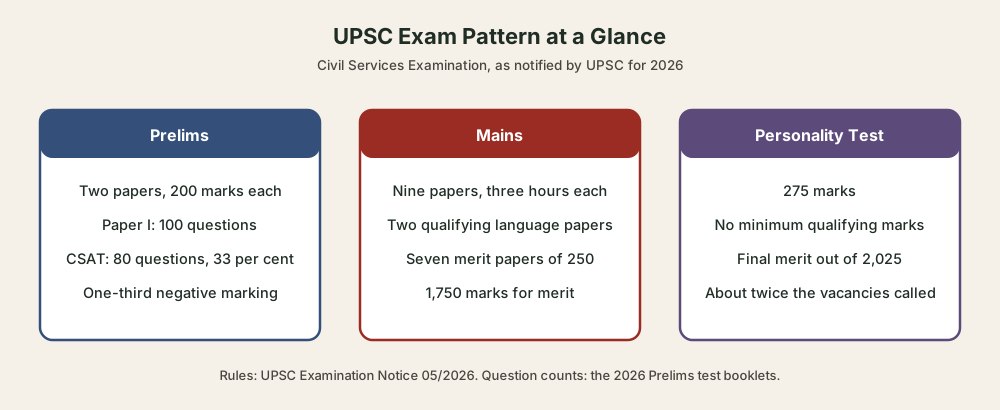
The UPSC exam pattern has three steps: a Preliminary Examination of two objective papers of 200 marks each, a Main Examination of nine written papers of which seven count for 1,750 merit marks, and a Personality Test of 275 marks. This guide sets out every paper, the negative marking rule and the tie-breaking rules from the official notice, and then uses UPSC's cut-offs and results to show what scores the pattern demands in practice.
Stages of the UPSC Civil Services Examination
Two Stages and Three Steps: Prelims, Mains and Personality Test
The UPSC exam pattern has two successive stages in the notice and three steps in practice. The Civil Services (Preliminary) Examination is an objective screening test. The Civil Services (Main) Examination has a written part of nine papers and an Interview or Personality Test, and only this second stage decides the rank.
| Step | Papers and marks | Counts for rank |
|---|---|---|
| Prelims: GS Paper I | 100 questions, two hours, 200 marks | No, screening only |
| Prelims: CSAT | 80 questions, two hours, 200 marks | No, qualifying at 33 per cent |
| Mains: Papers A and B | Two language papers, three hours each, 300 marks each | No, qualifying at 25 per cent |
| Mains: seven merit papers | Essay, GS I to IV and Optional 1 and 2, 250 marks each, 1,750 in all | Yes |
| Interview | Personality Test by a Board, 275 marks | Yes |
| Final merit | Seven merit papers and the interview, 2,025 marks | Rank and service |
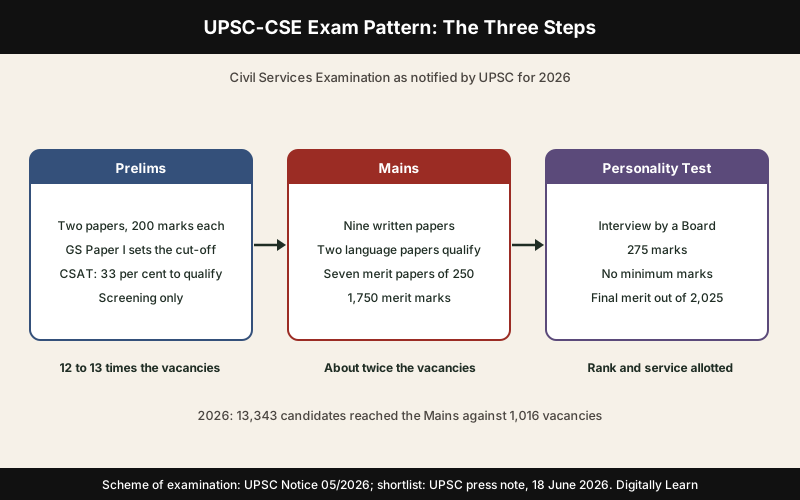
Each step is explained below with what its rules mean for your score: how negative marking works, how many correct answers the cut-off needs, and how much each paper counts in the final total.
Number of Candidates Admitted to Each Stage
The notice fixes the width of each gate in advance. About twelve to thirteen times the number of vacancies are admitted to the Main Examination, and about twice the number of vacancies are called for the Personality Test.
UPSC's own results match the rule. In the 2026 examination, 13,343 candidates were shortlisted for the Main Examination against 1,016 notified vacancies, which is 13.1 times. In 2025 the figures were 14,161 candidates against 1,087 vacancies, or 13.0 times. A Prelims aspirant is therefore competing for roughly thirteen places per vacancy, whatever the number of applicants.
UPSC Prelims Exam Pattern: Two Papers of 200 Marks
General Studies Paper I: 100 Questions and 200 Marks
Paper I is the paper that decides who reaches the Main Examination. The 2026 test booklet carries 100 questions for 200 marks in two hours, every question has four options, and all questions carry equal marks, which makes each one worth two marks. The paper is printed in Hindi and English.
The syllabus in the notice has seven heads, and the list below follows the notice closely. The UPSC Prelims syllabus guide shows how many questions each one has produced.
- Current events of national and international importance.
- History of India and Indian National Movement.
- Indian and World Geography: Physical, social and economic geography of India and the world.
- Indian Polity and Governance: Constitution, political system, Panchayati Raj, public policy, rights issues.
- Economic and Social Development: Sustainable development, poverty, inclusion, demographics, social sector initiatives.
- General issues on environmental ecology, biodiversity and climate change that do not require subject specialisation.
- General Science.
CSAT and the Final Merit: 80 Questions, Qualifying at 33 Per Cent
Paper II, widely called the CSAT (see the CSAT syllabus guide), carries 80 questions for 200 marks in two hours, so each question is worth two and a half marks. It is a qualifying paper with the minimum fixed at 33 per cent, which is 66 marks. The notice sets one figure for every category; there is no lower qualifying mark for any group.
- Comprehension.
- Interpersonal skills including communication skills.
- Logical reasoning and analytical ability.
- Decision making and problem solving.
- General mental ability.
- Basic numeracy and data interpretation (charts, graphs, tables, data sufficiency), both at Class X level.
The notice calls the Preliminary Examination a screening test only. Marks obtained in it are not counted for the final order of merit. UPSC draws the list for the Main Examination from candidates who score at least 33 per cent in Paper II, ranked by their marks in Paper I up to the cut-off that the Commission fixes that year.
Negative Marking in UPSC Prelims and the Guessing Arithmetic
The One-Third Penalty and What a Guess Is Worth
The notice sets three rules for marking answers in both Prelims papers:
- Wrong answer: One-third of the marks assigned to the question is deducted, which is about 0.67 of a mark in Paper I and about 0.83 of a mark in Paper II.
- More than one answer: Treated as a wrong answer, with the same penalty, even if one of the marked answers is correct.
- Blank: No penalty for a question left unanswered.
The same instruction is printed on the front page of both test booklets, so the penalty applies to the CSAT as much as to Paper I.
The one-third penalty has a precise effect. With four options, a blind guess is right one time in four: a quarter of two marks gained, against three quarters of 0.67 lost, which comes to exactly zero, so pure guessing neither helps nor hurts on average. The balance changes as soon as a candidate can rule options out.
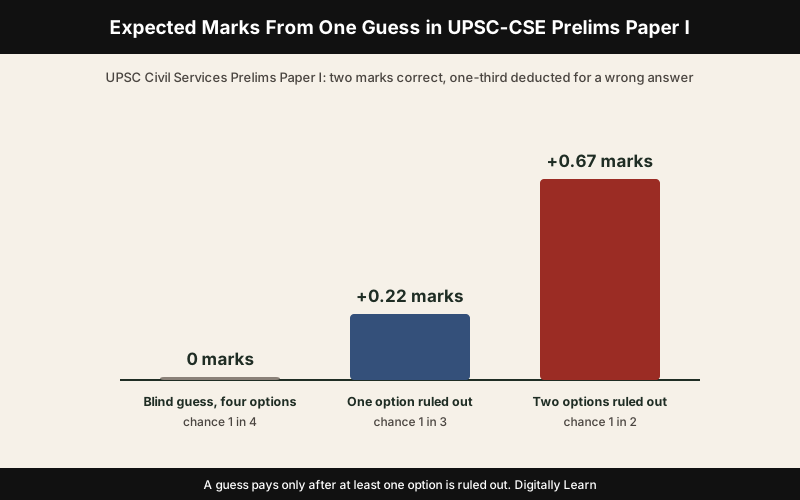
| Situation | Chance of being right | Expected marks |
|---|---|---|
| Blind guess among four options | 1 in 4 | 0 |
| One option ruled out | 1 in 3 | +0.22 |
| Two options ruled out | 1 in 2 | +0.67 |
Over twenty questions in which two options have been ruled out, the expected gain is about 13 marks, which is larger than the gap between the 2024 and 2025 cut-offs. An average is not a guarantee, and a run of bad luck is possible, but the arithmetic explains why elimination, and not blind guessing, is the skill that Prelims rewards.
How Many Correct Answers the Prelims Cut-off Needs
The table below asks a practical question of Paper I: for a given number of questions attempted, how many must be correct to reach the General category cut-off. It uses the official cut-offs of 87.98 for 2024 and 92.66 for 2025.
| Attempts | Correct needed (2024, 2025) | Accuracy (2025) |
|---|---|---|
| 60 | 48 and 50 | 83 per cent |
| 70 | 51 and 53 | 76 per cent |
| 80 | 53 and 55 | 69 per cent |
| 90 | 56 and 58 | 64 per cent |
| 100 | 58 and 60 | 60 per cent |
Two readings follow. Attempting more questions lowers the accuracy required, from 83 per cent at 60 attempts to 60 per cent at 100, but only if the extra attempts are better than blind guesses. And between 48 and 60 correct answers were enough in both years, depending on the attempts, which means the paper is cleared by getting a little over half of it right, not by knowing everything.
To work out a score by hand, multiply the correct answers by two and subtract two-thirds of a mark for each wrong answer in Paper I. In Paper II, multiply the correct answers by two and a half and subtract five-sixths of a mark for each wrong answer; 66 marks qualify.
CSAT Qualifying Arithmetic: 66 Marks
In Paper II each correct answer adds 2.5 marks and each wrong answer removes about 0.83. The number of correct answers needed for 66 marks therefore rises with every wrong answer.
| Wrong answers | Correct answers needed | Questions attempted |
|---|---|---|
| 0 | 27 | 27 |
| 10 | 30 | 40 |
| 20 | 34 | 54 |
| 30 | 37 | 67 |
A candidate who is accurate needs only 27 of the 80 questions. A candidate who attempts everything and gets 30 wrong needs 37 right. The paper does not count for rank, but a score below 66 makes the Paper I score irrelevant, so it deserves timed practice well before the examination.
UPSC Mains Exam Pattern: Nine Papers and 1,750 Merit Marks
UPSC Mains Marks Distribution, Paper by Paper
The written part of the Main Examination has nine papers of the conventional essay type, each of three hours. Two are qualifying language papers and seven are counted for merit.
| Paper | Subject | Marks |
|---|---|---|
| Paper A | One Indian language from the Eighth Schedule (qualifying) | 300 |
| Paper B | English (qualifying) | 300 |
| Paper I | Essay | 250 |
| Paper II | General Studies I: Indian heritage and culture, history and geography of the world and society | 250 |
| Paper III | General Studies II: governance, Constitution, polity, social justice and international relations | 250 |
| Paper IV | General Studies III: technology, economic development, biodiversity, environment, security and disaster management | 250 |
| Paper V | General Studies IV: ethics, integrity and aptitude | 250 |
| Paper VI | Optional subject, Paper 1 | 250 |
| Paper VII | Optional subject, Paper 2 | 250 |
| Written total | Papers I to VII | 1,750 |
| Personality Test | 275 | |
| Grand total | 2,025 |
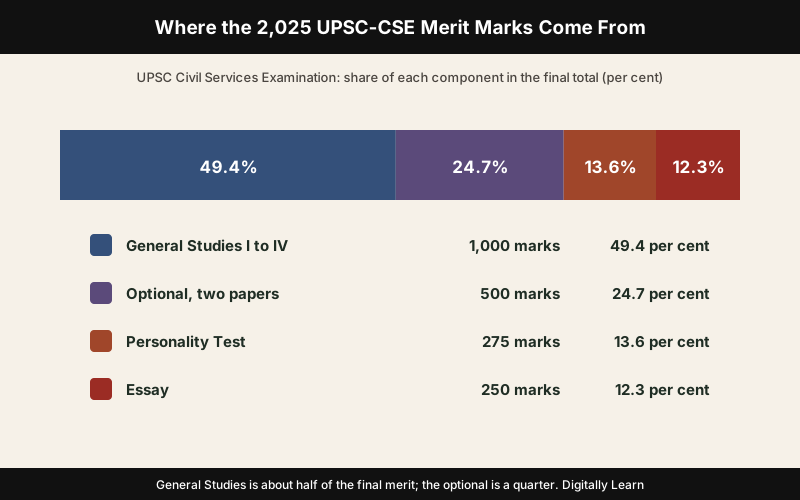
The four General Studies papers carry 1,000 marks, which is 49.4 per cent of the final total. The optional subject carries 500 marks, or 24.7 per cent: one subject chosen by the candidate weighs as much as two General Studies papers. The Personality Test is 13.6 per cent and the Essay 12.3 per cent.
Each Mains paper has its own guide: GS Paper 1, GS Paper 2, GS Paper 3 and GS Paper 4, with the syllabus in full and what each has asked.
Qualifying Language Papers and the 25 Per Cent Rule
Papers A and B are of Matriculation standard and their marks are not counted for ranking. A candidate must score at least 25 per cent in each, which is 75 marks out of 300. UPSC evaluates all papers together, but it takes the Essay, General Studies and Optional papers into account only for candidates who clear both language papers.
Paper A is not compulsory for candidates hailing from Arunachal Pradesh, Manipur, Meghalaya, Mizoram, Nagaland and Sikkim. It is also not compulsory for candidates with a benchmark disability in the hearing impairment sub-category who were exempted from second or third language courses by their Board or University, on a self-declaration to the Commission.
Medium of Answers, Scripts and Conduct Rules in Mains
- Medium: All papers other than the two language papers may be answered in English or in any one language of the Eighth Schedule; a candidate who chooses such a language may still write the optional papers in English.
- Question papers: Set in Hindi and English only, except the literature papers.
- Technical terms: An English version may be given in brackets beside the term, and misuse of this rule attracts a deduction.
- Identity marks: Irrelevant matter, signs or marks that could disclose identity lead to a deduction of marks or to the script not being evaluated.
- Handwriting: A deduction is made if the handwriting is not easily legible, and credit is given for orderly, effective and exact expression with due economy of words.
- Calculators: Scientific, non-programmable calculators are allowed in the conventional papers and are not permitted in the objective papers of Prelims.
- Scribe and extra time: Candidates with specified benchmark disabilities may use a scribe and receive compensatory time of twenty minutes per hour.
Optional Subjects: Official List and Candidate Choices
25 Optional Subjects, 23 Literatures and What Candidates Choose
A candidate chooses one optional subject, examined in two papers. The notice lists 25 subjects: Agriculture; Animal Husbandry and Veterinary Science; Anthropology; Botany; Chemistry; Civil Engineering; Commerce and Accountancy; Economics; Electrical Engineering; Geography; Geology; History; Law; Management; Mathematics; Mechanical Engineering; Medical Science; Philosophy; Physics; Political Science and International Relations; Psychology; Public Administration; Sociology; Statistics; and Zoology.
The alternative is the literature of one language from a list of 23: Assamese, Bengali, Bodo, Dogri, Gujarati, Hindi, Kannada, Kashmiri, Konkani, Maithili, Malayalam, Manipuri, Marathi, Nepali, Odia, Punjabi, Sanskrit, Santhali, Sindhi, Tamil, Telugu, Urdu and English.
UPSC's 74th Annual Report gives, for the 2022 examination, the number of candidates who wrote each optional and the number finally recommended. The eight subjects with the most candidates are shown below.
| Optional subject | Appeared, recommended, success rate |
|---|---|
| Political Science and International Relations | 2,378 appeared, 187 recommended (7.9 per cent) |
| Sociology | 1,836 appeared, 143 recommended (7.8 per cent) |
| Anthropology | 1,800 appeared, 139 recommended (7.7 per cent) |
| Geography | 1,260 appeared, 94 recommended (7.5 per cent) |
| Mathematics | 839 appeared, 53 recommended (6.3 per cent) |
| History | 636 appeared, 38 recommended (6.0 per cent) |
| Public Administration | 521 appeared, 46 recommended (8.8 per cent) |
| Philosophy | 380 appeared, 29 recommended (7.6 per cent) |
Two things stand out. The four most popular optionals all returned between 7.5 and 7.9 per cent, close to the overall rate of 8.0 per cent, so popularity by itself neither helps nor harms. And the report records that 84.1 per cent of the optionals taken by recommended candidates were from the humanities, although 53.1 per cent of those candidates were engineers: most successful candidates chose a subject outside their degree.
Personality Test: 275 Marks and the Qualities Assessed
Purpose and Method of the Interview
The Personality Test carries 275 marks with no minimum qualifying marks. A Board that has the candidate's record before it asks questions on matters of general interest, to assess personal suitability for a career in public service. The notice describes it as a natural, directed and purposive conversation, not a strict cross-examination, and not a test of specialised or general knowledge, which the written papers have already tested.
The qualities named in the notice are mental alertness, critical powers of assimilation, clear and logical exposition, balance of judgement, variety and depth of interest, ability for social cohesion and leadership, and intellectual and moral integrity. Candidates are expected to have taken an intelligent interest in events within and outside their own State and country.
Final Merit of 2,025 Marks, Cut-offs and Tie-breaking
UPSC Cut-off Marks for 2024 and 2025 by Category
After each examination UPSC publishes the marks of the last recommended candidate in each category at each stage. The Prelims figure is out of 200 (Paper I only), the Mains figure out of 1,750 and the final figure out of 2,025.
| Group | Prelims (of 200) | Mains (of 1,750) | Final (of 2,025) |
|---|---|---|---|
| General | 92.66 | 739 | 963 |
| EWS | 89.34 | 706 | 926 |
| OBC | 92 | 717 | 931 |
| SC | 84 | 700 | 905 |
| ST | 82.66 | 694 | 902 |
| Group | Prelims (of 200) | Mains (of 1,750) | Final (of 2,025) |
|---|---|---|---|
| General | 87.98 | 729 | 947 |
| EWS | 85.92 | 696 | 917 |
| OBC | 87.28 | 702 | 910 |
| SC | 79.03 | 685 | 880 |
| ST | 74.23 | 684 | 884 |
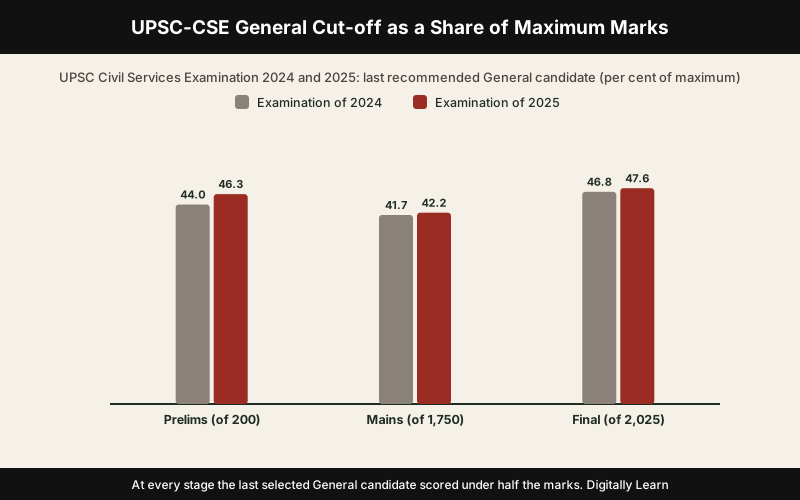
Converted to percentages, the General cut-off in 2025 was 46.3 per cent at Prelims, 42.2 per cent at Mains and 47.6 per cent in the final total. In 2024 the three figures were 44.0, 41.7 and 46.8 per cent.
The Main Examination cut-off also carries a condition: a candidate must secure at least 10 per cent in each of the seven merit papers. The practical lesson is balance. A Mains average of about 106 out of 250 in every paper matched the 2025 written cut-off, and one neglected paper can undo six good ones.
Tie-breaking Rules in the Final List
- First: The candidate with more marks in the compulsory papers (Essay and General Studies I to IV) and the Personality Test put together ranks higher.
- Second: If still equal, the candidate with more marks in the compulsory papers alone ranks higher.
- Third: If still equal, the candidate senior in age ranks higher.
- Last: A tie that persists is resolved at the discretion of the Commission.
The optional papers are absent from the tie-break. Between two candidates with the same total, the one who scored more in the papers common to everyone is placed above.
Common Questions About the UPSC Exam Pattern
How many papers are there in UPSC Prelims and Mains?
Prelims has two papers, both objective, held on one day. The written Main Examination has nine papers, of which two are qualifying and seven are counted for merit. With the Personality Test, a candidate who goes the full distance is assessed for 2,025 marks.
Are the CSAT qualifying marks the same for every category?
The qualifying mark in Paper II is 33 per cent, or 66 marks out of 200, for every category. The notice gives no separate figure for OBC, SC, ST, EWS or PwBD candidates, and wrong answers in the CSAT carry the same one-third penalty.
How many marks are needed for IAS, IPS and IFS?
UPSC publishes the marks of the last recommended candidate in each category, not a cut-off for each service. The service depends on the candidate's rank, the preferences entered and the vacancies in that category, so the marks that secured the IAS in one year are not a fixed target. The final cut-offs above show the minimum for a place in the list; the top services go to the ranks well above it.
Is there negative marking in UPSC Prelims?
Yes, in both papers. One-third of the marks for a question is deducted for each wrong answer, about 0.67 of a mark in General Studies Paper I and about 0.83 in CSAT; marking more than one answer counts as wrong, and a question left blank costs nothing.
Will the UPSC exam pattern change for 2027?
The pattern on this page is the one in the 2026 notice. UPSC's programme for 2027 lists the notification for 13 January 2027 and the Preliminary Examination for 23 May 2027, and the pattern for that year will be the one printed in that notice. Eligibility rules are covered in the guide on the UPSC age limit and number of attempts.
Official Sources
- Union Public Service Commission: Examination Notice No. 05/2026-CSE, Civil Services Examination 2026
- Union Public Service Commission: Civil Services Examination 2025, minimum qualifying marks
- Union Public Service Commission: Civil Services Examination 2024, minimum qualifying marks
- Union Public Service Commission: Civil Services (Preliminary) Examination 2026, General Studies Paper I test booklet
- Union Public Service Commission: Civil Services (Preliminary) Examination 2026, General Studies Paper II test booklet
- Union Public Service Commission: press note of 18 June 2026, result of the Civil Services (Preliminary) Examination 2026
- Union Public Service Commission: 74th Annual Report 2023-24 (Appendix 9, profile of candidates, Civil Services Examination 2022)
- Union Public Service Commission: Programme of Examinations and Recruitment Tests 2027
- Department of Personnel and Training: Gazette notifications (the Civil Services Examination Rules are notified here each year)
- Legislative Department, Ministry of Law and Justice: The Constitution of India (Eighth Schedule, languages)
- Department of Empowerment of Persons with Disabilities: Rights of Persons with Disabilities Act, 2016, rules and guidelines
- Union Public Service Commission: online registration and application portal
- Wikipedia: Civil Services Examination
Editorial Disclaimer
This guide explains the scheme of examination in the official notice for the Civil Services Examination, with cut-offs and statistics published by the Commission. The notice and the examination rules published in the Gazette of India are the final authority, and the scheme for a later year applies only as the Commission notifies it.