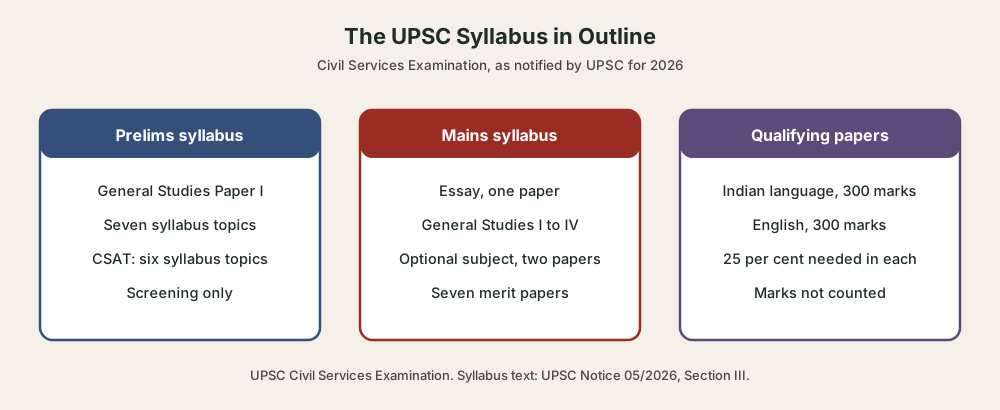
The UPSC syllabus is printed in Section III of the Commission's examination notice, and it is far shorter than most candidates expect. The Prelims General Studies Paper I syllabus names just seven topics, and the CSAT six. Each of the four General Studies papers at the Main Examination runs to between 238 and 330 words. Everything else that circulates as a UPSC CSE syllabus is somebody's expansion of that text. The official syllabus follows in full, paper by paper, with how often each topic has actually been asked.
What the UPSC CSE Syllabus Covers: Prelims, Mains and the Interview
UPSC Exam Stages and Which Marks Count for the Rank
The Civil Services Examination has two stages in the notice and three steps in practice. The Preliminary Examination is a screening test. The Main Examination has nine written papers, and the Personality Test follows for those who clear them. Only the second stage decides the rank, so the syllabus matters twice: once to get through the screening test, and again to decide where a candidate finishes.
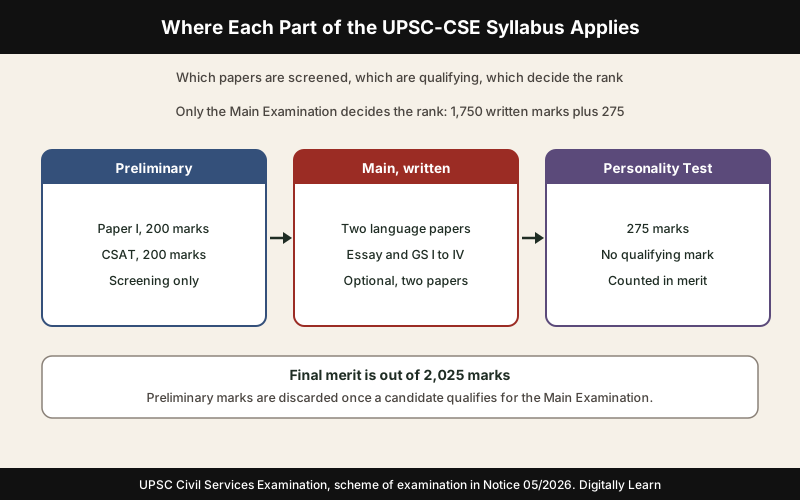
Preliminary marks are discarded once a candidate qualifies, so the Prelims syllabus decides whether a candidate continues and nothing else. The Main Examination carries 1,750 marks across seven papers, the Personality Test carries 275, and the final merit is out of 2,025. The marks themselves are set out in the guide on the UPSC exam pattern.
Of the nine written papers at the Main Examination, two are language papers that a candidate must pass but whose marks are never counted. Paper A is an Indian language from the Eighth Schedule to the Constitution and Paper B is English, each of 300 marks, each needing 25 per cent. Failing either means the rest of the papers are not evaluated at all.
The seven papers that count are the Essay, General Studies I, II, III and IV, and two papers on one optional subject. Each carries 250 marks. A candidate therefore writes about the whole General Studies syllabus for 1,000 marks and about one optional subject for 500.
The Preliminary and Main syllabuses overlap in subject names and differ completely in demand. Prelims lists broad subjects for an objective paper that only screens. Mains names specific themes for written answers, and adds material that never appears in Prelims at all, such as ethics, case studies and answer writing itself.
UPSC Prelims Syllabus: General Studies Paper I Topics in Full
Official UPSC Prelims GS Paper I Syllabus Text
This is the complete General Studies Paper I syllabus, exactly as the Commission prints it. The paper carries two hundred marks, lasts two hours, and its syllabus names just seven topics.
- Current events of national and international importance.
- History of India and Indian National Movement.
- Indian and World Geography-Physical, Social, Economic Geography of India and the World.
- Indian Polity and Governance-Constitution, Political System, Panchayati Raj, Public Policy, Rights Issues, etc.
- Economic and Social Development-Sustainable Development, Poverty, Inclusion, Demographics, Social Sector Initiatives, etc.
- General issues on Environmental ecology, Bio-diversity and Climate Change - that do not require subject specialization.
- General Science.
Read the list closely and three things stand out. The first topic, current events, has no limit of time or subject. Three topics end in the word etc., which means the list is open rather than complete. And the last topic is just two words, General Science, with no indication of level or scope.
Subject-wise Weightage in UPSC Prelims, 2011 to 2025
The syllabus tells a candidate what may be asked, but not how often. From 2011 to 2025, Preliminary General Studies Paper I asked 1,500 questions, and 1,494 of them fall under one of the seven syllabus topics. The other six were on international relations or sport, which the Preliminary syllabus does not name separately.
| Syllabus topic | Questions | Average a year | 2011 to 2015 | 2021 to 2025 | Shift |
|---|---|---|---|---|---|
| Economic and Social Development | 299 | 19.9 | 19.0 | 17.0 | -2.0 |
| Environmental ecology, Bio-diversity and Climate Change | 274 | 18.3 | 20.2 | 16.6 | -3.6 |
| History of India and Indian National Movement | 250 | 16.7 | 17.4 | 15.0 | -2.4 |
| Indian Polity and Governance | 216 | 14.4 | 13.8 | 15.2 | +1.4 |
| General Science | 205 | 13.7 | 13.8 | 13.6 | -0.2 |
| Indian and World Geography | 168 | 11.2 | 12.6 | 13.6 | +1.0 |
| Current events of national and international importance | 82 | 5.5 | 3.2 | 8.0 | +4.8 |
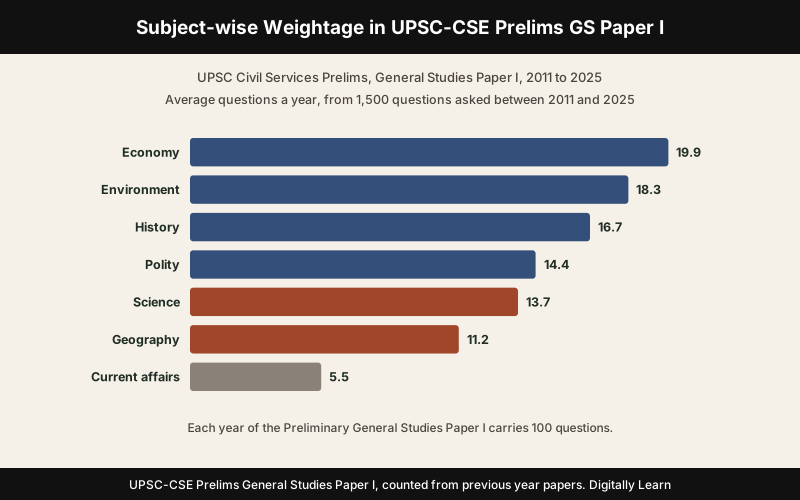
Economic and Social Development is the most heavily tested topic at 19.9 questions a year, and environment follows at 18.3. History carries 16.7 and polity 14.4. Geography, at 11.2, is the lightest of the traditional subjects.
Rising and Falling Subjects in UPSC Prelims: 2011-2015 and 2021-2025
The syllabus text has not changed in fifteen years, but the paper has. Comparing the first five years, 2011 to 2015, with the last five, 2021 to 2025, shows the Commission moving questions between subjects without altering a word of the syllabus.
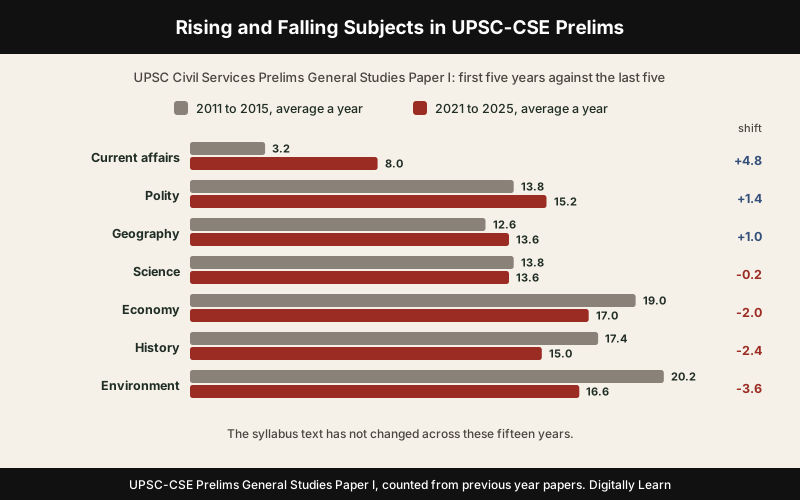
Current events has more than doubled, from 3.2 questions a year to 8.0. That is the largest change in the paper, and it falls on the one topic the syllabus does not limit at all. Environment has fallen by 3.6 questions a year, history by 2.4 and economy by 2.0. Polity and geography have each risen by about one.
General Science in UPSC Prelims: What Is Asked
General Science is the shortest topic in the syllabus and one of the hardest to prepare. It is two words long, and the notice gives no level and no list. In practice it has carried 205 questions since 2011, about 13.7 a year, and it has been the steadiest of the seven topics: it has moved by 0.2 of a question a year across fifteen years.
Of those questions, 97 test school-level science, biology, health, genetics, physics and chemistry. The rest turn on applied technology: launch vehicles and satellites, biotechnology regulation, telecommunications, semiconductors, nuclear power. The Commission almost always asks the school concept through a current application, which is why a candidate who reads only the technology news struggles with the reasoning and a candidate who reads only the textbook struggles with the framing.
The safest way to prepare it is the school science textbooks for the concepts and the year's science news for the context. Our Study Library covers both.
UPSC CSAT Syllabus: The Qualifying General Studies Paper II
Official CSAT Syllabus and the 33 Per Cent Qualifying Mark
General Studies Paper II, commonly called the CSAT, carries 200 marks over two hours, and its syllabus lists six topics.
- Comprehension;
- Interpersonal skills including communication skills;
- Logical reasoning and analytical ability;
- Decision making and problem solving;
- General mental ability;
- Basic numeracy (numbers and their relations, orders of magnitude, etc.) (Class X level), Data interpretation (charts, graphs, tables, data sufficiency etc., Class X level);
Two notes in the notice govern this paper, and both matter more than its syllabus. The paper is qualifying at 33 per cent, which is 66 marks of 200. And a candidate must appear in both Preliminary papers to be evaluated at all: missing the CSAT disqualifies the candidate even if General Studies Paper I was written well.
Why the Qualifying CSAT Paper Still Eliminates Candidates
A paper that does not add to the score is easy to treat as a paper that does not matter. It is the reverse. A candidate who clears the General Studies cut-off and misses 66 in the CSAT is out of the examination for that year, and an attempt is spent. The paper cannot raise a rank, but it can end a candidature, which is why it should never be left to chance.
The syllabus itself explains why the paper catches people out. Comprehension and basic numeracy are described as Class X level, but the difficulty of a CSAT paper lies in reading speed and the density of the passages rather than in the mathematics. A candidate out of practice with sustained reading can know every concept in the syllabus and still miss the qualifying mark.
Across the CSAT papers set since 2011, some 1,195 questions in all, the paper is dominated by comprehension passages and by reasoning closer to puzzle-solving than to arithmetic. Basic numeracy and data interpretation appear reliably but rarely account for most of the paper.
The marks never reach the final merit list: the CSAT is qualifying at 33 per cent and its score is added to nothing. Even so, the practical target is not 33 per cent but a clear margin above it, because comprehension accuracy is the part of the paper a candidate controls least on the day. The UPSC Prelims Test Series 2027 includes CSAT papers set to the same pattern, with every option explained.
UPSC Mains Syllabus: Four General Studies Papers and the Essay
UPSC Mains GS Papers I to IV: What Each Paper Covers
The four General Studies papers carry 1,000 of the 1,750 marks that decide a rank, and each has its own character as well as its own subjects. Knowing which paper a topic belongs to is most of the work, because the same topic can be asked very differently across two of them.
- General Studies I: The broadest of the four in period and in geography: Indian culture from ancient times, modern Indian history from the middle of the eighteenth century, the freedom struggle, post-independence consolidation, world history, Indian society and physical geography.
- General Studies II: The most institutional of the four: the Constitution and the separation of powers, the functioning of Parliament, the judiciary and the executive, welfare schemes, the social sector, and India's relations with its neighbours and the wider world.
- General Studies III: The widest spread of unrelated subjects: the Indian economy, agriculture, science and technology, biodiversity and environment, disaster management and internal security.
- General Studies IV: The only paper whose syllabus states its own method. The notice says it will test approach and attitude through problems, and about half the paper is case studies.
| Paper | What the syllabus covers | Questions asked |
|---|---|---|
| General Studies I | Heritage and culture, history and geography of the world and society | 294 |
| General Studies II | Governance, Constitution, polity, social justice and international relations | 285 |
| General Studies III | Technology, economic development, biodiversity, environment, security and disaster management | 285 |
| General Studies IV | Ethics, integrity and aptitude | 252 |
Each of the four General Studies papers has a guide of its own, built the same way: the official syllabus in full, then what the paper has actually asked. See General Studies I, II, III and IV.
UPSC Essay Paper Syllabus and the Official Instructions
The Essay paper carries 250 marks and the entire official syllabus for it is forty-five words. It is worth reading them, because they state the marking priorities plainly and most candidates never see them.
Three instructions sit inside those words: keep closely to the subject, arrange the ideas in order, and write concisely. The notice adds that credit is given for effective and exact expression. None of that is about the topic, and all of it is about the writing.
How to Read the UPSC Syllabus and Build a Reading List
Topics Ending in 'Etc.': How Far the Syllabus Extends
Three Preliminary topics end in etc.: polity and governance, economic and social development, and basic numeracy. The word matters. It tells a candidate that the list is illustrative rather than closed, and it is the reason two published syllabus breakdowns for the same examination can differ by a hundred topics.
The useful response is neither to ignore the word nor to treat it as endless. A topic belongs inside an etc. if it sits in the same family as the items named before it. Panchayati Raj is named under polity; municipal governance is not, but it plainly belongs to the same family. Election law does too. The monetary policy framework does not belong to polity at all; it falls under economic development.
The notice states the standard of the General Studies papers in its own words, and the sentence is a ceiling as much as a description. It says the questions will be such that a well-educated person can answer them without specialised study.
A candidate can use that sentence as a test. If a preparation resource teaches a level of detail that a well-educated non-specialist could not reach, it has gone beyond the syllabus, whatever its cover says. No other sentence in the notice is as useful for deciding how deep to read.
Turning the UPSC Syllabus Into a Reading List
The method that works is simple, and it takes four steps for each of the seven Prelims topics.
- Take one syllabus topic and write out everything it names.
- Add the topics that sit in the same family as the named ones.
- Find the shortest authoritative source for each topic.
- Read that source rather than a summary of it.
Applied to polity, that gives the Constitution, the political system, Panchayati Raj, public policy and rights issues as the named topics, and then the institutions that run them. The authoritative sources are the bare text of the Constitution, the polity articles in our Study Library and the standard school textbooks for the underlying concepts.
Doing this once for each of the seven Prelims topics produces a reading list you can check against the notice, which is safer than a list borrowed from somebody else. The guides to the Prelims paper, the CSAT paper, the Essay and General Studies I, II, III and IV do exactly that, one paper at a time.
Common Questions About the UPSC Syllabus
Does the UPSC syllabus change every year?
No. The syllabus has been stable for years, and the text on this page is the one printed in the notice for 2026. No notification for the 2027 Civil Services Examination has been published yet, so no separate UPSC syllabus 2027 exists. UPSC's published programme lists the 2027 notification for 13 January 2027 and the Preliminary Examination for 23 May 2027, and this page will be updated when that notice appears.
How do you download the UPSC syllabus PDF?
The only UPSC syllabus PDF worth downloading is the Commission's own. The syllabus is Section III of the examination notice, published as Examination Notice 05/2026-CSE, with the syllabus beginning on page 32. The link is in the sources at the foot of this page.
An unofficial PDF can be out of date, can quietly expand the syllabus, and cannot be checked against anything. The notice can. If a PDF disagrees with the notice, the notice wins.
Section III runs to dozens of pages, but almost all of that is the optional subjects and the literature papers, and a candidate reads only the one they have chosen. The General Studies syllabus that applies to every candidate is six pages: seven topics for Prelims Paper I, six for the CSAT, the Essay paragraph, and about a page for each of the four General Studies papers.
Is the IAS syllabus the same as the UPSC syllabus?
Yes. There is no separate IAS syllabus. The Indian Administrative Service is one of the services filled through the Civil Services Examination, and every candidate for every service in that examination writes the same papers from the same syllabus. Service allocation happens after the result, on rank and preference, not through a different paper. The same is true of the Indian Police Service and the other services filled through this examination.
Is the UPSC syllabus the same as a state PCS syllabus?
No, although they often look similar. Each state public service commission sets and publishes its own syllabus in its own notice, and while many are modelled on the UPSC pattern of a screening paper followed by written papers, they add material specific to that state and can differ in the number of papers, the marks and the qualifying rules. Preparation overlaps heavily, but the authority for a state examination is that commission's notice and never this one.
How many subjects are in the UPSC syllabus?
The syllabus is written as a list of topics rather than a list of subjects, which is why no two counts agree. At Prelims, General Studies Paper I names seven topics and the CSAT six. At Mains there are four General Studies papers, the Essay, and two papers on one optional subject the candidate chooses.
Why is the UPSC syllabus so vast?
Most of the apparent vastness comes from two features of the text rather than from the number of topics. Three Prelims topics end in etc., which leaves the list open, and the first topic, current events, has no limit of time or subject at all. Everything else is bounded and short. The syllabus that applies to every candidate is six pages, and the breakdowns that run to hundreds of topics are somebody's reading of those six.
Which subject carries the most questions in UPSC Prelims?
Economic and Social Development carries the most, at 19.9 questions a year across 2011 to 2025, followed by environment at 18.3. The lightest of the traditional subjects is geography at 11.2. Current events carries 5.5 on average but has risen to 8.0 in the last five years.
Official Sources
- Union Public Service Commission: Examination Notice No. 05/2026-CSE, Civil Services Examination 2026
- Union Public Service Commission: Programme of Examinations and Recruitment Tests 2027
- Union Public Service Commission: Civil Services Examination 2025, minimum qualifying marks
- Union Public Service Commission: 74th Annual Report 2023-24 (Appendix 9, profile of candidates, Civil Services Examination 2022)
- Legislative Department, Ministry of Law and Justice: The Constitution of India (Eighth Schedule, languages)
- Department of Personnel and Training: Gazette notifications (the Civil Services Examination Rules are notified here each year)
- National Council of Educational Research and Training: school textbooks, the standard reading for several syllabus topics
- Union Public Service Commission: online registration and application portal
- Wikipedia: Civil Services Examination
Editorial Disclaimer
The syllabus on this page is reproduced from the Commission's current examination notice, with the notice's dashes replaced by commas and colons for readability. The notice published in the Gazette of India is the final authority, and the syllabus for a later year applies only as the Commission notifies it.