


Overview
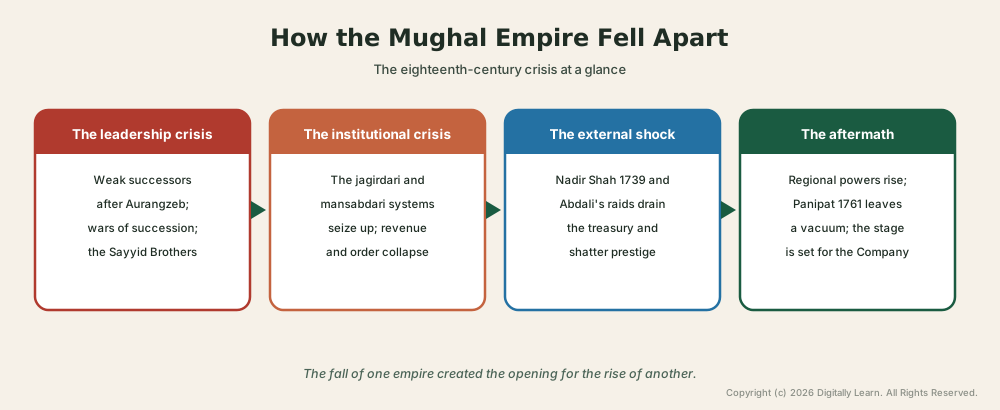
The decline of the Mughal Empire is the long crisis through which the greatest power in early-modern India came apart after the death of Aurangzeb in 1707. A line of weak successors, ruinous wars of succession, a structural jagirdari crisis and a weakening economy hollowed out the centre, while the invasions of Nadir Shah in 1739 and Ahmad Shah Abdali, ending at the Third Battle of Panipat in 1761, shattered its prestige. As the empire fragmented into regional powers, it opened the political vacuum that the English East India Company would eventually fill.
Introduction: The Meaning and Scope of Modern Indian History
Where Modern Indian History Begins
Why this matters: the decline of the Mughal Empire is where the story of modern India opens. The eighteenth century was the hinge between the medieval and the modern order, the period in which a great centralised empire dissolved and a new set of powers, including a European trading company, contended for what was left.
What is the significance of this period: it explains how the political ground was prepared for colonial conquest. The empire did not fall to a single blow; it came apart through a long crisis of leadership, revenue and authority, and historians still debate whether the age was a dark age of disorder or a creative transition that gave rise to vibrant regional states.
The Causes of Mughal Decline: Aurangzeb's Legacy and the Weak Successors
The Long Reign of Aurangzeb and the Feeble Successors
What is the significance of Aurangzeb's reign: it left the empire overstretched. His long campaigns in the Deccan exhausted the treasury and the army, while his religious and political policies strained the loyalties that had held the empire together. When he died in 1707, no strong hand remained to manage the inheritance.
Distinguishing the leadership failure: the later Mughals were a procession of weak emperors raised up and pulled down by court factions. The Sayyid Brothers became kingmakers who made and unmade rulers between 1713 and 1720, and bloody wars of succession drained the centre at the very moment it needed strength, as the causes below set out.
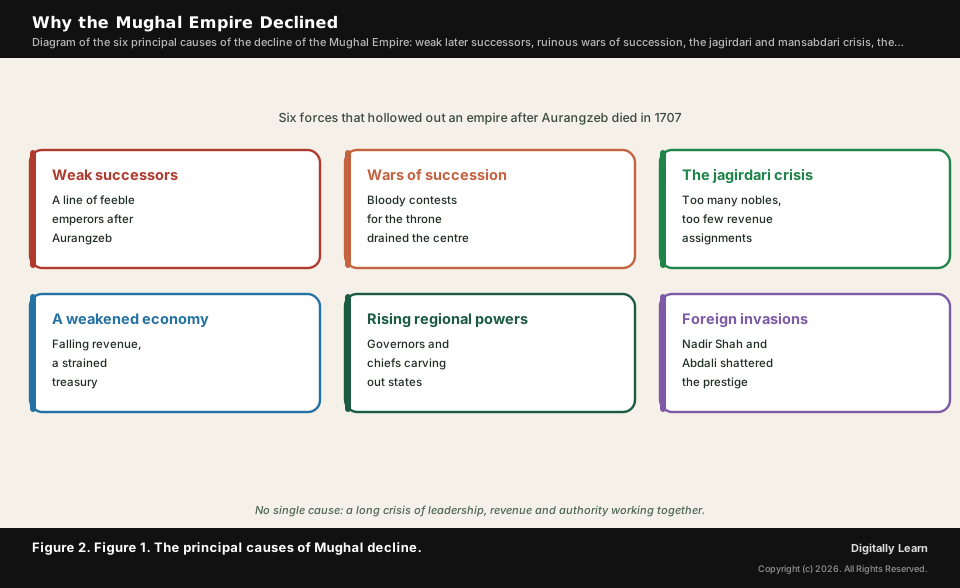
A Procession of Later Mughals
Observable outcomes can be read in the reigns themselves. Bahadur Shah I, Jahandar Shah and Farrukhsiyar followed in quick and unstable succession, and even the long reign of Muhammad Shah only watched the provinces drift away. The table below traces the descent.
Distinguishing the pattern: each weak reign deepened the same disorder. The court split into factions, the treasury emptied, and powerful governors learned that they could rule their provinces with little reference to Delhi, so that royal authority shrank even where the emperor's name was still read in the Friday prayers and stamped on the coinage.
| Emperor | Reign | Significance |
|---|---|---|
| Aurangzeb | 1658 to 1707 | The last of the strong emperors; the Deccan wars overstretched the empire |
| Bahadur Shah I | 1707 to 1712 | A brief, conciliatory reign; the decline sets in |
| Jahandar Shah | 1712 to 1713 | A short reign ended by the rise of the Sayyid Brothers |
| Farrukhsiyar | 1713 to 1719 | A puppet of the Sayyid Brothers, the kingmakers |
| Muhammad Shah | 1719 to 1748 | A long, weak reign; provinces break away and Nadir Shah invades |
| Shah Alam II | 1759 to 1806 | Reigns through Panipat and Buxar; the empire is a shadow |
The Jagirdari and Mansabdari Crisis Explained
How the Empire Ran Out of Land to Pay Its Nobles
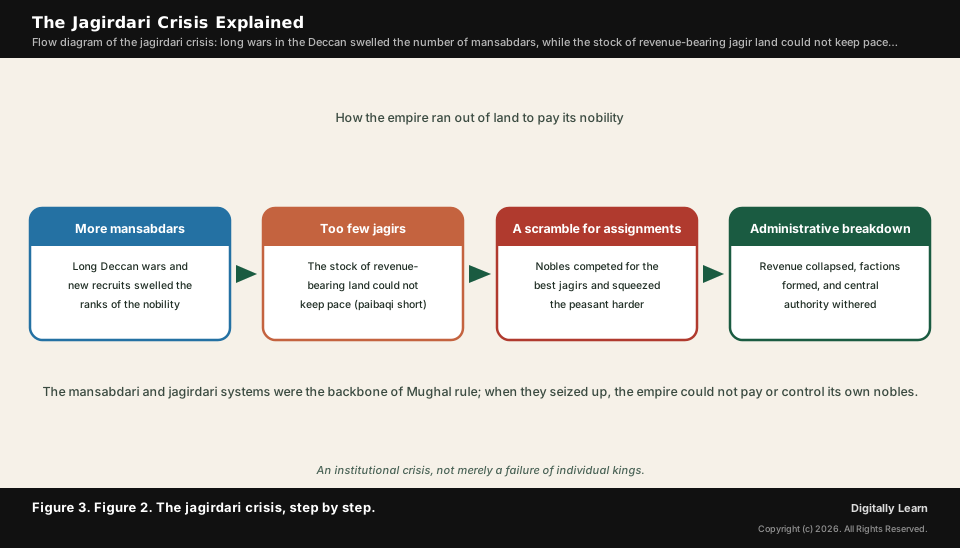
What is the significance of the jagirdari crisis: it was the structural rot beneath the political drama. The mansabdari system ranked the nobility and paid most of them through jagirs, assignments of the revenue of a piece of land, rather than in cash. The whole order depended on there being enough revenue-bearing land to go round.
Distinguishing the mechanism: long wars and fresh recruitment swelled the number of mansabdars, while the stock of assignable land could not keep pace, a shortage of reserve or paibaqi land. Nobles scrambled for the best jagirs, squeezed the peasant harder and fell into faction, and the revenue and administrative order broke down, as the flow below shows.
The Foreign Invasions: Nadir Shah and Ahmad Shah Abdali
Persia and Afghanistan Fall Upon a Hollow Empire
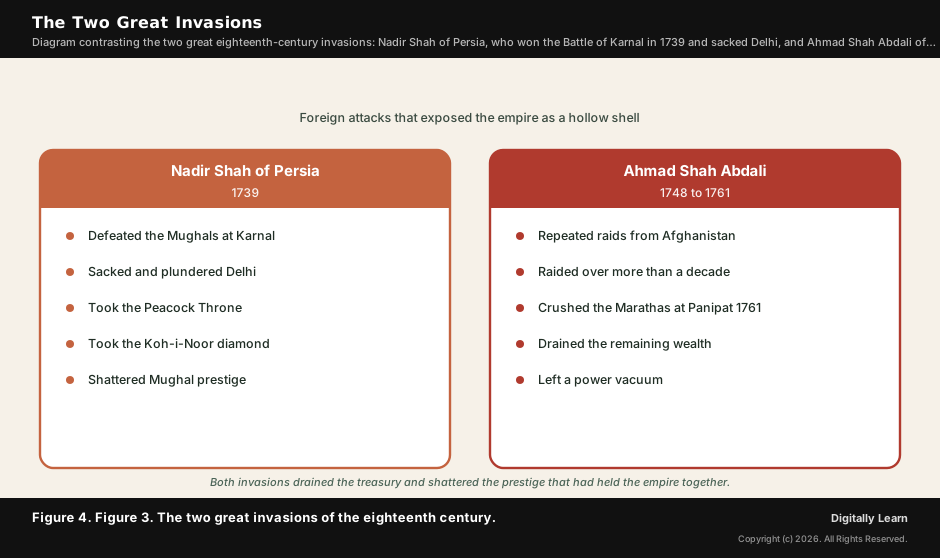
What is the significance of the invasions: they exposed to the world that the empire was a hollow shell. In 1739 Nadir Shah of Persia destroyed the Mughal army at the Battle of Karnal, sacked Delhi and carried off a fortune, including the Peacock Throne and the Koh-i-Noor diamond.
Distinguishing the second shock: from the late 1740s Ahmad Shah Abdali of Afghanistan raided repeatedly, draining what wealth remained and reducing the emperor to a name. The plunder and humiliation are set out below; together the two invasions destroyed both the treasury and the aura of invincibility on which Mughal authority had rested.
The Third Battle of Panipat 1761 and the Collapse of a Counterpoise
When the Marathas Were Broken
What is the significance of Panipat: by 1761 the Marathas had become the strongest Indian power and the likeliest successor to the Mughals across the north. Their defeat by Ahmad Shah Abdali at the Third Battle of Panipat in 1761 removed the one force that might have built a new pan-Indian order.
Distinguishing the place: Panipat lay north of Delhi on the historic invasion route from the north-west, and so was the gateway to the imperial capital. That is why empire-shaking battles were fought there again and again, in 1526, in 1556 and now in 1761.
Distinguishing the consequence: the immediate trigger was Abdali's wish to avenge the expulsion of his viceroy Timur Shah from Lahore by the Marathas. The battle's deeper result was a power vacuum: with the Mughals spent and the Marathas checked, no single authority could hold the subcontinent together, and the field lay open for the regional states and the Company alike.
Political Fragmentation and the Stage for the Company
An Empire Becomes a Patchwork
Observable outcomes of the long crisis appeared across the land: a polity in pieces. Provincial governors and local chiefs turned their charges into hereditary states, paying only nominal allegiance to Delhi. The successor states of Bengal, Awadh and Hyderabad, and the rising powers of the Marathas, Sikhs and others, are the subject of the next part.
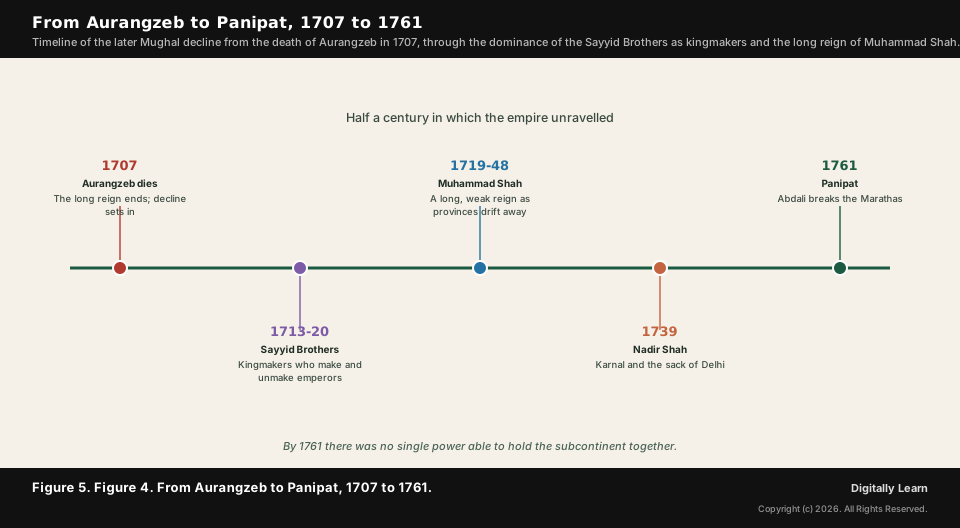
Distinguishing the long view: the eighteenth century is best read not as mere chaos but as a transition. Authority devolved from the imperial centre to dynamic regional capitals, and the chronology below traces that descent from Aurangzeb to Panipat.
Significance: Why the Decline Opened the Door to Conquest
From the Fall of One Empire to the Rise of Another
Contemporary linkages run straight from this crisis to the colonial age that follows. The fragmentation of Mughal power meant there was no unified state to resist the English East India Company when it turned from trade to territory; the Company would face, and pick off, regional powers one by one.
The larger significance is that the decline reframes the British conquest, not as the defeat of a strong, united India, but as the filling of a vacuum left by an empire that had already collapsed from within. The points below gather the threads, and the next part turns to the regional states that rose from the wreckage.
- Mughal decline was a long, multi-causal crisis, not a single sudden fall.
- The jagirdari crisis shows the breakdown was institutional, not merely personal.
- Nadir Shah and Abdali drained the treasury and destroyed Mughal prestige.
- Panipat 1761 removed the Marathas as a possible all-India successor.
- The resulting vacuum, not Indian weakness in arms, opened the way for the Company.
Previous Year UPSC-CSE Questions
Previous Year UPSC-CSE Questions By the end you will be able to draft model answers for the following UPSC questions. Each question carries a collapsible framework showing how to approach it in the exam.
- UPSC Mains 2017 GS-IClarify how mid-eighteenth-century India was beset with the spectre of a fragmented polity.
How to structure the answer in the exam
Introduction: Open with the death of Aurangzeb in 1707 and the unravelling of central authority.
Body (sub-themes to develop):
- The weak later Mughals, wars of succession and the Sayyid Brothers as kingmakers.
- The jagirdari and mansabdari crisis as the institutional breakdown.
- The invasions of Nadir Shah (1739) and Abdali, and the loss of prestige.
- The rise of successor and regional states, and Panipat 1761.
Conclusion: Conclude that a once-unified empire dissolved into a patchwork, opening the way for new powers.
- UPSC Mains 2014 GS-IThe third battle of Panipat was fought in 1761. Why were so many empire-shaking battles fought at Panipat?
How to structure the answer in the exam
Introduction: Open with Panipat as the gateway to Delhi on the north-western invasion route.
Body (sub-themes to develop):
- The strategic geography: the road from the north-west to the imperial capital.
- The three battles of Panipat (1526, 1556, 1761) and the prize of Delhi.
- The Third Battle of 1761: Abdali against the Marathas.
- The consequence: the Maratha check and the power vacuum.
Conclusion: Conclude that control of Delhi made Panipat the recurring arena where the fate of empires was decided.
- UPSC Prelims 2010 GS Paper IWhat was the immediate reason for Ahmad Shah Abdali to invade India and fight the Third Battle of Panipat?
How to approach this Prelims question
Approach: Recall the immediate provocation for Abdali's 1761 campaign.
Trap to watch: The immediate trigger was the Maratha expulsion of his viceroy Timur Shah from Lahore, not a Mughal revenue dispute or an invitation from a governor.
Key facts to recall:
- Third Battle of Panipat 1761
- Ahmad Shah Abdali vs the Marathas
- Timur Shah expelled from Lahore by the Marathas
Answer signal: Avenging the expulsion of Timur Shah from Lahore, so option (a).
Sources and Further Reading
- Wikipedia: Fall of the Mughal Empire
- Wikipedia: Mughal Empire
- Wikipedia: Nader Shah's invasion of the Mughal Empire
- Wikipedia: Third Battle of Panipat
- NCERT, Themes in Indian History and Our Pasts (Modern India)
- Indian Culture Portal, Ministry of Culture
- National Portal of India
- Press Information Bureau, Government of India
- National Archives of India
- Azadi Ka Amrit Mahotsav, Ministry of Culture
Editorial Disclaimer
This article is prepared for UPSC examination preparation. Verify key facts and interpretations against standard reference histories before relying on them.