


Overview
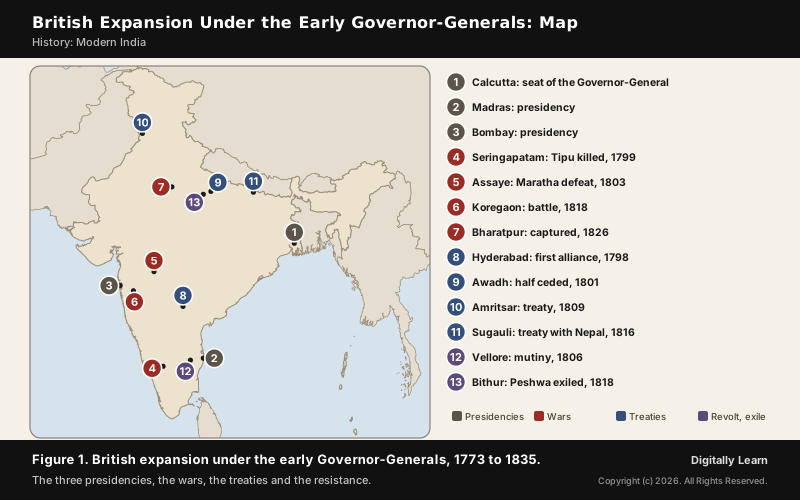
The first Governor-General of India was Lord William Bentinck, who took the new title at the end of 1833 under the Charter Act of that year. Before him the office was Governor-General of Bengal, created by the Regulating Act of 1773, and its first holder was Warren Hastings. Between them, Cornwallis, Wellesley, Lord Hastings and others turned the East India Company from a trading power into the ruler of most of India.
First Governor-General of India: From Bengal in 1773 to India in 1833
Who Was the First Governor-General of India? Warren Hastings and William Bentinck
By the 1770s the Company ruled three presidencies, Bengal, Madras and Bombay, each under a Governor. The Regulating Act of 1773 brought Madras and Bombay under Bengal's control and raised Hastings from Governor to the new post of Governor-General, but it made him only one member of a five-man Supreme Council. He had direct control only over his own presidency and supervised the Company's officials elsewhere.
Sixty years later the office grew into a government for the whole of British India. The Charter Act of 1833 redesignated the Governor-General of Bengal as the Governor-General of India, and for the first time his government was called the Government of India. The Governor-General in Council gained exclusive legislative powers, taking them away from the governors of Bombay and Madras, and a fourth, legal member was added to the council for making laws; Macaulay was the first.
Governor-Generals of Bengal and India, 1773 to 1835: Tenures and Landmarks
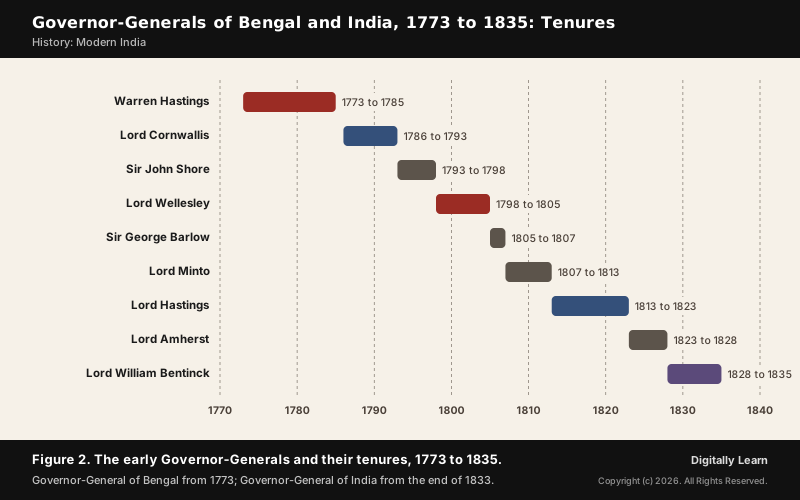
Nine men held the office between 1773 and 1835. The table gives the tenure and the landmark of each; the sections below explain them. Warren Hastings (1773 to 1785) and Lord Hastings (1813 to 1823) are different men, a common source of confusion. The title itself changed with the law: Governor-General of Bengal under the Regulating Act of 1773, Governor-General of India under the Charter Act of 1833.
| Governor-General | Tenure and landmark |
|---|---|
| Warren Hastings | 1773 to 1785: Regulating Act, courts, Asiatic Society |
| Lord Cornwallis | 1786 to 1793: Permanent Settlement, Cornwallis Code |
| Sir John Shore | 1793 to 1798: Charter Act of 1793, Battle of Kharda |
| Lord Wellesley | 1798 to 1805: subsidiary alliance, Fourth Mysore War |
| Sir George Barlow | 1805 to 1807 (acting): Vellore Mutiny |
| Lord Minto | 1807 to 1813: Treaty of Amritsar with Ranjit Singh |
| Lord Hastings | 1813 to 1823: paramountcy, Third Maratha War |
| Lord Amherst | 1823 to 1828: First Burmese War |
| Lord William Bentinck | 1828 to 1835: sati banned, English education |
Warren Hastings (1773 to 1785): Courts, Codes and Impeachment
Warren Hastings' Reforms: District Courts, Law Digests and Oriental Learning
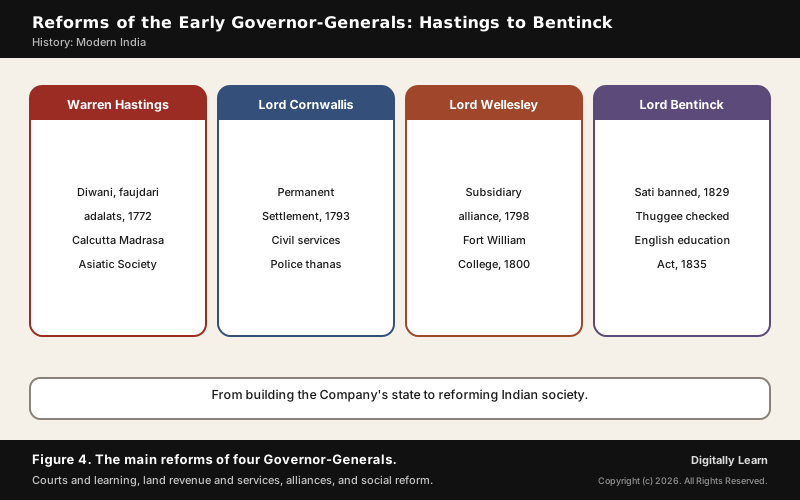
Warren Hastings introduced several administrative reforms, above all in justice. From 1772 each district was to have two courts, a criminal court, the faujdari adalat, and a civil court, the diwani adalat. Maulvis and Hindu pandits interpreted Indian laws for the European collectors who presided over the civil courts, while the criminal courts stayed under a qazi and a mufti, supervised by the collectors.
- Law digests: Because pandits interpreted local laws differently, eleven pandits compiled a digest of Hindu laws in 1775, which N.B. Halhed translated into English; a code of Muslim laws followed by 1778.
- New courts: Under the Regulating Act of 1773 a Supreme Court was set up at Calcutta, with a court of appeal, the Sadar Nizamat Adalat.
- The Collector: The principal figure in a district, he collected revenue and kept law and order, and his office became the new centre of power.
- Oriental learning: Hastings set up the Calcutta Madrasa in 1781 to promote Arabic, Persian and Islamic law, and backed William Jones, who founded the Asiatic Society in Calcutta on 15 January 1784.
Warren Hastings' Wars, the Pitt's India Act and His Impeachment
Hastings also fought. He sent Company troops in 1774 to help the Nawab of Awadh against the Rohillas, the first of several wars that later harmed his name. The First Anglo-Maratha War ended in 1782 with the Treaty of Salbai and no clear victor, and the Second Anglo-Mysore War against Haidar Ali and Tipu Sultan ran from 1780 to 1784. The Pitt's India Act followed in 1784.
When Hastings went back to England in 1785, Edmund Burke accused him of personal responsibility for the misgovernment of Bengal. The charges included corruption and the alleged judicial killing of Maharaja Nandakumar. The trial opened in Westminster Hall on 13 February 1788 and lasted seven years, and in 1795 Hastings was acquitted. Burke's opening speech impeached him in the name of the people of India.
Lord Cornwallis (1786 to 1793): Permanent Settlement, Civil Service and Police
Lord Cornwallis and the Permanent Settlement of 1793: Zamindars and the Sunset Law
The Bengal famine of 1770 had killed about ten million people, and the Company needed a way to secure its revenue and revive farming. After two decades of debate, Lord Cornwallis introduced the Permanent Settlement in 1793. Rajas and taluqdars were recognised as zamindars; they collected rent from the peasants and paid revenue to the Company, and the amount was fixed permanently, never to be raised.
- The hope: A fixed demand would give the Company a regular income and encourage zamindars to invest in the land, since they would keep the gain from higher production.
- The Sunset Law: The revenue did not change with the harvest and had to be paid on time; if it did not arrive by sunset on the fixed date, the zamindari could be auctioned.
- The problem: The demand was set so high that many zamindars could not pay, and numerous zamindaris were auctioned; in Burdwan the Raja’s estates were sold in 1797.
- The peasant’s lot: Rents were high and rights insecure, and a cultivator who could not pay was evicted from land his family had tilled for generations.
Later officials turned away from a permanent demand. The mahalwari settlement of 1822 in the North Western Provinces fixed revenue village by village and revised it periodically, and the ryotwari system, tried by Alexander Read and developed by Thomas Munro, settled directly with the cultivators in the south.
Cornwallis Code: Civil Services, Courts and a Regular Police
The Cornwallis Code of 1793 set out rules for policing, justice and civil administration, and it separated revenue administration from civil justice. Revenue collectors ran the districts, and district judges answered to provincial courts in civil cases and courts of circuit in criminal ones.
- Civil services: Cornwallis was the first to bring the civil services into existence and organise them, checking corruption by raising salaries, enforcing the rules against private trade, barring presents and bribes, and promoting by seniority.
- Police: In 1791 he organised a regular police force, with thanas under an Indian daroga and a superintendent of police at the head of a district, and relieved the zamindars of police duties.
- Exclusion: The higher ranks of the services were kept for the British, depriving Indians of any responsible office.
- Third Anglo-Mysore War: The war (1790 to 1792) forced Tipu Sultan to cede half his territory and hand over two sons as hostages.
Sir John Shore, who followed from 1793 to 1798, saw the Charter Act of 1793 and the Battle of Kharda between the Nizam and the Marathas in 1795.
Lord Wellesley (1798 to 1805): Subsidiary Alliance and Expansion
Lord Wellesley's Subsidiary Alliance: Terms, Aims and the States That Joined
Lord Wellesley came to India with one priority, to defeat French power, at a time when Britain was at war with France in Europe. His chief tool was the subsidiary alliance. Indian rulers under it could not keep independent armed forces; the Company protected them, but they had to pay for the subsidiary forces, and if they failed, part of their territory was taken as a penalty.
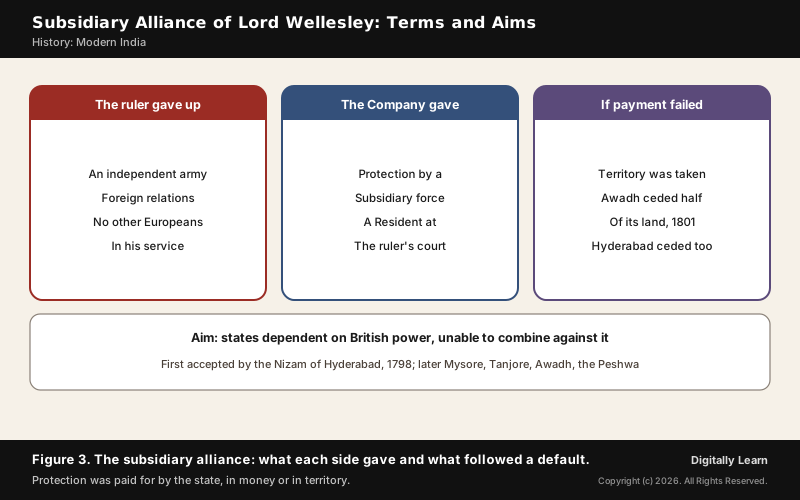
- Terms: The ruler kept the Company’s army at or near his capital, accepted British supremacy in external affairs, paid in money or territory for the troops, expelled other Europeans, and accepted a British Resident at his court.
- Aim: In February 1801 Wellesley wrote that the policy was to place the states in such dependence on British power that they could not form any confederacy against it.
- States that joined: The Nizam of Hyderabad accepted first, in 1798, then Mysore, Tanjore (1799), Awadh (1801) and the Peshwa (1802).
- Penalties: Awadh was forced to hand over half its territory in 1801 for failing to pay, and Hyderabad also ceded territories.
Fourth Mysore War, Second Maratha War and Fort William College
Wellesley turned first on Mysore. In 1798 he learnt that Tipu Sultan was negotiating an alliance with France. In the Fourth Anglo-Mysore War of 1799 Tipu was killed defending his capital, Seringapatam, on 4 May 1799; Mysore was given back to the old Wodeyar dynasty, and a subsidiary alliance was imposed on it.
The Marathas came next. In 1802 the Peshwa, Baji Rao II, fled to British protection and signed the Treaty of Bassein, ceding territory for a subsidiary force. The Second Anglo-Maratha War (1803 to 1805), with the Maratha defeat at Assaye in September 1803, gave the British Orissa and the lands north of the Yamuna, including Agra and Delhi.
- Fort William College: Founded on 18 August 1800 at Calcutta as a training ground for future European administrators; in 1806 the Court of Directors preferred a college at Haileybury in England.
- Its legacy: The college’s collection of manuscripts is now among the Oriental Records of the National Archives of India.
Barlow, Minto, Lord Hastings and Amherst: Paramountcy, 1805 to 1828
Barlow, Minto and Lord Hastings: Vellore, Amritsar and Paramountcy
Cornwallis was reappointed in 1805 to curb Wellesley's expansion, arrived in July and died on 5 October at Ghazipur, where his memorial is a protected monument. Sir George Barlow then acted as Governor-General until Lord Minto arrived in 1807. In 1806 the sepoys at Vellore rose in the Vellore Mutiny, provoked by an order of William Bentinck, then Governor of Madras, forbidding native troops their traditional attire; the order was withdrawn and Bentinck was recalled in 1807.
Lord Minto, Governor-General from 1807 to 1813, secured the north-west by diplomacy. The Treaty of Amritsar with Ranjit Singh, signed on 25 April 1809, made the Sutlej the boundary between the Company and the Sikh kingdom. Minto also extended British power to Java and other Dutch possessions in the East Indies during the Napoleonic Wars.
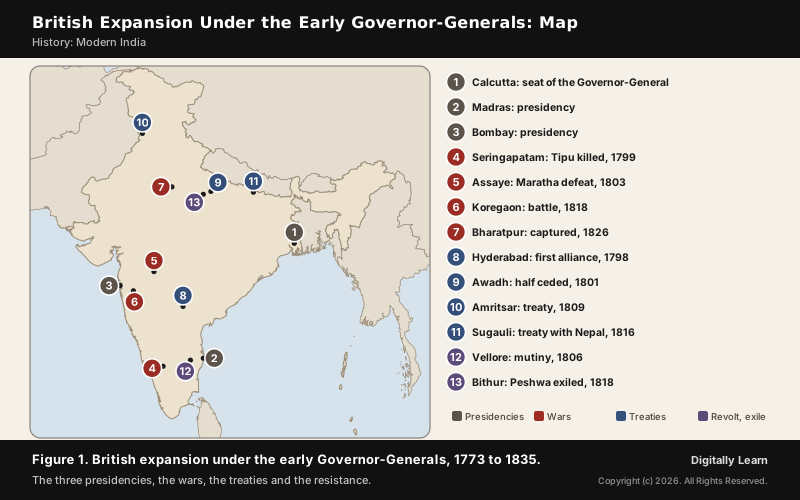
Under Lord Hastings, Governor-General from 1813 to 1823, a new policy of paramountcy began. The Company now claimed that its authority was paramount, greater than that of any Indian state, and that it could annex or threaten to annex any kingdom to protect its interests. The same view guided later British policy.
- Nepal: The Anglo-Nepal war of 1814 to 1816 ended with the Treaty of Sugauli.
- Marathas: After Pindari raids in 1817, the Third Anglo-Maratha War of 1817 to 1819 crushed Maratha power; at Koregaon on 1 January 1818 a small Company force held off the Peshwa’s army, and the Peshwa was sent to Bithur near Kanpur with a pension.
- Revenue: The ryotwari system was established in Madras by Thomas Munro in 1820.
- Resistance: When the British tried to annex Kitoor, Rani Channamma took up arms; she was arrested in 1824 and died in prison in 1829.
Lord Amherst (1823 to 1828) fought the First Burmese War of 1824 to 1826, which brought the cession of Arakan and Tenasserim, and captured Bharatpur in 1826.
Why the Company's Armies Won: Discipline, Alliances and Divided Rivals
The Company's power rested on its army, and the army was mostly Indian. Mughal armies had been dominated by cavalry, but the Company, like Awadh and Benaras before it, recruited peasants and trained them as professional soldiers, the sepoy army. From the early nineteenth century they were put through European-style training, drill and discipline, and as warfare changed its infantry regiments, armed with muskets, became more important.
- Allies against a rival: In 1792 Tipu Sultan faced the combined forces of the Marathas, the Nizam and the Company, and was forced to sign a treaty.
- Divided rivals: After 1761 the Marathas were split among chiefs, the Sindhia, Holkar, Gaikwad and Bhonsle, held together only loosely under the Peshwa.
- Disarmed states: The subsidiary alliance took away the allied rulers’ own armies and made them pay for the Company’s.
- Small forces, big results: At Koregaon the British were outnumbered, yet the Maratha army was decimated.
Lord William Bentinck (1828 to 1835): Reforms of the First Governor-General of India
Lord William Bentinck's Reforms: Abolition of Sati and Suppression of Thuggee
Lord William Bentinck, Governor-General from 1828 to 1835, is remembered for social reform. Raja Rammohun Roy had campaigned against sati, showing that widow burning had no sanction in ancient texts, and British officials were willing to listen. On 4 December 1829 the Bengal Sati Regulation, Regulation XVII of 1829, made sati illegal and punishable by the criminal courts.
- Opposition: Conservative Hindus led by Radhakanta Deb and the Dharma Sabha appealed to the Privy Council, but the ban was upheld.
- Other practices: Bentinck is also credited with suppressing female infanticide and human sacrifice.
- Thuggee: William Henry Sleeman led the campaign against the thugs, gangs of ritual stranglers, and served as General Superintendent of the Thuggee Department from 1835 to 1855.
- The army: Bentinck removed flogging as a punishment in the Indian Army.
English Education Act 1835, Charter Act 1833 and Bentinck's Economies
Bentinck also settled the long argument over what Indians should be taught. Thomas Babington Macaulay's minute of 2 February 1835 dismissed Eastern learning and argued for English. Following it, the English Education Act of 1835 made English the medium of instruction for higher education and stopped the promotion of Oriental institutions such as the Calcutta Madrasa and the Benaras Sanskrit College.
- Law Commission: The Charter Act of 1833 provided for a commission to consolidate and codify Indian laws, and in 1835 Macaulay became chairman of the First Law Commission.
- Finance: Bentinck carried out a wide range of cost-cutting measures, cutting even military wages, and is credited with more efficient financial management.
- Territory: Mysore was annexed in 1831 and Coorg in 1834.
- Company trade: The Charter Act of 1833 ended the Company’s commercial activities and made it a purely administrative body.
The acts that framed these offices are explained in the Regulating Act, Pitt's India Act and the Charter Acts, and the story continues with Lord Dalhousie's administration.
Previous Year UPSC-CSE Questions
Previous Year UPSC-CSE Questions By the end you will be able to draft model answers for the following UPSC questions. Each question carries a collapsible framework showing how to approach it in the exam.
- UPSC Mains 2022 GS-IWhy did the armies of the British East India Company – mostly comprising of Indian soldiers – win consistently against the more numerous and better equipped armies of the then Indian rulers? Give reasons.
Answer outline: how to structure the answer
What the question asks, the main arguments, relevant examples and the direction of the conclusion. This is not a full model answer.
Introduction: State that the Company's armies were largely Indian sepoys, yet won against larger Indian armies between the 1790s and 1818.
Body (sub-themes to develop):
- Organisation: peasants trained as professional infantry with European-style drill and muskets.
- Diplomacy: allies against one rival at a time, as against Tipu in 1792.
- Rivals divided: the Maratha chiefs under a loose confederacy.
- Subsidiary alliance: allied rulers disarmed and paying for Company troops.
- Example: Koregaon, 1818, where an outnumbered force held.
Conclusion: Conclude that organisation and diplomacy, more than numbers or equipment, decided the wars.
- UPSC Prelims 2007 Prelims-GSConsider the following statements:
- Robert Clive was the first Governor-General of Bengal.
- William Bentinck was the first Governor-General of India.
Which of the statements given above is/are correct?
How to approach this Prelims question
Approach: Step 1: statement 1: the office of Governor-General of Bengal was created by the Regulating Act of 1773 and its first holder was Warren Hastings; Robert Clive had been Governor of Bengal, not Governor-General; wrong. Step 2: statement 2: the Charter Act of 1833 renamed the office, and William Bentinck became the first Governor-General of India; correct.
Trap to watch: Clive was Governor of Bengal, not Governor-General.
Key facts to recall:
- (a) 1 only: wrong. Statement 1 is wrong: the first Governor-General of Bengal was Warren Hastings, not Clive.
- (b) 2 only: correct. Bentinck became the first Governor-General of India under the Charter Act of 1833.
- (c) Both 1 and 2: wrong. Clive was the first British Governor of Bengal, a different and earlier office.
- (d) Neither 1 nor 2: wrong. Statement 2 is correct.
Answer signal: 2 only, option (b).
- UPSC Prelims 2023 Prelims-GSBy which one of the following Acts was the Governor General of Bengal designated as the Governor General of India?
How to approach this Prelims question
Approach: Step 1: the Regulating Act of 1773 created the Governor-General of Bengal. Step 2: the Charter Act of 1833 renamed the office Governor-General of India. Step 3: Pitt's India Act (1784) and the Charter Act of 1793 left the title unchanged.
Trap to watch: The Regulating Act created the Governor-General of Bengal, not of India.
Key facts to recall:
- (a) The Regulating Act: wrong. It created the office of Governor-General of Bengal in 1773.
- (b) Pitt's India Act: wrong. It set up the Board of Control in 1784 and did not rename the office.
- (c) The Charter Act of 1793: wrong. It renewed the Company's charter under Sir John Shore and kept the old title.
- (d) The Charter Act of 1833: correct. It made the Governor-General of Bengal the Governor-General of India.
Answer signal: The Charter Act of 1833, option (d).
- UPSC Prelims 2010 Prelims-GSWho among the following Governor Generals created the Covenanted Civil Service of India which later came to be known as the Indian Civil Service?
How to approach this Prelims question
Approach: Step 1: the covenanted civil service, with high salaries and a ban on private trade, was Lord Cornwallis's reform of 1786 to 1793. Step 2: Warren Hastings is known for courts and codes, Wellesley for the subsidiary alliance and Fort William College, Bentinck for social reforms and English education.
Trap to watch: Wellesley trained recruits at Fort William College; he did not create the service.
Key facts to recall:
- (a) Warren Hastings: wrong. His reforms were the district courts, the law digests and oriental learning.
- (b) Wellesley: wrong. He is known for the subsidiary alliance and for training civil servants at Fort William College.
- (c) Cornwallis: correct. He raised salaries, barred private trade and built the covenanted service that became the ICS.
- (d) William Bentinck: wrong. His reforms were the ban on sati, the suppression of thuggee and English education.
Answer signal: Cornwallis, option (c).
- UPSC Prelims 2018 Prelims-GSWhich one of the following statements does not apply to the system of Subsidiary Alliance introduced by Lord Wellesley ?
How to approach this Prelims question
Approach: Step 1: under the subsidiary alliance an Indian ruler kept a Company force paid for by his own state, so the Company kept a large army at others' expense. Step 2: Wellesley's first priority was to defeat French power while Britain was at war with France, and the system made the Company paramount. Step 3: a fixed income was not its aim.
Trap to watch: The states paid for the troops, but a fixed income was not the policy's aim.
Key facts to recall:
- (a) To maintain a large standing army at others' expense: applies. The allied states paid for the Company's troops.
- (b) To keep India safe from the Napoleonic danger: applies. Wellesley came to India to defeat French power.
- (c) To secure a fixed income for the Company: does not apply, so this is the answer. The alliance aimed at troops and control, not a fixed income.
- (d) To establish British paramountcy over the Indian states: applies. Allied rulers lost control of their foreign policy.
Answer signal: To secure a fixed income for the Company, option (c).
- UPSC Prelims 2018 Prelims-GSWith reference to educational institutions during colonial rule in India, consider the following pairs: Institution – Founder
- Sanskrit College at Benaras – William Jones
- Calcutta Madarsa – Warren Hastings
- Fort William College – Arthur Wellesley
Which of the pairs given above is/are correct?
How to approach this Prelims question
Approach: Step 1: pair 1: the Sanskrit College at Benaras was proposed by Jonathan Duncan, not William Jones; wrong. Step 2: pair 2: Warren Hastings set up the Calcutta Madrasa in 1781; correct. Step 3: pair 3: Fort William College was founded by Richard Wellesley, not Arthur Wellesley; wrong.
Trap to watch: Arthur Wellesley was the brother; Richard Wellesley founded the college.
Key facts to recall:
- (a) 1 and 2: wrong. Pair 1 is wrong: William Jones founded the Asiatic Society, not the Benaras college.
- (b) 2 only: correct. Only the Calcutta Madrasa and Warren Hastings are correctly paired.
- (c) 1 and 3: wrong. Both pairs name the wrong founder.
- (d) 3 only: wrong. Fort William College was founded by Richard Wellesley, the Governor-General, not his brother Arthur.
Answer signal: 2 only, option (b).
- UPSC Prelims 2020 Prelims-GSWellesley established the Fort William College at Calcutta because
How to approach this Prelims question
Approach: Step 1: Fort William College opened at Calcutta on 18 August 1800 as a training ground for future European administrators. Step 2: the Court of Directors did not ask for it; in 1806 they preferred a college at Haileybury in England.
Trap to watch: The college did oriental studies, but its purpose was to train British civil servants.
Key facts to recall:
- (a) He was asked by the Board of Directors in London: wrong. The Directors preferred their own college at Haileybury.
- (b) He wanted to revive interest in oriental learning: wrong. Its languages were taught to serve administration.
- (c) He wanted to employ William Carey and his associates: wrong. Carey was a missionary based at Serampore, and the college was not founded to employ him.
- (d) He wanted to train British civilians for administration in India: correct. That was the college's purpose.
Answer signal: To train British civilians for administration, option (d).
- UPSC Prelims 1997 Prelims-GSWho among the following was associated with the suppression of Thugs?
How to approach this Prelims question
Approach: Step 1: under Lord William Bentinck the campaign against the thugs was led by William Henry Sleeman, General Superintendent of the Thuggee Department from 1835. Step 2: the other three officers are known for other work.
Trap to watch: Alexander Burnes is linked to Afghanistan, not the thugs.
Key facts to recall:
- (a) General Henry Prendergast: wrong. He was a Madras Army officer and Victoria Cross holder, not the thuggee officer.
- (b) Captain Sleeman: correct. He led the campaign against the thugs and headed the Thuggee Department.
- (c) Alexander Burnes: wrong. He was an explorer of Central Asia in the Great Game, known as Bokhara Burnes.
- (d) Captain Robert Pemberton: wrong. He served in Manipur and drew the Manipur-Burma boundary known as Pemberton's Line.
Answer signal: Captain Sleeman, option (b).
Sources
- NCERT: Our Pasts III Part I (Class VIII), From Trade to Territory and Ruling the Countryside
- NCERT: Our Pasts III Part II (Class VIII), Civilising the Native and Women, Caste and Reform
- NCERT: Themes in Indian History Part III (Class XII), Colonialism and the Countryside
- Legislative Department, Government of India: Introduction (Charter Act 1833, Law Commission)
- National Archives of India: Oriental Records (Fort William College Collection)
- Ministry of Culture: The Asiatic Society Act, 1984
- Wikipedia: Governor-General of India
- Wikipedia: Warren Hastings
- Wikipedia: Impeachment of Warren Hastings
- Wikipedia: Aliah University
- Wikipedia: Charles Cornwallis, 1st Marquess Cornwallis
- Wikipedia: Cornwallis Code
- Wikipedia: John Shore, 1st Baron Teignmouth
- Wikipedia: Richard Wellesley, 1st Marquess Wellesley
- Wikipedia: Subsidiary alliance
- Wikipedia: Fort William College
- Wikipedia: Second Anglo-Maratha War
- Wikipedia: Sir George Barlow, 1st Baronet
- Wikipedia: Gilbert Elliot-Murray-Kynynmound, 1st Earl of Minto
- Wikipedia: Treaty of Amritsar (1809)
- Wikipedia: Francis Rawdon-Hastings, 1st Marquess of Hastings
- Wikipedia: Third Anglo-Maratha War
- Wikipedia: William Amherst, 1st Earl Amherst
- Wikipedia: Lord William Bentinck
- Wikipedia: Bengal Sati Regulation, 1829
- Wikipedia: William Henry Sleeman
- Wikipedia: English Education Act 1835
- Wikipedia: Saint Helena Act 1833
- Wikipedia: Sampurnanand Sanskrit Vishwavidyalaya
- UPSC: Civil Services Examination question papers
Editorial Disclaimer
This article draws on the NCERT history textbooks and the other sources listed on this page. Tenure years follow NCERT where the sources differ.