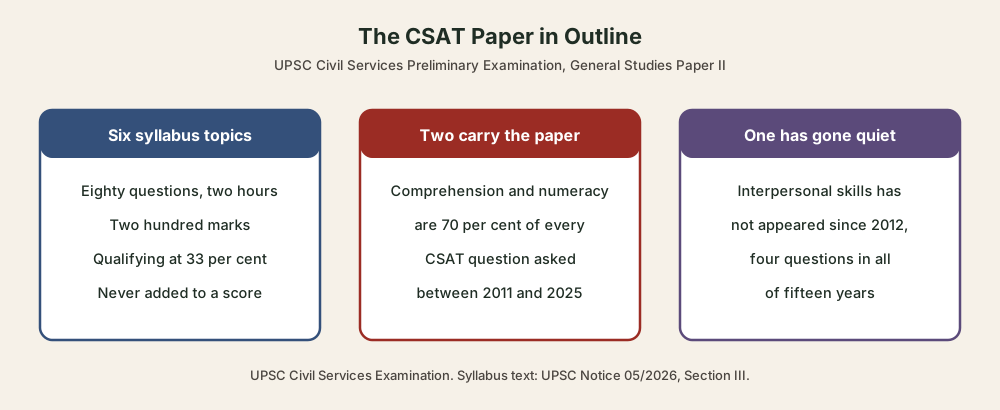
The UPSC CSAT syllabus covers comprehension, reasoning, general mental ability and Class X level maths in six topics. CSAT is General Studies Paper II of the Prelims: eighty questions, 200 marks, two hours, qualifying at 33 per cent. This guide gives the full syllabus and what 1,195 past questions show.
What Is CSAT in UPSC? Paper II of the Prelims
CSAT at a Glance: 80 Questions, 200 Marks, 33 Per Cent to Qualify
CSAT is General Studies Paper II of the UPSC Civil Services Preliminary Examination, the aptitude paper that sits beside General Studies Paper I. It tests comprehension, reasoning and basic maths, and it is qualifying only: you must score 33 per cent, but its marks are never added to your Prelims score. This page gives the full UPSC CSAT syllabus and shows what the paper has actually asked.
- Questions and marks: Eighty multiple-choice questions for 200 marks, so 2.5 marks a question; the 2025 paper had eighty.
- Time: Two hours, about ninety seconds a question including the reading.
- Qualifying marks: 33 per cent, which is 66 marks out of 200.
- Negative marking: One-third of a question's marks, 0.83, is deducted for each wrong answer.
- Language: The paper is set in both Hindi and English.
The Official UPSC CSAT Syllabus in Full
The Six Topics of the CSAT Syllabus
The whole CSAT syllabus is six topics in Examination Notice 05/2026, reproduced below in its own words. There is no separate CSAT syllabus PDF; the notice itself is the PDF, and the same six topics have appeared in it for years.
- Comprehension
- Interpersonal skills including communication skills
- Logical reasoning and analytical ability
- Decision making and problem solving
- General mental ability
- Basic numeracy (numbers and their relations, orders of magnitude, etc.) (Class X level), Data interpretation (charts, graphs, tables, data sufficiency etc., Class X level)
Three of the topics are maths and reasoning (basic numeracy with data interpretation, logical reasoning, and general mental ability), one is reading (comprehension), and two are about judgement (decision making, and interpersonal and communication skills). The maths is fixed at Class X level.
CSAT Syllabus Weightage: What Past Papers Show
Questions by Syllabus Topic, 2011 to 2025
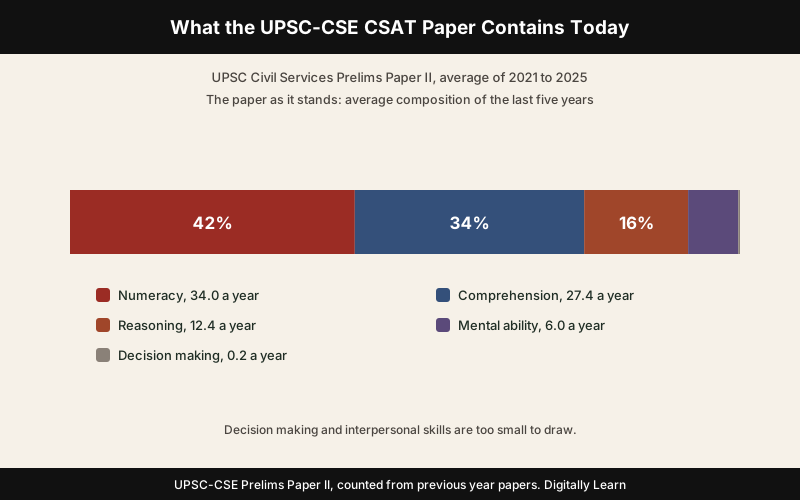
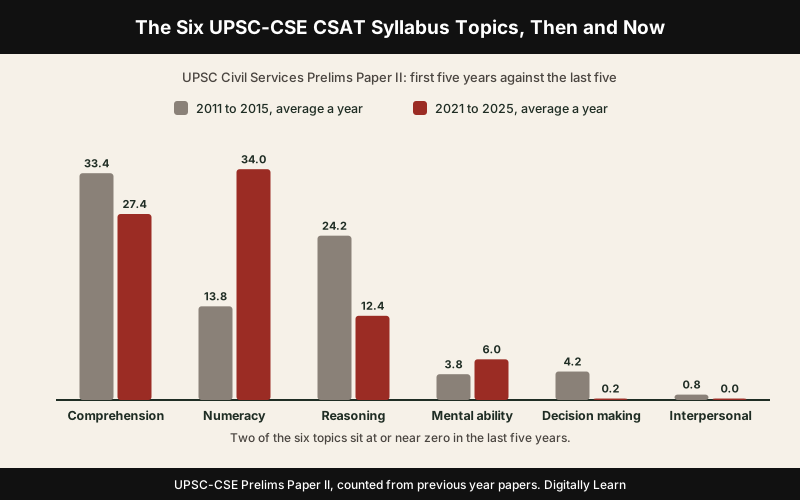
All 1,195 CSAT questions from 2011 to 2025 are sorted here by the syllabus topic each one tests. Two topics carry the paper: comprehension with 442 questions and basic numeracy with data interpretation with 392, together 70 per cent. The last column compares the average a year in 2011 to 2015 with 2021 to 2025.
| Syllabus topic | Questions (share) | A year, then to now |
|---|---|---|
| Comprehension | 442 (37%) | 33.4 to 27.4 |
| Basic numeracy and data interpretation | 392 (33%) | 13.8 to 34.0 |
| Logical reasoning and analytical ability | 247 (21%) | 24.2 to 12.4 |
| General mental ability | 87 (7%) | 3.8 to 6.0 |
| Decision making and problem solving | 23 (2%) | 4.2 to 0.2 |
| Interpersonal skills including communication skills | 4 (0%) | 0.8 to 0.0 |
Numeracy Has More Than Doubled Since 2015
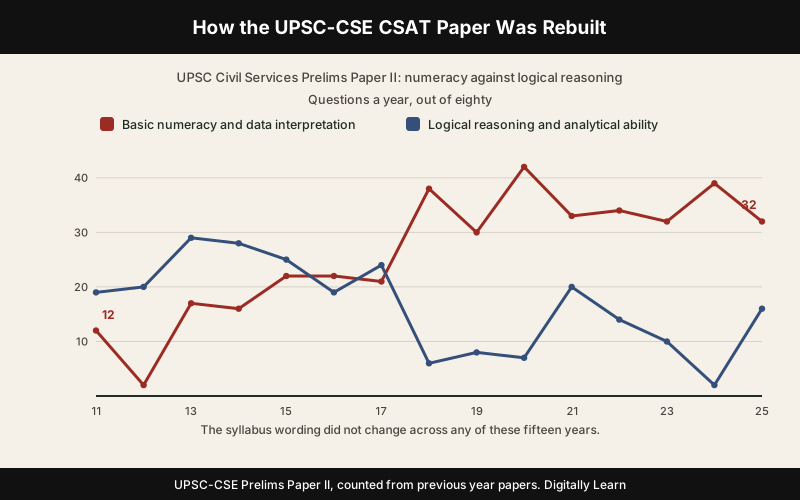
Basic numeracy and data interpretation rose from 13.8 questions a year in 2011 to 2015 to 34.0 in 2021 to 2025. Over the same years logical reasoning fell from 24.2 to 12.4, and comprehension from 33.4 to 27.4. The turning point was 2018: numeracy jumped to 38 questions and reasoning fell to six. Before 2018 numeracy never passed 22 in a paper; since then it has never dropped below 30.
Interpersonal Skills and Decision Making: Two Topics Gone Quiet
The interpersonal skills topic has produced only 4 questions in fifteen years and none since 2012. Decision making has produced 23, of which 21 came in 2011 to 2013, and just one in the last five papers. Both topics are still in the notice and could return, but neither needs a preparation block of its own.
CSAT Syllabus Section by Section
CSAT Maths Syllabus: Basic Numeracy and Data Interpretation
The CSAT maths syllabus is basic numeracy (numbers and their relations, orders of magnitude) and data interpretation (charts, graphs, tables and data sufficiency), both at Class X level. The content is school arithmetic; the difficulty is doing it in about ninety seconds a question. It now makes up about 42 per cent of the paper.
| Question type | Questions | Share of the paper |
|---|---|---|
| Basic numeracy | 183 | 15.3% |
| Arithmetic | 75 | 6.3% |
| Data interpretation | 51 | 4.3% |
| Time, distance and work | 41 | 3.4% |
| Counting and probability | 26 | 2.2% |
| Geometry and mensuration | 16 | 1.3% |
- Number basics: Divisibility, remainders, number properties and orders of magnitude.
- Arithmetic: Percentages, ratios, averages, profit and loss, and interest.
- Time, distance and work: Speed and relative motion, pipes and work rates.
- Data interpretation: Reading tables and charts, and data sufficiency.
Data sufficiency questions deserve a method of their own, because they ask whether the data is enough, not for the answer itself. Work through them in a fixed order:
- Read the question alone first: Decide exactly what would settle it, such as a single value or a yes or no.
- Test each statement on its own: Ignore the other statement completely while you test one.
- Only then combine them: Try the two together only if neither is enough alone.
- Stop when it is settled: You rarely need to finish the calculation, only to know that it can be finished.
Reading Comprehension in CSAT
The comprehension topic is still the largest in the paper, at 27.4 questions a year recently. The passages are not hard in vocabulary; they are dense, often in the register of a policy note, and the questions turn on a qualifier rather than the main claim.
- Stay inside the passage: The commonest trap is an option that is true in the world but not stated in the passage.
- Watch the qualifiers: Words such as only, most, may and always usually decide the answer.
- Find the author's claim: Many questions ask for the central idea or a valid inference, not a detail.
With about ninety seconds a question, a passage with three questions allows roughly four and a half minutes in all. A steady routine keeps comprehension inside that time:
- Read the questions first: A quick look tells you what to watch for in the passage.
- Read the passage once, fully: Mark the main claim and any contrast words such as however or but.
- Answer from the text: Go back to the exact line for each question rather than to memory.
- Move on: If two options remain after the passage, choose the narrower one that the text supports.
CSAT Reasoning Syllabus: Logical Reasoning and Mental Ability
The CSAT reasoning syllabus covers logical reasoning and analytical ability, and general mental ability. Logical reasoning is down to 12.4 questions a year, and general mental ability has risen slightly to 6.0; in practice the second is often arithmetic reasoning with numbers and counting.
- Arrangements: Seating, ordering and ranking puzzles with several conditions.
- Series and patterns: Number and letter sequences.
- Relations and directions: Blood relations and direction sense.
- Syllogisms and statements: Conclusions that must follow from given statements.
Reasoning questions reward a quick diagram: a line or circle for seating, a family tree for relations, a compass rose for directions, and circles for syllogisms. Drawing the conditions first turns a puzzle of several constraints into a picture you can read, and it prevents the commonest error of losing a condition halfway through.
CSAT Qualifying Marks: How Many Correct Answers You Need
Correct Answers Needed to Reach 66 Marks
The CSAT qualifying marks are 66 out of 200. Each correct answer earns 2.5 marks and each wrong answer loses 0.83, so the number of correct answers you need depends on how many questions you attempt.
| Attempted | Correct needed | Accuracy needed |
|---|---|---|
| 30 | 28 | 93% |
| 40 | 30 | 75% |
| 50 | 33 | 66% |
| 60 | 35 | 58% |
| 70 | 38 | 54% |
| 80 | 40 | 50% |
Attempt all eighty and 40 correct answers reach 66 marks, half of them. Attempt thirty and 28 of them must be right, 93 per cent. Every question left blank raises the accuracy the rest must carry.
Aim Well Above 66, Not at It
A single hard passage can cost several marks at once, so a plan built to score exactly 66 has no margin for a difficult paper. Aim for a comfortable margin, and treat speed as the main lever: the more questions you can read and answer in two hours, the lower the accuracy the paper demands.
How to Prepare for CSAT
A Preparation Order That Follows the Paper
Order your CSAT preparation by what the paper now contains, not by the order the syllabus lists.
- Maths under time: Percentages, ratios, averages, time and work, then data interpretation.
- Comprehension against the clock: Full passages with their question sets, timed.
- Reasoning: Arrangements, series, relations and syllogisms, at their smaller weight.
- Full papers: Past papers from 2018 onwards, sat in two hours, to judge your margin above 66.
A six-week plan, alongside General Studies preparation, is a reasonable way to build a margin:
- Weeks 1 and 2: Arithmetic basics, twenty timed questions a day, and one passage set a day.
- Weeks 3 and 4: Data interpretation, data sufficiency and reasoning, with a full past paper at the end of each week.
- Weeks 5 and 6: Two full papers a week in two hours, with time spent only on the questions you got wrong.
Our Prelims test series includes CSAT papers built to the current mix of questions, and the UPSC exam pattern page explains how CSAT sits beside the General Studies paper in the Prelims result.
Common Questions About the UPSC CSAT Syllabus
What is CSAT in UPSC?
CSAT is General Studies Paper II of the UPSC Prelims: eighty questions on comprehension, reasoning and basic maths, for 200 marks in two hours. It is qualifying only, at 33 per cent.
What are the CSAT qualifying marks?
33 per cent, which is 66 marks out of 200. CSAT marks are not added to the Prelims score; only the General Studies Paper I score decides the Prelims cut-off.
Is there negative marking in CSAT?
Yes. One-third of the marks for a question, 0.83 of its 2.5 marks, is deducted for each wrong answer, the same rule as in General Studies Paper I.
What level is the CSAT maths syllabus?
Class X level, as the notice states. It covers basic numeracy and data interpretation; the challenge is speed rather than the difficulty of the maths.
How many questions should I attempt in CSAT?
As many as you can do better than chance on. Attempting all eighty needs 40 correct answers to reach 66 marks; attempting fifty needs 33; attempting thirty needs 28. A guess that rules out even one option has a small positive value.
Is there a CSAT syllabus PDF?
Not as a separate file. The CSAT syllabus is part of the Commission's examination notice, which is published as a PDF each year; the 2026 notice is linked in the sources below.
Official Sources
- Union Public Service Commission: Examination Notice No. 05/2026-CSE, Civil Services Examination 2026
- Union Public Service Commission: previous years' question papers
- National Council of Educational Research and Training: school textbooks, the Class X level the notice refers to
- Legislative Department, Ministry of Law and Justice: The Constitution of India
- Union Public Service Commission: Civil Services Examination 2025, minimum qualifying marks
- Union Public Service Commission: Programme of Examinations and Recruitment Tests 2027
- Union Public Service Commission: online registration and application portal
- Department of Personnel and Training: Gazette notifications (the Civil Services Examination Rules are notified here each year)
- Wikipedia: Civil Services Examination
Editorial Disclaimer
The syllabus and the rules of the paper are taken from the current examination notice of the Commission. Sorting past questions by syllabus topic is Digitally Learn's own reading and is not published by the Commission. The notice in the Gazette of India is the final authority.