UPSC Prelims 2026 Answer Key and Question Paper: Every Option Explained
The UPSC Prelims 2026 answer key for GS Paper 1, taken from UPSC's own provisional key for Sets A, B, C and D, with all 100 questions of the paper and every option explained. The paper is also in Hindi. Practise them against a timer, work out your score, or save them as a PDF.
100questions, 200 marksGS Paper I, two hours
99questions scoredUPSC dropped one (Set A Q64)
24 Mayexam held, 2026Provisional key out on 27 May
0.66marks lost per wrong answerOne-third of 2; blanks score zero
UPSC Prelims 2026 Paper Analysis: Subjects and Question Types
Questions by subject
Subject
Questions
Economy
17
Science and Technology
15
History
13
International Relations
10
Environment and Ecology
9
Polity and Governance
9
Art and Culture
8
Geography
8
Internal Security and Defence
5
Ethics
3
Current Affairs
3
Questions by format
Format
Questions
Statements or items with an answer code ("1 and 2 only")
61
Direct single-answer questions
21
Count the correct statements ("there is only one correct statement")
5
Match List I with List II
4
Administrative case studies
3
Assertion with its evidence
2
Relationship between Statements I, II and III
2
"How many" of the rows or items are correct
2
Why this mattersEconomy (17) and Science and Technology (15) together made up almost a third of the paper, and 61 questions asked you to judge several statements at once. Eight questions were framed in the negative ("not correct", "not included"), which is where careful readers gain marks others lose.
Practise and check
All 100 UPSC Prelims 2026 Questions with Answers, Every Option Explained
Read each question with its answer, practise one by one, or take a timed drill. The timed modes use UPSC's marking and show your score by subject at the end. Choose your booklet series to see the questions in your own order.
Economy 17Science and Technology 15History 13International Relations 10Environment and Ecology 9Polity and Governance 9Art and Culture 8Geography 8Internal Security and Defence 5Ethics 3Current Affairs 3
Q1Art and Culture
Which one of the following Carnatic music ragas is similar to Raga Bilawal in Hindustani music?
aNat Bhairavi
bKamavardhini
cHanumatodi
dDheera Shankarabharanam
See the answer and explanationWith how to crack it
Answer: (d) Dheera Shankarabharanam
Raga Bilawal is the parent scale (thaat) of Hindustani music whose seven notes are all natural (shuddha), which makes it the same scale as the Western major scale.
In Carnatic music the melakarta (parent raga) with exactly this set of notes is the 29th melakarta, Dheera Shankarabharanam. That is why musicians treat Bilawal and Shankarabharanam as equivalents.
Nat Bhairavi matches the Hindustani Asavari thaat, Hanumatodi matches Bhairavi thaat, and Kamavardhini (Pantuvarali) is close to Purvi. None of them has Bilawal's all-natural scale.
How to crack it
Hold on to one idea: Bilawal is the all-natural-notes scale, the Western major scale. Ask which Carnatic raga is 'all natural'; the other three have altered notes, so eliminate them.
Remember
Learn the Hindustani thaat and Carnatic melakarta equivalents as pairs: Bilawal and Shankarabharanam, Kafi and Kharaharapriya, Bhairavi and Hanumatodi.
The artificially fixed rupee-sterling exchange rate prescribed by the Hilton-Young Commission (1926) was adopted by the British Government for which one of the following reasons?
aAiding the flow of remittances from India and maintaining India's creditworthiness
bProviding support to Indian importers
cEncouraging export of cotton produce from India
dPreventing depreciation of the Rupee in terms of gold
See the answer and explanationWith how to crack it
Answer: (a) Aiding the flow of remittances from India and maintaining India's creditworthiness
The Hilton-Young Commission (Royal Commission on Indian Currency and Finance, 1926) fixed the rupee at one shilling and six pence (1s 6d), and the Currency Act of 1927 made that the legal rate. The rupee stayed at 1s 6d until independence.
Indian opinion wanted the lower rate of 1s 4d. A higher rupee meant that the sterling payments India owed Britain every year (the 'Home Charges': pensions, interest on debt and salaries) cost fewer rupees to send, and a steady rupee protected India's credit in London, where the Government of India borrowed. That is option (a).
The high ratio made Indian exports dearer and imports cheaper, so it hurt exporters such as cotton growers rather than helping them. Cheaper imports were a side effect, not the purpose, and the rate was about sterling, not gold.
How to crack it
Ask who gained from a high rupee. A higher rupee cut the rupee cost of Britain's sterling payments (the Home Charges), so the option about remittances to Britain fits, while help to Indian importers or cotton exporters does not.
Remember
The 'ratio controversy' of 1927 is a standard link between Modern History and the drain of wealth: an overvalued rupee served remittances to Britain, not Indian producers.
I. Pali texts contain the first definite references to coins, e.g., kahapana, nikkha, kamsa, and kakanika.
II. The literary evidence from Pali texts is corroborated by archaeological evidence of punch-marked coins from many sites, most of them made of silver.
The above statements have been associated with which of the following?
1. Emergence of urban life
2. Transition to money economy
Select the answer using the code given below:
a1 only
b2 only
cBoth 1 and 2
dNeither 1 nor 2
See the answer and explanationWith how to crack it
Answer: (c) Both 1 and 2
Coins such as the kahapana (karshapana) and nikkha appear in Pali texts of the sixth to fourth centuries BCE, the same period in which cities grew in the Ganga valley. Punch-marked silver coins found at many sites confirm that coins were in real use.
Coins are a sign of trade carried on through money instead of barter, so the evidence points to a transition to a money economy. Coins also circulated mainly in towns, among merchants, craft guilds and rulers collecting taxes, so the same evidence is tied to the emergence of urban life (the 'second urbanisation').
Both associations hold, so the answer is (c).
How to crack it
Treat each statement as a link: texts name coins, finds of punch-marked silver coins back them up, and coins mean money-based trade in towns. When both links are well established, 'Both' is the safe choice.
Remember
Coins, cities and a money economy belong together in questions on the early historic period, which begins in about the sixth century BCE.
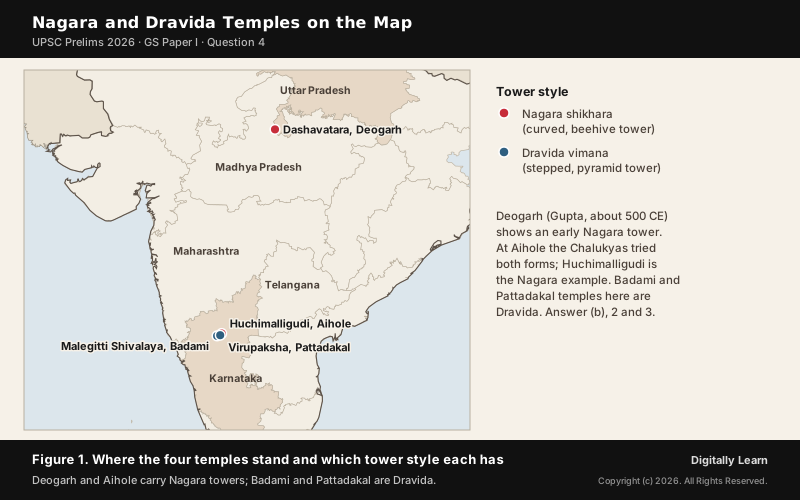
Which of the following temples has/have a Nagara-style shikhara?
1. Malegitti Shivalaya, Badami
2. Huchimalligudi Temple, Aihole
3. Dashavatara Temple, Deogarh
4. Virupaksha Temple, Pattadakal
Select the answer using the code given below:
a1 and 2
b2 and 3
c3 only
d3 and 4
See the answer and explanationWith how to crack it
Answer: (b) 2 and 3
The Nagara style has a curved, beehive-like tower (shikhara) rising over the sanctum. The Dravida style has a stepped, pyramid-like tower (vimana) topped by a small dome.
The Dashavatara Temple at Deogarh (Gupta period, about 500 CE) shows an early Nagara shikhara. At Aihole, the Chalukyan builders experimented with both northern and southern forms, and the Huchimalligudi Temple is the example UPSC treats as Nagara.
The Malegitti Shivalaya at Badami and the Virupaksha Temple at Pattadakal are classic Dravida temples with stepped towers. So the answer is (b), 2 and 3.
Tap the figure to open it full size.
How to crack it
Use a style rule, not memory of each temple: Gupta-period north India means Nagara, and Pattadakal and Badami are Chalukyan Dravida showpieces. That removes every option carrying 1 or 4.
Remember
Pattadakal has both styles side by side: Virupaksha and Sangameshwara are Dravida, while Papanatha and Galaganatha are Nagara. UPSC likes this contrast.
Among the four main forms of existence of life recognized in Jainism, which one of the following is not included?
aDeva (gods)
bYaksha (demi-gods)
cManushya (humans)
dTiryancha (animals and plants)
See the answer and explanationWith how to crack it
Answer: (b) Yaksha (demi-gods)
Jainism recognises four gatis (states of existence) into which a soul can be born: deva (heavenly beings), manushya (humans), naraki (hell beings) and tiryancha (animals, plants and other lower life forms).
Yaksha is not one of the four gatis, so it is the form that is not included. Answer (b).
How to crack it
Recall the four gatis as a set: deva, manushya, naraki, tiryancha. Any name outside that set, here Yaksha, is the odd one out.
Remember
Remember the four gatis by the Jain swastika: its four arms stand for deva, manushya, naraki and tiryancha.
The Hallisalasya painting in the Bagh Caves represents:
aA joyous folk dance
bBuddha in a meditative pose
cThe depiction of Shiva and Parvati on Kailasha
dSamudramanthan (Churning of the Ocean)
See the answer and explanationWith how to crack it
Answer: (a) A joyous folk dance
The Bagh Caves in Dhar district, Madhya Pradesh, hold Gupta-period murals (about the 5th to 6th century CE), close in style to Ajanta.
UPSC's key gives (a). The Hallisalasya panel shows the hallisaka, a joyous circular group dance with women dancers and musicians. The Bagh murals are scenes of music, dance and processions, not the Buddha in meditation, Shiva and Parvati, or the churning of the ocean.
How to crack it
The name gives it away: 'hallisaka' is a circular group dance. Bagh murals are scenes of music and procession, so the religious-scene options fall away.
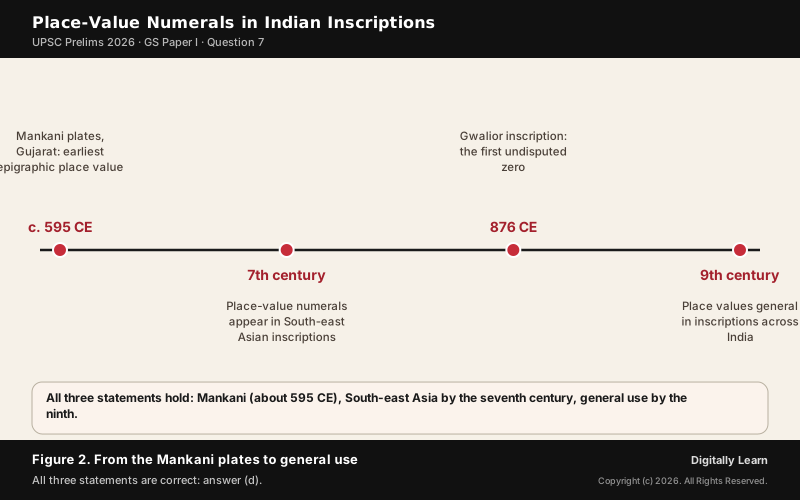
Consider the following statements relating to the use of the place-value system in India:
1. The earliest epigraphic use of the place-value system in India is found in the Mankani plates from Gujarat (AD 595-596).
2. In the ninth century, place-values become general in inscriptions all over India.
3. The place-values have been found in Sanskrit inscriptions in South-east Asia as early as the seventh century.
Which of the statements given above are correct?
a1 and 2 only
b1 and 3 only
c2 and 3 only
d1, 2 and 3
See the answer and explanationWith how to crack it
Answer: (d) 1, 2 and 3
Statement 1 is correct: a sixth-century copper-plate grant from Mankani in Gujarat, dated in the year 346 of the Kalachuri era (about 595 CE), is the example usually cited as the earliest epigraphic use of place-value numerals in India.
Statement 2 is correct: place-value numerals spread through Indian inscriptions over the following centuries, and by the ninth century they were in general use. The Gwalior inscription of 876 CE shows the first undisputed zero.
Statement 3 is correct: by the end of the seventh century decimal place-value numerals appear in inscriptions in South-east Asia as well as in India. All three are correct, answer (d).
Tap the figure to open it full size.
How to crack it
When every statement is a milestone in the same story (earliest use, spread to South-east Asia, general use), check for internal consistency: nothing contradicts, so 'all three' is safe.
Remember
Place-value numerals appear in South-east Asian inscriptions by the end of the seventh century, well before the famous zero of the Gwalior inscription (876 CE). This is a favourite trap.
Consider the following statements about the archaeological findings in Harappan towns:
I. There is wide occurrence of spindle-whorls in the houses but absence of spinning wheels.
II. Weights and measurement scales, complete with graduations have been discovered.
III. There are houses built in large part with baked bricks, around relatively spacious courtyards, with their own wells, bathing platforms, and large rooms.
Which of the following inferences can be drawn from the above statements?
1. Statement I suggests that spinning was a laborious activity done at home.
2. Statement II suggests the extent of the scientific knowledge that the Harappans possessed.
3. Statement III suggests the emergence of a common property system.
Select the answer using the code given below:
a1 and 2 only
b2 and 3 only
c1 and 3 only
d1, 2 and 3
See the answer and explanationWith how to crack it
Answer: (a) 1 and 2 only
Inference 1 holds. Spindle-whorls (small weights used on a hand spindle) are found in many houses but no spinning wheel, so thread was spun slowly by hand in the home. That makes spinning a laborious household activity.
Inference 2 holds. Harappan weights follow a precise binary and decimal system, and graduated scales (such as the shell scale from Mohenjodaro and the ivory scale from Lothal) show accurate measurement. That reveals the Harappans' practical scientific knowledge.
Inference 3 does not hold. Large baked-brick houses with private courtyards, wells and bathing platforms point to private, family-owned property and differences in wealth, not a common property system. So the answer is (a), 1 and 2 only.
How to crack it
Test each inference against the evidence it claims: hand spindles mean home spinning; graduated scales mean measurement. Baked-brick houses do not prove a particular social claim, so drop the third.
Remember
In inference questions, check whether the evidence points the other way. Private wells and big houses are evidence of private wealth and social difference.
Which one of the following statements about the Eka Movement and Bardoli Satyagraha is correct?
aThe Eka Movement was throughout supported and organized by the Congress while Bardoli Satyagraha was initially independent of Congress influence and was only in the last stages supported by the Congress.
bThe Eka Movement was provided leadership by the taluqdars of Awadh, whereas the Bardoli Satyagraha was a movement of the landless labourers.
cThe Bardoli Satyagraha was a campaign against the enhancement of land revenue, while the Eka Movement was a protest against excessive extraction of rents.
dThe Eka Movement was located in the Varanasi and Mirzapur districts of the present-day U.P., while the Bardoli Satyagraha took place in Saurashtra.
See the answer and explanationWith how to crack it
Answer: (c) The Bardoli Satyagraha was a campaign against the enhancement of land revenue, while the Eka Movement was a protest against excessive extraction of rents.
Option (c) is correct. The Bardoli Satyagraha of 1928, led by Vallabhbhai Patel, opposed a 22 per cent increase in land revenue by the Bombay government. The Eka (unity) Movement of 1921 to 1922 in Awadh protested high rents, extra levies (nazrana) and forced labour extracted by landlords.
Option (a) is wrong: the Eka Movement began in Congress and Khilafat circles but soon passed out of Congress control under Madari Pasi and other low-caste leaders. Bardoli was organised by Patel, a Congress leader, from the start.
Option (b) is wrong: the taluqdars of Awadh were the targets of the Eka Movement, not its leaders, and Bardoli was a movement of land-owning peasants. Option (d) is wrong on both places: Eka was centred in Hardoi, Bahraich and Sitapur districts, and Bardoli is in Surat district of Gujarat, not Saurashtra.
How to crack it
Look for the option with an exact, checkable detail: Bardoli opposed a revenue increase by the Bombay government. The others make sweeping claims ('throughout supported by Congress') that the history contradicts.
Consider the following statements about the Rigvedic period:
I. Irrigation from wells allowed agriculture to expand away from flood plains and strips on river margins into the present Punjab and Haryana plains having underground water levels reasonably close to the surface.
II. Draught-animal power was employed to draw up water out of the wells.
Which of the following information support/supports the above statements?
1. There is evidence in the Rigveda of the use of ashma chakra (stone pulley wheel) and ahava (strapped wooden pails) to draw up water.
2. Mention has been made in the Rigveda of the use of implements like parashu/kulisha (axe) and datra/sreni (sickle).
3. There is a history of the use of ox, even before the Rigveda, for ploughing the land and pulling the carts.
Select the answer using the code given below:
a1 and 2 only
b1, 2 and 3
c1 and 3 only
d3 only
See the answer and explanationWith how to crack it
Answer: (c) 1 and 3 only
The two statements describe irrigation from wells and the use of draught animals to lift water. Information 1 supports both directly: the Rigveda mentions the ashma chakra (stone pulley wheel) and pails used to lift water from wells.
Information 3 supports statement II: oxen were used for ploughing and pulling carts even before the Rigvedic period, as Harappan evidence of a ploughed field at Kalibangan and toy carts shows, so animal power was available for lifting water.
Information 2 is about axes and sickles. These are tools for clearing and harvesting, not for drawing water from wells, so they do not support these statements. Answer (c), 1 and 3 only.
How to crack it
Match each piece of information to the statement it can prove. Axes and sickles say nothing about wells or animal power, so any option with that item is out.
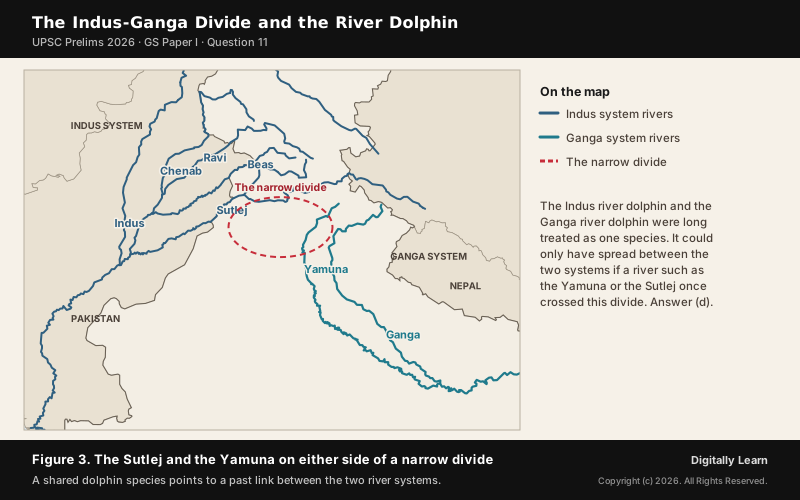
Consider the following assertion: In the Pleistocene period either the Yamuna once flowed into the Indus, or the Sutlej flowed into the Yamuna and one major tributary of either had shifted from the Ganga to the Indus or vice versa.
1. The Nadi-Sukta of the Rigveda
2. The explorations of the Sutlej and the Yamuna by Robert Bruce Foote
3. The presence of the same species of dolphins in both the Indus and the Ganga river systems
Which of the following is/are the basis of the above assertion?
Select the answer using the code given below:
a1 only
b2 only
c1 and 2
d3
See the answer and explanationWith how to crack it
Answer: (d) 3
The assertion is about river courses in the Pleistocene, the geological period before about 11,700 years ago. The Rigveda is far too recent to be evidence for that, and Robert Bruce Foote was a geologist best known for Palaeolithic finds in South India, not for exploring the Sutlej and Yamuna. So 1 and 2 are not the basis.
The basis is biological: the river dolphin of the Indus and that of the Ganga were long treated as one species. A species can only have spread between the two separate river systems if the rivers were once connected, which is what a shift of the Yamuna or Sutlej between the systems would have done. Answer (d), 3 only.
Tap the figure to open it full size.
How to crack it
Check the time scale: the Pleistocene is tens of thousands of years back, far older than the Rigveda. Only biological evidence (one dolphin species in both systems) can reach that far.
Remember
The Indus and Ganga river dolphins were treated as one species from the late 1990s and recognised again as two separate species in 2021; their close relationship still points to a past river connection. Both are Endangered on the IUCN Red List.
What does an empty seat represent in early Buddhist iconography?
aThe meditation of the Buddha
bThe Buddha's First Sermon
cThe Buddha's Mahaparinibbana
dThe Buddha's Mahabhinishkramana
See the answer and explanationWith how to crack it
Answer: (a) The meditation of the Buddha
Early Buddhist art (Sanchi, Bharhut, Amaravati) did not show the Buddha in human form. Symbols stood in for him and for events in his life.
An empty seat was meant to indicate the meditation of the Buddha. A stupa stood for the mahaparinibbana, a wheel for the first sermon at Sarnath, and a horse (or the Bodhi tree for enlightenment) for other events. Answer (a).
How to crack it
Remember the symbol set of early Buddhist art: seat for meditation, wheel for the first sermon, stupa for the mahaparinibbana. One symbol, one event.
Remember
Symbol and event pairs in early Buddhist sculpture: an empty seat for the Buddha's meditation, and a stupa for his mahaparinibbana.
Sources: NCERT Class 12, Themes in Indian History Part I, p.103
Q13History
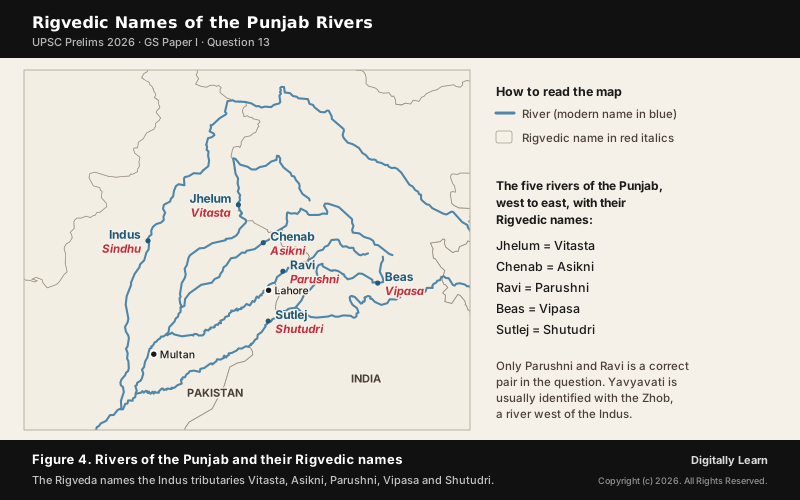
Which of the following pairs of ancient and modern names of rivers is/are correctly matched?
1. Vitasta : Chenab
2. Asikni : Jhelum
3. Parushni : Ravi
4. Yavyavati : Beas
Select the answer using the code given below:
a1 and 2
b3 and 4
c3 only
d4 only
See the answer and explanationWith how to crack it
Answer: (c) 3 only
Pair 1 is wrong: Vitasta is the Jhelum. Pair 2 is wrong: Asikni is the Chenab. The two names have been swapped.
Pair 3 is correct: Parushni, the river on whose banks the Battle of the Ten Kings was fought, is the Ravi. Pair 4 is wrong: the Rigvedic name of the Beas is Vipasa; Yavyavati is usually identified with the Zhob, a river in present-day Pakistan.
Only pair 3 is correct, answer (c).
Tap the figure to open it full size.
How to crack it
Learn the Rigvedic rivers as a west-to-east list: Vitasta (Jhelum), Asikni (Chenab), Parushni (Ravi), Vipasa (Beas). Swapped pairs are the usual trap.
Remember
Rigvedic names of the Punjab rivers: Vitasta (Jhelum), Asikni (Chenab), Parushni (Ravi), Vipasa (Beas), Shutudri (Sutlej).
Which of the following statements on the Amaravati Stupa and its relief sculpture is/are correct?
1. It was located in the lower Krishna valley.
2. In India, it was next only to the Sanchi Stupa in size.
3. The Amaravati school of sculpture made a lasting impact on the later South Indian sculpture, and its products were carried to Sri Lanka and South-east Asia.
Select the answer using the code given below:
a1 only
b1 and 3 only
c2 and 3 only
d1, 2 and 3
See the answer and explanationWith how to crack it
Answer: (b) 1 and 3 only
Statement 1 is correct: the Amaravati Stupa stood at Amaravati in Guntur district of Andhra Pradesh, on the lower Krishna.
Statement 2 is not correct: Amaravati was not a smaller stupa than Sanchi. Its final railing alone was about 59 metres (192 feet) across, and it is described as the most richly decorated stupa known.
Statement 3 is correct: the Amaravati (Andhra) school of sculpture had a strong influence on art in South India, Sri Lanka and South-east Asia, carried by the maritime trade of the east coast. Answer (b), 1 and 3 only.
How to crack it
A statement ranking one stupa below Sanchi 'in size' is a comparative claim, a common trap. Amaravati was the more lavish stupa, so any option with 2 goes.
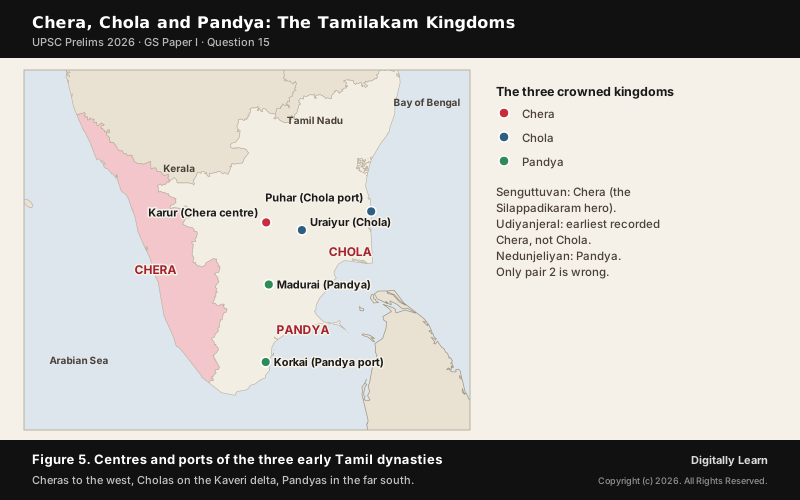
Which of the following pairs of the king and his dynasty in early historical Tamilakam is/are not correctly matched?
1. Senguttuvan : Chera
2. Udiyanjeral : Chola
3. Nedunjeliyan : Pandya
Select the answer using the code given below:
a1 and 2
b2 only
c1 and 3
d3 only
See the answer and explanationWith how to crack it
Answer: (b) 2 only
The question asks which pairs are NOT correctly matched.
Senguttuvan (Chenguttuvan) was a Chera king, the hero of the Kannagi story in the Silappadikaram, so pair 1 is correct. Nedunjeliyan was a Pandya king, so pair 3 is correct.
Udiyanjeral (Uthiyan Cheralathan) is generally taken as the earliest recorded Chera ruler, not a Chola. Only pair 2 is wrongly matched, answer (b).
Tap the figure to open it full size.
How to crack it
The question asks what is NOT correctly matched: read it twice. Udiyanjeral is a Chera name ('-jeral' echoes 'Cheral'), so pair 2 is the mismatch.
Remember
The Sangam kingdoms and their symbols: Chera (bow), Chola (tiger), Pandya (fish).
Which of the following factors contributed to the formation of the Forward Bloc by Subhas Chandra Bose in 1939?
1. Bose failed to win the confidence of Mahatma Gandhi.
2. The Congress Left was disunited and failed to support Bose.
3. The Communists did not support Bose in his endeavours.
4. The supporters of M.N. Roy and socialist leaders like Jayaprakash Narayan preferred Congress unity to supporting Bose.
Select the answer using the code given below:
a1, 2 and 3
b1, 2 and 4
c1, 3 and 4
d2 and 4 only
See the answer and explanationWith how to crack it
Answer: (b) 1, 2 and 4
Bose was re-elected Congress president in 1939, defeating Gandhi's candidate Pattabhi Sitaramayya by 1,580 votes to 1,377, but he could not win Gandhi's confidence or form a working committee, and he resigned (statement 1).
The Congress Left did not stand together behind him (statement 2). The Congress Socialists, led by Jayaprakash Narayan, and the followers of M.N. Roy chose Congress unity over an open split (statement 4). Isolated, Bose formed the Forward Bloc within the Congress in 1939.
UPSC's key gives (b), 1, 2 and 4, and leaves out statement 3. The Communists did later part ways with Bose over his call for a parallel organisation, so statement 3 is not false in itself; but no option includes all four statements, and the key counts only the three factors that directly isolated Bose in 1939.
How to crack it
UPSC often keeps the obvious causes and adds one doubtful one. Gandhi's opposition, a divided Left and the socialists choosing Congress unity all fit Bose's isolation; the Communist claim is the weaker link.
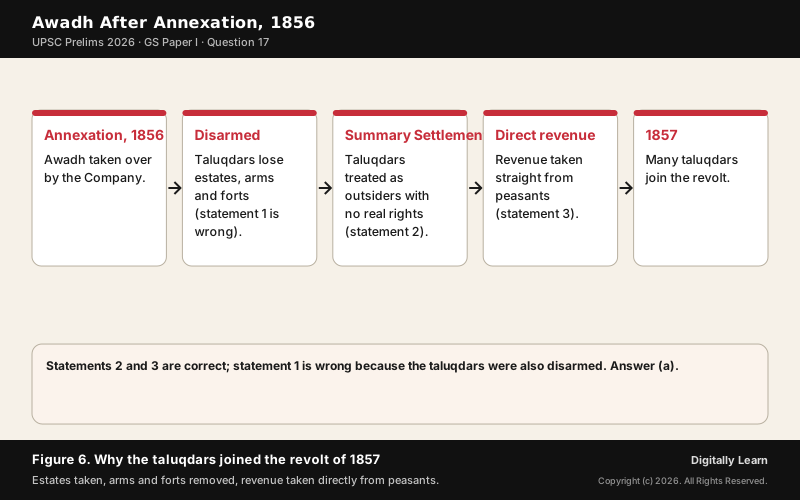
Consider the following statements regarding the British policy in Awadh immediately after its annexation in 1856:
1. The taluqdars were dispossessed of their estates but allowed to retain their arms and forts.
2. A Summary Revenue Settlement was made in 1856 assuming that the taluqdars were outsiders.
3. The British believed in taking revenue directly from the peasants by removing the taluqdars.
Which of the statements given above is/are correct?
a2 and 3 only
b1 and 3 only
c1, 2 and 3
d2 only
See the answer and explanationWith how to crack it
Answer: (a) 2 and 3 only
Statement 1 is wrong. After annexing Awadh in 1856, the British took away the taluqdars' estates and also disarmed them and destroyed their forts. Losing both land and military power is why many taluqdars joined the revolt of 1857.
Statement 2 is correct: the Summary Settlement of 1856 treated the taluqdars as intruders (outsiders) with no real rights to the land. Statement 3 is correct: the British wanted to remove the taluqdar middlemen and collect revenue directly from the peasants, hoping to raise revenue and win peasant loyalty.
Answer (a), 2 and 3 only.
Tap the figure to open it full size.
How to crack it
Look for the internal contradiction: dispossessed yet 'allowed to keep arms and forts' makes little sense for a new ruler. Statements 2 and 3 describe one consistent policy.
Remember
In Awadh the taluqdars lost both their land and their forts, which is why so many of them joined the revolt of 1857.
Sources: NCERT Class 12, Themes in Indian History Part III, p.55
Q18History
Consider the following assertion: The genesis of political alliances based on community lay in the very nature of the Montague-Chelmsford Reforms, 1919.
1. Reforms retained and extended the principle of separate electorates.
2. Separate electorates were supposed to counter Indian nationalism, which was growing stronger.
3. Deprived classes rallied around the favours inherent in separate electorates.
Which of the following statements support/supports the above assertion?
Select the answer using the code given below:
a1 only
b2 and 3 only
c1 and 2 only
d1, 2 and 3
See the answer and explanationWith how to crack it
Answer: (d) 1, 2 and 3
The Montagu-Chelmsford Reforms (Government of India Act, 1919) kept separate electorates for Muslims and extended them to Sikhs, Indian Christians, Anglo-Indians and Europeans (1 is correct).
The British intended separate electorates to divide Indians by community and so blunt the growing national movement (2 is correct). Communities that gained seats and favours through separate electorates organised around them, including the depressed classes who began to seek their own representation (3 is correct).
All three support the assertion that community-based political alliances grew out of the 1919 reforms. Answer (d).
How to crack it
When a question offers reasons for an assertion, check whether each reason is true and linked. All three here describe how separate electorates bred community politics.
Pandit Mallikarjun Mansur, the famous classical singer from Karnataka, represented the:
aAgra Gharana
bGwalior Gharana
cPatiala Gharana
dJaipur-Atrauli Gharana
See the answer and explanationWith how to crack it
Answer: (d) Jaipur-Atrauli Gharana
Pandit Mallikarjun Mansur (1910 to 1992) of Dharwad in Karnataka was a leading singer of the Jaipur-Atrauli gharana, founded by Ustad Alladiya Khan. He trained under Manji Khan and Bhurji Khan, the sons of Alladiya Khan. Answer (d).
How to crack it
Gharana questions are pure recall: pair each singer with a gharana in your notes. Mansur and Jaipur-Atrauli is a standard pair.
Remember
Karnataka's Dharwad region produced many Hindustani singers: Mallikarjun Mansur (Jaipur-Atrauli), and Bhimsen Joshi, Gangubai Hangal and Basavaraj Rajguru (Kirana).
In which one among the following texts does the term kshetra-patni ('mistress of the field') originate?
aRigveda
bAtharvaveda
cAshtadhyayi
dArthashastra
See the answer and explanationWith how to crack it
Answer: (b) Atharvaveda
UPSC's provisional key gives (b), the Atharvaveda.
The Atharvaveda is the Veda of hymns and charms for everyday life: health, family, cattle and crops. That agricultural setting is where a term like kshetra-patni, 'mistress of the field', belongs.
The Ashtadhyayi is Panini's grammar and the Arthashastra a treatise on statecraft, so neither is the origin of this term.
How to crack it
Use the nature of each text: a grammar (Ashtadhyayi) and a statecraft manual (Arthashastra) are unlikely homes for a farming charm. The Atharvaveda deals with everyday life, crops included.
Remember
For Vedic texts, sort by content: Rigveda (hymns to gods), Samaveda (melodies), Yajurveda (sacrificial formulas), Atharvaveda (charms and spells for daily life, including agriculture and healing).
Consider the following statements with reference to India's response to climate change:
I. India's Long-Term Low Emission Development Strategy (LT-LEDS) is a crucial tool for achieving net-zero emissions by 2070.
II. India's 4th Biennial Update Report (BUR-4) submitted in December, 2024 recorded around 8% decrease in Greenhouse gas emissions in 2020 over 2019.
III. Climate-resilient development necessarily depends on quick and short-term achievement of emission reduction targets.
Which of the following relationships among the above statements is/are correct?
1. Statement I is empirically supported by statement II.
2. Statement III contradicts the approach implicit in statement I.
3. Statement I and statement III together establish the premise of long-term sustainability.
Select the answer using the code given below:
a1 only
b1 and 2
c2 and 3
d3 only
See the answer and explanationWith how to crack it
Answer: (b) 1 and 2
Statement I is correct: India's LT-LEDS, submitted to the UNFCCC in November 2022, sets out the pathway to net-zero by 2070. Statement II is correct: India's fourth Biennial Update Report (BUR-4), submitted in December 2024, reported a 7.93 per cent fall in total emissions in 2020 compared with 2019.
Relationship 1 holds: a measured fall in emissions is empirical support for a low-emission strategy. Relationship 2 holds: statement III claims resilience depends on quick, short-term cuts, which contradicts the long-term, phased approach built into the LT-LEDS.
Relationship 3 fails because statements I and III pull in opposite directions, so together they cannot establish one premise. Answer (b), 1 and 2.
How to crack it
In statement-relationship questions, judge each statement first, then the link. A measured fall in emissions supports a low-emission strategy; a claim that resilience needs quick short-term cuts contradicts a long-term plan.
Remember
India's climate targets: net-zero by 2070; updated NDC (2022) of 45 per cent lower emissions intensity of GDP by 2030 over 2005 and 50 per cent of installed power capacity from non-fossil sources by 2030.
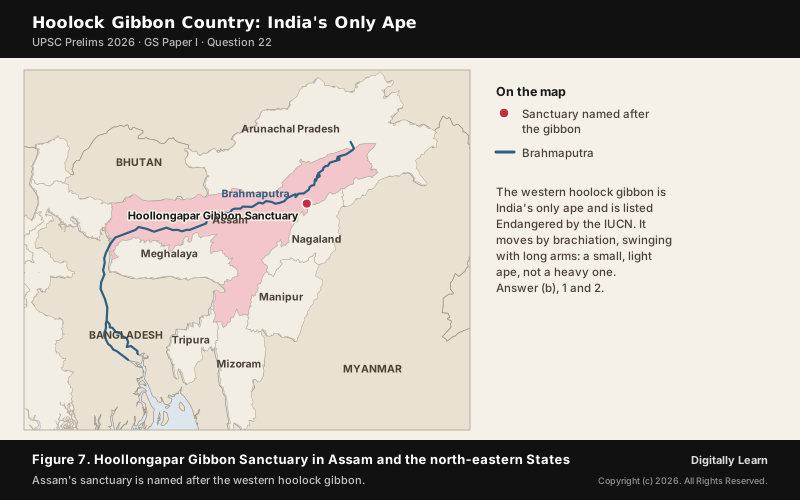
With respect to the Western Hoolock Gibbons, which of the following statements is/are correct?
1. A Sanctuary in North-east India is home to this ape species listed as Endangered in the International Union for Conservation of Nature (IUCN) Red List.
2. They have specialized brachiation and can easily swing between trees.
3. They possess a strong and heavy build like gorillas, yet are remarkably agile tree climbers.
Select the answer using the code given below:
a1 only
b1 and 2
c2 and 3
d3 only
See the answer and explanationWith how to crack it
Answer: (b) 1 and 2
Statement 1 is correct: the western hoolock gibbon, one of India's two apes (both are hoolock gibbons), is listed as Endangered on the IUCN Red List, and Assam's Hoollongapar Gibbon Sanctuary is named after it.
Statement 2 is correct: hoolock gibbons move by brachiation, swinging through the trees with their long arms.
Statement 3 is wrong: gibbons are small, light apes built for swinging, the opposite of a heavy gorilla-like build. Answer (b), 1 and 2.
Tap the figure to open it full size.
How to crack it
Physical traits follow lifestyle: an ape that swings through trees (brachiation) must be light. That knocks out the 'heavy like a gorilla' statement.
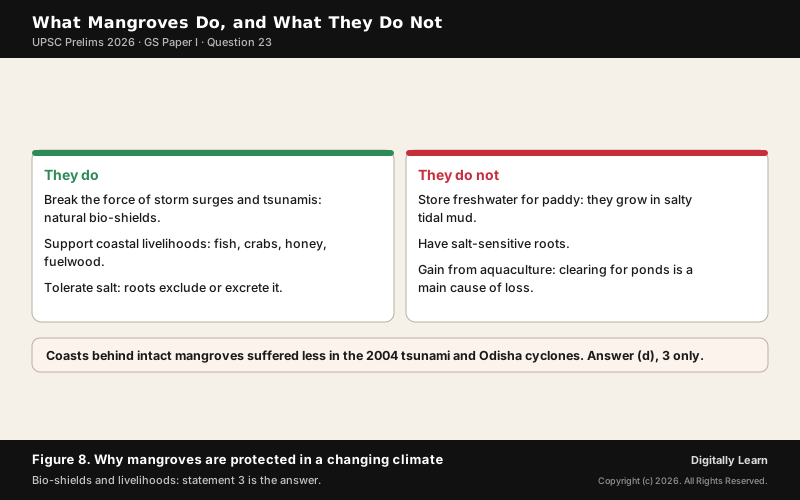
Which of the following best explain(s) the rationale for protecting mangrove ecosystems in the context of climate resilience?
1. Mangroves reduce tidal energy and store freshwater, making them ideal sites for paddy cultivation in saline estuarine belts.
2. Their salt-sensitive roots filter seawater, making mangroves key to converting coastal land into freshwater aquaculture zones.
3. By withstanding tidal surges and offering biomass resources, mangroves function both as natural bio-shields and livelihood bases for rural communities.
Select the answer using the code given below:
a1 only
b1 and 2
c2 and 3
d3 only
See the answer and explanationWith how to crack it
Answer: (d) 3 only
Statement 1 is wrong: mangroves grow in salty, tidal mud, which is not ideal for paddy, and they do not store freshwater for farming.
Statement 2 is wrong: mangrove roots are salt-tolerant, not salt-sensitive. They exclude or excrete salt, and clearing mangroves for aquaculture is one of the main causes of their loss, not a reason to protect them.
Statement 3 is correct: mangroves break the force of storm surges and tsunamis, acting as natural bio-shields, and give coastal people fish, crabs, honey and fuelwood. The 2004 tsunami and cyclones in Odisha showed lower damage behind intact mangroves. Answer (d), 3 only.
Tap the figure to open it full size.
How to crack it
Spot the reversed science: mangroves are salt-tolerant, not salt-sensitive, and they grow in salty mud, not freshwater paddy land. Statements with reversed facts are wrong.
In what way(s) does the Vizhinjam International Seaport represent a structural shift in India's maritime trade and logistics policy?
1. By functioning exclusively as a domestic cargo hub to reduce reliance on coastal shipping and eliminate the need for foreign collaborations.
2. By focusing primarily on passenger cruise tourism and heritage shipping to increase Kerala's profile as a maritime heritage destination.
3. By leveraging its natural deep draft and strategic location to reduce dependence on foreign trans-shipment ports, enhance revenue retention, and reposition India in regional maritime trade.
Select the answer using the code given below:
a1 only
b1 and 2
c2 and 3
d3 only
See the answer and explanationWith how to crack it
Answer: (d) 3 only
Vizhinjam International Seaport near Thiruvananthapuram, commissioned in May 2025, is India's first dedicated deep-water container transshipment port. Its natural depth of about 20 metres close to the shore and its position near the East-West international shipping route let the largest container ships call directly (3 is correct).
Before Vizhinjam, most Indian containers were transshipped at Colombo, Singapore or Dubai, so India lost revenue and time. Vizhinjam aims to bring that cargo home.
Statement 1 is wrong: it is an international transshipment hub, developed with a private operator, not a purely domestic cargo port. Statement 2 is wrong: it is a container port, not a cruise port. Answer (d), 3 only.
How to crack it
Watch for 'exclusively' and 'primarily': they usually signal a wrong statement. Vizhinjam's point is transshipment of international containers.
Identify the river of the Indian sub-continent on the basis of the following information:
1. It has an antecedent drainage system.
2. It flows through three countries.
3. It originates in the Tibetan Plateau and is an important river for irrigation.
4. It does not form distributaries.
Select the answer from the following:
aBrahmaputra
bIndus
cSutlej
dTeesta
See the answer and explanationWith how to crack it
Answer: (c) Sutlej
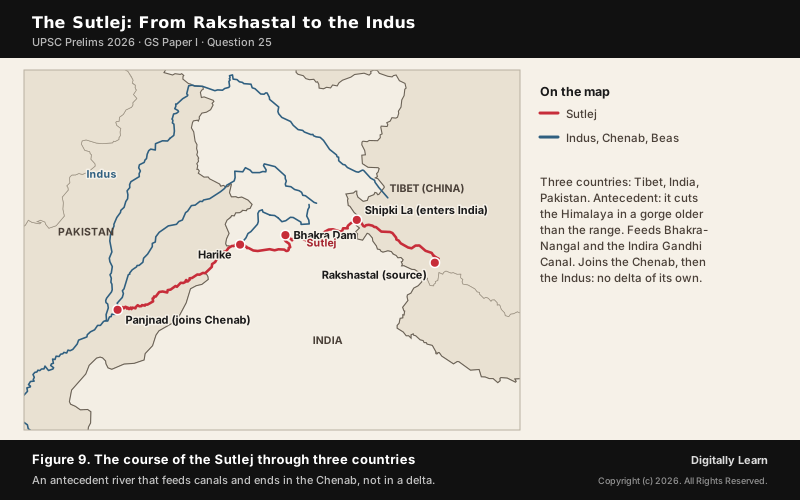
The Sutlej rises near Lake Rakshastal in Tibet, cuts across the Himalaya in a deep gorge (an antecedent river, older than the mountains it crosses), and flows through China (Tibet), India and Pakistan. It feeds the Bhakra-Nangal and Indira Gandhi Canal systems, so it is vital for irrigation, and it joins the Chenab and then the Indus without forming a delta of its own.
The Indus flows through China, India and Pakistan too, but it forms a large delta with many distributaries. The Brahmaputra flows through China, India and Bangladesh and forms a delta with the Ganga. The Teesta rises in Sikkim, not Tibet. Answer (c), Sutlej.
Tap the figure to open it full size.
How to crack it
Use elimination by one clue at a time: 'no distributaries' removes the Indus and the Brahmaputra (both form deltas), and 'originates in Tibet' removes the Teesta.
Remember
The Sutlej (Satluj) is an antecedent river, and it feeds the canal system of the Bhakra Nangal project.
Sources:Sutlej (Wikipedia); NCERT Class 11, India: Physical Environment, Drainage System
Q26Geography
Which of the following with reference to Indian States is/are not correct?
1. Uttar Pradesh shares its boundary with the highest number of other Indian States.
2. Rajasthan shares the longest international border among all Indian States.
3. Sikkim is the only State that shares its boundary with just one other Indian State.
Select the answer using the code given below:
a1 only
b1 and 2
c2 and 3
d3 only
See the answer and explanationWith how to crack it
Answer: (c) 2 and 3
The question asks which statements are NOT correct.
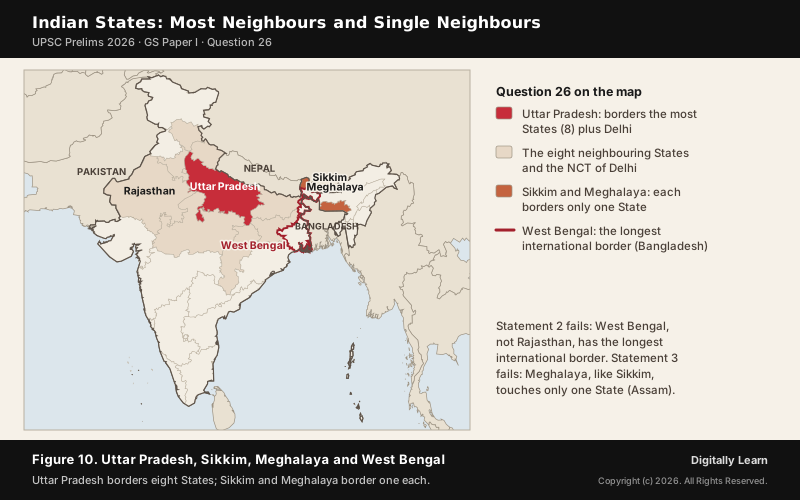
Statement 1 is correct: Uttar Pradesh borders eight States (Uttarakhand, Himachal Pradesh, Haryana, Rajasthan, Madhya Pradesh, Chhattisgarh, Jharkhand and Bihar) plus the National Capital Territory of Delhi, more than any other State.
Statement 2 is not correct: West Bengal has the longest international border of any State, mainly its border of about 2,217 km with Bangladesh. Rajasthan's border with Pakistan is about 1,070 km.
Statement 3 is not correct: Sikkim shares a boundary with only West Bengal, but so does Meghalaya, which borders only Assam. Sikkim is not the only one. Answer (c), 2 and 3.
Tap the figure to open it full size.
How to crack it
It asks what is NOT correct. Check superlatives: 'longest international border' belongs to West Bengal, and 'only State with one neighbour' ignores Meghalaya.
Remember
Quick border facts: Bangladesh is India's longest land border (4,096.7 km), and West Bengal holds the largest share of it.
Which of the following statements with regard to the arrival of Amur Falcons at Doyang Lake in Nagaland each year from Mongolia is/are correct?
1. It showcases how sustained local conservation efforts can contribute to the arrival and protection of international migratory birds.
2. It reflects the global success of advanced tracking technologies that guide migratory birds back to their stopover sites.
3. It confirms that Amur Falcons have adapted to permanent residency in India due to favourable habitat changes.
Select the answer using the code given below:
a1 only
b1 and 2
c2 and 3
d3 only
See the answer and explanationWith how to crack it
Answer: (a) 1 only
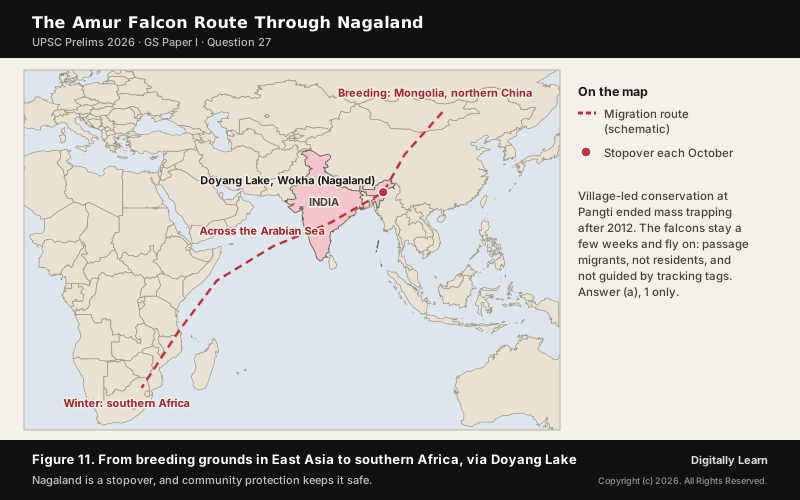
Statement 1 is correct. Amur falcons stop at Doyang Lake in Wokha district, Nagaland, every October on their migration from Mongolia and northern China to southern Africa. Until 2012 tens of thousands were trapped for meat there; community conservation led by the villages of Pangti and nearby ended the hunting, and the site is now celebrated for protecting them.
Statement 2 is wrong: birds are not guided by tracking technology. Satellite tags only record the route scientists follow.
Statement 3 is wrong: the falcons are passage migrants that stay a few weeks and fly on across the Arabian Sea. They have not become residents. Answer (a), 1 only.
Tap the figure to open it full size.
How to crack it
Extreme or odd claims are usually false: migrants 'guided by tracking technology' or turned into 'permanent residents' contradict what migration means.
Remember
The Amur falcon's migration from East Asia to southern Africa includes a non-stop crossing of the Arabian Sea.
Which among the following is/are the objective(s) of the Rainfed Area Development (RAD) initiative under the National Mission for Sustainable Agriculture (NMSA)?
1. Encouraging monoculture in rainfed areas
2. Increasing rice cultivation in irrigated regions
3. Enhancing productivity and minimising climatic risks through Integrated Farming Systems (IFS)
Select the answer using the code given below:
a1 only
b1 and 2
c2 and 3
d3 only
See the answer and explanationWith how to crack it
Answer: (d) 3 only
Rainfed Area Development (RAD) is a component of the National Mission for Sustainable Agriculture (NMSA). It promotes Integrated Farming Systems that combine crops with livestock, fisheries, horticulture and agroforestry, so that a farmer in a rainfed area has several sources of income and is less exposed to a failed monsoon (3 is correct).
Monoculture is the opposite of what RAD encourages (1 is wrong). RAD works in rainfed areas, not on raising rice in irrigated regions (2 is wrong). Answer (d), 3 only.
How to crack it
Read the scheme's own name: 'rainfed' and 'sustainable' rule out monoculture and irrigated rice. Integrated farming is the only fit.
Which of the following is/are the most significant implication(s) of obtaining Oeko-Tex certification for Eri Silk in the global textile industry?
1. It allows Indian exporters to compete in high-end markets that prioritise chemical-free products.
2. It confirms that Eri Silk meets international safety, environmental, and quality standards, enabling its entry into premium eco-conscious markets.
Select the answer using the code given below:
a1 only
b2 only
cBoth 1 and 2
dNeither 1 nor 2
See the answer and explanationWith how to crack it
Answer: (c) Both 1 and 2
OEKO-TEX is an international certification that tests textiles for harmful substances. Eri silk, from Assam and the North-east, is often called 'peace silk' or 'ahimsa silk' because the moth is allowed to leave the cocoon before the silk is spun.
Certification opens premium international markets that demand chemical-safe products (statement 1) and confirms that the product meets international safety and quality standards, so it can be sold to eco-conscious buyers (statement 2). Both are real implications, answer (c).
How to crack it
Both statements describe the same benefit from two angles (market access and certified standards). When statements do not conflict and both follow from certification, 'Both' is safe.
Ships from which of the following countries have to cross the Strait of Hormuz to reach out to the Indian Ocean?
1. Bahrain
2. Syria
3. Qatar
4. Egypt
Select the answer using the code given below:
a1 and 2
b1 and 3
c2 and 3
d3 and 4
See the answer and explanationWith how to crack it
Answer: (b) 1 and 3
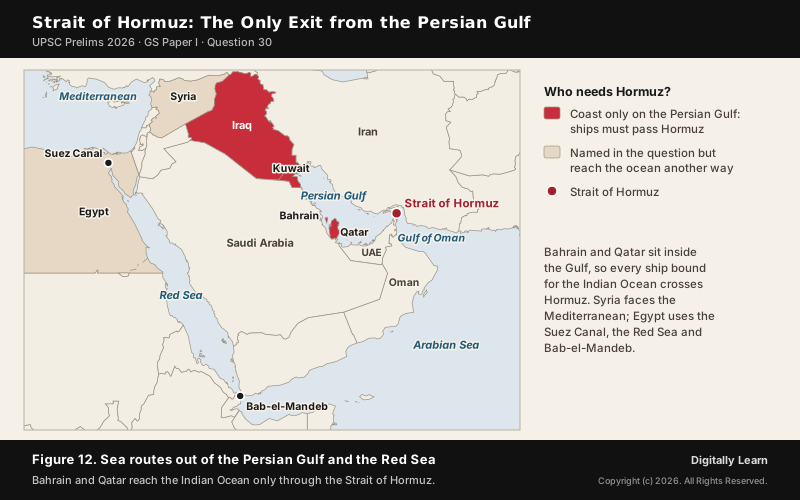
The Strait of Hormuz is the only sea exit from the Persian Gulf. Every country whose coast lies wholly inside the Gulf, such as Bahrain, Qatar, Kuwait and Iraq, must pass through it to reach the Arabian Sea and the Indian Ocean.
Syria lies on the Mediterranean and Egypt reaches the Indian Ocean through the Red Sea and the Bab-el-Mandeb, so neither uses Hormuz. Answer (b), 1 and 3.
Tap the figure to open it full size.
How to crack it
Picture the map: Hormuz is the only exit from the Persian Gulf. Only countries wholly inside the Gulf need it; Mediterranean and Red Sea countries do not.
Remember
Map pairs to memorise: Hormuz (Persian Gulf to Gulf of Oman), Bab-el-Mandeb (Red Sea to Gulf of Aden), Malacca (Indian Ocean to South China Sea).
Tungurahua Volcano, which was declared a Global Geopark by UNESCO in 2025, is situated in which one among the following countries?
aEcuador
bPeru
cBolivia
dColombia
See the answer and explanationWith how to crack it
Answer: (a) Ecuador
Tungurahua is an active stratovolcano in the Andes of central Ecuador. In 2025 UNESCO added the Tungurahua Volcano Geopark to its Global Geoparks Network. Answer (a), Ecuador.
How to crack it
Tungurahua is in the Andes; place it by a nearby landmark. Ecuador's central Andes hold several famous volcanoes.
With reference to the climate of Andaman and Nicobar Islands, which of the following statements is/are correct?
1. The climate can be defined as a humid, tropical coastal climate.
2. It receives rainfall from both South-west monsoon and North-east monsoon.
3. Maximum precipitation is between December and May.
Select the answer using the code given below:
a1 only
b1 and 2
c2 and 3
d3 only
See the answer and explanationWith how to crack it
Answer: (b) 1 and 2
Statement 1 is correct: the islands lie near the equator and are surrounded by sea, giving a hot, humid tropical coastal climate with little change in temperature through the year.
Statement 2 is correct: the islands get rain from the south-west monsoon (May to September) and again from the north-east monsoon (roughly October to December).
Statement 3 is wrong: the rainy season runs from about May to December. The months from January to April are the driest. Answer (b), 1 and 2.
How to crack it
Link rainfall to the two monsoons: May to December, with January to April driest. A statement putting peak rain in December to May mixes the seasons.
Which of the following geographical features or phenomena is/are associated with the Peninsular Block of India?
1. Submergence of parts of the western coast due to tectonic activity
2. Presence of residual mountain ranges such as the Veliconda hills and Mahendragiri hills
3. Deep, V-shaped river valleys formed by fast-flowing rivers
Select the answer using the code given below:
a1 only
b1 and 2
c2 and 3
d3 only
See the answer and explanationWith how to crack it
Answer: (b) 1 and 2
Statement 1 is correct: parts of the western coast subsided and were submerged by the sea as the Peninsular Block went through faulting and vertical movement.
Statement 2 is correct: the Peninsula is an old, stable landmass, and its hills are relict or residual mountains worn down over a very long time, such as the Aravalli, Nallamala, Javadi, Veliconda, Palkonda and Mahendragiri hills.
Statement 3 is wrong: deep V-shaped valleys cut by fast young rivers are typical of the Himalaya. Peninsular rivers flow in broad, shallow, mature valleys. Answer (b), 1 and 2.
How to crack it
Sort features by age: the Peninsula is old and worn (residual hills), while deep V-shaped valleys belong to the young Himalaya.
Remember
Contrast the two blocks: Himalaya = young, fold mountains, V-shaped gorges, antecedent rivers; Peninsula = old, stable, residual hills, broad graded valleys.
Sources: NCERT Class 11, India: Physical Environment, Ch. 2, p.10
Q35Economy
Consider the following statements with reference to the Sagarmala Programme of the Government of India:
I. The Sagarmala Programme seeks to achieve port-led economic growth through cost-effective and sustainable coastal infrastructure.
II. The success of the Sagarmala Programme is reflected in significant growth in coastal and inland waterway shipping, along with improved global port rankings.
III. Sagarmala 2.0 aims to position India as a global maritime innovation hub aligned with Atmanirbhar Bharat and Viksit Bharat 2047 visions.
Which of the following relationships among the above statements is/are correct?
1. Statement II validates the effectiveness of the strategies envisioned in statement I.
2. Statement III extends the objectives of statement I by embedding them into a future-oriented innovation framework.
3. Statement I contradicts statement III by focusing only on traditional infrastructure instead of modern innovation.
Select the answer using the code given below:
a1 only
b1 and 2
c2 and 3
d3 only
See the answer and explanationWith how to crack it
Answer: (b) 1 and 2
Statement I is the core aim of Sagarmala (launched 2015): port-led development with efficient coastal and port infrastructure. Statement II describes results such as the rise in coastal shipping and inland waterway cargo and India's better showing in the World Bank's port rankings, so relationship 1 holds: II validates the strategy of I.
Statement III describes Sagarmala 2.0, which carries the same port-led aims into innovation, shipbuilding and the Viksit Bharat 2047 vision, so relationship 2 holds: III extends I.
Relationship 3 fails because III builds on I; it does not contradict it. Answer (b), 1 and 2.
How to crack it
Treat each statement as aim, result, or extension. Results validate an aim; a new phase extends it.
Consider the following statements about Rhynchostylis retusa (Foxtail orchid):
1. It is an epiphytic orchid.
2. The species is endemic to North-east India.
3. It is the State flower of Arunachal Pradesh and Assam.
Which of the statements given above is/are correct?
a1 only
b1 and 3
c2 and 3
d3 only
See the answer and explanationWith how to crack it
Answer: (b) 1 and 3
Statement 1 is correct: the foxtail orchid grows on tree trunks and branches, so it is epiphytic.
Statement 2 is wrong: Rhynchostylis retusa is widely spread across South and South-east Asia, from India and Sri Lanka to Indonesia and the Philippines, so it is not endemic to North-east India.
Statement 3 is correct: it is the State flower of both Arunachal Pradesh and Assam (where it is called kopou phool and worn in Bihu). Answer (b), 1 and 3.
How to crack it
The word 'endemic' is a frequent trap: a species found across South and South-east Asia is not endemic to one region.
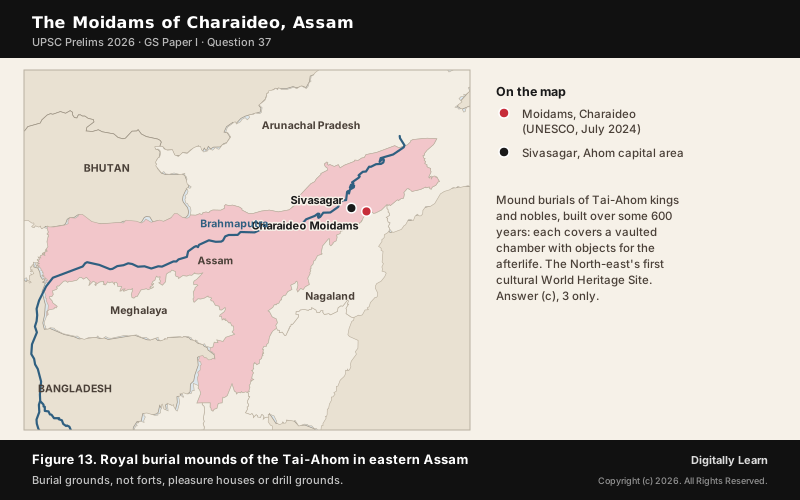
Which one of the following statements with regard to the Moidams, built by the Tai-Ahom kingdom and inscribed as a World Heritage Site by UNESCO, is/are correct?
1. They acted as army fortresses.
2. They were recreation centres of the Royals and Nobles.
3. They were burial grounds of the Royals and Nobles.
4. They were battle drill centres of the Royals and Nobles.
Select the answer using the code given below:
a1 only
b1 and 3
c3 only
d2 and 4
See the answer and explanationWith how to crack it
Answer: (c) 3 only
The Moidams of Charaideo in Assam are mound burials of the Tai-Ahom royal family and nobles, built over some 600 years. They were inscribed on the UNESCO World Heritage List in July 2024 as the North-east's first cultural World Heritage Site.
Each moidam covers a vaulted chamber holding the remains of a king or noble with objects for the afterlife, so they were burial grounds, not forts, pleasure houses or drill grounds. Answer (c), 3 only.
Tap the figure to open it full size.
How to crack it
UNESCO descriptions are exact: Moidams are royal burial mounds. Military or recreational uses are distractors.
At the United Nations Ocean Conference (UNOC) held in June, 2025 in France, the Food and Agricultural Organization (FAO) of the United Nations demonstrated its leading voice on marine and ocean issues, especially on sustainable fisheries and aquaculture for resilient livelihood and "Blue Transformation". Which of the following combinations about the "Four Betters" proposed by FAO for "Blue Transformation" is correct?
aBetter production, better nutrition, better environment and better ocean
bBetter production, better nutrition, better environment and better life
cBetter coral reefs, better nutrition, better environment and better life
dBetter estuaries, better nutrition, better environment and better mangrove vegetation
See the answer and explanationWith how to crack it
Answer: (b) Better production, better nutrition, better environment and better life
FAO's Strategic Framework 2022-31 is built around the 'Four Betters': better production, better nutrition, a better environment and a better life, leaving no one behind. Blue Transformation is FAO's roadmap for applying them to fisheries and aquaculture. Answer (b).
How to crack it
FAO's framework words come in a fixed set: better production, nutrition, environment and life. Options that swap in coral reefs or estuaries are altered copies.
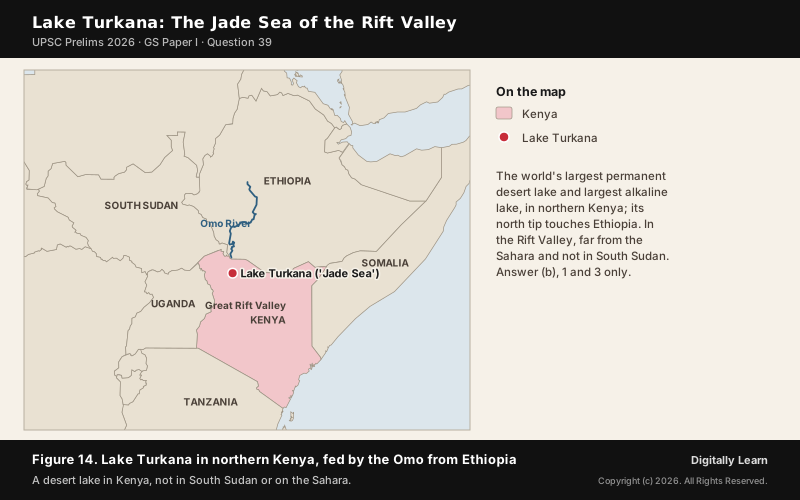
Which of the following statements with reference to Lake Turkana is/are correct?
1. It is the largest desert lake in the world.
2. The lake is situated in South Sudan along the eastern fringe of the Sahara desert.
3. The lake is listed as a UNESCO World Heritage Site and is also referred to as the 'Jade Sea'.
Select the answer using the code given below:
a1 only
b1 and 3 only
c2 and 3 only
d1, 2 and 3
See the answer and explanationWith how to crack it
Answer: (b) 1 and 3 only
Statement 1 is correct: Lake Turkana in northern Kenya is the world's largest permanent desert lake and the largest alkaline lake.
Statement 2 is wrong: the lake is in Kenya (its northern tip touches Ethiopia), in the Great Rift Valley of East Africa, far from the Sahara and not in South Sudan.
Statement 3 is correct: the Lake Turkana National Parks are a UNESCO World Heritage Site, and the lake's colour gives it the name 'Jade Sea'. Answer (b), 1 and 3 only.
Tap the figure to open it full size.
How to crack it
Check place names in each statement against a mental map: Lake Turkana is in Kenya's Rift Valley, far from South Sudan and the Sahara.
Which one of the following is the first Plan Vivo certified Reducing Emissions from Deforestation and Forest Degradation (REDD+) project in India?
aUttarakhand REDD+ project
bICFRE-ICIMOD Transboundary REDD+ project in North-Eastern Himalayas
cKhasi Hills Community REDD+ project
dSikkim Mamley Kamrang Community REDD+ project
See the answer and explanationWith how to crack it
Answer: (c) Khasi Hills Community REDD+ project
The Khasi Hills Community REDD+ Project in Meghalaya, run by local Khasi community institutions, was India's first REDD+ project certified under the Plan Vivo standard. It pays communities to protect and restore their forests. Answer (c).
How to crack it
Remember one fact per first: India's first Plan Vivo REDD+ project was community-run in Meghalaya's Khasi Hills.
Which of the following statements with regard to genetic medicine is/are correct?
1. Genetic medicines correct/compensate for the faulty genes responsible for disease.
2. Engineered viruses and lipid nanoparticles are used as carriers of the genetic medicine.
3. Genetic medicines alter the entire DNA sequence.
Select the answer using the code given below:
a1 only
b2 and 3 only
c1 and 2 only
d1, 2 and 3
See the answer and explanationWith how to crack it
Answer: (c) 1 and 2 only
Statement 1 is correct: genetic medicines replace, silence or make up for a faulty gene, or add a working copy.
Statement 2 is correct: they need a carrier to get into cells, most often engineered harmless viruses (viral vectors), or non-viral carriers such as tiny fat-based particles (lipid nanoparticles).
Statement 3 is wrong: they target a specific gene or its message and do not rewrite the whole DNA sequence. Answer (c), 1 and 2 only.
How to crack it
Watch for 'entire': genetic medicines target a specific gene, so 'alter the entire DNA sequence' is the overstatement to reject.
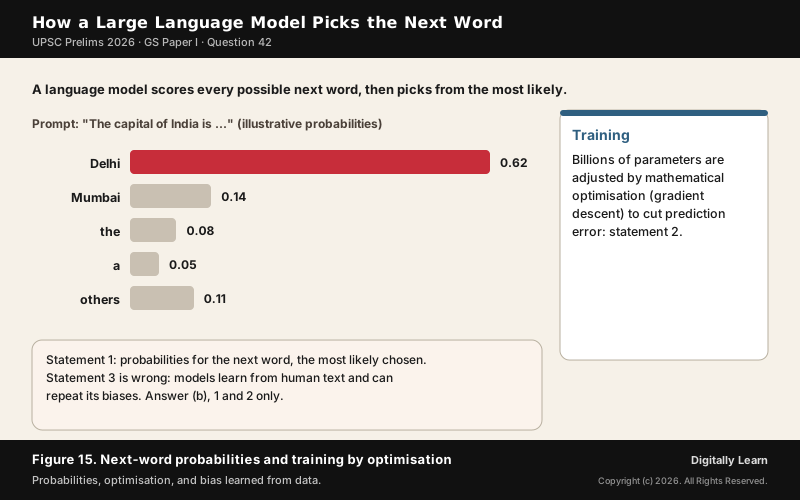
Which of the following statements with regard to Large Language Models (LLMs) used in machine learning is/are correct?
1. LLMs assign probabilities to the next possible words and then pick the one with the highest probability.
2. LLMs process data through mathematical optimization to minimise prediction errors.
3. LLMs produce unbiased outputs.
Select the answer using the code given below:
a1 only
b1 and 2 only
c2 and 3 only
d1, 2 and 3
See the answer and explanationWith how to crack it
Answer: (b) 1 and 2 only
Statement 1 is correct in its basic sense: a large language model works out a probability for every possible next token and chooses from the most likely ones (in the simplest setting, the single most probable one).
Statement 2 is correct: training adjusts billions of parameters through mathematical optimisation (gradient descent) to reduce prediction error.
Statement 3 is wrong: LLMs learn from human-written data and can reproduce its biases, which is why bias testing is part of responsible AI. Answer (b), 1 and 2 only.
Tap the figure to open it full size.
How to crack it
Absolute claims like 'unbiased' are almost always false for systems learned from human data.
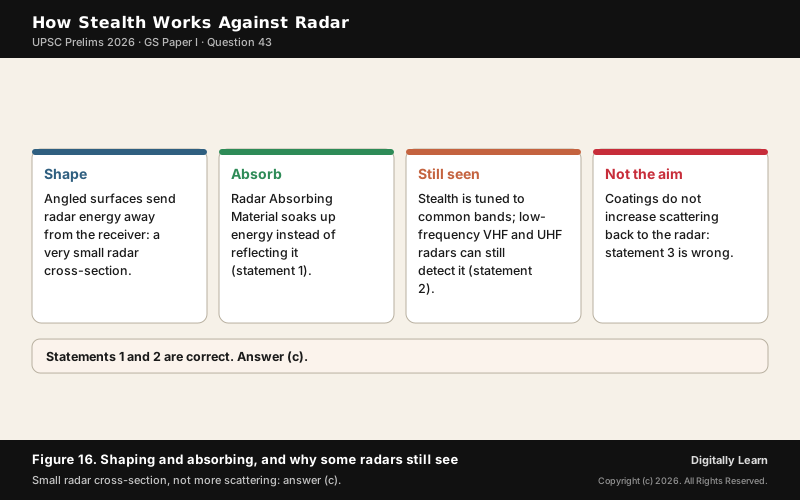
Which of the following statements with regard to stealth technology is/are correct?
1. Stealth objects have a very small radar cross-section and are coated with Radar Absorbing Material.
2. Stealth objects can be detected using specific frequencies.
3. Stealth objects are coated with metamaterials to increase the scattering of electromagnetic radiation.
Select the answer using the code given below:
a1 only
b2 and 3 only
c1 and 2 only
d1, 2 and 3
See the answer and explanationWith how to crack it
Answer: (c) 1 and 2 only
Statement 1 is correct: stealth aircraft and ships are shaped to give a very small radar cross-section and are coated with radar-absorbent material.
Statement 2 is correct: stealth is tuned to common radar bands, so low-frequency (VHF/UHF) radars and other bands can still pick them up.
Statement 3 is wrong: the aim is to absorb or deflect radar energy away from the receiver, not to increase scattering back towards it. Metamaterials are researched to bend or absorb waves, which reduces detection. Answer (c), 1 and 2 only.
Tap the figure to open it full size.
How to crack it
Ask what stealth wants: less energy returning to the radar. Any statement that increases scattering back works against that aim.
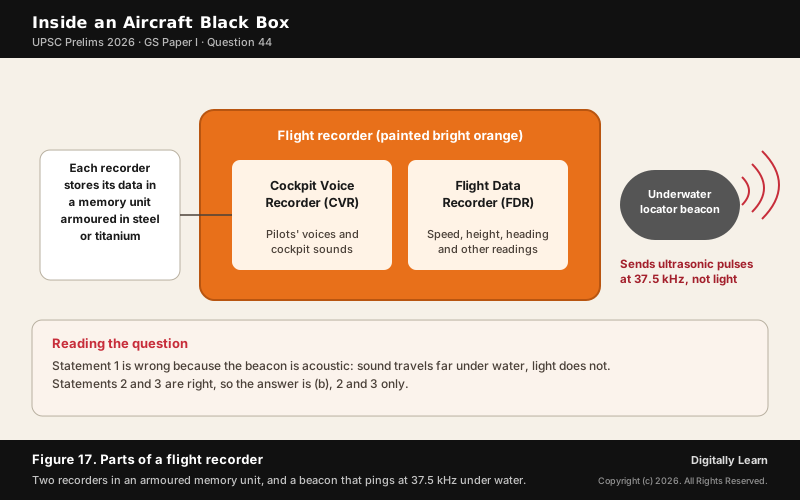
Which of the following statements with regard to Black Boxes used in modern aircrafts is/are correct?
1. They carry a beacon emitting red light pulses to facilitate underwater detection.
2. They record both the cockpit voice and flight data.
3. Their memory units are made using either stainless steel or titanium.
Select the answer using the code given below:
a1 only
b2 and 3 only
c1 and 2 only
d1, 2 and 3
See the answer and explanationWith how to crack it
Answer: (b) 2 and 3 only
Statement 1 is wrong: the underwater locator beacon on a flight recorder sends ultrasonic pulses at 37.5 kHz, which can travel through water. It does not flash red light.
Statement 2 is correct: the 'black box' is really two recorders, the cockpit voice recorder and the flight data recorder, often combined in one unit.
Statement 3 is correct: the crash-survivable memory unit is housed in stainless steel or titanium to survive impact and fire. (The boxes are painted bright orange, not black.) Answer (b), 2 and 3 only.
Tap the figure to open it full size.
How to crack it
Physics decides it: light does not travel far underwater, sound does. A beacon of 'red light pulses' cannot be right.
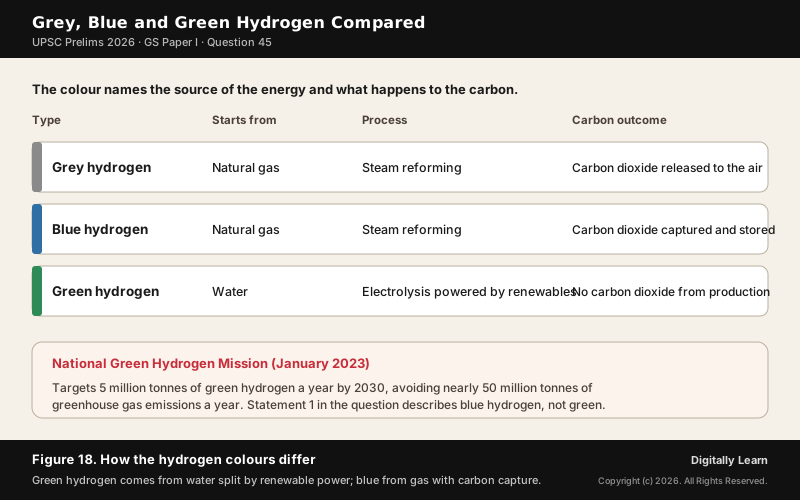
Which of the following statements with regard to Green Hydrogen is/are correct?
1. It is decarbonized hydrogen obtained from natural gas reforming combined with carbon capture and storage (CCS).
2. It is produced using electrolysis of water with electricity generated by renewable energy.
3. National Green Hydrogen Mission of India aims for abatement of nearly 50 MMT of annual greenhouse gas emissions by 2030.
Select the answer using the code given below:
a1 only
b2 and 3 only
c2 only
d1, 2 and 3
See the answer and explanationWith how to crack it
Answer: (b) 2 and 3 only
Statement 1 is wrong: hydrogen from natural gas with carbon capture is called 'blue hydrogen'.
Statement 2 is correct: green hydrogen is produced by electrolysis of water using renewable electricity. India's Green Hydrogen Standard (2023) also allows biomass routes and caps emissions at 2 kg CO2 per kg of hydrogen.
Statement 3 is correct: the National Green Hydrogen Mission (January 2023) aims for 5 million tonnes of green hydrogen a year by 2030, which is expected to avoid nearly 50 million tonnes of greenhouse gas emissions a year. Answer (b), 2 and 3 only.
Tap the figure to open it full size.
How to crack it
Colour codes for hydrogen: grey from gas, blue from gas with carbon capture, green from renewable electrolysis. The first statement describes blue.
Remember
Hydrogen colours: grey (from natural gas without carbon capture), blue (from natural gas with carbon capture), green (from renewable-powered electrolysis).
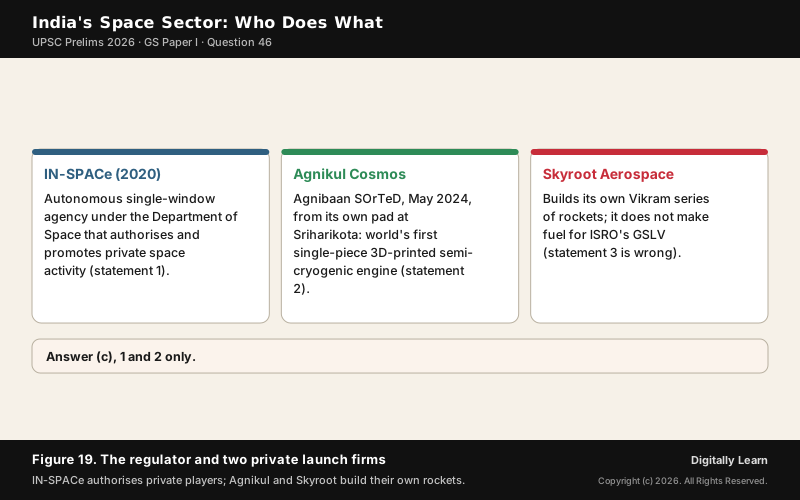
Consider the following statements with regard to involvement of private entities in India's space programme:
1. The Indian National Space Promotion and Authorisation Centre (IN-SPACe) is an autonomous agency formed to facilitate participation of private entities.
2. Agnikul Cosmos launched the world's first flight using 3D-printed rocket engine.
3. Skyroot Aerospace has developed liquid fuel for GSLV.
Which of the statements given above is/are correct?
a1 only
b2 and 3 only
c1 and 2 only
d1, 2 and 3
See the answer and explanationWith how to crack it
Answer: (c) 1 and 2 only
Statement 1 is correct: IN-SPACe, set up in 2020 under the Department of Space, is the single-window autonomous agency that authorises and promotes private space activity.
Statement 2 is correct: in May 2024 Agnikul Cosmos launched Agnibaan SOrTeD from its own launchpad at Sriharikota, powered by the world's first single-piece 3D-printed semi-cryogenic engine.
Statement 3 is wrong: Skyroot Aerospace builds its own Vikram series of rockets; it does not make fuel for ISRO's GSLV. Answer (c), 1 and 2 only.
Tap the figure to open it full size.
How to crack it
Separate the regulator from the firms: IN-SPACe authorises; Agnikul and Skyroot build their own rockets. 'Makes fuel for GSLV' is the odd claim.
Which of the following statements with regard to drone swarms is/are correct?
1. They use Terahertz band of frequency to communicate with the command centre.
2. Individual drones in the swarm can communicate with other drones in the swarm.
3. GPS Spoofing is a commonly used technique to counter drone swarm attack.
Select the answer using the code given below:
a1 only
b2 and 3 only
c1 and 2 only
d1, 2 and 3
See the answer and explanationWith how to crack it
Answer: (b) 2 and 3 only
Statement 1 is wrong: drone swarms communicate on ordinary radio bands (such as 2.4 GHz and 5.8 GHz). Terahertz links are still experimental because they have a very short range.
Statement 2 is correct: the defining feature of a swarm is that the drones share data with each other and coordinate, so the group can act together even if one drone is lost.
Statement 3 is correct: GPS spoofing, which feeds false satellite signals, and jamming are standard ways to confuse and defeat drones that navigate by GPS. Answer (b), 2 and 3 only.
How to crack it
Test the frequency claim: terahertz links have very short range, so they are unlikely for command links. Swarm coordination and GPS spoofing are standard.
Which of the following statements with regard to GenomeIndia Project is/are correct?
1. It is a part of the Human Genome Project.
2. The project is funded by the Department of Biotechnology (DBT), Government of India.
3. Its primary aim is to build a catalogue of genetic diversity of the Indian population.
Select the answer using the code given below:
a1 only
b2 and 3 only
c1 and 2 only
d1, 2 and 3
See the answer and explanationWith how to crack it
Answer: (b) 2 and 3 only
Statement 1 is wrong: GenomeIndia is India's own national project. The international Human Genome Project was completed in 2003 and GenomeIndia is not part of it.
Statement 2 is correct: it is funded by the Department of Biotechnology and carried out by a consortium of Indian institutions.
Statement 3 is correct: it sequenced the whole genomes of about 10,000 healthy Indians from many communities across the country to build a reference catalogue of Indian genetic variation, now held at the Indian Biological Data Centre. Answer (b), 2 and 3 only.
How to crack it
'Part of' claims are traps: GenomeIndia is India's own project, not part of the Human Genome Project completed in 2003.
Which of the following statements with regard to the National Quantum Mission (NQM) is/are correct?
1. It aims at developing intermediate-scale quantum computers with 50-1000 physical qubits.
2. Its implementation includes setting up of four Thematic Hubs (T-Hubs) in academic and national R&D institutes across India.
Select the answer using the code given below:
a1 only
b2 only
cBoth 1 and 2
dNeither 1 nor 2
See the answer and explanationWith how to crack it
Answer: (c) Both 1 and 2
Statement 1 is correct: the National Quantum Mission (approved April 2023, Rs 6,003.65 crore for 2023-24 to 2030-31) aims to build intermediate-scale quantum computers with 50 to 1,000 physical qubits within eight years.
Statement 2 is correct: it is being implemented through four Thematic Hubs (T-Hubs) in quantum computing, quantum communication, quantum sensing and metrology, and quantum materials, hosted at IISc Bengaluru, IIT Madras, IIT Bombay and IIT Delhi. Answer (c), both.
How to crack it
Both statements are specific mission design points (50 to 1,000 qubits; four thematic hubs). When a mission's documents list both, choose 'Both'.
Mr. X, a senior officer, was overseeing a critical vaccination programme during a pandemic. He found that a private service provider responsible for vaccine distribution was compromising on quality to make profits. Despite immense pressure to manage the issue due to vested interests, he raised his voice based on the principles of public administration which he learnt during various training programmes attended across his career. He reported the issue to the appropriate vigilance authority and halted the contract to ensure citizen welfare. Which one among the following principles of public administration was most strongly demonstrated by Mr. X's actions?
aEsprit de corps
bEquity
cAccountability
dDelegation
See the answer and explanationWith how to crack it
Answer: (c) Accountability
Accountability means a public official answers for the use of public power and money and acts to protect the people the programme serves. Mr. X reported the wrongdoing to the vigilance authority and stopped the contract, holding both himself and the contractor to account for the quality of a public service. Answer (c).
Esprit de corps is loyalty and team spirit within the organisation, which here would have pushed him to keep quiet. Equity is fairness in how benefits are shared, and delegation is passing authority to subordinates. Neither describes what he did.
How to crack it
In ethics MCQs, match the action to the value it shows: reporting a failing contractor and stopping the contract is answering for public money and public safety, which is accountability. Loyalty (esprit de corps) would have kept him quiet.
Remember
In case-study MCQs, match the action to the value: reporting and fixing a wrong is accountability; declining a favour is integrity; treating groups fairly is equity; acting openly is transparency.
In a multi-ethnic district where both economic competition and historical grievances frequently led to community tensions, a flashpoint has arisen with a Government decision to allocate land for a waste management facility near a tribal hamlet, sparking protests by the tribal community, which claimed that the land was sacred and critical to their cultural identity. At the same time, urban residents and local industries supported the project, citing severe solid waste challenges and health concerns due to lack of a proper disposal site. The conflict has escalated with road blockades, social media campaigns, and allegations of police excesses. As a responsible Government official, you are tasked with resolving the situation through mediation, ensuring a sustainable outcome that balances environmental needs, tribal rights, and urban public health. Consider the following statements with reference to the above:
1. A successful conflict resolution process must begin with acknowledging the cultural concerns of the protesting tribal community before discussing technical alternatives.
2. The Government should move ahead with the project without delay to address urban health concerns, which outweigh the sentiments of a small group.
3. Creating a multi-stakeholder dialogue platform, including tribal leaders, environmental experts, and municipal representatives, to build mutual understanding and help de-escalate tensions.
4. Conducting an independent Environmental and Social Impact Assessment (ESIA) and sharing findings transparently with both sides to facilitate evidence-based decision-making.
Which of the statements given above would contribute to the resolution process?
a1, 3 and 4 only
b2, 3 and 4 only
c1 and 2 only
d1, 2, 3 and 4
See the answer and explanationWith how to crack it
Answer: (a) 1, 3 and 4 only
Statements 1, 3 and 4 describe good mediation. Starting by acknowledging the tribal community's cultural concerns builds trust; a multi-stakeholder dialogue brings all sides to one table and lowers tension; and an independent Environmental and Social Impact Assessment, shared openly, lets the decision rest on evidence both sides can see.
Statement 2 pushes the project through and dismisses the tribal community as 'a small group'. That ignores their rights (including consent over sacred and customary land) and would deepen the conflict, so it does not help resolve it. Answer (a), 1, 3 and 4 only.
How to crack it
Reject any option that bulldozes a community ('move ahead without delay', 'a small group'). Options that start with acknowledgement, dialogue and independent evidence reflect good mediation.
Ms. X is a mid-level civil service official working in the urban development department of a major city. Recently, she was involved in approving a contract for a public infrastructure project, a new community park. During the approval process, she received a piece of confidential information indicating that one of the shortlisted contractors had a history of poor workmanship and allegations of corruption in other cities, though nothing had been legally proven. The Head of the Department, Mr. Y, advised her not to disclose this information to the project committee or the public because it could delay the project and damage the city's reputation. However, Ms. X believed that withholding such information compromised transparency and public trust. What amongst the following should Ms. X do now?
1. Immediately disclose the information to the project committee and the public
2. Recommend removing the contractor from the shortlist to protect the project's integrity
3. Propose a 'limited disclosure' to an oversight committee, while keeping the information confidential from the public for the time being
Select the answer using the code given below:
a1 and 2 only
b3 only
c2 and 3 only
d1, 2 and 3
See the answer and explanationWith how to crack it
Answer: (b) 3 only
The allegations are unproven, so disclosing them to the public at once (1) could be unfair to the contractor and damage the process, and removing the contractor on the strength of rumours alone (2) punishes before any finding.
Hiding the information completely, as Mr. Y advises, would betray transparency and the public interest. The balanced course is a limited disclosure to an oversight committee that can check the facts while the information stays confidential for now (3). Answer (b), 3 only.
How to crack it
Unproven allegations call for a proportionate step: neither going public at once nor punishing on rumour. The middle path, limited disclosure to an oversight body, is usually the ethical answer.
Remember
UPSC's ethics MCQs reward the option that protects the public interest through proper channels, without either covering up or acting on unverified claims.
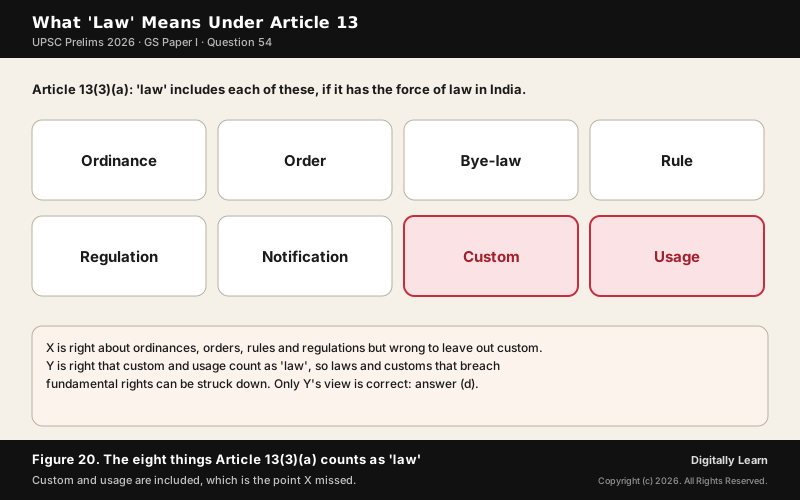
'X' was addressing a seminar on the meaning of the term 'law' as provided under Article 13, Part III of the Constitution of India. 'X' explained that the meaning of the term 'law' in the Constitution of India was very comprehensive. It included ordinances, orders and even rules and regulations. 'Y' pointed out that the term 'law' in Article 13 also included custom or usage having in the territory of India the force of law, to which 'X' was not convinced. Based on the above, select the correct conclusion from the options given below:
a'X' is correct in the interpretation of law, including the view on non-inclusion of custom.
bThe view of 'Y' that 'law' included custom is not correct.
cThe views of both 'X' and 'Y' are correct.
dThe view of only 'Y' is correct.
See the answer and explanationWith how to crack it
Answer: (d) The view of only 'Y' is correct.
Article 13(3)(a) of the Constitution defines 'law' to include 'any Ordinance, order, bye-law, rule, regulation, notification, custom or usage having in the territory of India the force of law'.
So Y is right that custom or usage is included. X is right about ordinances, orders, rules and regulations, but X denies that custom is covered, and on that point X is wrong. Only Y's view is correct as stated. Answer (d).
Tap the figure to open it full size.
How to crack it
Know the exact list in Article 13(3)(a) and look for the word the speaker left out. 'Custom or usage' is in the list, so whoever denies it is wrong.
Remember
Because custom and usage count as 'law' under Article 13, a custom that violates Fundamental Rights can be struck down by the courts.
Consider the following statements with reference to the Constitution of India:
1. There is no Article in the Constitution of India that specifies that the Constitution of India will be officially called the 'Constitution of India'.
2. There is no Article in the Constitution of India that specifies that the Indian Independence Act, 1947 and the Government of India Act, 1935 stand repealed.
3. There is no Article in the Constitution of India that mentions 26th January, 1950 as the date of the commencement of the Constitution of India.
Which one of the following conclusions based on the above statements is correct?
aAll three statements are correct.
bThere is no correct statement.
cThere are two correct statements that include statement 3.
dThere is only one correct statement.
See the answer and explanationWith how to crack it
Answer: (b) There is no correct statement.
Statement 1 is false: Article 393 says, 'This Constitution may be called the Constitution of India.'
Statement 2 is false: Article 395 repeals the Indian Independence Act, 1947 and the Government of India Act, 1935.
Statement 3 is false: Article 394 says the articles it lists came into force at once (26 November 1949) and 'the remaining provisions of this Constitution shall come into force on the twenty-sixth day of January, 1950, which day is referred to in this Constitution as the commencement of this Constitution'.
All three statements claim no such Article exists, and each is contradicted by an Article, so there is no correct statement. Answer (b).
How to crack it
Constitution trivia questions test the final Articles: 393 (name), 394 (commencement) and 395 (repeals). If you remember these three, every 'there is no Article' claim collapses.
Remember
Part XXII (Articles 393 to 395) holds the short title, the commencement and the repeals, a frequent source of statement questions.
Which of the following statements with regard to the persons with disabilities in India is/are correct?
1. The Rights of Persons with Disabilities Act, an Act passed by the Parliament of India in 2018, mandates reservation in education and employment, places a legal duty on Governments to ensure accessibility and non-discrimination.
2. The Sugamya Bharat Abhiyan focuses on achieving universal accessibility for Persons with Disabilities across three key domains: built infrastructure, transport systems and information and communication technology.
3. The National Divyangjan Finance and Development Corporation (NDFDC) is a public sector organisation set up by the Ministry of Corporate Affairs as a not-for-profit company to promote entrepreneurship among Persons with Disabilities (PwDs).
Select the answer using the code given below:
a1 and 2
b2 only
c1 and 3
d1 only
See the answer and explanationWith how to crack it
Answer: (b) 2 only
Statement 1 is wrong on the year: the Rights of Persons with Disabilities Act was passed in 2016 (in force from April 2017). It does provide reservation in education (5 per cent) and government jobs (4 per cent) and places duties of accessibility and non-discrimination on governments.
Statement 2 is correct: the Accessible India Campaign (Sugamya Bharat Abhiyan, 2015) targets three areas: the built environment, the transport system, and information and communication technology.
Statement 3 is wrong: NDFDC was set up by the Ministry of Social Justice and Empowerment (it now works under its Department of Empowerment of Persons with Disabilities), not the Ministry of Corporate Affairs. Answer (b), 2 only.
How to crack it
Check years first: the RPwD Act is of 2016, not 2018. A wrong year makes an otherwise true statement false.
Consider the following statements about the provisions pertaining to the Scheduled Castes and the Scheduled Tribes in India:
1. Provisions regarding the administration of the Tribal Areas in the States of Assam, Meghalaya, Tripura and Mizoram are given in the Fifth Schedule of the Constitution of India.
2. Some tribes of India are entitled to exemption from paying Income Tax on certain incomes.
3. The Constitution of India provides for reservation of seats in Panchayats for women belonging to the Scheduled Castes and the Scheduled Tribes.
Which one of the following conclusions based on the above statements is correct?
aThere are two correct statements, that include statement 2.
bThere are two correct statements, that are statements 1 and 3.
cThere is only one correct statement.
dAll three statements are correct.
See the answer and explanationWith how to crack it
Answer: (a) There are two correct statements, that include statement 2.
Statement 1 is wrong: the tribal areas of Assam, Meghalaya, Tripura and Mizoram are governed by the Sixth Schedule (Article 244(2)). The Fifth Schedule covers Scheduled Areas in other States.
Statement 2 is correct: section 10(26) of the Income-tax Act exempts certain income of members of Scheduled Tribes living in specified areas of the North-east and in Ladakh.
Statement 3 is correct: Article 243D(2) reserves not less than one-third of the seats reserved for SCs and STs in Panchayats for women of those groups. So two statements are correct, including statement 2. Answer (a).
Tap the figure to open it full size.
How to crack it
The four north-eastern States (Assam, Meghalaya, Tripura, Mizoram) belong to the Sixth Schedule; that single fact knocks out statement 1 and most options.
Consider the following statements in respect of questions asked by the Members in the Parliament of India:
1. Unstarred questions are those to which a Member desires an oral answer in the House.
2. Starred questions are those to which a Member desires a written answer.
3. No supplementary question can be asked on an unstarred question.
Which one of the following conclusions based on the above statements is correct?
aAll the three statements are correct.
bThere are two correct statements, that include statement 2.
cThere is only one correct statement.
dThere is no correct statement.
See the answer and explanationWith how to crack it
Answer: (c) There is only one correct statement.
Statement 1 is wrong: an unstarred question gets a written answer. Statement 2 is wrong: a starred question (marked with an asterisk) is the one answered orally in the House.
Statement 3 is correct: because an unstarred question is answered in writing, no supplementary questions can follow it. Supplementaries are allowed only on starred questions. Only one statement is correct. Answer (c).
Tap the figure to open it full size.
How to crack it
Starred means oral (the asterisk marks it for the floor), unstarred means written. Once you fix that pair, the statement about supplementaries follows.
Remember
Three kinds of questions: starred (oral answer, supplementaries allowed), unstarred (written answer, no supplementaries) and short notice (urgent, oral).
Consider the following statements about the Committee on the Welfare of Scheduled Castes and Scheduled Tribes of the Parliament of India:
1. Although members of this Committee are elected from both Houses of Parliament, the Chairperson of this Committee is appointed by the Chairman of the Rajya Sabha.
2. Twenty members are elected by the Rajya Sabha and ten members by the Lok Sabha.
3. No Minister, except for the Union Minister of Social Justice and Empowerment, is eligible to be a member of this Committee.
4. Members are elected for a fixed term of two years from the date they enter their office.
Which one of the following conclusions based on the above statements is correct?
aThere are four correct statements.
bThere is only one correct statement, that is statement 2.
cThere are two correct statements, that include statement 1.
dThere is no correct statement.
See the answer and explanationWith how to crack it
Answer: (d) There is no correct statement.
Statement 1 is wrong: the Chairperson of the Committee on the Welfare of SCs and STs is appointed by the Speaker of the Lok Sabha.
Statement 2 is wrong: the Committee has 30 members, 20 elected by the Lok Sabha and 10 by the Rajya Sabha, the reverse of what is stated.
Statement 3 is wrong: no Minister can be a member, and a member who becomes a Minister leaves the Committee. Statement 4 is wrong: members serve for one year, not two. No statement is correct. Answer (d).
Tap the figure to open it full size.
How to crack it
Parliamentary committee questions often reverse numbers or officers. The Lok Sabha side is larger and its Speaker appoints the Chair; watch for these swaps.
Q60Internal Security and Defence
Consider the following statements about Mission Sudarshan Chakra of India:
1. It aims to enhance India's air defence, ballistic missile defence and aerial offensive capabilities.
2. This Mission is being designed to enhance rapid, precise, and powerful defence responses, reinforcing India's strategic autonomy.
3. One of the aims of this Mission is to cover all public places of India by an expanded nationwide security shield by 2035.
Which of the statements given above is/are correct?
a1, 2 and 3
b1 and 2 only
c2 and 3 only
d1 only
See the answer and explanationWith how to crack it
Answer: (a) 1, 2 and 3
Mission Sudarshan Chakra was announced by the Prime Minister on Independence Day 2025. It is planned as a nationwide, multi-layered shield that combines air defence and missile defence with the ability to strike back (1 is correct).
It is meant to give fast, precise and powerful responses to threats and to rely on Indian technology, which supports strategic autonomy (2 is correct).
The stated aim is to cover the country's important places, including civilian and public places, with an expanded security shield by 2035 (3 is correct). Answer (a), 1, 2 and 3.
How to crack it
When a mission's stated aims include defence plus strike-back and self-reliance, statements repeating those aims are safe; a statement narrowing its coverage is the one to question.
Consider the following statements about river bridges connecting India with neighbouring countries:
1. 'Maitri Setu', built over Feni river, connects Ramgarh in India with Sabroom in Bangladesh.
2. Jhulaghat suspension bridge connects India with Myanmar.
3. Mechi bridge and its approaches connect Panitanki Bypass in India with Kakarvitta in Nepal.
Which of the statements given above is/are correct?
a1 and 2
b2 and 3
c1 only
d3 only
See the answer and explanationWith how to crack it
Answer: (d) 3 only
Statement 1 is wrong in its direction: Maitri Setu over the Feni river joins Sabroom in Tripura (India) with Ramgarh in Bangladesh. The statement swaps the two towns.
Statement 2 is wrong: the Jhulaghat suspension bridge over the Mahakali river in Pithoragarh district, Uttarakhand, connects India with Nepal, not Myanmar.
Statement 3 is correct: the Mechi bridge and its approaches link the Panitanki bypass in West Bengal with Kakarvitta in Nepal. Answer (d), 3 only.
Tap the figure to open it full size.
How to crack it
Check both ends of each bridge: a single swapped town or neighbour makes a statement wrong. Jhulaghat is on the Nepal border, not Myanmar.
Which of the following statements about a Zero First Information Report (Zero FIR) under the Bharatiya Nagarik Suraksha Sanhita (BNSS), 2023 is/are correct?
1. A Zero FIR can be lodged at a police station, even though the place of commission of a cognizable/non-cognizable offence is outside the territorial jurisdiction of that police station.
2. The Officer-in-Charge of the police station where a Zero FIR has been lodged may, with the permission of the competent authority, initiate a preliminary enquiry.
3. Under Zero FIR, it is obligatory for the informant to furnish information electronically.
Select the answer using the code given below:
a1, 2 and 3
b2 and 3 only
c1 only
d2 only
See the answer and explanationWith how to crack it
Answer: (d) 2 only
Statement 1 is wrong: section 173(1) of the BNSS lets a person report a cognizable offence at any police station, 'irrespective of the area where the offence is committed'. That rule covers cognizable offences, not non-cognizable ones.
Statement 2 is correct in UPSC's provisional key: under section 173(3) the officer in charge may, with the prior permission of an officer not below the rank of Deputy Superintendent of Police, hold a preliminary enquiry (within 14 days) for offences punishable with three to seven years in prison.
Statement 3 is wrong: information can be given orally, in writing or electronically. Giving it electronically is an option, not an obligation. Answer (d), 2 only.
Tap the figure to open it full size.
How to crack it
Read the legal scope word: section 173 speaks of cognizable offences. A statement that adds 'non-cognizable' or makes an option ('electronically') compulsory is wrong.
Remember
BNSS changes on FIRs: Zero FIR is written into the law, an FIR can be given electronically, and a preliminary enquiry is allowed for offences carrying three to seven years.
With reference to the organisations under the Government of India, consider the following details:
Sl. No.
Organisation
Function
Controlling Union Ministry
1.
Central Economic Intelligence Bureau (CEIB)
To coordinate between various law enforcement agencies
Ministry of Home Affairs
2.
Serious Fraud Investigation Office (SFIO)
To investigate complex corporate frauds
Ministry of Finance
3.
Central Bureau of Investigation (CBI)
To preserve values in public life and ensure the health of the national economy
Ministry of Personnel, Public Grievances and Pension
In how many of the above rows are the given details correctly matched?
a1
b2
c3
dNone
See the answer and explanationWith how to crack it
Answer: (a) 1
Row 1 is wrong: the Central Economic Intelligence Bureau coordinates economic intelligence among enforcement agencies, but it works under the Ministry of Finance (Department of Revenue), not the Ministry of Home Affairs.
Row 2 is wrong: the Serious Fraud Investigation Office investigates complex corporate fraud, but it works under the Ministry of Corporate Affairs, not the Ministry of Finance.
Row 3 is correct: the CBI states its mission as preserving values in public life and ensuring the health of the national economy, and it works under the Department of Personnel and Training, Ministry of Personnel, Public Grievances and Pensions. Only one row is correct. Answer (a).
How to crack it
Ministry questions test the parent department: CEIB sits with Finance (Revenue), SFIO with Corporate Affairs. Mismatched parents are the traps.
Which of the following international conventions have not been ratified by India?
1. Employment Policy Convention
2. Abolition of Forced Labour Convention
3. International Convention on the Protection of the Rights of All Migrant Workers and Members of Their Families
4. Geneva Convention Relative to the Protection of Civilian Persons in Time of War
5. Convention on Reduction of Statelessness
Select the answer using the code given below:
a2 and 4
b1 and 2
c3 and 4 only
d3, 4 and 5
See the answer and explanationWith how to crack it
Dropped by UPSC in the provisional key. This question is not scored.
UPSC dropped this question from scoring in its provisional key, so every candidate gets it treated as not counted.
The likely reason is that no option matches the facts. India has ratified the Abolition of Forced Labour Convention (ILO C105, in 2000), the Geneva Conventions of 1949 including the Fourth (on civilians), and the Employment Policy Convention (ILO C122, in 1998). India has not ratified the UN Migrant Workers Convention (1990) or the 1961 Convention on the Reduction of Statelessness. The correct set would be 3 and 5, which is not among the options.
How to crack it
This question was dropped by UPSC, so it carries no marks for anyone. In the exam, when no option fits the facts you know, leaving it blank avoids a negative mark.
Remember
A dropped question is removed from scoring for everyone. Check whether UPSC's final key keeps the drop.
Consider the following statements with respect to the AI Impact Summit, 2026 held in New Delhi:
1. The Summit's intellectual framework was based on three foundational Sutras: People, Planning, and Progress.
2. The Preamble of the Summit stresses Democratising AI Resources, which acknowledges the Charter for Democratic Diffusion of AI as a binding framework to support locally relevant innovation and strengthen resilient AI ecosystems while respecting national laws.
3. The New Delhi Declaration on AI Impact was structured around seven Chakras (Pillars), which included Access for Social Empowerment, AI for Science, and Secure and Trusted AI.
Which of the statements given above is/are correct?
a1, 2 and 3
b1 and 2 only
c2 and 3 only
d3 only
See the answer and explanationWith how to crack it
Answer: (d) 3 only
Statement 1 is wrong: the AI Impact Summit (New Delhi, February 2026) was framed around three Sutras: People, Planet and Progress, not 'Planning'.
Statement 2 is wrong: countries took note of the Charter for the Democratic Diffusion of AI as a voluntary and non-binding framework, not a binding one.
Statement 3 is correct: the New Delhi Declaration on AI Impact was built around seven Chakras (pillars), including broadening access for social empowerment, AI in science, and trustworthy AI. Answer (d), 3 only.
How to crack it
Summit framework words are exact: People, Planet, Progress. One changed word ('Planning') and a 'binding' claim for a voluntary charter make statements wrong.
Which of the following connectivity projects is/are a part of cooperation between India and the ASEAN member countries?
1. Kaladan Multi-Modal Transit Transport Project
2. IMT Trilateral Highway
3. Agartala-Akhaura Rail Line
Select the answer using the code given below:
a1 and 2
b2 and 3
c1 and 3
d2 only
See the answer and explanationWith how to crack it
Answer: (a) 1 and 2
The Kaladan Multi-Modal Transit Transport Project links Kolkata to Sittwe port in Myanmar and on to Mizoram, and the India-Myanmar-Thailand Trilateral Highway links Moreh in Manipur to Mae Sot in Thailand. Myanmar and Thailand are ASEAN members, so both are part of India's connectivity cooperation with ASEAN under the Act East Policy.
The Agartala-Akhaura rail line links Tripura with Bangladesh, which is not an ASEAN member. Answer (a), 1 and 2.
Tap the figure to open it full size.
How to crack it
Ask whether the partner country is in ASEAN: Myanmar and Thailand are, Bangladesh is not. That removes the Agartala-Akhaura link.
Match List I with List II and select the answer using the code given below the Lists:
List I (Project Supported by India)
List II (Country)
A. Mangdechhu Hydroelectric Project
1. Maldives
B. Restoration of Stor Palace
2. Afghanistan
C. District Hospital at Dickoya
3. Bhutan
D. Institute of Security and Law Enforcement Studies
4. Sri Lanka
Code:
aA-1, B-4, C-2, D-3
bA-3, B-2, C-4, D-1
cA-3, B-4, C-2, D-1
dA-1, B-2, C-4, D-3
See the answer and explanationWith how to crack it
Answer: (b) A-3, B-2, C-4, D-1
Mangdechhu Hydroelectric Project (720 MW) is in Bhutan (A-3). The restoration of the Stor Palace in Kabul was done with Indian help in Afghanistan (B-2). The District Hospital at Dickoya, in Sri Lanka's hill-country tea region, was built with Indian grant assistance (C-4). The Institute of Security and Law Enforcement Studies is an Indian-assisted project in the Maldives (D-1).
A-3, B-2, C-4, D-1 is option (b).
How to crack it
In match-the-following, lock the pair you are surest of first (Mangdechhu is in Bhutan), then eliminate options that do not have it.
Which of the following items of defence hardware is/are manufactured in India?
1. Su-30 MKI Fighter Jets
2. T-90 MK-III Tanks
3. Akula Class Submarine
Select the answer using the code given below:
a1 and 2
b1 and 3
c1 only
d2 only
See the answer and explanationWith how to crack it
Answer: (a) 1 and 2
Statement 1 is correct: Hindustan Aeronautics Limited builds the Su-30 MKI under licence at Nashik.
Statement 2 is correct: the T-90 is built under licence at the Heavy Vehicles Factory, Avadi.
Statement 3 is wrong: Akula-class nuclear submarines are Russian-built. India has leased them (INS Chakra), but they are not made in India. Answer (a), 1 and 2.
How to crack it
Licence production counts as manufactured in India (Su-30 MKI at Nashik, T-90 at Avadi). Leased platforms, like the Akula-class submarine, do not.
Consider the following statements about platforms for multilateral co-operation:
1. The 'Colombo Process' is a regional consultative process in which member states take binding decisions by consensus.
2. The 'Abu Dhabi Dialogue' is a voluntary non-binding consultative process among Asian countries of labour origin and destination to facilitate regional cooperation on contractual labour mobility.
3. The 'Global Forum for Migration and Development', created upon the proposal of a former UN Secretary General, is a voluntary forum whose decisions are non-binding in nature.
Which of the statements given above is/are correct?
a1, 2 and 3
b1 and 3 only
c2 and 3 only
d2 only
See the answer and explanationWith how to crack it
Answer: (c) 2 and 3 only
Statement 1 is wrong: the Colombo Process, a forum of Asian countries of origin for overseas workers, is a voluntary and non-binding regional consultative process. Its decisions are not binding.
Statement 2 is correct: the Abu Dhabi Dialogue is a voluntary, non-binding forum between Asian countries of origin and Gulf and Asian countries of destination on contractual labour mobility.
Statement 3 is correct: the Global Forum on Migration and Development began in 2007 on the proposal of the then UN Secretary-General Kofi Annan; it is a voluntary, state-led, non-binding process. Answer (c), 2 and 3 only.
How to crack it
'Binding' is the trap word: regional consultative processes on migration are voluntary and non-binding.
How many of the above has/have been awarded the Nobel Prize twice?
a1
b2
c3
d4
See the answer and explanationWith how to crack it
Answer: (a) 1
The UN High Commissioner for Refugees won the Nobel Peace Prize twice, in 1954 and 1981.
UNICEF won it once (1965), the International Labour Organization once (1969) and the World Food Programme once (2020). Only one of the four has won twice. Answer (a).
How to crack it
Nobel Peace Prize trivia: UNHCR is the UN body with two prizes (1954, 1981). Remember the single double-winner and the rest follow.
Remember
The International Committee of the Red Cross has won the Peace Prize three times (1917, 1944, 1963), the most of any organisation.
Match List I with List II and select the answer using the code given below the Lists:
List I (UN Peacekeeping Operation)
List II (Period of Operation)
A. UNMIL
1. 2007-2010
B. MINURCAT
2. 2002-2005
C. MINUSTAH
3. 2003-2018
D. UNMISET
4. 2004-2017
Code:
aA-3, B-4, C-1, D-2
bA-3, B-1, C-4, D-2
cA-2, B-1, C-4, D-3
dA-2, B-4, C-1, D-3
See the answer and explanationWith how to crack it
Answer: (b) A-3, B-1, C-4, D-2
UNMIL (Liberia) ran from 2003 to 2018 (A-3). MINURCAT (Central African Republic and Chad) ran from 2007 to 2010 (B-1). MINUSTAH (Haiti) ran from 2004 to 2017 (C-4). UNMISET (Timor-Leste) ran from 2002 to 2005 (D-2).
A-3, B-1, C-4, D-2 is option (b).
Tap the figure to open it full size.
How to crack it
For peacekeeping missions, start from the country in each acronym (UNMIL Liberia, MINUSTAH Haiti) and then check dates, beginning with the pair you know.
Match List I with List II and select the answer using the code given below the Lists:
List I (BIMSTEC Centre/Establishment)
List II (Location)
A. BIMSTEC Cultural Industries Observatory
1. NOIDA
B. BIMSTEC Energy Centre
2. Bengaluru
C. BIMSTEC Centre for Weather and Climate
3. Colombo
D. BIMSTEC Technology Transfer Facility
4. Thimphu
Code:
aA-3, B-2, C-1, D-4
bA-3, B-1, C-2, D-4
cA-4, B-2, C-1, D-3
dA-4, B-1, C-2, D-3
See the answer and explanationWith how to crack it
Answer: (c) A-4, B-2, C-1, D-3
The BIMSTEC Cultural Industries Observatory is in Thimphu, Bhutan (A-4). The BIMSTEC Energy Centre is in Bengaluru (B-2). The BIMSTEC Centre for Weather and Climate is at NOIDA, hosted by India's National Centre for Medium Range Weather Forecasting (C-1). The BIMSTEC Technology Transfer Facility is in Colombo, Sri Lanka (D-3).
A-4, B-2, C-1, D-3 is option (c).
Tap the figure to open it full size.
How to crack it
BIMSTEC centres are spread across members; fix one (the Energy Centre in Bengaluru) and eliminate options that do not carry it.
Which one of the following pairs is not correctly matched? (Indian Army Corps : Headquarters)
a3 Corps : Dimapur
b4 Corps : Tezpur
c14 Corps : Leh
d33 Corps : Srinagar
See the answer and explanationWith how to crack it
Answer: (d) 33 Corps : Srinagar
3 Corps (Spear Corps) is at Rangapahar near Dimapur, 4 Corps (Gajraj Corps) at Tezpur, and 14 Corps (Fire and Fury Corps) at Leh, so (a), (b) and (c) are correct.
33 Corps (Trishakti Corps) has its headquarters at Sukna near Siliguri, West Bengal. Srinagar is the headquarters of 15 Corps (Chinar Corps). So (d) is not correctly matched.
Tap the figure to open it full size.
How to crack it
Corps questions test the number and the city. Remember 15 Corps is Srinagar and 33 Corps is near Siliguri; the swap is the trap.
Which of the following statements with respect to the Revamped Rashtriya Gram Swaraj Abhiyan (RGSA) is/are correct?
1. The period of its implementation is 1st April, 2021 to 31st March, 2026.
2. The key objective of the Revamped RGSA is to develop the governance capabilities of the Panchayati Raj Institutions to deliver on the Sustainable Development Goals.
3. The share of the Central funding for the Revamped RGSA is 100% for all States and Union Territories.
Select the answer using the code given below:
a1 and 2
b2 only
c1 and 3
d2 and 3
See the answer and explanationWith how to crack it
Answer: (b) 2 only
Statement 1 is wrong: the Revamped RGSA was approved for 2022-23 to 2025-26, from 1 April 2022 to 31 March 2026.
Statement 2 is correct: its main aim is to build the governance capacity of Panchayati Raj Institutions so that they can deliver on the Sustainable Development Goals, through the localisation of the SDGs.
Statement 3 is wrong: central components are fully centrally funded, but the State components are shared 60:40 between the Centre and States (90:10 for the North-eastern and hill States and Jammu and Kashmir, and 100 per cent for other Union Territories). Answer (b), 2 only.
How to crack it
Scheme questions often shift the start year by one. The Revamped RGSA runs from 2022-23 to 2025-26, so the 2021 date is the tell.
Which of the following countries are members of the European Union?
1. Belarus
2. Poland
3. Germany
4. Switzerland
Select the answer using the code given below:
a1, 2 and 4
b1 and 4 only
c2 and 3
d2 and 4 only
See the answer and explanationWith how to crack it
Answer: (c) 2 and 3
Poland (joined 2004) and Germany (a founding member) are members of the European Union.
Belarus is not a member and is closely aligned with Russia. Switzerland is not a member either; it is linked to the EU through bilateral agreements and belongs to the Schengen area and EFTA. Answer (c), 2 and 3.
Tap the figure to open it full size.
How to crack it
Know two classic non-members in Europe: Switzerland (bilateral deals) and Belarus (aligned with Russia). Any option containing them goes.
Match List I with List II and select the answer using the code given below the Lists:
List I (INTERPOL Notice)
List II (Description)
A. Silver Notice
1. To seek information on unidentified bodies
B. Blue Notice
2. To collect additional information about a person's identity, location, or activities in relation to a criminal investigation
C. Black Notice
3. To provide warning about a person's criminal activities, where the person is considered to be a possible threat to public safety
D. Green Notice
4. To identify and trace criminal assets
Code:
aA-3, B-1, C-2, D-4
bA-3, B-2, C-1, D-4
cA-4, B-2, C-1, D-3
dA-4, B-1, C-2, D-3
See the answer and explanationWith how to crack it
Answer: (c) A-4, B-2, C-1, D-3
INTERPOL notices are colour-coded. The Silver Notice, introduced in 2025, is used to identify and trace criminal assets (A-4). The Blue Notice seeks more information about a person's identity, location or activities in a criminal investigation (B-2). The Black Notice seeks information on unidentified bodies (C-1). The Green Notice warns about a person's criminal activities where the person may be a threat to public safety (D-3).
A-4, B-2, C-1, D-3 is option (c).
Tap the figure to open it full size.
How to crack it
INTERPOL notices follow colour logic: Black for unidentified bodies, Blue for more information on a person, Green for warnings, and the new Silver for assets.
Remember
Other colours: Red (locate and arrest a wanted person), Yellow (find a missing person), Orange (warn of an imminent threat), Purple (criminals' methods). India's CBI is the national contact point for INTERPOL.
Which of the following statements in relation to NIRANTAR (National Institute for Research and Application of Natural Resources to Transform, Adapt and Build Resilience), a platform of institutions under the Ministry of Environment, Forest and Climate Change, is/are correct?
1. Ecosystem Survey and Analysis is a vertical under this platform, the lead institute of which is Botanical Survey of India, Kolkata.
2. Research and Management of Ecosystem Service is a vertical under this platform, the lead institute of which is Central Zoo Authority, New Delhi.
3. Capacity Development Support is a vertical under this platform, the lead institute of which is Indian Institute of Forest Management, Bhopal.
Select the answer using the code given below:
a1, 2 and 3
b1 and 3 only
c2 only
d3 only
See the answer and explanationWith how to crack it
Answer: (b) 1 and 3 only
NIRANTAR is a platform through which the Ministry of Environment, Forest and Climate Change groups its research institutions into four verticals, each led by one institute.
Statement 1 is correct: the Botanical Survey of India, Kolkata, leads the Ecosystem Survey and Analysis vertical. Statement 3 is correct: the Indian Institute of Forest Management, Bhopal, leads Capacity Development Support.
Statement 2 is wrong: the Research and Management of Ecosystem Service vertical is led by the Indian Council of Forestry Research and Education (ICFRE), Dehradun, not the Central Zoo Authority. Answer (b), 1 and 3 only.
How to crack it
Scheme verticals test which institute leads which; fix the one you know (the Botanical Survey leads ecosystem survey) and question the rest.
The Chancellor of the Federal Republic of Germany visited India in January, 2026. Which of the following is/are not correct in terms of outcomes of this visit?
1. Signing of a Memorandum of Understanding between the All India Institute of Ayurveda and the University of Hamburg
2. Signing of a Memorandum of Understanding on Youth Hockey Development between Hockey India and the German Hockey Federation
3. Establishment of a bilateral dialogue mechanism on the Indo-Pacific
4. Opening of an Honorary Consul of Germany in Lucknow
Select the answer using the code given below:
a2 and 3
b1 and 4
c3 and 4
d1 only
See the answer and explanationWith how to crack it
Answer: (b) 1 and 4
The question asks which outcomes are NOT correct for German Chancellor Friedrich Merz's visit to India on 12 and 13 January 2026.
The official list of outcomes includes a Memorandum of Understanding on youth hockey development between Hockey India and the German Hockey Federation (2) and a bilateral dialogue mechanism on the Indo-Pacific (3), so both are correct.
Outcome 1 is wrong: the Ayurveda agreement was between the All India Institute of Ayurveda and Charité University, Berlin, not the University of Hamburg. Outcome 4 is wrong: the new Honorary Consul of Germany is in Ahmedabad, not Lucknow. Answer (b), 1 and 4.
How to crack it
It asks which outcomes are NOT correct. Check partner names in each MoU: one wrong university or institution makes an outcome false.
Which of the following statements about DHRUV64 is/are correct?
1. It is the third chip fabricated under the DIR-V Programme with an overall aim to enable the creation of microprocessors for India.
2. It is India's first homegrown 1.0 GHz, 64-bit dual-core microprocessor.
Select the answer using the code given below:
a1 only
b2 only
cBoth 1 and 2
dNeither 1 nor 2
See the answer and explanationWith how to crack it
Answer: (c) Both 1 and 2
Statement 1 is correct: DHRUV64 is the third processor produced under the Digital India RISC-V (DIR-V) programme, whose aim is a family of Indian microprocessors based on the open RISC-V design.
Statement 2 is correct: developed by C-DAC and announced in December 2025, DHRUV64 is described by the government as India's first homegrown 1.0 GHz, 64-bit dual-core microprocessor. Answer (c), both.
How to crack it
When both statements come from the official announcement (third DIR-V chip, first 1.0 GHz 64-bit dual-core), 'Both' is the safe pick.
The Bureau of Indian Standard (BIS) recently introduced a national standard to test and assess bomb disposal system. Which of the following statements with regard to this system is/are correct?
1. The new standard is known as IS 19445 : 2025.
2. It will improve interoperability of equipment across agencies.
3. It was developed by TBRL, DRDO in collaboration with the 30 Central Scientific Research Institute, Russia.
Select the answer using the code given below:
a1, 2 and 3
b2 and 3 only
c1 and 2 only
d1 only
See the answer and explanationWith how to crack it
Answer: (c) 1 and 2 only
Statement 1 is correct: the Bureau of Indian Standards issued IS 19445:2025 on the performance evaluation of bomb disposal systems in December 2025.
Statement 2 is correct: one common standard lets equipment bought by different security agencies be tested in the same way, which helps it work together.
Statement 3 is wrong: the standard was drawn up in India, on a request from the Ministry of Home Affairs and DRDO's Terminal Ballistics Research Laboratory (TBRL), which led the expert panel. There was no Russian institute involved. Answer (c), 1 and 2 only.
How to crack it
A foreign partner claim is often the planted error. This Indian standard was drawn up in India, with DRDO's TBRL in the lead.
'X', born in the UK, was conferred the Nobel Prize in 2025. He was a professor in an American university when this prize was announced. Identify 'X':
aMichel H. Devoret
bRichard Robson
cJohn Clarke
dJoel Mokyr
See the answer and explanationWith how to crack it
Answer: (c) John Clarke
John Clarke, born in Cambridge, England, shared the 2025 Nobel Prize in Physics with Michel H. Devoret and John M. Martinis for showing macroscopic quantum tunnelling and energy quantisation in an electric circuit. He is a professor at the University of California, Berkeley. Answer (c).
Michel Devoret was born in France. Richard Robson (Chemistry 2025) was born in the UK but works at the University of Melbourne in Australia. Joel Mokyr (Economics 2025) was born in the Netherlands and works at Northwestern University.
How to crack it
Use two filters at once: born in the UK AND working in the USA. Only one laureate passes both.
Which of the following statements with regard to the Grand Slam Tennis Tournaments is/are correct?
1. The tournaments have a shared governance structure establishing the partnership among the four Grand Slam tournaments.
2. They are open for entry to all internationally ranked tennis players above the age of 14.
3. There is a limitation on the number of 'Wild Cards' a player may receive to compete in a Grand Slam Tournament.
Select the answer using the code given below:
a1 and 2 only
b2 and 3 only
c1 only
d1, 2 and 3
See the answer and explanationWith how to crack it
Answer: (a) 1 and 2 only
UPSC's provisional key gives (a), 1 and 2 only.
The four Grand Slams (Australian Open, Roland-Garros, Wimbledon and the US Open) share a common structure through the Grand Slam Board, which runs the Official Grand Slam Rulebook (1).
Under that Rulebook, the tournaments are open to ranked players, but minors under the age of fourteen are not eligible (2).
Statement 3 is wrong: the Rulebook states that there is no limitation on the number of wild cards a player may receive.
How to crack it
Rulebook questions: look for absolute limits. 'There is a limitation on wild cards' fails because the rulebook sets none.
The question asks which pair is NOT correctly matched.
The CG Power plant with Renesas and Stars Microelectronics is at Sanand, Gujarat. Tata Semiconductor Assembly and Test is building its plant at Jagiroad, Assam. SiCSem is setting up India's first compound (silicon carbide) semiconductor plant in Bhubaneswar, Odisha.
The HCL-Foxconn joint venture plant approved in May 2025 is near Jewar airport in Uttar Pradesh, not Madhya Pradesh. Answer (c).
Tap the figure to open it full size.
How to crack it
It asks which pair is NOT correct. Check each company against its announced State; the HCL-Foxconn plant is in Uttar Pradesh.
Which of the following statements with regard to India's indigenous new high resolution weather model, the 'Bharat Forecast System', is/are correct?
1. Its objective is to generate forecasts at the Panchayats cluster level.
2. It was developed by IIT Delhi.
Select the answer using the code given below:
a1 only
b2 only
cBoth 1 and 2
dNeither 1 nor 2
See the answer and explanationWith how to crack it
Answer: (a) 1 only
Statement 1 is correct: the Bharat Forecast System, unveiled in May 2025, runs at about 6 km resolution, and it was developed to give forecasts down to the level of a cluster of panchayats.
Statement 2 is wrong: it was developed by the Indian Institute of Tropical Meteorology (IITM), Pune, under the Ministry of Earth Sciences. Answer (a), 1 only.
How to crack it
Institution questions: weather models come from the Ministry of Earth Sciences' institutes (IITM Pune), not the IITs.
Consider the following statements with regard to the film 'Boong':
1. The film has recently won the British Academy of Film and Television Arts (BAFTA) Award in the Children's and Family Film category.
2. The film is directed by Lakshmipriya Devi.
3. This is the first Indian film to win a BAFTA award in the Children's and Family Film category.
Which of the statements given above is/are correct?
a1, 2 and 3
b2 and 3 only
c1 and 2 only
d3 only
See the answer and explanationWith how to crack it
Answer: (a) 1, 2 and 3
Boong, a Manipuri film directed by Lakshmipriya Devi, won the BAFTA for Children's and Family Film in 2026. It is the first Indian film to win in that category. All three statements are correct, answer (a).
How to crack it
When every statement fits the same news event and nothing contradicts, 'all three' is right. Boong is a Manipuri film by Lakshmipriya Devi.
Which of the following statements regarding the features of blockchain technology are correct?
1. Records stored in the database may be made visible to relevant stakeholders without risk of alteration.
2. Copies of the entire database are stored on multiple computers on a network, syncing within seconds.
3. Consortium blockchain is a blend of public and private blockchains allowing selective data access.
4. Mathematical algorithms make it impossible to change or delete any data once recorded and accepted.
Select the answer using the code given below:
a1 and 3
b2 and 4 only
c1, 2 and 4
d1 and 4 only
See the answer and explanationWith how to crack it
Answer: (c) 1, 2 and 4
Statement 1 is correct: a blockchain can let chosen stakeholders see records while making them very hard to alter.
Statement 2 is correct: every node on the network keeps a full copy of the ledger, and copies are synchronised as new blocks are added.
Statement 3 is wrong as framed: a consortium blockchain is a permissioned blockchain run by a group of organisations. It is a form of private blockchain, while the blend of public and private is usually called a hybrid blockchain.
Statement 4 is correct in the sense intended: cryptographic hashing links each block to the one before, so recorded data cannot practically be changed or deleted. Answer (c), 1, 2 and 4.
Tap the figure to open it full size.
How to crack it
Know the four blockchain types: public, private, consortium (a permissioned group chain) and hybrid (the blend). A statement that mixes up two names is the wrong one.
An e-commerce revenue model where the seller has control over pricing but doesn't keep products in stock and instead transfers customer orders and shipment details to a third-party supplier, who then ships the goods directly to the customer, is called:
aDropshipping Model
bAffiliate Revenue Model
cTransaction Fee Revenue Model
dAgency Revenue Model
See the answer and explanationWith how to crack it
Answer: (a) Dropshipping Model
In dropshipping the seller lists products and sets prices but keeps no stock. When a customer orders, the seller passes the order and shipping details to a supplier, who sends the goods straight to the customer. Answer (a).
In the affiliate model a site earns commission for sending buyers to another seller; in the transaction-fee model a platform takes a cut of each sale; in the agency model the supplier, not the platform, sets the price.
How to crack it
Define each model in one line: dropship (no stock, supplier ships), affiliate (commission for referrals), transaction fee, agency. Only one fits 'sets price, holds no stock'.
Which one of the following correctly represents the three key sub-indices of the Financial Inclusion Index (FI-Index) of the Reserve Bank of India (RBI)?
aCredit access, Insurance depth, and Pension coverage
bBanking access, GDP contribution, and Financial literacy
cAccess, Usage, and Quality
dAccess, Affordability, and Transparency
See the answer and explanationWith how to crack it
Answer: (c) Access, Usage, and Quality
The RBI's Financial Inclusion Index, launched in 2021 and published every year, has three sub-indices: Access (35 per cent weight), Usage (45 per cent) and Quality (20 per cent). It covers banking, investment, insurance, postal services and pensions, and stood at 67.0 for March 2025. Answer (c).
Tap the figure to open it full size.
How to crack it
The FI-Index sub-indices tell a simple story: can you reach services, do you use them, how good are they. Access, Usage, Quality.
Which one of the following best describes the key objective of India's 'Open Network for Digital Commerce' (ONDC) initiative?
aTo allow government control over all digital commerce transactions
bTo replace private e-commerce players
cTo break the dominance of large e-commerce platforms by enabling interoperability across networks
dTo mandate UPI-based payments for all online transactions
See the answer and explanationWith how to crack it
Answer: (c) To break the dominance of large e-commerce platforms by enabling interoperability across networks
ONDC is an open network, set up in 2021 by the Department for Promotion of Industry and Internal Trade, that lets buyers on one app buy from sellers on any other app joined to the network. By making platforms interoperable it aims to break the dominance of a few large e-commerce platforms and help small sellers. Answer (c).
ONDC does not give the government control of transactions, does not replace private companies (they join it), and does not make UPI compulsory.
How to crack it
Reject options with 'all', 'replace' or 'mandate': ONDC is an open network to widen competition, not a takeover.
Which one of the following statements about Unified Payments Interface (UPI) and Central Bank Digital Currency (Digital Rupee) is not correct?
aUPI is a real-time payment system but Digital Rupee is akin to sovereign paper currency.
bIn case of UPI, settlement for end users happens instantly as the money gets immediately debited or credited but in case of Digital Rupee, there is no settlement as the wallet balance gets transferred to another wallet.
cUPI transactions are recorded by banks and reflected in bank statements but in case of Digital Rupee, no data is captured in bank statements as transactions are from one wallet to another.
dIn both the cases (UPI and Digital Rupee), the liability lies with the users and their respective banks.
See the answer and explanationWith how to crack it
Answer: (d) In both the cases (UPI and Digital Rupee), the liability lies with the users and their respective banks.
The question asks which statement is NOT correct.
Statements (a), (b) and (c) are correct: UPI is a real-time payment system that moves money between bank accounts, while the Digital Rupee (e-rupee) is a digital form of RBI-issued currency. Paying with it moves the token from one wallet to another, so there is no separate interbank settlement, and wallet-to-wallet transfers do not appear in bank statements.
Statement (d) is not correct: the Digital Rupee is a direct liability of the Reserve Bank of India, like a banknote. It is not a liability of the user or the user's bank. Answer (d).
Tap the figure to open it full size.
How to crack it
It asks which statement is NOT correct. Currency is the central bank's liability, so any claim that users or banks carry the e-rupee's liability is false.
Which of the following statements about Real-World Assets (RWA) Tokenization are correct?
1. Tokenization is the process of turning real world assets into digital tokens using blockchain technology.
2. Tokenization of real world assets offers 24x7 access, promoting financial inclusion.
3. Tokenization of real world assets will allow the access to high growth investment opportunities for individuals in India.
Select the answer using the code given below:
a1, 2 and 3
b2 and 3 only
c1 and 2 only
d1 and 3 only
See the answer and explanationWith how to crack it
Answer: (a) 1, 2 and 3
Statement 1 is correct: tokenisation turns ownership of a real asset such as property, bonds or gold into digital tokens recorded on a blockchain.
Statement 2 is correct: tokens can trade around the clock, and splitting an asset into small tokens lets small investors take part, which supports financial inclusion.
Statement 3 is correct in UPSC's key: fractional tokens can give ordinary investors access to high-value, high-growth assets once out of their reach. Answer (a), 1, 2 and 3.
How to crack it
When all three statements describe benefits the official key accepts (tokens, round-the-clock access, fractional ownership), 'all three' is the choice.
A bond whose proceeds are used only to finance or refinance a combination of both environmental and social projects is called:
aGreen Bond
bSocial Bond
cSustainability Bond
dSovereign Bond
See the answer and explanationWith how to crack it
Answer: (c) Sustainability Bond
A sustainability bond funds a mix of green (environmental) and social projects. A green bond funds only environmental projects, a social bond only social projects, and a sovereign bond is simply one issued by a national government, whatever it funds. Answer (c).
Tap the figure to open it full size.
How to crack it
Match the bond name to its use: green (environment), social (social), sustainability (both), sovereign (issuer, not purpose).
Which of the following statements about M1xchange's role in Micro, Small & Medium Enterprises (MSMEs) financing is/are correct?
1. M1xchange provides collateral based loans to MSMEs.
2. M1xchange facilitates discounting of invoices and Bills of Exchange for MSMEs.
3. M1xchange functions as a credit rating agency for MSMEs.
Select the answer using the code given below:
a1, 2 and 3
b2 only
c2 and 3 only
d1 only
See the answer and explanationWith how to crack it
Answer: (b) 2 only
M1xchange is one of India's Trade Receivables Discounting System (TReDS) platforms licensed by the RBI. MSMEs upload invoices and bills of exchange owed by large buyers, and banks and NBFCs bid to discount them, so the MSME gets paid early (2 is correct).
TReDS financing is without collateral, because it rests on the buyer's obligation to pay, so M1xchange does not give collateral-based loans (1 is wrong). It is not a credit rating agency (3 is wrong). Answer (b), 2 only.
How to crack it
Know what TReDS platforms do: invoice discounting without collateral. Loans against collateral and credit ratings are other institutions' work.
Which one of the following best describes the 'Crowding Out Effect' in the context of fiscal policy?
aA situation where private investment increases due to increased Government spending
bA situation where Government borrowing leads to higher interest rates, which reduces private investment
cA situation where an increase in taxes leads to increased private sector investment
dA situation where Government spending has no impact on aggregate demand
See the answer and explanationWith how to crack it
Answer: (b) A situation where Government borrowing leads to higher interest rates, which reduces private investment
Crowding out happens when the government borrows heavily to finance its spending. Its demand for loans pushes up interest rates, which makes borrowing dearer for private firms, so private investment falls. Answer (b).
Tap the figure to open it full size.
How to crack it
Crowding out is a chain: more government borrowing, higher interest rates, less private investment. Pick the option that states the chain.
Remember
The opposite idea is 'crowding in': public investment in roads or power can raise returns for private firms and draw more private investment.
Which of the following statements about Rare Earth Elements (REEs) and Critical Minerals is/are correct?
1. Modern technological innovations including Artificial Intelligence, robotics and space exploration extensively utilise Rare Earth Elements (REEs).
2. China has the highest share in mining of REEs followed by India.
3. The Government of India launched the National Critical Mineral Mission (NCMM) in 2025 to establish a robust framework for self-reliance in the critical mineral sector.
4. Rare Earth Elements are a set of 13 metallic elements.
Select the answer using the code given below:
a1 and 3 only
b3 only
c1, 3 and 4
d1, 2 and 4
See the answer and explanationWith how to crack it
Answer: (a) 1 and 3 only
Statement 1 is correct: rare earth elements go into the permanent magnets, electronics and alloys used in AI hardware, robotics, electric vehicles and spacecraft.
Statement 2 is wrong: China is by far the largest miner of rare earths, but the second largest is the United States, followed by Myanmar and Australia. India holds large reserves but mines relatively little.
Statement 3 is correct: the National Critical Mineral Mission was approved in January 2025 to build self-reliance across the value chain of critical minerals.
Statement 4 is wrong: rare earth elements are 17 elements (the 15 lanthanides plus scandium and yttrium). Answer (a), 1 and 3 only.
How to crack it
Watch rankings: China leads rare-earth mining, but India is not second. A wrong rank makes a statement false.
Which of the following statements about insurance in aviation sector is/are correct?
1. 'Aviation Hull Insurance' covers the physical aircraft, including the body, engine, and on-board equipment.
2. Under the Montreal Convention, adopted in 1999 by over 130 countries, including India, airlines are strictly liable to pay compensation to the family/nominee of every deceased passenger without requiring the family to prove fault.
Select the answer using the code given below:
a1 only
b2 only
cBoth 1 and 2
dNeither 1 nor 2
See the answer and explanationWith how to crack it
Answer: (c) Both 1 and 2
Statement 1 is correct: hull insurance covers physical damage to the aircraft itself, including its body, engines and equipment on board.
Statement 2 is correct: under the Montreal Convention, 1999, to which India is a party, airlines are strictly liable for proven damages up to a set limit when a passenger dies or is injured, without the passenger's family having to prove fault. Answer (c), both.
How to crack it
Hull insurance is about the aircraft itself; the Montreal Convention makes airlines strictly liable up to a limit. Both are standard, so 'Both'.
Which of the following statements about Crowdfunding is/are correct?
1. Crowdfunding is solicitation of funds (small amount) from multiple investors through a web-based platform or social networking site for a specific project.
2. Small and Medium Enterprises (SMEs) are able to raise funds at lower cost of capital without undergoing rigorous procedures.
Select the answer using the code given below:
a1 only
b2 only
cBoth 1 and 2
dNeither 1 nor 2
See the answer and explanationWith how to crack it
Answer: (c) Both 1 and 2
Statement 1 is correct: crowdfunding raises small sums from many people, usually through an online platform, for a particular project or venture.
Statement 2 is correct in UPSC's key: it gives small and medium enterprises a way to raise money without the long procedures and costs of a bank loan or a public issue. Answer (c), both.
How to crack it
Crowdfunding means many small contributions through a platform; the SME cost advantage is accepted in UPSC's key. Both statements hold.
With reference to different Committees in India, consider the following details:
Sl. No.
Committee
Objective
Organization under which it was formed
1.
R.N. Malhotra Committee
Comprehensive reforms of Insurance sector in India
Insurance Regulatory and Development Authority of India
2.
L.C. Gupta Committee
Preparing a roadmap for the introduction of derivatives trading in India
Securities and Exchange Board of India
3.
Urjit R. Patel Committee
Preparing a roadmap for reforming bank lending to the Housing sector
Reserve Bank of India
4.
Y.H. Malegam Committee
Preparing a roadmap for reforms in Microfinance sector in India
Reserve Bank of India
In which of the above rows are all the details correctly matched?
a2 only
b2 and 3
c1, 3 and 4
d2 and 4
See the answer and explanationWith how to crack it
Answer: (d) 2 and 4
Row 1 is wrong: the R.N. Malhotra Committee (1993) on insurance reforms was set up by the Government of India. Its report led to the creation of the IRDA in 1999, so it could not have been formed under IRDAI.
Row 2 is correct: SEBI set up the L.C. Gupta Committee (1996) to design the framework for derivatives trading in India.
Row 3 is wrong: the Urjit Patel Committee of the RBI (2014) was on revising the monetary policy framework, which led to inflation targeting, not on housing loans.
Row 4 is correct: the RBI's Y.H. Malegam Committee (2010 to 2011) looked at issues in the microfinance sector. Answer (d), 2 and 4.
How to crack it
Committee questions test the parent body. The Malhotra Committee came before IRDA existed, so it cannot be an IRDAI committee.
Consider the following statements about the Non-Banking Financial Companies (NBFCs) in India:
1. NBFCs cannot accept demand deposits.
2. All the NBFCs operating in India have to be registered with the RBI.
3. NBFCs form part of the payment and settlement system and can issue cheque drawn on itself.
4. Deposit insurance facility of Deposit Insurance and Credit Guarantee Corporation (DICGC) is not available to the depositors of deposit taking NBFCs.
Which of the statements given above is/are correct?
a1 and 4
b1, 2 and 3
c4 only
d2, 3 and 4
See the answer and explanationWith how to crack it
Answer: (a) 1 and 4
Statement 1 is correct: NBFCs cannot accept demand deposits (such as savings or current account money repayable on demand).
Statement 2 is wrong: some NBFCs are exempt from registration with the RBI because another regulator covers them, for example insurance companies (IRDAI), stock brokers and merchant bankers (SEBI), and chit funds (State governments).
Statement 3 is wrong: NBFCs are not part of the payment and settlement system and cannot issue cheques drawn on themselves.
Statement 4 is correct: deposit insurance by DICGC is not available to depositors of NBFCs, unlike bank depositors. Answer (a), 1 and 4.
Tap the figure to open it full size.
How to crack it
Separate NBFCs from banks on four markers: no demand deposits, not all registered with the RBI, no cheques, no DICGC cover.
Consider the following statements about Multidimensional Poverty Index (MPI):
1. MPI is calculated using Alkire-Foster methodology.
2. MPI calculated by NITI Aayog has a total of twelve indicators.
3. Maternal Health and Bank Account are common indicators in the MPI of NITI Aayog and MPI of United Nations Development Programme (UNDP).
Which of the statements given above is/are correct?
a1 and 2 only
b1, 2 and 3
c1 and 3 only
d2 only
See the answer and explanationWith how to crack it
Answer: (a) 1 and 2 only
Statement 1 is correct: both the global MPI and NITI Aayog's national MPI use the Alkire-Foster method.
Statement 2 is correct: NITI Aayog's MPI has 12 indicators. It adds maternal health and bank account to the ten indicators of the global MPI.
Statement 3 is wrong: maternal health and bank account are exactly the two indicators NITI Aayog added, so they are not shared with the UNDP-OPHI global MPI. Answer (a), 1 and 2 only.
Tap the figure to open it full size.
How to crack it
NITI Aayog's MPI is the global MPI plus two indicators (maternal health, bank account). So those two cannot be 'common' to both.
Remember
NITI Aayog's 2023 MPI report: about 13.5 crore people moved out of multidimensional poverty between 2015-16 and 2019-21.
The whole paper is also in Hindi, in UPSC's own printed Hindi: every question, statement and option exactly as it appears in the official bilingual booklet, with the same answer key and UPSC timing.
UPSC announces the Prelims cut-off only after the final result. The last official figures, for Prelims 2025, give a fair guide to the range. They are counted on GS Paper I alone; CSAT only has to be cleared at 33 per cent.
Category
Prelims 2025 cut-off (out of 200)
General
92.66
EWS
89.34
OBC
92.00
SC
84.00
ST
82.66
PwBD-1
76.66
Source: UPSC, Civil Services Examination 2025, minimum qualifying marks (9 March 2026).
Coming next
Coming Next: UPSC Prelims 2027 and Mains 2027 Answer Keys
Prelims GS from 2016, CSAT from 2018 and Mains from 2014 in one practice section: full papers, subject-wise and topic-wise sets, in English and Hindi.
PRELIMS 2027 · 23 MAY 2027
Answer key on exam day
Our answer key with an explanation for all 100 questions goes live as soon as the paper is out, and switches to UPSC's provisional key when it is published.
MAINS 2027 · FROM 20 AUGUST 2027
Mains 2027 papers
The Mains 2027 papers follow the same pattern, question by question, within days of each paper.
Dates: UPSC Annual Calendar 2027 and the Mains 2026 time table.
Questions students ask
UPSC Prelims 2026 Answer Key: Common Questions
Is this the official UPSC Prelims 2026 answer key?
Yes, the answers are UPSC's own. UPSC published a provisional answer key for GS Paper I on 27 May 2026, three days after the exam, and the answers here follow it for all four booklet series. The key is provisional: UPSC publishes the final key after the final result of the examination, and it can still change a few answers.
Which question was dropped in UPSC Prelims 2026?
One question was dropped, so 99 questions count towards the score. It is Question 64 in Set A (the question on international conventions India has not ratified), which is Question 54 in Set B, Question 79 in Set C and Question 89 in Set D.
How do I calculate my UPSC Prelims 2026 score?
Give yourself 2 marks for every right answer and take away 0.66 marks (one-third of 2) for every wrong answer. A question you left blank scores zero. The score calculator above does this for you: choose your booklet series, mark the answers you gave, and it adds up the marks.
I had Set B, C or D. Can I use this page?
Yes. Choose your set in the booklet menu and every question is shown under the number it had in your booklet, in the same order. The answer key tables also give each set separately.
What was the UPSC Prelims cut-off last year?
UPSC's official cut-off for Prelims 2025, counted on GS Paper I only, was 92.66 for General, 89.34 for EWS, 92.00 for OBC, 84.00 for SC and 82.66 for ST candidates. UPSC publishes the 2026 cut-offs only after the final result.
Where is the CSAT (GS Paper II) answer key?
CSAT questions with worked solutions are being added as the next part of this system. CSAT is qualifying: you need 33 per cent (66 of 200) for your GS Paper I marks to count.
Answer key at a glance
UPSC Prelims 2026 Answer Key for Sets A, B, C and D
One question dropped by UPSC
UPSC has dropped one question from GS Paper I, so it is not counted for any candidate and 99 questions are scored. It is Question 64 in Set A, Question 54 in Set B, Question 79 in Set C and Question 89 in Set D (the question on international conventions India has not ratified).
Pick the set printed on your booklet. Each box shows the question number and UPSC's provisional answer.
Final answer key, GS Paper IUPSC releases it after the final result. The key on this page will be checked against it then.
Every UPSC previous year question, explained
Prelims GS from 2016, CSAT from 2018 and Mains from 2014 can already be practised here, and explanations are being added year by year. Leave your email and we will send each new year as it goes live, with a PDF of the explanations.
Questions are reproduced from the official question paper published by the Union Public Service Commission. Answers follow UPSC's provisional answer key. Explanations are written by Digitally Learn and are its copyright. upsc.gov.in