


Overview
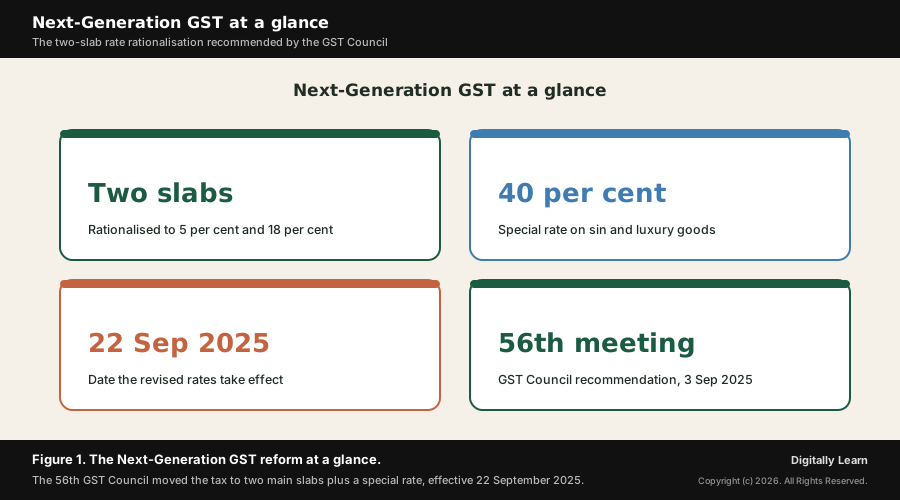
The Next-Generation GST reform, popularly called GST 2.0, is a package of changes to India's Goods and Services Tax recommended by the GST Council at its 56th meeting on 3 September 2025. Its centrepiece is a rate rationalisation that collapses the earlier four-slab structure into a simplified two-slab structure of 5 per cent and 18 per cent, removing the 12 per cent and 28 per cent slabs, with a special 40 per cent rate kept only for a small set of sin and luxury goods. The revised rates take effect from 22 September 2025. Alongside the rates, the reform simplifies registration and return filing, speeds up refunds and lowers compliance costs, with relief aimed at the common man, small business, farmers and the health sector.
The GST Council Rationalises GST into a Two-Slab Structure
The 56th GST Council and the move to two main slabs
India has reshaped its main indirect tax. At its 56th meeting on 3 September 2025, chaired by the Union Finance Minister, the GST Council recommended a Next-Generation GST reform, widely called GST 2.0. Its centrepiece is a rate rationalisation that simplifies the structure of the Goods and Services Tax, the single nationwide tax on most goods and services.
The reform replaces the earlier four-rate structure with a simplified two-slab structure. Goods and services now fall mainly under a 5 per cent merit rate or an 18 per cent standard rate, while the old 12 per cent and 28 per cent slabs are removed. A special 40 per cent rate is kept for a small set of sin and luxury goods, so that the simpler structure does not give away revenue on items the State chooses to tax heavily.
The 40 per cent rate falls on goods such as pan masala, tobacco products, aerated drinks, high-end cars, yachts and private aircraft. The revised rates and exemptions come into effect from 22 September 2025, so the new structure is already in force. The figure below sets out the reform at a glance.
Why the GST Reform Is in the News: A Long-Awaited Rate Overhaul
The biggest rate change since GST began
Why it matters now is that this is the most significant overhaul of GST rates since the tax began in 2017. For years, businesses and economists had argued that four slabs plus a cess made the tax complicated, bred classification disputes and weighed on small firms. The 56th Council took up that long-standing demand and acted on it.
The change is also timed for effect. By bringing the revised rates in from 22 September 2025, just before the festive season, the Government framed the reform as relief for households and a spur to consumption. The combination of lower and simpler rates with easier compliance is why the reform has drawn such close attention from consumers, traders and the states alike.
Understanding the Significance of the GST Reform for India
A simpler tax, relief for the common man and a maturing of GST
What is the significance of the GST reform lies first in the simplicity it brings. Moving from four slabs to two makes the tax easier to understand and to administer, and cuts the disputes that arose when similar goods sat in different slabs. A clearer rate structure lowers the friction of doing business and the cost of compliance.
Its second significance is the relief it offers. With many everyday goods at the lower rate and the standard rate held at 18 per cent, the reform is aimed at the common man, farmers and small business, easing the tax on essentials and on labour-intensive industries while keeping high taxes only on sin and luxury goods.
Its third significance is institutional. That a change of this scale was settled by the GST Council, where the Centre and all the states sit together, shows the maturing of GST and of the cooperative federalism the Council embodies. The reform is therefore read as much as a test of fiscal federalism as of tax policy.
What GST Is: One Nation One Tax, the 101st Amendment and the GST Council
GST as a destination-based tax with input tax credit
To read the reform, it helps to recall what GST is. The Goods and Services Tax came into effect on 1 July 2017 through the Constitution (One Hundred and First Amendment) Act, 2016, which gave both the Centre and the states the power to tax goods and services in a single, nationwide system, summed up in the phrase one nation, one tax.
GST is a comprehensive, multi-stage, destination-based tax: it is collected at each stage of the supply chain but ultimately borne where the goods or services are consumed, not where they are produced. Its defining mechanism is the input tax credit, by which a business sets off the tax it has already paid on its inputs against the tax it owes on its output, so that tax is levied only on the value added at each stage and does not cascade.
Indian GST has a dual structure. On every intra-state supply, both the Centre and the state levy GST together, as Central GST and State GST, while inter-state supplies attract an Integrated GST that is later shared. This design keeps GST a genuinely shared tax rather than a purely central or purely state levy.
The central and state indirect taxes that GST subsumed
The great achievement of GST in 2017 was to subsume a tangle of earlier central and state indirect taxes into one tax. Before GST, a single product could attract a chain of different levies as it moved through production and across state borders, taxing tax upon tax. GST replaced that chain with a single, creditable tax.
On the central side, GST subsumed the Central Excise duty and additional excise duties, the Service Tax, and the additional customs duties known as the countervailing duty and the special additional duty. These were the main taxes the Union levied on manufacture and on services.
On the state side, GST subsumed the State Value Added Tax or sales tax, entertainment tax not levied by local bodies, octroi and entry tax, luxury tax, purchase tax, and taxes on lotteries, betting and gambling. Bringing these many state levies into one tax is what made GST a genuine one nation, one tax reform. The list below names the main taxes subsumed.
- Central Excise and additional excise duties: The Union’s tax on the manufacture of goods, now within GST.
- Service Tax: The central tax on the supply of services, subsumed into GST.
- Additional customs duties: The countervailing duty and special additional duty on imports, subsumed into GST.
- State VAT or sales tax: The states’ main tax on the sale of goods within the state.
- Entertainment, luxury and entry taxes: Entertainment tax (except by local bodies), luxury tax, octroi and entry tax.
- Taxes on lotteries, betting and gambling: State levies on these activities, brought under GST.
| Level | Indirect taxes subsumed into GST |
|---|---|
| Central taxes | Central Excise duty, additional excise duties, Service Tax, and additional customs duties (countervailing duty and special additional duty) |
| State taxes | State VAT or sales tax, entertainment tax (except by local bodies), octroi, entry tax, luxury tax, purchase tax, and taxes on lotteries, betting and gambling |
Read together, the two rows show the reach of GST: it folded the main taxes of both the Centre and the states into one creditable tax, which is what made the 2017 change a genuine one-nation-one-tax reform rather than a partial measure.
The GST Council under Article 279A and the old slabs
GST is run not by the Centre alone but by the GST Council, a constitutional body created by Article 279A, inserted by the same 101st Amendment. The Council is chaired by the Union Finance Minister and includes the Union Minister of State for Finance and the finance ministers of all the states, so that decisions on rates, exemptions and rules are taken jointly.
The Council is the clearest institutional expression of cooperative federalism in Indian taxation: the Union and the states pool their sovereignty to set a common tax, and most decisions are reached by consensus, with a weighted voting formula in reserve. Every rate change, including the present reform, is a recommendation of this Council, not a unilateral act of the Centre.
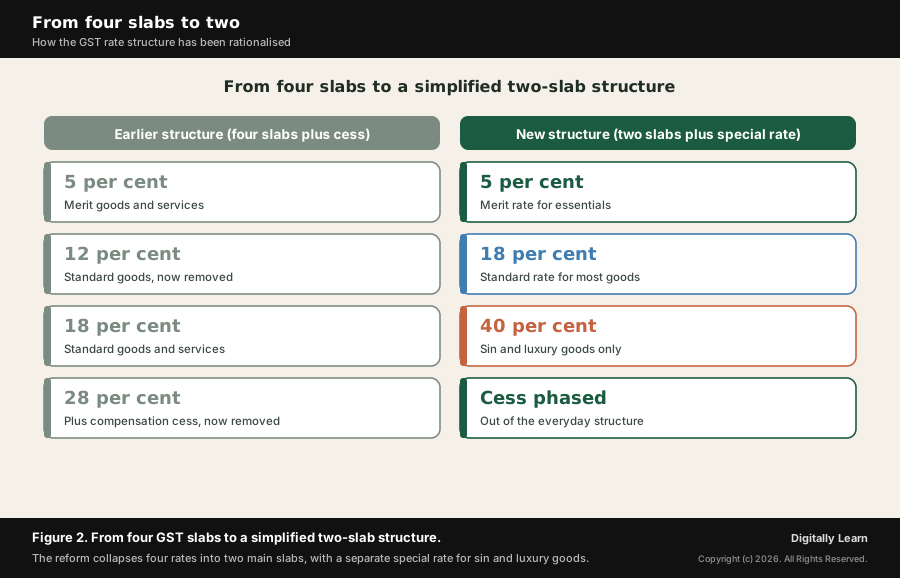
Under the old design, GST had four main slabs of 5, 12, 18 and 28 per cent, with essentials exempt or at the lowest rate and a compensation cess levied on a few demerit and luxury goods on top of the 28 per cent rate. It is this four-slab structure that the Next-Generation reform has now simplified into two main slabs. The figure below contrasts the old and the new structures.
The New GST Structure: Two Slabs, the Special Rate and Easier Compliance
The 5 and 18 per cent slabs and the 40 per cent special rate
At the heart of the reform is the two-slab structure. Most goods and services now sit at either a 5 per cent merit rate or an 18 per cent standard rate. The 12 per cent and 28 per cent slabs are removed, so that items earlier taxed at 12 per cent generally move down towards 5 per cent and items at 28 per cent move down to 18 per cent, unless they fall in the special category.
Above the two main slabs sits a single special rate of 40 per cent. It applies only to a small set of sin and luxury goods, such as pan masala, tobacco products, aerated drinks, high-end cars, yachts and private aircraft. Keeping a high rate on these goods lets the structure stay simple for everything else without surrendering the revenue the State raises from goods it chooses to tax heavily or discourage.
One group is treated separately during the transition. For cigarettes, chewing tobacco such as zarda, unmanufactured tobacco and beedi, the existing GST and the compensation cess continue for now, and the new rates will apply later, on a date to be notified, once the loan and interest liabilities tied to the compensation cess are fully discharged. This keeps the cess-linked obligations honoured before these items move to the new regime.
Simpler registration, returns and faster refunds
The reform is not only about rates. It also simplifies compliance, the part of GST that small firms find hardest. Registration has been made more technology-driven and time-bound, so that small businesses and startups can come into the system quickly rather than waiting on manual approvals.
Return filing has been eased through pre-filled returns, which carry forward data the system already holds, reduce manual entry and cut the mismatches that earlier triggered notices. Refunds have been made faster through automated processing, of particular help to exporters and to businesses caught in an inverted-duty position, where the tax on inputs exceeds the tax on the finished good and refunds had often been slow.
Taken together, simpler registration, pre-filled returns and quicker refunds lower the cost of compliance, easing the burden on businesses and especially on MSMEs and startups. For a small trader, less time and money spent on tax paperwork is as real a gain as a lower rate.
Impact of the GST Reform: Relief, Revenue and the Federalism Question
Who the reform is meant to relieve
The reform is framed squarely around relief. By holding most goods at 5 or 18 per cent and moving many items down from the higher slabs, it is aimed at the common man, easing the tax on everyday goods and so leaving more in the hands of households. The timing, just before the festive season, was meant to give consumption an immediate lift.
Specific groups are singled out. Labour-intensive industries, which employ large numbers, gain from lower input and output taxes; farmers and agriculture gain from cheaper inputs and farm-related goods; and the health sector gains from lower taxes on medicines and devices. Small business gains twice over, from lower rates and from the easier compliance described above.
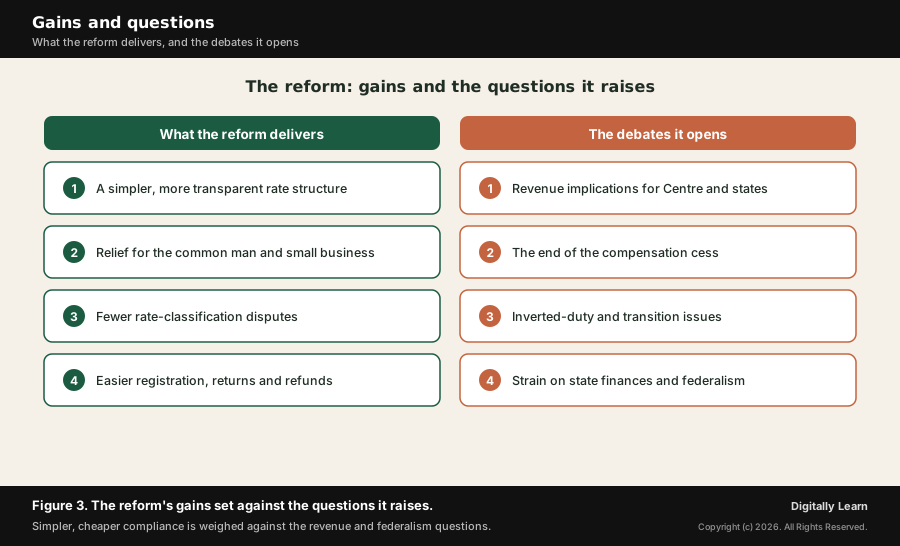
There is also a wider economic logic. By lifting take-home spending power and lowering the cost of compliance, the reform is expected to support consumption and growth, while a simpler structure reduces the litigation and classification disputes that earlier clogged the system. The figure below pairs these gains with the questions the reform raises.
The revenue implications since 2017 and the end of the cess
A balanced reading must weigh the revenue implications, which run back to GST's design in 2017. When GST subsumed the states' own buoyant taxes, the states feared a loss of revenue, so the Constitution promised them compensation for any shortfall for a five-year transition. The GST (Compensation to States) Act, 2017 protected each state's revenue at a growth of 14 per cent over the 2015-16 base year, financed by a dedicated compensation cess on demerit and luxury goods.
Since July 2017 the revenue record has been mixed. GST collections grew over time and crossed high monthly marks as the base widened and compliance improved, but revenue stayed below the original buoyancy assumed in 2017, and the COVID-19 shock forced the Centre to borrow to meet the compensation owed to the states. The five-year compensation window has since lapsed, leaving states to manage without the assured 14 per cent cushion.
The present reform, by cutting rates, raises a fresh question of revenue neutrality: whether the lower slabs will be offset by higher consumption and better compliance, or will leave a gap in collections for both the Centre and the states. As the compensation cess is phased out of the everyday structure, how the revenue is shared, and whether states are made whole, becomes central to the reform's success.
Inverted duties, transition and fiscal federalism
Beyond revenue, the reform raises practical transition issues. Moving lakhs of items between slabs requires businesses to re-price stock, re-set billing systems and re-file under the new rates, and a few inverted-duty cases, where inputs are taxed more than outputs, may persist and need correction so that credit does not pile up unused.
The deeper question is one of fiscal federalism. Because rates are now set jointly in the GST Council, an individual state can no longer adjust its own indirect taxes to its needs, so a reform that lowers rates affects every state's finances at once. States that depend more on consumption taxes worry about the hit to their own revenues and about their autonomy over taxation.
Set against these concerns are the reform's real gains: a simpler and more transparent tax, lower compliance cost, relief for consumers and small business, and fewer disputes. The fair assessment is that the Next-Generation GST is a significant step forward whose success will depend on protecting revenue and on the Centre and the states continuing to act together in the Council.
The GST Reform in Context: Fiscal Federalism, Growth and Indirect-Tax Reform
How the reform sits within India's wider fiscal story
Contemporary linkages place the reform within India's wider fiscal story. It is the clearest test yet of fiscal federalism under GST, the arrangement by which the Centre and the states share a single tax base and decide rates together in the GST Council, balancing a uniform national market against the states' need for revenue and autonomy.
It also connects to the debate on consumption and growth. By lowering and simplifying rates just before the festive season, the reform is meant to lift household spending and support demand, linking tax policy to the management of the economic cycle in a year of uncertain global growth.
The reform belongs, too, to the longer arc of indirect-tax reform in India, which moved from a fragmented system of central and state taxes, through the 2017 one-nation-one-tax change, to this rationalisation of rates. Each step has aimed at a simpler, more efficient and more unified tax. The points below connect the reform to its neighbours.
- The GST Council and Article 279A: The constitutional forum of the Centre and states that recommends every rate change, the heart of GST federalism.
- Compensation cess and state finances: The five-year revenue guarantee to states and its end, central to the reform’s revenue debate.
- Inverted-duty structure: Where inputs are taxed more than outputs, a long-standing GST issue the rate change must manage.
- Direct-tax reform: The parallel effort to simplify income tax, alongside which GST rationalisation completes the tax-reform picture.
Finally, the reform sits within India's pursuit of a single, efficient national market. A simpler GST lowers the friction of moving goods and services across state lines, which is one of the original promises of the 2017 reform and a continuing goal of economic policy.
UPSC Relevance and Exam Focus
This topic maps directly to General Studies Paper III: the Indian economy, mobilisation of resources, and government budgeting, and to the taxation and fiscal-federalism themes that recur across the Economy syllabus. It also links to General Studies Paper II, through the GST Council as an instance of cooperative federalism and the functioning of constitutional bodies.
For Prelims, hold the high-yield facts: GST came into force on 1 July 2017 through the 101st Constitutional Amendment; it is a destination-based tax with input tax credit; the GST Council is a constitutional body under Article 279A chaired by the Union Finance Minister; and the Next-Generation reform rationalises the rates into two main slabs of 5 and 18 per cent, with a 40 per cent special rate.
For Mains, the recurring framing is to enumerate the indirect taxes that GST subsumed and to comment on its revenue implications, and to weigh the gains of a simpler tax against the strain on state finances and fiscal federalism. A strong answer treats GST as a balance between a unified national market and the states' need for revenue and autonomy.
Recurring linked concepts an aspirant should keep in working memory:
- Input tax credit: The set-off of tax paid on inputs against tax on output, which stops tax cascading under GST.
- Destination-based taxation: GST accrues where goods or services are consumed, not where they are produced.
- GST Council (Article 279A): The constitutional Centre-state forum that recommends rates, exemptions and rules.
- Compensation cess: The cess that funded the five-year revenue guarantee to states after GST began.
A common Prelims trap is to confuse GST with a purely central tax. GST is a dual tax shared by the Centre and the states, governed jointly through the GST Council, not a levy of the Union alone.
A common Mains trap is to praise the reform without testing it. Its exam value lies in a balanced judgment: the genuine advance of a simpler tax and lower compliance, set honestly against the questions of revenue neutrality, the end of the compensation cess and the strain on state finances.
Previous Year UPSC-CSE Questions By the end you will be able to draft model answers for the following UPSC questions. Each question carries a collapsible framework showing how to approach it in the exam.
- UPSC Mains 2019 GS-IIIEnumerate the indirect taxes subsumed in GST in India, and comment on the revenue implications of GST since July 2017.
How to structure the answer in the exam
Body (sub-themes to develop):
- Central taxes subsumed: Central Excise duty and additional excise duties, Service Tax, and the additional customs duties (countervailing duty and special additional duty).
- State taxes subsumed: State VAT or sales tax, entertainment tax (except by local bodies), octroi and entry tax, luxury tax, purchase tax, and taxes on lotteries, betting and gambling.
- Revenue design since 2017: states' feared revenue loss met by a five-year compensation guarantee protecting revenue at 14 per cent growth over the 2015-16 base year, financed by a compensation cess.
- The revenue record: collections grew and crossed high monthly marks but stayed below the buoyancy assumed in 2017; the COVID-19 shock forced borrowing to meet compensation; the five-year window has lapsed.
- The fresh question: the Next-Generation rate cut reopens revenue neutrality for the Centre and states as the compensation cess is phased out, making revenue-sharing and state finances central.
Sources and Further Reading
- Press Information Bureau: Recommendations of the 56th Meeting of the GST Council
- Press Information Bureau: Next-Gen GST Overhaul, Staple Foods Tax-Free, Processed Foods at 5 per cent
- Press Information Bureau: Frequently Asked Questions on the decisions of the 56th GST Council
- Goods and Services Tax Council: official portal and GST Council meetings
- Central Board of Indirect Taxes and Customs: Central Goods and Services Tax Act, 2017
- Gazette of India: The Constitution (One Hundred and First Amendment) Act, 2016
- National Portal of India: Goods and Services Tax
- Wikipedia: Goods and Services Tax (India)
- Wikipedia: One Hundred and First Amendment to the Constitution of India
Editorial Disclaimer
This briefing is for UPSC preparation. Verify the rates, slabs and provisions against the official PIB, GST Council and CBIC sources before relying on them.


