


Overview
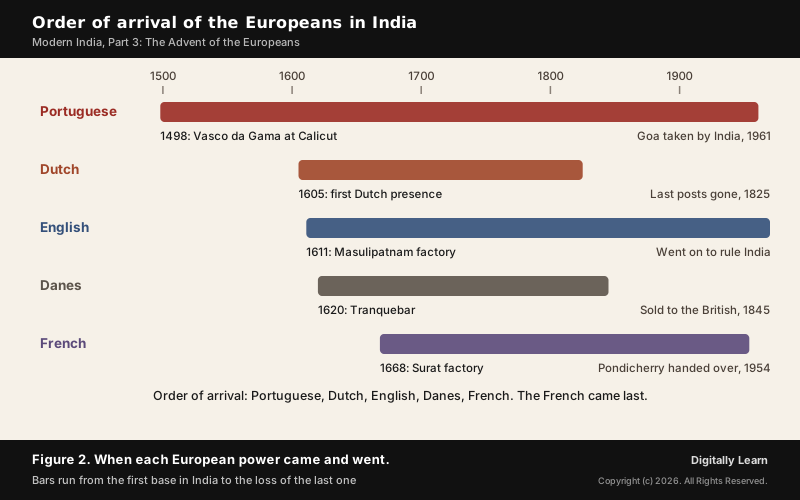
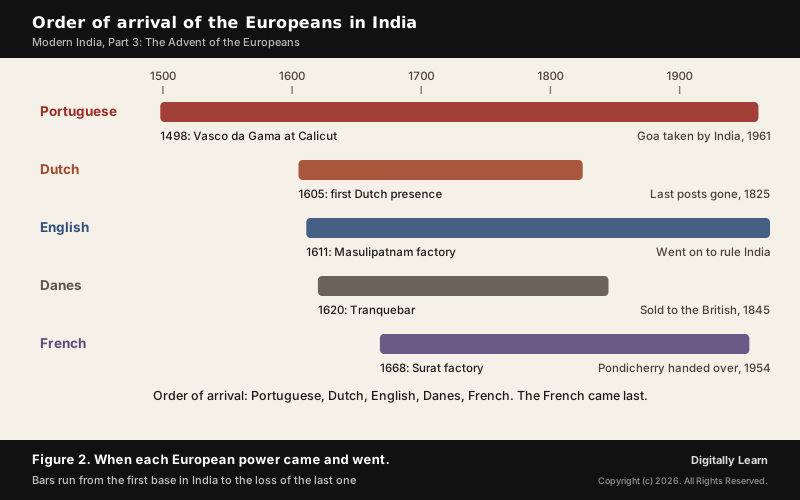
The advent of Europeans in India began when the Portuguese sailor Vasco da Gama landed near Calicut on 20 May 1498 by the new sea route round Africa. The Portuguese were followed by the Dutch, the English, the Danes and, last, the French, each through a chartered trading company. They came for spices and textiles, fought one another for the trade, fortified their settlements and were drawn into Indian politics, which in the end let the English East India Company rule India.
Why Europeans Came to India: Spices, Textiles and the Sea Route
Spices, Cotton and the Sea Route Round the Cape
Europe wanted what India made and grew. The fine cotton and silk of India had a big market there, and pepper, cloves, cardamom and cinnamon were in great demand. The Portuguese explorer Vasco da Gama found the sea route: sailing round the Cape of Good Hope and across the Indian Ocean from Malindi in Kenya, he landed at Kappad near Calicut (Kozhikode) on 20 May 1498, where the Zamorin received him.
The Europeans who followed came through chartered companies. A royal charter gave one company the sole right to trade with the East, so it did not fear rivals from its own country. Such mercantile companies made their profit mainly by excluding competition, buying cheap and selling dear. A charter could not keep out the other European nations, though, and that set the stage for their wars.
Portuguese in India: Estado da India, Goa and the Cartaz System
From Calicut to Goa: Cabral, Almeida, Albuquerque and the Northern Province
The Portuguese moved quickly from a landing to a network of bases. Pedro Alvares Cabral reached Calicut on 13 September 1500 and set up a factory there, but in a dispute with the Zamorin the factory was attacked and Cabral bombarded the city. The Portuguese turned to Cochin, whose kingdom became a Portuguese protectorate in 1505. That year King Manuel I made Francisco de Almeida the first viceroy of the Estado da India, the Portuguese State of India, and Almeida strengthened Fort Manuel at Cochin.
- Battle of Diu, 3 February 1509: Almeida’s fleet defeated the joint fleet of the Sultan of Gujarat, the Mamluk Sultanate of Egypt and the Zamorin of Calicut.
- Its meaning: The victory gave Portugal dominance in the Indian Ocean for more than a century and showed the superiority of Portuguese ships and guns.
- Kozhikode: A Portuguese factory and fort worked at Calicut only for a short time, from 1511 to 1525.
Afonso de Albuquerque, viceroy from 1509 to 1515, turned bases into an empire. He captured Goa from the Bijapur Sultanate in 1510 and Malacca in 1511, and Goa became the main anchorage for Portuguese fleets; the capital of the Estado moved there from Cochin in 1530.
The Portuguese then gained a chain of ports on the Gujarat coast from Bahadur Shah, the sultan of Gujarat, who needed their help against the Mughal emperor Humayun. By the Treaty of Bassein of 23 December 1534 they received Bassein (Vasai) with its territory, including Daman and the Bombay islands. Bahadur Shah then gave them leave to build a factory at Diu in 1535; instead they built the Diu Fort. Daman, sacked in 1531, was ceded in 1539. Together these formed the Northern Province.
Portuguese Rule in Goa: Casados, Sati Ban, Inquisition and Printing
Goa under the Portuguese became a colony, not just a trading post. Albuquerque encouraged his soldiers to settle and marry local women, paying them to do so: within two months Goa had 200 such casados (married men), and about 2,000 by the middle of the sixteenth century. He appointed local people to posts in the administration and left local customs alone, with one exception: he abolished sati.
- Religion: The Jesuit Francis Xavier asked the king for an Inquisition in Goa on 16 May 1546; it was set up in 1560 and over the next century brought about 16,000 people to trial, driving many non-Christians out of Goa.
- Printing: The first printing press in India was installed in 1556 at Saint Paul’s College, Goa.
- Reach: From Goa the viceroy governed Portuguese Ceylon and Portuguese Chittagong as well as the Indian ports.
The Cartaz System and the Decline of the Portuguese
Portuguese power rested on the sea. Under the cartaz system, in use from about 1502 to 1750, an Asian ship needed a Portuguese naval trade licence, a cartaz, to sail the Indian Ocean; the name comes from cartas, letters.
- Challenge at sea: In the Battle of Swally, 29 and 30 November 1612, four English galleons beat four Portuguese galleons and 26 smaller boats off Surat.
- Loss of Bombay: Portugal gave Bombay to England on 11 May 1661 as part of the dowry of Catherine of Braganza on her marriage to Charles II.
- Pulicat and Ceylon: The Dutch took Pulicat from the Portuguese and later conquered Ceylon from them.
- The end: In December 1961 India took Goa, Daman and Diu in Operation Vijay, air, sea and land strikes over 36 hours that ended 451 years of Portuguese rule. Portugal recognised Indian control by a treaty of 31 December 1974.
Dutch in India: The VOC on the Coromandel Coast
Dutch East India Company Factories: Pulicat, Masulipatnam and Chinsurah
The Dutch East India Company (VOC) was formed on 20 March 1602 by the States General of the Netherlands, which merged existing companies and gave it a 21-year monopoly of Asian trade. It was one of the first joint-stock companies in the world: any Dutch citizen could buy its shares. Its main prize was the spice trade of the East Indies, and Indian textiles were what it exchanged for spices.
The Dutch came because the Portuguese could not meet Europe's demand, above all for pepper. For a time in the seventeenth century the VOC held a monopoly of nutmeg, mace and cloves and sold them in Europe and in Akbar's Mughal empire at 14 to 17 times the price it paid in Indonesia.
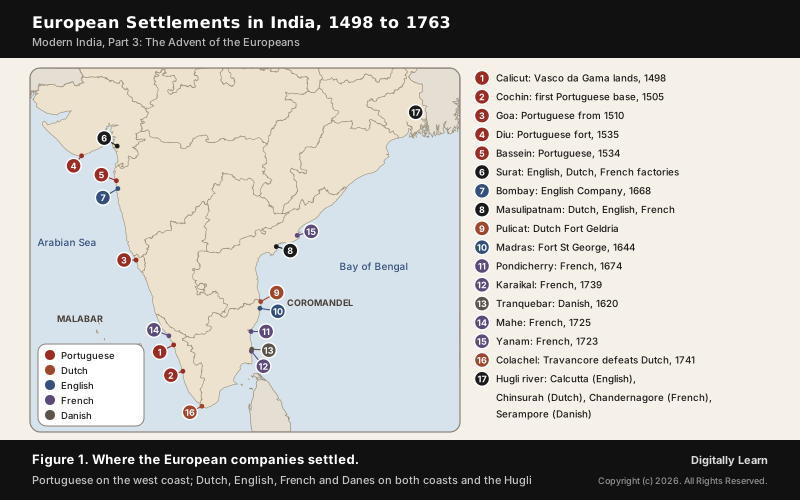
- Pulicat: In 1608, under Vijayanagara, the Dutch were allowed to build a fort and trade at Pulicat; Fort Geldria made it the chief Dutch centre on the Coromandel coast, and its headquarters from 1616 to 1690.
- Masulipatnam: The VOC settled there in the early seventeenth century.
- Surat and Bengal: Dutch Surat followed in 1616 and Dutch Bengal in 1627, with Chinsurah on the Hugli river.
- Span: The Dutch were in India from 1605 to 1825, and even held Pondicherry from 1693 to 1699.
Dutch Decline: Amboyna, the Battle of Colachel and the Battle of Chinsurah
The Dutch put the spice islands first. After the Amboyna massacre of 1623, in which the Dutch beheaded ten Englishmen, the English withdrew from most of the Indonesian islands and turned to other parts of Asia, above all India. On the Coromandel coast the Dutch were weakened further when Golconda forces under Mir Jumla conquered the region, and in India itself they lost two battles that ended their ambitions.
- Battle of Colachel, 10 August 1741: King Marthanda Varma of Travancore defeated the forces of the VOC.
- Battle of Chinsurah (Biderra or Bedara), 25 November 1759: Company troops under Francis Forde defeated a Dutch force that the Nawab of Bengal, Mir Jafar, had invited in.
- Exit: Under the Anglo-Dutch Treaty of 1824, the last Dutch posts passed to Britain on 1 March 1825.
English East India Company: Charter, Factories and Farmans
The Royal Charter of 1600 and the First English Factories
In 1600 the East India Company received a charter from Queen Elizabeth I, dated 31 December 1600, giving it the sole right to trade with the East. Company ships reached Surat in 1608. Its first Indian factory was set up at Masulipatnam on the Andhra coast in 1611, and its second at Surat in 1615. By 1647 it had 23 factories and settlements in India.
- Battle of Swally, 1612: Victory over the Portuguese off Surat, the principal port of the Mughals.
- Sir Thomas Roe: Sent by James I as envoy to the Mughal emperor Jahangir, he stayed at the court until 1619; the result was permission and protection for the Company’s factory at Surat.
- What a factory was: A trading post, with a warehouse for goods and offices where the Company’s traders, called factors, worked.
Madras, Bombay and Calcutta: The Three Presidency Towns
- Madras: In 1639 Francis Day, with the local Nayak Damarla Venkatadri, obtained a strip of coast from the Vijayanagara king Peda Venkata Raya. Fort St George, completed on 23 April 1644, was the first English fortress in India.
- Bombay: Charles II received Bombay in 1661 as part of Catherine of Braganza’s dowry and leased it to the Company by a charter of 27 March 1668 for £10 a year, with powers of defence and justice. The Company moved its western headquarters there from Surat in 1687.
- Calcutta: The first English factory in Bengal was set up on the Hugli in 1651. Job Charnock founded a settlement at Calcutta on 24 August 1690; a fort was begun in 1696, and two years later the Company got zamindari rights over three villages, one of them Kalikata.
Each town began as a trading post and became a fortified base. The Company also tried force against the Mughals once, in the Anglo-Mughal war of 1686 to 1690, and was defeated; it got its factories back only by submitting to the emperor. For most of its first century the Company cultivated the Mughals and traded peacefully at great profit. From these three towns grew the Madras, Bombay and Bengal presidencies.
Aurangzeb's Farman, the 1717 Farrukhsiyar Farman and Dastaks
Trading rights came from Mughal farmans, royal orders. The Company persuaded Aurangzeb to issue a farman letting it trade duty free in Bengal. In 1717 the emperor Farrukhsiyar gave it the right to reside and trade in the empire, free of customs in Bengal except for a yearly payment of 3,000 rupees, and the right to issue dastaks, passes for moving goods.
The privilege belonged to the Company, not to its officials, but the officials used dastaks for their own private trade and refused to pay duty, costing Bengal large sums of revenue. Murshid Quli Khan protested, and his successors Alivardi Khan and Sirajuddaulah refused new concessions, denied the Company the right to mint coins and stopped it extending its forts. That quarrel led to the Battle of Plassey and the conquest of Bengal, told in Part 4.
French in India and the Danes: The Last European Companies
French East India Company: Surat, Pondicherry and Chandernagore
France was the last of the major European maritime powers to enter the East India trade. Its French East India Company, formed under Cardinal Richelieu in 1642, was reconstructed under Jean-Baptiste Colbert in 1664. An expedition under François Caron reached Surat in 1668 and set up the first French factory in India; another followed at Masulipatnam in 1669.
- Pondicherry: Acquired in 1673 from the qiladar of Valikondapuram under the Sultan of Bijapur. François Martin, its first governor, began building the town in 1674 and made a fishing village a flourishing port.
- Chandernagore: Set up in 1692 with the permission of Shaista Khan, the Mughal governor of Bengal.
- Later settlements: Yanam (1723), Mahe (1725) and Karaikal (1739).
- Setbacks: The Dutch held Pondicherry from 1693 until the Treaty of Ryswick returned it in 1699.
French rule outlived French power. The five settlements of Pondicherry, Karaikal, Yanam, Mahe and Chandernagore stayed French until they joined India, Chandernagore in 1950 and the others by the de facto transfer of 1954; the union became legal in 1962, when the French Parliament ratified the treaty.
Dupleix and the Anglo-French Contest for the Carnatic
The French turned from trade to politics under Joseph François Dupleix, made governor general of the French settlements in 1742. He saw the succession disputes among Indian princes as a chance to advance French interests, and he built an army of Indian soldiers, the sepoys, trained as infantry; Hyder Ali of Mysore served in it. Recalled in favour of Charles Godeheu, Dupleix died in poverty in France. The two companies fought the Carnatic Wars from 1740 to 1763, told in detail in Part 4.
- Battle of Wandiwash, 1760: Sir Eyre Coote defeated the French under the Comte de Lally, and Pondicherry fell to the British in 1761.
- Treaty of Paris, 1763: France got back Pondicherry and Chandernagore and could keep trading posts in India, but French traders were forbidden to administer them.
- End of the company: In 1769 the French East India Company, unable to support itself financially, was wound up.
Danish in India: Tranquebar, Serampore and the Minor Companies
The Danish East India Company was chartered by King Christian IV on 17 March 1616, envious of Dutch and English success. Its first expedition, under Admiral Ove Gjedde, sailed in 1618. On 20 November 1620 Raghunatha Nayak of Tanjore granted the Danes the village of Tranquebar (Tharangambadi), the right to build Fort Dansborg and the right to levy taxes. Their later settlement at Serampore on the Hugli was Danish from 1755 to 1845.
- Weight: The Danes were never a military or commercial threat to the larger powers. Denmark sold Tranquebar and its other mainland settlements to the British in 1845, and its rights to the Nicobar Islands in 1868.
- Ostend Company: Chartered in 1722 in the Austrian Netherlands, it had factories at Covelong on the Coromandel coast and Banquibazar in Bengal, but was closed in 1731 under British diplomatic pressure.
- Swedish East India Company: Founded in 1731 at Gothenburg; it traded mainly with China.
European Trading Companies Compared: Why the English Prevailed
European Settlements in India at a Glance
| Power | Main bases | Fate |
|---|---|---|
| Portuguese | Calicut, Cochin, Goa, Diu, Daman | Out, 1961 |
| Dutch | Masulipatnam, Pulicat, Chinsurah | Out, 1825 |
| English | Masulipatnam, Madras, Bombay, Calcutta | Ruled India |
| Danish | Tranquebar, Serampore | Out, 1845 |
| French | Surat, Pondicherry, Mahe, Karaikal | Out, 1954 |
The Hugli river shows the whole story in one place. The Portuguese, the Dutch, the French, the Danes and the English all set up trading posts, called kuthis, in the district: Chinsurah was Dutch, Serampore Danish and Chandernagore French, while Calcutta, a few kilometres away, became the capital of British India.
The companies also wanted different things. The Portuguese sought control of the sea lanes and the spread of their faith, taxing Asian shipping through the cartaz. The Dutch put the spice islands first and treated India as a source of textiles to pay for spices. The English built a broad Indian trade: by 1717 their main business was cotton, silk, opium, indigo, saltpetre and tea.
Why the English East India Company Prevailed Over Its Rivals
No single cause decided the contest; several advantages added up. The English beat the Portuguese at sea, profited when the Dutch turned to the spice islands, and outlasted the French, whose company kept running short of money.
- Sea power: Victory at Swally in 1612 over the Portuguese, who until then had held a monopoly of the sea trade with India.
- Fortified bases: Fort St George (1644), Bombay with its own defence powers (1668) and the Calcutta fort (1696) gave the Company secure ports on both coasts.
- Bengal’s trade: Duty-free trade in Bengal, the richest region of the Mughal empire, and after Plassey its revenue, which equipped the British to defeat the French at Wandiwash.
- Rivals’ weaknesses: The Dutch concentrated on the East Indies; the French company faced financial trouble and was wound up in 1769.
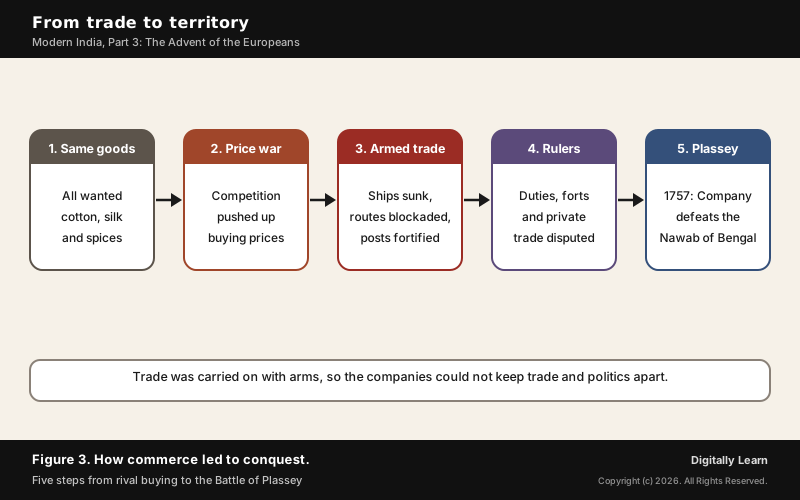
Behind all of this lay the logic of armed trade. Because every company wanted the same goods, competition pushed up prices, and the only way to profit was to eliminate rivals: companies sank each other's ships, blockaded routes and fortified their posts. Fortification brought conflict with Indian rulers, so the Company found it could not separate trade from politics. The regional powers it met are described in Part 2 on the successor states of the Mughal Empire.
Previous Year UPSC-CSE Questions
Previous Year UPSC-CSE Questions By the end you will be able to draft model answers for the following UPSC questions. Each question carries a collapsible framework showing how to approach it in the exam.
- UPSC Prelims 2022 Prelims-GSWith reference to Indian history, consider the following statements :
- The Dutch established their factories/warehouses on the east coast on lands granted to them by Gajapati rulers.
- Alfonso de Albuquerque captured Goa from the Bijapur Sultanate.
- The English East India Company established a factory at Madras on a plot of land leased from a representative of the Vijayanagara empire.
Which of the statements given above are correct ?
How to approach this Prelims question
Approach: Check who granted each piece of land.
Trap to watch: The Gajapatis did not grant the Dutch their east-coast land; Vijayanagara did.
Key facts to recall:
- Goa from Bijapur, 1510
- Madras land via Damarla Venkatadri, 1639
Answer signal: 2 and 3 only: option (b).
- UPSC Prelims 2009 Prelims-GSWith whose permission did the English set up their first factory in Surat?
How to approach this Prelims question
Approach: Link the Surat factory to Roe's embassy.
Trap to watch: Jahangir ruled from 1605 to 1627; the English opened their first factories in 1611 and 1615, after Akbar's reign.
Key facts to recall:
- Roe at Jahangir's court until 1619
- Surat factory 1615
Answer signal: Jahangir: option (b).
- UPSC Prelims 2007 Prelims-GSWho among the following Europeans were the last to come to pre-independence India as traders?
How to approach this Prelims question
Approach: Recall the order: Portuguese, Dutch, English, Danes, French.
Trap to watch: The English charter (1600) came before the Dutch company (1602), but the French came decades later.
Key facts to recall:
- French company reconstructed 1664
- First French factory, Surat 1668
Answer signal: French: option (c).
- UPSC Prelims 2023 Prelims-GSWho among the following rulers of medieval Gujarat surrendered Diu to Portuguese?
How to approach this Prelims question
Approach: Match Diu with the sultan who sought Portuguese help against the Mughals.
Trap to watch: The 1509 Battle of Diu was fought against Gujarat's fleet; the handover came later, under Bahadur Shah.
Key facts to recall:
- Treaty of Bassein, 1534
- Diu Fort built instead of a factory, 1535
Answer signal: Bahadur Shah: option (c).
- UPSC Prelims 2010 Prelims-GSWith reference to Pondicherry (now Puducherry), consider the following statements :
- The first European power to occupy Pondicherry were the Portuguese.
- The second European power to occupy Pondicherry were the French.
- The English never occupied Pondicherry.
Which of the statements given above is/are correct ?
How to approach this Prelims question
Approach: List the powers at Pondicherry in order.
Trap to watch: The Dutch and Danes came before the French, and the British did capture the town.
Key facts to recall:
- Portuguese 1521
- French 1674; British capture 1761
Answer signal: 1 only: option (a).
Sources and Further Reading
- NCERT: Our Pasts III (Class VIII), Chapter 2, From Trade to Territory
- Government of Puducherry: History
- Yanam, Government of Puducherry: History
- Kozhikode District, Government of Kerala: History
- Hooghly District, Government of West Bengal: History
- Wikipedia: Vasco da Gama
- Wikipedia: Portuguese India
- Wikipedia: Francisco de Almeida
- Wikipedia: Afonso de Albuquerque
- Wikipedia: Battle of Diu (1509)
- Wikipedia: Cartaz
- Wikipedia: Bahadur Shah of Gujarat
- Wikipedia: Annexation of Goa
- Wikipedia: Dutch East India Company
- Wikipedia: Dutch India
- Wikipedia: Dutch Coromandel
- Wikipedia: Battle of Colachel
- Wikipedia: Battle of Chinsurah
- Wikipedia: East India Company
- Wikipedia: Battle of Swally
- Wikipedia: Thomas Roe
- Wikipedia: History of Chennai
- Wikipedia: Bombay Presidency
- Wikipedia: Job Charnock
- Wikipedia: Farrukhsiyar
- Wikipedia: French India
- Wikipedia: Joseph François Dupleix
- Wikipedia: Carnatic Wars
- Wikipedia: Danish India
- Wikipedia: Ostend Company
- UPSC: Previous year question papers
Editorial Disclaimer
This article draws on the NCERT history textbook, Government of India and state history pages and the other sources listed below. Where sources give different dates, the article follows the one cited.