


Overview
The extremist leaders were the nationalists who, in the first decade of the twentieth century, rejected the Moderates' politics of petition and demanded self-rule through self-reliance, boycott and sacrifice. The best known are the trio called Lal Bal Pal (Lala Lajpat Rai of Punjab, Bal Gangadhar Tilak of Maharashtra and Bipin Chandra Pal of Bengal), together with Aurobindo Ghosh, who gave their politics its sharpest philosophy. The Moderates and the British called them Extremists or Radicals. They called themselves simply Nationalists, because they saw nothing extreme in asking for an independent Indian nation. Later writers also call them the Garam Dal, the hot faction, against the Moderate Naram Dal.
The Extremist Leaders Compared: Region, Press and Method
Region, Newspaper and Signature Idea of Each Leader
The trio's home provinces lay far apart, so the name "Lal Bal Pal" itself shows that the new politics was an all-India force and not a Bengal affair. The four careers differed in region, in the medium each used and in the idea each is remembered for.
| Leader | Region | Main medium and institutions | Signature contribution |
|---|---|---|---|
| Bal Gangadhar Tilak | Maharashtra | Kesari and Mahratta; Ganesh and Shivaji festivals | Mass mobilisation through the press and public festivals; Home Rule League of 1916 |
| Lala Lajpat Rai | Punjab | Arya Samaj; DAV schools; Punjab National Bank; Punjabee | Self-help and national education; the Punjab agitation of 1907; the protest against the Simon Commission |
| Bipin Chandra Pal | Bengal | Public oratory; Bande Mataram; New India | The fullest public preaching of swadeshi and boycott in the cities |
| Aurobindo Ghosh | Baroda and Bengal | Bande Mataram; Bengal National College | The doctrine of passive resistance and the demand for complete independence |

Bal Gangadhar Tilak: Lokmanya and the Voice of Swaraj
Early Career: Deccan Education Society, Kesari and Mahratta
Bal Gangadhar Tilak was born on 23 July 1856 in Ratnagiri and grew up in Poona. In 1880 he co-founded the New English School with Gopal Ganesh Agarkar, Vishnushastri Chiplunkar and others, and in 1884 the Deccan Education Society, which set up Fergusson College in 1885. He left the Society in 1890 for more openly political work. In the Indian National Congress he found the leaders too moderate.
His weapon was the press. He started two weeklies, Kesari in Marathi (first issued on 4 January 1881) and Mahratta in English, with Agarkar as the first editor of Kesari. Agarkar left over the priority of political against social reform, and Tilak succeeded him. In Kesari he wrote on land revenue, war expenditure, the high salaries of British officials and the colonial drain on Indian resources, and he attacked the Moderates in the Congress.
Tilak came to be called Lokmanya, "revered by the people". The British writer Valentine Chirol called him the "father of Indian unrest", a phrase that stuck to him.
Ganesh and Shivaji Festivals as Mass Politics
Tilak saw that politics could not stay a drawing-room activity. In 1894 he turned the household worship of Ganesha into the Sarvajanik Ganeshotsav, a public festival of several days with processions, music and subscriptions raised by neighbourhood, caste or occupation. In 1895 he founded the Shri Shivaji Fund Committee for the celebration of Shiv Jayanti, the birth anniversary of Shivaji, and for the rebuilding of Shivaji's tomb at Raigad. Students used the festivals to speak on political questions and to promote swadeshi goods.
The festivals reached beyond the English-educated elite, because whole neighbourhoods, castes and occupations took part in them. Later, the same festivals carried swadeshi propaganda in Bengal as well. Their organisers also urged Hindus to protect cows and to stay away from Muharram processions they had earlier joined, so the festivals also deepened religious tension.
Plague, the Chapekar Murders and the 1897 Sedition Trial
In late 1896 bubonic plague spread from Bombay to Pune, and by January 1897 it was an epidemic. The measures used against it, including forced entry into houses, evacuation to camps and destruction of belongings, caused deep resentment. Tilak took up the grievance in Kesari and Mahratta. On 22 June 1897 the Chapekar brothers shot dead the Plague Commissioner W. C. Rand and Lieutenant Ayerst; the brothers were betrayed, arrested and hanged.
Tilak was charged with publishing seditious articles that incited violence. He was sentenced to 18 months of rigorous imprisonment. He came out of prison a national hero and a martyr in the eyes of the public. A slogan coined by his associate Kaka Baptista, "Swaraj is my birthright and I shall have it", became attached to his name after his release.
This was the first of his sedition trials; the second came in 1908.
Swadeshi, Boycott and Tilak's Part in the Split
After the Partition of Bengal, Tilak took swadeshi and boycott beyond Bengal, into Poona and Bombay. He described the two as the two sides of the same coin, since boycott of foreign goods created a gap that only Indian production could fill. With Lajpat Rai, Pal and Aurobindo he wanted the movement to become a full mass struggle for swaraj, not only a boycott of cloth.
The Moderates who dominated the Congress would not go that far, and the argument ended in the Surat Split of December 1907, in which Tilak was the central figure.
The 1908 Trial, Mandalay and the Gita Rahasya
On 30 April 1908 two young Bengalis, Khudiram Bose and Prafulla Chaki, threw a bomb at a carriage at Muzaffarpur intended for the magistrate Douglas Kingsford and killed two women. In Kesari Tilak defended the revolutionaries and called for immediate swaraj. He was charged with sedition. A special jury convicted him by a majority of seven to two, and Justice Dinshaw Davar sentenced him to six years' imprisonment at Mandalay in Burma and a fine of ₹1,000. Muhammad Ali Jinnah was his lawyer. The trial was rushed and unfair, and the judgement was sharply criticised.
Asked if he had anything to say, Tilak replied that higher powers rule the destinies of men and nations, and that the cause he represented might be benefited more by his suffering than by his pen and tongue.
At Mandalay he read and wrote, and he completed his Gita Rahasya, an analysis of Karma Yoga in the Bhagavad Gita, which argues that the Gita justifies action in the world and not withdrawal from it. He was released on 16 June 1914, in poor health and mellowed by prison.
Home Rule League and the Lucknow Pact of 1916
Released in 1914, Tilak set himself three tasks, namely to reunite the two factions of the Congress, to promote Hindu-Muslim cooperation and to work towards home rule. He had also made conciliatory gestures to the government, telling Indians that acts of violence had only slowed political progress.
In April 1916, at Belgaum, he founded his Indian Home Rule League, which covered Maharashtra outside Bombay city, Karnataka, the Central Provinces and Berar. His demands included swarajya, linguistic states and education in the vernacular. Annie Besant formed her own League in Madras in September 1916 for the rest of India, and the two Leagues worked side by side. Home rule meant self-government within the British Empire, a smaller demand than the complete independence Aurobindo had asked for, but it was seen as a practical first step.
At the Lucknow session of December 1916 the Congress reunited, and the Congress and the Muslim League signed the Lucknow Pact, in which the Congress accepted separate electorates for Muslims. In 1916 Jinnah again defended Tilak in a sedition case, this time successfully.
Tilak died on 1 August 1920.
Lala Lajpat Rai: Punjab Kesari, Self-Help and the Simon Commission Protest
Arya Samaj, DAV Schools and Self-Help Institutions
Lala Lajpat Rai was born on 28 January 1865 at Dhudike in Punjab. He studied law at Government College, Lahore, where he came under the influence of Swami Dayanand's Arya Samaj and edited the Arya Gazette. In 1886 he helped Mahatma Hansraj set up the Dayanand Anglo-Vedic (DAV) School at Lahore, the first of the DAV institutions that offered a modern education rooted in Indian values. He practised law at Hisar and later at the Lahore High Court.
For him self-help was a working programme. He was one of the founders and early directors of the Punjab National Bank, started at Lahore in 1895 solely with Indian capital. He wrote for The Tribune, edited the paper Punjabee with the motto of self-help at any cost, and in articles in Kayastha Samachar he endorsed technical education and industrial self-sufficiency. He wrote biographies of Mazzini, Garibaldi, Shivaji and Shri Krishna to give young Indians models of patriotism.
His forceful speeches and writings earned him the title Punjab Kesari, the Lion of Punjab.
The Punjab Agitation and the Deportation of 1907
Punjab in 1906‑07 was restless. Canal colony settlers and peasants resented a Colonisation Bill of 1906 that tightened rules of inheritance and allowed property to revert to the government. Land revenue and irrigation charges had risen, and famines were frequent. Sardar Ajit Singh, the uncle of Bhagat Singh, led the protests and organised the Anjuman-i-Muhibban-i-Watan, a society that published the journal Bharat Mata. In March 1907 a large meeting at Lyallpur was addressed by Ajit Singh and Lajpat Rai.
In May 1907 the government banned political meetings and deported both men to Mandalay in Burma under emergency powers, without a trial. Evidence of subversion was insufficient to hold Lajpat Rai, and he returned to public life. The deportation made him a national figure and showed how nervous the authorities had become.
Extremism in Punjab died down quickly after the deportations, and Ajit Singh and some associates drifted towards revolutionary terrorism. At the Surat session in December 1907 the Extremists wanted Lajpat Rai or Tilak as president; Lajpat Rai withdrew, and Rash Behari Ghosh became president.
Abroad: Young India, the Home Rule League of America and Unhappy India
In 1914 Lajpat Rai gave up his law practice and left for Britain. Wartime restrictions and a blacklisted passport kept him from returning, so he went on to the United States in 1916. There he published Young India: An Interpretation and a History of the Nationalist Movement from Within in 1916, and in October 1917 he founded the Indian Home Rule League of America in New York and a monthly journal, Young India. He sent the United States House Committee on Foreign Affairs a 32-page petition on British misrule, which was discussed in the Senate in October 1917. He stayed in the United States until 1920.
His later book Unhappy India appeared in 1928. His other books include The Story of My Deportation (1908) and England's Debt to India (1917). He used these forced years abroad to win international opinion for the Indian case.
Return, the Congress and the Protest against the Simon Commission
Lajpat Rai presided over the Calcutta Special Session of the Congress in 1920 and was the first president of the All India Trade Union Congress, founded on 31 October 1920. He founded the Servants of the People Society in 1921 and was later elected to the Central Assembly. He was initially against the boycott of schools in the Non-Cooperation Movement, but later supported it.
The Simon Commission of 1927‑28 had no Indian member. When it reached Bombay on 3 February 1928 it was met by protesters, and "Simon Go Back" rang through city streets. On 30 October 1928 Lajpat Rai led a nonviolent march in Lahore, with black flags. The police were ordered to lathi charge the marchers, and Lajpat Rai was personally assaulted by the police superintendent James A. Scott. Badly injured, he addressed a meeting the same evening and declared that the blows struck at him would be the last nails in the coffin of British rule in India.
He died on 17 November 1928, 18 days later. In December 1928 Bhagat Singh and his associates of the Hindustan Socialist Republican Association set out to kill Scott in revenge and by mistake shot a younger police officer, John P. Saunders. The leader who had been deported in 1907 thus became the martyr of the 1928 protest.
Bipin Chandra Pal: Orator of Swadeshi and Boycott
Pal's Programme, Bande Mataram and the 1907 Case
Bipin Chandra Pal was born on 7 November 1858 at Pail in Sylhet district, then in the Bengal Presidency. At the Madras session of the Congress in 1887 he made a strong plea for repeal of the discriminatory Arms Act. He was a journalist and orator who worked for Bengal Public Opinion, The Tribune and New India, and edited New India.
His programme was swadeshi, boycott and national education, and he played a major role in popularising the movement, especially in the cities. He is called the Father of Revolutionary Thoughts in India, and Aurobindo called him one of the mightiest prophets of nationalism. With Aurobindo he was recognised as a chief exponent of the new nationalism around the ideals of complete autonomy, swadeshi, boycott and national education.
In 1906 Pal launched the English daily Bande Mataram, and Aurobindo joined him and soon took charge of it. NCERT dates the launch to 1906, while other accounts give 1905 for the founding. In 1907 the government prosecuted the paper. Aurobindo was acquitted because the prosecution could not prove he was the editor, and Pal, who declined to give evidence, was sentenced to six months in prison. Pal's influence waned after this prison term, and when Aurobindo withdrew to Pondicherry in 1910 the movement in Bengal was left without its leaders.
Pal's Later Views and His Break with Gandhi
Pal's social ideas were as radical as his politics. He opposed the caste system, supported widow remarriage, married a widow himself after his first wife's death and joined the Brahmo Samaj. He advocated a 48-hour working week and higher wages for workers.
By the time of the Non-Cooperation Movement he stood apart from the mainstream. He had no faith in non-cooperation and had nothing in common with Gandhi on that issue, and he criticised Gandhi's ways as rooted in "magic" instead of "logic". In the last six years of his life he parted company with the Congress and lived a secluded life. He died on 20 May 1932.
Aurobindo Ghosh: Philosopher of Extremist Politics
From Cambridge to Baroda: New Lamps for Old
Aurobindo Ghosh was born in Calcutta on 15 August 1872. His father wanted him in the Indian Civil Service, and the family moved to England in 1879. He won a scholarship to King's College, Cambridge, and passed the written ICS examination, ranking 11th among 250 competitors. He had no interest in the service, however, and deliberately failed to appear for the horse-riding test, which disqualified him. He also joined a secret society called Lotus and Dagger, whose members took an oath to work for India's freedom.
He returned to India in February 1893 and joined the Baroda state service. In Baroda he contributed articles to the paper Indu Prakash and later became vice-principal of Baroda College. Barred by his post from overt politics, he worked behind the scenes and established contact with Tilak.
His series of articles New Lamps for Old made a systematic critique of the Moderate politics of the Congress. It marked him out early as a voice of the militant school.
Bhawani Mandir, Anushilan Samiti and the Revolutionary Link
Aurobindo's nationalism had a secret side. In Bengal the Anushilan Samiti was set up in 1902 to give young men intellectual, moral and physical training, and Aurobindo, then in Baroda, tried to coordinate its action with the help of his brother Barindra Kumar Ghose. After the Partition of Bengal was announced in 1905 he took leave from Baroda to work in Bengal.
In August 1905 he published a blueprint for a training centre for young men, Bhawani Mandir, drawing on the sannyasis of Bankim Chandra's Anandamath. Barindra took over its plan, and the ultra-radical Jugantar group, an offshoot of the Anushilan Samiti, drew on Aurobindo's ideas. Its Bengali newspaper, also called Jugantar, preached open revolt.
So the extremist leaders worked at two levels. Tilak, Pal and Lajpat Rai led an open agitation, and Aurobindo stood between the open movement and the underground.
Bande Mataram and the Doctrine of Passive Resistance
Aurobindo moved to Calcutta in 1906 and became the first principal of the Bengal National College, a post he left in August 1907 as his political work grew. As editor of Bande Mataram he became the movement's foremost thinker. The paper set out the doctrine of passive resistance, which went beyond swadeshi, boycott and national education.
The doctrine aimed at complete independence. "Political freedom is the lifebreath of a nation," he wrote. His programme was to make the administration impossible by an organised refusal to do anything that would help British commerce or British officialdom. The refusal covered government schools and colleges, courts, legislative councils, municipalities, government service and titles. These techniques of refusal came to be associated later with Gandhian politics.
For Aurobindo swaraj meant complete independence from foreign rule, while for Tilak it meant a form of self-government, so the leaders used one word for different goals.
Alipore Bomb Case, Uttarpara and Pondicherry
On 2 May 1908, days after the Muzaffarpur bomb, Aurobindo, his brother Barindra and many others were arrested and held at Alipore jail. The authorities called him "the most dangerous man we have to deal with at present". The Alipore Bomb Case ran for about a year, from 1908 to 1909, in the Alipore Sessions Court. Aurobindo was defended by Chittaranjan Das. During the trial the approver Naren Goswami was shot dead inside the jail, and the case against Aurobindo collapsed; he was acquitted. Barindra was sentenced to death; the sentence was commuted on appeal to life imprisonment in the Cellular Jail, and he was released about a decade later.
Out of prison, Aurobindo started two publications, Karmayogin, in English, and Dharma, in Bengali, and gave the Uttarpara Speech, which hinted at a turn from politics to spiritual concerns. Facing possible prosecution and deportation, he went to Chandernagore, a French settlement, and then in 1910 to Pondicherry. There he devoted himself to his philosophy of spiritual evolution and integral yoga, and he took no further part in political activity. He became known as Sri Aurobindo and died on 5 December 1950.
Other Extremist Thinkers: Rajnarayan Basu, Ashwini Kumar Dutta and Ajit Singh
Rajnarayan Basu and Ashwini Kumar Dutta in Bengal
The extremist politics of 1905 had earlier roots. By the dawn of the twentieth century a band of nationalist thinkers favoured a more militant approach, among them Rajnarayan Basu, Ashwini Kumar Dutta and Aurobindo Ghosh in Bengal, Vishnushastri Chiplunkar and Tilak in Maharashtra, and Lajpat Rai in Punjab. Their tenets were hatred for foreign rule, self-help, swaraj as the goal and direct political action.
Rajnarayan Basu (1826‑1899) was a Brahmo writer who was called the "Grandfather of Indian Nationalism". He issued a Prospectus of a Society for the Promotion of National Feeling among the Educated Natives of Bengal, and in 1867 he helped Nabagopal Mitra and Manomohan Bose found the Hindu Mela, a gathering that promoted sports, indigenous arts and crafts and nationalistic songs. His work links the cultural revival of Bengal with the later politics of self-reliance.
Ashwini Kumar Dutta (1856‑1923) of Barisal was an educationist who founded the Brojomohun School and College. After the Partition of Bengal he founded the Swadesh Bandhab Samiti, a volunteer body that became a powerful means of mass mobilisation. It used magic lantern lectures, swadeshi songs, physical and moral training, relief work in famines and epidemics, village schools and arbitration courts. At Surat he tried to reconcile the two sides. In 1908 the government of Eastern Bengal and Assam banned the Samiti and deported him to Lucknow jail.
Ajit Singh and the Leaders in Other Provinces
Ajit Singh (1881‑1947) led the Punjab agitation of 1907 with Lajpat Rai. He led the Pagri Sambhal Jatta movement, was exiled to Mandalay in 1907 and then spent about 38 years in exile abroad, continuing revolutionary activity; he died on 15 August 1947.
Beyond the four leaders, the call was taken up in other regions. Syed Haider Raza popularised the Swadeshi movement in Delhi, and V. O. Chidambaram Pillai spread it to Madras and founded the Swadeshi Steam Navigation Company at Tuticorin. In Punjab Lajpat Rai started a publication titled Vande Mataram, and in Madras the poet Subramania Bharati translated the song Vande Mataram into Tamil and wrote poems calling on Mother India to rise.
Shared Methods of the Extremist Leaders
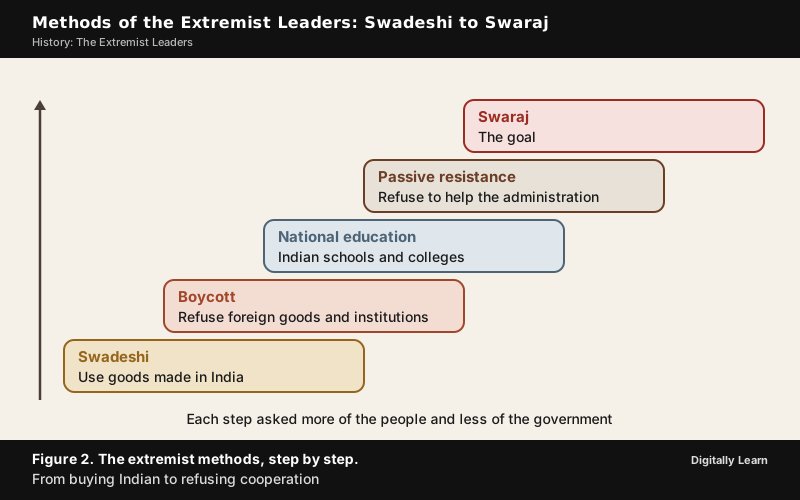
Swadeshi and Boycott: The Core Methods
The extremists agreed on two linked methods. Swadeshi meant using goods made in India and building Indian enterprise, and boycott meant refusing foreign goods and, in the wider form, British institutions. Foreign cloth was burnt in bonfires in the streets, and wearing cloth woven in India became a symbol of self-reliance. Priests refused to solemnise marriages involving foreign goods and washermen refused to wash foreign clothes.
Boycott went further than cloth. It targeted government schools, colleges and courts, but the impact there was limited because India's own institutions were not ready to offer a transition.
The idea of swadeshi was not entirely new. In 1886 Jamsetji Tata set up the Swadeshi Mills in Bombay, Indian businessmen started the Punjab National Bank in 1895, and in 1901 Prafulla Chandra Ray founded Bengal Chemicals and Pharmaceuticals. The extremists turned scattered examples into a national programme.
National Education and Self-Reliance
The extremists feared that English education was denationalising young Indians. In 1906 leading citizens created a National Council of Education and launched the Bengal National College, providing a genuinely Indian education with modern subjects rooted in Indian thought and values. Aurobindo was its first principal. After independence it was integrated into Jadavpur University. In Punjab Lajpat Rai's DAV schools and the National College at Lahore played a similar part.
Self-reliance, or atma shakti, meant a re-assertion of national dignity and confidence, and social and economic regeneration of the villages, including campaigns against caste oppression, early marriage, the dowry system and alcohol. The new forms of struggle were boycott, public meetings and processions, volunteer corps or samitis, traditional festivals and melas, self-reliance and national education.
At the Calcutta session of December 1906, with Dadabhai Naoroji as president, the Congress declared swaraj, swadeshi, boycott and national education to be its objectives. Swaraj was not defined; it could mean anything from self-rule inside the Empire to full independence.
Passive Resistance and Mass Mobilisation
Passive resistance, in the extremist sense, was the organised refusal of cooperation with the government. It was added to swadeshi, boycott and national education, and it carried the boycott from foreign goods to the institutions of British rule.
The press carried the method to the people. Kesari, Mahratta, Bande Mataram and Punjabee reached readers in their own languages, and public meetings, processions and volunteer samitis took the message to towns and villages. Passive resistance remained mostly an idea, because the movement did not build the organisation to put it into practice.
Cultural Symbols: Bharat Mata, Vande Mataram and the Revival
The extremists also drew on India's cultural and religious heritage to give the movement emotional depth. A theme in the speeches and writings of many Nationalists was Mother India or Bharat Mata, partly inspired by Bankim's Anandamath, which saw India as a divine motherland. In 1905 Abanindranath Tagore painted Bharat Mata. Songs such as Vande Mataram were sung in the street processions in Calcutta, and the authorities banned their public singing. Tilak used Shivaji and Ganesh, Lajpat Rai the Arya Samaj, Aurobindo the language of spirit, and the Hindu Mela had already shown in 1867 that sports, crafts and songs could build a feeling of nationhood.
In this way the nineteenth-century revival of pride in India's past supplied the material from which an assertive national identity and a demand for swaraj were built. That is the direct link between the "Indian Renaissance" and the national movement.
Surat Split of 1907: Extremists and Moderates Part Ways
The Road to Surat: Banaras 1905 and Calcutta 1906
The quarrel between the two wings grew in stages. At the Banaras session of 1905 under Gokhale, the Extremists wanted to carry boycott and swadeshi beyond Bengal and to widen boycott to government service, courts and councils, and the Moderates wanted strictly constitutional methods. A mild compromise resolution averted a split for the time being.
At Calcutta in December 1906 the Extremists wanted Tilak or Lajpat Rai as president, while the Moderates proposed Dadabhai Naoroji, whom all Nationalists respected. Naoroji was elected, and the goal of the Congress was defined as swarajya, or self-government like that of the United Kingdom or the self-governing colonies. The word swaraj thus appeared in a Congress resolution for the first time. The British were alarmed, and pressed some Moderate leaders to step back from the Calcutta resolutions.
The Moderates were encouraged by news that council reforms were coming, and decided to tone down the Calcutta programme. The two sides headed for a showdown.
The Split at Surat, December 1907
The Extremists wanted the 1907 session at Nagpur, with Tilak or Lajpat Rai as president and the Calcutta resolutions repeated. The Moderates moved it to Surat, in Tilak's home province of Bombay, because a leader of the host province could not be president. They backed Rash Behari Ghosh for president and wanted to drop the resolutions on swadeshi, boycott and national education.
At the session on 26‑27 December 1907, Tilak was prevented from speaking, and chaos broke out. The Nationalist camp led by Tilak, Lajpat Rai and Aurobindo had to leave and hold its own session. Rash Behari Ghosh presided over a Congress that reaffirmed self-government within the British Empire by constitutional methods.
| Issue | Moderates (Naram Dal) | Extremists (Garam Dal) |
|---|---|---|
| Goal | Self-government within the British Empire | Swaraj, understood by Aurobindo as complete independence |
| Method | Petition, deputation, constitutional agitation | Swadeshi, boycott, national education, passive resistance |
| Candidate for president at Surat | Rash Behari Ghosh | Tilak or Lajpat Rai |
| Venue wanted for 1907 | Surat | Nagpur |
| Extent of the movement | Bengal only | All of India |
The government used the split. Between 1907 and 1911 five new laws were passed against anti-government activity, including the Seditious Meetings Act of 1907, the Indian Newspapers (Incitement to Offences) Act of 1908, the Criminal Law Amendment Act of 1908 and the Indian Press Act of 1910. Tilak went to Mandalay and Aurobindo withdrew to Pondicherry; Lajpat Rai left for abroad a few years later. The Moderates were left with no popular base. The split was healed only at the Lucknow session of 1916.
Assessment of the Extremist Leaders: Achievements and Limits
What the Extremist Leaders Achieved
The extremists gave the idea of independence the central place in Indian politics. Aurobindo's argument was that political freedom comes before social, educational or industrial reform. They raised patriotism from a level of "academic pastime" to one of "service and sacrifice for the country", and they stressed mass participation and the need to broaden the social base of the movement, which was a progressive improvement on Moderate politics.
They also supplied the techniques of later movements, among them boycott, swadeshi, passive resistance, a fearless press, the use of cultural symbols and the willingness to go to prison. Non-cooperation, the filling of British jails, social reform and constructive work, all tried in the Swadeshi years, returned in Gandhian politics.
They changed what the Congress demanded. The Calcutta session of 1906 made swaraj its objective, and in December 1929 the Lahore session passed the resolution for Purna Swaraj, a demand that Aurobindo had raised in Bande Mataram two decades earlier.
Limits: Hindu Idiom, Weak Organisation and a Narrow Base
The extremists' weaknesses were as clear as their gifts. The Swadeshi movement had died down by 1908. Repression was severe, the movement had no effective organisation or party structure, its leaders were arrested or retired, Surat magnified its internal quarrels, its base was confined to the upper and middle classes and zamindars, and passive resistance and non-cooperation remained ideas.
The ideology lacked consistency, too. Its leaders gave swaraj different meanings, as Tilak's and Aurobindo's readings show. The politically progressive extremists were socially conservative. Tilak opposed the Age of Consent Bill, though his main objection was that such reforms must come from a self-governing people and not under alien rule, and he organised the Ganesh and Shivaji festivals as national festivals and supported the anti-cow-killing campaigns. Pal and Aurobindo spoke of a Hindu nation and Hindu interests. These revivalist tactics were directed against the foreign rulers, yet they promoted an unhealthy relationship between politics and religion.
From the Extremists to Gandhi
The Swadeshi movement of 1905‑07 broadened the Congress's appeal among the middle classes and brought Tilak, Pal and Lajpat Rai to the front of national politics.
By 1908 the open phase of the movement was over, and with Tilak in Mandalay the national movement declined for a time. On his release in 1914 Tilak picked up the threads, launched the Home Rule League and rejoined the Congress at Lucknow in 1916. The next phase of mass politics came with Gandhi, who had returned to India in 1915 and who, with Tilak's death on 1 August 1920, became the undisputed mass leader of the Congress.
Key Dates of the Extremist Leaders
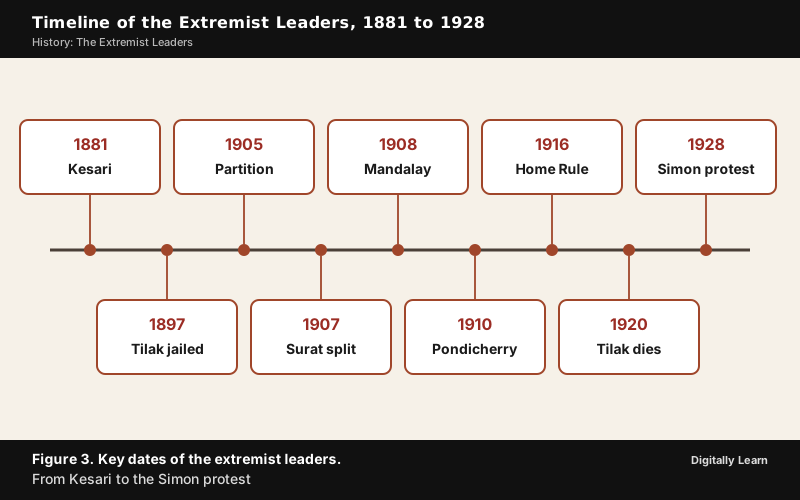
The careers of the four leaders ran across nearly half a century, from the founding of Kesari in 1881 to the Simon Commission protest of 1928.
| Year | Event |
|---|---|
| 1881 | Tilak starts Kesari (Marathi) and Mahratta (English) |
| 1894 | Tilak makes Ganesh worship a public festival |
| 1895 | Shivaji festival begun; Punjab National Bank founded at Lahore |
| 1897 | Chapekar brothers kill Rand; Tilak sentenced to 18 months |
| 1905 | Partition of Bengal; Bhawani Mandir published |
| 1906 | Bande Mataram launched; Bengal National College opens; Calcutta Congress adopts swaraj, swadeshi, boycott, national education |
| 1907 | Lajpat Rai and Ajit Singh deported to Mandalay (May); Surat Split (December) |
| 1908 | Muzaffarpur bomb (30 April); Aurobindo arrested (2 May); Tilak sentenced to six years in Mandalay |
| 1909 | Aurobindo acquitted in the Alipore case |
| 1910 | Aurobindo to Pondicherry |
| 1914 | Tilak released (16 June) |
| 1916 | Home Rule League (April); Lucknow Pact (December) |
| 1917 | Lajpat Rai founds the Home Rule League of America in New York |
| 1920 | Tilak dies (1 August); Lajpat Rai presides over the Calcutta Special Session |
| 1928 | Lajpat Rai injured (30 October) and dies (17 November) |
Previous Year UPSC‑CSE Questions
Each Prelims question is explained option by option, and each Mains question comes with an answer outline.
- UPSC Prelims 2018He wrote biographies of Mazzini, Garibaldi, Shivaji and Shrikrishna; stayed in America for some time; and was also elected to the Central Assembly. He was
How to approach this Prelims question
Approach: Take the three clues in turn. Biographies of Mazzini, Garibaldi, Shivaji and Shri Krishna are among Lajpat Rai's writings; he went to the United States in 1916 and stayed until 1920; and he was later elected to the Central Assembly. All three clues fit one man.
Trap to watch: Aurobindo and Pal also wrote and lived abroad, but neither wrote these biographies nor lived in America.
Why each option is right or wrong:
- (a) Aurobindo Ghosh: Wrong. His career ran through England, Baroda, Calcutta and Pondicherry, with no stay in America.
- (b) Bipin Chandra Pal: Wrong. His work was journalism and oratory; the biographies and the American stay are Lajpat Rai's.
- (c) Lala Lajpat Rai: Correct. The biographies, the American years and the Central Assembly are all his.
- (d) Motilal Nehru: Wrong. He is known for the Nehru Report of 1928, not for these biographies or a stay in America.
Answer: (c) Lala Lajpat Rai. The biographies, the American stay and the Central Assembly seat are all his.
- UPSC Prelims 2016What was the main reason for the split in the Indian National Congress at Surat in 1907?
How to approach this Prelims question
Approach: The split was an internal quarrel of the Congress over method and leadership. Test each option for whether it concerns that quarrel or something outside it.
Trap to watch: The Muslim League and the Morley-Minto reforms are near in time but outside the Congress quarrel.
Why each option is right or wrong:
- (a) Introduction of communalism into Indian politics by Lord Minto: Wrong. The Morley-Minto reforms came in 1909, two years after the split.
- (b) Extremists' lack of faith in the capacity of the moderates to negotiate with the British Government: Correct. The Extremists saw the Moderates as a drag on an aroused people, while the Moderates wanted to tone down the Calcutta programme.
- (c) Foundation of Muslim League: Wrong. The League was formed at Dhaka in December 1906, and the Surat quarrel was inside the Congress.
- (d) Aurobindo Ghosh's inability to be elected as the President of the Indian National Congress: Wrong. The Extremists wanted Tilak or Lajpat Rai as president, not Aurobindo.
Answer: (b) Extremists' lack of faith in the capacity of the moderates to negotiate with the British Government. The split came from the Extremists' distrust of Moderate methods.
- UPSC Prelims 2015Which one of the following movements has contributed to a split in the Indian National Congress resulting in the emergence of 'moderates' and 'extremists'?
How to approach this Prelims question
Approach: The split at Surat came in 1907, so the movement must belong to the years just before it.
Trap to watch: The later Gandhian movements are well known but came decades after 1907.
Why each option is right or wrong:
- (a) Swadeshi Movement: Correct. The movement of 1905‑07 divided the two wings over how far boycott should go, ending at Surat.
- (b) Quit India Movement: Wrong. It was launched in August 1942.
- (c) Non-Cooperation Movement: Wrong. It followed the First World War and Gandhi's return, long after 1907.
- (d) Civil Disobedience Movement: Wrong. It began with the Salt March in 1930.
Answer: (a) Swadeshi Movement. The Swadeshi Movement of 1905‑07 came just before the split; the other movements came decades later.
- UPSC Prelims 2013The people of India agitated against the arrival of Simon Commission because
How to approach this Prelims question
Approach: The question says agitation against the arrival, so the cause must be known before the Commission reported. It came to study constitutional reform without a single Indian member, and the slogan Simon Go Back followed.
Trap to watch: Options (b) and (d) are about what the Commission recommended, which came only after the protests began.
Why each option is right or wrong:
- (a) Indians never wanted the review of the working of the Act of 1919: Wrong. The objection was to who was reviewing, not to the review.
- (b) Simon Commission recommended the abolition of Dyarchy in the Provinces: Wrong. The protests began when it reached Bombay on 3 February 1928, before it had reported.
- (c) there was no Indian member in the Simon Commission: Correct. The all-white Commission was the cause of the protests.
- (d) the Simon Commission suggested the partition of the country: Wrong. The protests began on its arrival, before any report.
Answer: (c) there was no Indian member in the Simon Commission. An all-white Commission had been sent to review India's constitution, and that drew the protests.
- UPSC Prelims 2008Who among the following gave a systematic critique of the moderate politics of the Indian National Congress in a series of articles entitled New Lamps for Old?
How to approach this Prelims question
Approach: Ask who attacked Moderate politics from inside the nationalist camp. The critique of the cautious politics of the early Congress came from the new, militant side, and its author was Aurobindo, then in Baroda.
Trap to watch: R. C. Dutt was a critic of British economic policy, not of the Moderate Congress.
Why each option is right or wrong:
- (a) Aurobindo Ghosh: Correct. He wrote New Lamps for Old, a systematic critique of the Moderate Congress.
- (b) R. C. Dutt: Wrong. He was a historian who traced the drain of wealth from India in his Economic History of India; New Lamps for Old is not his.
- (c) Syed Ahmad Khan: Wrong. He campaigned against the Congress and founded the All India Muhammadan Educational Conference in 1886 as a separate platform, so he was no critic of its method from inside the nationalist camp.
- (d) Viraraghavachari: Wrong. He was a founder of the Madras Mahajan Sabha, an early Moderate association.
Answer: (a) Aurobindo Ghosh. He wrote New Lamps for Old, a critique of Moderate politics from the militant side.
- UPSC Prelims 1998Assertion and Reason:
- Assertion (A): Partition of Bengal in 1905 brought to an end the Moderates' role in the Indian freedom movement.
- Reason (R): The Surat session of Indian National Congress separated the Extremists from the Moderates.
How to approach this Prelims question
Approach: Judge A and R one at a time. The Partition made the Extremists strong, but it did not end the Moderates' role. After Surat the Moderates dominated the Congress and reaffirmed self-government within the Empire, so A is false. Surat did separate the Extremists from the Moderates, so R is true.
Trap to watch: R is true and sounds like an explanation, which tempts (a).
Why each option is right or wrong:
- (a) Both A and R are true, and R is the correct explanation of A: Wrong. A is false.
- (b) Both A and R are true, but R is NOT a correct explanation of A: Wrong. A is false.
- (c) A is true, but R is false: Wrong. R is true and A is false, the reverse.
- (d) A is false, but R is true: Correct. The Moderates kept the Congress after Surat, and Surat did divide the two wings.
Answer: (d) A is false, but R is true. After Surat the Moderates dominated the Congress, so the Partition did not end their role, while Surat did divide the two wings.
- UPSC Prelims 1998What is the correct sequence of the following events?
- I. Tilak's Home Rule League
- II. Kamagatamaru Incident
- III. Mahatma Gandhi's arrival in India
Select the correct answer using the codes given below:
How to approach this Prelims question
Approach: Date each event. The Komagata Maru passengers were refused entry at Vancouver in May 1914 (II); Gandhi returned to India in 1915 (III); Tilak founded his Home Rule League in April 1916 (I). The order is II, III, I.
Trap to watch: Students who place Tilak's League of 1916 before Gandhi's return in 1915 pick (c), II, I, III.
Why each option is right or wrong:
- (a) I, II, III: Wrong. It puts the League of 1916 first.
- (b) III, II, I: Wrong. Gandhi's return in 1915 comes after the Komagata Maru incident of 1914.
- (c) II, I, III: Wrong. It puts the League of 1916 before Gandhi's return in 1915.
- (d) II, III, I: Correct. 1914, 1915 and 1916.
Answer: (d) II, III, I. The Komagata Maru incident came in 1914, Gandhi returned in 1915 and Tilak's League followed in 1916.
- UPSC Mains 2019 GS‑IExamine the linkages between the nineteenth century's 'Indian Renaissance' and the emergence of national identity.
Answer outline
The outline sets out what the question asks, the main arguments, relevant examples and the direction of the conclusion; it is not a full model answer.
Introduction: The nineteenth-century revival restored self-respect and a sense of a shared past.
Body (sub-themes to develop):
- Early institutions: The Hindu Mela of 1867 and Rajnarayan Basu's society for national feeling.
- Revival into politics: Tilak's Ganesh and Shivaji festivals, Lajpat Rai's Arya Samaj and DAV schools, Aurobindo's Bhawani Mandir and Bande Mataram.
- Symbols: Bharat Mata, Anandamath and Vande Mataram gave the movement its emotional identity.
- The cost: An identity in largely Hindu symbols kept Muslims away; the Muslim League was formed in 1906.
Conclusion: The revival supplied the self-respect on which the demand for swaraj was built; later leaders had to widen the identity.
Sources
- NCERT: Exploring Society, India and Beyond (Class 8), India's Long Road to Independence
- NCERT: Exploring Society, India and Beyond (Class 8), Part I, The Colonial Era in India
- NCERT: Themes in Indian History (Class XII), Mahatma Gandhi and the Nationalist Movement
- Press Information Bureau: Lokmanya Tilak, Swaraj to Self-Reliant India (2020)
- Prime Minister of India: Address at the Akhil Bharatiya Marathi Sahitya Sammelan (2025)
- President of India: Address at Puducherry on Sri Aurobindo's 150th birth anniversary
- Wikipedia: Bal Gangadhar Tilak
- Wikipedia: Kesari (Marathi newspaper)
- Wikipedia: Lala Lajpat Rai
- Wikipedia: 1907 Punjab unrest
- Wikipedia: Surat Split
- Wikipedia: Simon Commission
- Wikipedia: Bipin Chandra Pal
- Wikipedia: Political history of Sri Aurobindo
- Wikipedia: Bande Mataram (publication)
- Wikipedia: Sri Aurobindo
- Wikipedia: Emperor v. Aurobindo Ghosh and Others
- Wikipedia: Rajnarayan Basu
- Wikipedia: Hindu Mela
- Wikipedia: Ashwini Kumar Dutta
- Wikipedia: Sardar Ajit Singh
- Wikipedia: Garam Dal
- Wikipedia: Komagata Maru incident
- UPSC: Civil Services Examination question papers
Editorial Disclaimer
This article uses the current NCERT textbooks and the other sources listed under Sources. Where NCERT and other accounts differ on a date, NCERT's is given first.
See more of our UPSC articles in Google Search
Add to Preferred Sources