


Overview
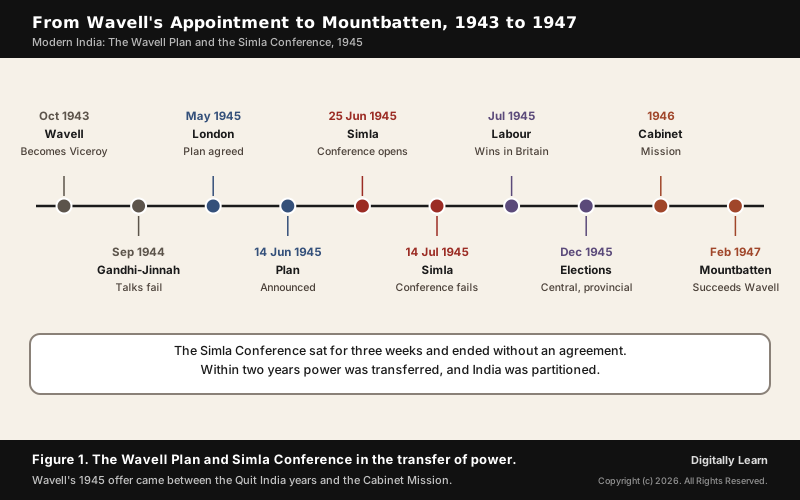
The Wavell Plan was the British offer of 14 June 1945, announced by the Viceroy, Lord Wavell, to reconstitute the Viceroy's Executive Council so that every member except the Viceroy and the Commander-in-Chief would be Indian, with parity between caste Hindus and Muslims. To settle the names, Wavell called Indian leaders to the Simla Conference (25 June to 14 July 1945), which failed when the Muslim League insisted on nominating every Muslim member.
Wavell Plan 1945 at a Glance
What Was the Wavell Plan: Date, Proposals and Outcome
The Wavell Plan was a proposal to give Indians control of the central government during the last months of the Second World War, without deciding India's future constitution. It was made public on 14 June 1945 by Leo Amery, the Secretary of State for India, in the House of Commons, and by Wavell in a broadcast from Delhi. The key facts are few and are asked often:
| Question | Answer |
|---|---|
| Announced | 14 June 1945, by Amery in the House of Commons and by Wavell in a broadcast from Delhi |
| Proposed by | Lord Wavell, Viceroy of India from October 1943 |
| Core proposal | An Executive Council of Indians, except the Viceroy and the Commander-in-Chief |
| Communal formula | Equal numbers of caste Hindus and Muslims (parity) |
| Conference | Simla Conference, Viceregal Lodge, 25 June to 14 July 1945 |
| Outcome | Failed over the Muslim League's claim to nominate all Muslim members |
| What followed | Labour government, elections of 1945-46, the Cabinet Mission of 1946 |
Background to the Wavell Plan: Wartime Deadlock, 1943 to 1945
Lord Wavell as Viceroy After the Quit India Movement
Archibald Wavell, a Field Marshal who had been Commander-in-Chief in India, replaced Lord Linlithgow as Viceroy in October 1943. India was in crisis. The Congress leaders had been in jail since the Quit India Movement of August 1942, Bengal was in the grip of famine, and Japanese forces stood on the eastern border. One of Wavell's first acts was to order the army to carry relief to the famine districts of Bengal.
Wavell believed that Indian support for the war could be won only with a clear political promise. He urged Winston Churchill, the Prime Minister, to promise Dominion status after the war, and Churchill refused. In May 1944 Wavell released Gandhi from prison on medical grounds, after his health had broken down there. As late as December 1944 Churchill's war cabinet rejected Wavell's proposals for reform.
The Gandhi-Jinnah Talks of 1944 and Why Britain Moved in 1945
The first attempt to break the deadlock came from Indian leaders themselves. C. Rajagopalachari put forward a formula that accepted the Muslim right to a separate homeland, and on 9 September 1944 Gandhi met Jinnah at Jinnah's house on Malabar Hill in Bombay. Meetings and letters went on through September, but nothing came of them. Wavell summed up the gap: Gandhi wanted independence first and a communal settlement afterwards, and Jinnah wanted the communal question settled first.
By mid-1945 the British had reasons to act. The war in Europe ended in May 1945, and the Conservative government faced a general election in Britain that summer and wanted to be seen seeking a settlement. Wavell went to London in May 1945; the talks there produced a definite plan, and the Congress Working Committee members were released in June 1945 so that they could take part.
Proposals of the Wavell Plan: The Reconstituted Executive Council
Main Provisions of the Wavell Plan
The plan dealt with the Viceroy's Executive Council, the body of members who ran the departments of the Government of India under the Viceroy. It did not create a new constitution; the reconstituted council was to work as an interim government within the framework of the Government of India Act, 1935. Its main proposals were these:
- The Executive Council would be reconstituted at once, with more members.
- Every member except the Viceroy and the Commander-in-Chief would be Indian.
- Caste Hindus and Muslims would have equal representation on the council.
- An Indian would hold Foreign Affairs, and a British commissioner would look after trade matters.
- Defence would remain in British hands until power was finally transferred.
- The Viceroy would call a meeting of Indian leaders, including the Congress and the Muslim League, to nominate the members.
- If the plan worked at the centre, similar councils of local leaders would be formed in the provinces.
- Nothing in the plan would prejudice the form of India’s future permanent constitution.
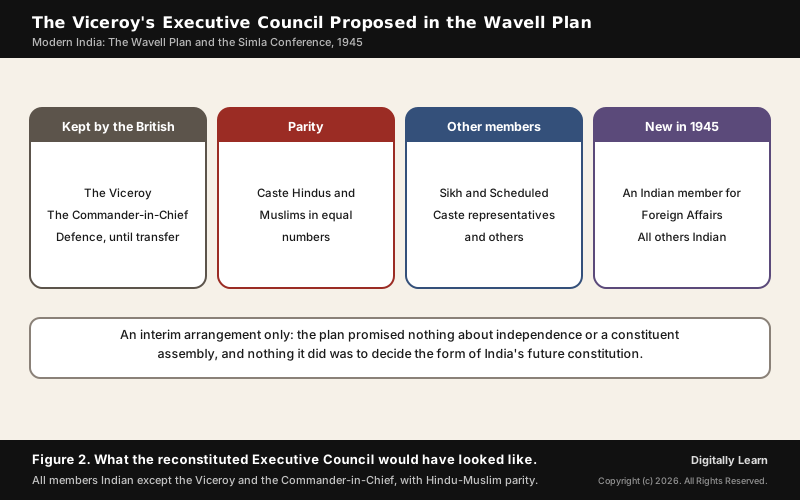
Two points explain the plan. First, it was an interim measure: a wartime government of Indians until a constitution was agreed. Second, the council would still be responsible to the Viceroy, not to the Central Legislative Assembly, so it gave Indians office without full self-government.
Parity Between Caste Hindus and Muslims and the Criticism of the Plan
The plan proposed the complete Indianisation of the Executive Council, but it reserved seats by religion and caste instead of letting parties nominate members of all communities. The formula of parity between caste Hindus and Muslims was its most debated feature. Gandhi resented the phrase "caste Hindus", and the Congress objected that the plan tried to reduce it to a purely caste Hindu party when it claimed to speak for Indians of every community.
- No promise of independence: The plan contained no guarantee that India would be free.
- No constituent assembly: It said nothing about a body to frame the future constitution.
- No division of power: It made no proposal on how power would be shared among India’s parties.
- Communal seats: Reserving seats by religion and caste treated the Congress as one community among many.
The Simla Conference of 1945: Venue, Leaders and Proceedings
Shimla Conference Date and Venue: Viceregal Lodge, 25 June to 14 July 1945
The Simla Conference met from 25 June to 14 July 1945 at the Viceregal Lodge in Shimla, then the summer capital of British India. The lodge had been built as a home for Lord Dufferin, Viceroy from 1884 to 1888, and housed every Viceroy after him; today it houses the Indian Institute of Advanced Study.
A wide range of leaders came to Shimla. The Congress was represented by its president, Maulana Abul Kalam Azad, with Jawaharlal Nehru and others; the League by Jinnah and Liaquat Ali Khan; and there were Master Tara Singh for the Sikhs, Bhulabhai Desai, C. Rajagopalachari, Rajendra Prasad and G. B. Pant. Gandhi met Wavell at the lodge before the conference opened.
- 24 June: Wavell met Azad, Gandhi and Jinnah separately to judge their positions.
- 25 June: Wavell opened the conference at 11 am. Azad spoke of the Congress’s non-communal character; Jinnah answered that it was a mainly Hindu body, and Wavell had to calm the exchange.
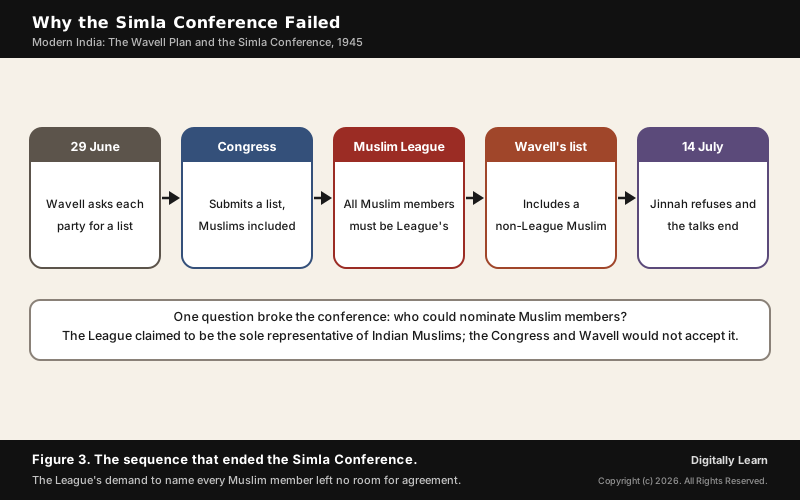
- 29 June: Wavell asked each party for a list of names for the new council. Azad agreed; Jinnah would not submit one before consulting the League’s Working Committee.
- 14 July: After an adjournment, the conference ended without agreement.
Why the Simla Conference Failed: The Muslim League's Demand
The conference broke on a single question: who could nominate the Muslim members of the council. The Muslim League claimed to be the sole representative of Indian Muslims and would not accept a council in which the Congress named Muslims too. The League also feared that the other minorities would side with the Congress and leave it a one-third minority on the council.
During the adjournment Wavell met Jinnah on 8 July. Jinnah was determined that all the Muslim members come from the League and called the Congress's Muslim representatives "show boys". Wavell's letter was placed before the League's Working Committee on 9 July, and Jinnah replied that without an assurance that every Muslim member would be a League nominee, the League could not submit a list.
Wavell then drew up his own list of fourteen, including himself and the Commander-in-Chief, and sent it to Amery:
| Group | Wavell's names |
|---|---|
| Muslim League | Liaquat Ali Khan, Khawaja Nazimuddin, Chaudhry Khaliquzzaman, Eassak Sait |
| Non-League Muslim | Muhammad Nawaz Khan, a Punjabi landlord |
| Caste Hindus | Jawaharlal Nehru, Vallabhbhai Patel, Rajendra Prasad, M. S. Aney, B. N. Rau |
| Sikhs | Tara Singh |
| Scheduled Castes | B. R. Ambedkar |
| Christians | John Mathai |
Jinnah refused to let any League member join unless the League's right to name all Muslims was accepted. Wavell found that demand impossible, told Gandhi that the talks had failed, and closed the conference on 14 July 1945.
Consequences of the Failed Simla Conference
Wavell's Decision and the Muslim League's Veto
By ending the talks when the League refused, Wavell in effect gave the Muslim League a veto: no settlement could now go ahead without Jinnah's consent. The episode strengthened the League, whose claim to speak for all Muslims had held the whole conference up, and it raised Jinnah's standing before the elections that followed.
The failure at Shimla is often described as perhaps the last viable opportunity for a united, independent India. That judgement explains why the Simla Conference is taught as a turning point: after July 1945 the question was increasingly not whether India would be free, but whether it would be one country or two.
Elections of 1945-46 and the Cabinet Mission
Britain changed government within weeks. A Labour government came to power in July 1945 and committed itself to granting India independence. On 19 September 1945 Wavell announced elections to the central and provincial legislatures, to be held from December 1945 to January 1946. The results showed how far politics had polarised:
| Election | Congress | Muslim League |
|---|---|---|
| Central Legislative Assembly, December 1945 | 57 of the 102 elected seats | Every Muslim constituency |
| Provincial legislatures, early 1946 | About 90 per cent of general seats | About 87 per cent of Muslim seats |
In February 1946 naval ratings of the Royal Indian Navy rose against the British at Bombay, and the revolt spread to Karachi and Calcutta before the sailors surrendered. The next month a Cabinet Mission of three ministers, Lord Pethick-Lawrence, Sir Stafford Cripps and A. V. Alexander, arrived on 24 March 1946 to plan the transfer of power. Distrust between the Congress and the League defeated its plan as well.
Wavell's Breakdown Plan and His Replacement by Mountbatten
Wavell came to believe that the best that could be done was a Breakdown Plan: the British would withdraw from India in stages, with India independent by 31 March 1948. The Labour Prime Minister, Clement Attlee, lost confidence in him, and in February 1947 Wavell was replaced as Viceroy by Lord Mountbatten, who announced that British India would be freed but also divided.
| Aspect | Wavell Plan (1945) | Cabinet Mission Plan (1946) |
|---|---|---|
| Made by | Viceroy Wavell with the Conservative government | Three Cabinet ministers sent by the Labour government |
| Aim | An interim all-Indian Executive Council | A constitution and a united federal India |
| Communal formula | Parity of caste Hindus and Muslims | Groups of provinces under a federal union |
| Where it broke | League's claim to nominate all Muslims | Congress-League distrust over the scheme |
Wavell Plan in UPSC Previous Year Questions
What UPSC Has Asked About the Wavell Plan and Simla Conference
UPSC's objective questions on this topic test two things: the parity rule of the Wavell Plan and the Viceroy who presided at Shimla. Both traps are simple once the dates are fixed, since Mountbatten arrived only in 1947. The Mains question asks how British policy complicated the transfer of power in the 1940s, and the Wavell Plan supplies evidence for it: seats reserved by religion and caste, and talks ended on the League's refusal.
| Year | What the question asked | The point being tested |
|---|---|---|
| 2005 | Whether Mountbatten was Viceroy at the Shimla Conference, and where the naval revolt of 1946 took place | Wavell was Viceroy; the revolt was at Bombay and Karachi |
| 2007 | Parity of Hindu and Muslim members, with the claim that parity would avoid partition | The parity rule is true; the claimed motive is false |
| 2019 Mains | The British role in complicating the transfer of power in the 1940s | Parity, the League's veto and delay as evidence |
Previous Year UPSC-CSE Questions
Previous Year UPSC-CSE Questions By the end you will be able to draft model answers for the following UPSC questions. Each question carries a collapsible framework showing how to approach it in the exam.
- UPSC Mains 2019 GS-IAssess the role of British imperial power in complicating the process of transfer of power during the 1940s.
How to structure the answer in the exam
Introduction: Open with the 1940s as the decade in which Britain accepted it would leave but not how.
Body (sub-themes to develop):
- Delay: Churchill's refusal of a Dominion promise and the wartime deadlock to 1945.
- Communal framing: parity of caste Hindus and Muslims in the Wavell Plan.
- The League's veto: ending the Simla Conference when Jinnah refused.
- Shifting plans: Cabinet Mission groups, the Breakdown Plan, then Mountbatten and partition.
- Balance: Indian divisions, seen in the 1944 talks and the 1945-46 elections, also mattered.
Conclusion: Conclude that British policy did not create the divide but repeatedly deepened it.
- UPSC Prelims 2007 Prelims-GSAssertion and Reason:
- Assertion (A): According to the Wavell Plan, the number of Hindu and Muslim members in the Executive Council were to be equal.
- Reason (R): Wavell thought that this arrangement would have avoided the partition of India.
How to approach this Prelims question
Approach: Judge the assertion and the reason separately, then ask whether one explains the other.
Trap to watch: The parity rule is real, which tempts option (a); the motive given in the reason is not in the plan.
Key facts to recall:
- Parity of caste Hindus and Muslims on the Executive Council
- The plan said nothing in it would prejudice the future constitution
Answer signal: A true, R false: option (c).
- UPSC Prelims 2005 Prelims-GSConsider the following statements:
- Lord Mountbatten was the Viceroy when Shimla Conference took place.
- Indian Navy Revolt, 1946 took place when the Indian sailors in the Royal Indian Navy at Bombay and Karachi rose against the Government.
Which of the statements given above is/are correct?
How to approach this Prelims question
Approach: Fix the Viceroy for each event: Wavell for Shimla 1945, Mountbatten only from February 1947.
Trap to watch: Mountbatten is the famous last Viceroy, but he had not arrived by 1945.
Key facts to recall:
- Wavell was Viceroy from October 1943 to February 1947
- The naval revolt of February 1946 began at Bombay and spread to Karachi
Answer signal: Statement 2 only: option (b).
Sources
- NCERT: Themes in Indian History Part III (Class XII), Mahatma Gandhi and the Nationalist Movement
- Press Information Bureau: Rare Footage of 1945 Simla Conference now in NFAI collection
- Shimla District, Government of Himachal Pradesh: Indian Institute of Advanced Study
- Ministry of External Affairs: Simla Agreement, 2 July 1972 (treaty text)
- Wikipedia: Simla Conference
- Wikipedia: Archibald Wavell, 1st Earl Wavell
- Wikipedia: 1945 Indian general election
- Wikipedia: 1946 Indian provincial elections
- Wikipedia: Cabinet Mission
- Wikipedia: Royal Indian Navy mutiny
- Wikipedia: Simla Agreement
- UPSC: Civil Services Examination question papers
Editorial Disclaimer
This article is for UPSC and State PCS preparation. Verify dates and interpretations against NCERT and standard reference histories before relying on them.


