


Overview

The economic impact of British rule in India was the transformation of India into a colonial economy, one whose structure was decided by the interests of Britain. The impact of British rule on the Indian economy differed from that of earlier invaders: the British changed the structure of the economy and drained its wealth as tribute. The main effects of British rule in India were deindustrialisation, an impoverished peasantry, the commercialisation of agriculture, recurring famines and a steady drain of wealth to Britain.
From Company Rule to a Colonial Economy
India's Economy Before British Rule and the Colonial Economy
India was a leading manufacturing economy before British rule. Mughal India produced around 25 per cent of the world's industrial output in the early eighteenth century, and its exports to Europe included cotton textiles, silks, indigo, spices and peppers. Bengal was famous for its textiles, especially muslin.
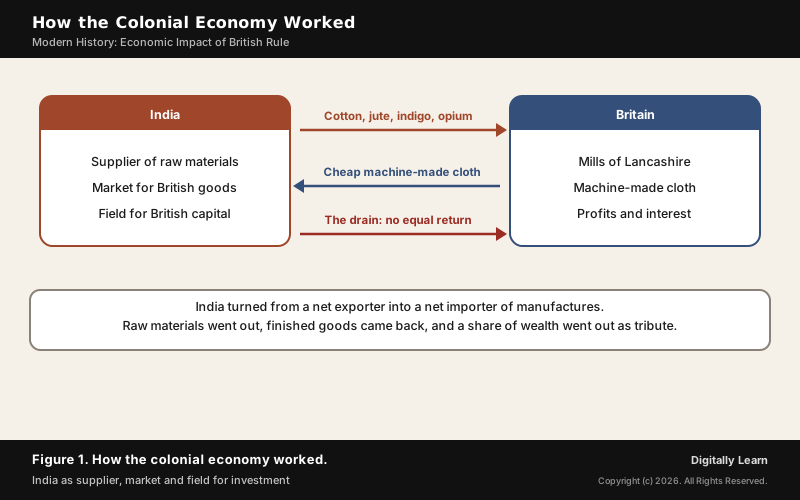
British rule changed the direction of this economy. In the words of the early nationalist economists, India was turned into a supplier of foodstuffs and raw materials to Britain, a market for British manufactures and a field for the investment of British capital. India's share of global manufacturing exports fell from 27 per cent to 2 per cent over the period of British rule.
Economic Impact of Company Rule in India, 1757 to 1858
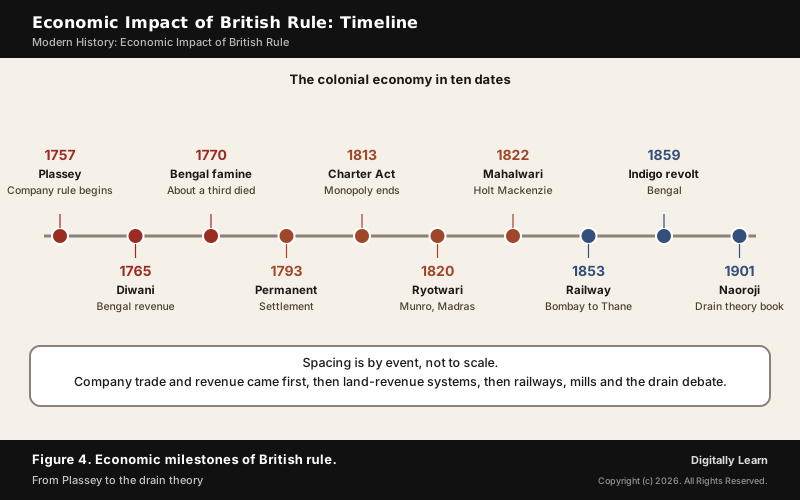
The economic impact of Company rule in India was to turn Bengal's revenue into the Company's trading capital, crush the artisans and push the countryside into crisis. The Company's rule began after the Battle of Plassey in 1757, and in 1765 the Mughal emperor made it the Diwan of Bengal.
- Revenue replaced bullion: Before, the Company bought Indian goods with gold and silver from Britain. The outflow of gold slowed after Plassey and stopped after the Diwani; now Indian revenue paid for Company purchases, troops and forts.
- Artisans squeezed: In Bengal, artisans were paid low wages and forced to sell their products at low prices.
- Crisis and famine: Artisanal production declined and agriculture showed signs of collapse. In 1770 a famine killed ten million people in Bengal, about one-third of the population.
- New revenue order: To secure revenue, the Company introduced the Permanent Settlement in 1793, and later the Ryotwari and Mahalwari systems.
- Monopoly ends, free trade begins: The Charter Act of 1813 ended the Company’s monopoly of Indian trade, except in tea and trade with China, and opened India to British goods.
Deindustrialisation and the Ruin of Indian Handicrafts
Deindustrialisation: Causes, Effects and the Ruin of Artisans
The decline of industrial activity in an economy is called deindustrialisation. In India it meant the ruin of artisans and handicraftsmen, and it came from several causes working together.
- One-way free trade: After the Charter Act of 1813 allowed one-way free trade for British citizens, cheap machine-made imports flooded the Indian market.
- Closed markets abroad: Indian products found it harder to enter Europe; after 1820 European markets were virtually closed to Indian exports.
- Railways: The new rail network carried European goods to the remotest corners of the country.
- Loss of patrons: Princes and nobles, the traditional buyers of fine goods, lost power and took to western tastes.
The scale shows in trade figures. The value of British textile imports into India grew from 5.2 million pounds in 1850 to 18.4 million pounds in 1896. Crucially, the loss of traditional livelihoods was not followed by industrialisation, as it was in other countries of the time, so India lost its industries just as Europe was industrialising.
Artisans who lost their trade had nowhere to go but the land. Many abandoned their professions, moved to villages and took to agriculture, which increased the pressure on land.
- Decline of cities: Many old manufacturing cities declined, and India went through a process of ruralisation.
- Overburdened agriculture: More people living off the same land became a major cause of poverty under British rule.
- Net importer: From being a net exporter of manufactured goods, India became a net importer.
The human cost was noticed even by British officials. Governor-General William Bentinck is quoted as saying that the misery hardly found a parallel in the history of commerce: "the bones of cotton weavers are bleaching the plains of north India".
Land Revenue Systems and the Impoverishment of the Peasantry
Permanent Settlement, Ryotwari and Mahalwari Systems
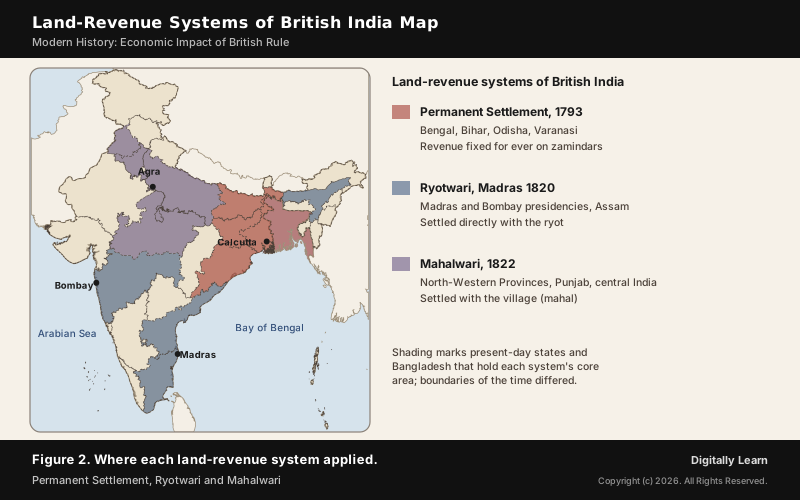
Land revenue was the government's main income, and the British built three systems to collect it. Each placed a different person between the state and the land.
| System | Introduced | Main areas | Revenue settled with |
|---|---|---|---|
| Permanent Settlement | 1793, Lord Cornwallis | Bengal, Bihar, Odisha, Varanasi | Zamindars, at a fixed amount for ever |
| Ryotwari | Tried by Alexander Read; developed by Thomas Munro, Madras Governor from 1820 | Madras and Bombay presidencies, Assam | The individual cultivator (ryot) |
| Mahalwari | 1822, Holt Mackenzie | North-Western Provinces, Punjab, parts of central India | The village or mahal as a unit |
Under the Permanent Settlement, rajas and taluqdars were recognised as zamindars, who collected rent from peasants and paid the Company a revenue fixed permanently. The revenue was so high that many zamindars could not pay, and their estates were auctioned: in 1797 several mahals of the Raja of Burdwan were sold.
The Company hoped a fixed demand would give it a regular flow of revenue and give zamindars a reason to invest. Instead, many zamindars fell into arrears, and in villages the rich peasants, the jotedars, consolidated their position while zamindars faced crisis. In the south, Munro gradually cut the Ryotwari rate from one-half to one-third of the gross produce, which was still an excessive tax; under Mahalwari the demand was revised periodically rather than fixed for ever.
Impoverishment of the Peasant and the Ruin of Old Zamindars
The government cared mainly about maximising rent and securing its share of revenue, and spent little on improving the land. Transferability of land made tenants insecure, and zamindars with new powers resorted to evictions, illegal dues and begar, forced labour.
- The triple burden: The peasant carried the government, the zamindar and the moneylender, and suffered most in times of famine and scarcity. This held in zamindari, Ryotwari and Mahalwari areas alike.
- The moneylender: Peasants borrowed to pay their dues; the moneylender, often also the grain merchant, forced them to sell produce at low prices.
- Ruin of old zamindars: By 1815, half the land in Bengal had passed into new hands. New zamindars turned to land-grabbing and sub-infeudation, which multiplied intermediaries and absentee landlordism.
- A case from Bengal: The once powerful rulers of Bishnupur were reduced to mere zamindars. The famine of 1770 swept away much of the population, and in 1806 the estate was sold for arrears of land revenue and bought by the Maharaja of Burdwan.
- Stagnant farming: With no means or incentive to invest, and land fragmented, productivity stayed low.
The new landlord class depended on British rule for its position, so its interests lay in the perpetuation of British rule and in opposing the national movement.
Commercialisation of Agriculture and Famines in British India
Commercialisation of Agriculture: Indigo, Cotton and the Deccan
In the latter half of the nineteenth century, agriculture began to be run on commercial considerations. Commercialisation of agriculture meant growing crops for sale in national and international markets rather than for the village: cotton, jute, groundnut, oilseeds, sugarcane and tobacco, and in plantations, tea, coffee, rubber and indigo, mostly owned by Europeans.
- What drove it: A money economy, a unified national market, better communications by rail and road, and British finance capital.
- Two systems of indigo: Under nij cultivation the planter grew indigo on land he controlled, with hired labour; less than 25 per cent of indigo land was under it. The rest was under the ryoti system.
- Indigo revolt: Planters forced ryots to sign contracts to grow indigo; in March 1859 thousands of ryots in Bengal refused, the start of the Indigo revolt, or Blue Rebellion. The Indigo Commission held the planters guilty of coercion.
- Cotton: When the American Civil War broke out in 1861, British mills turned to Indian cotton; prices rose, then crashed in 1866, bringing indebtedness, famine and the Deccan riots of the 1870s.
For most peasants commercialisation was a forced process. They had little surplus to invest, and it tied their fortunes to world prices. When prices fell, the cultivator was hit hardest, while the gains of good years went mostly to intermediaries.
Famines in British India: Causes and Scale
Famines recurred throughout British rule. They were not simply the result of a shortage of foodgrains; they followed from the poverty the colonial economy created. Between 1850 and 1900, about 2.8 crore people died in famines.
- Revenue collected regardless: In the 1770 Bengal famine, net revenue was kept up only because collection was violently kept to its former standard.
- Policy: Rack-renting, levies for war, free trade, the expansion of export agriculture and the neglect of agricultural investment made harvest failures deadly.
- Poverty: Ruined artisans and indebted peasants had no reserves when the rains failed.
- The record: The 1901 Famine Commission found twelve famines and four severe scarcities between 1765 and 1858.
| Famine | Region | Note |
|---|---|---|
| 1770 | Bengal | About ten million died, one-third of the population |
| 1876 to 1878 | Madras, Bombay, Mysore, Hyderabad, Punjab | Led to the Famine Commission under Richard Strachey, 1878 |
| 1943 | Bengal and Orissa | An estimated 0.8 to 3.8 million died, during the Second World War |
Drain of Wealth and the Nationalist Critique
The Drain of Wealth and the Home Charges
The economic drain was the portion of India's national product that was not available to its people but was sent to Britain for political reasons, without adequate economic or material return. Dadabhai Naoroji put forward the drain theory, set out in his 1901 book Poverty and Un-British Rule in India.
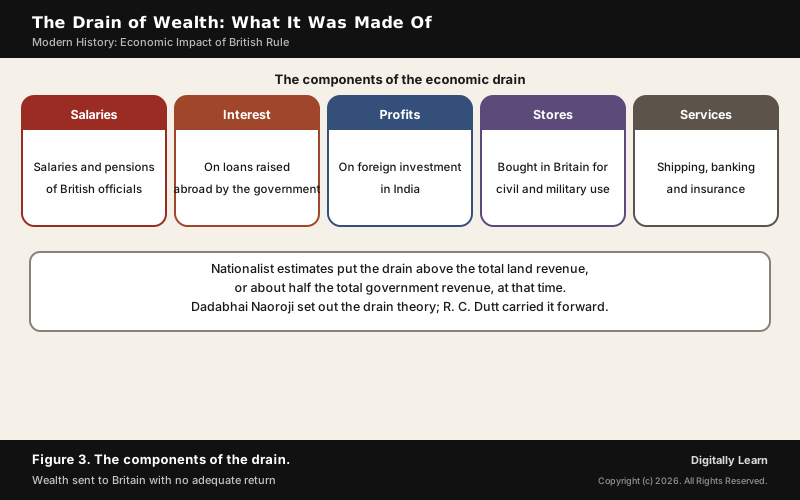
India paid for Britain's civil administration in India and for its Indian army in the form of the Home Charges. The drain checked capital formation in India while the same wealth accelerated the growth of the British economy; the surplus then came back into India as finance capital, draining it further.
Naoroji built the charge on official figures. In a paper, England's Duties to India, read on 2 May 1867, he calculated that the Home Charges alone had transferred about 100 million pounds from India to England since 1829, drawing on the Parliamentary Returns of Indian Accounts. His 1876 paper, Poverty of India, went into acreage, crop production, prices, imports and exports.
Nationalist Critique of the Colonial Economy
Early intellectuals first supported British rule, expecting it to modernise India. After the 1860s disillusionment set in. Dadabhai Naoroji, the Grand Old Man of India, led the analysis, joined by Justice M. G. Ranade, Romesh Chandra Dutt, author of The Economic History of India, and G. K. Gokhale.
- Poverty was man-made: India was poor and growing poorer because of British rule, so poverty was a national problem that could be explained and removed.
- Development meant industry: Industrialisation was to be based on Indian, not foreign, capital.
- Trade and railways: Foreign trade made India an exporter of raw materials and an importer of finished goods; railways brought a commercial, not an industrial, revolution.
- Size of the drain: Nationalist estimates put it above the total land revenue, or half the total government revenue, or about 8 per cent of the national product in today’s terms.
- Tax demands: They asked for lower land revenue, abolition of the salt tax, and income tax and excise on goods bought by the rich.
The critique was one of the stimulants of national consciousness in the moderate phase (1875 to 1905). It undermined the claim that foreign rule served Indian interests.
Railways and Modern Industry Under British Rule
Railways and the Rise of Modern Industry Under British Rule
Railways came first as a colonial tool. A line between Red Hills and Chintadripet in Madras, used for ferrying granite, became operational in 1837. The first passenger train in India ran in 1853, between Bombay and Thane, over 34 kilometres. With the government guaranteeing a five per cent return to private English companies, investment flowed in and the network grew fast.
The nationalists argued that railways were not planned around India's industrial needs. They helped foreign goods outsell Indian products, and the benefits of the steel, machinery and capital they used went to Britain. G. V. Joshi remarked that expenditure on railways should be seen as an Indian subsidy to British industries.
The railways also left monuments to the colonial economy. Bombay's Victoria Terminus, now Chhatrapati Shivaji Terminus and a UNESCO World Heritage Site, was built over ten years from 1878, and it became a symbol of Bombay as a major mercantile port city within the British Commonwealth.
Modern machine industry came only in the second half of the nineteenth century. The first cotton mill in Bombay came up in 1854 and went into production two years later, and the first jute mill in Bengal came up in 1855. Most modern industries were foreign-owned and run by British managing agencies. Foreign capital rushed in for high profits, cheap labour, cheap raw material and a ready market.
- Indian-owned industry: Cotton textiles and jute in the nineteenth century, sugar and cement in the twentieth.
- Handicaps: Credit problems, no tariff protection, unequal competition from foreign firms and opposition from British capital.
- Lopsided growth: Core and heavy industry and power were neglected, some regions were favoured, and technical education was weak.
- New classes: An industrial capitalist class and a working class emerged, though the colonial setting retarded an independent Indian bourgeoisie.
Previous Year UPSC-CSE Questions
Previous Year UPSC-CSE Questions By the end you will be able to draft model answers for the following UPSC questions. Each question carries a collapsible framework showing how to approach it in the exam.
- UPSC Mains 2014 GS-IExamine critically the various facets of economic policies of the British in India from mid-eighteenth century till independence.
How to structure the answer in the exam
Introduction: British rule turned India into a colonial economy, shaped by the interests of Britain rather than India.
Body (sub-themes to develop):
- Company rule: Diwani revenue replaced bullion; artisans squeezed; 1770 famine.
- Land settlements of 1793, 1820 and 1822; the peasant's triple burden.
- Charter Act 1813 and one-way free trade: deindustrialisation.
- Crown rule: railways, commercialisation, finance capital, the drain; slow modern industry.
Conclusion: Conclude that the policies served British interests, leaving a poor peasantry and a narrow industrial base.
- UPSC Mains 2022 GS-IWhy was there a sudden spurt in famines in colonial India since the mid-eighteenth century? Give reasons.
How to structure the answer in the exam
Introduction: Famines in colonial India followed from the poverty the colonial economy created, not from rainfall alone.
Body (sub-themes to develop):
- Revenue collected in full even in famine (Bengal 1770).
- Export agriculture and commercial crops displacing food crops.
- Deindustrialisation pushing artisans onto the land; no reserves.
- Free trade, war levies and neglect of agricultural investment.
Conclusion: Conclude that the famines became a powerful charge against British economic policy.
- UPSC Mains 2024 GS-IHow far was the Industrial Revolution in England responsible for the decline of handicrafts and cottage industries in India?
How to structure the answer in the exam
Introduction: Cheap machine-made goods from England's mills were the main blow to Indian handicrafts.
Body (sub-themes to develop):
- Machine-made imports after the Charter Act of 1813.
- Tariffs and closed European markets after 1820.
- Railways carrying British goods inland.
- Loss of courtly patrons; no industrialisation to absorb artisans.
Conclusion: Conclude that the Industrial Revolution acted through colonial trade policy; together they ruined handicrafts.
- UPSC Prelims 2011 Prelims-GSWith reference to the period of colonial rule in India, "Home Charges" formed an important part of drain of wealth from India. Which of the following funds constituted "Home Charges"?
- Funds used to support the India Office in London.
- Funds used to pay salaries and pensions of British personnel engaged in India.
- Funds used for waging wars outside India by the British. Select the correct answer using the codes given below:
How to approach this Prelims question
Approach: Match each fund to what the Home Charges covered.
Trap to watch: Wars outside India are not part of the answer.
Key facts to recall:
- India Office in London
- Salaries and pensions of British personnel
Answer signal: 1 and 2 only: option (b).
- UPSC Prelims 2018 Prelims-GSEconomically, one of the results of the British rule in India in the 19th century was the
How to approach this Prelims question
Approach: Pick the result that actually happened.
Trap to watch: Handicraft exports fell, and urbanisation did not rise rapidly.
Key facts to recall:
- Commercialisation in the latter half of the nineteenth century
Answer signal: Commercialization of Indian agriculture: option (c).
- UPSC Prelims 2012 Prelims-GSWith reference to Ryotwari Settlement, consider the following statements:
- The rent was paid directly by the peasants to the Government.
- The Government gave Pattas to the Ryots.
- The lands were surveyed and assessed before being taxed.
Which of the statements given above is/are correct?
How to approach this Prelims question
Approach: Test each feature of the Ryotwari Settlement.
Trap to watch: Direct payment to the government is the defining feature.
Key facts to recall:
- Revenue settled with the ryot
- Associated with Thomas Munro
Answer signal: 1, 2 and 3: option (c).
Sources and Further Reading
- NCERT: Our Pasts III (Class VIII), Ruling the Countryside
- NCERT: Themes in Indian History Part III (Class XII), Colonialism and the Countryside
- Wikipedia: Deindustrialization in India
- Wikipedia: Economy of India under Company rule
- Wikipedia: Economy of India under the British Raj
- Wikipedia: Permanent Settlement
- Wikipedia: Ryotwari
- Wikipedia: Mahalwari
- Wikipedia: Famine in India
- Wikipedia: Bengal famine of 1943
- Wikipedia: Indigo revolt
- Wikipedia: Dadabhai Naoroji
- Wikipedia: Romesh Chunder Dutt
- Wikipedia: Rail transport in India
- PIB: Dadabhai Naoroji, the man who brought statistics into politics (2017)
- UNESCO World Heritage Centre: Chhatrapati Shivaji Terminus (formerly Victoria Terminus)
- Bankura District, Government of West Bengal: History
- UPSC: Previous year question papers
Editorial Disclaimer
This article explains the economic impact of British rule in India for UPSC preparation, drawing on standard historical and economic sources. Figures and attributions reflect the cited authorities and the documented economic record. Readers should consult the linked sources for fuller treatment.


