


Overview
Jahangir (1569 to 1627), born Prince Salim, was the fourth Mughal emperor and ruled from 1605 to 1627. His reign is remembered for the Chain of Justice, the power of his empress Nur Jahan, the submission of Mewar and the loss of Qandahar, the first English factories and the high point of Mughal painting.
Jahangir: Early Life of Prince Salim and Accession to the Throne
Jahangir's Early Life: Father, Mother and Education of Prince Salim
Salim was born at Fatehpur Sikri on 31 August 1569, the son of the emperor Akbar and his consort Mariam-uz-Zamani, a Kachhwaha princess and daughter of the Rajput ruler of Amber. Two elder brothers had died in infancy, and Akbar had sought the blessing of the Sufi saint Salim Chishti of Sikri for a son; the boy was named after the saint.
His education began at the age of five. Tutors taught him Persian, Arabic, Turkish, Hindi, arithmetic, history, geography and the sciences, and Abdur Rahim Khan-i-Khanan was among them. He grew up fluent in Persian and Hindustani, with a sound knowledge of Turki, the ancestral language of the Mughals.
As a young prince he also commanded an army for his father and made the marriages that shaped the next reign.
- Orchha, 1594: Sent by Akbar against the rebel Bundela chief Vir Singh Deo, the prince subdued him; the Jahangir Mahal at Orchha was later built in his honour.
- Marriages: His first wife was a Kachhwaha princess of Amber, mother of Khusrau; a Rathor princess of Marwar, Jagat Gosain, was the mother of Shah Jahan.
Prince Salim's Revolt Against Akbar and Jahangir's Accession in 1605
The prince did not wait quietly for the throne. In 1599, while Akbar was campaigning in the Deccan, Salim declared himself emperor at Allahabad, struck coins in his own name and held his own court. Akbar chose reconciliation over punishment, and by 1604 father and son were at peace again.
Akbar died in October 1605, and Salim succeeded him on 3 November 1605, taking the title Jahangir, the World Seizer.
Khusrau's Rebellion of 1606 and the Execution of Guru Arjan
The new reign began with a revolt by the emperor's eldest son. In April 1606 Khusrau left Agra, claiming the throne on the strength of Akbar's wishes, and laid siege to Lahore. Jahangir relieved the city and defeated him at Bhairowal, and the prince was captured while crossing the Chenab. After a later plot he was blinded and kept a prisoner; he died at Burhanpur in 1622, killed on the orders of his brother Khurram.
The revolt drew in the Sikh Guru. Jahangir accused Guru Arjan, the fifth Sikh Guru and compiler of the Adi Granth, of supporting Khusrau, and ordered his execution in 1606. Jahangir already looked on the growing Sikh community around the Harmandar Sahib at Ramdaspur as a potential threat; the next Guru, Hargobind, was imprisoned at Gwalior for a time and later released.
Jahangir's Administration: Justice, Religious Policy and Memoir
Chain of Justice and the Twelve Orders of Jahangir
Jahangir wanted to be seen above all as a just king. The Chain of Justice was a golden chain hung with golden bells, as contemporary paintings show it. In his memoir he wrote that he had it made so that any subject denied justice at any level could appeal to the emperor himself, and the English ambassador Thomas Roe describes petitioners using it to draw the emperor's attention.
- Twelve orders: Issued at his accession; one forbade the making and sale of rice spirit and intoxicating drugs, and another set up free hospitals with physicians in the cities of the empire.
- Jharoka darshan: Each morning the emperor showed himself to his subjects at an east-facing balcony, the jharoka; Akbar made it a daily practice, and Jahangir kept it up punctiliously.
- Tobacco ban: Smoking spread quickly after 1604, and Jahangir banned it; the ban failed, and by the end of the century tobacco was grown and traded all over India.

Court painting gave the ideal of the just ruler an image. Abu'l Hasan's Emperor Jahangir Triumphing over Poverty, painted around 1620 to 1625, shows the emperor shooting at a human figure that stands for poverty, a device called allegory, in which an abstract idea is expressed through a person.
Jahangir's Religious Policy: Sulh-i-Kul and Its Limits
Jahangir kept his father's principle of sulh-i-kul, universal peace, which judged subjects by a common ethic of honesty, justice and peace rather than by religion. He described Akbar's policy in his own words, and Shah Jahan followed the same principle.
- Patronage: He made grants to the Chaitanya sect for temples at Vrindavan and appointed Srikant of Kashmir as a qazi, or judge, for the Hindus, so that they had a judicial officer of their own.
- Bans: Cow slaughter, and the killing of animals on certain days of the week, as under Akbar.
- Orthodox pressure: Nobles close to Ahmad Sirhindi pressed him to undo parts of Akbar's policy, and the conquest of Kangra was marked with Islamic rites.
The record is mixed, and his memoir is not a neutral witness. The execution of Guru Arjan and an order against Jain monks, soon withdrawn, sit beside grants to temples and close ties with Jain teachers. Jahangir wrote for a Persian-reading Muslim audience and presented himself in the memoir as a ruler opposed to idol worship, while in practice he generally continued his father's religious policy.
Tuzuk-i-Jahangiri: Jahangir's Memoir, the Jahangirnama
Like his great-grandfather Babur, Jahangir wrote his own memoir. The Tuzuk-i-Jahangiri, also called the Jahangirnama, is in Persian and covers his reign from 1605; he wrote it until 1622, after which Mu'tamad Khan and then Muhammad Hadi carried it on to his death in 1627.
- Natural history: Long descriptions of birds, animals and plants, with paintings ordered to go with them; a falcon sent by the ruler of Iran in 1619 was painted by Ustad Mansur.
- Economy: Notes such as the Banjaras carrying grain on their bullocks to sell in towns.
- Court and family: Ceremonies such as the weighing of Prince Khurram against gold, silver and other wealth.
- Experiments: He tested bitumen on a broken bone of a chicken and compared the air of Ahmadabad and Mahmudabad by how fast meat decayed.
The memoir belongs to a larger body of Persian writing. Akbar made Persian the language of the court and the official language of the empire, and it became the language of administration and of court culture, in which histories and poetry were written. The official chronicles were written at court about the emperor's reign: Abu'l Fazl's Akbarnama and, for Shah Jahan, the Padshahnama of the court historian Abdul Hamid Lahori, which gives most space to military campaigns while its paintings show life at court. Read with care, they show the spirit of the age, from the ideal of the just king and the court's ceremonial to its curiosity about the natural world and the policy of sulh-i-kul.
Nur Jahan: Jahangir's Wife and the Power Behind the Throne
Nur Jahan's Early Life: From Mehrunnisa to Padshah Begum
Nur Jahan was born Mehrunnisa in 1577 at Qandahar, while her family was travelling from Iran to seek service under Akbar. Her father, Mirza Ghiyas Beg, rose in Mughal service and received the title Itimad-ud‑Daula, Pillar of the State; she was educated in Arabic and Persian, literature, art and music.
- First marriage, 1594: To Ali Quli Istajlu, an Iranian officer given the title Sher Afgan; their daughter, Ladli Begum, was born in 1605. Sher Afgan was killed in 1607 in a clash with the governor of Bengal.
- Marriage to Jahangir, 1611: After four years at court as lady-in-waiting to Ruqaiya Sultan Begum, she married Jahangir on 25 May 1611 and became his last wife.
- Titles: First Nur Mahal, Light of the Palace, then Nur Jahan, Light of the World; from 1620 she held the rank of Padshah Begum, chief queen.
Nur Jahan's Power: Coins, Farmans and the Nur Jahan Junta
No Mughal empress before or after held such power. Jahangir struck silver coins with his own titles on one side and, on the other, the words "struck in the name of the Queen Begum, Nur Jahan". She issued her own orders, or farmans, under a seal that called her Nur Jahan Padshah Begum, and as Jahangir's health failed she came to decide many affairs of state herself.
Her family rose with her. Her father became chief minister and her brother Asaf Khan a leading noble, and historians call this group of relatives in high office the Nur Jahan junta. From 1611 the empress and her Persian relatives dominated politics at court, and Mughal women of the elite after her continued to exercise power, issue grants and influence political decisions.
Marriages tied the family to both rival princes, and in the end that divided it. Asaf Khan's daughter Mumtaz Mahal married Prince Khurram in 1612, and in 1621 Nur Jahan married her own daughter Ladli Begum to the youngest prince, Shahryar. In 1627 brother and sister backed different sons-in-law.
Nur Jahan's Patronage: Itimad-ud‑Daula's Tomb and Her Buildings
Nur Jahan built on a grand scale. When her father died in 1622, she raised a tomb for him and her mother on the eastern bank of the Yamuna at Agra, finished in 1628. She also built sarais for travellers, pleasure gardens and palaces in many parts of the empire.
- Itimad-ud‑Daula's tomb: One of the first Mughal buildings in white marble instead of red sandstone, with jali screens and pietra dura, inlay of cornelian, jasper, lapis lazuli, onyx and topaz set into the marble, among the earliest true examples in India; it is called the Baby Taj.
- Turning point in design: It marks the move from the red sandstone of Humayun's and Akbar's tombs towards the white marble and inlay of the Taj Mahal.
- Other works: The Pattar Masjid at Srinagar and a large sarai in Jalandhar district (1620).
After Jahangir's death she lived quietly at Lahore on an allowance from Shah Jahan, with her widowed daughter, and died in 1645. She is buried in the tomb she built for herself at Shahdara near Lahore, with her brother Asaf Khan's tomb nearby.
Jahangir's Wars, Frontiers and Rebellions
Jahangir's Campaigns: Mewar's Submission of 1615, Bengal and Kangra
Jahangir ended a century-long struggle with the Sisodiya house of Mewar. Rana Amar Singh, son of Maharana Pratap, kept up his father's resistance from the hills, and armies sent in 1606 and 1608 made no headway. In 1613 Jahangir came to Rajputana himself, and Prince Khurram pressed the campaign until Mughal posts were set up inside Mewar in 1614.
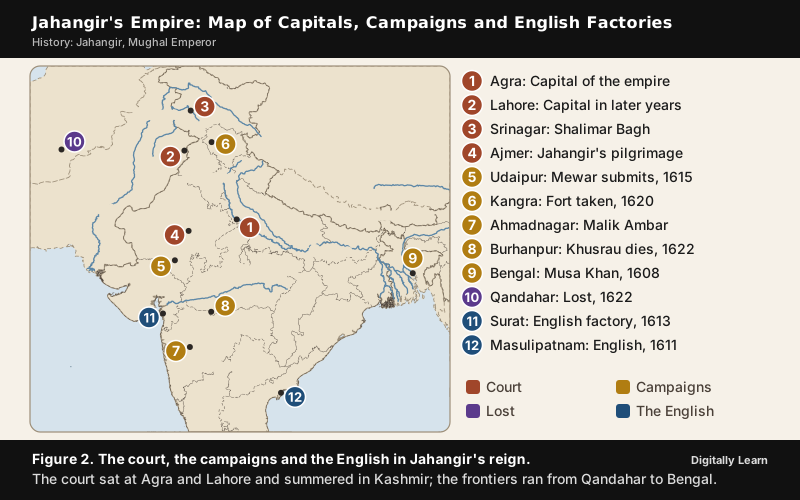
In 1615 Amar Singh agreed to meet Khurram and accepted Mughal service. As with the other Rajput houses, the terms were generous: Mewar accepted Mughal supremacy but kept its territory, and its ruling house received high rank in the nobility.
Jahangir's other campaigns filled out the edges of the empire rather than adding new provinces. Some succeeded and some did not.
- Bengal: From 1608 Islam Khan subdued Musa Khan, leader of the Baro-Bhuyan chiefs, and the Raja of Koch Bihar accepted Mughal overlordship.
- Kangra: The hill fort was besieged and taken in 1620, and the Raja of Chamba submitted; Kishtwar in Kashmir was conquered in the same year.
- The Ahoms: Campaigns against the Ahom kingdom of Assam made little headway.
Jahangir's Deccan Policy: Ahmadnagar and Malik Ambar
In the Deccan Jahangir carried on Akbar's campaigns with less success. Malik Ambar, born in Ethiopia and sold as a slave, rose to be Peshwa, or chief minister, and the real ruler of Ahmadnagar from 1600 to his death in 1626. His army by 1610 counted 10,000 Habshis and 40,000 Deccanis, and with guerrilla tactics he defeated the Mughal attempts on the kingdom for a decade.
- Malik Ambar's work: A revenue settlement of much of the Deccan, on which later settlements were based, and the founding of the city later called Aurangabad.
- Khurram in the Deccan: In 1616 Jahangir sent his favourite son, Prince Khurram, against Ahmadnagar, Bijapur and Golconda; on the prince's return in 1617, after successes there, Jahangir gave him the title Shah Jahan, King of the World.
- Jahangir's anger: The memoir never names Malik Ambar without abuse, and Abu'l Hasan painted Jahangir shooting arrows at Malik Ambar's head.
Loss of Qandahar in 1622: Jahangir and the Safavids
Qandahar mattered because of where it stood. The fortress city was a trading centre on the frontier between the Mughal Empire and Safavid Iran, and both empires wanted it: Humayun had given it to Iran in return for Safavid help in regaining his throne, and Akbar's forces took it back in the 1590s.
Relations with Shah Abbas began well. In 1613 an embassy under Khan Alam went to his court, and the two rulers exchanged rare gifts. In 1622 Shah Abbas besieged Qandahar himself. Jahangir was slow to respond, and the garrison of about 3,000 men surrendered after a siege of 45 days. Prince Khurram, asked to lead the relief from the Deccan, evaded the task and soon rose in revolt.
Jahangir's Sons at War: Shah Jahan's Rebellion and Mahabat Khan's Coup
The last years of the reign were shaped by the fight for the succession. Khurram, the emperor's favourite, saw in the marriage of Ladli Begum to Shahryar in 1621 a sign that Nur Jahan meant to make Shahryar the heir. The second son, Parviz, was weak and addicted to alcohol, so the real contest lay between Khurram and Shahryar. In 1622 Khurram rebelled, having first had his blind brother Khusrau killed; the general Mahabat Khan defeated him, and the civil war ended in 1625.
The victor then became a threat. Nur Jahan, wary of Mahabat Khan's new prestige, sent him to Bengal and summoned him to answer charges. In 1626 he struck first, seizing the emperor at his camp on the Jhelum with a force of Rajput soldiers. Nur Jahan tried to rescue her husband, then joined him in captivity and organised his escape, and the coup soon collapsed.
Jahangir and the English East India Company
William Hawkins and the First English Factories at Masulipatnam and Surat
The English East India Company reached the Mughal empire in Jahangir's reign. Its bases were called factories. A factory was not a place of manufacture but a trading post, where the Company's agents bought, stored and sold goods. Company ships came to Surat, the chief port of the Mughals, in 1608, and William Hawkins, captain of the Hector, travelled inland and reached Jahangir's court in 1609.
- Masulipatnam, 1611: The Company's first factory in India, on the Andhra coast; it remained the main English base on the east coast until the move to Madras after 1640.
- Battle of Swally, 1612: Captain Thomas Best's four ships beat a Portuguese squadron off Swally (Suvali) near Surat; during the talks the governor granted trading rights, subject to the emperor's approval.
- Surat, 1613: The Company set up its first permanent factory in India at Surat, with Mughal permission.
The Portuguese, long established on these seas, fought the English and also clashed with the Mughals. In 1613 they seized the Rahimi, a great pilgrim ship owned by Jahangir's mother, and Jahangir ordered Daman taken and the Portuguese in his empire arrested. The Dutch were close behind the English; in 1618 Jahangir issued a farman to the Dutch company in Gujarat allowing trade at Mughal ports.
Sir Thomas Roe at Jahangir's Court, 1615 to 1619
England's ambassador at Jahangir's court was Sir Thomas Roe, sent by King James I at the Company's request. He arrived in 1615 and stayed until 1619, and his journals are among the best sources for the reign.
- Gifts: Roe arrived with gifts that included many crates of red wine, and he is said to have become a favourite of the emperor.
- The result: Permission and protection for the Company's factory at Surat, though no major trading privileges.
- A test of painters: Jahangir had a European miniature copied several times and challenged Roe to pick out the original; Roe could not.
Art and Architecture Under Jahangir
Mughal Painting Under Jahangir: Portraits, Albums and Natural History
Mughal painting developed furthest under Jahangir, and its character changed. Akbar's studio had worked mainly on illustrated books, with several artists sharing a manuscript; Jahangir preferred single paintings collected in albums, or muraqqa, and portraits, studies of birds, animals and flowers, and scenes from his own life.
- Ustad Mansur: Master of natural history, given the title Nadir-al‑Asr, Unequalled of the Age; he made the earliest colour painting of the dodo and the first of the Siberian crane.
- Abu'l Hasan: The leading painter of political allegory, given the title Nadir-uz-Zaman, Wonder of the Age; Jahangir counted him and Ustad Mansur as his finest artists.
- Bishandas: Went with the embassy to Iran in 1613 and painted Shah Abbas from life.
- European influence: Portraits and paintings sent from England, and single-point perspective, taken up in the studio.

Jahangir judged painting closely. He claimed he could name the artist of any picture at a glance, even the painter of the eyes and eyebrows in a face done by several hands, and the works of his reign were catalogued, dated and often signed, so that historians can place them with fair accuracy.
Shalimar Bagh, Jahangir Mahal and the Tomb of Jahangir
Gardens were Jahangir's favourite form of building. The Mughals laid out the chahar bagh, a walled garden divided into four quarters by water channels, and some of the most beautiful were made by Jahangir and Shah Jahan in Kashmir, Agra and Delhi.
- Shalimar Bagh, Srinagar: Built by Jahangir in 1619 on the shore of Dal Lake and named Farah Baksh; it was the summer residence of the court, which moved to Kashmir many times. The Mughal Gardens in Kashmir have been on India's Tentative List for UNESCO World Heritage since 2010.
- Jahangir Mahal, Orchha: The palace built by Vir Singh Deo Bundela in honour of Jahangir.
- Tomb of Jahangir: Built in 1637 under Shah Jahan in the Dilkusha garden at Shahdara, across the Ravi from Lahore, with frescoes and marble inside.
Death of Jahangir and an Assessment of His Reign
How Jahangir Died: Death in 1627 and the War of Succession
Jahangir died in October 1627 near Bhimber, on the way back from Kashmir to Lahore. A lifelong user of opium and wine, he had been often ill in the 1620s and had gone to Kashmir and Kabul to recover his health; he was buried at Shahdara near Lahore.
- Shahryar: Nur Jahan's son-in-law took power at Lahore from November 1627 to January 1628, relying on her support.
- Asaf Khan: Her brother backed his own son-in-law Khurram, set up Dawar Bakhsh as a puppet ruler in the meantime, and confined Nur Jahan.
- Shah Jahan: Khurram reached Agra in February 1628, had Shahryar and Dawar Bakhsh executed, and became emperor as Shah Jahan.
The war of succession followed the Mughal pattern, in which the throne went to the prince who won it; Shah Jahan's reign began in 1628.
Jahangir's Reign: An Assessment of His Achievements and Failures
Historians have judged Jahangir unevenly. Henry Beveridge, editor of his memoir, called him a weak ruler who would have been happier running a natural history museum, and blamed his dependence on Nur Jahan for the quarrel with Shah Jahan; others stress that the institutions of his father's empire held firm under him. Expansion slowed but did not stop: Jahangir pressed the empire's claims in the Deccan and brought Mewar to terms.
| Area | Gains | Setbacks |
|---|---|---|
| Frontiers | Mewar submitted (1615); Kangra taken (1620) | Qandahar lost (1622); Ahmadnagar unconquered |
| Court and succession | Chain of Justice; administration and mansabs maintained | Revolts of Khusrau (1606) and Khurram (1622); rise of the Nur Jahan junta; Mahabat Khan's coup (1626) |
| Religion and culture | Sulh-i-kul kept; height of Mughal painting; gardens; the memoir | Execution of Guru Arjan (1606) and a lasting break with the Sikhs |
| Trade | English factories at Masulipatnam and Surat | Portuguese seizure of the Rahimi (1613) |
Previous Year UPSC‑CSE Questions
Each Prelims question is explained option by option, and each Mains question comes with an answer outline.
- UPSC Prelims 2019Who among the following Mughal Emperors shifted emphasis from illustrated manuscripts to album and individual portrait?
How to approach this Prelims question
Approach: Place each emperor in the history of the Mughal studio and ask which one changed what it produced.
- Step 1: Humayun brought Persian painters but had no large studio of his own.
- Step 2: Akbar's studio produced illustrated books such as the Hamzanama and the Akbarnama.
- Step 3: Jahangir preferred single paintings in albums, portraits and studies of nature.
- Step 4: Shah Jahan kept the portrait but made no such shift, so the change belongs to Jahangir's reign.
Trap to watch: Akbar is the great patron of the studio, but his studio worked mainly on illustrated manuscripts.
Why each option is right or wrong:
- (a) Humayun: Wrong. He brought Abd al‑Samad and Mir Sayyid Ali from Iran, but the studio's work came later.
- (b) Akbar: Wrong. His studio made illustrated manuscripts, the very thing the shift moved away from.
- (c) Jahangir: Correct. He favoured albums of single paintings, portraits and natural history.
- (d) Shah Jahan: Wrong. Portraits continued under him, but the shift had already been made.
Answer: (c) Jahangir. Jahangir moved the emphasis from the illustrated book to the album and the single portrait.
- UPSC Prelims 2009With whose permission did the English set up their first factory in Surat?
How to approach this Prelims question
Approach: Find the year of the Surat factory and the emperor who ruled then.
- Step 1: The first English factory at Surat dates from 1613.
- Step 2: The emperor in 1613 was Jahangir.
- Step 3: Roe's embassy of 1615 to 1619 then won the factory the emperor's protection.
Trap to watch: Shah Jahan is often linked with the English through later grants; Surat came earlier.
Why each option is right or wrong:
- (a) Akbar: Wrong. He died in 1605; English ships reached Surat only in 1608.
- (b) Jahangir: Correct. The Surat factory of 1613 and Roe's mission fall in his reign.
- (c) Shahjahan: Wrong. He came to the throne in 1628.
- (d) Aurangzeb: Wrong. He came to the throne in 1658.
Answer: (b) Jahangir. The Surat factory of 1613 was set up with Jahangir's permission, and Roe's embassy later won it his protection.
- UPSC Prelims 2008During the time of which Mughal Emperor did the English East India Company establish its first factory in India?
How to approach this Prelims question
Approach: Date the first factories and match the dates to the reigns.
- Step 1: The English opened their first factory at Masulipatnam in 1611 and their first permanent factory at Surat in 1613.
- Step 2: Akbar ruled to 1605, Jahangir from 1605 to 1627, Shah Jahan from 1628 to 1658 and Aurangzeb from 1658 to 1707.
- Step 3: Both dates fall in Jahangir's reign.
Trap to watch: The Company was chartered in 1600, under Akbar, but its first factory came under Jahangir.
Why each option is right or wrong:
- (a) Akbar: Wrong. He died in 1605, before the Company's ships reached Surat in 1608.
- (b) Jahangir: Correct. Masulipatnam (1611) and Surat (1613) both date from his reign.
- (c) Shahjahan: Wrong. His reign began in 1628, after the first factories.
- (d) Aurangzeb: Wrong. His reign began in 1658.
Answer: (b) Jahangir. The first English factories, at Masulipatnam (1611) and Surat (1613), both date from Jahangir's reign.
- UPSC Prelims 1998The loss of Qandahar was a big blow to the Mughal empire from the viewpoint of
How to approach this Prelims question
Approach: Ask what the Mughals valued Qandahar for.
- Step 1: Qandahar was a fortress on the north-western frontier, wanted by both the Mughals and the Safavids.
- Step 2: It was valued as a military position, not for its resources, as a neutral buffer or as a line of communication, so its loss was the loss of a stronghold.
Trap to watch: Buffer territory sounds right, but Qandahar was a fortress the Mughals held themselves, not a neutral zone between empires.
Why each option is right or wrong:
- (a) Natural resources: Wrong. Qandahar was not valued for resources.
- (b) Buffer territory: Wrong. It was a fortress held by one side, a bone of contention, not a neutral buffer.
- (c) Communication: Wrong. It lay on a route, but its value was military control of that route.
- (d) Strategic stronghold: Correct. Qandahar was the strategic frontier fortress that Shah Abbas besieged and took in 1622.
Answer: (d) Strategic stronghold. Qandahar was the frontier fortress that both empires fought for, and Shah Abbas took it in 1622.
- UPSC Prelims 1996Mughal painting reached its zenith under
How to approach this Prelims question
Approach: Compare Mughal painting reign by reign and find where it was finest.
- Step 1: Mughal painting grew under Akbar, Jahangir and Shah Jahan.
- Step 2: Under Jahangir the brushwork became finest, natural history and portraiture flourished, and the emperor himself judged every work.
- Step 3: The zenith of painting is therefore placed in his reign.
Trap to watch: Shah Jahan's reign is the zenith of Mughal architecture, not of painting.
Why each option is right or wrong:
- (a) Humayun: Wrong. Painting only began at his court with the Persian masters.
- (b) Akbar: Wrong. His studio laid the foundation with illustrated books.
- (c) Jahangir: Correct. Mughal painting reached its height under him.
- (d) Shahjahan: Wrong. His reign is remembered above all for its buildings; painting had peaked before him.
Answer: (c) Jahangir. Under Jahangir, with Ustad Mansur and Abu'l Hasan in his studio, Mughal painting reached its height.
- UPSC Mains 2020 GS‑IPersian literary sources of medieval India reflect the spirit of the age. Comment.
Answer outline
The outline sets out what the question asks, the main arguments, relevant examples and the direction of the conclusion; it is not a full model answer.
Introduction: Persian was the language of the Mughal court and of administration, and the chronicles and memoirs written in it are the main literary record of the period.
Body (sub-themes to develop):
- What they reflect: The ideal of the just king (Jahangir's Chain of Justice), court ceremonial (jharoka, weighing ceremonies) and sulh-i-kul as a principle of rule.
- Curiosity and culture: Jahangir's notes on birds, animals and plants, painted by Ustad Mansur; the Banjaras and the grain trade; the tobacco ban.
- Named texts: The Baburnama, Akbarnama, Jahangirnama and Padshahnama, whose titles equate the history of the empire with the emperor.
- Limits: Written by courtiers or by the ruler himself, they have silences, such as Roe's absence from the memoir, and shape facts on religion, so they are read with foreign accounts and paintings.
Conclusion: The Persian sources do reflect the spirit of the age, but the age as the court saw it, and they must be read beside other evidence.
Sources
- NCERT: An Introduction to Indian Art, Part II (Class XI), The Mughal School of Miniature Painting
- NCERT: Exploring Society: India and Beyond (Class VIII, Book 1), Reshaping India's Political Map
- NCERT: Exploring Society: India and Beyond (Class VIII, Book 2), Cultural Currents: 13th to 17th Centuries
- NCERT: Themes in Indian History, Part II (Class XII), Peasants, Zamindars and the State
- INCOIS (Ministry of Earth Sciences): Science, civilisation and society, Jahangir
- Incredible India (Ministry of Tourism): Itimad-ud‑Daulah's Tomb, Agra
- PIB: India, properties on the UNESCO Tentative List (2023)
- Wikipedia: Jahangir
- Wikipedia: Nur Jahan
- Wikipedia: Thomas Roe
- Wikipedia: Khusrau Mirza
- Wikipedia: Guru Arjan
- Wikipedia: Tomb of I'timad-ud‑Daulah
- Wikipedia: Mahabat Khan
- Wikipedia: Jahangirnama
- Wikipedia: Ustad Mansur
- Wikipedia: Mughal painting
- Wikipedia: Shalimar Bagh, Srinagar
- Wikipedia: Malik Ambar
- Wikipedia: Mirza Ghiyas Beg
- Wikipedia: Tomb of Jahangir
- Wikipedia: Amar Singh I
- Wikipedia: Shah Jahan
- Wikipedia: Shahryar Mirza
- Wikipedia: Battle of Swally
- Wikipedia: East India Company
- Wikipedia: Machilipatnam
- Wikipedia: Jharokha Darshan
- Wikipedia: Padshahnama
- Wikipedia: Abdul Hamid Lahori
- Wikipedia: Bishandas
- Wikipedia: Abu'l-Hasan (artist)
- Wikipedia: Mughal-Safavid war (1622‑1623)
- Wikipedia: Persian language in the Indian subcontinent
- UPSC: Civil Services Examination question papers, Prelims 1996, 1998, 2008, 2009 and 2019, Mains 2020
Editorial Disclaimer
This article draws on the NCERT history textbooks and standard reference works.
See more of our UPSC articles in Google Search
Add to Preferred Sources