


Overview
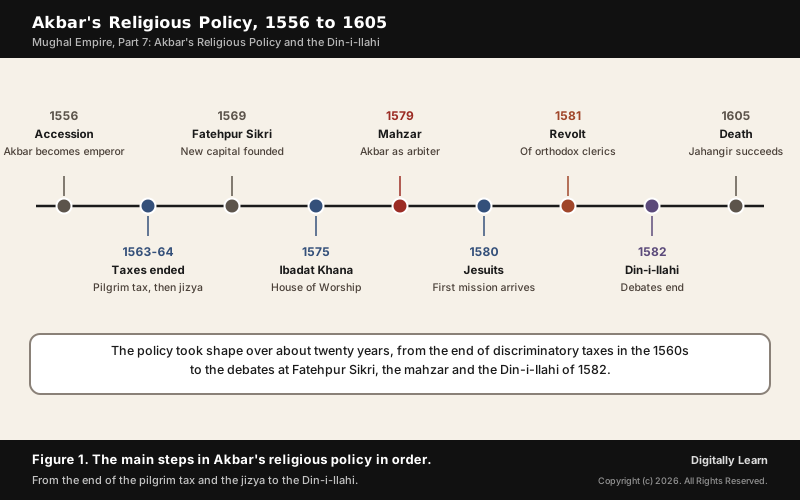
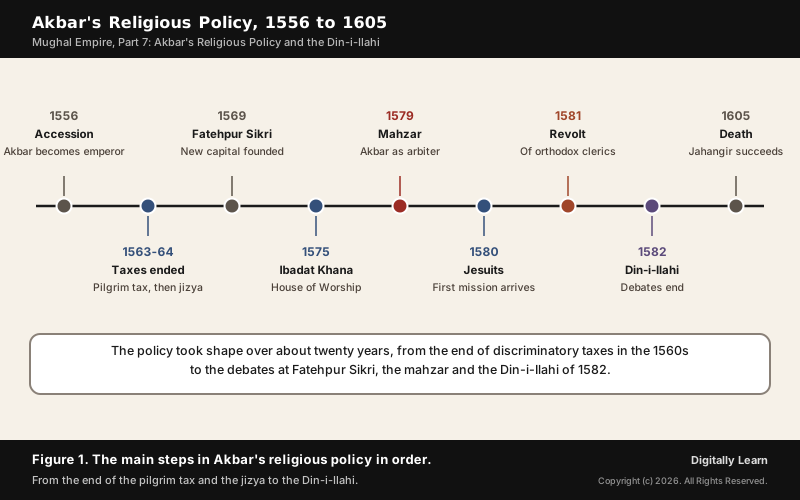
The Din-i-Ilahi, 'Divine Faith', called in Akbar's own time the Tauhid-i-Ilahi, 'Oneness of the Divine', was a small order of discipleship that the Mughal emperor Akbar founded in 1582. It grew out of his religious policy of sulh-i-kul, 'universal peace', under which he ended the pilgrim tax (1563) and the jizya (1564), held debates among scholars of every faith in the Ibadat Khana at Fatehpur Sikri from 1575, and took the power to settle disputes among the ulama by the mahzar of 1579.
Akbar's Religious Policy at a Glance
What Is Din-i-Ilahi and Who Founded It
The Din-i-Ilahi was founded by Akbar in 1582, at the end of about twenty years in which his religious policy moved from Sunni orthodoxy to a position above all faiths. It was the last step of that policy, not its centre. The key facts are:
| Question | Answer |
|---|---|
| Founded by | Akbar, Mughal emperor 1556 to 1605 |
| Year | 1582 |
| Name at the time | Tauhid-i-Ilahi, 'Oneness of the Divine'; Din-i-Ilahi means 'Divine Faith' |
| What it was | A discipleship of chosen nobles centred on the emperor |
| Members | Fewer than twenty are known; Birbal the only Hindu |
| Parent policy | Sulh-i-kul, 'universal peace' |
| Opposed by | Orthodox ulama, the historian Badauni, and Shaikh Ahmad Sirhindi |
| After Akbar | Lapsed under Jahangir; Aurangzeb reversed the wider policy |
From Orthodoxy to Sulh-i-kul: How Akbar's Views Changed
Akbar did not begin as a reformer. Early in his reign, on the advice of the orthodox Shaikh Abdu'n Nabi, he had a Shia grave in Delhi dug up in 1567 because it lay near the grave of Amir Khusrau, and he proclaimed the fall of Chittor, in 1568, as a victory of Islam over unbelievers.
Several influences drew him away from that position. He came to know the Sufi mysticism being preached in the country; he brought into his court men of liberal views such as Abul Fazl, his brother Faizi and Birbal; and his marriage alliances placed Rajput queens in his household. His chief consort, Mariam-uz-Zamani, a princess of Amer, is regarded as a driving force behind his religious neutrality. From 1575 he questioned scholars of every faith himself, and the debates convinced him that no single religion held a monopoly of truth.
Sulh-i-kul: Akbar's Policy of Universal Peace
Sulh-i-kul Meaning: Universal Peace Above All Faiths
The phrase sulh-i-kul means 'universal peace' or 'absolute peace'. It did not favour one religion over another; it rested on a system of ethics, honesty, justice and peace, that applied to everyone. Abul Fazl, Akbar's friend and chronicler, helped him frame a vision of government around it.
Under sulh-i-kul every religion and school of thought had freedom of expression, on one condition: that it did not undermine the authority of the state or fight the others. The emperor stood above all religious and ethnic groups and mediated among them. Akbar's son Jahangir described the result: "Sunnis and Shias met in one mosque and Christians and Jews in one church to pray."
Sulh-i-kul in Practice: Jizya, Pilgrim Tax and a Composite Nobility
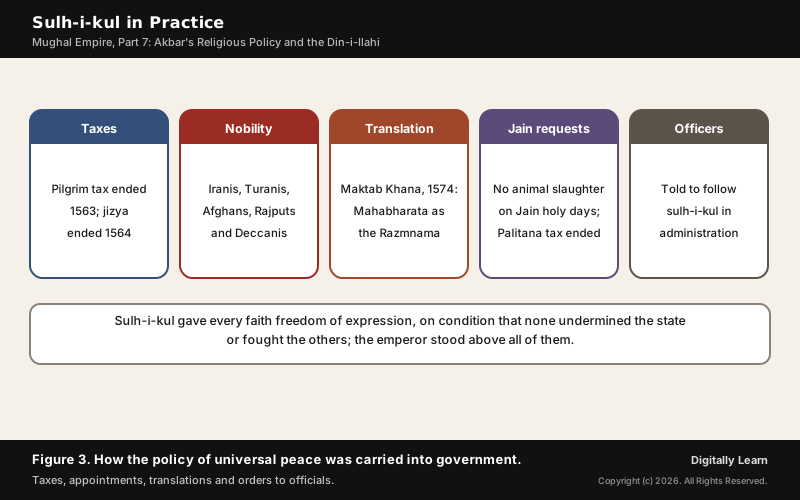
Akbar carried the principle into government through concrete measures. Each one removed a religious distinction from the way the state taxed, appointed or governed its subjects:
- Taxes: He abolished the tax on pilgrimage in 1563 and the jizya, the tax on non-Muslims, in 1564, because both were based on religious discrimination.
- Nobility: Iranis, Turanis, Afghans, Rajputs and Deccanis were given positions and awards for their service and loyalty, not for their faith.
- Officials: Instructions went out to officers across the empire to follow sulh-i-kul in administration.
- Translation: In 1574 he set up a Maktab Khana, a House of Translation, at Fatehpur Sikri to put the Mahabharata, the Ramayana and the Rajatarangini into Persian; the Mahabharata became the Razmnama.
- Record: Abul Fazl’s Akbar Nama, whose third book is the Ain-i Akbari, completed in 1598, set out the ideal of sulh-i-kul as the cornerstone of enlightened rule.
- Requests from the Jains: He banned animal slaughter on Jain holy days and ended the tax on Jain pilgrim places such as Palitana.
The same principle shaped Akbar's idea of kingship. Abul Fazl defined sovereignty as a social contract: the emperor protected four things for his subjects, life, property, honour and faith, and in return asked for obedience and a share of resources.
The Ibadat Khana at Fatehpur Sikri
Ibadat Khana: The House of Worship and Its Debates, 1575 to 1582
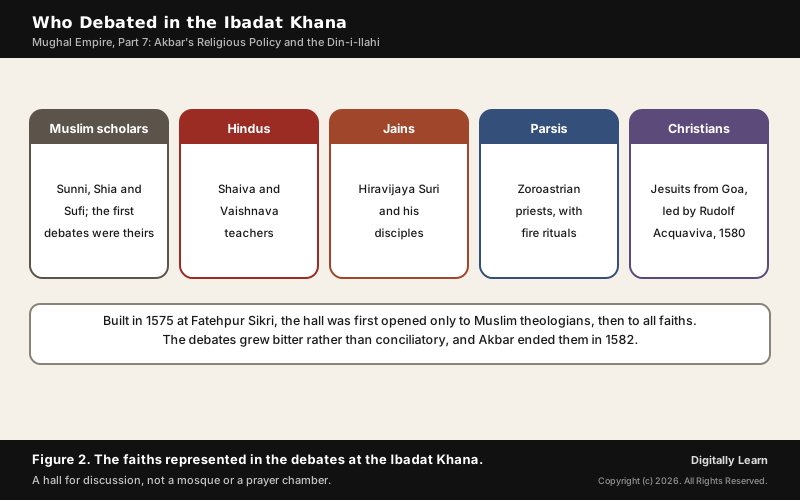
Akbar built the Ibadat Khana, or House of Worship, in 1575 at Fatehpur Sikri, the new capital he had founded in 1569. It was a debating hall: on Thursday evenings he invited theologians, mystics and selected courtiers to discuss matters of spirituality before him.
The debates were at first restricted to Muslim scholars, then opened to Hindus of the Shaiva and Vaishnava traditions, Jains, Parsis, Christians and even atheists. They did not bring the faiths closer: each side tried to prove its own superiority, the exchanges grew bitter, and Akbar ended them in 1582.
Fatehpur Sikri, the 'City of Victory', served as the Mughal capital for only about ten years, yet the Archaeological Survey of India counts the Ibadat Khana, the Din-i-Ilahi and the doctrine of sulh-i-kul among the institutions founded there.
For centuries the building's exact site was unknown. In the early 1980s an excavation at Fatehpur Sikri uncovered steps, platforms and a boundary wall that matched a painting of the Ibadat Khana from Akbar's time.
The Jesuits and the Jains at Akbar's Court
Curious about Christianity, Akbar sent an embassy to Goa to invite Jesuit priests. The first Jesuit mission, led by Rudolf Acquaviva, reached Fatehpur Sikri in 1580 and stayed about two years; two more missions came to his court at Lahore in 1591 and 1595. The Jesuits debated with the ulama, tutored his children and left the earliest European accounts of the Mughal court. Akbar had his scribes translate the New Testament and allowed the Jesuits to preach.
The Jains left a deeper mark on his habits. Impressed by a Jain woman's six-month fast, Akbar invited her teacher Hiravijaya Suri to Fatehpur Sikri; Jain arguments against eating meat persuaded him to become a vegetarian, and he later received Hiravijaya's successor Vijayasena Suri as well. In 1584, 1592 and 1598 he declared the Amari Ghosana, forbidding the slaughter of animals during the Jain festivals of Paryushan and Mahavira's birth.
The Mahzar of 1579 and the Divine Light of Kingship
The Mahzar, the Revolt of 1581 and the Theory of Farr-i Izadi
To strengthen his position against the ulama, the Muslim legal scholars, Akbar issued a mahzar, a declaration signed by all the major ulama, in 1579. It declared him the Khalifa of the age, a rank higher than that of a mujtahid, an interpreter of the law.
Its practical effect was narrow but important: where the mujtahids differed on a question, Akbar could choose any one of their opinions and issue decrees of his own. It made him the arbiter of disputes among the scholars, not a prophet or the founder of a new law, and it took the last word on religious questions away from the orthodox clergy.
The clergy resisted. In 1581 orthodox clerics led by Mullah Muhammad Yazdi and the chief qazi of Bengal rebelled, seeking to replace Akbar with his brother; Akbar crushed the revolt and punished the qazis severely.
Akbar's authority over religious questions rested on a theory of divine light. Abul Fazl placed Mughal kingship at the top of a hierarchy of things receiving light emanating from God, the farr-i izadi, an idea first developed by the Iranian Sufi Shihabuddin Suhrawardi. In this hierarchy the king received the Divine Light and became the source of spiritual guidance for his subjects.
The theory fitted Akbar's own practice. He moved towards a form of divine worship focused on light and the sun, and he treated a select band of nobles as his disciples, or murids. Later Mughal painters showed emperors with a halo to express the same idea.
The Din-i-Ilahi of 1582
Din-i-Ilahi Beliefs, Practices and Followers
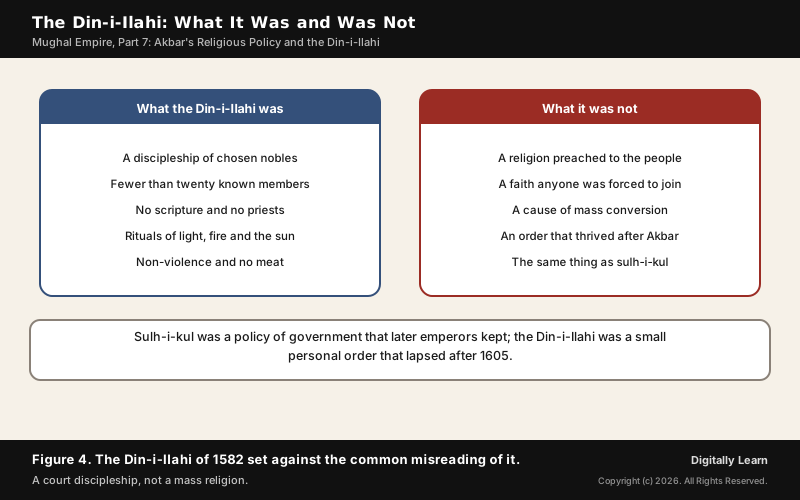
The Din-i-Ilahi drew its spirit from Sufism, including the ideas of the Andalusian mystic Ibn al-Arabi, and borrowed from Hindu, Jain, Zoroastrian and Christian practice. Its main features were:
- Belief: The unity of God, and a soul purified through longing for God.
- Virtues: Generosity, forgiveness, abstinence, prudence, wisdom, kindness and piety; celibacy respected but not required.
- Worship: Light was its focus, with a light-fire ritual and a hymn of the thousand Sanskrit names of the sun.
- Conduct: Non-violence to all living things, and no meat.
- Structure: No scripture and no priestly hierarchy; members, called chelas or disciples, greeted one another with ‘Allahu Akbar’ and ‘Jalla Jalaluhu’.
Its following was tiny. Historians have identified no more than eighteen or nineteen members, nearly all nobles of the court; Birbal, the minister and commander, was the only Hindu among them. It was never preached to the people, and it was not for the masses.
Was Din-i-Ilahi a New Religion? The Historians' Debate
Historians do not agree on what the Din-i-Ilahi was. One view treats it as a new religion that Akbar founded after leaving Islam. Another holds that it was a spiritual discipleship of the emperor's own belief, and that the idea of a new religion grew from later British mistranslations of Abul Fazl.
The name itself is part of the argument: the historian Mubarak Ali notes that 'Din-i-Ilahi' was not the name used in Akbar's time, when Abul Fazl called it Tauhid-i-Ilahi. The historian M. Athar Ali saw sulh-i-kul, the essence of the order, as a part of general imperial administrative policy, not a purely religious project.
Opposition to and Legacy of Akbar's Religious Policy
The Orthodox Reaction and the Fate of Sulh-i-kul After Akbar
The court historian Abdul Qadir Badauni was the sharpest critic from inside the court. A theologian and courtier, he wrote the Muntakhab-ut Tawarikh critically of Akbar's policies and did not wish it made public; he recorded, for example, that in 1578 the emperor prostrated himself publicly before the sun and the fire.
Outside the court, the Naqshbandi scholar Shaikh Ahmad Sirhindi (1564 to 1624) rejected the Din-i-Ilahi and wrote hundreds of letters to his disciples, to Mughal nobles and to the emperor against the participation of Hindus in government. His defence of orthodoxy against Akbar and later Jahangir earned him the title Mujaddid, 'reviver', among South Asian Muslims.
The two halves of Akbar's policy had different fates. Sulh-i-kul as a principle of government was followed by Jahangir and Shah Jahan, and all Mughal emperors gave grants to build and maintain places of worship. The Din-i-Ilahi, a personal order, was made defunct by Jahangir.
The decisive break came with Aurangzeb. He reimposed the jizya on non-Muslim subjects and executed his brother Dara Shikoh, who had tried to revive Akbar's approach. The contrast between Akbar and Aurangzeb remains one of the central themes of Mughal history.
Akbar's Religious Policy in UPSC Previous Year Questions
What UPSC Has Asked About Akbar's Religion
UPSC has tested this topic at both stages. The objective question asked what the Ibadat Khana was; the Mains question asked for the main aspects of Akbar's religious syncretism, which needs the policy, the debates, the Din-i-Ilahi and their limits together. The same facts, especially the dates 1564, 1575, 1579 and 1582, also serve statement questions on the Mughals.
| Year | What the question asked | The point being tested |
|---|---|---|
| 2014 Prelims | What the Ibadat Khana at Fatehpur Sikri was | A hall for discussion with scholars of all faiths |
| 2025 Mains | The main aspects of Akbar's religious syncretism | Sulh-i-kul, debates, Din-i-Ilahi and limits |
Previous Year UPSC-CSE Questions
Previous Year UPSC-CSE Questions By the end you will be able to draft model answers for the following UPSC questions. Each question carries a collapsible framework showing how to approach it in the exam.
- UPSC Mains 2025 GS-IExamine the main aspects of Akbar's religious syncretism.
How to structure the answer in the exam
Introduction: Open with Akbar's move from early orthodoxy to a position above all faiths.
Body (sub-themes to develop):
- Policy: sulh-i-kul; pilgrim tax (1563) and jizya (1564) ended; a composite nobility.
- Dialogue: the Ibadat Khana (1575 to 1582); Jesuits, Jains, Parsis, Hindus.
- Culture: the Maktab Khana and the Razmnama.
- Authority: the mahzar of 1579 and Abul Fazl's farr-i izadi.
- Din-i-Ilahi: a small discipleship, not a mass religion; the debate over its nature.
- Limits: Badauni, the 1581 revolt, Sirhindi; Aurangzeb's reversal.
Conclusion: Conclude that sulh-i-kul, not the Din-i-Ilahi, was the lasting part of Akbar's syncretism.
- UPSC Prelims 2014 Prelims-GSIbadat Khana at Fatehpur Sikri was
How to approach this Prelims question
Approach: Recall what the Ibadat Khana was used for.
Trap to watch: It was not a mosque or a private prayer chamber, though its name means House of Worship.
Key facts to recall:
- Built 1575 at Fatehpur Sikri
- Debates among scholars of all religions until 1582
Answer signal: The hall for discussions with scholars of various religions, option (c).
Sources
- NCERT: Our Pasts II (Class VII), The Mughal Empire
- NCERT: Themes in Indian History Part II (Class XII), Kings and Chronicles
- Archaeological Survey of India: Fatehpur Sikri
- UNESCO World Heritage Centre: Fatehpur Sikri
- Incredible India (Ministry of Tourism): Fatehpur Sikri
- Wikipedia: Din-i Ilahi
- Wikipedia: Ibadat Khana
- Wikipedia: Akbar
- Wikipedia: Abu%27l-Fazl ibn Mubarak
- Wikipedia: Abd al-Qadir Badayuni
- Wikipedia: Birbal
- Wikipedia: Razmnama
- Wikipedia: Ahmad Sirhindi
- Wikipedia: Fatehpur Sikri
- UPSC: Civil Services Examination question papers
Editorial Disclaimer
This article is for UPSC preparation. The account of Akbar's religious policy rests on the Akbarnama of Abul Fazl, the hostile chronicle of Badauni, and the standard scholarship on the Mughal Empire.