


Overview
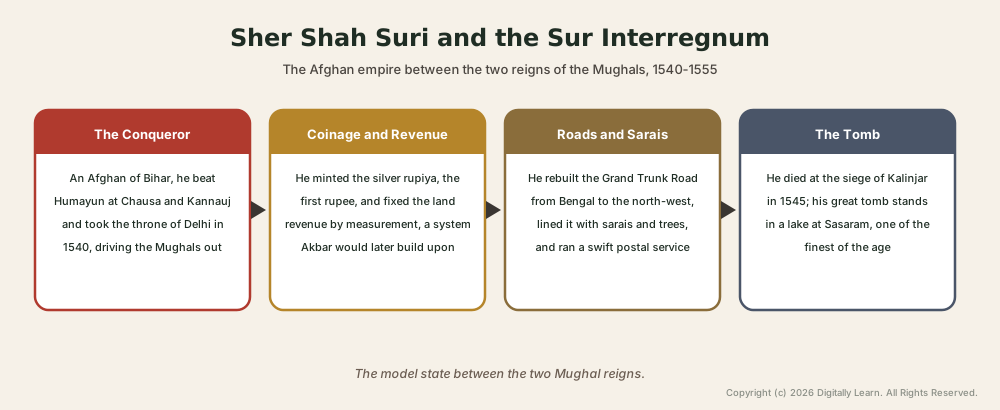
Sher Shah Suri (reigned 1540 to 1545) was the Afghan ruler who broke the rule of the Mughal Humayun and held the empire of north India for five years, between the two reigns of Humayun, in what is called the Sur interregnum. Born Farid Khan, he won the title Sher, the tiger, and built a power in the east before he defeated Humayun at Chausa and Kannauj. In his short reign he built one of the great administrations of medieval India: he minted the silver rupiya, the ancestor of the rupee, rebuilt the Grand Trunk Road with its sarais, and set the land revenue by measurement, a model that the Mughals under Akbar would build upon. He died at the siege of Kalinjar in 1545. This part covers his rise, his administration, his end, and the exam focus.
The Rise of Sher Shah
From Farid Khan to the Throne of Delhi
What is the significance of Sher Shah: he was the one ruler who broke the Mughals for a time, and his short reign gave India one of its best medieval governments.
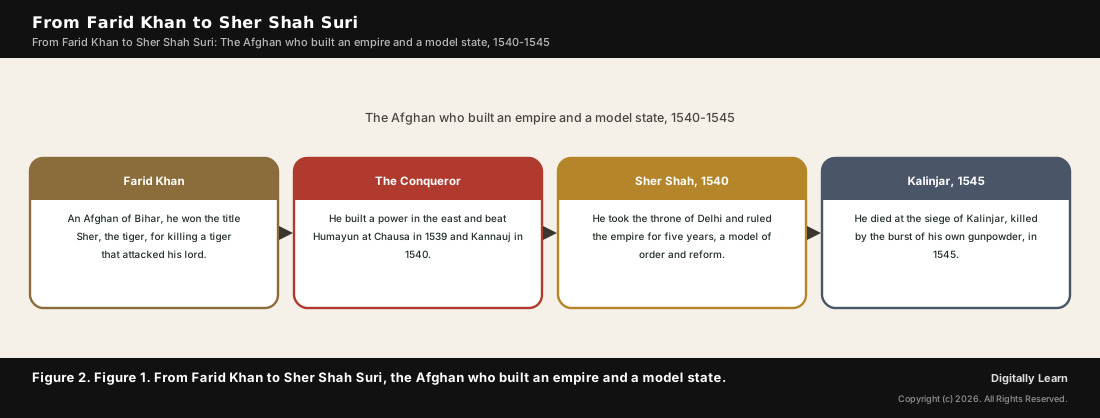
He rose from a small beginning. Born Farid Khan, an Afghan of Bihar, he won his famous title, Sher, the tiger, for killing a tiger that had attacked his lord. He served and learned under the Afghans, and built for himself a strong power in Bihar and Bengal in the east, in the troubled years after Babur's death.
He drove out the Mughals. When Humayun marched against him, Sher Shah defeated him in two great battles, at Chausa in 1539 and at Kannauj in 1540, and drove the Mughals out of India. He took the throne of Delhi as Sher Shah, and ruled the empire for five years. The figure below sets out his rise.
The Model Administration
The Coinage, the Revenue, the Roads and the Post
What is the significance of his administration: in only five years Sher Shah built a system of government so good that the Mughals under Akbar took it as their model.
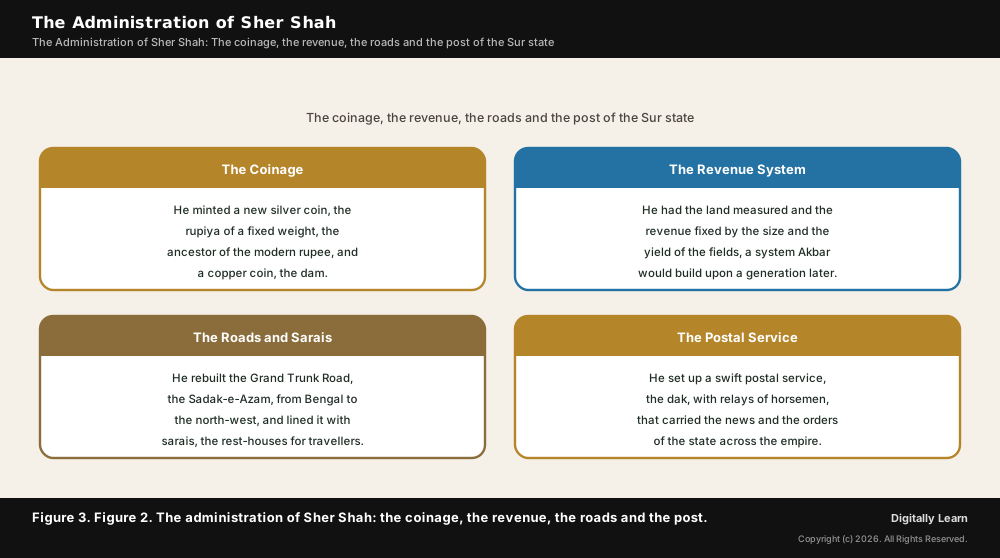
He reformed the coinage and the revenue. Sher Shah minted a fine new silver coin of a fixed weight, the rupiya, which is the ancestor of the modern rupee, and a copper coin, the dam. He set the land revenue on a sure footing, having the land measured and the demand fixed by the size and the yield of the fields, a system of measurement that Akbar's revenue minister would later build upon.
He built roads and rest-houses. He rebuilt the great Grand Trunk Road, the Sadak-e-Azam, that ran across the north of India from Bengal to the north-west frontier, and lined it with sarais, the rest-houses where travellers and the royal post could halt. He set up a swift postal service, the dak, with relays of horsemen. The table below sets out his chief reforms, and the figure that follows sets them out together.
| Reform | What it was |
|---|---|
| The rupiya | A new silver coin of fixed weight, the ancestor of the modern rupee. |
| The revenue system | The land measured and the demand fixed by size and yield, the model for Akbar's. |
| The Grand Trunk Road | Rebuilt from Bengal to the north-west, lined with sarais and trees. |
| The postal service | The dak, a swift relay of horsemen carrying news and orders. |
The Sur Empire and the Great Road
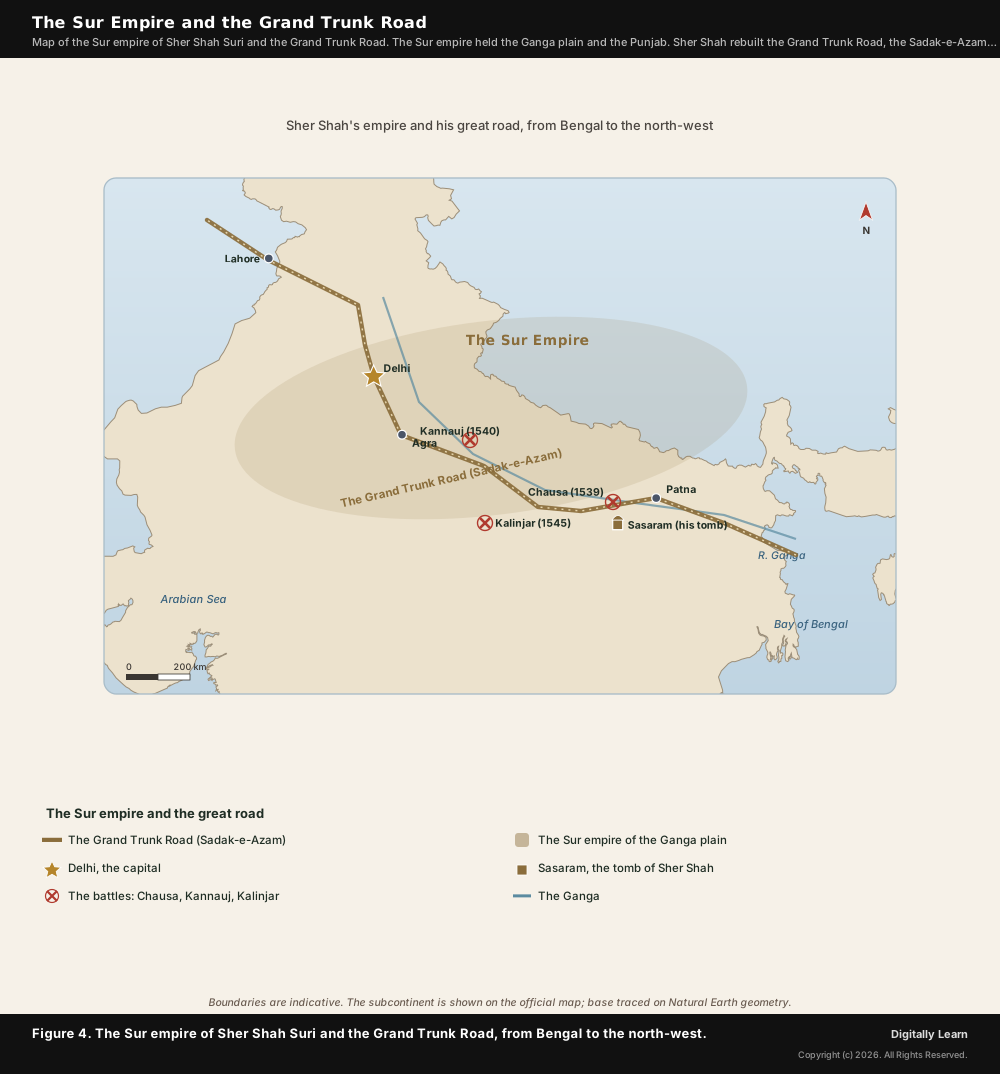
Distinguishing the reach of the Sur state: the Sur empire held the whole Ganga plain and the Punjab, and the great road bound it together from end to end.
The empire stretched across the north. From his capital at Delhi, Sher Shah ruled the Ganga plain from Bengal in the east to the Punjab and the north-west in the west, with the Grand Trunk Road running through the length of it. The map below sets out the Sur empire and the road.
The End and the Legacy
The Siege of Kalinjar and the Tomb at Sasaram
What is the significance of his end: his sudden death cut short a great reign, but his work and his tomb outlived him.
He died at Kalinjar in 1545. While besieging the strong Rajput fort of Kalinjar in 1545, Sher Shah was mortally hurt by the burst of his own gunpowder, and died of his wounds. His son and the later Sur rulers could not hold the empire together, and it fell into disorder, so that Humayun was able to win back his throne in 1555.
His tomb is one of the finest of the age. Over Sher Shah was raised a great mausoleum at Sasaram, in his native Bihar, a tall building of red sandstone standing in the middle of an artificial lake, one of the noblest tombs of the Indo-Afghan style. His reign, though short, left a deep mark, above all on the Mughal government that followed it.
UPSC Relevance and Exam Focus
Where Sher Shah Suri Fits in the UPSC-CSE Syllabus
This topic belongs to General Studies Paper I: medieval Indian history, and Sher Shah, with his coinage, his road and his revenue system, is a favourite ground for questions on medieval administration.
The questions most often test the rupiya, the Grand Trunk Road and the sarais, the revenue system that Akbar copied, and the tomb at Sasaram.
Several linked points recur and are worth holding in working memory:
- The rupiya: Sher Shah’s silver coin, the ancestor of the modern rupee.
- The Grand Trunk Road: Rebuilt from Bengal to the north-west, lined with sarais.
- The revenue system: Land measured and the demand fixed by yield, the model for Akbar’s.
- Chausa and Kannauj: His two victories over Humayun, in 1539 and 1540.
- The tomb at Sasaram: His great red-sandstone mausoleum, standing in a lake.
A 1995 question asked which monument has one of the largest domes in the world; the answer was the Gol Gumbaz at Bijapur, of the Deccan Sultanates, but the tomb of Sher Shah at Sasaram was among the choices, for it too is one of the great domed tombs of medieval India.
A reader who knows the Sasaram tomb as the great red-sandstone mausoleum of Sher Shah, set in its lake, can place it at once, and tell it apart from the marble domes of the Mughals and the giant dome of the Gol Gumbaz.
Previous Year UPSC-CSE Questions
Previous Year UPSC-CSE Questions By the end you will be able to draft model answers for the following UPSC questions. Each question carries a collapsible framework showing how to approach it in the exam.
- UPSC Prelims 1995 GS-IWhich one of the following monuments has a dome which is said to be one of the largest in the world?
How to approach this Prelims question
Approach: Recall that the Gol Gumbaz at Bijapur has one of the largest single-chamber domes in the world; the Sasaram tomb, the Jama Masjid and the Tughlaq tomb, though great, are not the largest dome.
Trap to watch: The Sasaram tomb of Sher Shah is the distractor here; the largest dome is the Gol Gumbaz at Bijapur.
Key facts to recall:
- The Gol Gumbaz at Bijapur has one of the largest domes in the world.
- Sher Shah's tomb is at Sasaram, a red-sandstone tomb in a lake.
- The Sasaram tomb is in the Indo-Afghan style.
Answer signal: Gol Gumbaz, Bijapur.
Sources and Further Reading
Editorial Disclaimer
This article is for UPSC preparation. The history of Sher Shah rests on the Persian chronicles and the standard scholarship on the medieval Indian state.