


Overview
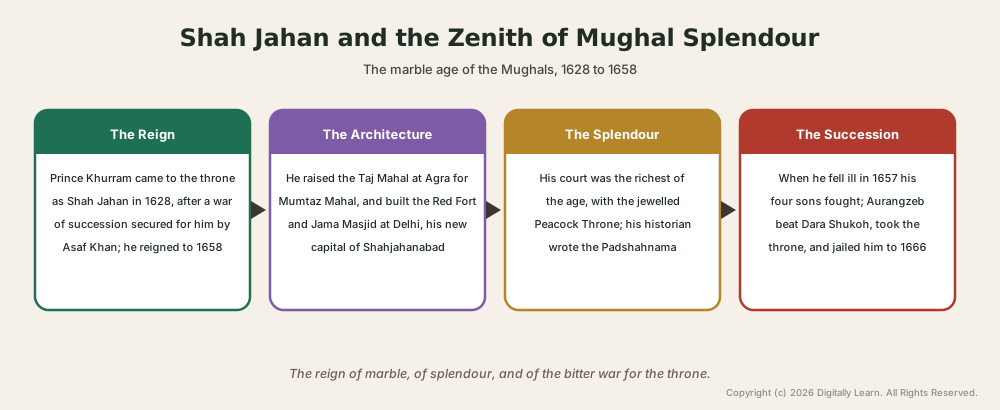
Shah Jahan, the son of Jahangir, ruled the Mughal empire from 1628 to 1658, the golden age of its architecture. Born Prince Khurram, he came to the throne after a war among the heirs, settled by his father-in-law Asaf Khan. He is remembered above all as the builder of the Taj Mahal, the marble tomb he raised at Agra for his queen Mumtaz Mahal, and of the Red Fort and the Jama Masjid at Delhi, his new capital of Shahjahanabad. His court, with its jewelled Peacock Throne, was the richest of the age. His reign ended in the great war of succession, from which Aurangzeb emerged the victor, imprisoning the old emperor at Agra. This part covers the reign, the architecture, the war of succession, and the exam focus.
The Reign of Shah Jahan
The Accession and the Splendour of the Court
What is the significance of Shah Jahan's reign: it was the high noon of the Mughal empire, the age of its greatest wealth and of the most beautiful of its buildings.
Prince Khurram came to the throne as Shah Jahan in 1628. On the death of Jahangir in 1627 there was a struggle among the heirs, but the throne was secured for Khurram by his father-in-law Asaf Khan, and he was crowned in 1628 with the title Shah Jahan, 'King of the World'. He reigned for thirty years, until 1658.
His court was the richest of the age. The wealth of the empire, drawn from its vast and fertile lands, was displayed in a splendour that astonished travellers from Europe. The famous Peacock Throne, the Takht-i-Taus, was made for him, a throne of gold set with the rarest jewels. His official historian, Abdul Hamid Lahori, recorded the reign in his great chronicle, the Padshahnama.
The Taj Mahal and the Architecture
The Marble Age of Mughal Building
What is the significance of the architecture: the reign of Shah Jahan was the golden age of Mughal building, when the red sandstone of the earlier age gave way to white marble, and the most famous of Indian monuments was raised.
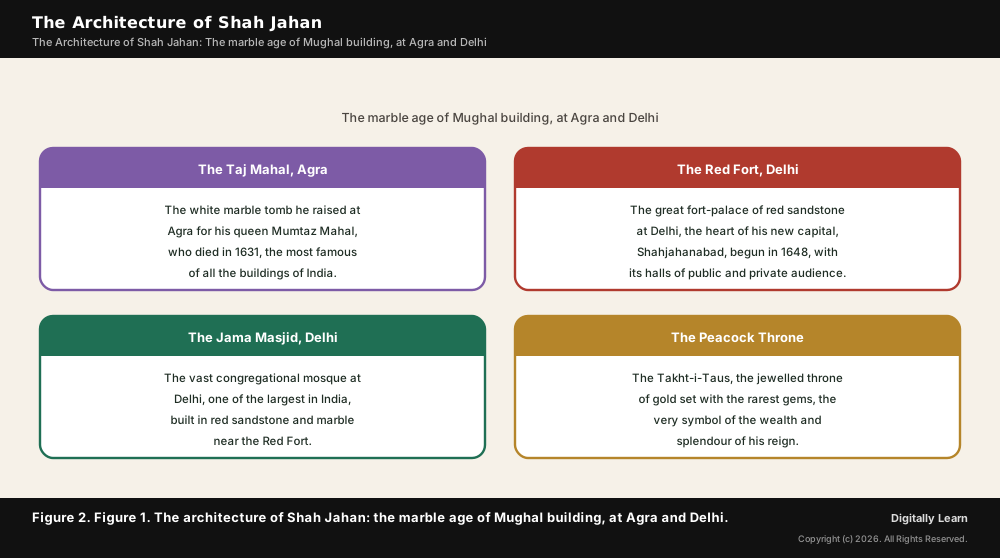
The Taj Mahal is the glory of his reign. When his beloved queen Mumtaz Mahal died in 1631, Shah Jahan raised over her grave at Agra the Taj Mahal, a tomb of white marble inlaid with precious stones, set in a great garden by the river. Built over some twenty years, it is held to be the most perfect of all the buildings of India, and one of the wonders of the world.
He built a new capital at Delhi. From 1648 Shah Jahan made a new capital, Shahjahanabad, at Delhi, and adorned it with two great works: the Red Fort, the fort-palace of red sandstone, with its halls of audience and its marble pavilions; and the Jama Masjid, the vast congregational mosque, one of the largest in India. He also built the Moti Masjid, the Pearl Mosque, in the fort at Agra. The figure below sets out his chief buildings.
The Empire at its Height
The Wealth of the Empire and the Wars of the Reign
What is the significance of the empire's height: under Shah Jahan the Mughal empire was at its richest and most stable, though the seeds of later strain were already being sown in costly wars.
The empire was at its height of wealth. The revenues of the state were vast, the trade of the towns flourished, and the court and the nobles lived in a luxury that has become a byword. Yet the very cost of the buildings, the court and the wars laid a heavy burden on the peasants who bore the land revenue.
The wars brought both gains and losses. In the Deccan the Mughals pressed south, and the kingdoms of Ahmadnagar and others were brought low. But in the north-west the costly Balkh campaign, sent to secure a friendly ruler in Balkh and Badakhshan beyond Kabul, ended in failure, and the great fortress of Qandahar was lost to Persia, a blow to Mughal pride.
The War of Succession and the End
The Four Sons and the Triumph of Aurangzeb
What is the significance of the war of succession: it decided the future of the empire, for it brought to the throne the stern Aurangzeb in place of the liberal Dara Shukoh, and so set the course of the Mughal decline.
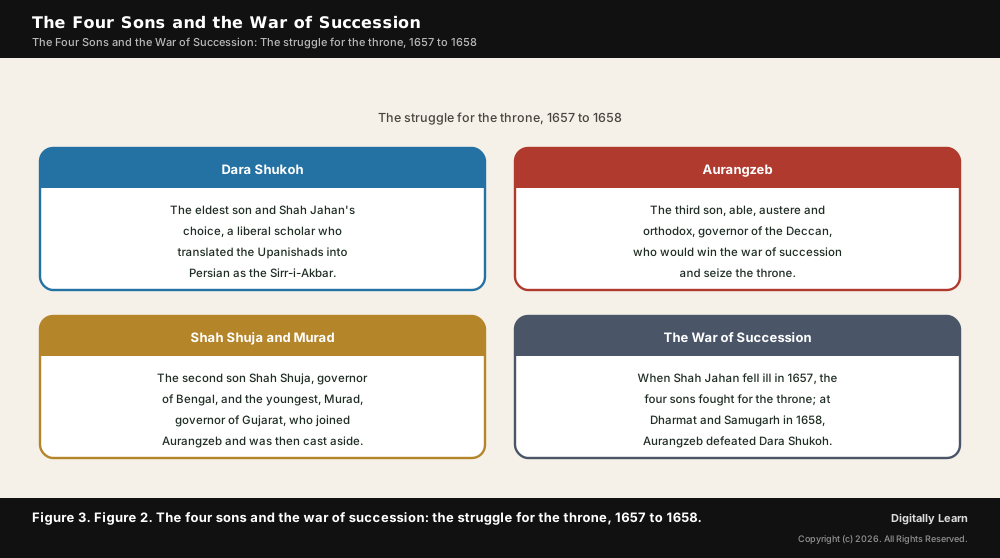
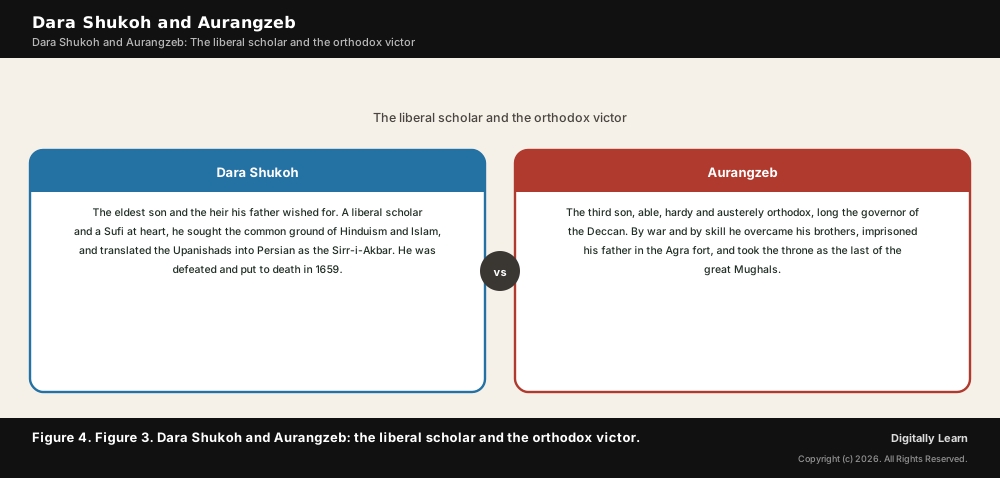
Shah Jahan had four sons. The eldest was Dara Shukoh, his father's favourite and chosen heir, a liberal scholar and a Sufi at heart, who sought the common ground of Hinduism and Islam and translated the Upanishads into Persian as the Sirr-i-Akbar. The others were Shah Shuja, the governor of Bengal; the able and orthodox Aurangzeb, the governor of the Deccan; and the youngest, Murad, the governor of Gujarat.
The brothers fought for the throne. When Shah Jahan fell gravely ill in 1657, the four sons took up arms. At the battles of Dharmat and Samugarh in 1658, Aurangzeb, joined for a time by Murad, defeated the forces of Dara Shukoh. The figure below sets out the four sons and the war.
Aurangzeb won and seized the throne. Dara Shukoh was hunted down and put to death in 1659, and the other brothers were destroyed in turn. Aurangzeb imprisoned his father, Shah Jahan, in the fort of Agra, where the old emperor lived out his last years in sight of the Taj Mahal, and died in 1666. The contrast of the two chief rivals is set out below.
UPSC Relevance and Exam Focus
Where Shah Jahan Fits in the UPSC-CSE Syllabus
This topic belongs to General Studies Paper I: medieval Indian history and culture, and the reign of Shah Jahan is examined for its architecture, its chronicles and its war of succession.
The questions most often test the buildings (the Taj Mahal, the Red Fort and the Jama Masjid), the chronicler Abdul Hamid Lahori, and the war of succession between Aurangzeb and Dara Shukoh.
Several linked points recur and are worth holding in working memory:
- The reign: Shah Jahan ruled from 1628 to 1658; Prince Khurram was his name before accession.
- The Taj Mahal: built at Agra for Mumtaz Mahal, who died in 1631.
- The new capital: Shahjahanabad at Delhi, with the Red Fort and the Jama Masjid, from 1648.
- The chronicler: Abdul Hamid Lahori, the official historian, wrote the Padshahnama.
- The succession: Aurangzeb defeated Dara Shukoh at Dharmat and Samugarh, 1658; Dara was executed in 1659.
| Person or work | What to remember |
|---|---|
| Shah Jahan | Prince Khurram; reigned 1628 to 1658; the marble age of building. |
| Taj Mahal | White marble tomb at Agra for Mumtaz Mahal (died 1631). |
| Shahjahanabad | New capital at Delhi, 1648, with the Red Fort and Jama Masjid. |
| Peacock Throne | The Takht-i-Taus, the jewelled throne of the reign. |
| Abdul Hamid Lahori | Official historian of Shah Jahan; wrote the Padshahnama. |
| Dara Shukoh | Eldest son; liberal scholar; defeated by Aurangzeb; executed 1659. |
A 2006 question asked who Abdul Hamid Lahori was, and the answer was that he was an official historian of the reign of Shah Jahan, the author of the Padshahnama, and not a figure of Akbar's, Aurangzeb's or Muhammad Shah's time.
A 2003 question asked between whom the battle of Dharmat was fought, and the answer was Aurangzeb and Dara Shukoh, in the war of succession of 1658, in which Aurangzeb was the victor.
Previous Year UPSC-CSE Questions
Previous Year UPSC-CSE Questions By the end you will be able to draft model answers for the following UPSC questions. Each question carries a collapsible framework showing how to approach it in the exam.
- UPSC Prelims 2006 GS-IIn Indian history, who was Abdul Hamid Lahori?
How to approach this Prelims question
Approach: Recall that the Padshahnama, the official history of Shah Jahan's reign, was written by Abdul Hamid Lahori. Match him to the option naming him the official historian of Shah Jahan.
Trap to watch: He belongs to Shah Jahan's reign, not Akbar's, Aurangzeb's or Muhammad Shah's; the distractors place him in the wrong reigns.
Key facts to recall:
- Abdul Hamid Lahori = official historian of Shah Jahan.
- He wrote the Padshahnama.
- It is a chief source for the buildings and the court.
Answer signal: An official historian of the reign of Shah Jahan.
- UPSC Prelims 2003 GS-IThe battle of Dharmat was fought between
How to approach this Prelims question
Approach: Place the battle of Dharmat (1658) in the war of succession for Shah Jahan's throne, fought between Aurangzeb and Dara Shukoh.
Trap to watch: Dharmat belongs to the 1658 Mughal succession war, not to Muhammad Gori, Babur, or the later Marathas; the distractors are battles of other ages.
Key facts to recall:
- Dharmat (1658) = Aurangzeb vs Dara Shukoh.
- Samugarh (1658) was the decisive battle of the same war.
- Aurangzeb was the victor.
Answer signal: Aurangzeb and Dara Shikoh.
Sources and Further Reading
Editorial Disclaimer
This article is for UPSC preparation. The account of Shah Jahan's reign rests on the Padshahnama of Abdul Hamid Lahori, the records of European travellers, and the standard scholarship on the Mughal Empire.