


Overview
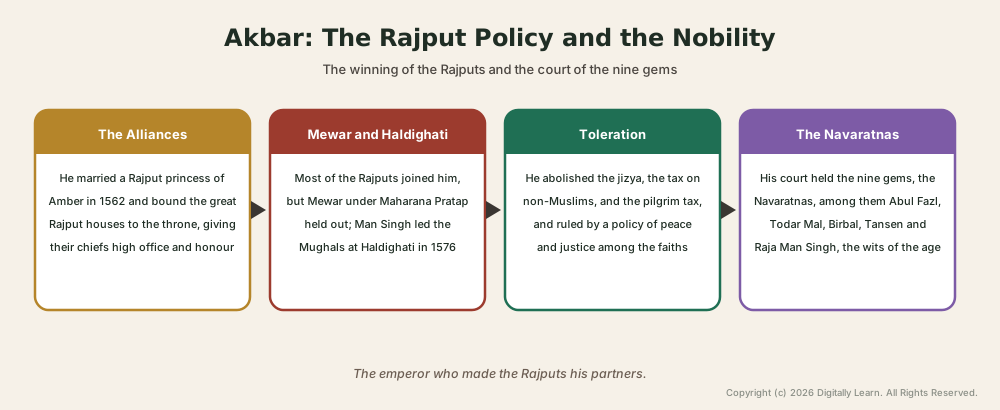
The Rajput policy of Akbar was one of the wisest acts of his reign, and the foundation of the strength of the Mughal empire. Instead of treating the proud Rajput kings as enemies, Akbar won them to his side, binding the great houses to the throne by marriage, beginning with the princess of Amber in 1562, and giving their chiefs high office and honour as generals and ministers. He abolished the jizya, the tax on non-Muslims, and ruled by a policy of toleration. Only Mewar, under Maharana Pratap, held out, and the two met at the Battle of Haldighati in 1576. At his court Akbar gathered the Navaratnas, the nine gems of the age. This part covers the Rajput policy, Mewar and Haldighati, the nobility and the Navaratnas, and the exam focus.
The Rajput Policy
The Alliances, the Honour and the Toleration
What is the significance of the Rajput policy: it turned the proud and warlike Rajputs from the enemies of the Mughals into the partners of the empire, and gave it a strength no force alone could have won.
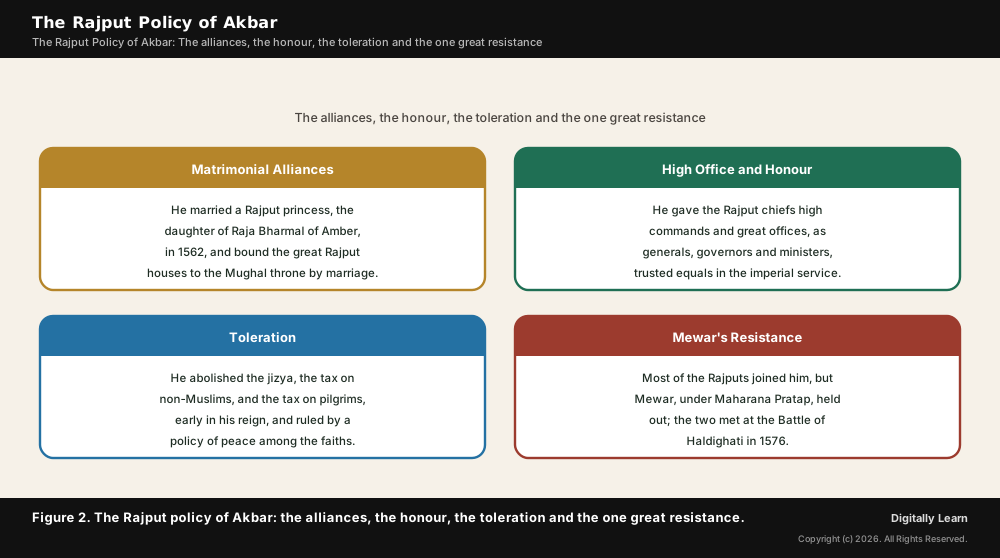
Akbar won the Rajputs by alliance. Rather than crush the Rajput kings, he bound them to his throne. The first and the famous step was his marriage in 1562 to the daughter of Raja Bharmal of Amber, and other marriages followed, so that the blood of the Rajputs ran in the royal house itself. He gave the Rajput chiefs high commands and great offices, as generals, governors and ministers, trusted as the equals of the Muslim nobles.
He ruled by toleration. Akbar abolished the jizya, the old tax on non-Muslims, and the tax on Hindu pilgrims, early in his reign, and set himself to rule by a policy of peace and justice among the faiths. By these means he made the Rajputs the firm pillars of the empire. The figure below sets out his Rajput policy.
The Results and the Wisdom of the Rajput Policy
What is the significance of the results: the Rajput policy did more than make peace; it gave the Mughal empire roots in Indian soil, a body of loyal warriors, and a strength that lasted as long as the policy itself was kept.
The Rajputs became the sword-arm of the empire. Once won, the Rajput chiefs gave the Mughals their finest soldiers and most trusted generals, men who fought the empire's wars from Bengal to the Deccan. The Amber princess whom Akbar married, later honoured as Mariam-uz-Zamani, was the mother of the next emperor, Jahangir, so that the Mughal line itself now carried Rajput blood, and the bond between the two houses was made one of family as much as of state.
The policy was partnership, not mere tolerance. Akbar did not simply spare the Rajputs; he raised them to the highest ranks of his service. Raja Man Singh of Amber rose to one of the greatest commands in the empire and served as governor of Kabul, of Bihar and of Bengal in turn, while Raja Todar Mal held the revenue ministry.
The Rajputs were thus not subjects to be watched, but partners in the rule of the empire, and their loyalty was the firmer for it. No Indian power before the Mughals had so fully drawn the old ruling houses into its own service.
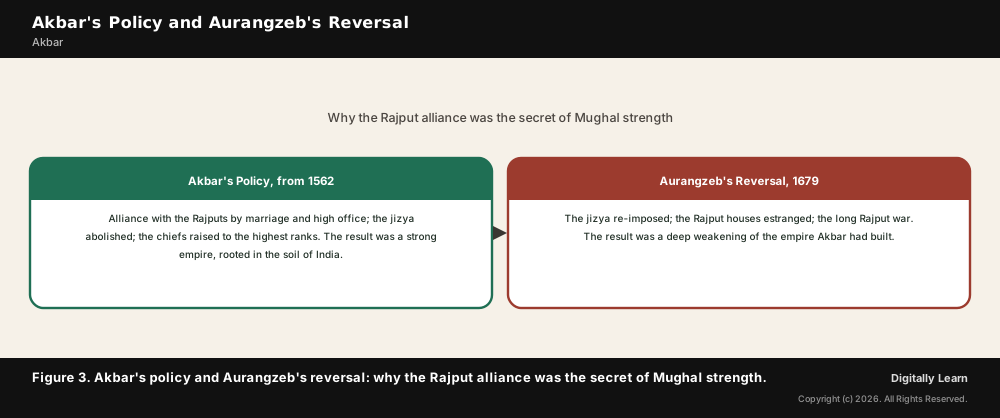
The wisdom of the policy is seen by contrast. A century later the emperor Aurangzeb reversed Akbar's course, re-imposed the jizya in 1679, and quarrelled with the Rajput houses; the result was the Rajput war and a deep weakening of the empire. The comparison shows how far Akbar's policy of alliance had been the secret of Mughal strength.
Mewar and the Battle of Haldighati
Maharana Pratap and the Stand of Mewar
What is the significance of Mewar: it was the one Rajput kingdom that would not bow to Akbar, and its long resistance under Maharana Pratap is among the famous stories of Indian history.
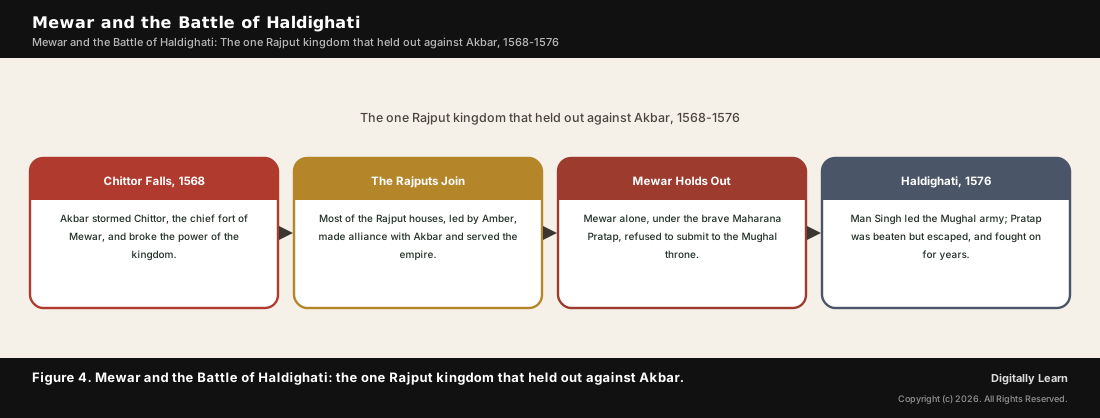
Mewar alone held out. Most of the Rajput houses, led by Amber, made their peace with Akbar; but the kingdom of Mewar, under its brave king Maharana Pratap, refused to submit to the Mughal throne, even after Akbar had stormed its chief fort of Chittor in 1568.
The two met at Haldighati. In 1576, at the pass of Haldighati, the Mughal army, led by the Rajput general Raja Man Singh of Amber, fought Maharana Pratap. The Mughals had the better of the day, but Pratap was not taken; he escaped, and carried on the struggle for years from the hills, recovering much of his land before he died. The figure below sets out the stand of Mewar.
After Haldighati: the Recovery of Mewar
What is the significance of what followed: the battle did not end the war, and the long struggle of Maharana Pratap to win back his land became one of the great stories of courage in Indian history.
Pratap fought on from the hills. Beaten on the field of Haldighati, the Rana would not give in. He withdrew into the hill country of Mewar, where the heavy Mughal armies could not easily follow, and waged a war of raids and ambushes for years.
By patient effort he won back most of his kingdom, fort by fort, keeping only Chittor and a few strong places out of his reach, so that at his death in 1597 Mewar was once more his in all but name.
Peace came in the next reign. The quarrel between Mewar and the Mughals was not settled until 1615, when Pratap's son, Amar Singh, made a treaty with the emperor Jahangir, on terms that left Mewar its honour. The long resistance of Mewar, and the figure of Maharana Pratap on his horse, became for later ages a lasting symbol of Rajput valour and of the love of one's own land.
The Nobility and the Navaratnas
The Composite Nobility and the Nine Gems
What is the significance of the nobility: Akbar built a nobility drawn from many peoples and faiths, and his court was the most brilliant of the age.
The nobility was a mixed body. Akbar drew his nobles from many groups, the Turanis of Central Asia, the Iranis of Persia, the Afghans, the Rajputs and the Indian Muslims, so that no one party could grow too strong, and all served the throne together. This composite nobility was a chief source of the empire's strength.
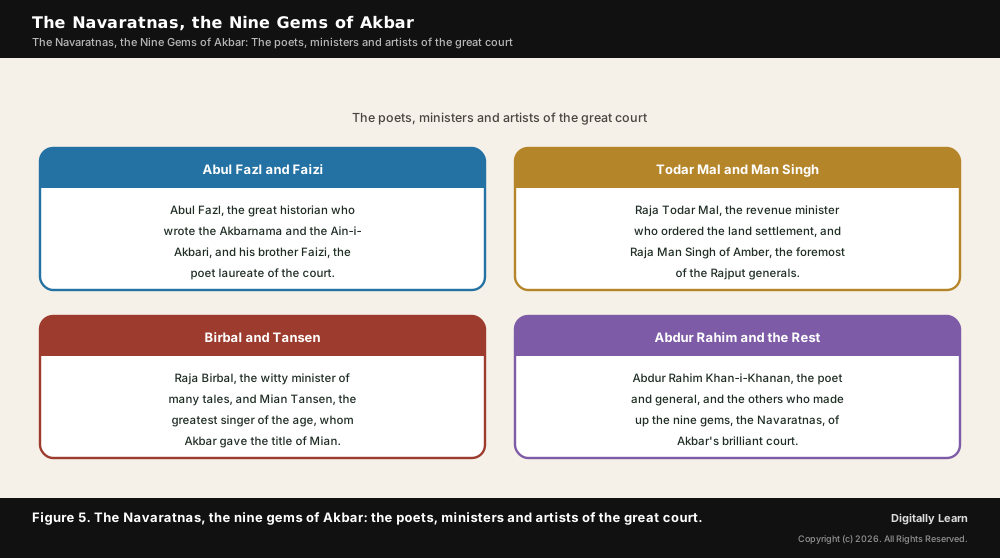
His court held the Navaratnas, the nine gems, the most famous men of the age. Among them were Abul Fazl, the historian of the Akbarnama; Raja Todar Mal, the revenue minister; Raja Birbal, the witty courtier; Mian Tansen, the greatest singer of the age; and Raja Man Singh, the foremost Rajput general. The table below names the chief of the nine gems, and the figure that follows sets them out.
| Gem | Known for |
|---|---|
| Abul Fazl | The historian who wrote the Akbarnama and the Ain-i-Akbari. |
| Faizi | The poet laureate of the court, brother of Abul Fazl. |
| Raja Todar Mal | The revenue minister who ordered the land settlement. |
| Raja Man Singh | The foremost of the Rajput generals, of Amber. |
| Raja Birbal | The witty minister of many famous tales. |
| Mian Tansen | The greatest singer of the age; Akbar gave him the title Mian. |
The Mansab and the Service of the Nobles
What is the significance of the mansab: it was the framework that held the whole nobility together, the system of rank by which every great officer of the empire took his place and his pay.
Every noble held a mansab, a rank or grade fixed by the emperor, which marked both his standing at court and the number of horsemen he was bound to keep for the imperial service. The higher the mansab, the greater the noble; the rank could be raised or lowered at the emperor's will, so that the nobility was never a closed caste of birth, but a body of servants whose place depended on the throne.
By this means Akbar kept his Turani, Irani, Afghan and Rajput nobles in one ordered service, each in his grade, and none able to grow into an independent power.
The nobles were paid for their service, most often by the grant of a jagir, an assignment of the revenue of a tract of land, in place of a salary in cash. The jagir was not the noble's own property; it could be moved or taken back, and the noble had no hereditary hold on it.
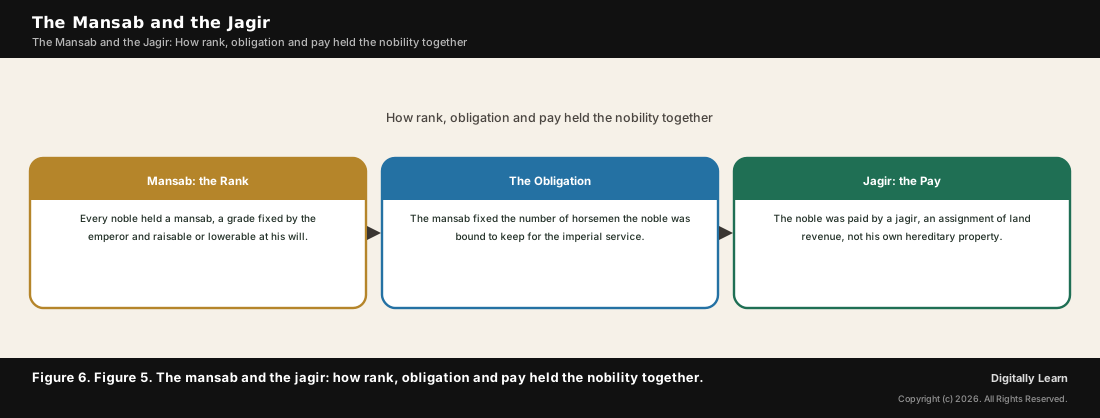
The detail of this rank-and-revenue system, the mansabdari and the jagirdari, belongs to the next part, on Akbar's administration; here it is enough to see that the brilliant nobility of the court rested upon an ordered grant of rank by the emperor.
UPSC Relevance and Exam Focus
Where Akbar's Rajput Policy Fits in the UPSC-CSE Syllabus
This topic belongs to General Studies Paper I: medieval Indian history and culture, and Akbar's Rajput policy, the Battle of Haldighati and the Navaratnas are a regular ground for questions.
The questions most often test the alliance with the Rajputs, the Battle of Haldighati and Maharana Pratap, and the members of the Navaratnas, above all Tansen and Birbal.
Several linked points recur and are worth holding in working memory:
- The Amber alliance: Akbar married the daughter of Raja Bharmal of Amber in 1562.
- Haldighati: 1576; Raja Man Singh led the Mughals against Maharana Pratap, who escaped.
- The jizya: Abolished by Akbar; it was re-imposed by Aurangzeb a century later.
- The Navaratnas: Abul Fazl, Faizi, Todar Mal, Man Singh, Birbal, Tansen and others.
- Tansen: The greatest singer of the court; Akbar gave him the title Mian.
A 2019 question asked which statement about Mian Tansen is not correct, and the answer was the statement that Tansen was a title given to him by Akbar; in truth the title Akbar gave him was Mian, while Tansen was already his name when he came to the court.
A reader who knows that Akbar gave Tansen the title Mian, and that the name Tansen was his own, can pick out the incorrect statement; the others, that he composed Dhrupads, sang of his patrons and made new ragas, are all true.
Previous Year UPSC-CSE Questions
Previous Year UPSC-CSE Questions By the end you will be able to draft model answers for the following UPSC questions. Each question carries a collapsible framework showing how to approach it in the exam.
- UPSC Prelims 2019 GS-IWith reference to Mian Tansen, which one of the following statements is not correct?
How to approach this Prelims question
Approach: Test each statement: 'Tansen was the title given by Akbar' is NOT correct (the title Akbar gave was Mian; Tansen was his name); the Dhrupads, songs on patrons, and new ragas are all correct.
Trap to watch: Akbar gave Tansen the title Mian, not the name Tansen; so the statement that Tansen was Akbar's title is the incorrect one.
Key facts to recall:
- Tansen was one of the Navaratnas of Akbar's court.
- Akbar gave him the title Mian; Tansen was already his name.
- He composed Dhrupads and is said to have invented many ragas.
Answer signal: The statement that Tansen was a title given by Akbar (the incorrect one).
Sources and Further Reading
Editorial Disclaimer
This article is for UPSC preparation. The history of Akbar's Rajput policy rests on the Akbarnama, the Persian chronicles and the standard scholarship on the Mughal Empire.