


Overview
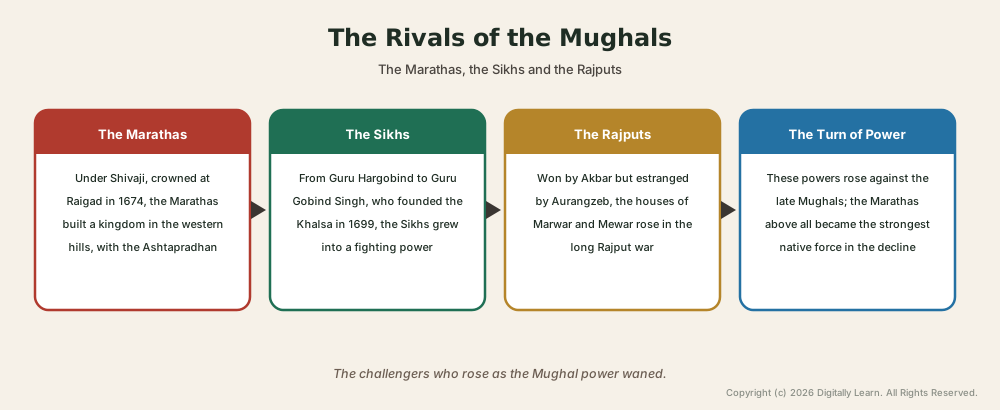
The rivals of the Mughals were the powers that rose against the empire and, as it declined, came to fill the place it left: the Marathas, the Sikhs and the Rajputs. The greatest were the Marathas, who under Shivaji built a kingdom in the western hills, with his coronation at Raigad in 1674 and his council of eight, the Ashtapradhan. The Sikhs, under a line of Gurus from Guru Hargobind to Guru Gobind Singh, who founded the Khalsa in 1699, grew from a faith into a fighting power. The Rajputs, won by Akbar but estranged by Aurangzeb, rose in the long Rajput war. This part covers the Marathas, the Sikhs, the Rajputs, and the exam focus.
The Marathas under Shivaji
Shivaji, the Coronation and the Maratha State
What is the significance of the Marathas: they were the greatest of the rivals of the Mughals, who built in the western Deccan a power that outlasted the empire and became, in the age of its decline, the strongest in India.
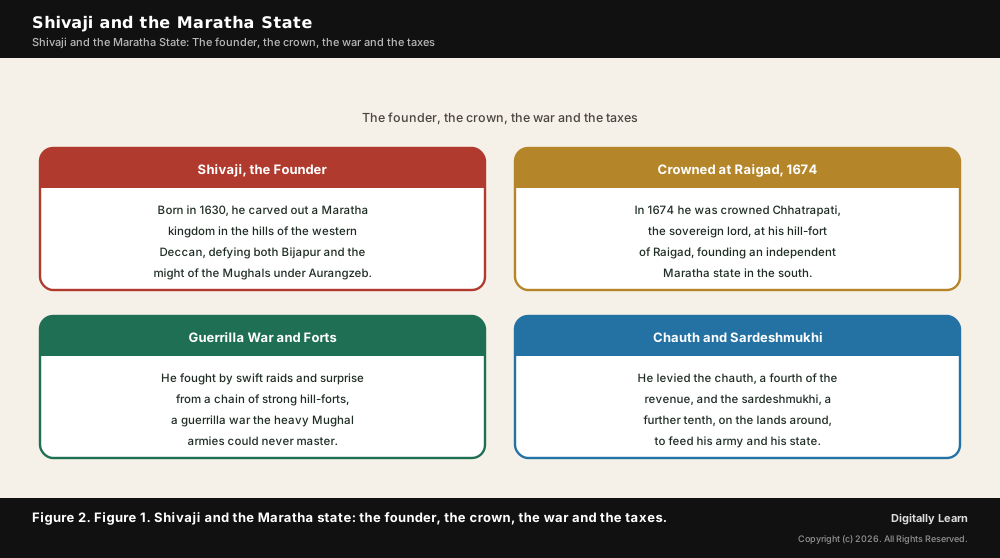
Shivaji built the Maratha kingdom. Born in 1630, Shivaji carved out, in the hills of the western Deccan, an independent Maratha kingdom, defying both the sultan of Bijapur and the might of the Mughals under Aurangzeb. He fought by a war of swift raids and surprise from a chain of strong hill-forts, a guerrilla war that the heavy Mughal armies could never master.
He was crowned at Raigad in 1674. In 1674 Shivaji was crowned Chhatrapati, the sovereign lord, at his hill-fort of Raigad, founding a Maratha state that stood on its own. To feed his army and his state, he levied the chauth, a fourth of the revenue, and the sardeshmukhi, a further tenth, upon the lands around. The figure below sets out his work.
The Ashtapradhan and the Rise of the Peshwas
What is the significance of the Ashtapradhan: it was the ordered council of government by which Shivaji ruled his state, and one of the best-known features of Maratha administration.
Shivaji ruled through the Ashtapradhan, a council of eight ministers, each over one branch of the state. At its head was the Peshwa, the chief minister; the Sumant, or Dabir, looked after foreign affairs; and the others held the finance, the records, the army, the justice and the religious charities of the kingdom. The table below names the eight.
| Minister | Charge |
|---|---|
| Peshwa | The chief minister, the head of the council. |
| Amatya (Mazumdar) | The finance and the accounts of the state. |
| Sachiv | The royal correspondence and records. |
| Mantri (Waqenavis) | The record of the king's daily doings. |
| Senapati (Sar-i-Naubat) | The commander of the army. |
| Sumant (Dabir) | Foreign affairs and dealings with other states. |
| Nyayadhish | Justice and the courts of law. |
| Panditrao | Religious affairs and charities. |
After Shivaji the Peshwas rose. His son Sambhaji carried on the struggle and was at last taken and killed by Aurangzeb. In the years that followed, the office of the Peshwa grew greater than the throne itself; Balaji Vishwanath, the first of the great Peshwas, restored and streamlined the Maratha power after Sambhaji, and under his line the Marathas became the strongest native power of India.
The Sikhs: from Faith to Power
From Guru Hargobind to the Khalsa
What is the significance of the Sikhs: under their later Gurus the Sikhs were changed from a peaceful religious community into a fighting people, and became, in time, a power that broke the Mughal hold on the Punjab.
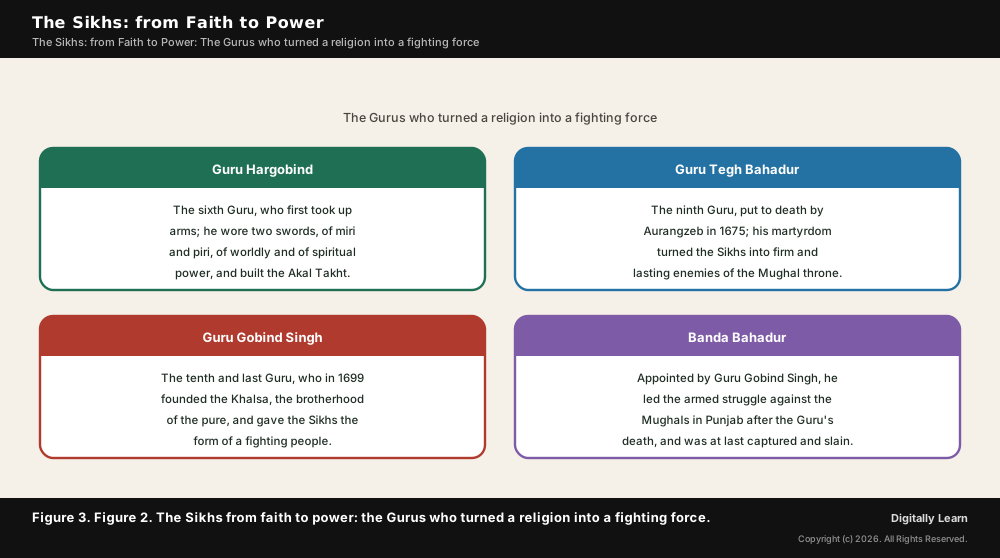
The Sikhs first took up arms under Guru Hargobind. The sixth Guru, Guru Hargobind, wore two swords, of miri and piri, of worldly and of spiritual power, and built the Akal Takht at Amritsar; with him the Sikhs began to arm themselves against the persecution of the Mughals.
The martyrdom of Guru Tegh Bahadur hardened them. The ninth Guru, Guru Tegh Bahadur, was put to death by Aurangzeb in 1675, and his martyrdom turned the Sikhs into firm and lasting enemies of the Mughal throne.
Guru Gobind Singh founded the Khalsa. The tenth and last Guru, Guru Gobind Singh, in 1699 founded the Khalsa, the brotherhood of the pure, and gave the Sikhs the form and the discipline of a fighting people. After his death his general Banda Bahadur, whom he himself had appointed, led the armed struggle against the Mughals in the Punjab, until he too was captured and slain. The figure below sets out the rise of the Sikhs.
The Rajputs and the Mughals
From the Alliance of Akbar to the War with Aurangzeb
What is the significance of the Rajputs: they were first the firmest pillars of the empire and then, when that bond was broken, among the powers that turned against it.
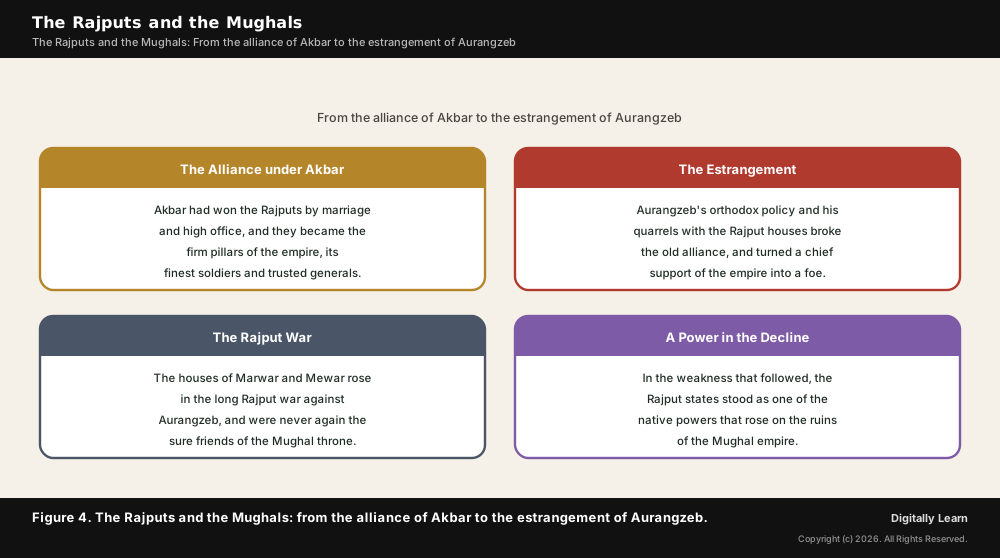
Akbar had won the Rajputs. By marriage and by high office Akbar had bound the great Rajput houses to the Mughal throne, and for three reigns they were the finest soldiers and the most trusted generals of the empire, the firm pillars of its strength.
Aurangzeb estranged them. The orthodox policy of Aurangzeb, and his quarrels with the Rajput houses, broke the old alliance. The houses of Marwar and Mewar rose in the long Rajput war against him, and the Rajputs were never again the sure friends of the Mughal throne. In the weakness that followed, the Rajput states stood as one of the native powers that rose on the ruins of the empire. The figure below sets out the story.
UPSC Relevance and Exam Focus
Where the Rivals of the Mughals Fit in the UPSC-CSE Syllabus
This topic belongs to General Studies Paper I: medieval Indian history, and the Marathas, the Sikhs and the Rajputs are a favourite ground for questions, the Marathas above all.
The questions most often test Shivaji and the Ashtapradhan, the rise of the Peshwas, the founding of the Khalsa, and the place of these powers in the decline of the empire.
Several linked points recur and are worth holding in working memory:
- Shivaji: crowned Chhatrapati at Raigad in 1674; the chauth (a fourth) and sardeshmukhi (a further tenth).
- The Ashtapradhan: Shivaji’s council of eight ministers; the Sumant held foreign affairs.
- The Peshwas: Balaji Vishwanath, the first of the great Peshwas, after Sambhaji.
- The Khalsa: founded by Guru Gobind Singh, the tenth Guru, in 1699.
- The Rajputs: won by Akbar, estranged by Aurangzeb; the houses of Marwar and Mewar.
A 1995 question asked of which administration the Ashtapradhan was the council of ministers, and the answer was the Maratha administration, the council of eight by which Shivaji governed his state, not the Gupta, the Chola or the Vijayanagara.
A 2000 question asked who streamlined the Maratha administration after Sambhaji, and the answer was Balaji Vishwanath, the first of the great Peshwas, under whose line the Marathas became the strongest power in India.
Previous Year UPSC-CSE Questions
Previous Year UPSC-CSE Questions By the end you will be able to draft model answers for the following UPSC questions. Each question carries a collapsible framework showing how to approach it in the exam.
- UPSC Prelims 1995 GS-IAshtapradhan was a Council of Ministers
How to approach this Prelims question
Approach: Recall that the Ashtapradhan was Shivaji's council of eight ministers; therefore it belongs to the Maratha administration.
Trap to watch: It is the Maratha council, not the Gupta, Chola or Vijayanagara; do not confuse it with other administrative systems.
Key facts to recall:
- Ashtapradhan = Shivaji's council of eight ministers.
- It was headed by the Peshwa.
- It belongs to the Maratha administration.
Answer signal: In the Maratha Administration.
- UPSC Prelims 2000 GS-IWho among the following streamlined the Maratha administration after Sambhaji?
How to approach this Prelims question
Approach: Recall that after Sambhaji the Peshwas rebuilt the Maratha power, and that the first of the great Peshwas was Balaji Vishwanath.
Trap to watch: Raja Ram (Rajaram) carried on the struggle, but it was Balaji Vishwanath who streamlined the administration as the first great Peshwa.
Key facts to recall:
- Sambhaji, Shivaji's son, was killed by Aurangzeb.
- Balaji Vishwanath was the first of the great Peshwas.
- Under the Peshwas the Marathas became the strongest power.
Answer signal: Balaji Viswanath.
Sources and Further Reading
Editorial Disclaimer
This article is for UPSC preparation. The account of the Marathas, the Sikhs and the Rajputs rests on the standard scholarship on the Mughal Empire and the powers that rose in its decline.