


Overview

Aurangzeb (1618 to 1707) was the sixth Mughal emperor, who ruled from 1658 to 1707 under the title Alamgir. The third son of Shah Jahan and Mumtaz Mahal, he won the throne in a war of succession against his brothers. Under him the Mughal Empire reached its greatest extent, with the annexation of Bijapur and Golconda, but his orthodox religious policy, the jizya of 1679, a string of revolts and a war of more than twenty years with the Marathas in the Deccan left it drained when he died.
Aurangzeb: Birth, Family and the War of Succession
Aurangzeb Rule Period, Birth and Career as a Prince
Aurangzeb grew up as a soldier and administrator. He was educated in military strategy, administration, Islamic studies and Persian literature, mastered the Quran and the hadith, and preferred Persian to his ancestral Chagatai Turkic. His father Shah Jahan gave him a string of hard postings, and these shaped the emperor he became.
- Viceroy of the Deccan, 1636 to 1644: In 1636 he brought the Nizam Shahi dynasty of Ahmednagar to an end; the Mughal Deccan then had four provinces, Khandesh, Berar, Telangana and Daulatabad.
- Gujarat, 1645 to 1647: Governor of Gujarat, rewarded for bringing stability.
- Balkh, 1647: A costly Central Asian campaign against the Uzbeks that ended in retreat.
- Multan and Sindh, 1648 to 1652: Two failed attempts, in 1649 and 1652, to retake Kandahar from the Safavids of Iran.
- Deccan again, 1653 to 1658: His officer Murshid Quli Khan extended the zabt revenue system of the north to the Deccan, and Aurangzeb attacked Golconda and Bijapur until Shah Jahan made peace with them.
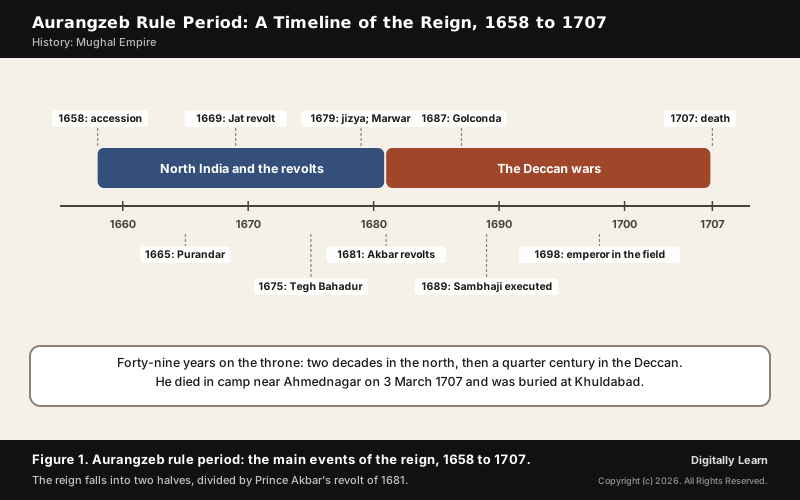
His family also shaped the succession that followed him. His chief wife was Dilras Banu Begum, a Safavid princess married in 1637 and remembered as Rabia-ud-Daurani; he also married Nawab Bai in 1638. His sons were Muhammad Sultan, the eldest, who died in prison; Muhammad Muazzam, later Bahadur Shah I; Muhammad Azam Shah; Muhammad Akbar, who rebelled against him in 1681; and Kam Bakhsh.
Mughal War of Succession, 1657 to 1659: How Aurangzeb Won
The Mughals had no rule that the eldest son inherits. They followed the Timurid custom of coparcenary inheritance, a division of the inheritance among all the sons, so each prince had a claim, and the phrase takht ya takhta, the throne or the coffin, describes the result. When Shah Jahan fell ill in September 1657, rumours spread that he had died, and his four sons, each a provincial governor, moved to seize the throne.
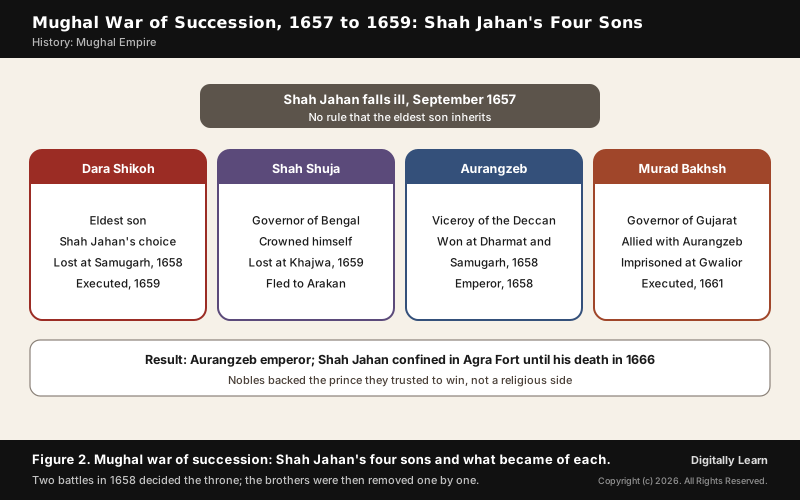
- Bahadurpur, 14 February 1658: An imperial army under Dara’s son Sulaiman Shikoh and Raja Jai Singh defeated Shah Shuja near Varanasi.
- Dharmat, 15 April 1658: The combined armies of Aurangzeb and Murad Bakhsh defeated the imperial army under Jaswant Singh of Marwar, helped by better artillery and tactics.
- Samugarh, 29 May 1658: Near Agra, Aurangzeb’s experienced army routed Dara Shikoh’s hastily raised force; Dara left the field and fled.
- Khajwa, 5 January 1659: Aurangzeb defeated Shah Shuja, who fled to Arakan.
Victory was followed by removal. Aurangzeb broke his agreement with Murad Bakhsh, imprisoned him at Gwalior and had him executed in 1661. Dara was captured and executed in 1659 on a charge of apostasy. After Shah Jahan recovered in July 1658, Aurangzeb declared him unfit to rule and confined him in the Agra Fort, where his daughter Jahanara cared for him until his death in 1666.
Aurangzeb Religious Policy and the Jizya
Orthodox Rule: Sharia, Zawabit and the Fatawa-i-Alamgiri
Aurangzeb's religious policy was that of an orthodox Sunni ruler. He was a follower of the Mujaddidi order of Ahmad Sirhindi's line, whose puritan thought is held to have inspired him, and based his kingship on the Quran instead of the Persian idea of farr-i izadi, a divine light passing to the king, that Akbar's court had used. Where Akbar had followed sulh-i kul, peace with all, Aurangzeb set out to rule as a defender of the sharia, Islamic law.
- Fatawa-i-Alamgiri: Hundreds of jurists compiled a digest of Hanafi law for the empire, which remained a reference text of Islamic law in South Asia long after him.
- Zawabit: Alongside the sharia he issued secular decrees and insisted that these could override it, so the state was never run on religious law alone.
- Court life: He banned the Persian new year festival of Nauroz, cut back court patronage of painting and stopped stamping verses of the Quran on coins, because coins passed through many hands.
- Social orders: In 1663 he ordered officials never again to allow a widow to be burnt as sati, an order that could be evaded by bribing officials.
- Taxes remitted: Soon after coming to power he abolished more than 80 long-standing taxes that fell on all his subjects.
His orthodoxy also fell on Muslims. The mystic Sarmad was executed for heresy, and governors were told to punish Muslims who dressed like non-Muslims. Historians still debate how far music was banned: court patronage fell sharply, but there was no complete ban. Akbar's contrasting approach is in Akbar's religion and the Din-i-Ilahi.
What Is Jizya Tax? Its Reimposition in 1679
The jizya of 1679 was graded by wealth, so the amount varied with a subject's economic status, and collection was often waived in regions hit by calamity. Its collectors had to be Muslims. Large groups were exempt from it, and the tax drew protest from Hindu rulers, members of the royal family and officials at court.
- Exempt: Rajput and Maratha state officials, Brahmins, women, children, the old, the disabled, the unemployed and the ill.
- Customs duty: Hindu merchants paid 5 per cent against 2.5 per cent for Muslim merchants, a break from Akbar’s uniform rates.
- Land tax: To meet the cost of his wars he raised land taxes, which fell heavily on the Jat peasants around Mathura.
Why did he reimpose it? Most modern historians see realpolitik more than bigotry: the treasury was strained by constant war, and the tax won him the support of the orthodox ulema, the Muslim scholars whose backing he needed after deposing his father and killing his brothers. Its immediate effect was protest among the people and among Hindu officials at court.
Temples, Grants and Hindu Nobles: The Historians' Debate
Aurangzeb both destroyed temples and endowed them, and historians weigh the two. Court chronicles record demolitions: the Vishvanath temple at Varanasi in 1669, the Kesava Deo temple at Mathura after the Jat rising of 1669 to 1670, and around 1679 temples at Khandela, Udaipur, Chittor and Jodhpur, which were patronised by rebels. In 1672 to 1673 he also ordered grants held by Hindus throughout the empire to be resumed.
Yet the same emperor issued farmans in support of temples, maths and gurudwaras, among them the Mahakaleshwar temple at Ujjain, the Umananda temple at Guwahati, the Balaji temple at Chitrakoot, the Shatrunjaya Jain temples and a gurudwara at Dehradun. In 1661-62 he sent a cloth and 25 rupees to a jogi, Anand Nath, and asked to be told whenever he could be of service. Mughal emperors, Aurangzeb included, issued grants for the repair of temples damaged in war.
| Reading | What it stresses | Example |
|---|---|---|
| Religious zeal | Orthodoxy drove policy | Jizya; Vishvanath, 1669 |
| Political reading | Temples as seats of power | Rebel patrons' temples, 1679 |
| Mixed record | Grants alongside demolitions | Temples at Ujjain, Guwahati |
His nobility tells a similar mixed story. Between 1679 and 1707 the share of Hindu officials in the Mughal administration rose by half to 31.6 per cent, mainly because Marathas were recruited for the Deccan wars, and in the second half of his reign Marathas outnumbered Rajputs. He gave the title Mirza Raja to his two highest nobles, Jai Singh and Jaswant Singh, both Rajputs.
Execution of Guru Tegh Bahadur in 1675
Guru Tegh Bahadur was the ninth Sikh Guru, leader of the Sikhs from 1664, the founder of Anandpur Sahib, and a poet whose 115 hymns are in the Guru Granth Sahib. Kashmiri Pandits facing forced conversion approached him for help, and he sent word to Aurangzeb that if the Guru himself could be made to convert, they would follow.
- Aurangzeb ordered his arrest, and the Guru was brought to Delhi and pressed to convert.
- Three companions arrested with him, Bhai Mati Das, Bhai Dayal Das and Bhai Sati Das, were killed before him.
- He refused, and was beheaded in 1675 at Chandni Chowk, near the Red Fort, on Aurangzeb’s orders.
- Gurudwara Sis Ganj Sahib and Gurudwara Rakab Ganj Sahib in Delhi mark the places of his execution and cremation.
The execution changed the Sikh response to Mughal power. His son and successor, Guru Gobind Singh, militarised his followers and founded the Khalsa in 1699, and in 1705 wrote the Zafarnama to Aurangzeb, accusing him of cruelty. The Guru is remembered as Hind di Chadar, the protector of India, and India observes his martyrdom day, Shaheedi Diwas, on 24 November.
Revolts Against Aurangzeb in North India and the Frontiers
Jat, Satnami and Pashtun Revolts
Aurangzeb faced rebellion from peasant and tribal groups in the heart of the empire. Mughal taxation and his religious policy fed their grievances, and these groups had gained military experience in Mughal service or in opposing it. The Sikhs, Jats and Satnamis in the north, the Ahoms in the north-east and the Marathas in the Deccan all rose against him.
| Revolt | Leader and place | Outcome |
|---|---|---|
| Jat, 1669 | Gokula, near Mathura | Crushed; Gokula executed |
| Satnami, 1672 | Narnaul, near Delhi | Crushed by a large army |
| Pashtun, 1672 | Khushal Khan Khattak | Only partly suppressed |
- Jats: In 1669 Gokula, a zamindar of Tilpat, rallied about 20,000 Jats and peasants against Mughal taxation and killed the faujdar Abdul Nabi Khan; he was captured and executed, but Raja Ram Jat rose again, plundered Akbar’s tomb, and was killed in 1688. The rising led in time to the Jat kingdom of Bharatpur.
- Satnamis: A sect founded by Bir Bhan at Narnaul in 1657, drawing on Kabir’s teaching and rejecting caste; in 1672 its peasants rose and marched on Delhi until an army of 10,000 with artillery crushed them.
- Pashtuns: In 1672 the Afghan tribes around the Khyber rose under the poet Khushal Khan Khattak and routed a Mughal army; by 1674 Aurangzeb had camped at Attock to take charge, and used force, diplomacy and bribery to split the tribes.
Rathore Rebellion in Marwar and Prince Akbar's Revolt
Rajput chiefs had served the Mughals as high nobles since Akbar's time, and Aurangzeb's handling of Marwar turned the Rathores against him. When Maharaja Jaswant Singh of Marwar died in 1678, Aurangzeb interfered in the succession: he tried to divide Marwar between two claimants and proposed that the infant heir Ajit Singh be raised as a Muslim.
- Leader: Durgadas Rathore protected the infant Ajit Singh and led the Rathore nobles in a war of guerrilla raids and alliances that lasted from 1679 to 1707.
- Allies: Mewar joined the Rathores, so the conflict became a wider Rajput rising.
- Outcome: Jodhpur was retaken by the Rathores on 12 March 1707, nine days after Aurangzeb’s death, and Ajit Singh was restored.
The rebellion drew in the emperor's own son. In 1681 Prince Muhammad Akbar rebelled against his father and went to Rajputana, where Durgadas gave him refuge. He then turned to the Marathas and the Deccan Sultanates for support before going into exile in Safavid Iran in 1686; he died in 1706. Aurangzeb moved his court to Aurangabad and took command in the Deccan, where he spent the last twenty-six years of his life.
Ahom Resistance and the Battle of Saraighat (1671)
In the north-east, the Ahom kingdom of Assam resisted Mughal expansion for decades. In 1661 Mir Jumla, the viceroy of Bengal, took Kuch Behar and reached the Ahom capital Garhgaon in March 1662, and the Ahoms were defeated in 1663; Mir Jumla died on the way back to Dhaka.
The Ahoms rose again. In 1671 the Ahom commander Lachit Borphukan defeated the Mughal forces under Raja Ram Singh I in a naval battle on the Brahmaputra at Saraighat, near present-day Guwahati, and pushed the Mughals west beyond the Manas river. The Ahoms took Guwahati for good after the battle of Itakhuli in 1682.
Bengal saw Mughal success in the same years. The governor Shaista Khan, appointed in 1664, drove out the Portuguese and Arakanese pirates and in 1666 recaptured the port of Chittagong from the Arakanese king.
Aurangzeb Deccan Policy: Shivaji, Bijapur, Golconda and the Marathas
Aurangzeb and Shivaji: Shaista Khan, Purandar and the Escape From Agra
The Deccan policy of Aurangzeb had two aims: to end the Deccan Sultanates of Bijapur and Golconda, and to crush the rising Maratha power. Shivaji built that power by taking forts from Bijapur and killing its general Afzal Khan, and then turned on Mughal territory. The contest between the two men ran through four stages.
- Shaista Khan, 1660 to 1663: Aurangzeb sent his maternal uncle with a large army; on the night of 5 April 1663 Shivaji raided his residence in Pune, killed his son and cut off three of his fingers.
- Surat, 1664: Shivaji sacked the wealthy Mughal port and carried off plunder worth more than Rs 1 crore.
- Purandar, 1665: Raja Jai Singh I besieged Purandar fort, and by the treaty of 11 June 1665 Shivaji gave up 23 forts, kept 12, and agreed to serve the Mughals, with his son Sambhaji as a mansabdar of 5,000.
- Agra, 1666: On 12 May 1666 Shivaji was made to stand at court among low-ranking nobles; he refused imperial service, was placed under house arrest, escaped, and resumed his campaigns.
The insult at Agra cost the Mughals dearly. Shivaji recovered his forts, sacked Surat a second time in 1670 and in 1674 was crowned Chhatrapati at Raigad, declaring an independent kingdom. He died on 3 April 1680. The Mughals had long made it a rule to defeat an opponent without humiliating him, and the Agra episode showed what breaking that rule could cost.
Aurangzeb Empire Map: Bijapur, Golconda and the Greatest Extent
After Prince Akbar's revolt, Aurangzeb sent his armies against the Deccan Sultanates, which had given support to the rebel prince. Aurangzeb had first proposed attacking the Adil Shahis of Bijapur and the Qutb Shahis of Golconda as a prince, when he besieged Golconda Fort in 1656.
- Bijapur: Mughal forces under Prince Azam Shah besieged the city from April 1685; Aurangzeb arrived in person, and Sikandar Adil Shah surrendered in September 1686 and was imprisoned. NCERT dates the annexation of Bijapur to 1685.
- Golconda: In 1687 Aurangzeb besieged Golconda Fort for eight months; it fell only when a gate was opened by treachery, and Abul Hasan Qutb Shah spent his last twelve years in Mughal prison.
- The prize: Golconda held the Kollur diamond mine, then probably the most productive in the world.

By 1689 the Mughal Empire covered about 4 million square kilometres, with an estimated population of over 158 million, its greatest extent. The conquest also had effects beyond the Deccan: when Golconda fell, the European companies looked for new bases, the English moved their trade to Bombay, Calcutta and Madras, and the port of Masulipatnam declined.
The Long Maratha War: Sambhaji, Rajaram and Tarabai (1689 to 1707)
Shivaji's son Sambhaji ruled from 1681 and sheltered Prince Akbar. In February 1689 Mughal forces captured him at Sangameshwar, and on Aurangzeb's order he was tortured and executed at Tulapur, on the Bhima river near Pune, on 11 March 1689. Aurangzeb expected the Maratha state to collapse. It did not.
- Rajaram: Shivaji’s younger son escaped south to the fort of Jinji in present-day Tamil Nadu and carried on the war until his death in 1700.
- Tarabai: Rajaram’s widow then led the resistance as regent for her young son Shivaji II.
- Guerrilla war: The Marathas avoided set battles and raided instead; with no single centre to capture, the Mughals had to contest every fort and district.
- Maratha expansion: Even as the emperor took forts such as Satara, Maratha bands raided east into Malwa and Hyderabad.
From 1698 Aurangzeb managed the Deccan campaigns in person, moving with a vast camp from fort to fort. The war cost him about a fifth of his army and brought the treasury close to bankruptcy, and it was still unresolved when he died. The Maratha story after 1707 continues in the rivals of the Mughals: the Marathas, the Sikhs and the Rajputs.
Administration, Europeans and Architecture Under Aurangzeb
Mansabdari and the Jagir Crisis Under Aurangzeb
The Mughal nobility served through the mansabdari system: each noble, or mansabdar, held a rank whose zat fixed his position and salary and whose sawar fixed the horsemen he kept. Most were paid through jagirs, assignments of the revenue of a territory, rather than cash. Under Aurangzeb this system came under strain.
- More nobles: In Akbar’s reign 29 mansabdars held a rank of 5,000 zat; by Aurangzeb’s reign there were 79.
- Fewer good jagirs: The revenue actually collected from a jagir was often less than the sum granted, and nobles waited long for an assignment.
- Pressure on peasants: Jagirdars tried to extract as much as they could while they held a jagir, and the peasantry suffered in the last years of the reign.
- New nobles: Marathas and Deccanis entered the nobility in large numbers during the Deccan wars, which enlarged the demand for jagirs further.
Aurangzeb tried to keep the revenue records exact. In 1665 he ordered his revenue officials to prepare annual records of the number of cultivators in each village and to assess the jama, the demand, after careful scrutiny. The system itself is explained in Akbar's administration, mansabdari and the revenue system.
Aurangzeb and the European Companies: Child's War of 1686 to 1690
European trading companies were growing along the coasts in Aurangzeb's reign, and he dealt with them from a position of strength. In 1667 he issued a firman allowing the French East India Company to open a factory at Surat, after an embassy carrying a letter from Louis XIV.
- Child’s War, 1686 to 1690: The English East India Company, failing to win trading privileges by negotiation, went to war with the empire; in 1689 a Mughal fleet from Janjira under Sidi Yaqub blockaded Bombay.
- Pardon, 1690: The Company sent envoys to Aurangzeb’s camp to ask for pardon, agreed to pay an indemnity and promised not to repeat such actions.
- Piracy, 1695: When the English pirate Henry Every captured the Mughal ship Ganj-i-Sawai near Surat, Aurangzeb shut four English factories until the Company promised reparations.
The episode shows the balance of power in the 1680s. On land the English Company was no match for the empire, and it had to accept Mughal terms. By 1765 the same Company held the diwani of Bengal, the right to collect its revenue, from his weakened successors.
Aurangzeb Architecture: Moti Masjid, Badshahi Mosque and Bibi ka Maqbara
Aurangzeb was less involved in building than his father, and most of his building revolved around mosques. He repaired more mosques than any earlier Mughal ruler. He was a skilled calligrapher in the naskh script and copied the Quran himself.
| Monument | Place | Feature |
|---|---|---|
| Moti Masjid | Red Fort, Delhi | White marble; his private mosque |
| Badshahi Mosque | Lahore | Largest Mughal-era mosque |
| Bibi ka Maqbara | Aurangabad | Taj of the Deccan |
- Moti Masjid: The Pearl Mosque, built of white marble inside the Red Fort at his own expense and completed in 1663, so that he could pray close to his private rooms.
- Badshahi Mosque: Built at Lahore between 1671 and 1673, opposite the Lahore Fort, it was the largest mosque built in the Mughal era.
- Bibi ka Maqbara: The tomb of his wife Dilras Banu Begum, built by their son Azam Shah and modelled on the Taj Mahal.
His secular works were practical ones. He built a wall around Aurangabad, many of whose gates survive, along with bridges, caravanserais and gardens, patronised the dargahs of Sufi saints such as Bakhtiyar Kaki, and tried to maintain the royal tombs. The full story of Mughal building and painting is in Mughal art, architecture and painting.
Aurangzeb Death, Tomb and the Decline of the Mughal Empire
How Aurangzeb Died: Death in 1707 and His Grave at Khuldabad
Aurangzeb died in camp shortly after his morning prayer. He had outlived many of his children, and he left only 300 rupees, which were given to charity on his instructions. He asked for a simple funeral, and his last letters show a man troubled by the long war and by what he had failed to do for the empire.
- The grave: An open-air grave in the courtyard of a Sufi shrine at Khuldabad, unlike the great Mughal tombs such as the Taj Mahal.
- The cost: It is said he paid for it by stitching caps, and that it cost 14 rupees and 12 annas.
- Later changes: Lord Curzon had it covered with marble and a pierced marble screen; the grave is still open to the sky.
He named no successor and told his sons to divide the empire, and they fought instead. In June 1707 his son Azam Shah was defeated and killed at the battle of Jajau by the army of his elder brother Muazzam, who took the throne as Bahadur Shah I. The later Mughals are covered in the decline of the Mughal Empire.
Was Aurangzeb Responsible for the Mughal Decline? An Assessment
Aurangzeb left the empire at its largest and at its most strained. The long war in the Deccan had depleted its military and financial resources, the jagir crisis had weakened the nobility, and revolts had spread among the Marathas, Jats, Sikhs and Rajputs. His successors could not check their powerful mansabdars, and governors who held both revenue and military office, diwani and faujdari, slowly became rulers in their own right.
| Factor | Under Aurangzeb | After 1707 |
|---|---|---|
| Finances | Deccan war drains treasury | Revenue to Delhi falls |
| Nobility | Jagir shortage | Governors rule provinces |
| Resistance | Marathas, Jats, Sikhs, Rajputs | Regional states rise |
Historians differ on how much of this was his doing. One view holds that his orthodoxy provoked the revolts that broke the empire; another stresses deeper causes, the overstretch of a vast empire, the jagir system and the rise of regional powers, which a weaker ruler would also have faced. A balanced answer gives him a large share of the blame without making him its only cause. The regional states that followed are in the successor states of the Mughal Empire.
Previous Year UPSC-CSE Questions
Previous Year UPSC-CSE Questions By the end you will be able to draft model answers for the following UPSC questions. Each question carries a collapsible framework showing how to approach it in the exam.
- UPSC Mains 2017 GS-IClarify how mid-eighteenth century India was beset with the spectre of a fragmented polity.
Answer outline: how to structure the answer
What the question asks, the main arguments, relevant examples and the direction of the conclusion. This is not a full model answer.
Introduction: Introduce the eighteenth century as a time when Mughal authority passed to regional powers after Aurangzeb's death in 1707.
Body (sub-themes to develop):
- Legacy of Aurangzeb: Deccan war, exhausted treasury, jagir crisis.
- Weak successors and factions of nobles; governors holding diwani and faujdari.
- Successor states: Awadh, Bengal, Hyderabad under former governors.
- States won by force: Marathas, Sikhs, Jats; Rajput states.
- Invasions of Nadir Shah (1739) and Ahmad Shah Abdali exposing Delhi's weakness.
Conclusion: Conclude that the empire fragmented into regional polities, many still acknowledging the emperor in form, which opened the way for the English Company.
- UPSC Prelims 2003 Prelims-GSAssertion and Reason:
- Assertion (A): Marathas emerged as the strongest native power in India after the decline of Mughal empire.
- Reason (R): Marathas were the first to have clear concept of a united Indian nation.
How to approach this Prelims question
Approach: Step 1: test the assertion: the Marathas outlasted Aurangzeb's long war in the Deccan, raided into Malwa and Hyderabad, and after 1707 won their independence by force, so A is true. Step 2: the official key also accepts R. Step 3: a claim about ideas of nationhood does not explain military and political strength, so R does not explain A.
Trap to watch: A claim about ideas of nationhood does not explain military and political strength.
Key facts to recall:
- (a) Both true and R explains A: wrong. The Marathas' rise rested on their war against Aurangzeb and their expansion by force, not on an idea of a united nation.
- (b) Both true, but R does not explain A: correct, the official answer. A holds, the key accepts R, and nationhood does not explain military strength.
- (c) A true but R false: wrong by the official key, which accepts R as true.
- (d) A false but R true: wrong. A is true: the Marathas outlasted Aurangzeb and won their independence by force after 1707.
Answer signal: Both true, but R is not the correct explanation of A: option (b), the official answer.
Sources
- NCERT: Our Pasts II (Class VII), The Mughal Empire; Eighteenth-Century Political Formations
- NCERT: Themes in Indian History II (Class XII), Bhakti-Sufi Traditions; Peasants, Zamindars and the State; Kings and Chronicles
- PIB: PM's address on the 350th Shaheedi Diwas of Sri Guru Tegh Bahadur Ji, Kurukshetra
- PIB: Home Minister's tribute on Guru Tegh Bahadur's 350th Martyrdom Day
- Delhi Tourism (Govt of NCT of Delhi): Spiritual Delhi, Gurudwara Sis Ganj
- Maharashtra Tourism (Govt of Maharashtra): Bibi-ka-Maqbara
- Wikipedia: Aurangzeb
- Wikipedia: Mughal war of succession (1658–1659)
- Wikipedia: Battle of Samugarh
- Wikipedia: Battle of Dharmat
- Wikipedia: Dara Shikoh
- Wikipedia: Jizya
- Wikipedia: Fatawa-e-Alamgiri
- Wikipedia: Guru Tegh Bahadur
- Wikipedia: Shivaji
- Wikipedia: Treaty of Purandar (1665)
- Wikipedia: Sambhaji
- Wikipedia: Rajaram I
- Wikipedia: Mughal–Maratha Wars
- Wikipedia: Siege of Bijapur
- Wikipedia: Siege of Golconda
- Wikipedia: Muhammad Akbar (Mughal prince)
- Wikipedia: Durgadas Rathore
- Wikipedia: Satnami rebellion
- Wikipedia: Gokula
- Wikipedia: Battle of Saraighat
- Wikipedia: Child's War
- Wikipedia: Moti Masjid (Red Fort)
- Wikipedia: Badshahi Mosque
- Wikipedia: Bibi Ka Maqbara
- Wikipedia: Tomb of Aurangzeb
- Wikipedia: Bahadur Shah I
- UPSC: Civil Services Examination question papers
Editorial Disclaimer
This article draws on the NCERT history textbooks and the other sources listed on this page. Some dates differ by a year between sources.