


Overview
Why India's pre-1966 food crisis forced the seed-based agricultural transformation.
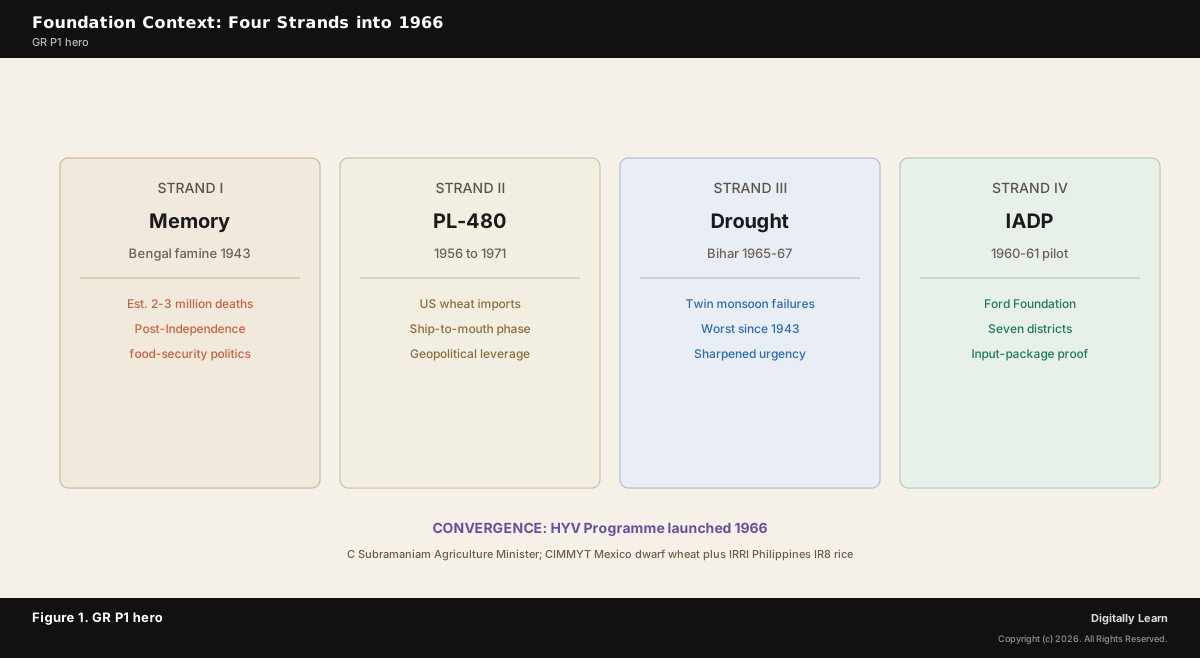
The Green Revolution in India is the seed-based agricultural transformation of the late 1960s and 1970s that ended the post-Independence food-deficit phase and made the country self-sufficient in food grains. The transformation was built on the High-Yielding-Variety (HYV) Programme launched 1966, with dwarf wheat and rice varieties developed at the International Maize and Wheat Improvement Centre (CIMMYT) Mexico and the International Rice Research Institute (IRRI) Philippines, adapted for Indian conditions at the Indian Agricultural Research Institute (IARI) New Delhi. The foundation context that made this transformation politically urgent included the Bengal famine 1943 institutional memory, the post-Independence food-grain deficit, the PL-480 (Public Law 480) wheat-import dependence on the United States from 1956 onwards, the Ship-to-mouth phase of the early 1960s, the 1965-66 and 1966-67 Bihar drought, and Lal Bahadur Shastri's Jai Jawan Jai Kisan slogan of 1965. The Ford Foundation Intensive Agricultural District Programme (IADP) of 1960-61 and the Intensive Agricultural Area Programme (IAAP) that followed were the institutional pilots that proved the input-package model.
Background and Historical Context
The foundation context shows why the Green Revolution was not a technocratic optimisation but a politically forced response to a recurring food crisis. India's first two decades of Independence operated under structural food deficit; the country imported wheat under PL-480 with the geopolitical leverage that came with American food aid. The Bihar drought of 1965-67 sharpened the urgency. Lal Bahadur Shastri's Jai Jawan Jai Kisan slogan in 1965 yoked national-security and food-security imperatives. UPSC Prelims has tested FCI's economic-cost composition that emerged from the GR procurement architecture (UPSC Prelims 2019), the CGIAR-and-ICRISAT international agricultural research lineage that includes CIMMYT where Norman Borlaug worked (UPSC Prelims 2021), and the National Food Security Act 2013 provisions that completed the legal scaffolding of the GR-era food-security project (UPSC Prelims 2018).
What is the significance of the pre-Green-Revolution context? Three operational dimensions follow. The food-deficit baseline binds the institutional memory of the Bengal famine 1943 (deaths estimated at two to three million) to the post-Independence import-dependence that ran from PL-480 in 1956 through the early 1960s Ship-to-mouth phase. The geopolitical leverage dimension explains how American wheat aid under PL-480 created political pressure that pushed India toward seed-based self-sufficiency rather than continued import-dependence. The institutional pilot dimension covers the Ford Foundation Intensive Agricultural District Programme of 1960-61 across seven districts, expanded as IAAP, which proved the HYV-seed-fertiliser-irrigation input-package model before the national HYV Programme launched 1966.
The foundation thread connects to several current policy debates. The food-security architecture built on the GR foundation runs from FCI (established 1965 under Food Corporations Act 1964) through the National Food Security Act 2013 (covered in Agri P10), into contemporary nutrition-security debates around PMGKAY, eShram, and the One-Nation-One-Ration-Card system. The international agricultural research lineage that produced the Green Revolution still operates through CGIAR centres including CIMMYT Mexico, IRRI Philippines, and ICRISAT Hyderabad. The seed-system reform debate around private-sector breeding versus public-sector breeding traces back to the original HYV public-private partnership architecture. The doubling farmers' income goal of the Ashok Dalwai Committee 2017-2018 represents the next-phase reframing of the foundational food-self-sufficiency objective.
Introduction: The Foundation Context
Why the foundation context matters before the revolution narrative
Most accounts of the Green Revolution start with Norman Borlaug at CIMMYT Mexico or with MS Swaminathan at IARI New Delhi. That entry point makes the revolution feel like a technocratic optimisation. The honest account starts with the food-deficit phase that pushed India toward seed-based transformation. The post-Independence food-grain output trailed population growth; recurring drought tested the buffer; American wheat under PL-480 covered the gap with geopolitical strings attached.
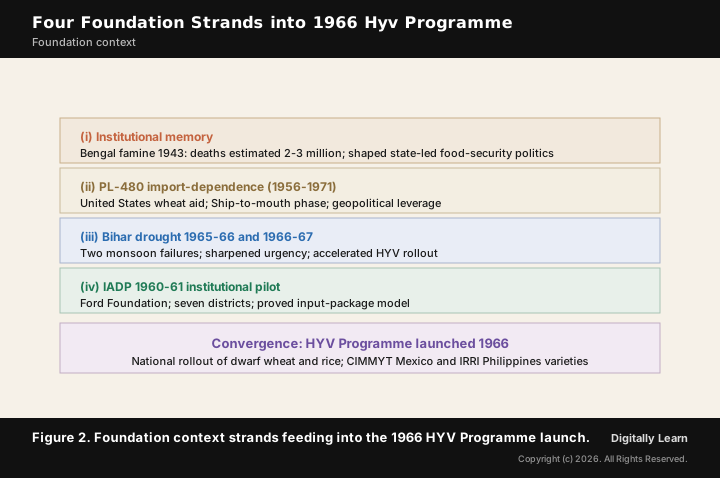
This foundation entry covers four anchor strands of the pre-Green-Revolution context. The institutional memory strand traces the Bengal famine 1943 into the post-Independence food-security imperative. The import-dependence strand covers PL-480 wheat aid from 1956 onward and the Ship-to-mouth phase of the early 1960s. The drought-trigger strand covers the Bihar drought of 1965-66 and 1966-67 that sharpened urgency. The institutional-pilot strand covers the Ford Foundation Intensive Agricultural District Programme of 1960-61 that proved the input-package model.
- (i) Institutional memory: Bengal famine 1943, with deaths estimated in the range of two to three million, shaped post-Independence food-security politics and the case for state-led intervention.
- (ii) Food-deficit baseline: First two decades of Independence operated under structural food deficit; output trailed population growth; buffer stocks were thin.
- (iii) PL-480 import-dependence: Public Law 480 wheat aid from the United States ran from 1956 to 1971; created the Ship-to-mouth phase and geopolitical leverage.
- (iv) Bihar drought 1965-67: Two successive monsoon failures sharpened the food-crisis urgency and accelerated the HYV Programme rollout.
- (v) IADP 1960-61: Ford Foundation Intensive Agricultural District Programme across seven districts proved the HYV-seed-fertiliser-irrigation input-package model that the 1966 national rollout adopted.
PL-480 and the Ship-to-Mouth Phase
American wheat aid, geopolitical leverage, and the case for self-sufficiency
The United States Agricultural Trade Development and Assistance Act of 1954, popularly known as Public Law 480 or PL-480, allowed American agricultural surpluses to be sold to developing countries in local currency. India became one of the principal recipients, with wheat imports ramping up from 1956 onwards.
By the early 1960s the country was importing wheat in bulk under PL-480 terms, with the buffer stock running so thin that fresh consignments were unloaded directly into the distribution pipeline. This precarious pattern was popularly called the Ship-to-mouth phase, a dependence on the next arriving cargo rather than on a domestic reserve.
- (a) PL-480 origins 1954: Eisenhower-era United States Agricultural Trade Development and Assistance Act allowed surplus-grain sale in recipient-country local currency, easing balance-of-payments pressure on importer.
- (b) India recipient phase 1956 to 1971: Wheat imports under PL-480 ran for around fifteen years; rupee-funded payments accumulated as American holdings of Indian rupees that fed back into bilateral programmes.
- (c) Ship-to-mouth phase early 1960s: Buffer stocks so thin that fresh wheat consignments were unloaded directly into the public distribution system; recurring fear of import-disruption shock.
- (d) Geopolitical leverage: American food aid created political pressure during the 1965 Indo-Pakistan war and around the 1971 Bangladesh Liberation War; the leverage strengthened the domestic case for food self-sufficiency.
- (e) Phase-out 1971: PL-480 imports tapered after the HYV Programme delivered domestic wheat output gains; the programme formally ended its India operation in the early 1970s.
Bihar Drought, IADP, and the Convergence into 1966
The drought trigger, the Ford Foundation pilot, and the institutional convergence
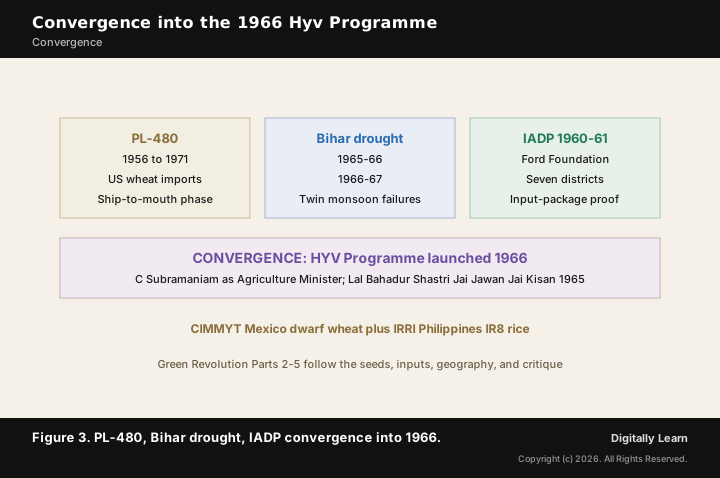
The 1965-66 and 1966-67 successive monsoon failures produced the Bihar drought, the most severe Indian food crisis since the Bengal famine. The crisis tested the thin buffer stock of the Ship-to-mouth phase and sharpened the political case for HYV-based transformation.
Parallel to this trigger, the Ford Foundation Intensive Agricultural District Programme (IADP) launched 1960-61 in seven districts (Pali, Aligarh, Ludhiana, Raipur, Thanjavur, West Godavari, and Shahabad). The pilot had been demonstrating that the integrated input package of HYV seeds, chemical fertilisers, assured irrigation, and credit could deliver durable yield gains.
- (a) Bihar drought 1965-67: Two successive monsoon failures produced the most severe food crisis since 1943; reinforced the urgency of seed-based transformation.
- (b) Lal Bahadur Shastri 1965: Prime Minister coined the Jai Jawan Jai Kisan slogan during the 1965 Indo-Pakistan war; yoked national-security and food-security narratives.
- (c) C Subramaniam 1964-1967: Agriculture Minister who championed the HYV approach; political risk-taking in 1965-66 enabled the national HYV Programme launch.
- (d) Ford Foundation IADP 1960-61: Seven-district pilot proving the input-package model; Pali, Aligarh, Ludhiana, Raipur, Thanjavur, West Godavari, Shahabad.
- (e) IAAP follow-on: Intensive Agricultural Area Programme expanded IADP coverage; demonstrated scalability before the 1966 national HYV Programme rollout.
- (f) HYV Programme launch 1966: National rollout of dwarf wheat and rice varieties; the proximate event marking the start of the Green Revolution covered in GR Part 2.
Definition, Intensive Agriculture, and the Geography Lens
What the Green Revolution is and what it is not
The Green Revolution is the seed-based agricultural transformation that ended India's post-Independence food deficit through the integrated input package of dwarf high-yielding varieties, chemical fertilisers, assured irrigation, mechanisation, and supportive credit.
The revolution was geographically concentrated in the Indo-Gangetic Plain, covered in GR Part 4. It was institutionally enabled by FCI (1965), the Minimum Support Price regime (covered in Agri P10), and the international agricultural research lineage built on CIMMYT Mexico and IRRI Philippines.
| Dimension | Pre-Green-Revolution (to mid-1960s) | Post-1966 pivot |
|---|---|---|
| Food-grain balance | Net importer dependent on PL-480 wheat aid | Toward self-sufficiency, surplus by the early 1980s |
| Seed base | Traditional tall varieties, low response to fertiliser | Dwarf high-yielding wheat and rice varieties |
| Yield trend | Stagnant per-hectare yields among the world's lowest | Sharp yield gains in the wheat-rice belt |
| Price and procurement | Thin buffer stock, ship-to-mouth distribution | FCI procurement at Minimum Support Price from 1965 |
| Shock exposure | Recurrent famine and drought, 1943 and 1965-67 crises | Buffer-stock cushion against monsoon failure |
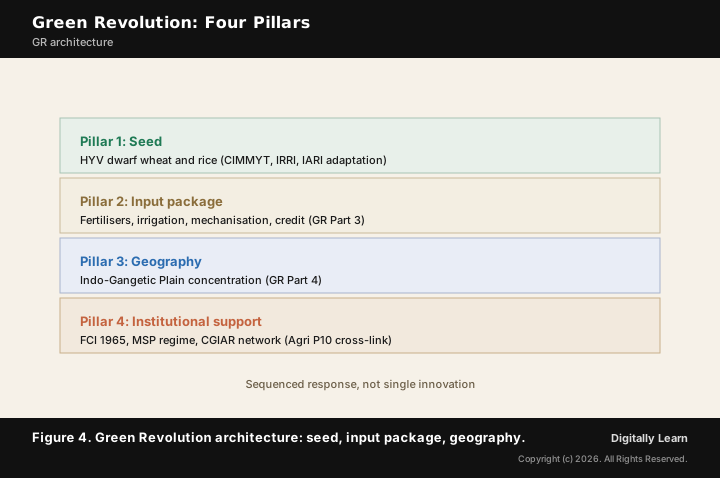
- (a) Seed-based transformation: HYV dwarf wheat and rice varieties at the centre, distinct from the labour-and-organisation transformation of the White Revolution covered in the live 4-part WR series.
- (b) Integrated input package: HYV plus chemical fertilisers plus assured irrigation plus mechanisation plus credit; weak link in any one collapses the productivity gain (covered in GR Part 3).
- (c) Geographic concentration: Indo-Gangetic Plain wheat-rice belt; Punjab, Haryana, Western Uttar Pradesh dominant; covered in GR Part 4.
- (d) Institutional architecture: FCI established 1965; Minimum Support Price regime (CACP recommends, CCEA approves) covered in Agri P10; international research lineage through CGIAR including CIMMYT and IRRI (UPSC Prelims 2021).
- (e) Intensive agriculture concept: Higher inputs per unit area, multiple cropping per year, yield maximisation rather than acreage expansion; distinct from extensive agriculture which expands cultivated area.
The institutional-design lesson is that the Green Revolution succeeded as a sequenced response rather than a single innovation. The seeds came from international research, the inputs from public-sector and cooperative supply chains, the irrigation from canal-and-tube-well expansion, the price support from FCI-and-MSP architecture, and the political will from the food-crisis urgency that the foundation context produced. GR Parts 2 through 5 cover each component in depth.
Previous Year UPSC-CSE Questions
Previous Year UPSC-CSE Questions By the end you will be able to draft model answers for the following UPSC questions. Each question carries a collapsible framework showing how to approach it in the exam.
- UPSC Prelims 2019The economic cost of food grains to the Food Corporation of India is Minimum Support Price and bonus (if any) paid to the farmers plus
How to approach this Prelims question
Approach: FCI's economic cost has three components: MSP plus procurement incidentals plus distribution cost. Recall the full chain from farm gate to fair-price shop.
Trap to watch: Options a, b, d each list a subset of the actual cost structure; the full answer combines procurement incidentals with distribution cost.
Key facts to recall:
- FCI established 1965 under Food Corporations Act 1964
- Economic cost: MSP plus procurement incidentals plus distribution cost
- Procurement incidentals: gunny bags, statutory levies, labour
- Distribution cost: storage, transport, handling to PDS shops
Answer signal: Correct answer is (c): procurement incidentals and distribution cost.
- UPSC Prelims 2021In the context of India's preparation for Climate-Smart Agriculture, consider the following statements:
- The Climate-Smart Village approach in India is a part of a project led by the Climate Change, Agriculture and Food Security (CCAFS), an international research programme.
- The project of CCAFS is carried out under Consultative Group on International Agricultural Research (CGIAR) headquartered in France.
- The International Crops Research Institute for the Semi-Arid Tropics (ICRISAT) in India is one of the CGIAR's research centres.
Which of the statements given above are correct?
How to approach this Prelims question
Approach: CCAFS is CGIAR; CGIAR headquartered in France; ICRISAT Hyderabad is a CGIAR centre. All three statements true.
Trap to watch: All three statements verified; pre-elimination on the assumption that any single statement is false misses the all-correct pattern.
Key facts to recall:
- CCAFS is a CGIAR research programme
- CGIAR headquartered in Montpellier, France
- ICRISAT Hyderabad is a CGIAR centre
- CIMMYT Mexico (Borlaug) and IRRI Philippines also CGIAR centres
Answer signal: Correct answer is (d): 1, 2 and 3.
- UPSC Prelims 2018With reference to the provisions made under the National Food Security Act, 2013, consider the following statements:
- The families coming under the category of below poverty line (BPL) only are eligible to receive subsidised food grains.
- The eldest woman in a household, of age 18 years or above, shall be the head of the household for the purpose of issuance of a ration card.
- Pregnant women and lactating mothers are entitled to a take-home ration of 1600 calories per day during pregnancy and for six months thereafter.
Which of the statements given above is/are correct?
How to approach this Prelims question
Approach: Verify each provision against NFSA Act 2013. Statement 1 wrong on BPL-only restriction; statement 2 correct on eldest woman head; statement 3 wrong on 1600 calorie (actual 600).
Trap to watch: Statement 1 baits the BPL-only confusion; NFSA explicitly covers Priority Households broader than BPL. Statement 3 inflates the calorie number.
Key facts to recall:
- NFSA 2013 covers Priority Households plus AAY around 67 per cent of population
- Eldest woman 18, is the ration-card head
- Pregnant and lactating mothers entitled to 600 calories take-home ration
- NFSA culminates the GR-era food-security architecture
Answer signal: Correct answer is (b): 2 only.
Sources
- NCERT Class 12 India People and Economy, Chapter 5 (Land Resources and Agriculture), pp 44-46
- Department of Agriculture and Farmers Welfare
- Food Corporation of India (FCI)
- Indian Council of Agricultural Research (ICAR)
- Department of Food and Public Distribution
- Ministry of Statistics and Programme Implementation (MoSPI)
- Wikipedia: Green Revolution in India
- Wikipedia: Food for Peace (Public Law 480)
Disclaimer
This article opens the ten-part Green Revolution series on Digitally Learn. It explains the foundation context, the food-deficit phase, the import-dependence, and the institutional pilots that preceded the seed-based transformation. Key facts are cross-verified with NCERT and the authoritative sources listed below.