


Overview
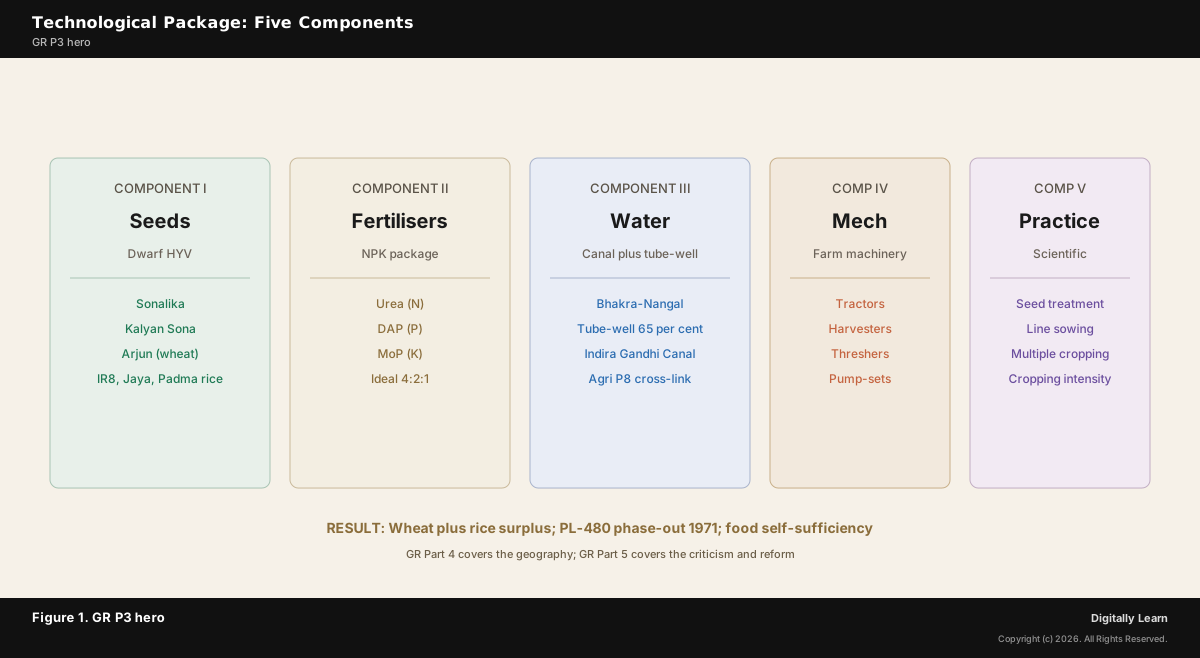
The Green Revolution technological package is the integrated set of inputs and practices that operationalised the imported HYV germplasm in Indian field conditions. The package has five interdependent components. The seed component covers the dwarf wheat varieties (Sonalika, Kalyan Sona, Arjun per UPSC Prelims 2002) and dwarf rice varieties (IR8, Jaya, Padma). The fertiliser component covers nitrogen (urea), phosphorus (DAP, diammonium phosphate), and potassium (MoP, muriate of potash) against the recommended 4:2:1 NPK ratio, now skewed toward nitrogen by urea subsidy (covered in Agri P9). The water component covers canal-and-tube-well irrigation expansion (deep-coverage in Agri P8). The mechanisation component covers tractors, harvesters, threshers, and pump-sets. The practice component covers scientific seed treatment, line sowing, weed management, and the multiple-cropping pattern enabled by assured irrigation. Each component is necessary; a single weak link collapses the productivity gain.
Background and Historical Context
The Green Revolution succeeded because the input package was integrated, not because any single component was decisive. Dwarf HYV seeds without fertiliser respond modestly; fertiliser without water leaches; water without mechanisation cannot scale across millions of hectares; mechanisation without scientific practice produces uneven application. The integration is the lesson. UPSC Prelims has tested HYV variety identification (UPSC Prelims 2002 on Arjun, Jaya, Padma, Sonalika), the Soil Health Card Scheme aim of checking fertiliser overuse (UPSC Prelims 2017), and the FCI economic-cost composition that the input-package output created the procurement surplus for (UPSC Prelims 2019, cross-cluster reuse).
What is the significance of the integrated package? Three operational dimensions follow. The component-interdependence binds seed to fertiliser to water to mechanisation to practice; the productivity gain is conditional on all five. The geographic-fit constraint means the package adopts best in regions that already have canal-or-tube-well irrigation and credit infrastructure (Indo-Gangetic Plain, covered in GR Part 4); rainfed regions adopt the package poorly. The cropping-intensity multiplier means assured irrigation plus dwarf short-duration varieties enables two or three crops per year rather than one, multiplying the per-hectare-per-year output beyond the per-crop yield gain.
Current threads include the Soil Health Card scheme launched 2015 for soil-test-based fertiliser recommendations (UPSC Prelims 2017 on its actual aims), the nano urea launched 2021 by IFFCO replacing the bulk-urea-bag form (covered in Agri P9), the direct benefit transfer route for fertiliser subsidy reform, and the Per Drop More Crop micro-irrigation component of PMKSY (covered in Agri P8). The institutional-design lesson is that the original Green Revolution package solved the production problem; the contemporary input architecture is solving the efficiency, sustainability, and equity problems that the original package generated.
Introduction: The Integrated Input Package
Five interdependent components
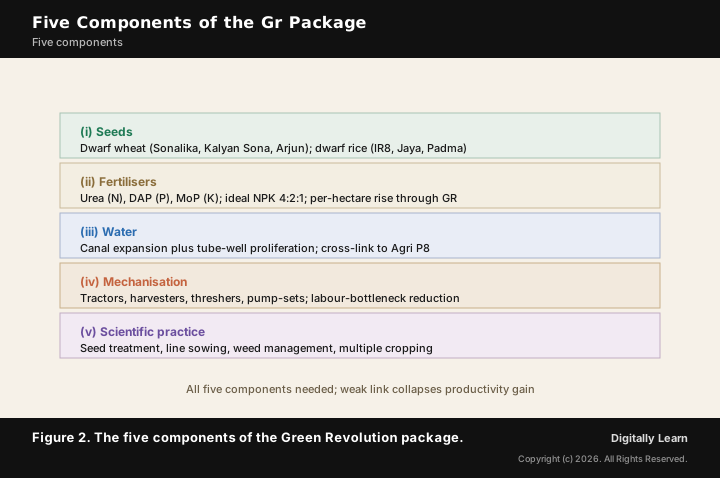
The Green Revolution succeeded as a package, not as a single technology. Dwarf HYV seeds without nitrogen fertiliser deliver modest yield gain. Fertiliser without water leaches into groundwater. Water without mechanisation cannot scale across millions of small holdings. Mechanisation without scientific practice produces uneven results. The integration of all five components is the operational lesson of the Green Revolution, and the operational constraint on its geographic spread.
- (i) Seeds: Dwarf wheat (Sonalika, Kalyan Sona, Arjun); dwarf rice (IR8, Jaya, Padma); semi-dwarf trait responds to fertiliser without lodging.
- (ii) Fertilisers: Urea for nitrogen, DAP for phosphorus, MoP for potassium; NPK ratio ideal 4:2:1; per-hectare consumption rose substantially through GR phase.
- (iii) Water: Canal expansion plus tube-well proliferation; around 65 per cent of irrigated area now groundwater-based (covered in Agri P8).
- (iv) Mechanisation: Tractors, harvesters, threshers, pump-sets; reduced labour bottleneck at sowing and harvest peaks.
- (v) Scientific practice: Seed treatment, line sowing, weed management, multiple cropping pattern enabled by short-duration varieties plus assured water.
Seeds: HYV Wheat and HYV Rice
Dwarf wheat varieties, dwarf rice varieties, seed multiplication architecture
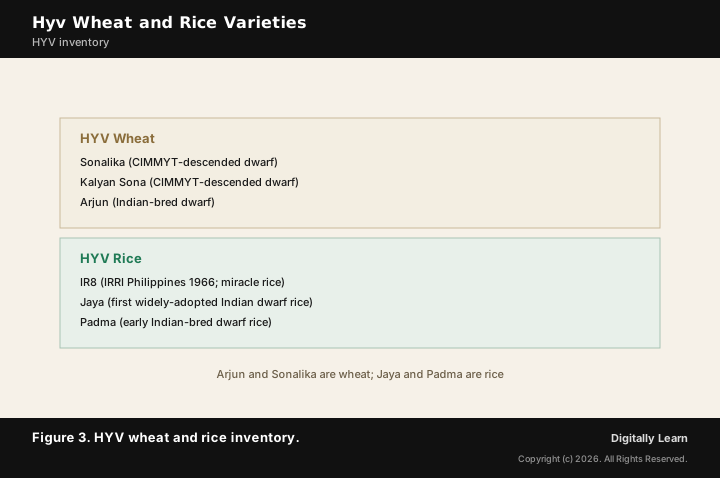
The seed component of the Green Revolution technological package centres on semi-dwarf varieties bred for nitrogen-response without lodging. Indian wheat HYVs include Sonalika, Kalyan Sona, and Arjun (UPSC Prelims 2002 on identification). Indian rice HYVs include the imported IR8 from IRRI Philippines and the Indian-bred Jaya and Padma.
The seed-multiplication architecture spans the public-sector National Seeds Corporation, the State Seeds Corporations, and the private-sector seed industry that has grown progressively since the 1980s. The architecture moves a small quantity of breeder seed through foundation and certified stages until enough certified seed reaches the farm gate each season.
- (a) Sonalika: Dwarf wheat variety released mid-1960s; widely adopted in Punjab, Haryana, Western Uttar Pradesh; descended from CIMMYT Mexican material.
- (b) Kalyan Sona: Dwarf wheat variety released alongside Sonalika; both descend from CIMMYT germplasm adapted for Indian conditions.
- (c) Arjun: Indian-bred dwarf wheat variety (UPSC Prelims 2002 confirms Arjun and Sonalika are wheat; Jaya and Padma are rice).
- (d) IR8: International Rice Research Institute Philippines dwarf rice released 1966; popularly miracle rice; transformed Asian paddy productivity.
- (e) Jaya: First widely-adopted Indian-bred dwarf rice; semi-dwarf cross developed at the All India Coordinated Rice Improvement Project.
- (f) Seed-multiplication architecture: National Seeds Corporation, State Seeds Corporations, private seed industry; Seed Replacement Rate of around 33 per cent target for self-pollinated crops (covered in Agri P9).
Fertilisers, Water, Mechanisation
The non-seed inputs that complete the package
Dwarf HYV varieties only deliver their yield potential when supplied with nitrogen-rich fertiliser, assured water, and mechanical farm operations at sowing-and-harvest peaks. The Green Revolution input package institutionalised these three non-seed components alongside the seed component. Chemical fertilisers covered urea (nitrogen), DAP (phosphorus), and MoP (potassium); per-hectare consumption rose substantially. Irrigation covered canal expansion (Bhakra-Nangal, Indira Gandhi Canal, Nagarjuna Sagar) plus tube-well proliferation. Mechanisation covered tractors, harvesters, threshers, and pump-sets.
- (a) Urea: Granular nitrogen fertiliser; bulk-bag 45-kilogram traditional form; nano-urea launched 2021 by IFFCO (covered in Agri P9) as efficiency-improvement.
- (b) DAP and MoP: Diammonium phosphate for phosphorus; muriate of potash for potassium; both import-dependent for raw material.
- (c) Soil Health Card scheme 2015: Soil-test-based fertiliser recommendations; aims at checking overuse of urea and balancing NPK ratio (UPSC Prelims 2017).
- (d) Canal-and-tube-well irrigation: Major canal systems (Bhakra-Nangal in Punjab, Indira Gandhi Canal in Rajasthan, Nagarjuna Sagar in Andhra Pradesh); tube-well proliferation in Indo-Gangetic Plain; cross-link to Agri P8 for the full irrigation architecture.
- (e) Farm mechanisation: Tractors for ploughing; harvesters for grain cutting; threshers for grain separation; pump-sets for tube-well operation; reduces labour bottleneck at peak operations.
- (f) Multiple cropping: Assured irrigation plus short-duration dwarf varieties enable two-or-three crops per year rather than one; cropping intensity (Gross Cropped Area divided by Net Sown Area) rose substantially in canal-irrigated regions.
| Component | Representative inputs | Function in the package |
|---|---|---|
| Seeds | Sonalika, Kalyan Sona, Arjun (wheat); IR8, Jaya, Padma (rice) | Semi-dwarf trait carries heavy grain without lodging |
| Fertilisers | Urea (N), DAP (P), MoP (K) | Supply nutrients the HYV plant draws down at high yield |
| Water | Canals (Bhakra-Nangal) and tube-wells | Assured, controlled moisture the dwarf varieties require |
| Mechanisation | Tractors, harvesters, threshers, pump-sets | Removes labour bottleneck at sowing and harvest peaks |
| Practice | Line sowing, weed and seed treatment, multiple cropping | Converts inputs into realised, repeatable field yield |
Integration and the Procurement Surplus
Why the integrated package produced food self-sufficiency
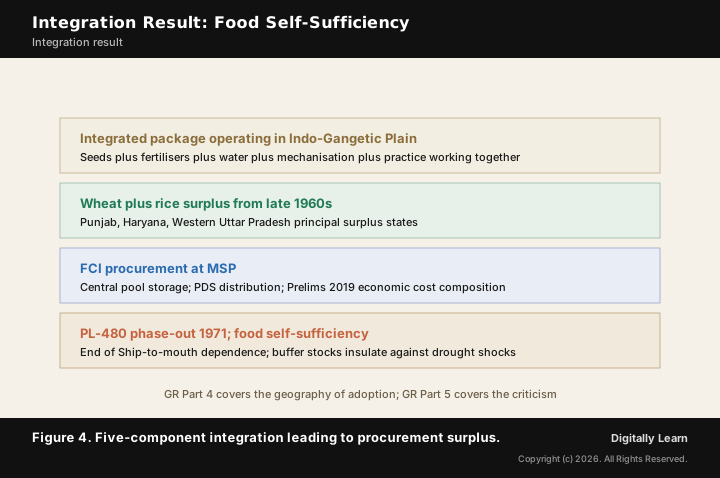
The five-component package operating together in the Indo-Gangetic Plain produced enough wheat and rice surplus from the late 1960s onwards for India to end the Ship-to-mouth PL-480 dependence (covered in GR Part 1) and build national buffer stocks. The procurement-surplus architecture was the second-order consequence of the input package working as intended.
The Food Corporation of India was the procurement arm for this surplus (covered in Agri P10); the central pool storage and the Public Distribution System were the downstream architecture. The economic cost of food grains to FCI is composed of MSP plus procurement incidentals plus distribution cost (UPSC Prelims 2019, cross-cluster reference).
- (i) Wheat surplus: Punjab and Haryana became the principal wheat-surplus states; FCI procurement at MSP locked the surplus into central pool.
- (ii) Rice surplus: Punjab and adjoining states became major rice procurement zones; addition to the wheat surplus established the food-self-sufficiency claim.
- (iii) PL-480 phase-out 1971: India ended the Ship-to-mouth dependence on American wheat aid; institutional confidence in domestic procurement displaced import-reliance.
- (iv) Buffer stocks: Central pool grew sufficient to insulate India from monsoon-failure shocks; the 1972-73 drought was managed without external imports.
- (v) Public Distribution System: FCI surplus fed the PDS supply chain; the National Food Security Act 2013 (UPSC Prelims 2018 from GR P1) is the legal culmination of this procurement-PDS architecture.
Previous Year UPSC-CSE Questions
Previous Year UPSC-CSE Questions By the end you will be able to draft model answers for the following UPSC questions. Each question carries a collapsible framework showing how to approach it in the exam.
- UPSC Prelims 2002Consider the following high yielding varieties of crops in India:
- Arjun
- Jaya
- Padma
- Sonalika
Which of these are wheat?
How to approach this Prelims question
Approach: Recall the GR-era HYV inventory by crop. Arjun and Sonalika are wheat; Jaya and Padma are rice; eliminate by crop-attribution.
Trap to watch: Mixing up wheat and rice HYV names; both have similar-sounding Indian names from the same era.
Key facts to recall:
- Sonalika and Kalyan Sona are CIMMYT-descended dwarf wheat
- Arjun is Indian-bred dwarf wheat
- Jaya is the first widely-adopted Indian-bred dwarf rice
- Padma is another early Indian-bred dwarf rice
Answer signal: Correct answer is (c): 1 and 4 (Arjun and Sonalika are wheat).
- UPSC Prelims 2017Consider the following statements: The nation-wide 'Soil Health Card Scheme' aims at
- Expanding the cultivable area under irrigation.
- Enabling the banks to assess the quantum of loans to be granted to farmers on the basis of soil quality.
- Checking the overuse of fertilizers in farmlands.
Which of the above statements is/are correct?
How to approach this Prelims question
Approach: Soil Health Card is a soil-test-based fertiliser-recommendation scheme. Eliminate distractors that conflate it with irrigation or credit policy.
Trap to watch: Statement 2 sounds plausible but conflates Soil Health Card with credit-assessment; Kisan Credit Card handles credit.
Key facts to recall:
- Soil Health Card launched 2015
- Aim: soil-test-based fertiliser recommendation
- Addresses NPK imbalance and urea overuse
- Kisan Credit Card is the separate credit scheme
Answer signal: Correct answer is (b): 3 only.
- UPSC Prelims 2019The economic cost of food grains to the Food Corporation of India is Minimum Support Price and bonus (if any) paid to the farmers plus
How to approach this Prelims question
Approach: FCI economic cost has three components: MSP plus procurement incidentals plus distribution cost.
Trap to watch: Options a, b, d each list a subset; complete answer combines incidentals with distribution.
Key facts to recall:
- FCI established 1965
- Economic cost: MSP plus incidentals plus distribution
- GR surplus was the input for FCI procurement
- PDS distribution closed the food-security loop
Answer signal: Correct answer is (c): procurement incidentals and distribution cost.
Sources
- NCERT Class 12 India People and Economy, Chapter 5 (Land Resources and Agriculture), pp 50-54
- Indian Council of Agricultural Research (ICAR)
- Department of Agriculture and Farmers Welfare
- Department of Fertilisers (Ministry of Chemicals and Fertilisers)
- Indian Farmers Fertiliser Cooperative (IFFCO)
- Soil Health Card scheme
- PMKSY Per Drop More Crop
- Wikipedia: Green Revolution in India
Disclaimer
This article is the third in the five-part Green Revolution series on Digitally Learn. It covers the integrated input-and-technology package that operationalised the HYV germplasm in Indian field conditions across seeds, fertilisers, water, mechanisation, and scientific practice. Key institutions and figures are cross-verified with NCERT and the authoritative sources listed in the Sources block below.