


Overview
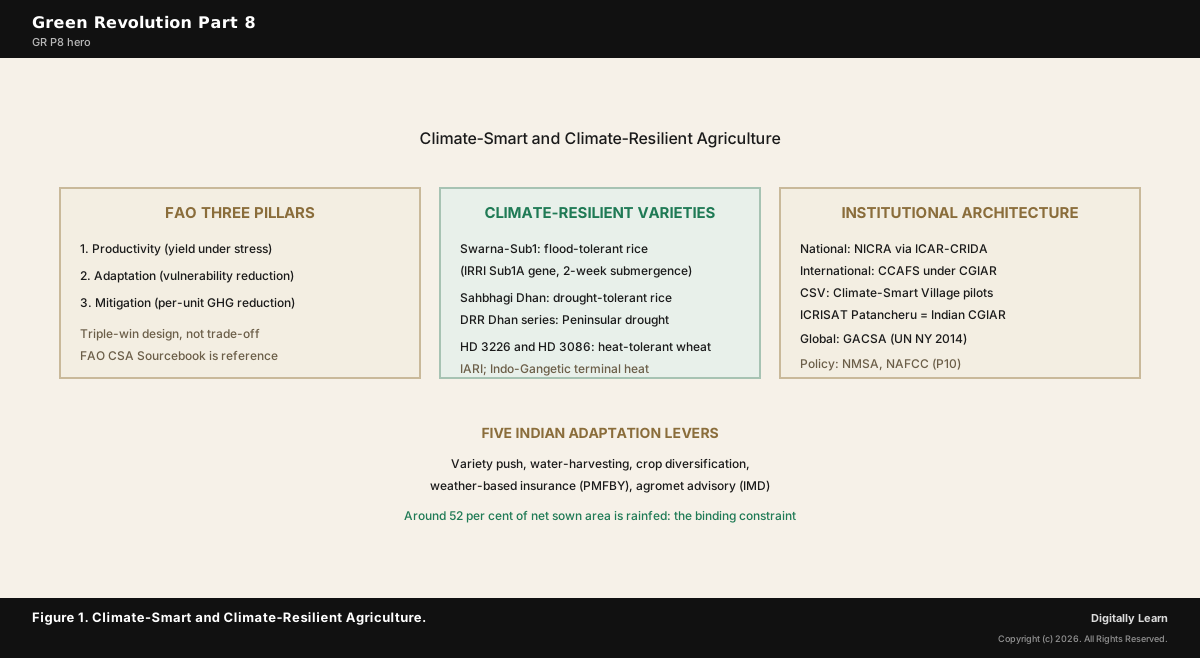
Climate-Smart Agriculture (CSA) in the Green Revolution 2.0 architecture is the agronomic-system framework that simultaneously raises productivity, adapts production to climate change, and reduces or removes greenhouse-gas emissions where possible. The framework is articulated in the FAO Climate-Smart Agriculture Sourcebook through three interlocking pillars. The productivity pillar sustains yield growth under tightening climate constraints. The adaptation pillar reduces farm-system vulnerability to monsoon variability, drought, flood, heat stress, and pest range-shifts. The mitigation pillar lowers per-unit agricultural greenhouse-gas emissions through reduced fertiliser-N volatilisation, methane management in paddy, and soil-carbon sequestration. The Indian institutional architecture rests on the National Innovations in Climate Resilient Agriculture (NICRA) programme coordinated by ICAR through ICAR-CRIDA Hyderabad (Central Research Institute for Dryland Agriculture; cross-link to Agri P11). The international architecture rests on the Climate Change, Agriculture and Food Security (CCAFS) programme under the Consultative Group on International Agricultural Research (CGIAR) which runs the Climate-Smart Village (CSV) approach in India with ICRISAT (International Crops Research Institute for the Semi-Arid Tropics, Patancheru) as the Indian CGIAR research centre. The climate-resilient variety set includes Swarna-Sub1 flood-tolerant rice (the IRRI-Sub1-gene introgression released for eastern India submergence-prone tracts), drought-tolerant rice varieties (DRR Dhan, Sahbhagi Dhan), and heat-tolerant wheat varieties (HD 3226, HD 3086). The framework conditions all future productivity gains on climate-resilience tests; production planning that ignores monsoon variability and heat stress will not survive the next two decades.
Background and Historical Context
Indian agriculture remains 52 per cent dependent on monsoon rainfall and is exposed to rising heat stress in the Indo-Gangetic wheat belt, monsoon-variability increases in Peninsular and eastern rainfed tracts, and submergence-prone river-basin paddy where one bad flood erases an entire kharif crop. The GR 1.0 input-intensification logic assumed monsoon stability; that assumption no longer holds.
UPSC Prelims has tested the CCAFS-CGIAR-ICRISAT-CSV architecture (UPSC Prelims 2021 and Prelims 2025), the GACSA international framework (UPSC Prelims 2018 on the UN Climate Summit 2014 origin and non-binding membership), and adaptation-relevant institutional facts across multiple papers. The framework is the operational answer Indian agriculture must deliver in the decades ahead.
What is the significance of the climate-smart and climate-resilient framing? Three operational dimensions follow. The triple-win dimension means CSA is engineered to win on productivity, adaptation, and mitigation simultaneously rather than trade one against another; the FAO three-pillar sourcebook is the binding framework. The variety-substitution dimension means the GR 1.0 dwarf-wheat-IR8-rice variety set is augmented by climate-resilient cultivars that retain yield under stress (Swarna-Sub1 survives two-week complete submergence in Bihar and West Bengal flood-prone tracts; Sahbhagi Dhan tolerates extended drought in Jharkhand and Odisha rainfed paddy); the substitution rebuilds the seed-system productivity floor under climate stress. The institutional-coordination dimension means national (NICRA-CRIDA), international (CCAFS-CGIAR), and policy (GACSA-UN, NMSA Indian) layers coordinate research, demonstration, and scheme support; the multi-layer coordination is the structural feature that distinguishes GR 2.0 climate response from ad-hoc state-level pilots.
Current threads include the NICRA Phase III rollout expanding climate-resilient demonstration to additional vulnerable districts beyond the original 100-district network, the Climate-Smart Village approach in India under CCAFS with cluster-based implementation in Bihar, Punjab, Haryana, and Karnataka, the Swarna-Sub1 area expansion to over two million hectares of flood-prone eastern Indian paddy, the GACSA membership growth to over 200 institutional members worldwide (India's GACSA participation expanded after the initial 2014-15 non-participation period), and the National Adaptation Fund for Climate Change (NAFCC) as the Indian financing layer for state-level climate-adaptation projects (covered in GR P10 policy architecture). The cluster-architecture lesson is that GR 2.0 climate response operates through nested institutional layers (international research, national programme, state implementation) rather than through a single technological breakthrough; each layer reinforces the others.
Climate-Smart Agriculture: FAO Three-Pillar Framework
Productivity, adaptation, mitigation as the simultaneous-win triplet
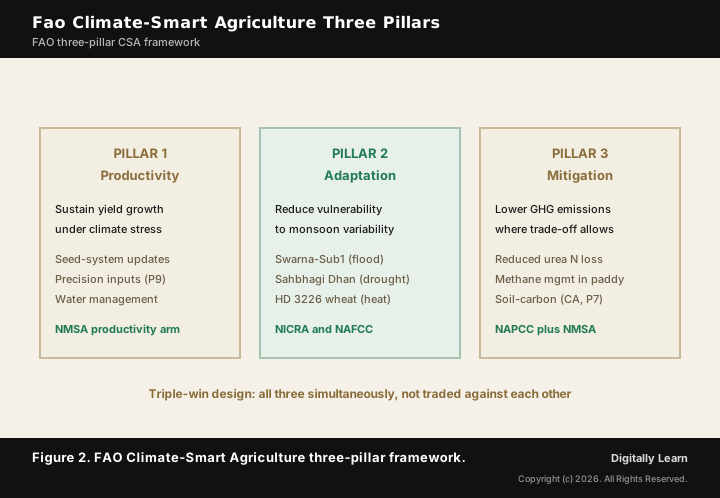
Climate-Smart Agriculture is the agronomic-system framework articulated in the FAO Climate-Smart Agriculture Sourcebook that engineers production systems to win on productivity, adaptation, and mitigation at the same time. The framework inverts the GR 1.0 single-objective logic of output per hectare by adding two binding constraints: the system must adapt to climate-stress shocks and must lower per-unit greenhouse-gas emissions where the trade-off allows.
- Pillar 1: Productivity: Sustain yield growth under tightening climate constraints; the seed-system, input-package, and water-management innovations all serve this pillar.
- Pillar 2: Adaptation: Reduce farm-system vulnerability to monsoon variability, drought, flood, heat stress, pest range-shifts; climate-resilient varieties (Swarna-Sub1, Sahbhagi Dhan, HD 3226 wheat) operationalise this pillar.
- Pillar 3: Mitigation: Lower per-unit agricultural greenhouse-gas emissions through reduced fertiliser-nitrogen volatilisation, methane management in paddy, soil-carbon sequestration through Conservation Agriculture (cross-link to GR P7).
- Triple-win design: The framework is engineered to win on all three simultaneously rather than trade one against another; FAO Sourcebook is the binding international reference.
Climate-Resilient Variety Set
Swarna-Sub1, Sahbhagi Dhan, HD 3226: the new germplasm floor
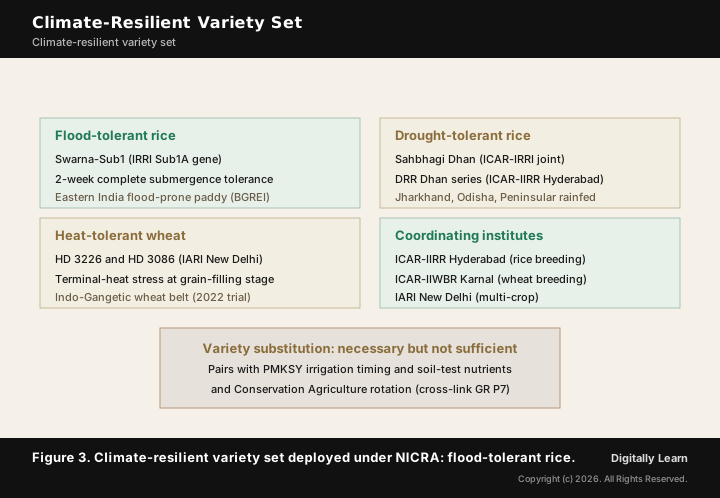
The climate-resilient variety set augments the GR 1.0 dwarf-wheat and IR8-rice germplasm with cultivars engineered to retain yield under stress. The varieties are not breakthrough replacements but tolerance-introgressions onto already-adapted base varieties; this preserves farmer-familiarity while adding the stress-tolerance trait. The three highest-impact deployments are flood-tolerant rice, drought-tolerant rice, and heat-tolerant wheat.
- Swarna-Sub1 (flood-tolerant rice): IRRI’s Sub1A gene introgressed into the popular Swarna variety; survives two-week complete submergence; central to the BGREI and eastern India flood-prone paddy belt (cross-link to GR P4 BGREI architecture).
- Sahbhagi Dhan (drought-tolerant rice): ICAR-IRRI joint release; tolerates extended dry spells in Jharkhand and Odisha rainfed paddy; reduces complete-crop-failure risk in deficit-monsoon years.
- DRR Dhan series (drought-tolerant rice): Indian Institute of Rice Research Hyderabad releases for deficit-monsoon Peninsular tracts.
- HD 3226 and HD 3086 (heat-tolerant wheat): IARI New Delhi releases targeting terminal-heat stress at grain-filling stage in the Indo-Gangetic wheat belt; the 2022 procurement cycle showed yield-erosion in non-heat-tolerant varieties under March temperature anomalies.
- Climate-resilient seed system: NICRA seed-multiplication network operationalises the variety set; ICAR-IIRR (rice) and ICAR-IIWBR Karnal (wheat) coordinate the breeding pipelines.
The variety substitution alone is necessary but not sufficient. The varieties operate within a broader package that includes irrigation-water timing (cross-link to Agri P8 PMKSY), soil-test-based nutrient application (cross-link to Agri P9 Soil Health Card), and crop-rotation discipline (cross-link to GR P7 Conservation Agriculture).Agri P9 Soil Health Card), and crop-rotation discipline (cross-link to GR P7 Conservation Agriculture).
NICRA: India's Climate-Resilient Agriculture Programme
ICAR-CRIDA-coordinated programme with district-network rollout
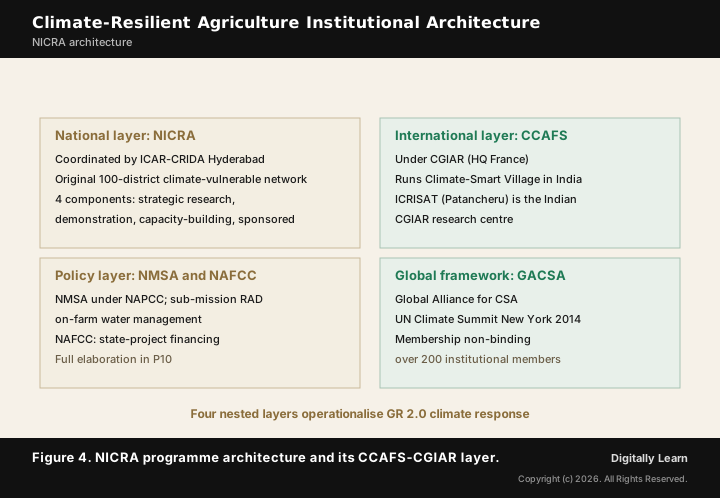
The National Innovations in Climate Resilient Agriculture (NICRA) programme is the Indian operational vehicle for climate-smart agriculture. NICRA is coordinated by the Indian Council of Agricultural Research through ICAR-CRIDA Hyderabad (Central Research Institute for Dryland Agriculture; covered as institution in Agri P11). The programme has four operational components.
- Strategic research: ICAR institutes conduct climate-resilient variety breeding, water-management technology development, and integrated-farming-system trials.
- Technology demonstration: Krishi Vigyan Kendras in climate-vulnerable districts (original 100-district network expanded under Phase III) host on-farm demonstration of climate-resilient varieties and practices (cross-link to GR P4 KVK institutional architecture).
- Capacity building: Training of state agricultural extension cadre and farmer field schools on weather-based advisories, crop-insurance enrolment, and climate-adaptive package adoption.
- Sponsored and competitive research: Grants to state agricultural universities and ICAR institutes for location-specific climate-resilience research.
| Layer | Lead body | Core function |
|---|---|---|
| National programme | NICRA via ICAR-CRIDA Hyderabad | Climate-resilient variety breeding, demonstration, and capacity building |
| International research | CCAFS under CGIAR | Climate-Smart Village pilots; ICRISAT Patancheru is the Indian centre |
| Policy umbrella | NMSA under NAPCC | Sustainable-agriculture mission with the Rainfed Area Development sub-mission |
| Financing layer | NAFCC | Funds state-level climate-adaptation projects (elaborated in Part 10) |
| Global framework | GACSA (UN Climate Summit New York 2014) | Voluntary multi-stakeholder alliance with non-binding membership |
Adaptation Strategies and International CSA Framework
Monsoon variability and heat-stress adaptation
Around 52 per cent of Indian net sown area remains rainfed and exposed to monsoon-variability shocks. The adaptation strategies operationalise the FAO three-pillar framework's adaptation pillar in the Indian context. Five adaptation levers carry most of the weight.
- Climate-resilient variety push: Swarna-Sub1, Sahbhagi Dhan, DRR Dhan, HD 3226 and HD 3086 wheat; covered above.
- Water-harvesting and recharge: PMKSY Per Drop More Crop sub-mission, watershed-based planning, recharge structures (covered in Agri P8 irrigation architecture).
- Crop diversification: Shift from water-intensive wheat-rice rotation to pulses, millets, oilseeds in groundwater-stressed tracts (cross-link to GR P6 Driver 4 monoculture crisis).
- Weather-based crop insurance: Pradhan Mantri Fasal Bima Yojana (PMFBY) and Restructured Weather-Based Crop Insurance Scheme (RWBCIS) (full elaboration in GR P10).
- Agromet advisory: India Meteorological Department block-level weather forecasts delivered to farmer phones; Krishi Vigyan Kendras translate forecasts into operational advisories.
Heat stress on Indo-Gangetic wheat at the grain-filling stage (mid-March temperature anomalies) is the most acute climate-adaptation problem in the wheat-belt itself. The 2022 procurement cycle showed substantial yield erosion in non-heat-tolerant varieties; the IARI heat-tolerant releases (HD 3226 and HD 3086) are the agronomic response. The longer-term challenge is the warming-trend convergence with the Indo-Gangetic wheat productivity peak.
CCAFS, CGIAR, ICRISAT, GACSA: the international architecture
The international layer of climate-smart agriculture in India rests on three institutions. The Climate Change, Agriculture and Food Security (CCAFS) programme is the CGIAR-led international research vehicle; it runs the Climate-Smart Village (CSV) approach in India with cluster-based pilots in Bihar, Punjab, Haryana, and Karnataka.
The Consultative Group on International Agricultural Research (CGIAR) coordinates 15 research centres globally with the system headquartered in France (per the UPSC answer key framing); ICRISAT at Patancheru in Telangana is the Indian CGIAR centre. The Global Alliance for Climate-Smart Agriculture (GACSA) was launched at the UN Climate Summit New York 2014 as a multi-stakeholder voluntary alliance; membership creates no binding obligations and India was not an initial member but joined subsequently.
The international and national institutional layers reinforce each other. CCAFS provides research and CSV-pilot evidence; NICRA scales evidence-based interventions through ICAR's national network; NMSA provides policy and financing support; NAFCC funds state-level adaptation projects. The lesson is that the climate-response system is multi-layered by design rather than by accident; single-layer interventions of variety alone, programme alone, or policy alone have proven insufficient against the scale of the challenge.
Previous Year UPSC-CSE Questions
Previous Year UPSC-CSE Questions By the end you will be able to draft model answers for the following UPSC questions. Each question carries a collapsible framework showing how to approach it in the exam.
- UPSC Prelims 2021In the context of India's preparation for Climate-Smart Agriculture, consider the following statements: 1. The 'Climate-Smart Village' approach in India is a part of a project led by the Climate Change, Agriculture and Food Security (CCAFS), an international research programme. 2. The project of CCAFS is carried out under Consultative Group on International Agricultural Research (CGIAR) headquartered in France. 3. The International Crops Research Institute for the Semi-Arid Tropics (ICRISAT) in India is one of the CGIAR's research centres. Which of the statements given above are correct?
How to approach this Prelims question
Approach: Trace the chain: the Climate-Smart Village approach is a CCAFS project, CCAFS runs under CGIAR, and ICRISAT is one of the CGIAR research centres.
Trap to watch: Doubting statement 2 because CGIAR has centres around the world; the question states its headquarters, which is in France.
Key facts to recall:
- CCAFS = Climate Change, Agriculture and Food Security programme under CGIAR.
- CGIAR = Consultative Group on International Agricultural Research; coordinates 15 research centres globally.
- The CGIAR System Organization is headquartered in France.
- The Climate-Smart Village approach in India is part of a CCAFS project.
- ICRISAT at Patancheru in Telangana is the Indian CGIAR research centre.
Answer signal: All three statements are correct. Correct answer: (d) 1, 2 and 3, as per UPSC's official answer key.
- UPSC Prelims 2021In the context of India's preparation for Climate-Smart Agriculture, consider the following statements:
- The Climate-Smart Village approach in India is a part of a project led by the Climate Change, Agriculture and Food Security (CCAFS), an international research programme.
- The project of CCAFS is carried out under Consultative Group on International Agricultural Research (CGIAR) headquartered in France.
- The International Crops Research Institute for the Semi-Arid Tropics (ICRISAT) in India is one of the CGIAR's research centres.
Which of the statements given above are correct?
How to approach this Prelims question
Approach: All three statements are factually correct per the UPSC answer key framing. CSV is CCAFS-led; CCAFS sits under CGIAR; CGIAR is headquartered in France (Montpellier); ICRISAT at Patancheru is a CGIAR research centre.
Trap to watch: Doubting statement 2 because CGIAR headquarters have moved historically; the answer key treats France as the location UPSC tests.
Key facts to recall:
- CCAFS Climate Change Agriculture and Food Security is an international research programme.
- CGIAR system organisation headquartered in France.
- CSV Climate-Smart Village approach in India is CCAFS-led, deployed in Bihar, Punjab, Haryana, Karnataka pilot clusters.
- ICRISAT at Patancheru in Telangana is one of 15 CGIAR research centres globally.
Answer signal: Correct answer is (d) (1, 2 and 3); all three statements correct.
- UPSC Prelims 2018With reference to the 'Global Alliance for Climate-Smart Agriculture (GACSA)', which of the following statements is/are correct?
- GACSA is an outcome of the Climate Summit held in Paris in 2015.
- Membership of GACSA does not create any binding obligations.
- India was instrumental in the creation of GACSA.
Select the correct answer using the code given below:
How to approach this Prelims question
Approach: Apply institutional-history: GACSA was launched at UN Climate Summit New York 2014, distinct from Paris Agreement 2015. Voluntary multi-stakeholder alliance with no binding obligations. India did not join at the initial 2014 launch (joined subsequently). Statements 1 and 3 are factually wrong.
Trap to watch: Conflating Paris 2015 Agreement with the GACSA New York 2014 launch; both are climate frameworks but distinct events.
Key facts to recall:
- GACSA launched at UN Climate Summit New York September 2014.
- Multi-stakeholder voluntary alliance; non-binding membership.
- India did not initially join (joined subsequently after 2014).
- Membership grew to over 200 institutional members worldwide.
- Paris Agreement was December 2015, a separate UNFCCC instrument.
Answer signal: Correct answer is (b) (2 only); only the non-binding-membership statement is correct.
Sources
- Class 12 India People and Economy, Chapter 5 (Land Resources and Agriculture)
- FAO Climate-Smart Agriculture Sourcebook and framework documents
- Climate-Smart Agriculture: Wikipedia overview
- Indian Council of Agricultural Research (ICAR) NICRA programme
- ICAR-CRIDA Hyderabad institutional context for dryland and climate-resilient research
- Consultative Group on International Agricultural Research (CGIAR) CCAFS programme
- International Crops Research Institute for the Semi-Arid Tropics (ICRISAT) Patancheru
- Department of Agriculture and Farmers Welfare NMSA and climate adaptation policy
- UNFCCC framework for agriculture and climate adaptation
- Press Information Bureau release on NICRA Phase III and climate-resilient varieties
Disclaimer
This article explains the climate-smart and climate-resilient agriculture pillar of Green Revolution 2.0 for UPSC preparation. Variety-area and coverage figures are illustrative and change as breeding pipelines advance. Aspirants should cross-check programme details against official ICAR and Ministry of Agriculture sources.