


Overview
Indian Agriculture, Part 4
India's dryland nutri-cereals and protein-rich legumes.
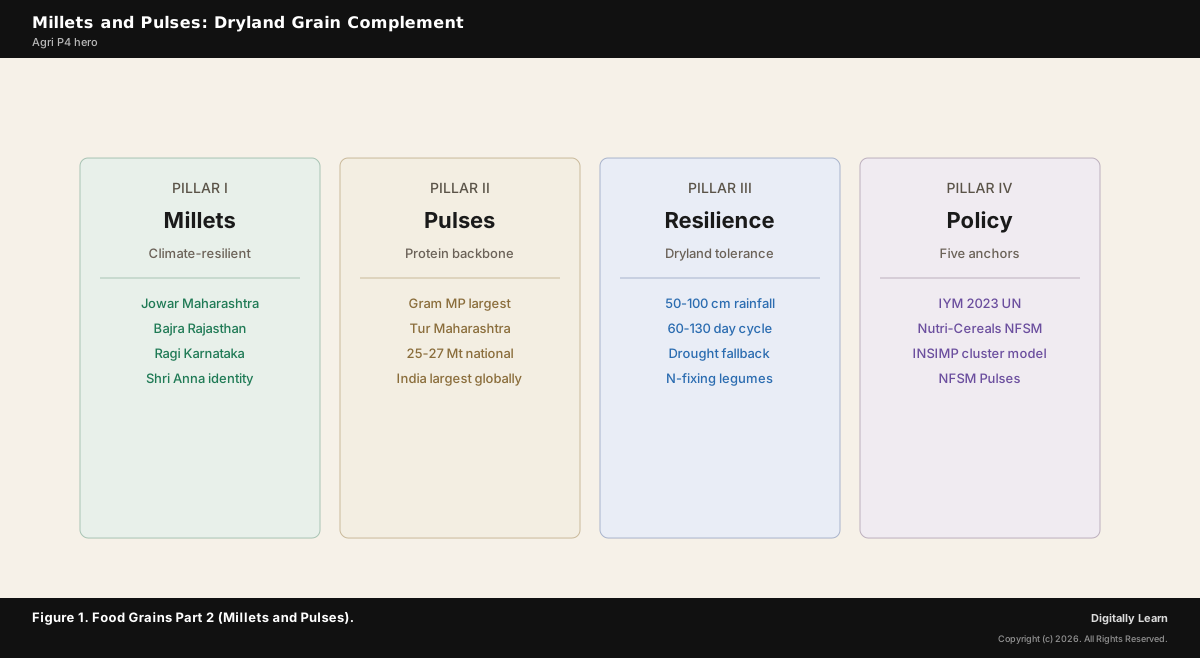
Millets and pulses together form the dryland-rainfed grain complement to the irrigated rice-and-wheat duopoly covered in Part 3. Millets are a group of small-grained cereals (jowar or sorghum, bajra or pearl millet, ragi or finger millet, plus minor millets like kodo, foxtail, barnyard, and proso) that tolerate low rainfall, high temperatures, and poor soils. India was the largest global producer of millets at the launch of International Year of Millets 2023, with the Government of India renaming millets as Shri Anna to elevate their public profile. Pulses are leguminous seeds rich in protein, including gram (chickpea), tur (arhar), urad (black gram), moong (green gram), masur (lentil), and matar (peas). India is the largest global producer of pulses at around 25 to 27 million tonnes annually, but pulses productivity remains low and per-capita protein availability constrained.
Background and Historical Context
Millets and pulses underwrite the dryland and semi-arid cropping systems that the rice-wheat package never reached. Together they occupy a substantial share of cropped area but yield far less per hectare than the Green Revolution cereals. UPSC Prelims has tested INSIMP, rainfed crops (groundnut/sesamum/pearl millet), and pulses-seasonality directly; Mains GS-III covers the millet-revival agenda under climate adaptation and protein-security policy.
What is the significance of the millet-pulse complement? Three operational dimensions follow. The climate-resilience advantage of millets explains why dryland Karnataka, Maharashtra, Rajasthan, Andhra Pradesh, and Tamil Nadu maintain bajra-jowar-ragi cropping despite limited monsoon rainfall; the crops finish their cycle on residual moisture. The nutritional dimension matters because both millets (rich in iron, calcium, fibre) and pulses (rich in protein) address documented Indian deficiencies; the National Nutrition Mission and the Mid-Day Meal Scheme expansion of millets supply leverages this. The protein-deficit gap in pulses despite India being the global production leader stems from low productivity (around 850 kg per hectare versus 1,200 to 1,500 in major producer countries); the National Food Security Mission Pulses component addresses this through area expansion and productivity enhancement.
The ICAR-Indian Institute of Millets Research at Hyderabad coordinates millet research; the ICAR-Indian Institute of Pulses Research at Kanpur coordinates pulses research. The International Year of Millets 2023 declared by the United Nations at India's proposal raised global millet visibility; follow-up programmes include the Shri Anna initiative, the Sub-Mission on Nutri-Cereals under NFSM, and millet-inclusive procurement under FCI. The NFSM Pulses aims to add productivity-led production growth in Madhya Pradesh, Maharashtra, Rajasthan, Uttar Pradesh, Karnataka, and Andhra Pradesh through assured seed supply, INM and IPM packages, and farmer training. Climate-change adaptation foregrounds both crops as drought-tolerant options for the rain-shadow Deccan and the Western Dry Region.
Introduction: Millets and Pulses as the Dryland Grain Complement
Why dryland grains complement the rice-wheat duopoly
Millets and pulses together form the dryland-rainfed grain system that complements the irrigated rice-and-wheat duopoly covered in Part 3. The two crop groups dominate the rain-shadow Deccan, the Western Dry Region of Rajasthan and Gujarat, and the central tribal belt of Madhya Pradesh and Chhattisgarh. Their geographies mirror the limits of canal-and-tube-well irrigation expansion.
Millets are small-grained cereals tolerant of low rainfall, high temperatures, and poor soils; they finish their growing cycle on residual moisture and sparse rainfall. Pulses are leguminous seeds rich in protein; they fix atmospheric nitrogen through root nodules, improving soil fertility and complementing cereal rotations. Together the two groups provide nutritional balance and climate-resilient livelihood security across the half of Indian agricultural area that the Green Revolution package never reached at scale.
Millets: Jowar, Bajra, Ragi, Minor Millets
Geographic conditions and the climate-resilience advantage
Millets thrive where rainfall falls between 50 and 100 cm, temperatures range between 25 and 35 degrees Celsius, and soils are light to moderately fertile. The crops complete their cycle in 60 to 120 days, allowing harvest before residual monsoon moisture exhausts. Pearl millet, along with groundnut and sesamum, is among the predominantly rainfed Indian crops.
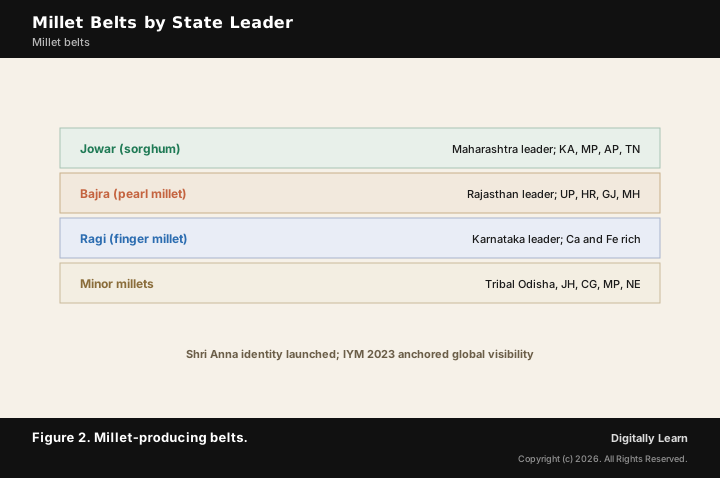
- (i) Jowar (sorghum): Both kharif and rabi depending on region; Maharashtra is the largest producer, followed by Karnataka, Madhya Pradesh, Andhra Pradesh, and Tamil Nadu; covers around 5.3 per cent of cropped area in earlier decades, declining under wheat displacement.
- (ii) Bajra (pearl millet): Kharif crop of the hot semi-arid regions; Rajasthan is the largest producer, followed by Uttar Pradesh, Haryana, Gujarat, and Maharashtra; covers around 5.2 per cent of cropped area.
- (iii) Ragi (finger millet): Kharif crop of the southern and central uplands; Karnataka is the largest producer; the crop is exceptionally rich in calcium and iron, central to the Shri Anna identity.
- (iv) Minor millets: Kodo, foxtail, barnyard, proso, little millet; cultivated by tribal communities in Odisha, Jharkhand, Chhattisgarh, Madhya Pradesh, and parts of north-east; nutritionally dense, low input requirement.
- (v) Nutritional profile: Higher iron and calcium content than rice or wheat; gluten-free; low glycemic index; positioned as Shri Anna for protein and micronutrient security under National Nutrition Mission.
Pulses: Gram, Tur, Urad, Moong, Masur
Protein-security crops with low-productivity challenge
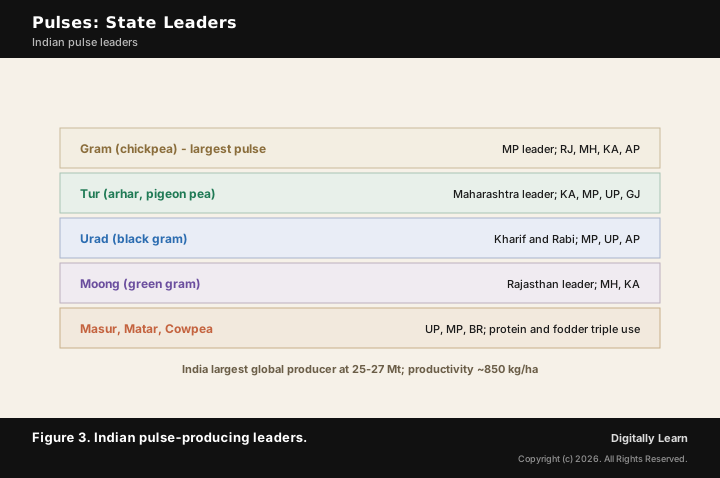
India is the world's largest producer, consumer, and importer of pulses. Annual production of 25 to 27 million tonnes covers around 75 per cent of national demand; the remainder is imported from Canada, Mozambique, Myanmar, and Australia. Productivity remains the principal challenge, with national average around 850 kilograms per hectare against 1,200 to 1,500 in major producer countries.
- (i) Gram (chickpea, Cicer arietinum): Largest Indian pulse by area and output; rabi crop sown October-November; Madhya Pradesh leader, followed by Rajasthan, Maharashtra, Karnataka, Andhra Pradesh; replaced by wheat in Punjab and Haryana following Green Revolution.
- (ii) Tur (arhar, pigeon pea): Second-largest Indian pulse; kharif crop sown June-July; Maharashtra leader, followed by Karnataka, Madhya Pradesh, Uttar Pradesh, Gujarat; marginal-land cultivation under rainfed conditions.
- (iii) Urad (black gram, Vigna mungo): Both kharif and rabi crop depending on region; Madhya Pradesh, Uttar Pradesh, Andhra Pradesh major producers.
- (iv) Moong (green gram, Vigna radiata): Short-duration crop usable as kharif, rabi, or zaid in different regions; Rajasthan leader followed by Maharashtra and Karnataka.
- (v) Other pulses: Masur (lentil) is a rabi crop important in UP, MP, Bihar; Matar (peas) is rabi UP and MP; Cowpea and horse-gram fulfill pulse-fodder-green manure triple roles.
Comparison: Resilience, Nutrition, Policy Geography
Three observable outcomes of the millet-pulse complement
Three observable outcomes follow from reading millets and pulses together. Both groups depend on dryland-rainfed agriculture, both serve nutritional ends that rice-wheat cannot, and both face the same policy challenge of low productivity despite favourable demand.
- (a) Climate resilience: Millets and pulses both tolerate moisture stress better than rice and wheat; both finish growing cycles in 60 to 130 days; both serve as drought-fallback crops when monsoon delivery falters.
- (b) Nutritional complement: Millets supply iron, calcium, and complex carbohydrates; pulses supply protein and dietary fibre. The two together provide near-complete nutrition in the absence of dairy or meat, central to the Indian vegetarian dietary pattern.
- (c) Productivity-gap policy: Both groups carry low productivity (millets average ~1,500 kg/ha, pulses ~850 kg/ha) against rice (~2,700) and wheat (~3,500). The Initiative for Nutritional Security through Intensive Millets Promotion (INSIMP) and National Food Security Mission Pulses target this gap through cluster-based productivity enhancement, improved seed supply, INM, and IPM packages.
| Attribute | Millets | Pulses |
|---|---|---|
| Crop type | Small-grained cereals (jowar, bajra, ragi) | Nitrogen-fixing legumes (gram, tur, urad, moong) |
| Main season | Mostly kharif; rabi jowar in parts | Mostly rabi; tur is kharif |
| Leading state | Bajra Rajasthan, jowar Maharashtra, ragi Karnataka | Gram Madhya Pradesh, tur Maharashtra |
| Nutrition role | Iron, calcium, fibre; gluten-free | Protein and dietary fibre |
| Policy peg | IYM 2023, Shri Anna, Sub-Mission on Nutri-Cereals | NFSM Pulses, productivity-led expansion |
Contemporary Policy: IYM 2023, Shri Anna, NFSM Pulses
Five policy anchors for the millet-pulse revival
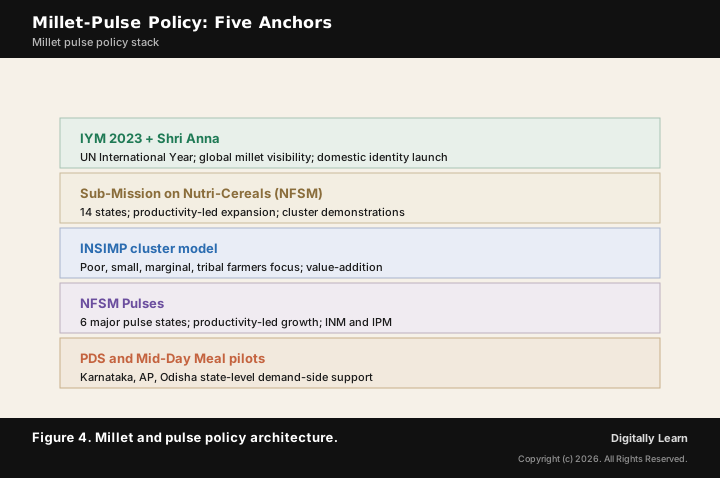
Both crop groups now sit at the centre of the climate-and-nutrition policy agenda. Five operational instruments structure the current policy push.
- International Year of Millets 2023: Declared by UN at India’s proposal; raised global millet visibility; anchored Shri Anna campaign domestically.
- Sub-Mission on Nutri-Cereals under NFSM: Targets millet productivity enhancement in 14 states; demonstration clusters; seed-supply chain support.
- Initiative for Nutritional Security through Intensive Millets Promotion (INSIMP): Cluster-approach demonstration model targeting poor, small, marginal and tribal farmers.
- NFSM Pulses: Productivity-led expansion in Madhya Pradesh, Maharashtra, Rajasthan, Uttar Pradesh, Karnataka, Andhra Pradesh; assured-seed supply, INM and IPM packages.
- Millet-inclusive PDS and Mid-Day Meal Scheme: State-level pilots in Karnataka, Andhra Pradesh, Odisha; shifts demand-side support toward millet consumption.
Previous Year UPSC-CSE Questions
Previous Year UPSC-CSE Questions By the end you will be able to draft model answers for the following UPSC questions. Each question carries a collapsible framework showing how to approach it in the exam.
- UPSC Prelims 2016With reference to ‘Initiative for Nutritional Security through Intensive Millets Promotion’, which of the following statements is/are correct?
- This initiative aims to demonstrate the improved production and post-harvest technologies, and to demonstrate value addition techniques, in an integrated manner, with cluster approach.
- Poor, small, marginal and tribal farmers have larger stake in this scheme.
- An important objective of the scheme is to encourage farmers of commercial crops to shift to millet cultivation by offering them free kits of critical inputs of nutrients and microirrigation equipment.
Select the correct answer using the code given below.
How to approach this Prelims question
Approach: INSIMP combined production-and-post-harvest demonstration with value-addition in a cluster approach focused on poor, small, marginal, tribal farmers. It did not offer free input kits to shift commercial-crop farmers to millets, so statement 3 is incorrect.
Key facts to recall:
- INSIMP launched 2011-12 under NFSM
- Cluster-approach demonstration model
- Targeted poor, small, marginal, tribal farmers
- Value-addition and post-harvest technology emphasis
- Free-input-kit crop-shift incentive was not an INSIMP objective
Answer signal: Correct answer is (c): 1 and 2 only.
- UPSC Prelims 2012Consider the following crops of India :
- Groundnut
- Sesamum
- Pearl millet
Which of the above is/are predominantly rainfed crop/crops?
How to approach this Prelims question
Approach: Pearl millet (bajra) is the canonical rainfed semi-arid kharif crop of Rajasthan. Groundnut and sesamum are oilseeds of the dryland Deccan and Saurashtra; both predominantly rainfed.
Key facts to recall:
- Bajra is canonical rainfed semi-arid kharif
- Groundnut is rainfed kharif in most regions; rabi in southern India
- Sesamum is rainfed kharif/rabi minor oilseed
- All three tolerate low soil moisture and high temperature
Answer signal: Correct answer is (d): all three are predominantly rainfed.
- UPSC Prelims 2020With reference to pulse production in India, consider the following statements:
- Black gram can be cultivated as both kharif and rabi crop.
- Green-gram alone accounts for nearly half of pulse production.
- In the last three decades, while the production of kharif pulses has increased, the production of rabi pulses has decreased.
Which of the statements given above is/are correct?
How to approach this Prelims question
Approach: Verify each statement against the pulses geography. Urad is both kharif and rabi depending on latitude. Gram (chickpea), not moong, is the largest pulse by area and output. Rabi pulse production has remained roughly stable; kharif growth comes from absolute expansion, not rabi decline.
Trap to watch: Statement 2 confuses moong (a smaller crop) with gram (the largest pulse). Statement 3 confuses relative shares with absolute production trends.
Key facts to recall:
- Urad is kharif in north India, rabi in south
- Gram is largest Indian pulse by area and output (MP leader)
- Tur is second-largest pulse (Maharashtra leader)
- Moong is short-duration usable kharif/rabi/zaid
- Rabi pulses dominated by gram and masur
Answer signal: Correct answer is (a): only statement 1.
Sources
- NCERT Class 12 India People and Economy, Chapter 5 (Land Resources and Agriculture), pp 47-50
- Indian Council of Agricultural Research (ICAR)
- ICAR-Indian Institute of Millets Research (IIMR), Hyderabad
- ICAR-Indian Institute of Pulses Research (IIPR), Kanpur
- Department of Agriculture and Farmers Welfare
- National Food Security Mission (NFSM)
- Agricultural and Processed Food Products Export Development Authority (APEDA)
- United Nations Food and Agriculture Organization: International Year of Millets 2023
- Ministry of Statistics and Programme Implementation (MoSPI)
- Wikipedia: Millets in India
- Wikipedia: Pulse (legume)
Disclaimer
This article is an explainer for UPSC preparation, not a substitute for primary documents. Key concepts and named institutions are cross-verified with NCERT and the authoritative sources listed below. Readers should confirm production figures and policy details against the latest government releases.