


Overview
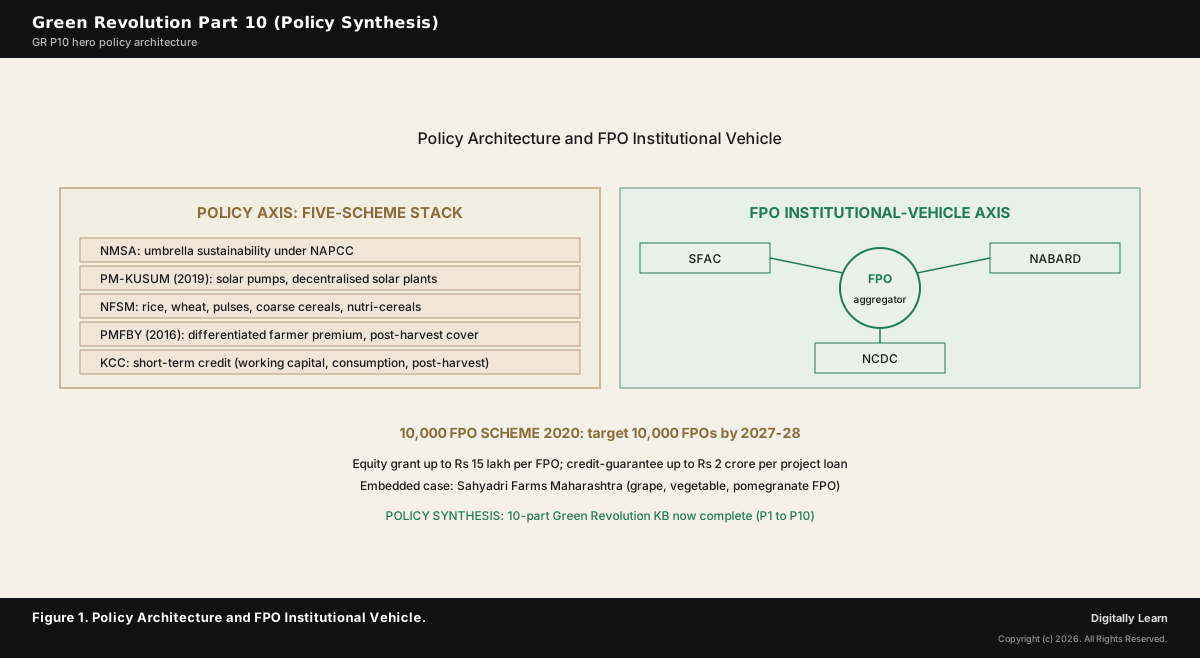
The policy architecture and FPO institutional vehicle of Green Revolution 2.0 is the unified scheme-and-institution layer that operationalises the technology, sustainability, climate, and digital flanks elaborated in GR P6 through GR P9. The architecture has two axes. The policy axis binds five centrally-sponsored schemes into the operational stack. The National Mission for Sustainable Agriculture (NMSA) is the umbrella sustainability scheme under the National Action Plan on Climate Change with sub-missions covering rainfed area development, on-farm water management, and soil health management. The PM-KUSUM (Pradhan Mantri Kisan Urja Suraksha evam Utthaan Mahabhiyan) launched 2019 deploys solar pumps and decentralised solar plants to break the diesel-or-electricity tube-well subsidy trap (cross-link to GR P5 groundwater critique). The National Food Security Mission (NFSM) targets productivity enhancement in rice, wheat, pulses, coarse cereals, nutri-cereals, and oilseeds. The Pradhan Mantri Fasal Bima Yojana (PMFBY) launched 2016 provides crop insurance with differentiated farmer-premium rates (2 per cent kharif food and oilseed, 1.5 per cent rabi food and oilseed, 5 per cent commercial and horticultural; UPSC Prelims 2016 reference on premium and post-harvest cover). The Kisan Credit Card (KCC) scheme provides short-term credit for working capital, consumption, and post-harvest expenses (UPSC Prelims 2020 reference on KCC scope). The FPO institutional vehicle axis rests on the 10,000 Farmer Producer Organisations Scheme launched 2020 with target of forming 10,000 FPOs by 2027-28, jointly sponsored by the Small Farmers' Agribusiness Consortium (SFAC), the National Bank for Agriculture and Rural Development (NABARD), and the National Cooperative Development Corporation (NCDC). The embedded case is Sahyadri Farms Maharashtra, one of the largest FPOs in India by membership and turnover, demonstrating the FPO model at scale.
Background and Historical Context
The GR 2.0 technology and sustainability flanks require a coordinated scheme-and-institution layer to reach the small and marginal farmer at scale. Standalone schemes without an institutional vehicle reach only the farmers who can navigate the application process alone; FPOs aggregate that farmer interface and channel scheme benefits through a single legal entity. The combined policy-plus-FPO architecture is the structural feature that completes GR 2.0, and UPSC Prelims has repeatedly tested its components: PMFBY premium differentiation (2016), the KCC short-term credit scope (2020), and the NFSM target-crop scope (2010).
What is the significance of the policy-plus-FPO architecture? Three operational dimensions follow. The integrated-scheme-stack dimension binds NMSA, PM-KUSUM, NFSM, PMFBY, and KCC into a coordinated farmer-facing package; the AgriStack farmer-registry (GR P9) makes the integration operational at the data layer. The institutional-aggregation dimension means the FPO interface aggregates small and marginal farmers into producer companies registered under the Companies Act 2013 (or cooperative societies under state laws), enabling collective procurement of inputs, collective marketing of output, and collective access to credit and crop insurance. The completeness dimension means GR 2.0 is now operationally whole as a ten-part architecture: Parts 1 to 5 close the GR 1.0 arc through the historical critique; Part 6 opens the 2.0 conceptual frame; Parts 7 to 9 cover sustainability, climate resilience, and technology; Part 10 binds the scheme stack and FPO institutional vehicle.
Current threads include the 10,000 FPO Scheme 2020 target of forming 10,000 FPOs by 2027-28 with a central outlay of around Rs 6,865 crore implemented through SFAC, NABARD, and NCDC, the PM-KUSUM Component-A and Component-B and Component-C rollout for grid-connected solar pumps and decentralised solar plants, the PMFBY restructured 2020 with voluntary enrolment for loanee farmers (previously compulsory), the Digital Agriculture Mission integration of FPO data into AgriStack for scheme-eligibility automation (covered in GR P9), and the Sahyadri Farms Maharashtra as a benchmark FPO across grape, vegetable, and pomegranate value chains. The cluster-architecture lesson is that the 10-part GR cluster establishes the canonical Indian agricultural-geography knowledge base for UPSC; the next clusters extend laterally to White Revolution dairy architecture, Blue Revolution fisheries architecture, and adjacent Agriculture-cluster topics already complete.
Policy and FPO: The Two-Axis Delivery Architecture
Policy axis plus FPO axis: the operational binding
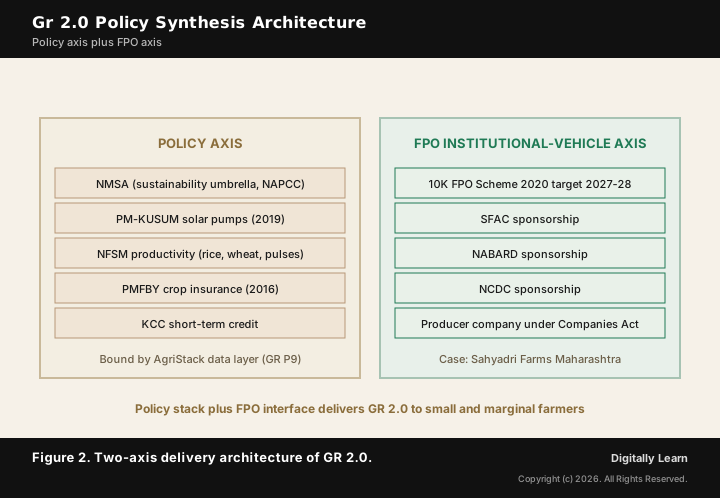
Green Revolution 2.0 reaches the small and marginal farmer through two interlocking axes. The policy axis binds five centrally-sponsored schemes (NMSA, PM-KUSUM, NFSM, PMFBY, KCC) into a coordinated farmer-facing package, with the AgriStack data layer providing the integration foundation. The FPO institutional-vehicle axis aggregates farmers into producer companies or cooperative societies.
Together the two axes replace the GR 1.0 individual-farmer scheme-access model with an aggregated and data-integrated model. A single producer entity now operates collective input procurement, collective output marketing, and collective access to credit and crop insurance, in place of the individual smallholder navigating each scheme application alone.
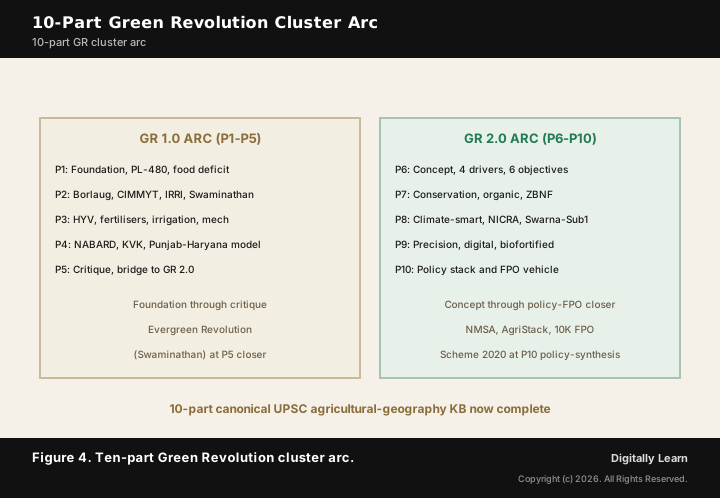
The ten-part reading is straightforward. Parts 1 through 5 close the original Green Revolution arc, from the food-deficit foundation through the socio-economic and environmental critique that bridges to the 2.0 pivot. Parts 6 through 9 cover concept, sustainable agriculture, climate-smart agriculture, and precision-digital-biofortified technology.
Part 10 binds the five-scheme stack and the FPO institutional vehicle as the operational layer that delivers the full architecture to farmers at scale. It is the structural feature that turns a set of standalone schemes into a single, navigable, data-integrated delivery system for Indian agriculture.
Policy Architecture: NMSA, PM-KUSUM, NFSM, PMFBY, KCC
The five-scheme operational stack
The GR 2.0 policy architecture rests on five centrally-sponsored schemes that operate as a coordinated stack rather than as standalone initiatives. The schemes are designed to be invoked in combination through the AgriStack data layer: a single farmer on the platform can access NMSA sub-mission support, PM-KUSUM solar-pump subsidy, NFSM target-crop incentive, PMFBY crop insurance, and KCC short-term credit through one unified eligibility decision.
- NMSA (National Mission for Sustainable Agriculture): Umbrella sustainability scheme under National Action Plan on Climate Change (NAPCC); sub-missions cover rainfed area development (RAD), on-farm water management (OFWM), soil health management (SHM).
- PM-KUSUM (Pradhan Mantri Kisan Urja Suraksha evam Utthaan Mahabhiyan): Launched 2019 with three components. Component-A: decentralised solar plants of 500 KW to 2 MW capacity on barren or fallow land. Component-B: standalone solar pumps for farmers without grid access. Component-C: grid-connected solar pumps with feeder-level solarisation.
- NFSM (National Food Security Mission): Originally launched 2007 with rice, wheat, pulses target-crop scope (UPSC Prelims 2010 reference); scope subsequently expanded to coarse cereals, nutri-cereals, oilseeds, commercial crops as per latest implementation framework.
- PMFBY (Pradhan Mantri Fasal Bima Yojana): Launched 2016 crop-insurance scheme with differentiated farmer-premium rates: 2 per cent for kharif food-and-oilseed crops, 1.5 per cent for rabi food-and-oilseed crops, 5 per cent for commercial-and-horticultural crops. Covers prevented sowing, standing-crop loss, post-harvest losses from cyclones and unseasonal rains (UPSC Prelims 2016 reference on post-harvest cover).
- KCC (Kisan Credit Card): Short-term credit support for working capital, consumption requirements of farm household, post-harvest expenses (UPSC Prelims 2020 reference on the three permitted short-term-credit purposes). Farm-machinery purchase and house construction are NOT KCC short-term scope; those operate through term-credit channels under NABARD refinance architecture.
| Scheme | Type | Launch year | Core function |
|---|---|---|---|
| NMSA | Sustainability umbrella (NAPCC) | 2014 | Rainfed area, water, and soil health sub-missions |
| PM-KUSUM | Solar energy support | 2019 | Solar pumps and decentralised solar plants for farms |
| NFSM | Productivity mission | 2007 | Target-crop yield gains in identified districts |
| PMFBY | Crop insurance | 2016 | Differentiated-premium cover against crop loss |
| KCC | Credit instrument | 1998 | Short-term working-capital, consumption, post-harvest credit |
FPO Institutional Vehicle and Sahyadri Farms Case
FPO architecture and the 10,000 FPO Scheme 2020
A Farmer Producer Organisation (FPO) is a legal entity formed by primary producers (farmers, milk producers, fishermen, weavers, rural artisans, craftsmen) that aggregates collective procurement, collective marketing, and collective access to credit and insurance. The FPO legal form is typically a producer company registered under the Companies Act 2013 (originally introduced as Part IXA of the Companies Act 1956 in 2002 on the Y K Alagh Committee recommendation) or a cooperative society registered under state cooperative laws.
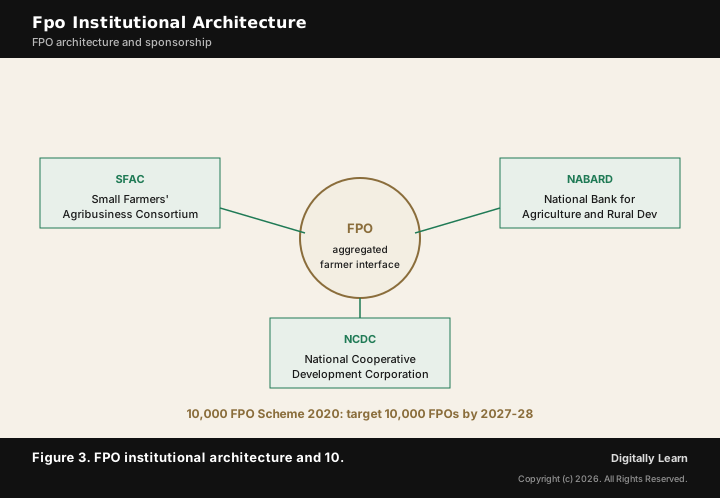
The 10,000 Farmer Producer Organisations Scheme was launched 2020 as a centrally-sponsored scheme targeting formation of 10,000 FPOs by 2027-28. The scheme is jointly sponsored by three institutional anchors: SFAC (Small Farmers' Agribusiness Consortium) under Department of Agriculture and Farmers Welfare, NABARD (National Bank for Agriculture and Rural Development) the apex refinance body (covered in GR P4 institutional architecture), and NCDC (National Cooperative Development Corporation) for the cooperative-form FPOs.
- Producer company legal form: Registered under Companies Act 2013; primary producer membership; limited liability; democratic governance through one-member-one-vote principle.
- Cooperative society legal form: Registered under state cooperative laws or Multi-State Cooperative Societies Act 2002; primary producer membership; cooperative governance principles.
- SFAC sponsorship: Small Farmers’ Agribusiness Consortium under Department of Agriculture and Farmers Welfare; promotes producer-company FPO form; capacity-building and credit-linkage support.
- NABARD sponsorship: National Bank for Agriculture and Rural Development; refinance and credit support to FPO sponsor-organisations; promotes producer-company and cooperative forms.
- NCDC sponsorship: National Cooperative Development Corporation; supports cooperative-society FPO form; financing and project assistance.
- Implementing-agency network: National Cooperative Development Corporation, NABARD, NABCONS, SFAC, NRLM, North-Eastern Region Agricultural Marketing Corporation among the cluster-based business organisations.
- Cluster-based formation: FPOs formed around crop clusters, regional commodities, or value-chain segments; equity grant of up to Rs 15 lakh per FPO and credit-guarantee facility up to Rs 2 crore per project loan.
Case: Sahyadri Farms Maharashtra benchmark FPO
Sahyadri Farms Producer Company Limited in Nashik, Maharashtra is one of the largest FPOs in India by membership and annual turnover. The company aggregates several thousand small and marginal farmer-members across grape, vegetable, pomegranate, banana, and other horticulture value chains. The operational model rests on three pillars: collective input procurement, collective marketing under the Sahyadri brand to retail and export channels, and collective access to credit and crop insurance through the FPO entity.
The case matters because it shows the FPO model reaching commercial scale while remaining a primary-producer-owned entity. Sahyadri Farms has built export channels to Europe and the Middle East for table grapes and other horticulture produce, replacing the legacy individual-farmer-with-middleman value chain with a single producer-owned interface.
The wider lesson is that the 10,000 FPO Scheme can replicate this aggregation in cluster-based formation across crop categories and regions. It scales the producer-owned interface to fit India's small-and-marginal-farmer-majority agricultural structure, where holdings are too fragmented for individual market access.
Synthesis: The Ten-Part Green Revolution Arc
What the 10-part cluster establishes
The ten-part Green Revolution series establishes a canonical Indian agricultural-geography reference for UPSC by binding the historical GR 1.0 arc to the contemporary GR 2.0 architecture in a single coherent narrative. The arc has a clear structure that mirrors the policy evolution itself.
Parts 1 through 5 close the original Green Revolution arc: foundation, global origins, the technological package, institutional and regional impact, and the socio-economic plus environmental critique that bridges to the 2.0 pivot. Parts 6 through 10 elaborate the GR 2.0 architecture, from concept and sustainable agriculture through climate-smart and precision technology to the closing policy and FPO institutional vehicle.
- GR P1 Foundation: Pre-Green-Revolution India, PL-480, food-grain deficit, agricultural-modernisation imperative.
- GR P2 Global Origins: Borlaug, CIMMYT, IRRI, Swaminathan, IADP, IAAP, agricultural-university network.
- GR P3 Technological Package: Dwarf HYV seeds, chemical fertilisers, irrigation, mechanisation, scientific practices.
- GR P4 Institutional and Regional Impact: NABARD, cooperative banks, agricultural universities, Krishi Vigyan Kendras, Punjab-Haryana wheat-belt success model, eastern India and dryland Peninsular lag.
- GR P5 Socio-Economic and Environmental Critique, Bridge to GR 2.0: Rural inequality, mechanisation displacement, groundwater depletion, soil degradation, agro-biodiversity loss, stubble burning. Evergreen Revolution by Swaminathan as the conceptual pivot.
- GR P6 GR 2.0 Concept: Four drivers, productivity-to-sustainability pivot, six core objectives, GR 1.0 vs 2.0 comparison.
- GR P7 Sustainable Agriculture: Conservation Agriculture, NPOP organic, PKVY, MOVCDNER, SPNF natural farming, BPKP, APCNF case, Sikkim 100 per cent organic state case.
- GR P8 Climate-Smart and Climate-Resilient Agriculture: FAO three pillars, NICRA via ICAR-CRIDA, Swarna-Sub1 flood-tolerant rice, CCAFS-CGIAR-ICRISAT, GACSA.
- GR P9 Precision, Digital, Biofortified: GIS and Remote Sensing via ISRO Bhuvan, drones under DGCA Rules 2021, Bollgard Bt cotton, Golden Rice, HHB-67-Improved pearl millet, HarvestPlus, AgriStack, Digital Agriculture Mission, Karnataka Millet Mission case.
- GR P10 Policy Architecture and FPO Institutional Vehicle: NMSA, PM-KUSUM, NFSM, PMFBY, KCC, 10,000 FPO Scheme 2020, SFAC-NABARD-NCDC sponsorship, Sahyadri Farms Maharashtra case.
With Part 10 the ten-part series is complete. Related extension paths include the White Revolution dairy series, the Blue Revolution fisheries series, and adjacent topics already covered in the Agriculture and Soils material. The Green Revolution series now serves as the canonical reference for the agriculture-and-policy area of the Economic Geography syllabus in UPSC preparation.
Previous Year UPSC-CSE Questions
Previous Year UPSC-CSE Questions By the end you will be able to draft model answers for the following UPSC questions. Each question carries a collapsible framework showing how to approach it in the exam.
- UPSC Prelims 2016With reference to Pradhan Mantri Fasal Bima Yojana, consider the following statements:
- Under this scheme, farmers will have to pay a uniform premium of two percent for any crop they cultivate in any season of the year.
- This scheme covers post-harvest losses arising out of cyclones and unseasonal rains.
Which of the statements given above is/are correct?
How to approach this Prelims question
Approach: Statement 1 inverts the differentiated-premium architecture. PMFBY explicitly uses three-tier premium: 2 per cent kharif food and oilseed, 1.5 per cent rabi food and oilseed, 5 per cent commercial and horticultural. The 'uniform' framing is the trap. Statement 2 is a standard PMFBY policy feature.
Trap to watch: Treating the 2 per cent kharif rate as uniform-across-all-crops; the differentiation is the load-bearing design feature.
Key facts to recall:
- PMFBY launched 2016; restructured 2020 with voluntary enrolment for loanee farmers.
- Three-tier farmer premium: 2 per cent kharif F and OS, 1.5 per cent rabi F and OS, 5 per cent commercial and horticultural.
- Post-harvest cover: cyclones, unseasonal rains, hailstorms; up to 14 days from harvest while crops in field.
- Subsidy on premium difference borne by central plus state governments.
Answer signal: Correct answer is (b) (2 only); differentiated premium not uniform; post-harvest cover yes.
- UPSC Prelims 2020Under the Kisan Credit Card scheme, short-term credit support is given to farmers for which of the following purposes?
- Working capital for maintenance of farm assets
- Purchase of combine harvesters, tractors and mini trucks
- Consumption requirements of farm households
- Post-harvest expenses
- Construction of family house and setting up of village cold storage facility
Select the correct answer using the code given below:
How to approach this Prelims question
Approach: Apply the short-vs-term-credit distinction: KCC short-term covers working capital, consumption, post-harvest expenses (statements 1, 3, 4). Term credit covers asset purchase like machinery (statement 2) and infrastructure like house or cold storage (statement 5). The distinction is the load-bearing concept.
Trap to watch: Treating any farmer-credit purpose as KCC-eligible; KCC is specifically short-term, not term credit.
Key facts to recall:
- KCC short-term scope: working capital, consumption, post-harvest.
- Term credit (separate): farm machinery purchase, house construction, cold storage, irrigation infrastructure.
- KCC operates through cooperative banks, RRBs, commercial banks under NABARD refinance.
- PM-KISAN income support, KCC credit, and PMFBY insurance form the farmer-facing scheme trio.
Answer signal: Correct answer is (b) (1, 3 and 4 only); KCC short-term covers working capital, consumption, post-harvest.
- UPSC Prelims 2010An objective of the National Food Security Mission is to increase the production of certain crops through area expansion and productivity enhancement in a sustainable manner in the identified districts of the country. What are those crops?
How to approach this Prelims question
Approach: Apply the 2010 NFSM scope which covered rice, wheat, pulses only. The other options either undersell (rice and wheat only) or overshoot (include oilseeds or vegetables) the 2010 framing. Post-2010 the scope expanded to coarse cereals and nutri-cereals and oilseeds; the UPSC 2010 question tests the original framing.
Trap to watch: Applying the current-framework (which includes coarse cereals and nutri-cereals and oilseeds) to the 2010-vintage question; the answer key reflects the 2010 scheme architecture.
Key facts to recall:
- NFSM launched 2007 with rice, wheat, pulses target crops (Prelims 2010 framing).
- Scope expanded post-2010 to coarse cereals and nutri-cereals (jowar, bajra, ragi, small millets).
- Oilseeds added to NFSM scope subsequently; commercial crops in current architecture.
- Cluster-based productivity-enhancement-plus-area-expansion in identified districts is the design.
Answer signal: Correct answer is (b) (Rice, wheat and pulses only); reflects 2010 NFSM scope framing.
Sources
- Class 12 India People and Economy, Chapter 5 (Land Resources and Agriculture)
- Indian Council of Agricultural Research (ICAR) institutional architecture
- Department of Agriculture and Farmers Welfare NMSA, PM-KUSUM, NFSM, PMFBY, KCC scheme architecture
- NABARD as one of the three 10,000 FPO Scheme sponsorship bodies
- National Food Security Mission (NFSM) target crops including coarse cereals and nutri-cereals
- Press Information Bureau releases on 10,000 FPO Scheme and PM-KUSUM scheme rollout
- Pradhan Mantri Fasal Bima Yojana: Wikipedia overview
- Niti Aayog policy documents on agricultural transformation and FPO architecture
- Ministry of Statistics and Programme Implementation: Agricultural Statistics at a Glance
- Reserve Bank of India guidelines on KCC short-term credit architecture
Disclaimer
This article is for UPSC preparation. Specific scheme outlays, FPO-formation figures, and rollout details vary over time. Aspirants should cross-check scheme particulars against official Ministry of Agriculture and NABARD sources.