


Overview
Variability, drought-flood-cyclone-heat regimes, the IPCC AR6 signal, and India's policy stack
How monsoon variability, climatic hazards, and the multi-decade climate-change signal converge on a single statutory response built on NDMA, NAPCC, the India NDC, and Net Zero 2070.
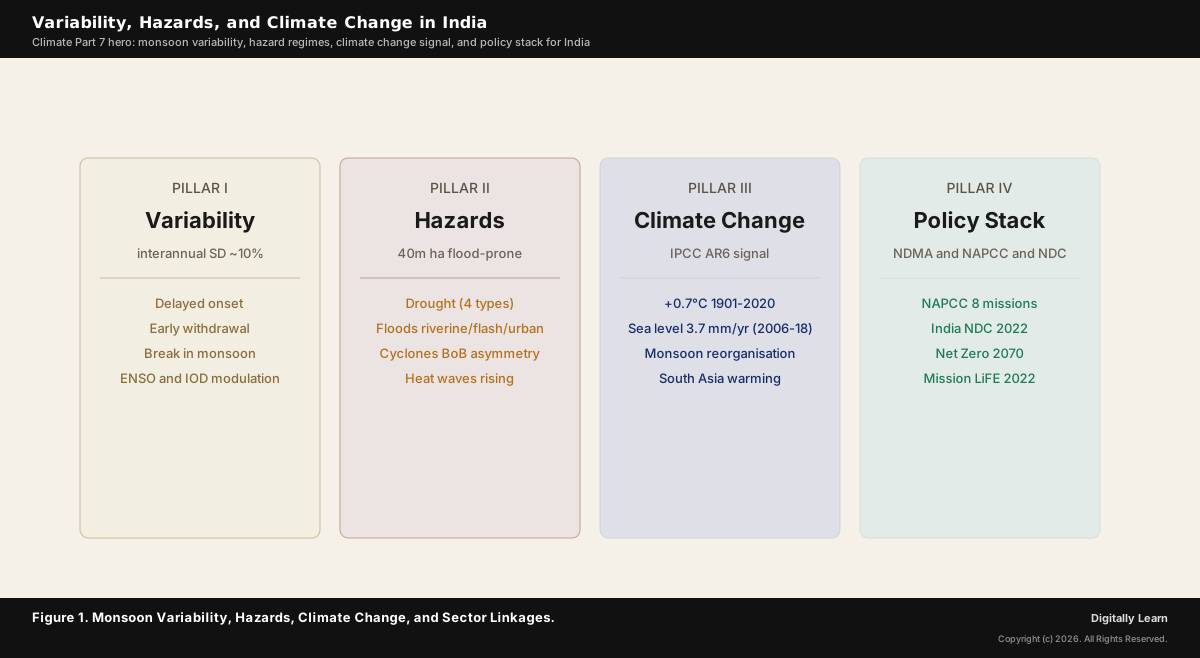
Monsoon variability, climatic hazards, and the climate-change signal are three policy-relevant dimensions of India's tropical-monsoon climate. Variability arises from the interannual fluctuation of the southwest monsoon driven by ENSO, IOD, MJO, and Tibetan plateau heating. Hazards are the lived outcomes: droughts, floods, tropical cyclones, heat waves, and cold waves. The climate-change signal is the multi-decade warming and precipitation reorganisation documented by the IPCC AR6 South Asia chapter, superimposed on both. India's policy stack on NDMA and NAPCC and NDC and Net Zero 2070 addresses all three on a single statutory timeline.
Background and Historical Context
Three quarters of India's annual rainfall is delivered by the southwest monsoon, and the interannual variability of the monsoon directly drives the kharif cropping cycle, hydropower reservoir filling, groundwater recharge, and food security for one and a half billion people. Approximately 19 per cent of India's geographical area and 12 per cent of the population face drought every year. The Rashtriya Barh Ayog identified approximately 40 million hectares of land as flood-prone. The retreating-monsoon Bay of Bengal cyclones (Cyclone Tauktae 2021, Cyclone Yaas 2021, Cyclone Mocha 2023) drive landfall emergencies on the east coast. UPSC Mains GS-I and GS-III treat variability, hazards, and the climate-change signal as a single integrated policy problem.
What is the significance of integrating the three pillars? Variability is intrinsic to the monsoon; hazards are its lived outcomes; and the climate-change signal is the slow-moving background driver intensifying both. The Disaster Management Act 2005 places the institutional response at the apex (NDMA), the NAPCC 2008 structures the mitigation-and-adaptation strategy across eight missions, and the India NDC update August 2022 binds the country to a 45 per cent reduction in emissions intensity by 2030 and 50 per cent non-fossil electricity capacity by 2030. The Net Zero 2070 target announced at COP-26 (Glasgow 2021) sets the long-horizon decarbonisation pathway.
The IPCC AR6 South Asia chapter (Working Group 1 Chapter 10 and Working Group 2 Chapter 10) projects amplification of heat-wave frequency, intensification of the monsoon's extreme-rainfall regime, and continued sea-level rise. Mission LiFE launched in October 2022 at Kevadia, Gujarat (showcased at COP-27 November 2022) frames the demand-side behavioural-change agenda; Loss and Damage Fund negotiated at COP-28 (Dubai 2023) and the Global Stocktake framework provide international cooperation paths. Sector linkages run across agriculture, water, energy, urban infrastructure, and health.
Introduction: Variability, Hazards, and Climate Change as a Single Policy Problem
Three pillars and the policy stack they share
The Indian monsoon is a high-variance climatological system. Year-to-year departures from the long-period average drive three distinct policy problems: monsoon variability, climatic hazards, and the climate-change signal imposed on both. The three pillars share a single policy stack built on the Disaster Management Act 2005, the National Action Plan on Climate Change, and India's Nationally Determined Contribution. This article integrates the three pillars and maps each to the institutional and statutory responses.
Almost one fifth of India's area suffers drought every year, two fifths is flood-prone per the Rashtriya Barh Ayog estimate, and the entire country is exposed to the multi-decade temperature rise documented by the IPCC AR6 South Asia chapter. The variability of the southwest monsoon is the immediate driver, climate change is the slow background driver, and the policy stack must address both timescales simultaneously.
Monsoon Variability: Onset, Withdrawal, Break, Burst
Foundations of interannual monsoon variability
The southwest monsoon delivers approximately three quarters of India's annual rainfall, and the kharif cropping cycle, hydropower reservoir filling, and groundwater recharge all depend on its timing and intensity.
The interannual standard deviation of all-India rainfall is approximately 10 per cent of the long-period average, but the regional figure is much higher (~30 per cent in some sub-divisions). UPSC Prelims has tested ENSO, IOD, and MJO mechanisms repeatedly; Mains treats variability as a climate-resilience policy problem.
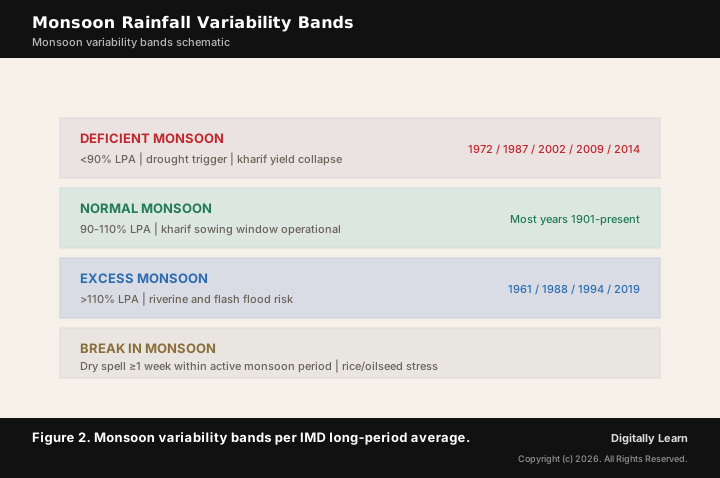
Variability is intrinsic to the monsoon system regardless of the climate-change signal. A delayed onset, early withdrawal, prolonged break, or compressed-burst monsoon can each produce hazard outcomes even in a stable climate.
The IMD's long-period rainfall record from 1901 onwards documents recurrent deficient-monsoon years (1972, 1987, 2002, 2009, 2014, 2015) and excess-monsoon years (1961, 1988, 1994, 2019). Each event maps to a downstream drought or flood emergency.
- Delayed onset: When the Kerala-coast normal date of 1 June slips by 5 to 15 days, the kharif sowing window contracts in Tamil Nadu, Karnataka, Maharashtra.
- Early withdrawal: When the northwestern withdrawal advances ahead of mid-September, soybean and pulses crops face moisture stress.
- Break in monsoon: Prolonged dry spells within the active monsoon period kill rice and oilseed yield at the tillering or flowering stage.
- Burst: A compressed-rainfall burst delivers a season’s rainfall in days, producing flash floods that destroy crops and infrastructure.
Drought Regimes in India
Four drought types per the IMD-NDMA framework
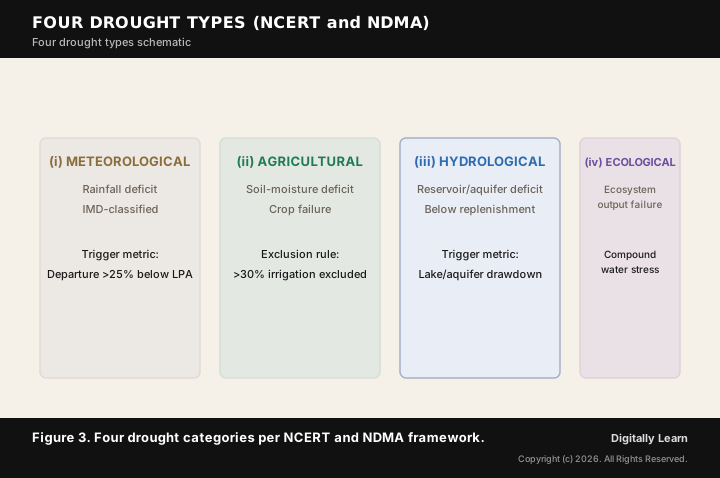
The Indian disaster-management framework recognises four drought categories, distinguished by the water-cycle compartment they affect. Meteorological drought is a prolonged period of inadequate rainfall with mal-distribution over time and space, defined by a rainfall departure threshold. Agricultural drought, also called soil-moisture drought, sets in when soil moisture falls below crop-water requirements; an area with more than 30 per cent of its gross cropped area under irrigation is excluded from the drought-prone category.
Hydrological drought occurs when the water in reservoirs, lakes, and aquifers falls below replenishment levels. Ecological drought occurs when natural ecosystem productivity fails due to compounded water shortage and ecological distress.
- (i) Meteorological drought: rainfall departure threshold, IMD-classified.
- (ii) Agricultural drought: soil-moisture deficit; 30 per cent irrigation threshold excludes from drought-prone category.
- (iii) Hydrological drought: reservoir and aquifer storage below replenishment.
- (iv) Ecological drought: natural ecosystem productivity failure under compound water stress.
Approximately 19 per cent of India's total geographical area and 12 per cent of the total population suffer drought every year. About 30 per cent of the country's area is classified drought-prone, affecting around 50 million people. Drought-prone regions are concentrated in Rajasthan, Gujarat, the Marathwada region of Maharashtra, Vidarbha, Rayalaseema in Andhra Pradesh, and the Karnataka inland plateau. Recurrence is the rule, not the exception.
| Indicator | Approximate value |
|---|---|
| Geographical area affected by drought yearly | 19 per cent |
| Population affected by drought yearly | 12 per cent |
| Area classified drought-prone | 30 per cent |
| People in drought-prone regions | around 50 million |
Flood Regimes: Riverine, Flash, and Urban
Flood typology and the 40-million-hectare flood-prone estimate
The Rashtriya Barh Ayog (National Flood Commission) identified approximately 40 million hectares of land as flood-prone in India. Three flood regimes dominate. Riverine floods recur along the Brahmaputra in Assam, the Ganga across Bihar and eastern Uttar Pradesh, and the Godavari and Mahanadi deltas.
Flash floods strike Punjab, Rajasthan, northern Gujarat, and Haryana when blocked streams and high-intensity rainfall combine; the same regime produces Himalayan glacial-lake-outburst floods. Urban floods are a new climate-induced disaster: Mumbai 2005, Chennai 2015, Bengaluru 2022, and Hyderabad 2020 show paved catchments overwhelming dated storm-water drains.
- Assam, West Bengal, Bihar: High flood-prone states with annual Brahmaputra-Ganga inundation.
- Punjab, Uttar Pradesh: Occasional flooding under deficient drainage and heavy rainfall.
- Rajasthan, Gujarat, Haryana, Punjab: Flash floods from blocked streams and burst-monsoon events.
- Tamil Nadu (November-January): Retreating-monsoon flooding along the east coast.
Mechanism features of Indian flood management span institutional, observational, and infrastructure layers, summarised below.
- (i) The Disaster Management Act 2005 structure places the National Disaster Management Authority at the apex.
- (ii) The Central Water Commission flood-forecasting network covers 332 stations across major basins.
- (iii) The AMRUT mission storm-water-drain upgrade targets the largest 500 cities.
- (iv) The IMD nowcast-and-warning service delivers urban-district lead time for short-duration rainfall.
Cyclones, Heat Waves, and Cold Waves
Tropical cyclones: Bay of Bengal versus Arabian Sea asymmetry
The Bay of Bengal produces approximately four times the tropical-cyclone landfalls of the Arabian Sea, driven by warmer sea surface temperatures, lower wind shear, and the Inter Tropical Convergence Zone's seasonal residence over the Bay.
The retreating-monsoon window of October and November is the peak landfall season for the east coast (Tamil Nadu, Andhra Pradesh, Odisha, West Bengal). The pre-monsoon and post-monsoon windows produce occasional Arabian Sea landfalls on the Gujarat and Kerala coasts (Cyclone Tauktae 2021, Cyclone Biparjoy 2023).
- (a) Bay of Bengal east-coast landfalls dominate the retreating-monsoon hazard calendar.
- (b) Arabian Sea cyclones have risen in frequency over the past decade, attributed by IITM and IMD to warming sea-surface temperatures.
- (c) Heat-wave days in northwestern and central India have risen sharply in the past two decades, with the IMD recording record May temperatures in 2010, 2015, 2019, and 2022.
Climate-Change Signal in India
IPCC AR6 South Asia signal and India's measured trends
The IPCC AR6 South Asia chapter (WG1 Chapter 10 and WG2 Chapter 10) documents regional warming of approximately 0.7 degrees Celsius from 1901 to 2020, faster than the global average in the lower troposphere.
IPCC AR6 WG1 reports global mean sea-level rise of approximately 3.7 millimetres per year over 2006-2018, with regional Indian Ocean rates varying around this figure; the historical 20th-century rate was approximately 1.7 millimetres per year.
Monsoon precipitation reorganisation appears as drying over the central Indo-Gangetic plain alongside an intensifying heavy-rainfall tail. The chapter projects more frequent and intense heat waves, heavier extreme rainfall, and continued sea-level rise through the twenty-first century. The direction of mean monsoon change is towards a wetter monsoon, though the magnitude carries large uncertainty.
| Indicator | Signal |
|---|---|
| Regional warming, 1901-2020 | approximately 0.7 degrees Celsius |
| Global mean sea-level rise, 2006-2018 | approximately 3.7 mm per year |
| Historical 20th-century sea-level rise | approximately 1.7 mm per year |
| Extreme rainfall | intensifying heavy-rainfall tail |
| Mean monsoon rainfall | projected to increase; magnitude uncertain |
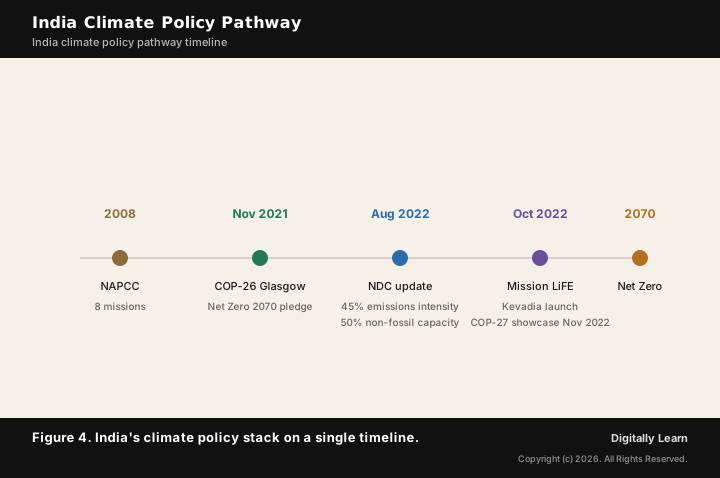
India's response is built on the National Action Plan on Climate Change (NAPCC, 2008) with its eight national missions covering solar, energy efficiency, sustainable habitat, water, Himalayan ecosystem, green India, sustainable agriculture, and strategic knowledge.
The India NDC update submitted to the UNFCCC in August 2022 commits to a 45 per cent reduction in emissions intensity of GDP by 2030 (over 2005 baseline) and 50 per cent non-fossil installed electricity capacity by 2030. India's Net Zero 2070 target was announced at COP-26 (Glasgow, 2021). Mission LiFE (Lifestyle for Environment) launched in October 2022 at Kevadia and frames the demand-side behavioural-change agenda.
Previous Year UPSC-CSE Questions
Previous Year UPSC-CSE Questions By the end you will be able to draft model answers for the following UPSC questions. Each question carries a collapsible framework showing how to approach it in the exam.
- UPSC Prelims 2025Consider the following statements:
- Statement I: At the 28th United Nations Climate Change Conference (COP28), India refrained from signing the 'Declaration on Climate and Health'.
- Statement II: The COP28 Declaration on Climate and Health is a binding declaration; and if signed, it becomes mandatory to decarbonize health sector.
- Statement III: If India's health sector is decarbonized, the resilience of its health-care system may be compromised.
Which one of the following is correct in respect of the above statements?
How to approach this Prelims question
Approach: Statement I: India refrained from signing the COP28 Declaration on Climate and Health (December 2023) – CORRECT (factual). Statement II: the Declaration is a VOLUNTARY, non-binding instrument; signing does NOT mandate health-sector decarbonisation – INCORRECT (it mischaracterises the Declaration). Statement III: India's documented rationale was that rapid health-sector decarbonisation could strain health-system resilience in remote and under-served regions – CORRECT. Only Statement III is correct and it explains why India refrained, so the answer is (c). This is a debated 2025 question; the dominant answer-key consensus is (c).
Trap to watch: Both Stmt II and Stmt III are framed as plausible explanations for India's refusal, but both are factually wrong; the Declaration is voluntary and decarbonisation does not compromise health-system resilience.
Key facts to recall:
- COP28 held at Dubai UAE in November-December 2023
- Declaration on Climate and Health is a VOLUNTARY non-binding declaration
- India refrained from signing while ~120 countries did sign
Answer signal: Correct answer is (c) (Only Statement III is correct and it explains Statement I).
- UPSC Prelims 2025Consider the following statements :
- Statement I : Article 6 of the Paris Agreement on climate change is frequently discussed in global discussions on sustainable development and climate change.
- Statement II : Article 6 of the Paris Agreement on climate change sets out the principles of carbon markets.
- Statement III : Article 6 of the Paris Agreement on climate change intends to promote inter-country non-market strategies to reach their climate targets.
Which one of the following is correct in respect of the above statements?
How to approach this Prelims question
Approach: Statement I: Article 6 is frequently discussed in sustainable-development climate talks – CORRECT. Statement II: Article 6.2 (Internationally Transferred Mitigation Outcomes) and Article 6.4 (international carbon market replacing CDM) set carbon-market principles – CORRECT. Statement III: Article 6.8 promotes non-market approaches for inter-country cooperation – CORRECT. Both Stmt II and Stmt III explain why Article 6 features prominently in climate discussions (it covers both market and non-market mitigation pathways).
Trap to watch: Article 6 covers BOTH markets (Articles 6.2 and 6.4) and non-markets (6.8); a common trap is to think Article 6 is markets-only.
Key facts to recall:
- Article 6.2: ITMOs (Internationally Transferred Mitigation Outcomes)
- Article 6.4: international carbon market mechanism (replaces CDM)
- Article 6.8: non-market approaches framework
Answer signal: Correct answer is (a) (Both II and III correct AND both explain I).
- UPSC Mains 2024 GS-IWhat is sea surface temperature rise? How does it affect the formation of tropical cyclones?
How to structure the answer in the exam
Introduction: Open by defining sea surface temperature rise and citing the IPCC AR6 finding of a warming Indian Ocean.
Body (sub-themes to develop):
- Mechanism: the 26.5 degrees Celsius threshold and the thermodynamic energy supply to cyclones
- Effects: intensification of windspeed, rainfall and duration; Bay of Bengal versus Arabian Sea asymmetry
- India context: recent cyclones (Tauktae, Yaas, Biparjoy, Mocha) and rising Arabian Sea frequency
Conclusion: Close by linking the SST trend to the NDMA cyclone-preparedness framework.
- UPSC Mains 2024 GS-IIIFlooding in urban areas is an emerging climate- induced disaster. Discuss the causes of this disaster. Mention the features of two such major floods in the last two decades in India. Describe the policies and frameworks in India that aim at tackling such floods.
How to structure the answer in the exam
Introduction: Open by defining urban flooding as an emerging climate-induced disaster distinct from riverine flooding.
Body (sub-themes to develop):
- Climate causes: rising extreme-rainfall regime and IPCC AR6 South Asia projections
- Urban-design causes: paved catchments, storm-water drain undersizing, drainage encroachment
- Two case studies: Mumbai 2005 and Chennai 2015 with their distinctive features
- Policy framework: AMRUT, Smart Cities, NDMA urban-flood guidelines, IMD nowcast
Conclusion: Close by arguing for integration of climate-resilience into urban planning and drainage codes.
- UPSC Mains 2023 GS-IDiscuss the consequences of climate change on the food security in tropical countries.
How to structure the answer in the exam
Introduction: Open by situating tropical countries' high agricultural vulnerability to a warming climate.
Body (sub-themes to develop):
- Yield decline from temperature stress (rice and wheat thresholds)
- Monsoon variability disrupting sowing-and-harvest calendars
- Extreme weather events (heat waves, floods, cyclones) damaging standing crops
- Sea-level rise threatening coastal agriculture and aquaculture
Conclusion: Close with the policy response: NICRA, Climate-Resilient Agriculture programmes, and NMSA.
- UPSC Mains 2023 GS-IIIThe Intergovernmental Panel on Climate Change (IPCC) has predicted a global sea level rise of about one metre by AD 2100. What would be its impact in India and the other countries in the Indian Ocean region?
How to structure the answer in the exam
Introduction: Open by stating the IPCC AR6 high-end projection of about one metre sea-level rise by 2100.
Body (sub-themes to develop):
- India coastal impacts: 7,500 km coastline erosion and salt-water intrusion
- India population impacts: displacement of low-lying coastal districts
- India economic impacts: port submergence and coastal-tourism loss
- Indian Ocean region: Maldives existential threat and Bangladesh delta inundation
Conclusion: Close with India's coastal-management response: CRZ notifications and the Integrated Coastal Zone Management Project.
Sources
- NCERT Class 11 India Physical Environment, Chapter 4 (Climate)
- NCERT Class 11 India Physical Environment, Chapter 7 (Natural Hazards and Disasters)
- IPCC Sixth Assessment Report (AR6) Working Group 1, Chapter 10 (Linking Global to Regional Climate Change)
- IPCC AR6 Working Group 2, Chapter 10 (Asia)
- India Meteorological Department (IMD) long-period rainfall archive
- Indian Institute of Tropical Meteorology (IITM), Pune
- National Disaster Management Authority (NDMA) hazard guidelines
- Ministry of Environment, Forest and Climate Change (MoEFCC) NDC update 2022
- UNFCCC India NDC submissions
- Wikipedia: Climate change in India
- Wikipedia: National Action Plan on Climate Change
- Wikipedia: Floods in India
Disclaimer
This article is intended for UPSC preparation and general awareness. Figures and policy targets follow the authoritative sources listed below and may be revised by the issuing agencies. Readers should consult the cited primary sources for the latest official position.