


Overview
Indian Agriculture, Part 3
Where and why India grows its two principal food grains.
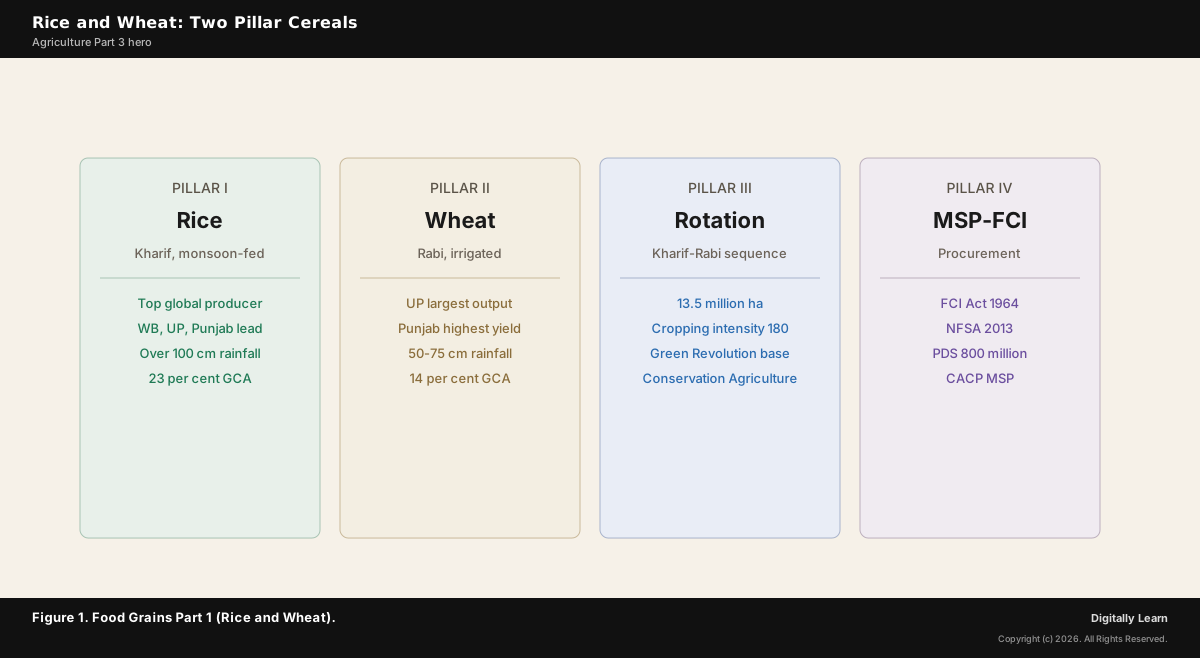
Rice and wheat are the two pillar cereals of Indian food security and the principal beneficiaries of the Green Revolution. Rice is a kharif crop of tropical and sub-tropical regions, requiring hot and humid conditions, over 100 cm of rainfall or assured irrigation, and fine clayey alluvial or laterite soils. India is among the world's largest rice producers and a leading exporter. Wheat is a rabi crop of cool sub-tropical and temperate regions, requiring cool moist winter sowing, bright sunny harvest, and moderate rainfall of 50 to 75 cm. The Indo-Gangetic Wheat Belt across Punjab, Haryana, Uttar Pradesh, Madhya Pradesh, Rajasthan, and Bihar dominates national production.
Background and Historical Context
Rice and wheat together account for the bulk of Indian foodgrain output and the largest share of cultivated area. Rice covers around 23 per cent of gross cropped area; wheat covers around 14 per cent. The two cereals underpin the Public Distribution System, the National Food Security Act 2013 entitlement, and the minimum-support-price procurement architecture of the Food Corporation of India. UPSC Prelims tests rice-methane attribution, HYV variety identification, and zero-tillage rice-wheat rotation directly; Mains GS-III covers procurement, subsidy, and diversification themes.
What is the significance of the rice-wheat duopoly? Three operational dimensions follow. The climatic complementarity means rice (kharif, monsoon) and wheat (rabi, winter) occupy the same physical land in two sequential seasons, producing the rice-wheat cropping system that defines the Indo-Gangetic alluvial belt. The Green Revolution package (HYV seeds, irrigation, fertiliser, mechanisation) was built on rice and wheat from the mid-1960s, transforming India from food-import dependence to self-sufficiency. The procurement architecture through FCI delivers MSP-backed market support to both crops; Punjab, Haryana, western Uttar Pradesh, and Madhya Pradesh dominate the procurement geography.
The ICAR-Central Rice Research Institute at Cuttack coordinates Indian rice research; the ICAR-Indian Institute of Wheat and Barley Research at Karnal coordinates wheat research. The Food Corporation of India handles MSP procurement, storage, and PDS distribution. Climate-change amplification is reshaping the rice-wheat system: rising temperatures shorten the wheat grain-filling window in northern India; monsoon variability shifts the kharif rice sowing date in eastern India; groundwater depletion from over-pumping in canal-command tracts threatens long-term sustainability. Conservation Agriculture (zero tillage, residue retention, crop diversification) is the canonical adaptation response.
Introduction: Rice and Wheat as Pillar Cereals
Why rice and wheat underpin Indian food security
Rice and wheat together supply the bulk of Indian calories and the largest share of cultivated cereal area. Rice occupies around 23 per cent of gross cropped area; wheat occupies around 14 per cent. Together the two cereals occupy over a third of national cropped area and supply roughly three-quarters of foodgrain output. Their dominance is both an outcome of and an input to the Public Distribution System and the National Food Security Act 2013 entitlement architecture.
India is among the world's largest rice producers and the leading rice exporter. India is also the second-largest wheat producer after China. The dual-cereal status underpins national food sovereignty and the rice-and-wheat-led Green Revolution legacy of the 1960s to 1980s.
| Variable | Rice | Wheat |
|---|---|---|
| Cropping season | Kharif (sown June-July, harvested September-October) | Rabi (sown October-November, harvested March-April) |
| Temperature | Hot and humid, 22 to 32 degrees Celsius | Cool sowing 10 to 20 degrees, warm sunny ripening |
| Rainfall | Over 100 cm or assured irrigation | 50 to 75 cm, irrigation-supported |
| Soil | Fine clayey alluvial and laterite, water-retentive | Well-drained loam and clayey-loam alluvium |
| Leading states | West Bengal, Uttar Pradesh, Punjab | Uttar Pradesh, Madhya Pradesh, Punjab, Haryana |
Rice Cultivation: Kharif, Monsoon-Fed, Eastern Belt
Geographic conditions and producing regions
How rice geography is set by the kharif calendar. Rice is the canonical kharif crop of monsoon India. The crop requires hot and humid conditions through the growing season, over 100 cm of rainfall or assured irrigation, and fine clayey soils that retain standing water. The transplanted-paddy system involves nursery preparation, transplanting after the first monsoon showers, and harvest in September-October.
- (i) Climatic requirements: 22 to 32 degrees Celsius growing temperature; over 100 cm rainfall during the growing season; high humidity.
- (ii) Soil requirements: Fine clayey alluvial soil that retains water; deltaic and valley-floor tracts of Indo-Gangetic-Brahmaputra plain; coastal alluvium; Kuttanad Kari peaty soil (below-sea-level rice covered in Soils Part 8).
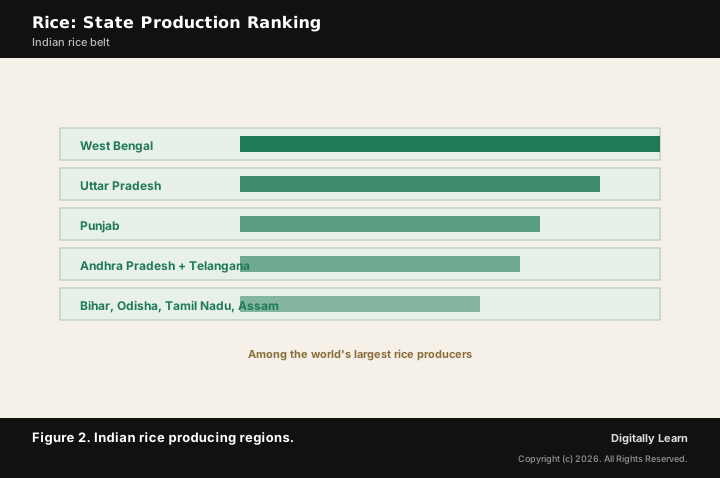
- (iii) Producing regions: West Bengal, Uttar Pradesh, and Punjab are consistently the leading producers; Andhra Pradesh, Telangana, Bihar, Tamil Nadu, Odisha, Chhattisgarh, and Assam complete the major rice-producing states.
- (iv) Three-crop system in southern India: Tamil Nadu and Andhra Pradesh practise the Aus (autumn), Aman (winter), and Boro (summer) rice cycle on the same land where irrigation supports a third cycle.
- (v) Methane emissions: Anaerobic decomposition in waterlogged paddy fields releases methane; the UPSC Prelims 2010 confirmed this as the canonical attribution for rice-cultivation global-warming contribution.
Wheat Cultivation: Rabi, Irrigated, Wheat Belt
Climatic requirements and the Indo-Gangetic Wheat Belt
How wheat geography is set by the rabi calendar. Wheat is the canonical rabi crop. It requires cool moist conditions during the sowing and tillering stages, followed by bright sunny weather during grain-filling and harvest. Moderate rainfall of 50 to 75 cm during the growing season is ideal; canal and tube-well irrigation supplement where natural rainfall is insufficient.
- (i) Climatic requirements: 10 to 20 degrees Celsius sowing temperature rising to 20 to 25 degrees at harvest; cool winter; 50 to 75 cm rainfall; frost-free spring crucial.
- (ii) Soil requirements: Well-drained loamy and clayey-loam Indo-Gangetic alluvial soils; Black Cotton Soil in central India also supports wheat.
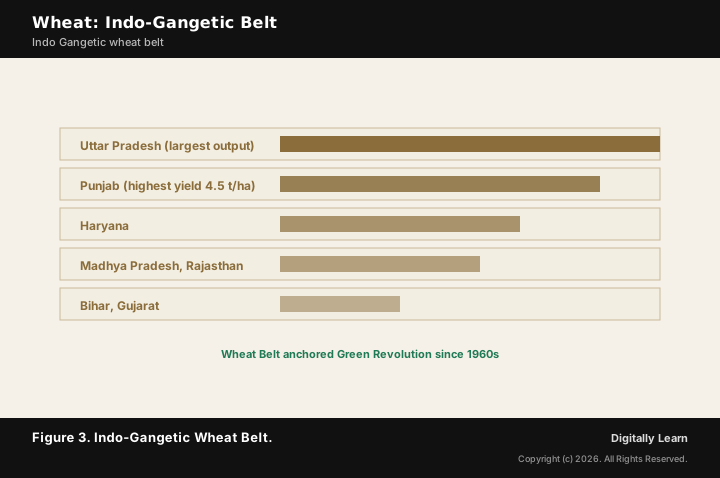
- (iii) The Wheat Belt: Punjab, Haryana, western Uttar Pradesh form the canal-irrigated Green Revolution heartland; Madhya Pradesh, Rajasthan, Bihar, and Gujarat extend the belt; Uttar Pradesh is the largest producer by absolute output.
- (iv) HYV varieties: Sonalika, Kalyan Sona, HUW-234, HD-2967, HD-3086 are major wheat HYVs. Arjun and Sonalika are wheat (per UPSC Prelims 2002); Jaya and Padma are rice (common trap).
- (v) Productivity: Punjab and Haryana reach over 4.5 tonnes per hectare; national average is around 3.5 tonnes per hectare; considerable yield gap remains in eastern wheat-growing states.
The Rice-Wheat Cropping System and Conservation Agriculture
How the kharif-rabi sequence shapes the Indo-Gangetic belt
The rice-wheat cropping system grows rice in the kharif (June-October) and wheat in the rabi (October-April) on the same physical land. The system covers around 13.5 million hectares across the Indo-Gangetic plain and produces the bulk of Indian foodgrain output. The system is the operational manifestation of the Green Revolution package.
- (a) Sequential cropping advantage: Rice utilises monsoon water; wheat utilises winter irrigation; the same field produces two cereals annually with cropping intensity above 180 per cent in Punjab and Haryana.
- (b) Sustainability concerns: Heavy nitrogen-fertiliser use depletes soil organic matter; canal-irrigation seepage drives secondary salinisation (Soils Part 7); groundwater pumping for tube-well irrigation lowers the water table by metres per decade in canal-command Punjab.
- (c) Conservation Agriculture response: Zero tillage, residue retention, direct-seeded rice, and crop diversification are the canonical responses. The UPSC Prelims 2020 confirmed three advantages of zero tillage: sowing wheat without residue burning, direct-seeded paddy, and carbon sequestration.
Stubble burning in Punjab and Haryana after rice harvest, ahead of wheat sowing, is a documented air-quality crisis affecting Delhi-NCR winters. Crop-residue management through the PUSA Decomposer and Happy Seeder mechanisation is the policy intervention.
MSP, FCI, and the Procurement Architecture
How Minimum Support Price stabilises the rice-wheat economy
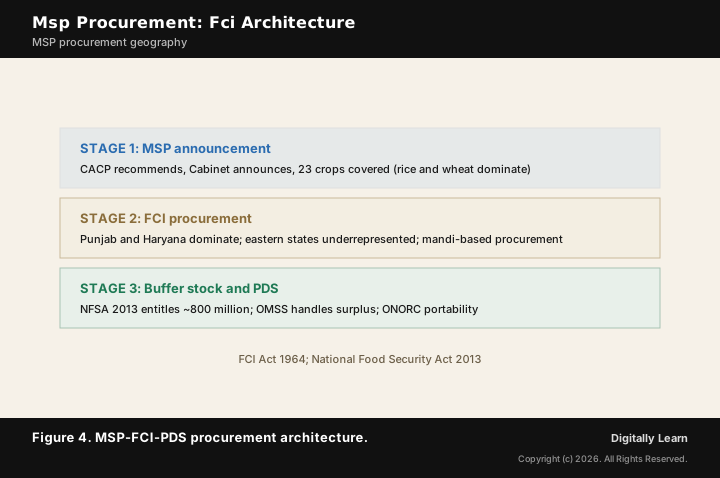
The Food Corporation of India, established 1965 on the FCI Act 1964, handles procurement of rice and wheat at the Minimum Support Price announced annually by the Commission for Agricultural Costs and Prices. Procurement supports the Public Distribution System under the National Food Security Act 2013 and maintains buffer stocks for emergency distribution.
- Minimum Support Price (MSP): Announced by CACP recommendation; covers 23 crops but rice and wheat dominate procurement volumes.
- Food Corporation of India (FCI): Procures, stores, and distributes rice and wheat; Punjab and Haryana dominate procurement geography; eastern states underrepresented despite comparable fertility.
- Public Distribution System (PDS): National Food Security Act 2013 entitles around two-thirds of population to subsidised rice and wheat through ration shops.
- Open Market Sale Scheme (OMSS): FCI sells stocks above buffer-norm to traders through e-auction to manage market prices.
- One Nation One Ration Card: Portable PDS entitlement implemented under Aatma Nirbhar Bharat; addresses migrant-worker food security.
Sources
- NCERT Class 12 India People and Economy, Chapter 5 (Land Resources and Agriculture), pp 45-47
- Indian Council of Agricultural Research (ICAR)
- ICAR-Central Rice Research Institute (CRRI), Cuttack
- ICAR-Indian Institute of Wheat and Barley Research (IIWBR), Karnal
- Department of Agriculture and Farmers Welfare
- Food Corporation of India (FCI)
- Agricultural and Processed Food Products Export Development Authority (APEDA)
- Ministry of Statistics and Programme Implementation (MoSPI)
- United Nations Food and Agriculture Organization (FAO): India
- Wikipedia: Rice production in India
- Wikipedia: Wheat production in India
Previous Year UPSC-CSE Questions
Previous Year UPSC-CSE Questions By the end you will be able to draft model answers for the following UPSC questions. Each question carries a collapsible framework showing how to approach it in the exam.
- UPSC Prelims 2010Due to their extensive rice cultivation, some regions may be contributing to global warming. To what possible reason/reasons is this attributable?
- The anaerobic conditions associated with rice cultivation cause the emission of methane.
- When nitrogen based fertilizers are used, nitrous oxide is emitted from the cultivated soil.
Which of the statements given above is/are correct?
How to approach this Prelims question
Approach: Identify rice-cultivation-specific mechanism: anaerobic decomposition of organic matter in waterlogged paddy fields releases methane. N2O from N-fertilisers occurs across many crops, not rice-specifically.
Trap to watch: Statement 2 is scientifically true but the official answer key treats only methane as the rice-cultivation-specific attribution.
Key facts to recall:
- Methane (CH4) from anaerobic decomposition in waterlogged paddy
- Methane has ~28x global warming potential of CO2 over 100 years
- Direct-seeded rice and alternate wetting and drying reduce field methane
- Nitrous oxide from N-fertilisers is a cross-crop issue not rice-specific
Answer signal: Correct answer is (a): methane (statement 1) only.
- UPSC Prelims 2002Consider the following high yielding varieties of crops in India:
- Arjun
- Jaya
- Padma
- Sonalika
Which of these are wheat?
How to approach this Prelims question
Approach: Recall Green Revolution era HYV names: Sonalika (Mexican-derived wheat), Kalyan Sona, Arjun are wheat varieties. Jaya, Padma, Ratna, Krishna are rice varieties (IR-8 was the parent line).
Key facts to recall:
- Sonalika and Arjun are wheat HYV (Mexican lineage)
- Jaya and Padma are rice HYV (IR-8 lineage)
- Kalyan Sona is wheat
- Norman Borlaug bred Mexican semi-dwarf wheat that drove the Indian wheat Green Revolution
Answer signal: Correct answer is (c): 1 and 4 (Arjun and Sonalika are wheat).
- UPSC Prelims 2020What is/are the advantage/advantages of zero tillage in agriculture?
- Sowing of wheat is possible without burning the residue of previous crop.
- Without the need for nursery of rice saplings, direct planting of paddy seeds in the wet soil is possible.
- Carbon sequestration in the soil is possible.
Select the correct answer using the code given below:
How to approach this Prelims question
Approach: All three advantages are documented. Zero tillage reduces stubble-burning incidence (Punjab-Haryana air quality crisis), permits direct-seeded rice (reducing transplanting labour and methane), and sequesters carbon (aligned with the 4-per-1000 Initiative).
Key facts to recall:
- Zero tillage uses Happy Seeder and PUSA Decomposer to avoid burning
- Direct-seeded rice cuts transplant labour and water demand
- Soil carbon sequestration aligns with 4-per-1000 Initiative
- Conservation Agriculture three pillars: zero tillage and residue retention and diversified rotation
Answer signal: Correct answer is (d): 1, 2 and 3.
Disclaimer
This article is an explainer prepared for UPSC preparation by the Digitally Learn editorial team. Concepts and named institutions are cross-verified with NCERT and the authoritative sources listed below. It is a study aid, not a substitute for primary government documents.