


Overview
Procurement, deficiency payments and price stabilisation behind the MSP
Approved in September 2018, PM-AASHA backs the Minimum Support Price for pulses, oilseeds and copra with procurement, deficiency payments and private stockists; a 2024 revamp converged price support with the Price Stabilisation Fund under a Rs 35,000 crore outlay to 2025-26.
The Pradhan Mantri Annadata Aay Sanrakshan Abhiyan, branded PM-AASHA, is an umbrella scheme of the Ministry of Agriculture and Farmers Welfare, approved by the Union Cabinet in September 2018 to assure remunerative prices to growers of pulses, oilseeds and copra. It puts delivery machinery behind the Minimum Support Price, so that when market prices fall below the declared MSP the farmer is still protected from distress sales. Its original components were the Price Support Scheme, the Price Deficiency Payment Scheme and a pilot Private Procurement and Stockist Scheme, and a 2024 revamp folded in the Price Stabilisation Fund and the Market Intervention Scheme.
What PM-AASHA Is: The 2018 Umbrella Scheme for Assured Prices on Pulses, Oilseeds and Copra
The September 2018 Cabinet approval, the umbrella design behind the Minimum Support Price, the original Price Support, Price Deficiency Payment and Private Procurement components, and the 2024 continuation
The Pradhan Mantri Annadata Aay Sanrakshan Abhiyan, known as PM-AASHA, is an umbrella scheme of the Ministry of Agriculture and Farmers Welfare, approved by the Union Cabinet in September 2018. Its purpose is to assure remunerative prices to growers of pulses, oilseeds and copra, the crops most exposed to a price crash at harvest. Rather than create a new price, PM-AASHA puts machinery behind the existing Minimum Support Price, so that a declared MSP becomes an effective floor the farmer can actually realise, and not merely a number announced each season.
Why it matters is that a support price on paper helps no one unless the state is ready to buy, or to pay, when the market falls below it. PM-AASHA was built to close that gap by giving the Minimum Support Price a set of delivery tools. Its three original components were the Price Support Scheme, under which agencies physically procure at MSP, the Price Deficiency Payment Scheme, which pays the farmer the shortfall in cash, and a pilot Private Procurement and Stockist Scheme for oilseeds.
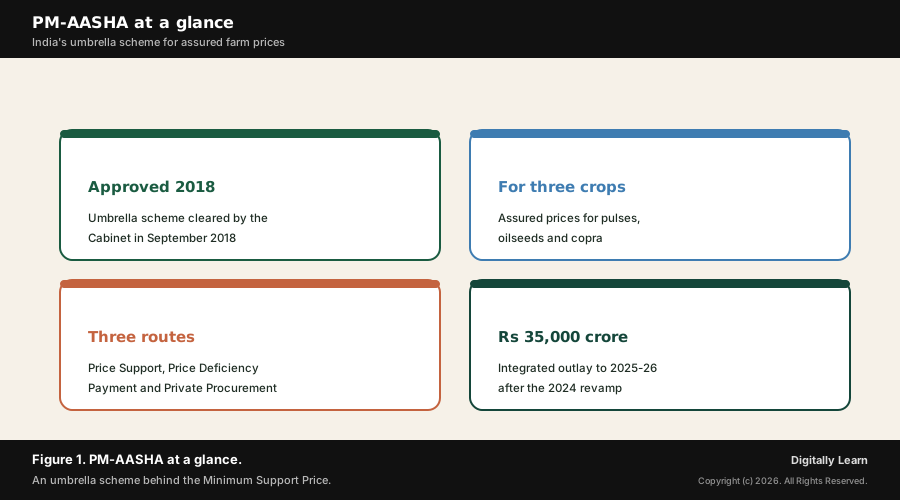
The scheme has since been continued and widened. In September 2024 the Cabinet approved an integrated PM-AASHA that converged the Price Support Scheme with the Price Stabilisation Fund and added the Market Intervention Scheme, with an outlay of Rs 35,000 crore up to 2025-26. The aim is twofold: assure the farmer a fair price, and keep essential commodities affordable for the consumer. The figure below sets out PM-AASHA at a glance.
Why India's Farmers Need Price Support: Harvest Glut, Distress Sales and the Low-Income Trap
The price risk of simultaneous harvest, the distress sales of small and marginal farmers without storage, farm-gate prices below the cost of production, and the low-income trap that price support is meant to break
Indian agriculture carries a deep price risk. Because most farmers harvest at the same time, supply floods the market in a few weeks, and prices for pulses, oilseeds and perishables can fall sharply below the cost of growing them. A small or marginal farmer, who must sell quickly to repay loans and has no storage, is forced into a distress sale at whatever the local trader offers, so a good harvest can paradoxically leave the grower poorer than a modest one.
The market itself offers weak protection. In many regulated mandis the farmer faces a handful of buyers, limited information and high transaction costs, so the farm-gate price can sit far below the retail price the consumer finally pays. Year-to-year swings in price also push farmers to chase whichever crop did well last season, which deepens the next glut. Without a credible floor, the grower bears the full weight of price volatility that owes more to the calendar of harvest than to any failure of effort.
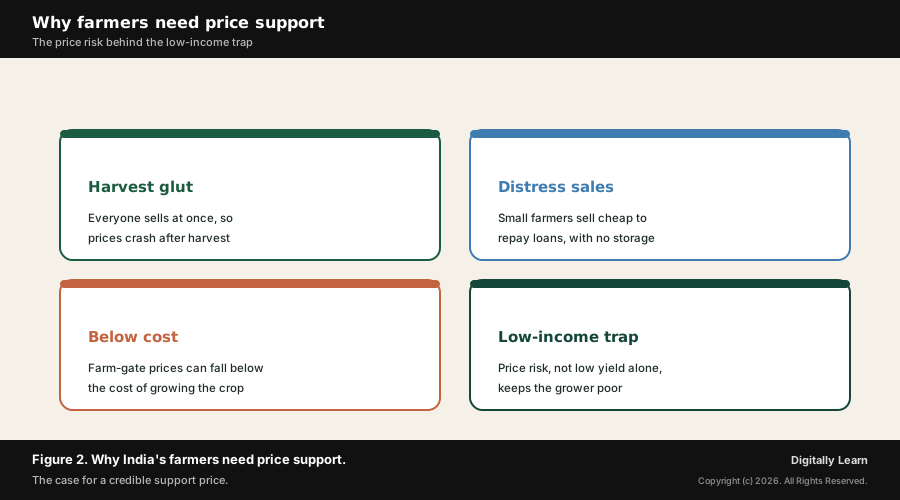
What is the significance of this is that price risk, not low yield alone, is what keeps many farmers in a low-income trap. The very question the 2018 examination raises is how the Minimum Support Price can rescue farmers from that trap. A dependable support price answers it by setting a floor below which the farmer need not sell, by curbing distress sales at harvest, and by signalling which crops the state will stand behind. PM-AASHA exists to make that floor real. The figure below maps why price support is needed.
What the Minimum Support Price Is: CACP, the 22 Mandated Crops and the Cost-Plus Formula
The pre-sowing announced floor, the recommendation by the Commission for Agricultural Costs and Prices, the 22 mandated crops, the A2, A2 plus FL and C2 cost concepts, and the 1.5 times formula against the Swaminathan demand
The Minimum Support Price is the price at which government agencies stand ready to buy a crop, announced before the sowing season so the farmer knows the floor in advance. It is recommended by the Commission for Agricultural Costs and Prices, a body under the Ministry of Agriculture and Farmers Welfare, and finally fixed by the Cabinet after the views of State Governments are taken. MSP is declared for 22 mandated crops each season, spanning the major cereals, pulses and oilseeds together with copra, cotton and jute, with sugarcane supported separately through a Fair and Remunerative Price.
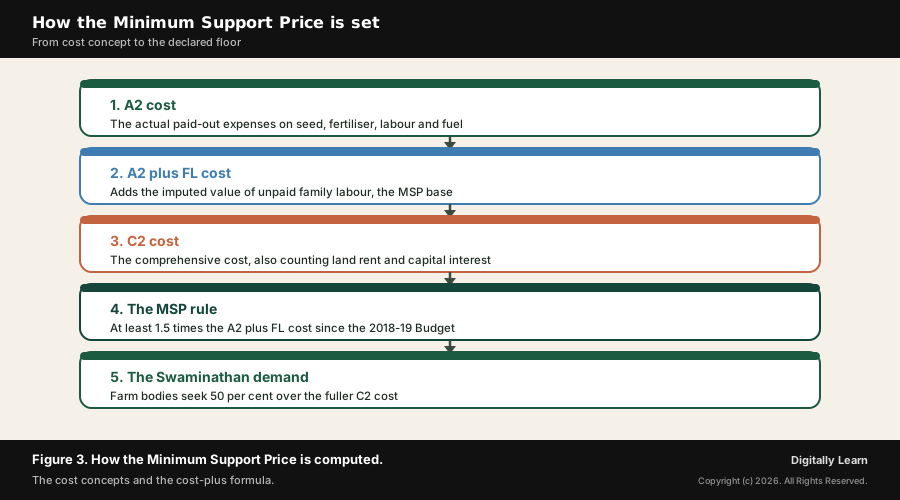
How the figure is set rests on cost concepts. The Commission weighs the A2 cost, the actual paid-out expenses, the A2 plus FL cost, which adds the imputed value of unpaid family labour, and the comprehensive C2 cost, which also counts the rent on owned land and the interest on owned capital. Since the Union Budget for 2018-19, the government has fixed MSP for the mandated crops at at least 1.5 times the A2 plus FL cost of production, giving the grower a margin of about fifty per cent over that cost.
What is the significance of the cost concept is that it decides how generous the floor really is. The National Commission on Farmers, chaired by M. S. Swaminathan, had recommended an MSP of at least fifty per cent above the fuller C2 cost, which includes land rent and capital interest, so a farmer body that compares the two sees the present formula as the leaner of the choices. The debate over A2 plus FL against C2 is therefore central to whether MSP truly lifts farm incomes. The figure and table below set out the computation.
| Cost concept | What it includes | Role in fixing the MSP |
|---|---|---|
| A2 | The actual paid-out expenses: seed, fertiliser, hired labour, fuel, irrigation and the like | The narrowest measure; the base on which the wider cost concepts build |
| A2 plus FL | The A2 costs together with the imputed value of unpaid family labour | The cost on which the government has set MSP at least 1.5 times since 2018-19 |
| C2 | The A2 plus FL costs together with the rent on owned land and the interest on owned capital | The fuller benchmark; the Swaminathan panel sought 50 per cent over this cost |
Price Support, Price Deficiency Payment and Private Procurement: The Three PM-AASHA Routes
The physical procurement of the Price Support Scheme, the cash shortfall of the Price Deficiency Payment Scheme, and the private-stockist pilot of the Private Procurement and Stockist Scheme for oilseeds
PM-AASHA reaches the farmer through distinct routes, each suited to a different situation. The Price Support Scheme is the oldest: when the market price of a notified pulse, oilseed or copra falls below its MSP during the peak harvest, central agencies physically procure the crop at MSP from the farmer, on the request of the State Government. The grower sells at the floor price, the produce enters public stocks, and the threat of a distress sale is removed for those who can reach a procurement centre.
The Price Deficiency Payment Scheme works without buying any grain. The farmer sells in the open mandi as usual, and the state then pays into the account the gap between the MSP and the lower price actually received, up to a capped limit. This avoids the cost and trouble of storing crops, but it depends on accurate mandi price data and reaches only registered sellers. It was offered mainly as an alternative for oilseeds, where physical procurement and storage are harder than for cereals.
The third route, the pilot Private Procurement and Stockist Scheme, lets a State involve private players in procuring oilseeds at MSP, with the private stockist taking on storage in return for a service charge. The idea is to draw private capital and capacity into price support where public agencies are stretched. What is the significance of three routes is that no single tool fits every crop: procurement suits pulses, deficiency payments suit oilseeds, and private stockists test a market-friendly model. The table below contrasts the three.
| PM-AASHA route | When it is used | How it supports the farmer |
|---|---|---|
| Price Support Scheme (PSS) | When the market price of a notified pulse, oilseed or copra falls below the MSP at peak harvest | Central agencies physically procure the crop at the MSP, on the request of the State Government |
| Price Deficiency Payment Scheme (PDPS) | Offered mainly for oilseeds, where physical procurement and storage are harder | Pays the farmer the gap between the MSP and the lower market price, with no procurement of grain |
| Private Procurement and Stockist Scheme (PPSS) | A pilot route a State may choose for oilseeds | Private stockists procure at the MSP for a service charge, drawing in private capacity |
The 2024 Integrated PM-AASHA: Converged Price Support and Price Stabilisation Fund, PDPS, MIS and the Rs 35,000 Crore Outlay
The September 2024 continuation, the convergence of the Price Support Scheme with the Price Stabilisation Fund, the four components of the integrated scheme, the Rs 35,000 crore outlay and the 25 per cent procurement ceiling
The scheme was recast in September 2024, when the Cabinet approved the continuation of an integrated PM-AASHA for the period up to 2025-26. The change merged two earlier instruments: the Price Support Scheme, which buys crops at MSP, was converged with the Price Stabilisation Fund, which intervenes to calm price spikes in pulses and onions for the consumer. Bringing them under one roof lets the same machinery defend the farmer when prices fall and the consumer when prices surge.
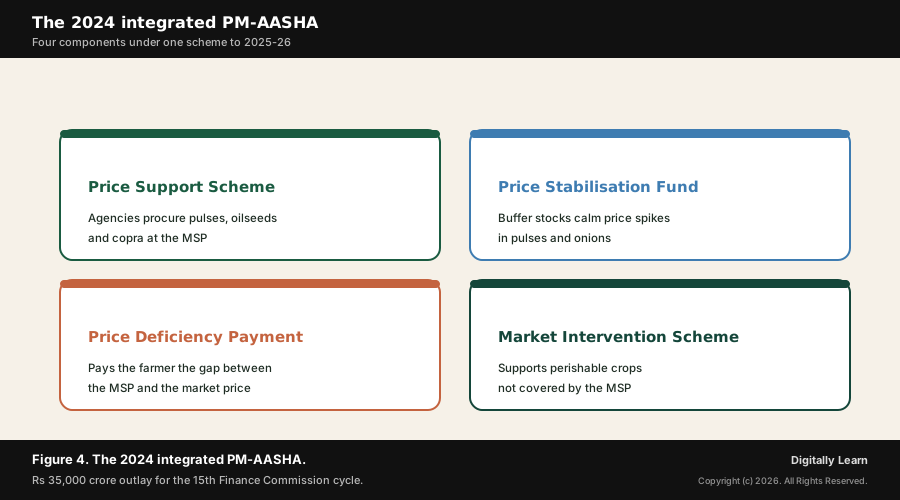
The integrated scheme now carries four components: the Price Support Scheme, the Price Stabilisation Fund, the Price Deficiency Payment Scheme and the Market Intervention Scheme, the last used for perishable horticultural crops not covered by MSP. It is funded with an outlay of about Rs 35,000 crore for the 15th Finance Commission cycle up to 2025-26. From the 2024-25 season, procurement of a notified crop under the Price Support Scheme is sanctioned up to twenty-five per cent of a State's production, extendable by a further share of national production.
What is the significance of the 2024 revamp is that it turns a set of separate schemes into a single, better-funded price-policy instrument. By converging price support with price stabilisation and lifting the procurement ceiling, the government signalled that it would buy a larger share of the pulses and oilseeds crop, the very produce where import dependence is high. The move ties MSP support to the wider goal of self-sufficiency in pulses and edible oils. The figure below sets out the integrated scheme.
Procurement Architecture: CACP, the Centre, the States, NAFED, NCCF and the Food Corporation of India
The recommendation by the CACP and fixing by the Cabinet, the State request for price support, and the procurement by the central nodal agencies NAFED, NCCF and the Food Corporation of India that pays the farmer at MSP
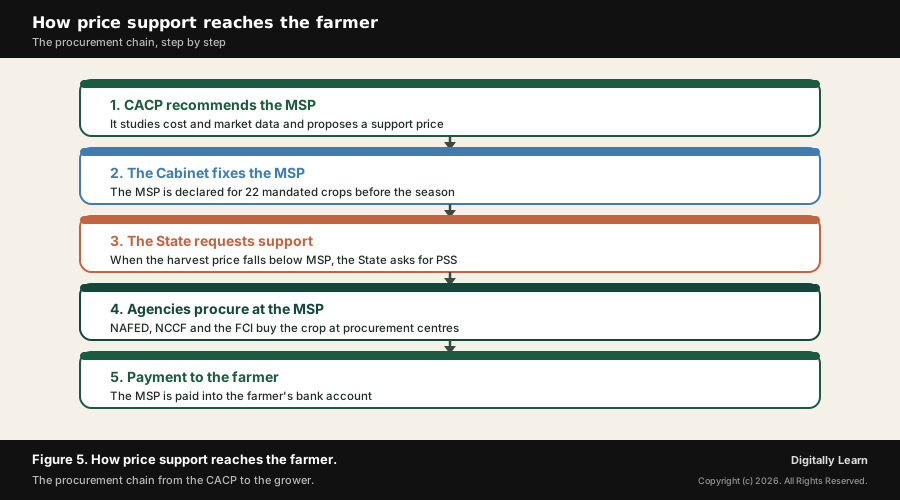
Price support runs through a clear institutional chain. The Commission for Agricultural Costs and Prices studies the cost and market data and recommends an MSP for each mandated crop; the Cabinet Committee on Economic Affairs then fixes the price. When the harvest price falls below MSP, the concerned State Government requests price support, and the Department of Agriculture and Farmers Welfare sanctions procurement under the scheme, setting the quantity and the centres at which the crop will be bought.
On the ground, procurement is carried out by central nodal agencies. The National Agricultural Cooperative Marketing Federation, known as NAFED, and the National Cooperative Consumers Federation buy pulses, oilseeds and copra at MSP through their centres, working with State agencies, and the Food Corporation of India also undertakes price-support operations in some States. The crop is weighed, the MSP is paid into the farmer's bank account, and the produce moves into public stocks for later use in welfare schemes or release into the market.
What is the significance of this architecture is that the support price reaches the farmer only when each link works. The Centre fixes the price and funds the scheme, but it is the States that must request procurement, and the agencies that must open enough centres close to the grower. Where a State acts early and centres are dense, the floor holds; where it is slow, farmers sell below MSP despite the announcement. The figure below traces the procurement chain.
The Reach of MSP and PM-AASHA: Mandated Crops, Procurement Volumes and Farmers Benefited
The 22 mandated crops, the volume and value of pulses, oilseeds and copra procured under PM-AASHA since 2018-19, the farmers benefited, and the recent paddy and wheat MSP levels
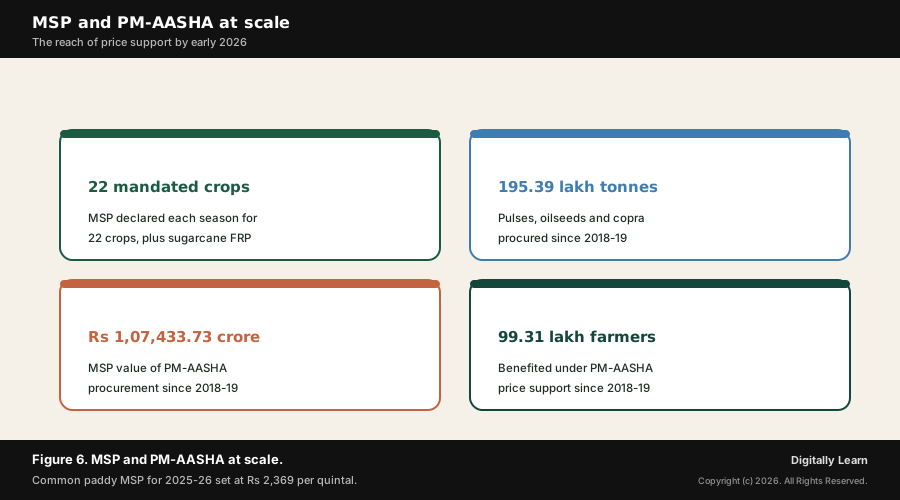
The reach of MSP-backed support has grown. MSP is now declared for 22 mandated crops, spanning the major cereals, pulses and oilseeds together with copra, cotton and jute. Under PM-AASHA itself, the government reports that since 2018-19 about 195.39 lakh metric tonnes of pulses, oilseeds and copra have been procured at an MSP value of about Rs 1,07,433.73 crore, benefiting close to 99.31 lakh farmers, a measure of how far the price floor has actually been put into the grower's hands.
The price levels themselves have climbed each season. For the Kharif marketing season 2025-26, the MSP for common paddy was fixed at Rs 2,369 per quintal, and for wheat in the Rabi marketing season 2025-26 the government estimated a margin of about 105 per cent over the all-India weighted average cost of production. These figures show the cost-plus formula at work, with the declared floor kept well above the paid-out and family-labour cost that the Commission reckons for the crop.
Read together, the numbers show a real but uneven reach. The procurement under PM-AASHA is large for pulses and oilseeds, yet the bulk of all MSP procurement by value still flows to paddy and wheat bought for the public distribution system. So a wide list of mandated crops coexists with a procurement effort concentrated on a few, a tension the next section examines. The figure below sets out MSP and PM-AASHA at scale.
Limits and Criticisms of MSP: Cereal-Centric Procurement, the A2-Plus-FL versus C2 Gap, WTO Concerns and the Legal-Guarantee Demand
The concentration of procurement in paddy, wheat and surplus States, the cost-formula debate over A2 plus FL against C2, the thin coverage of growers, and the World Trade Organization and legal-guarantee questions
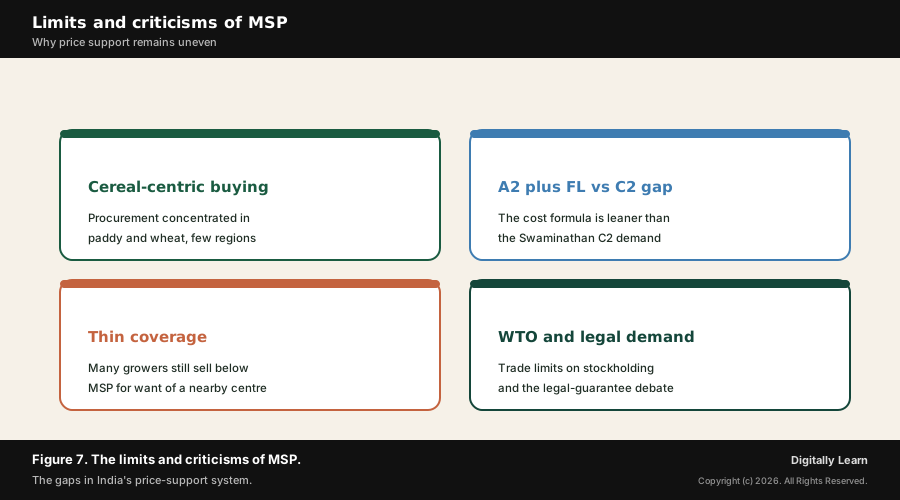
Judged honestly, MSP and PM-AASHA face real limits. Effective procurement is concentrated in a few crops, chiefly paddy and wheat, and in a few surplus States, so a farmer growing pulses or millets in a deficit region may see the MSP announced but never reach a buyer. This cereal-centric procurement skews the cropping pattern towards water-hungry rice and wheat, strains groundwater and the public granary, and works against the diversification into pulses and oilseeds that PM-AASHA itself seeks to encourage.
The cost formula is also contested. Because the present MSP is set at 1.5 times the leaner A2 plus FL cost, rather than the comprehensive C2 cost urged by the Swaminathan commission, many farm groups argue that the floor is too low to cover the true cost of cultivation. Coverage is thin as well: physical procurement happens only on a State's request and within ceilings, mandi price data for deficiency payments is patchy, and a large share of growers still sell below MSP for want of a nearby centre.
Two wider debates frame the scheme. First, India's MSP-backed public stockholding for food security sits uneasily with the World Trade Organization's farm-subsidy limits, and India relies on an interim Peace Clause while it presses for a permanent solution. Second, the demand for a legal guarantee of MSP, voiced strongly during the farmers' protests, would oblige the state to ensure the price for all crops and sellers, a step with large fiscal and market implications still under examination. The figure below sets out the main challenges.
Significance for Farmer Income: How an Assured Price Helps Rescue Farmers from the Low-Income Trap
How an assured floor curbs distress sales and supports investment, how stable prices steady income and encourage diversification, and how MSP works with PM-KISAN, crop insurance and credit to lift the poor farmer
The deeper purpose of MSP, and the second half of the 2018 examination question, is to rescue farmers from the low-income trap. A credible support price gives the grower an assured floor before sowing, so the decision to plant a crop no longer rests on a gamble about the harvest-time price. With the downside capped, the farmer can invest in better seed and inputs, borrow with more confidence, and avoid the forced distress sale that transfers the gain from a good harvest to the trader rather than the grower.
The income effect runs through stability and direction. By holding a floor under pulses and oilseeds, PM-AASHA narrows the year-to-year swings that keep small farmers poor, and it nudges them to diversify away from the over-grown cereals towards crops the country must otherwise import. Steadier prices mean steadier incomes, which in turn support consumption, debt repayment and the next season's investment, so the support price acts as a quiet form of insurance for the most vulnerable producers.
What is the significance of this for the poor farmer is that MSP works best as one strand among several. The price floor of PM-AASHA, the income transfer of PM-KISAN, the risk cover of crop insurance and the credit of the Kisan Credit Card together attack different faces of the same low-income trap. No single instrument is enough, but a dependable MSP, actually realised through procurement or deficiency payment, remains the anchor that lets a small grower plan, invest and climb slowly out of subsistence.
The Way Forward: Widening Crop and Regional Coverage, Strengthening Procurement and Market Linkage
Widening effective procurement to pulses, oilseeds and millets, expanding capacity in deficit States, digitising mandi prices, encouraging diversification, settling the cost-concept debate and resolving the World Trade Organization question
The task ahead is to make the support price wider, fairer and more certain, so that it reaches more crops, more regions and more of the smallest farmers. The measures below set out a balanced way to strengthen MSP and PM-AASHA without unbalancing the budget or the market.
- Widen effective procurement beyond paddy and wheat to pulses, oilseeds and millets, so that the price floor reaches the crops PM-AASHA was meant to protect.
- Expand procurement and storage capacity in deficit and eastern States, so that a farmer far from the surplus belts can still sell at the Minimum Support Price.
- Strengthen and digitise mandi price reporting, so that the Price Deficiency Payment Scheme can pay an accurate shortfall quickly and to every registered seller.
- Use the support price to encourage crop diversification towards pulses and edible oils, easing import dependence while reducing the strain on water and the public granary.
- Settle the cost-concept debate transparently, publishing how the A2 plus FL and C2 costs are computed, so that the basis of the Minimum Support Price is clear to the farmer.
- Pursue a durable solution at the World Trade Organization on public stockholding for food security, so that price support is not constrained by trade limits.
- Link the Minimum Support Price with PM-KISAN, crop insurance and credit, and track whether assured prices actually raise the incomes of small and marginal farmers.
UPSC Relevance: GS-III Agricultural Pricing, the Prelims Pointers and the MSP Mains Framing
The GS-III economy and agriculture fit, the Prelims facts on PM-AASHA, its components and the CACP cost formula, and the agricultural-pricing-and-farm-income Mains framing of the 2018 PYQ on the Minimum Support Price
For the examination, MSP and PM-AASHA sit in GS-III, under the economy, agriculture and food security. The facts worth fixing for Prelims are that PM-AASHA was approved in September 2018, that its components are the Price Support Scheme, the Price Deficiency Payment Scheme and the pilot Private Procurement and Stockist Scheme, later joined by the Price Stabilisation Fund and the Market Intervention Scheme, that MSP is recommended by the CACP for 22 mandated crops, and that it is set at 1.5 times the A2 plus FL cost.
For Mains, the topic is the standard vehicle for any answer on agricultural pricing and farm incomes. The 2018 question on the meaning of MSP and how it can rescue farmers from the low-income trap maps directly onto this article: a student can define MSP and the CACP cost formula, explain how an assured floor curbs distress sales and stabilises income, and then weigh the limits, the cereal-centric procurement, the A2 plus FL against C2 debate, the thin coverage and the WTO and legal-guarantee questions.
Contemporary linkages place MSP within a wider farm-income policy. It works alongside PM-KISAN income support, the crop insurance of the Pradhan Mantri Fasal Bima Yojana, the market reform of e-NAM, and the push for self-sufficiency in pulses and edible oils, and it speaks to debates on doubling farmers' income, on the cropping pattern and groundwater, and on India's stance at the World Trade Organization. Read this way, PM-AASHA is a central instrument of India's attempt to make farming remunerative and secure.
Previous Year UPSC-CSE Questions By the end you will be able to draft model answers for the following UPSC questions. Each question carries a collapsible framework showing how to approach it in the exam.
- UPSC Mains 2018 GS-IIIWhat do you mean by Minimum Support Price (MSP)? How will MSP rescue the farmers from the low-income trap?
How to structure the answer in the exam
Introduction: Open by defining the Minimum Support Price as a pre-sowing price floor recommended by the Commission for Agricultural Costs and Prices and fixed by the government for 22 mandated crops, and note that PM-AASHA gives it delivery teeth through procurement and deficiency payments.
Body (sub-themes to develop):
- Meaning of MSP: a guaranteed floor price announced before sowing, recommended by the CACP on the basis of cost concepts (A2, A2 plus FL and C2) and fixed at least 1.5 times the A2 plus FL cost since the 2018-19 Budget, declared for 22 mandated crops with a separate Fair and Remunerative Price for sugarcane.
- How MSP breaks the low-income trap, part one: an assured floor before sowing reduces price risk, curbs the distress sales that force small farmers to sell cheap at harvest, and lets the grower keep the gain of a good crop rather than surrender it to the trader.
- How MSP breaks the low-income trap, part two: steadier prices give steadier incomes that support investment, debt repayment and the next season's sowing, and a support price for pulses and oilseeds nudges diversification away from over-grown, water-hungry cereals.
- The PM-AASHA machinery that makes MSP real: the Price Support Scheme procures at MSP through NAFED, NCCF and the FCI, the Price Deficiency Payment Scheme pays the market shortfall in cash, the pilot Private Procurement and Stockist Scheme draws in private capacity, and the 2024 revamp converges price support with the Price Stabilisation Fund under a Rs 35,000 crore outlay.
- The limits to acknowledge: procurement is concentrated in paddy, wheat and surplus States, the A2 plus FL formula is leaner than the Swaminathan C2 demand, coverage is thin where centres are far, and public stockholding faces World Trade Organization limits and a legal-guarantee debate.
Conclusion: Conclude that MSP is a price floor that protects the farmer from a market crash, and that it rescues the grower from the low-income trap only when it is actually realised, through PM-AASHA procurement or deficiency payment, across more crops and regions; widening its reach and settling the cost and trade debates would make it a fuller instrument of remunerative, secure farming.
Relevance to this topic. The body defines the Minimum Support Price and the CACP cost formula, then shows how an assured floor curbs distress sales, steadies income and encourages diversification, with PM-AASHA's procurement and deficiency-payment routes as the means to rescue farmers from the low-income trap.
Sources and Further Reading
- Department of Agriculture and Farmers Welfare: amended guidelines for the Price Support Scheme under PM-AASHA
- Commission for Agricultural Costs and Prices: determinants of the Minimum Support Price and the A2, A2 plus FL and C2 cost concepts
- Press Information Bureau: Cabinet approves continuation of the integrated PM-AASHA with the Price Support Scheme, Price Stabilisation Fund, Price Deficiency Payment Scheme and Market Intervention Scheme
- Press Information Bureau: Minimum Support Prices, from safety net to self-sufficiency, the CACP cost formula and the 1.5 times principle
- NITI Aayog: agricultural marketing and farmer-friendly reforms to raise farm incomes
- Food and Agriculture Organization: agricultural market information and price policy for smallholder farmers
- World Bank: helping smallholder farmers reach markets and earn better prices
- Wikipedia: Pradhan Mantri Annadata Aay Sanrakshan Abhiyan
- Wikipedia: Minimum support price
Editorial Disclaimer
This briefing is for UPSC preparation. Verify the scheme components, the cost formula and the procurement figures against the official PM-AASHA material, the Commission for Agricultural Costs and Prices and Press Information Bureau sources before relying on them.


