


Overview
Marketing, Land Reforms, Policies
APMC mandis, the MSP regime, FCI procurement, the land-reform legacy, and the contemporary scheme umbrella.
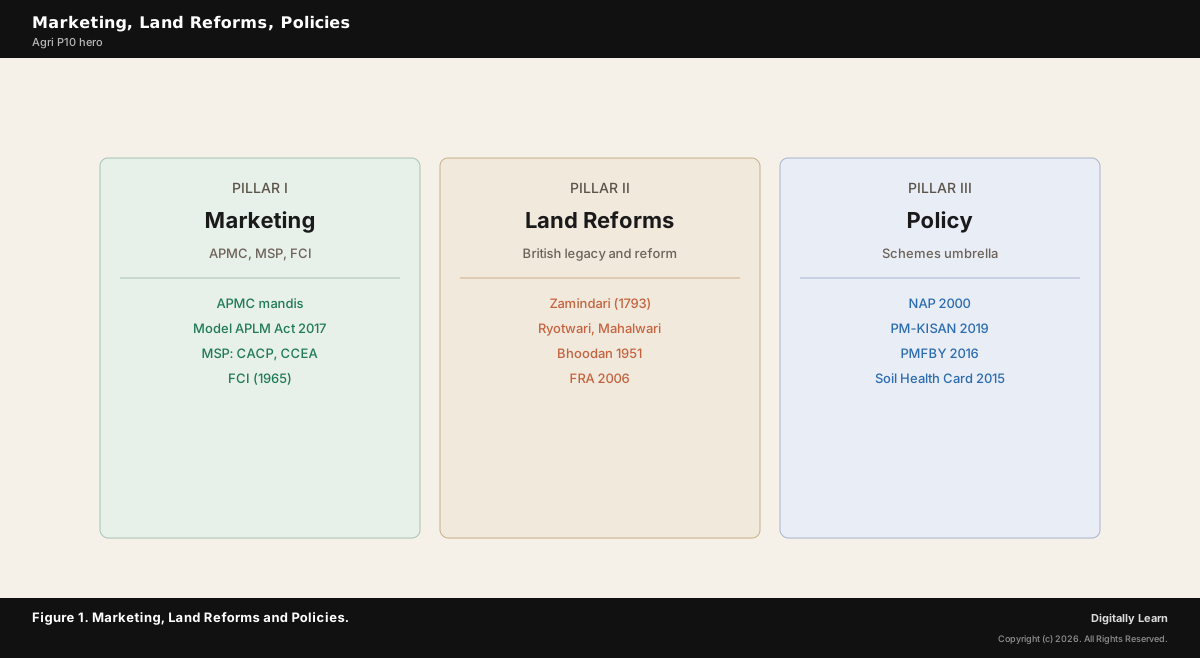
Indian agricultural marketing, land reforms, and policy together form the institutional architecture through which production is converted to income, land tenure is restructured, and farmer welfare is supported. Marketing operates through state-level Agricultural Produce Market Committees (APMCs), the central Model Agricultural Produce and Livestock Marketing Act 2017, the Minimum Support Price (MSP) regime with the Commission for Agricultural Costs and Prices (CACP) recommending and the Cabinet Committee on Economic Affairs (CCEA) approving, and the Food Corporation of India (FCI) established 1965 for procurement, storage, and Public Distribution System supply. Land reforms address the three British-era tenure systems (Zamindari, Ryotwari, Mahalwari) through post-Independence Zamindari abolition, tenancy reform, land ceiling laws, consolidation of holdings, the Bhoodan-Gramdan movement of Vinoba Bhave from 1951, and the Forest Rights Act 2006 recognising tribal forest tenure. The policy umbrella includes the National Agricultural Policy 2000, PM-KISAN launched 2019, PMFBY crop insurance launched 2016, and the Soil Health Card scheme launched 2015.
Background and Historical Context
Marketing, land reforms, and policy are the three institutional levers that translate agricultural production into farmer welfare. Production alone does not secure income; market access, secure land tenure, and predictable policy support determine whether the cultivator captures value from output. UPSC Prelims has tested the Permanent Settlement and Ryotwari tenure systems, factors affecting rice price including MSP and procurement, and MSP-procurement myths around unlimited procurement and market-price ceilings.
What is the significance of the marketing-and-reform architecture? Three operational dimensions follow. The marketing-architecture spine binds APMC mandis to the Model APLM Act 2017 template, the MSP-CACP-CCEA price-support sequence, and the FCI procurement-storage-PDS pipeline. The land-reform legacy sits across the three British-era tenure systems (Zamindari intermediary, Ryotwari peasant-direct, Mahalwari village-collective) and the post-Independence response of Zamindari abolition, tenancy reform, ceiling laws, consolidation, and the Bhoodan-Gramdan voluntary movement. The contemporary-policy umbrella covers National Agricultural Policy 2000, PM-KISAN income support 2019, PMFBY crop insurance 2016, Soil Health Card 2015, the Forest Rights Act 2006 for tribal land tenure, and the now-repealed three farm laws of 2020.
Current policy threads include the PM-KISAN launched 2019 paying around 6,000 rupees per year to landholding farmers; the Pradhan Mantri Fasal Bima Yojana (PMFBY) launched 2016 for area-based crop insurance with premium subsidy; the Soil Health Card scheme launched 2015 for soil-test-based fertiliser recommendations; the e-NAM platform (covered in Agriculture Part 9) integrating over 1,000 mandis; the Forest Rights Act 2006 recognising individual and community forest-resource rights for Scheduled Tribes and other traditional forest dwellers; and the repeal in 2021 of the three farm laws (Farmers' Produce Trade and Commerce Act, Farmers' Empowerment and Protection Agreement on Price Assurance and Farm Services Act, Essential Commodities Amendment Act) following sustained farmer protests.
Introduction: Three Institutional Pillars
Marketing, land reforms, and policy together secure farmer welfare
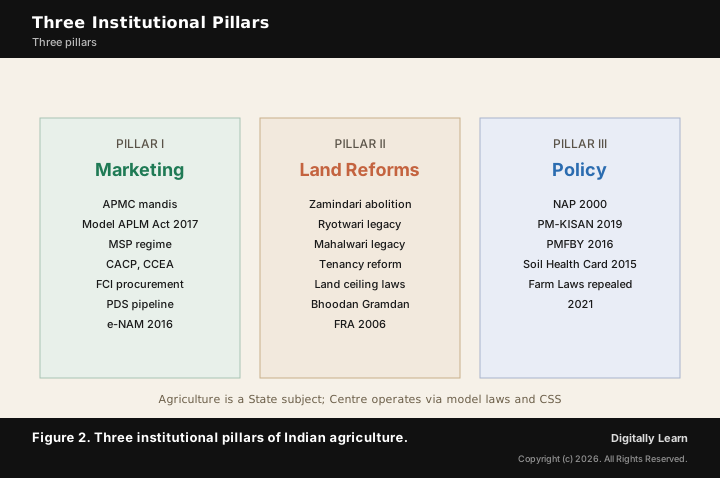
Indian agricultural marketing, land reforms, and policy are three interlocking institutional pillars that determine whether the cultivator captures value from output. Marketing operates through state-level APMC mandis, the central Model APLM Act template, the MSP regime with CACP recommending and CCEA approving, and FCI procurement-storage-distribution.
Land reforms address the inherited British tenure systems through post-Independence Zamindari abolition, tenancy reform, ceiling laws, consolidation, and the voluntary Bhoodan-Gramdan movement. Policy covers the contemporary scheme architecture: PM-KISAN income support, PMFBY crop insurance, Soil Health Card, Forest Rights Act, and the now-repealed three farm laws.
The three pillars are sequentially linked. Land reforms secure the underlying tenure that makes long-term cultivation possible. Marketing converts the resulting output into income through assured price-support and physical procurement. Policy bridges the residual gap through direct benefit transfer, insurance, soil-test recommendations, and tribal-tenure recognition. A weak link in any pillar collapses the value-capture chain.
- (i) Marketing pillar: APMC mandis, Model APLM Act 2017, MSP regime, CACP, CCEA, FCI procurement-storage-PDS pipeline, e-NAM platform integration (covered in Agriculture Part 9).
- (ii) Land-reforms pillar: British tenure legacy (Zamindari, Ryotwari, Mahalwari), Zamindari abolition (1950s state acts), tenancy reform, land ceiling laws, consolidation of holdings, Bhoodan-Gramdan, Forest Rights Act 2006.
- (iii) Contemporary-policy pillar: National Agricultural Policy 2000, PM-KISAN 2019, PMFBY 2016, Soil Health Card 2015, repealed farm laws 2020-21.
- (iv) Sequential interdependence: Secure tenure enables long-term cultivation; assured marketing enables income capture; policy bridges residual gaps via DBT, insurance, soil-test, tribal-tenure.
- (v) Federal-architecture context: Agriculture is a State subject under the Constitution; the Centre operates through model laws, central sector schemes, and centrally sponsored schemes that states can adopt or modify.
Marketing: APMC, MSP Regime, FCI
Agricultural Produce Market Committee architecture and the MSP regime
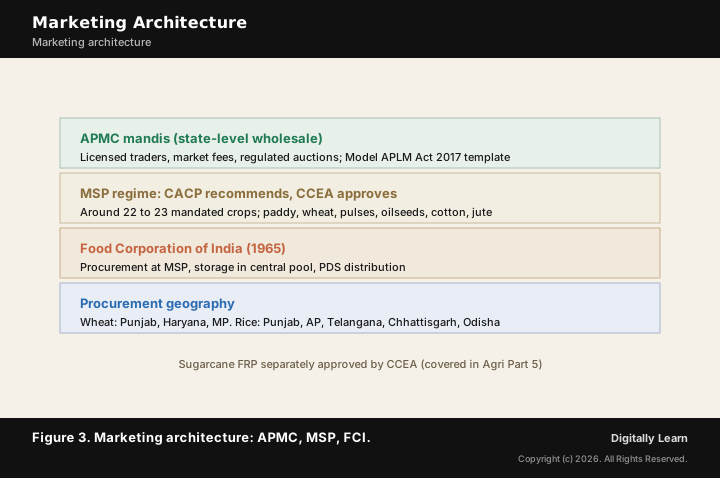
Indian agricultural marketing is structured around state-level Agricultural Produce Market Committees (APMCs) that operate regulated wholesale mandis, and the central Model APLM Act 2017 that provides a template for state-level reform.
The Minimum Support Price (MSP) regime works with the Commission for Agricultural Costs and Prices (CACP) recommending prices and the Cabinet Committee on Economic Affairs (CCEA) granting approval, while the Food Corporation of India handles procurement, storage, and Public Distribution System supply.
- (a) APMC mandis: State-level wholesale markets operating under state APMC Acts; regulate licensed traders, levy market fees, and set transaction rules. Critics cite middleman concentration and entry barriers.
- (b) Model APLM Act 2017: Central template (Model Agricultural Produce and Livestock Marketing Act) for state-level reform; addresses single-licence trading, electronic auction, and warehouse-receipt finance.
- (c) MSP regime: CACP recommends prices for around 22 to 23 mandated crops; CCEA approves; covers paddy, wheat, coarse cereals, pulses, oilseeds, cotton, sugarcane (FRP), copra, jute.
- (d) Food Corporation of India (FCI): Established 1965 under the Food Corporations Act 1964; handles procurement at MSP, storage in central pool, and distribution to states for Public Distribution System.
- (e) Procurement geography: Punjab, Haryana, Madhya Pradesh dominate wheat procurement; Punjab, Andhra Pradesh, Telangana, Chhattisgarh, Odisha dominate rice procurement. Concentration creates regional dependency.
Land Reforms: British Tenure Legacy and Post-Independence Response
Three British systems, Zamindari abolition, ceiling, Bhoodan, FRA
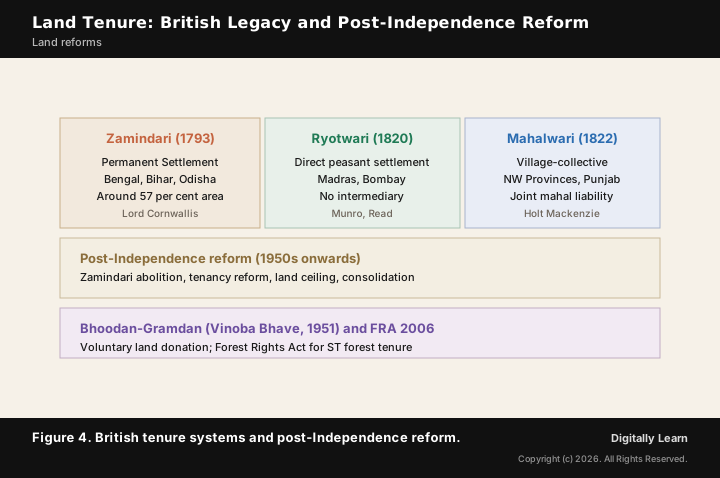
India inherited three British-era land-tenure systems at Independence. The Zamindari system covered around 57 per cent of cultivated area in Bengal, Bihar, Odisha, parts of Uttar Pradesh, and Madhya Pradesh; it was introduced through the Permanent Settlement of 1793 by Lord Cornwallis.
The Ryotwari system covered the Madras and Bombay presidencies, with direct settlement between the peasant ryot and the state; Thomas Munro and Captain Read codified it around 1820. The Mahalwari system covered the North-Western Provinces, parts of Punjab, and central provinces, with village-collective revenue assessment; Holt Mackenzie codified it around 1822.
- (a) Zamindari abolition: State-level Zamindari Abolition Acts in the 1950s (UP 1951, Bihar 1950, Madhya Pradesh 1951, West Bengal 1953); abolished intermediary tenure and brought ryots into direct relationship with the state.
- (b) Tenancy reform: Regulation of rent, security of tenure for tenants, and provisions for tenant purchase of land; uneven state-level implementation.
- (c) Land ceiling laws: State-level ceilings on individual and family landholding; surplus land redistributed to landless; gap between law and implementation widely documented.
- (d) Consolidation of holdings: Programme to consolidate fragmented holdings into compact parcels; effective in Punjab and Haryana; less effective elsewhere.
- (e) Bhoodan and Gramdan: Voluntary land-donation movement launched by Vinoba Bhave in 1951 (Pochampally, Telangana); around 4 million acres reportedly donated; complemented state-led reform.
- (f) Forest Rights Act 2006: Recognition of individual and community forest-resource rights for Scheduled Tribes and other traditional forest dwellers; under the Ministry of Tribal Affairs.
| System | Revenue payer | Region | Codified by |
|---|---|---|---|
| Zamindari (Permanent Settlement, 1793) | Zamindar intermediary | Bengal, Bihar, Odisha, parts of UP | Lord Cornwallis |
| Ryotwari (around 1820) | Cultivator ryot directly | Madras and Bombay presidencies | Thomas Munro and Captain Read |
| Mahalwari (around 1822) | Village or mahal collectively | North-Western Provinces, parts of Punjab | Holt Mackenzie |
Contemporary Policy: PM-KISAN, PMFBY, Soil Health Card, Repealed Farm Laws
Five contemporary scheme anchors
Indian agricultural policy converges around farmer-welfare schemes that bridge the gap between the marketing and land-reform pillars.
The five principal contemporary anchors are PM-KISAN income support launched 2019, Pradhan Mantri Fasal Bima Yojana crop insurance launched 2016, Soil Health Card scheme launched 2015, Forest Rights Act 2006 for tribal land tenure, and the National Agricultural Policy 2000 framework. The repealed three farm laws of 2020 are the most contested recent episode and shape the federal-architecture debate.
- (a) PM-KISAN (2019): Direct benefit transfer of around 6,000 rupees per year in three instalments to landholding farmers; extended in 2019 from small-and-marginal-only to all landholders.
- (b) PMFBY (2016): Pradhan Mantri Fasal Bima Yojana area-based crop insurance; farmer pays around 1.5 per cent of premium for rabi crops, around 2 per cent for kharif, around 5 per cent for commercial-horticulture; remainder subsidised by Centre and state.
- (c) Soil Health Card (2015): Soil-test-based crop and nutrient recommendations to farmers; addresses NPK imbalance and over-use of urea.
- (d) National Agricultural Policy 2000: First comprehensive policy document for Indian agriculture; targeted 4 per cent annual growth; emphasis on diversification, sustainable resource use, and price stability.
- (e) Repealed farm laws (2020-21): Farmers’ Produce Trade and Commerce Act, Farmers’ Empowerment and Protection Agreement on Price Assurance and Farm Services Act, Essential Commodities Amendment Act 2020; repealed in 2021 following sustained farmer protests.
Previous Year UPSC-CSE Questions
Previous Year UPSC-CSE Questions By the end you will be able to draft model answers for the following UPSC questions. Each question carries a collapsible framework showing how to approach it in the exam.
- UPSC Prelims 2024With reference to revenue collection by Cornwallis, consider the following statements:
- Under the Ryotwari Settlement of revenue collection, the peasants were exempted from revenue payment in case of bad harvests or natural calamities.
- Under the Permanent Settlement in Bengal, if the Zamindar failed to pay his revenues to the state, on or before the fixed date, he would be removed from his Zamindari.
Which of the statements given above is/are correct?
How to approach this Prelims question
Approach: Recall the rigidity of Ryotwari revenue collection (no calamity exemption) versus the Permanent Settlement Sunset Clause (Zamindar removal on non-payment). Apply the rigidity-distinction lens.
Trap to watch: Statement 1 sounds humanitarian but contradicts the historical record of Ryotwari rigidity that drove peasant indebtedness. Statement 2 captures the Sunset Clause accurately.
Key facts to recall:
- Ryotwari revenue was rigidly collected in cash; no calamity exemption
- Permanent Settlement Sunset Clause: Zamindar removed for non-payment
- Zamindari covered around 57 per cent of cultivated area
- Ryotwari covered Madras and Bombay presidencies
Answer signal: UPSC dropped this question from scoring in its official answer key, so it has no official answer. On the facts, the Permanent Settlement rule in statement 2 is accurate and the Ryotwari claim in statement 1 is not.
- UPSC Prelims 2020Which of the following factors/policies were affecting the price of rice in India in the recent past?
- Minimum Support Price
- Government's trading
- Government's stockpiling
- Consumer subsidies
Select the correct answer using the code given below:
How to approach this Prelims question
Approach: All four factors operate on rice price through documented channels. MSP sets the floor; FCI trading affects supply; stockpiling locks volume in central pool; PDS subsidies affect demand-side pricing.
Trap to watch: Pre-elimination of any factor on the assumption that government intervention is confined to one channel misses the all-correct pattern.
Key facts to recall:
- MSP sets floor price for rice procurement
- FCI trading affects open-market supply
- Central pool stockpiling locks volume
- PDS consumer subsidies affect demand-side pricing
Answer signal: Correct answer is (d): all four (1, 2, 3 and 4).
- UPSC Prelims 2020Consider the following statements :
- In the case of all cereals, pulses and oil-seeds, the procurement at Minimum Support Price (MSP) is unlimited in any State/UT of India.
- In the case of cereals and pulses, the MSP is fixed in any State/UT at a level to which the market price will never rise.
Which of the statements given above is/are correct ?
How to approach this Prelims question
Approach: Both statements misrepresent the MSP regime. Procurement is bounded by buffer norms (not unlimited). MSP is a floor (not a ceiling); market price can and does exceed MSP for many crops.
Trap to watch: Both statements sound plausible if MSP is misunderstood as universal-procurement-at-fixed-price. Recall the actual architecture: floor-pricing with bounded buffer-stock procurement.
Key facts to recall:
- MSP procurement is bounded by FCI buffer norms
- MSP is a price floor, not ceiling
- Market prices regularly exceed MSP for many crops
- MSP procurement is concentrated in Punjab, Haryana, Madhya Pradesh for wheat
Answer signal: Correct answer is (d): neither 1 nor 2 is correct.
Sources
- NCERT Class 12 India People and Economy, Chapter 5 (Land Resources and Agriculture), pp 72-78
- Department of Agriculture and Farmers Welfare
- Commission for Agricultural Costs and Prices (CACP)
- Food Corporation of India (FCI)
- Pradhan Mantri Kisan Samman Nidhi (PM-KISAN)
- Pradhan Mantri Fasal Bima Yojana (PMFBY)
- Ministry of Tribal Affairs (Forest Rights Act)
- electronic National Agriculture Market (e-NAM)
- Wikipedia: Land reforms in India
- Wikipedia: Minimum Support Price
Disclaimer
This article is prepared for UPSC preparation by Digitally Learn's editorial team. It covers agricultural marketing, the land-reform legacy, and the contemporary policy umbrella. Scheme details and figures are cross-verified with NCERT and the authoritative sources listed below.