


Overview
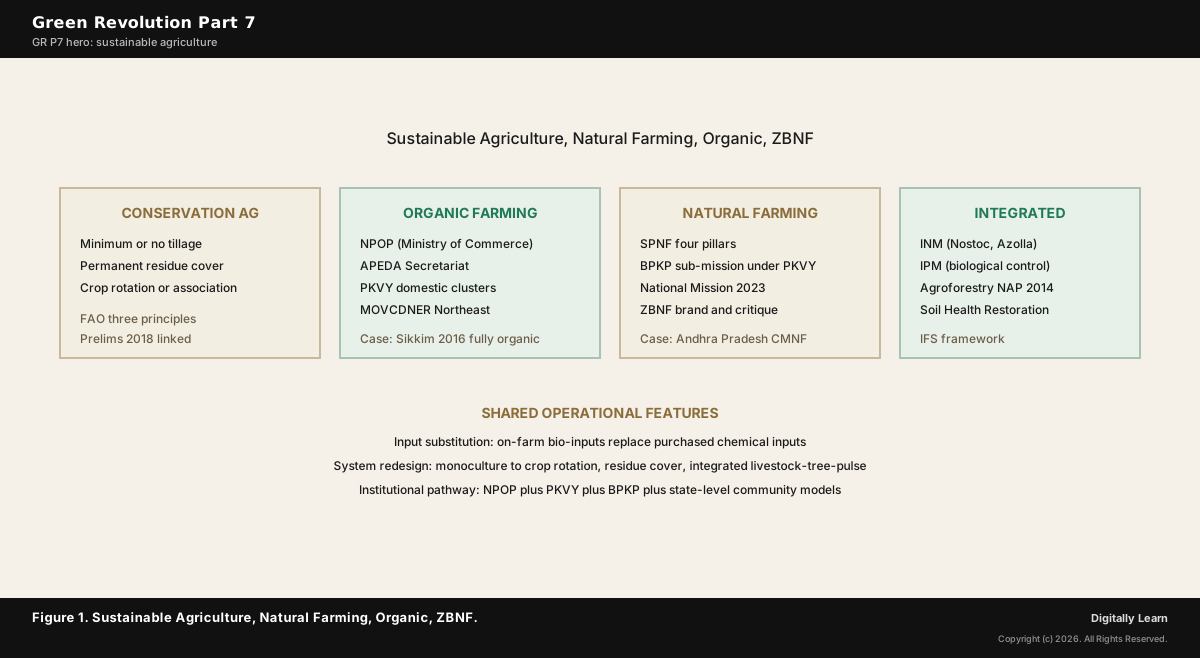
Sustainable agriculture in the Green Revolution 2.0 architecture is the set of agronomic systems that produce food without depleting soil, water, biodiversity, or farmer-income capital. The set has four interlocking sub-architectures. The Conservation Agriculture architecture rests on minimum tillage, permanent crop residue cover, and crop rotation (the three canonical principles tested in UPSC Prelims 2018; covered in GR P5 bridge framing). The Organic Farming architecture operates under the National Programme for Organic Production (NPOP) coordinated by the Ministry of Commerce with the Agricultural and Processed Food Products Export Development Authority (APEDA) as Secretariat (UPSC Prelims 2018 tested this institutional structure); the domestic-promotion lane operates through Paramparagat Krishi Vikas Yojana (PKVY) and the Mission Organic Value Chain Development for North-Eastern Region (MOVCDNER). The Natural Farming architecture covers Subhash Palekar Natural Farming (SPNF) and its institutional vehicle Bharatiya Prakritik Krishi Paddhati (BPKP) as a sub-mission under PKVY; the largest state-level implementation is Andhra Pradesh Community-Managed Natural Farming (APCNF). The Integrated practices architecture covers Integrated Nutrient Management (INM) using biofertilisers (Nostoc cyanobacterium per UPSC Prelims 2013), Integrated Pest Management (IPM), Agroforestry, and Soil Health Restoration. The embedded cases are Sikkim declared India's first fully organic state in 2016 and Andhra Pradesh CMNF as the largest state-level natural-farming programme.
Background and Historical Context
The GR 1.0 input-intensification logic produced the soil-degradation, groundwater-depletion, and chemical-pollution costs catalogued in GR P5. The sustainable agriculture sub-architectures elaborated in P7 are the operational response: they substitute on-farm bio-inputs for purchased chemical inputs, retain residue rather than burn it, integrate trees and pulses into cropping systems, and restore soil organic matter as the production base. UPSC Prelims has tested the NPOP institutional structure (UPSC Prelims 2018 on Ministry of Commerce not Rural Development, APEDA as Secretariat, and Sikkim fully organic), the water-conservation practice set under Conservation Agriculture (UPSC Prelims 2017 on reduced tillage and crop residue yes, gypsum no since gypsum addresses sodicity not water conservation), and the biofertiliser identification at the integrated-nutrient-management level (UPSC Prelims 2013 on Nostoc as cyanobacterial biofertiliser, Agaricus the mushroom and Spirogyra the alga not in the biofertiliser canon).
What is the significance of the sustainable agriculture sub-architecture? Three operational dimensions follow. The input-substitution dimension shifts the production logic from purchased external chemical inputs to on-farm bio-inputs (jeevamrutha, beejamrutha, vermicompost, neem-based pesticide, cow-dung-based fertiliser); the substitution lowers the input bill and reduces the chemical-pollution externality. The system-redesign dimension moves from monoculture-plus-intensive-tillage to crop rotation-plus-minimum-tillage-plus-permanent-residue-cover-plus-integrated-livestock-tree-pulse-cropping; the redesign rebuilds soil organic matter and biodiversity over the medium term. The institutional-pathway dimension operates through three scheme architectures (NPOP for export-grade organic certification; PKVY for domestic organic clusters; BPKP for natural farming) and the state-level community-implementation models (Andhra Pradesh CMNF as the most ambitious; Sikkim as the first fully organic state declared 2016).
Current threads include the Sikkim 2016 fully-organic-state achievement recognised by the Future Policy Award by FAO and World Future Council, the Andhra Pradesh CMNF scale-up targeting around six million farmers across the state with international research partnerships, the BPKP under PKVY mainstreaming natural farming in central policy (covered in GR P10 policy architecture), the National Mission on Natural Farming restructured from the BPKP from 2023-24 and approved as a standalone Centrally-Sponsored Scheme by the Union Cabinet in November 2024 for natural farming, and the Indian Council of Agricultural Research network sustainable agriculture stream that integrates Integrated Farming System research with the all-India natural farming validation trials (cross-link to GR P9 precision and digital agriculture for the technology layer). The cluster-architecture lesson is that sustainable agriculture is the GR 2.0 input-substitution and system-redesign flank; the climate-resilience flank is GR P8, the precision-and-digital flank is GR P9, and the policy-and-FPO closing architecture is GR P10.
Sustainable Agriculture: Four Sub-Architectures
Input substitution plus system redesign
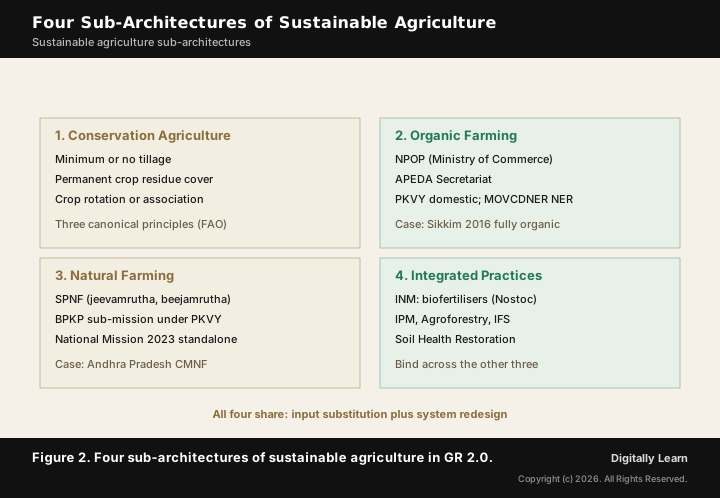
Sustainable agriculture in the Green Revolution 2.0 architecture sorts into four interlocking sub-architectures. The Conservation Agriculture sub-architecture redesigns tillage and residue management. The Organic Farming sub-architecture substitutes chemical inputs with bio-inputs under certified scheme architectures. The Natural Farming sub-architecture goes further and minimises even purchased bio-inputs in favour of on-farm-generated bio-resources. The Integrated practices sub-architecture binds the above with Integrated Nutrient Management, Integrated Pest Management, Agroforestry, and Soil Health Restoration.
The four sub-architectures share two operational features. The first is input substitution: on-farm bio-inputs (jeevamrutha, beejamrutha, vermicompost, neem-based pesticide) replace purchased chemical inputs (urea, DAP, synthetic pesticides) along the substitution continuum. The second is system redesign: monoculture-plus-intensive-tillage is replaced with crop rotation, minimum tillage, permanent residue cover, and integrated livestock-tree-pulse cropping. The redesign rebuilds soil organic matter and biodiversity over the medium term.
| Dimension | Organic Farming | Natural Farming (SPNF/ZBNF) | Conservation Agriculture |
|---|---|---|---|
| External inputs | Off-farm organic inputs permitted (compost, bio-fertilisers) | Minimal external input; mostly on-farm cow-dung and cow-urine brews | Reduced tillage and residue retention; inputs not the defining axis |
| Certification | Certified: NPOP (export) and PGS-India (domestic) | No formal product certification standard for the practice | Not a certification system; a set of agronomic principles |
| Core logic | Input substitution with certified organic standards | In-situ resource generation, near-zero purchased input | Soil-and-moisture conservation through three principles |
| Lead vehicle | PKVY, MOVCDNER; Sikkim 2016 state case | BPKP sub-mission, standalone NMNF 2024; Andhra Pradesh CMNF case | FAO three-principle framework; cross-system practice |
Organic Farming: NPOP, PKVY, Sikkim Case
NPOP institutional structure and certification
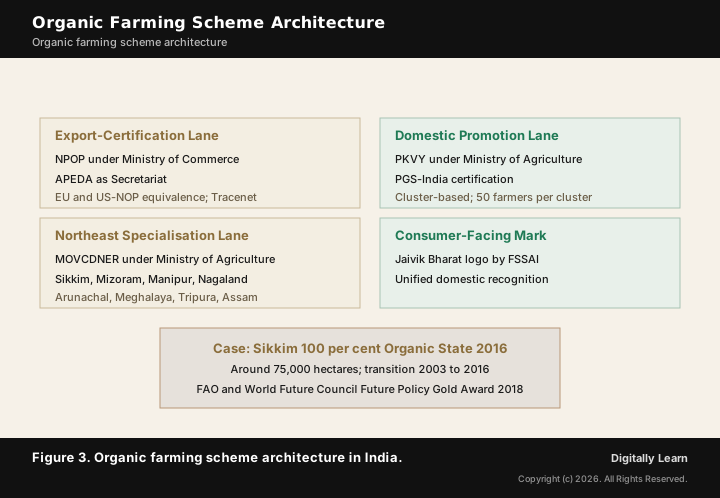
Organic farming in India operates under a layered scheme architecture covering export certification, domestic promotion, and regional specialisation. The export-certification lane runs through the National Programme for Organic Production (NPOP) coordinated by the Ministry of Commerce (not the Ministry of Rural Development; the misallocation is a tested trap in the UPSC Prelims 2018).
APEDA functions as the NPOP Secretariat and operates the Tracenet traceability platform for certified organic exports. The NPOP standards align with EU equivalence and US-NOP equivalence for major product categories, which lets Indian organic produce enter premium export markets without re-certification.
- NPOP (export certification): Ministry of Commerce with APEDA as Secretariat; standards aligned with EU and US-NOP equivalence; Tracenet traceability platform.
- PKVY Paramparagat Krishi Vikas Yojana (domestic promotion): Cluster-based approach (typically 50 farmers and 20 hectares per cluster); certification through Participatory Guarantee System for India (PGS-India); operates under Ministry of Agriculture and Farmers Welfare.
- MOVCDNER (regional NER specialisation): Mission Organic Value Chain Development for North-Eastern Region; covers Sikkim, Mizoram, Manipur, Nagaland, Arunachal Pradesh, Meghalaya, Tripura, Assam; focuses on value-chain integration from production to processing to marketing.
- Jaivik Bharat consumer-facing logo: Unified organic-product mark launched by Food Safety and Standards Authority of India (FSSAI) for domestic consumer recognition.
- Sikkim 100 per cent organic state: Declared 2016; recognised by Future Policy Award by FAO and World Future Council; achieved through state-wide chemical-input phase-out across all cultivated area.
Case: Sikkim 100 per cent organic state (2016)
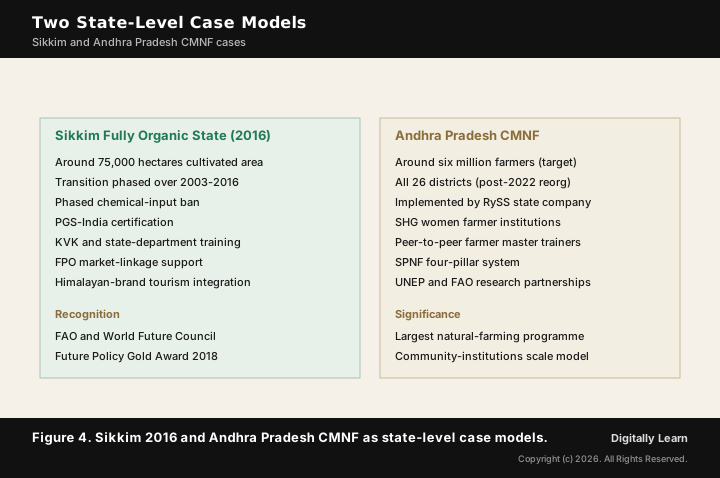
Sikkim became India's first fully organic state in 2016 after a multi-year transition that began with state policy in 2003 and the Sikkim Organic Mission in 2010. The transition covered around 75,000 hectares of cultivated area across the state.
The implementation pillars included a phased ban on chemical fertilisers and pesticides, a certification push under PGS-India, farmer training through Krishi Vigyan Kendras and the State Department of Agriculture, market-linkage support through farmer-producer organisations, and tourism-and-brand integration as a Himalayan differentiator.
The Sikkim Organic Mission received the Future Policy Gold Award 2018 from the World Future Council in partnership with FAO and IFOAM. The case is the strongest existing proof-of-concept that a state-wide chemical-input phase-out is operationally achievable when sustained over a decade with policy continuity.
Natural Farming, BPKP, ZBNF, Andhra Pradesh Case
Subhash Palekar Natural Farming, BPKP, ZBNF concept and critique
Natural farming in the Indian context derives primarily from the Subhash Palekar Natural Farming (SPNF) system articulated by agriculturalist Subhash Palekar across the 1990s and 2000s. The system rests on four pillars: jeevamrutha (microbial culture from cow dung, cow urine, jaggery, pulse flour, and topsoil), beejamrutha (seed treatment with similar inputs), aachhadana (mulching for moisture conservation), and waaphasa (soil aeration through alternate moist-and-dry cycles).
The institutional vehicle for natural farming in central policy is the Bharatiya Prakritik Krishi Paddhati (BPKP) launched as a sub-mission under PKVY 2020-21. BPKP support covers training, demonstration, certification, and limited input subsidy through cluster-based implementation. The National Mission on Natural Farming approved as a standalone Centrally-Sponsored Scheme in November 2024 elevates natural farming to a standalone Centrally-Sponsored Scheme (covered in GR P10 policy architecture).
Zero Budget Natural Farming (ZBNF) is the popular brand under which SPNF is widely promoted, particularly during 2017-2021 when Andhra Pradesh, Karnataka, and several other states ran ZBNF programmes. The zero-budget framing has been critiqued as misleading because labour, seed, and equipment costs remain non-zero even when external chemical inputs are eliminated.
The Niti Aayog and ICAR have moved toward the more neutral natural-farming framing in policy documents from 2021 onwards, while the substantive practice continues under the SPNF-BPKP architecture.
Case: RySS community model and the six-million-farmer scale-up
Andhra Pradesh Community-Managed Natural Farming (APCNF) is the largest state-level natural-farming programme in the world. It is implemented by Rythu Sadhikara Samstha (RySS), a state-owned not-for-profit company under the Andhra Pradesh Department of Agriculture. The model rests on three institutional layers that together let a low-external-input system reach scale.
- Implementing layer: community-managed self-help-group institutions of women farmers carry the programme at the village level.
- Dissemination layer: peer-to-peer extension through farmer-master-trainers spreads the four-pillar practice farm to farm.
- Scale target: a state-wide reach of around six million farmers across all 26 districts (the state was reorganised from 13 to 26 districts in April 2022).
Independent research partnerships with the United Nations Environment Programme, the Food and Agriculture Organisation, and the Centre for Sustainable Agriculture have documented yield-and-income outcomes across multi-year cohorts. The case is significant because it shows that a low-external-input system can scale to millions when the implementing layer is an existing community institution (the women self-help groups under the National Rural Livelihoods Mission) rather than a top-down extension cadre.
Integrated Practices: INM, IPM, Agroforestry, Soil Health
Integrated nutrient and pest management, agroforestry, soil health
The fourth sub-architecture is the set of integrated practices that bind the conservation, organic, and natural-farming systems through on-farm nutrient and pest management, tree integration, and active soil restoration. These practices are not exclusive to organic or natural systems; they apply across the whole substitution continuum, including input-intensive farms moving toward sustainability.
- Integrated Nutrient Management (INM): Combines bio-fertilisers (Nostoc cyanobacterium per UPSC Prelims 2013; Azolla aquatic fern; Rhizobium nitrogen-fixing bacterium; mycorrhizal fungi for phosphorus uptake), organic manures (farmyard manure, compost, vermicompost, green manure), and judicious chemical inputs as the residual lever; targets balanced nutrient supply with reduced chemical-fertiliser bill.
- Integrated Pest Management (IPM): Combines biological control (Trichoderma fungi, Bacillus thuringiensis bacteria, ladybug predators), cultural practices (crop rotation, resistant varieties, timely sowing), mechanical methods (light traps, pheromone traps, hand-picking), and chemical pesticides as last resort; reduces pesticide-residue accumulation that GR 1.0 produced.
- Agroforestry: Trees integrated into cropping systems (alley cropping, silvo-pasture, home-garden, boundary plantation); National Agroforestry Policy 2014 provides the policy framework; ICAR Central Agroforestry Research Institute (CAFRI) at Jhansi is the lead research institute; income diversification plus carbon-sequestration co-benefit.
- Soil Health Restoration: Builds soil organic matter through residue retention, cover cropping, green manuring, and reduced tillage; ICAR-Indian Institute of Soil Science (IISS) Bhopal coordinates the research; the soil-health-card programme (covered in Agri P9) provides the diagnostic layer; full restoration requires multi-year sustained practice.
The Integrated Farming System (IFS) framework is the operational integration of crop, livestock, fishery, and tree components on the same farm. The IFS model maximises per-hectare-per-year output across multiple revenue streams while building ecological resilience. ICAR-Indian Institute of Farming Systems Research (IIFSR) Modipuram is the lead research institute. The framework is particularly relevant to small and marginal farmers (cross-link to GR P10 FPO institutional vehicle) for whom diversification reduces income volatility.
Previous Year UPSC-CSE Questions
Previous Year UPSC-CSE Questions By the end you will be able to draft model answers for the following UPSC questions. Each question carries a collapsible framework showing how to approach it in the exam.
- UPSC Prelims 2018With reference to organic farming in India, consider the following statements:
- The National Programme for Organic Production (NPOP) is operated under the guidelines and directions of the Union Ministry of Rural Development.
- The Agricultural and Processed Food Products Export Development Authority (APEDA) functions as the Secretariat for the implementation of NPOP.
- Sikkim has become India's first fully organic State.
Which of the statements given above is/are correct?
How to approach this Prelims question
Approach: Apply the ministry-mandate logic: NPOP is an export-certification programme so it sits under the Ministry of Commerce, not Ministry of Rural Development. APEDA is the Commerce-Ministry attached body that operates the Tracenet traceability platform and acts as NPOP Secretariat. Sikkim's 2016 fully-organic-state declaration is widely recognised and award-validated.
Trap to watch: Statement 1 is the trap; aspirants associate organic-farming with rural-development framing. The export-certification rationale ties NPOP to the Ministry of Commerce.
Key facts to recall:
- NPOP under Ministry of Commerce and Industry with APEDA Secretariat; standards EU and US-NOP equivalent.
- PKVY under Ministry of Agriculture for domestic organic clusters (PGS-India certification).
- MOVCDNER under Ministry of Agriculture for Northeast organic value-chains.
- Sikkim declared 2016; recognised by FAO and World Future Council via Future Policy Gold Award 2018.
Answer signal: Correct answer is (b) (2 and 3 only); APEDA Secretariat and Sikkim status correct; Ministry of Rural Development attribution wrong.
- UPSC Prelims 2017Which of the following practices can help in water conservation in agriculture?
- Reduced or zero tillage of the land
- Applying gypsum before irrigating the field
- Allowing crop residue to remain in the field
Select the correct answer using the code given below:
How to approach this Prelims question
Approach: Apply the Conservation Agriculture three-principle test: minimum tillage (statement 1 yes) and residue retention (statement 3 yes) are both CA principles that contribute to water conservation. Gypsum (statement 2) is a sodic-soil amelioration input that improves soil structure for sodicity-affected lands; it does NOT directly conserve water and is not a CA principle.
Trap to watch: Treating gypsum as a generic soil-improvement tool that also helps water; the UPSC framing tests precise CA practice identification, and gypsum is specifically a sodicity-amelioration input.
Key facts to recall:
- Conservation Agriculture three principles: minimum or no tillage, permanent residue cover, crop rotation or association (cross-link to GR P5 UPSC Prelims 2018).
- Reduced tillage preserves soil structure and moisture-holding capacity.
- Crop residue cover reduces evaporative loss from soil surface and recycles nutrients.
- Gypsum is calcium sulphate; used to amend sodic soils by replacing exchangeable sodium with calcium.
Answer signal: Correct answer is (c) (1 and 3 only); reduced tillage and residue retention are water-conservation; gypsum is not.
- UPSC Prelims 2013Consider the following organisms:
- Agaricus
- Nostoc
- Spirogyra
Which of the above is/are used as biofertilizer/biofertilizers?
How to approach this Prelims question
Approach: Apply the biofertiliser canon: nitrogen-fixing bacteria (Rhizobium, Azotobacter, cyanobacteria like Nostoc, Anabaena), phosphate-solubilising bacteria, mycorrhizal fungi, Azolla aquatic fern. Agaricus is the common mushroom genus (food product, not biofertiliser). Spirogyra is a filamentous green alga (not used in biofertiliser industry). Only Nostoc qualifies.
Trap to watch: Treating any non-pathogenic micro-organism as a potential biofertiliser; the canon is narrower and tied to specific nutrient-mobilisation functions.
Key facts to recall:
- Biofertiliser canon: Rhizobium (pulse nodulation); Azotobacter (free-living N-fixer); cyanobacteria including Nostoc and Anabaena (paddy field N-fixation); Azolla (aquatic fern with cyanobacterial symbiont); mycorrhizal fungi (phosphorus uptake).
- Nostoc is a colonial cyanobacterium found in rice paddies; widely used as biofertiliser inoculant.
- Agaricus bisporus is the white button mushroom; a food fungus, not biofertiliser.
- Spirogyra is a green alga; not in the biofertiliser canon.
Answer signal: Correct answer is (b) (2 only); Nostoc is the biofertiliser; Agaricus and Spirogyra are not.
Sources
- Class 12 India People and Economy, Chapter 5 (Land Resources and Agriculture)
- Sustainable agriculture in India: Wikipedia
- Indian Council of Agricultural Research (ICAR) institutional architecture
- Department of Agriculture and Farmers Welfare PKVY and BPKP scheme architecture
- Agricultural and Processed Food Products Export Development Authority (APEDA) and NPOP
- Press Information Bureau release on National Mission on Natural Farming
- M S Swaminathan Research Foundation sustainability framing
- Niti Aayog: Natural Farming and Doubling Farmers Income reports
- Ministry of Statistics and Programme Implementation: Agricultural Statistics at a Glance
Disclaimer
This article elaborates the sustainable agriculture pillar of Green Revolution 2.0 covering Conservation Agriculture, Organic Farming, Natural Farming, and Integrated practices with Sikkim and Andhra Pradesh case studies. Statistical references and scheme architectures are illustrative; specific coverage figures vary year to year. Aspirants should cross-check scheme details against official APEDA and Ministry of Agriculture sources.