


Overview
and Climate Change
How India farms its rainfed half, restores soils, and adapts to a warming climate.
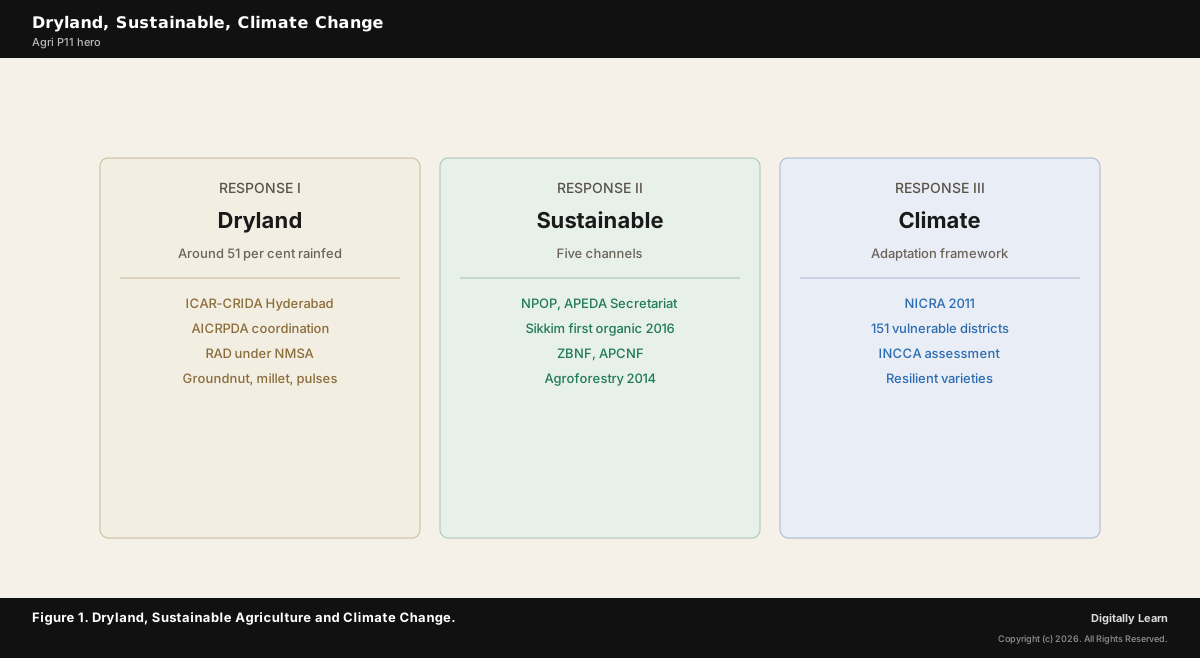
Dryland farming, sustainable agriculture, and climate-change adaptation are the three thematic responses to the structural water-stress, ecological-degradation, and climate-variability constraints on Indian agriculture. Dryland agriculture covers the rainfed peninsular plateau and eastern India belts where around half of the cultivated area depends on the monsoon; the ICAR-Central Research Institute for Dryland Agriculture (CRIDA) at Hyderabad coordinates research, and the National Innovations in Climate Resilient Agriculture (NICRA) programme covers technology demonstration. Sustainable agriculture spans the National Programme for Organic Production (NPOP) with APEDA as the Secretariat and Sikkim as India's first fully organic state, Zero Budget Natural Farming (ZBNF) championed by Andhra Pradesh, Integrated Pest Management (IPM), agroforestry, and climate-smart agricultural practices. Climate-change adaptation sits across genome-sequencing-derived climate-resilient varieties, the Indian Network for Climate Change Assessment (INCCA) framework, the Rainfed Area Development component of the National Mission for Sustainable Agriculture, and monsoon-variability-tracking under the IMD-IITM partnership.
Background and Historical Context
Indian agriculture faces three structural stresses that the dryland-sustainable-climate response framework addresses. Around 51 per cent of cultivated area remains rainfed and depends on monsoon performance; ecological degradation from over-use of fertilisers, water, and pesticides constrains long-run productivity; and climate change is already shifting monsoon onset, increasing extreme rainfall events, and stressing crop water requirements. UPSC Prelims has tested organic farming under NPOP, APEDA, and Sikkim's organic-state status, genome-sequencing applications for drought-tolerant crop varieties, and the identification of predominantly rainfed crops including groundnut, sesamum, and pearl millet.
What is the significance of the dryland-sustainable-climate response? Three operational dimensions follow. The dryland-research backbone binds ICAR-CRIDA Hyderabad to the All India Coordinated Research Project for Dryland Agriculture, with state-level dryland centres supplying region-specific technology. The sustainable-practice architecture spans organic certification under NPOP, natural farming via ZBNF or its rebranded Subhiksha Punarjeevana model in Andhra Pradesh, integrated pest management under the Plant Protection Division, and agroforestry under the National Agroforestry Policy 2014. The climate-resilience framework covers NICRA technology demonstration villages, INCCA assessment cycles, the National Mission for Sustainable Agriculture (NMSA) Rainfed Area Development component, and the Crop Weather Outlook bulletins from IMD-IITM.
Current policy threads include the NICRA programme launched 2011 covering technology demonstration in around 151 districts with high climate vulnerability; the National Agroforestry Policy 2014 as India's first standalone agroforestry policy; the Paramparagat Krishi Vikas Yojana (PKVY) launched 2015 for cluster-based organic farming with around 50 acres per cluster; the Mission Organic Value Chain Development for North-Eastern Region (MOVCDNER) launched 2015; the Andhra Pradesh Community-Managed Natural Farming (APCNF) targeting around 6 million farmers by 2030; and the third National Communication to UNFCCC documenting agriculture sector emissions and adaptation responses through INCCA.
Introduction: Three Thematic Responses
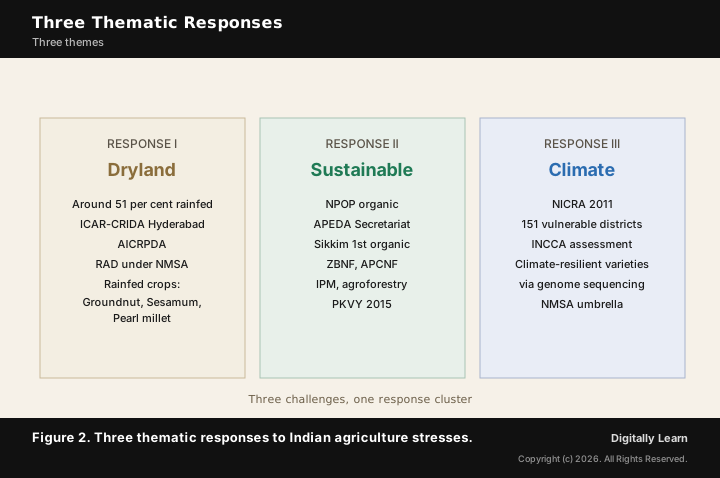
Why dryland, sustainable, climate-change form a single response cluster
Indian agriculture faces three structurally distinct stresses that converge into a single response cluster. The water-stress challenge concentrates in the rainfed peninsular plateau, eastern India, and arid western India, where around 51 per cent of cultivated area depends on monsoon performance with limited supplementary irrigation.
The ecological-degradation challenge stems from over-use of fertilisers, over-extraction of groundwater, and soil-erosion-induced productivity loss. The climate-change challenge adds monsoon-onset shifts, extreme rainfall events, heat-stress damage to wheat, and rising irrigation demand. The three challenges are treated together because their remedies overlap.
The three challenges share a common response architecture: rainfed-region productivity improvement through dryland-research technology, ecological restoration through organic and natural farming, and climate adaptation through resilient varieties and watershed development. The ICAR-CRIDA at Hyderabad anchors dryland research; the NPOP-APEDA framework anchors organic certification; NICRA anchors climate-resilience technology demonstration; INCCA anchors climate assessment.
- (i) Rainfed-area dominance: Around 51 per cent of cultivated area is rainfed; concentrates in peninsular plateau, eastern India, arid western India.
- (ii) ICAR-CRIDA Hyderabad: Central Research Institute for Dryland Agriculture; coordinates the All India Coordinated Research Project for Dryland Agriculture.
- (iii) NPOP and APEDA: National Programme for Organic Production under Ministry of Commerce; APEDA acts as the Secretariat for NPOP implementation.
- (iv) NICRA 2011: National Innovations in Climate Resilient Agriculture; technology demonstration villages in around 151 climate-vulnerable districts.
- (v) Cross-cluster context: NPK imbalance from Agri Part 9, groundwater depletion from Agri Part 8, saline-alkaline soils from Soils Part 7 all interact with dryland-sustainable-climate response.
Dryland: Rainfed Crops, CRIDA, RAD under NMSA
Rainfed agriculture geography and the dryland-research backbone
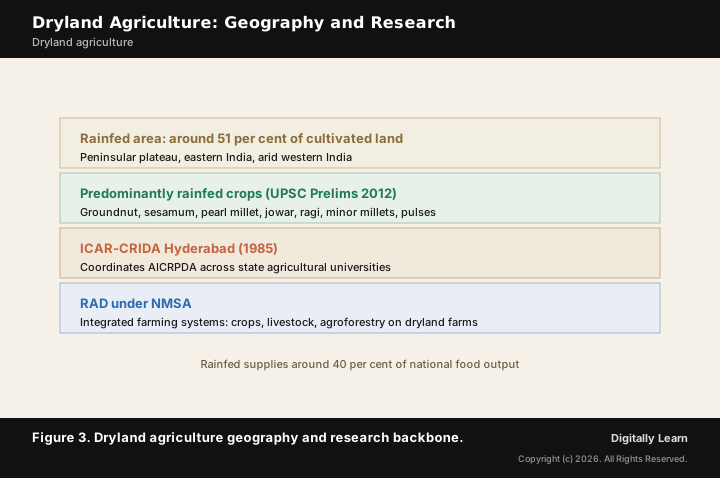
Around 51 per cent of Indian cultivated area is rainfed; this segment concentrates in the peninsular plateau (Maharashtra, Karnataka, Andhra Pradesh, Telangana, Tamil Nadu interior), eastern India, and arid western India (Rajasthan, Saurashtra).
Rainfed agriculture supplies around 40 per cent of food output and underwrites the livelihoods of a large share of farming households. Yields trail irrigated counterparts substantially, which creates the productivity-gap focus for dryland-research priority.
- (a) Predominantly rainfed crops: Groundnut, sesamum, pearl millet (all three confirmed predominantly rainfed by UPSC Prelims 2012), along with jowar, ragi, finger millet, minor millets, pulses (covered in Agri Part 4), and dryland oilseeds.
- (b) ICAR-CRIDA Hyderabad: Central Research Institute for Dryland Agriculture established 1985; coordinates the All India Coordinated Research Project for Dryland Agriculture (AICRPDA) across state agricultural universities.
- (c) Rainfed Area Development (RAD): Component of the National Mission for Sustainable Agriculture (NMSA); promotes integrated farming systems combining crops with livestock, fisheries, agroforestry on dryland farms.
- (d) Watershed Development Component: PMKSY-WDC (covered in Agri Part 8) soil-and-water conservation in rainfed areas; the Integrated Watershed Management Programme legacy continues here.
- (e) Dryland farming practices: Contour bunding, contour ploughing, ridge-and-furrow cropping, mulching, dryland-tolerant variety adoption, in-situ rainwater harvesting.
Sustainable Agriculture: NPOP, ZBNF, IPM, Agroforestry
Five sustainable-practice channels
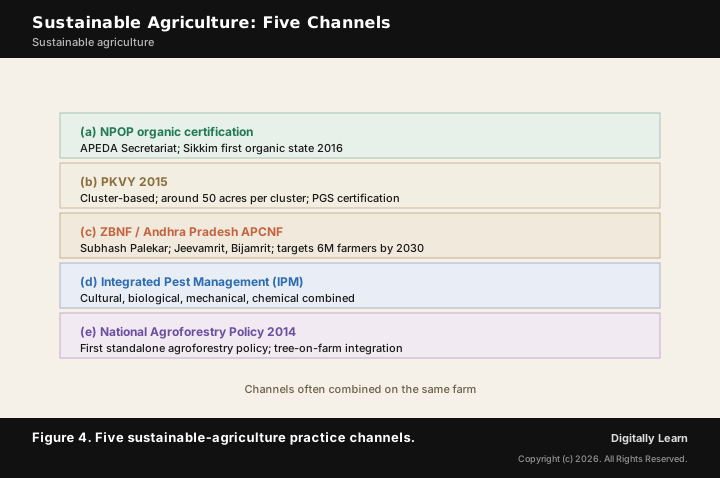
Indian sustainable agriculture spans five practice channels: certified organic farming under NPOP, natural farming via ZBNF and successor models, integrated pest management under the Plant Protection Division, agroforestry under the National Agroforestry Policy 2014, and climate-smart practices under NMSA and NICRA. The five channels are not mutually exclusive; many farms adopt multiple practices in combination.
- (a) NPOP organic certification: National Programme for Organic Production under Ministry of Commerce; APEDA as Secretariat; Sikkim declared India’s first fully organic state in 2016 (UPSC Prelims 2018). Statement 1 of that PYQ is FALSE because NPOP is under Commerce, not Rural Development.
- (b) Paramparagat Krishi Vikas Yojana (PKVY) 2015: Cluster-based organic farming with around 50 acres per cluster under the National Mission for Sustainable Agriculture; participatory guarantee system certification.
- (c) Zero Budget Natural Farming (ZBNF): Subhash Palekar method emphasising Jeevamrit, Bijamrit, Achhadana mulching, and Whapasa moisture management; rebranded as Subhiksha Punarjeevana in Andhra Pradesh; APCNF programme targets around 6 million farmers by 2030.
- (d) Integrated Pest Management (IPM): Cultural, biological, mechanical, and chemical control combined for pest suppression below economic threshold; Plant Protection Division under Department of Agriculture.
- (e) National Agroforestry Policy 2014: India’s first standalone agroforestry policy; tree-on-farm integration for soil-water conservation, biomass supply, supplementary farmer income.
| Dimension | Certified organic (NPOP) | Natural farming (ZBNF / APCNF) |
|---|---|---|
| Governing framework | National Programme for Organic Production under Ministry of Commerce | Promoted through state programmes and the natural-farming component of NMSA |
| Certification | Third-party or Participatory Guarantee System certification via APEDA | No formal national certification; relies on community and state verification |
| Input principle | Permits approved organic inputs and certified bio-fertilisers | Builds on on-farm preparations such as Jeevamrit and Bijamrit with minimal external input |
| Flagship example | Sikkim, India's first fully organic state (2016) | Andhra Pradesh Community-Managed Natural Farming targeting around 6 million farmers by 2030 |
Climate Change: NICRA, INCCA, Resilient Varieties
Climate-resilience framework and adaptation thread
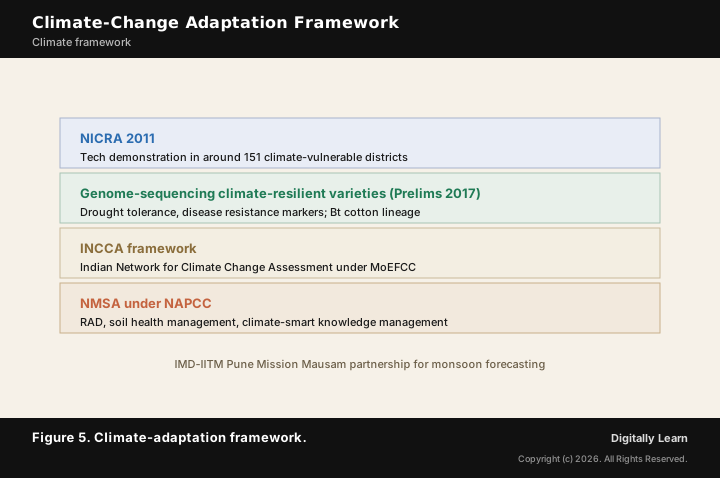
Indian agriculture faces documented climate-change pressure on three fronts. Monsoon variability shifts onset and increases extreme rainfall events; temperature rise stresses wheat grain-filling in northwest India and accelerates evapotranspiration; and extreme events (heatwaves, cyclones, floods) damage standing crops. The response framework combines climate-resilient variety development through genome-sequencing biotechnology, the NICRA technology demonstration programme, and the INCCA national assessment cycles.
- (i) NICRA 2011: National Innovations in Climate Resilient Agriculture launched by ICAR; technology demonstration villages in around 151 climate-vulnerable districts; tests heat-tolerant wheat, drought-tolerant millets, flood-tolerant rice.
- (ii) Genome-sequencing for resilient varieties: Identifies genetic markers for disease resistance and drought tolerance (UPSC Prelims 2017); accelerates variety development cycles. Bt cotton (Bollgard I and II covered in Agri Part 9) is the canonical biotechnology case.
- (iii) INCCA framework: Indian Network for Climate Change Assessment under Ministry of Environment, Forest and Climate Change; periodic national-scale assessment of climate impacts including agriculture.
- (iv) NMSA umbrella: National Mission for Sustainable Agriculture under National Action Plan on Climate Change (NAPCC); covers Rainfed Area Development, On-Farm Water Management, Soil Health Management, climate-smart agriculture knowledge management.
- (v) Monsoon-tracking partnership: India Meteorological Department (IMD) and Indian Institute of Tropical Meteorology (IITM) Pune; Mission Mausam strengthens forecasting; agromet advisory services to farmers.
Previous Year UPSC-CSE Questions
Previous Year UPSC-CSE Questions By the end you will be able to draft model answers for the following UPSC questions. Each question carries a collapsible framework showing how to approach it in the exam.
- UPSC Prelims 2018With reference to organic farming in India, consider the following statements:
- The National Programme for Organic Production (NPOP) is operated under the guidelines and directions of the Union Ministry of Rural Development.
- The Agricultural and Processed Food Products Export Development Authority (APEDA) functions as the Secretariat for the implementation of NPOP.
- Sikkim has become India's first fully organic State.
Which of the statements given above is/are correct?
How to approach this Prelims question
Approach: Identify the wrong ministry attribution in statement 1; verify APEDA Secretariat status and Sikkim organic-state status from public knowledge.
Trap to watch: Statement 1 misattributes NPOP to Rural Development; NPOP sits under Commerce because it is export-oriented certification.
Key facts to recall:
- NPOP under Ministry of Commerce and Industry
- APEDA is the NPOP Secretariat
- Sikkim is India's first fully organic state (declared 2016)
- PKVY launched 2015 under Ministry of Agriculture for cluster-based organic
Answer signal: Correct answer is (b): 2 and 3 only.
- UPSC Prelims 2017With reference to agriculture in India, how can the technique of genome sequencing, often seen in the news, be used in the immediate future?
- Genome sequencing can be used to identify genetic markers for disease resistance and drought tolerance in various crop plants.
- This technique helps in reducing the time required to develop new varieties of crop plants.
- It can be used to decipher the host-pathogen relationships in crops.
Select the correct answer using the code given below:
How to approach this Prelims question
Approach: All three applications are documented in agricultural biotechnology literature. Marker-assisted selection, accelerated variety development, and host-pathogen analysis are mainstream uses.
Trap to watch: Pre-elimination of any statement on the assumption that genome sequencing is confined to one application misses the all-correct pattern.
Key facts to recall:
- Genome sequencing enables marker-assisted selection for drought tolerance
- Accelerates variety development by skipping multiple field-trial cycles
- Decodes host-pathogen interaction for disease-resistance breeding
- Bt cotton (Bollgard I, II) is the canonical biotechnology case in India
Answer signal: Correct answer is (d): 1, 2 and 3 (all three).
- UPSC Prelims 2012Consider the following crops of India :
- Groundnut
- Sesamum
- Pearl millet
Which of the above is/are predominantly rainfed crop/crops?
How to approach this Prelims question
Approach: Recall the dryland-crop typology: oilseeds (groundnut, sesamum, sunflower) and millets (jowar, bajra, ragi) form the rainfed-crop backbone in India.
Trap to watch: Pre-elimination of any crop on the assumption that irrigation has substantially extended into oilseeds-and-millet belts misses the predominantly-rainfed pattern.
Key facts to recall:
- Groundnut grows on dryland Saurashtra and Deccan
- Sesamum is a kharif rainfed oilseed
- Pearl millet (bajra) is the canonical drought-tolerant millet
- Around 51 per cent of cultivated area is rainfed
Answer signal: Correct answer is (d): 1, 2 and 3 (all three rainfed).
Sources
- NCERT Class 12 India People and Economy, Chapter 5 (Land Resources and Agriculture), pp 78-84
- Indian Council of Agricultural Research (ICAR)
- ICAR-Central Research Institute for Dryland Agriculture (CRIDA), Hyderabad
- Department of Agriculture and Farmers Welfare
- Agricultural and Processed Food Products Export Development Authority (APEDA), NPOP Secretariat
- Ministry of Environment, Forest and Climate Change (INCCA, NMSA)
- Indian Meteorological Department (IMD)
- Wikipedia: Organic farming in India
- Wikipedia: Climate change and agriculture in India
Disclaimer
This article is an explainer for UPSC preparation and is not a substitute for primary documents. Scheme names, institutions, and figures should be confirmed against the latest government releases. Readers should consult the authoritative sources listed below for current details.