


Overview
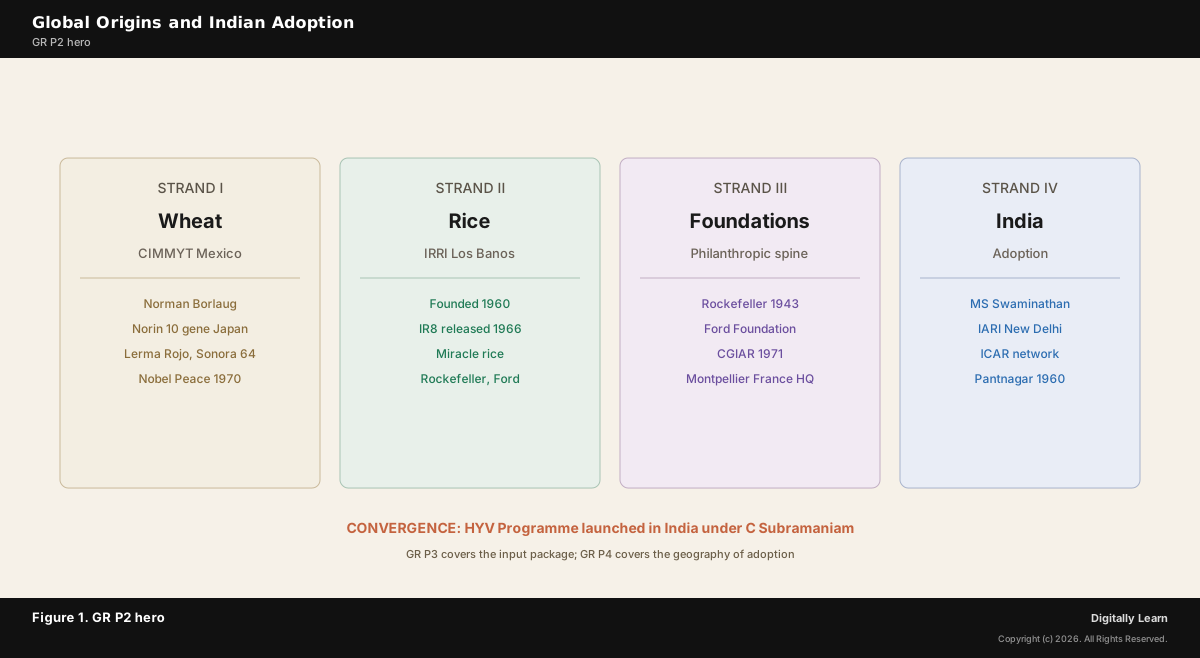
The global origins of the Green Revolution trace to the Mexican Agricultural Programme of 1943 under the Rockefeller Foundation, where Norman Borlaug bred dwarf wheat varieties (Lerma Rojo and Sonora 64) using the Japanese Norin 10 semi-dwarf gene. This breeding work won Borlaug the Nobel Peace Prize 1970; the Mexican programme matured into the International Maize and Wheat Improvement Centre (CIMMYT) formalised 1966. The parallel rice lineage ran through the International Rice Research Institute (IRRI) at Los Banos, Philippines, founded 1960, which released the dwarf rice IR8 in 1966, popularly called miracle rice. The Indian adoption architecture centred on MS Swaminathan at the Indian Agricultural Research Institute (IARI) New Delhi, the Indian Council of Agricultural Research (ICAR) network, and the new State Agricultural Universities (Pantnagar 1960 the first), which together adapted the Mexican and Filipino germplasm for Indian conditions and operationalised the HYV Programme launched 1966.
Background and Historical Context
The seed-revolution at the heart of the Green Revolution did not originate in India. The dwarf wheat that fed Punjab came from CIMMYT Mexico; the dwarf rice that fed the eastern delta came from IRRI Philippines. Understanding the Indian Green Revolution requires understanding the international agricultural research lineage that supplied the germplasm, the philanthropic foundations that funded it, and the Indian institutional adoption architecture that adapted varieties for local agronomy. UPSC Prelims has tested Norman Borlaug's country of origin (Prelims 2008), genome-sequencing applications for crop improvement (Prelims 2017), and the GM mustard hybrid system that traces back to the same biotechnology lineage (Prelims 2018).
What is the significance of the global-and-Indian architecture? Three operational dimensions follow. The germplasm-origin pipeline binds the Japanese Norin 10 semi-dwarf gene to Borlaug's Mexican wheat breeding programme, the IR8 rice to IRRI Philippines, and the Indian field-adaptation to IARI New Delhi. The philanthropic-funding spine covers the Rockefeller Foundation's Mexican Agricultural Programme 1943, the Ford Foundation's parallel rural-development support, and the subsequent CGIAR institutionalisation under World Bank coordination from 1971. The Indian institutional adoption spans MS Swaminathan's IARI programme, the ICAR coordination across crop research institutes, the State Agricultural Universities modelled on the United States land-grant pattern, and the political authorisation under Agriculture Minister C Subramaniam that launched the national HYV Programme in 1966.
The CGIAR network still operates today with around fifteen research centres including CIMMYT Mexico, IRRI Philippines, and ICRISAT Hyderabad. The Indian seed-system reform debate around private-sector breeding versus public-sector breeding traces directly back to the public-sector HYV foundation; the contemporary National Seeds Corporation, the State Seeds Corporations, and the private seed industry all operate within an architecture whose template was the IARI-led 1966 rollout. The Borlaug legacy continues through the World Food Prize that he established 1986 to honour individual contributions to global food security. The Swaminathan legacy continues through the MS Swaminathan Research Foundation that he established 1988 to advance sustainable agriculture in the Evergreen Revolution framing covered in Agri P11.
Introduction: Global Lineage Meets Indian Adoption
Two strands feeding into the 1966 HYV Programme
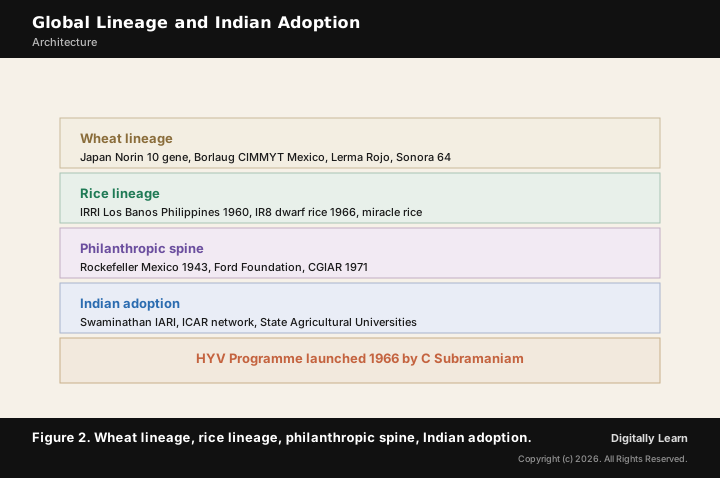
The Green Revolution's seed component was not invented in India. It was assembled from external germplasm lineages and adapted by domestic research. The wheat lineage ran from the Japanese Norin 10 gene through Borlaug's Mexican programme to Indian trials. The rice lineage ran from IRRI Los Banos through IR8 to Asian delta belts. The Indian adoption wove these strands together at IARI New Delhi, under ICAR coordination and the new State Agricultural Universities.
This article covers the global-and-Indian architecture as a single integrated story. Part 1 covered the political-economic foundation; Part 3 covers the input package; Part 4 covers the geographic concentration of gains; Part 5 covers the criticism and the post-1990s reframing.
- (i) Wheat lineage: Norin 10 semi-dwarf gene from Japan; Borlaug at CIMMYT Mexico bred Lerma Rojo and Sonora 64 varieties; introduced to India mid-1960s.
- (ii) Rice lineage: IRRI founded 1960 at Los Banos Philippines; IR8 dwarf rice released 1966 with semi-dwarf trait; popularly miracle rice.
- (iii) Philanthropic spine: Rockefeller Foundation funded Mexican Agricultural Programme 1943; Ford Foundation funded parallel agricultural-modernisation in India and Asia; CGIAR consolidated coordination from 1971.
- (iv) Indian adoption: MS Swaminathan at IARI New Delhi; ICAR network; State Agricultural Universities (Pantnagar first, 1960); land-grant model from United States.
- (v) Political authorisation: Agriculture Minister C Subramaniam launched the national HYV Programme in 1966 after the IADP pilot proof (covered in GR Part 1) and the Bihar drought 1965 to 1967 forcing function.
Norman Borlaug and the Mexican Wheat Revolution
Mexican Agricultural Programme, dwarf wheat breeding, and the Nobel recognition
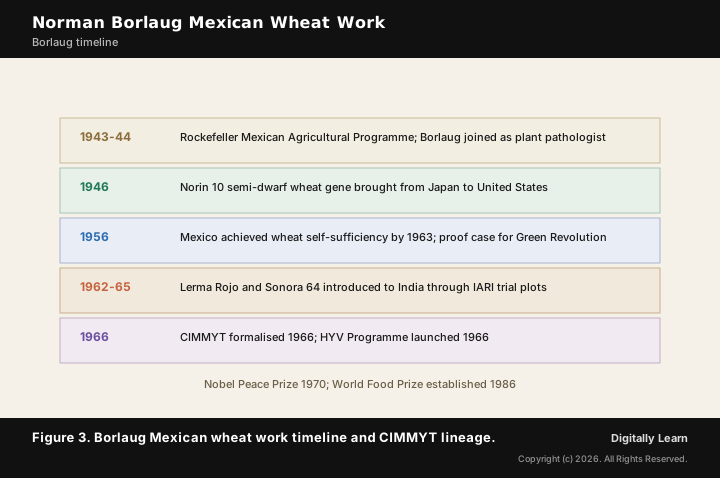
Born in Iowa in 1914, Norman Borlaug joined the Rockefeller Foundation's Mexican Agricultural Programme in 1944. His key insight was combining the Japanese Norin 10 semi-dwarf gene with high-yield Mexican varieties. The resulting dwarf cultivars Lerma Rojo and Sonora 64 carried short stiff straw, resisted lodging under heavy grain, and converted nitrogen fertiliser into grain rather than foliage. Mexico achieved wheat self-sufficiency by 1963, the proof case for the broader Green Revolution.
- (a) Mexican Agricultural Programme 1943: Rockefeller Foundation collaboration with Mexican government; Borlaug joined as plant pathologist 1944.
- (b) Norin 10 semi-dwarf gene: Japanese variety identified by US officer Cecil Salmon 1946; provided short-straw trait essential for nitrogen-responsive yield.
- (c) Lerma Rojo and Sonora 64: Borlaug’s flagship dwarf-wheat varieties; introduced to India 1962-1965 through trial plots; commercial release 1966.
- (d) CIMMYT formalised 1966: International Maize and Wheat Improvement Centre; succeeded Mexican Agricultural Programme; institutional home of Borlaug’s continuing work.
- (e) Nobel Peace Prize 1970: Awarded to Borlaug for contributions to world peace through increased food production; popularly Father of Global Green Revolution.
- (f) World Food Prize 1986: Borlaug established the prize to honour individual contributions to global food security; MS Swaminathan was the first recipient in 1987.
MS Swaminathan and the IARI Adaptation Programme
Indian institutional architecture for HYV adaptation and rollout
Born in 1925 in Tamil Nadu and trained as a plant geneticist at Cambridge, M S Swaminathan joined the Indian Agricultural Research Institute (IARI) New Delhi in 1954. By the early 1960s he was leading the Indian adaptation programme for Borlaug's Mexican dwarf wheat. He facilitated Borlaug's first India visit in 1963, organised trial plots across agro-climatic zones, and built the institutional case for the national HYV rollout that Agriculture Minister C Subramaniam authorised in 1966.
- (a) Indian Agricultural Research Institute (IARI): Founded 1905 at Pusa Bihar as Imperial Agricultural Research Institute; relocated to New Delhi 1934; Swaminathan headed the wheat-breeding programme.
- (b) ICAR network: Indian Council of Agricultural Research originally founded 1929 as Imperial Council; restructured post-Independence; coordinates national research across crop, livestock, fisheries, dairy.
- (c) State Agricultural Universities: Modelled on United States land-grant pattern; Pantnagar (Govind Ballabh Pant University of Agriculture and Technology) was the first, founded 1960 in Uttar Pradesh.
- (d) Borlaug India visit 1963: Swaminathan facilitated; visit confirmed Indian agro-ecological suitability of Mexican dwarf wheat varieties.
- (e) MS Swaminathan Research Foundation 1988: Swaminathan founded the foundation in Chennai to advance sustainable agriculture; the Evergreen Revolution reframing covered in Agri P11 originated here.
- (f) Father of Indian Green Revolution: Popular attribution to Swaminathan; complementary to C Subramaniam (political authorisation) and Borlaug (global germplasm); each occupies a distinct institutional role.
| Institution | Location | Crop lineage | Flagship variety |
|---|---|---|---|
| CIMMYT (International Maize and Wheat Improvement Centre) | El Batan, Mexico | Dwarf wheat (Borlaug) | Lerma Rojo, Sonora 64 |
| IRRI (International Rice Research Institute) | Los Banos, Philippines | Dwarf rice | IR8 (miracle rice) |
| IARI (Indian Agricultural Research Institute) | New Delhi, India | Indian wheat adaptation (Swaminathan) | Sonalika, Kalyan Sona |
| Pantnagar (G B Pant University of Agriculture and Technology) | Uttar Pradesh, India | First State Agricultural University | Land-grant extension model |
Convergence in 1966 and the Father Debate
Wheat, rice, foundation, adaptation, political will
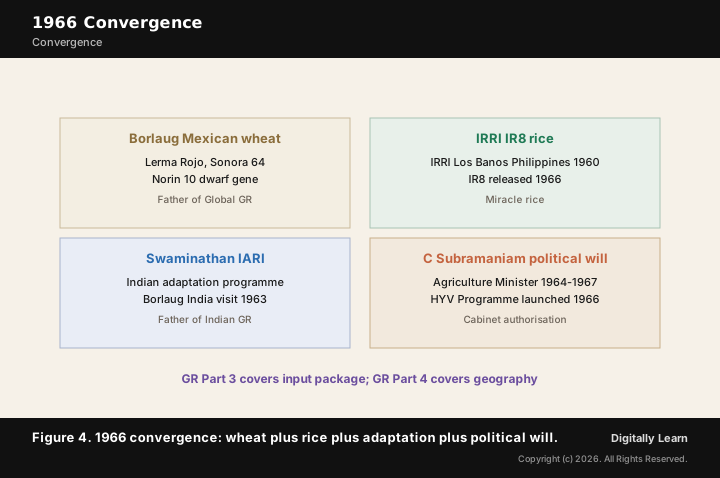
By the mid-1960s the global research lineage, the Indian institutional architecture, and the political authorisation met in one year. Mexican dwarf wheat had completed Indian trial plots; IR8 dwarf rice was released by IRRI; C Subramaniam carried the risk through Cabinet; and the Bihar drought of 1965 to 1967 forced the urgency. The seeds were not Indian; the institutional adaptation was; the political will was. Crediting any single actor as the Father is a historiographic choice.
- (i) Norman Borlaug: Father of Global Green Revolution; the wheat germplasm that fed the wheat belt traces directly to his Mexican breeding programme.
- (ii) MS Swaminathan: Father of Indian Green Revolution; the IARI adaptation programme that made Mexican wheat work in Indian fields was his institutional bridge.
- (iii) C Subramaniam: Political enabler as Agriculture Minister 1964-1967; the Cabinet authorisation in 1966 was the proximate political event launching the HYV Programme.
- (iv) IRRI Philippines: Founded 1960 by Rockefeller and Ford Foundations; released IR8 in 1966; the parallel rice lineage that complemented Mexican wheat.
- (v) CGIAR network 1971: World Bank coordination consolidated CIMMYT, IRRI, ICRISAT, and other centres into a multi-donor system; the institutional descendant of the Rockefeller and Ford foundation effort.
Previous Year UPSC-CSE Questions
Previous Year UPSC-CSE Questions By the end you will be able to draft model answers for the following UPSC questions. Each question carries a collapsible framework showing how to approach it in the exam.
- UPSC Prelims 2008Norman Ernest Borlaug who is regarded as the father of the Green Revolution in India is from which country?
How to approach this Prelims question
Approach: Distinguish Borlaug's birth country (USA) from his work location (Mexico); the question asks origin.
Trap to watch: Option b Mexico baits the CIMMYT-work-location confusion.
Key facts to recall:
- Norman Borlaug born Iowa USA 1914
- Worked at CIMMYT Mexico from 1944
- Developed Lerma Rojo and Sonora 64 dwarf wheat
- Nobel Peace Prize 1970
Answer signal: Correct answer is (a): United States of America.
- UPSC Prelims 2017With reference to agriculture in India, how can the technique of genome sequencing, often seen in the news, be used in the immediate future?
- Genome sequencing can be used to identify genetic markers for disease resistance and drought tolerance in various crop plants.
- This technique helps in reducing the time required to develop new varieties of crop plants.
- It can be used to decipher the host-pathogen relationships in crops.
Select the correct answer using the code given below:
How to approach this Prelims question
Approach: All three are mainstream uses of genome sequencing in agricultural biotechnology. Pre-elimination misses the all-correct pattern.
Trap to watch: Assuming any single application is the only valid one misses the integrated use.
Key facts to recall:
- Marker-assisted selection for drought tolerance
- Accelerated variety development cycles
- Host-pathogen interaction decoding
- Modern continuation of HYV breeding logic
Answer signal: Correct answer is (d): 1, 2 and 3.
- UPSC Prelims 2018With reference to the Genetically Modified mustard (GM mustard) developed in India, consider the following statements:
- GM mustard has the genes of a soil bacterium that give the plant the property of pest-resistance to a wide variety of pests.
- GM mustard has the genes that allow the plant cross-pollination and hybridization.
- GM mustard has been developed jointly by the IARI and Punjab Agricultural University.
Which of the statements given above is/are correct?
How to approach this Prelims question
Approach: Distinguish GM mustard (hybrid-seed enablement via barnase-barstar) from Bt cotton (pest resistance via soil-bacterium genes). Verify the developing institution.
Trap to watch: Statement 1 confuses biotechnology applications; statement 3 fabricates the developing institution.
Key facts to recall:
- GM mustard uses barnase-barstar gene system for hybrid seed production
- Bt cotton has soil-bacterium Bt gene for pest resistance
- DMH-11 developed at Delhi University CGMCP under Prof Deepak Pental
- IARI worked on wheat HYV not on GM mustard
Answer signal: Correct answer is (b): 2 only.
Sources
- NCERT Class 12 India People and Economy, Chapter 5 (Land Resources and Agriculture), pp 46-50
- Indian Council of Agricultural Research (ICAR)
- Department of Agriculture and Farmers Welfare
- Food Corporation of India (FCI)
- Ministry of Statistics and Programme Implementation (MoSPI)
- Wikipedia: Norman Borlaug
- Wikipedia: M S Swaminathan
- Wikipedia: International Rice Research Institute (IRRI)
- Wikipedia: Green Revolution in India
- CGIAR (Consultative Group on International Agricultural Research)
- IRRI (International Rice Research Institute), Los Banos Philippines
- CIMMYT (International Maize and Wheat Improvement Centre), Mexico
- MS Swaminathan Research Foundation (MSSRF)
Disclaimer
This article is the second in the ten-part Green Revolution series on Digitally Learn. It covers the global research lineage that produced HYV seeds and the Indian institutional adoption architecture that adapted them for local conditions. Key institutions and figures are cross-verified with NCERT and the authoritative sources listed in the Sources block below.