


Overview
Operation Flood was the dairy development programme of the National Dairy Development Board (NDDB), launched on 13 January 1970 and run in three phases until 1996. It is the programme behind India's White Revolution: it spread the Anand pattern of farmer-owned milk cooperatives across India, linked them in a National Milk Grid, and helped make India the world's largest milk producer by 1998.
Operation Flood: Meaning, Launch and Objectives
What Was Operation Flood? The White Revolution Programme of 1970
What is Operation Flood? It was a national programme, run by the National Dairy Development Board, to organise India's milk producers into cooperatives they owned and to connect them with city consumers. Operation Flood in India was launched on 13 January 1970 and ran for 26 years, to 1996, and it is counted among the world's largest rural development programmes.
The name described the goal: a "flood of milk". The programme did not create a new government dairy; it placed control of the dairy business in the hands of the farmers who produced the milk. How that idea began at Anand in 1946 is told in the article on the origins of the White Revolution.
Objectives of Operation Flood and the National Milk Grid
NDDB lists three objectives of Operation Flood:
- Increase milk production: “A flood of milk”.
- Augment rural incomes: Give milk producers a regular income from their own cooperatives.
- Reasonable prices for consumers: Bring milk to towns at fair prices.
The means was a National Milk Grid. It links milk producers throughout India with consumers in over 700 towns and cities, reducing seasonal and regional price variations while ensuring that producers get fair market prices, transparently and regularly. Milk grid meaning in one line: a single network that moves milk from surplus rural areas to deficit cities through cooperative dairies.
The bedrock of the programme was the village milk producers' cooperative, which procured milk and provided inputs and services, making modern management and technology available to its members. NDDB describes Operation Flood as much more than a dairy programme: dairying was used as an instrument of development, generating employment and regular incomes for millions of rural people.
NDDB, Verghese Kurien and the Road From Anand to a National Programme
The programme grew out of one cooperative. On 31 October 1964 Prime Minister Lal Bahadur Shastri visited Anand and spoke to the farmers of the Kaira cooperative, and on his return he set in motion an organisation to replicate it across India: the National Dairy Development Board, founded in 1965 with Verghese Kurien as its chairman.
| Year | Event |
|---|---|
| 1946 | Kaira District Co-operative Milk Producers' Union registered at Anand (14 December) |
| 1955 | The Kaira Union holds the brand name Amul |
| 1964 | Lal Bahadur Shastri visits Anand (31 October) |
| 1965 | National Dairy Development Board founded |
| 1970 | Operation Flood launched (13 January) |
| 1973 | Gujarat Co-operative Milk Marketing Federation set up; Amul brand transferred to it |
| 1996 | Phase III completed |
| 1998 | India overtakes the United States as the largest milk producer |
One technical breakthrough made the model possible. H. M. Dalaya, working with Kurien, developed a way to make skimmed milk powder from buffalo milk, which let Amul compete with cow-milk suppliers such as Nestle. NDDB is today a statutory body set up by an Act of Parliament and an Institution of National Importance, with its main office at Anand.
The buffalo point matters for India. Nearly half of the milk produced in India comes from water buffaloes rather than cows, and India's dairy industry is unusual among large producers for its large share of buffalo milk, which is why Dalaya's buffalo milk powder mattered so much.
Operation Flood Phases 1, 2 and 3: 1970 to 1996
Operation Flood Phase 1 (1970 to 1980): European Aid and Four Metros
Phase I (1970 to 1980) was financed by selling skimmed milk powder and butter oil gifted by the European Economic Community (EEC) through the World Food Programme. NDDB planned the programme and negotiated the details of the EEC assistance.
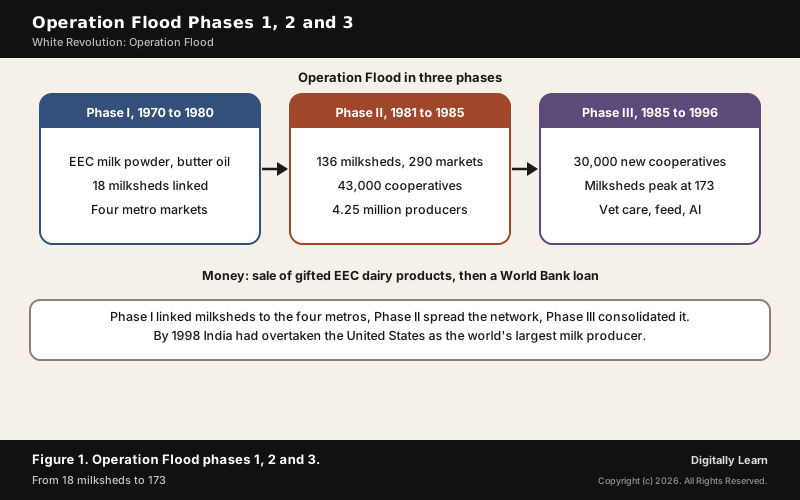
Phase I linked 18 of India's premier milksheds with consumers in the four major metropolitan cities, Delhi, Mumbai, Kolkata and Chennai, and set up mother dairies in the four metros. It was meant to finish in 1975 but lasted until the end of 1979, at a total cost of Rs 1.16 billion. Its aims were to improve the organised dairy sector in the four cities, raise the producers' share in the milk market, and speed up the development of dairy animals in rural areas.
Operation Flood Phase 2 (1981 to 1985): 136 Milksheds and Self-Reliance
Phase II (1981 to 1985) increased the milksheds from 18 to 136, and 290 urban markets expanded the outlets for milk. By the end of 1985 a self-sustaining system of 43,000 village cooperatives covering 4.25 million milk producers had become a reality.
- Milk powder: Domestic production rose from 22,000 tonnes in the year before the project to 140,000 tonnes by 1989, all of the increase from dairies set up under Operation Flood.
- Finance: EEC gifts and a World Bank loan, used in a way that promoted self-reliance.
- Marketing: Direct marketing of milk by producers’ cooperatives rose by several million litres a day.
The gifted powder had a clear purpose. Sold in India, it raised the money for the programme, and the dairies built under it then made more of the milk powder India had been receiving as a gift. That is what NDDB means when it says the gifts and the loan promoted self-reliance.
Operation Flood Phase 3 (1985 to 1996): Consolidation and Services
Phase III (1985 to 1996) enabled the dairy cooperatives to expand and strengthen the infrastructure needed to procure and market increasing volumes of milk. It added 30,000 new dairy cooperatives to those organised in Phase II, and the number of milksheds peaked at 173 in 1988-89.
- Services to members: Veterinary first-aid, feed and artificial insemination services were extended, with more member education.
- Women: The numbers of women members and of Women’s Dairy Cooperative Societies rose significantly.
- Research: Greater emphasis on animal health and nutrition, with innovations such as a vaccine for theileriosis, bypass protein feed and urea-molasses mineral blocks.
How Operation Flood Was Financed: EEC Gifts and the World Bank Loan
Operation Flood was financed in an unusual way. Instead of a grant of money, the EEC gave dairy commodities, skimmed milk powder and butter oil, through the World Food Programme. These were sold in India, and the proceeds financed the first phase of the programme.
| Who | What it gave | Phase |
|---|---|---|
| European Economic Community | Skimmed milk powder and butter oil, sold in India | Phase I onwards |
| World Food Programme | Channel for the EEC gifts | Phase I |
| World Bank | Loan | Phase II onwards |
| NDDB | Planning and negotiation of the assistance | All phases |
NDDB sums up the whole 26-year effort as a programme that used a World Bank loan to finance India's emergence as the world's largest milk producing nation. A World Bank report of 1997 called it "a twenty year experiment confirming the Rural Development Vision".
The Amul Model: Anand Pattern Three-Tier Structure
Three Tiers of the Anand Pattern: Village Society, District Union, State Federation
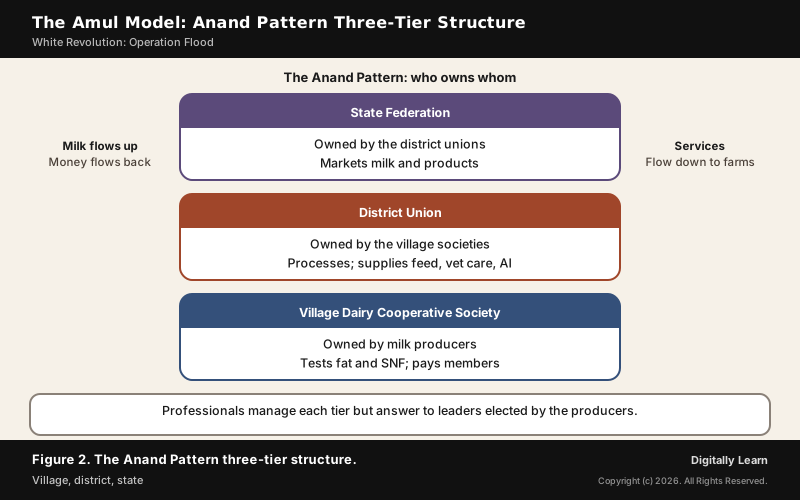
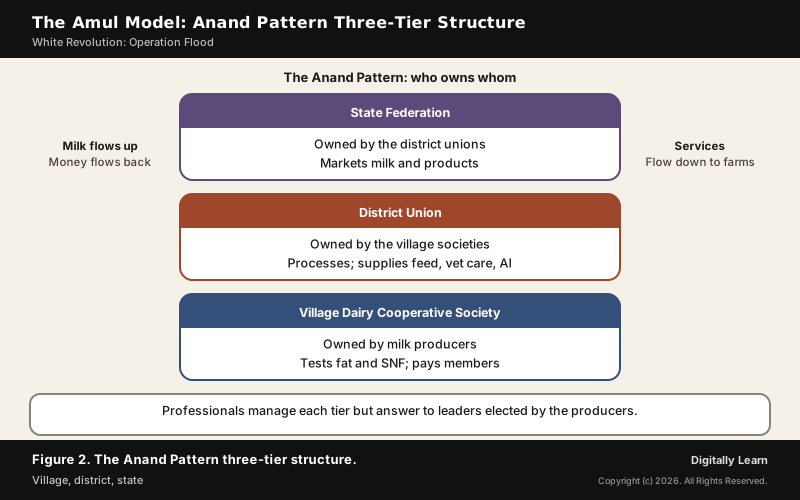
The Anand pattern, also called the Amul model, is an integrated cooperative structure that procures, processes and markets milk. Its village cooperative, dairy and cattle-feed plants and state and national marketing are all owned and controlled by the farmers, and it is built in three tiers.
| Tier | Owned by | What it does |
|---|---|---|
| Village dairy cooperative society | Milk producers | Collects milk daily, tests it, pays members |
| District milk producers' union | Village societies | Buys, processes and markets milk; supplies feed, vet care, AI |
| State federation | District unions | Markets the fluid milk and products of member unions |
In Gujarat the state tier is the Gujarat Co-operative Milk Marketing Federation, set up in 1973 so that the district cooperatives could expand the market, save on advertising and avoid competing against each other. The Kaira Union transferred the Amul brand to it, and it is now controlled by 3.6 million milk producers.
How a Village Dairy Cooperative Society Works: Fat, SNF and Patronage Bonus
A village dairy cooperative society is formed by the milk producers themselves. The rules are set out by NDDB:
- Membership: Any producer can join by buying a share and committing to sell milk only to the society.
- Collection: Each society has a collection centre where members bring milk every day.
- Payment: Each member’s milk is tested, and payment depends on its percentage of fat and SNF (solids-not-fat).
- Patronage bonus: At the end of each year part of the society’s profit is paid to members in proportion to the milk they poured.
Behind the society stands the district union. It buys all the societies' milk, processes and markets it, and supplies inputs and services that single farmers could neither afford nor manage: feed, veterinary care and artificial insemination. Its staff also train the leaders and staff of the village societies.
Why the Anand Pattern Worked: Farmer Ownership and No Middlemen
Before 1946 the farmers of Kaira sold to traders and agents who set milk prices arbitrarily, and Polson held a near-monopoly on milk collection. The cooperative removed the middlemen: the farmers supplied the Bombay Milk Scheme directly, and the producer received the largest share of the consumer's rupee.
- Professional management, farmer control: Professionals run the business but are accountable to leaders elected by producers.
- Open membership: Any farmer could join, whatever the religion, caste, gender or politics.
- Built for small producers: Most were marginal farmers delivering 1 to 2 litres a day, so collection was decentralised to every village.
- Services at scale: Feed, veterinary care and insemination came through the union.
Results of Operation Flood: India's Dairy Transformation
Operation Flood Achievements and India's Milk Production Today
Operation Flood transformed India from a milk-deficient nation into the world's largest milk producer, surpassing the United States in 1998. Within 30 years it doubled the milk available per person, and it made dairying India's largest self-sustainable rural employment generator.
| Measure | Figure (March 2019) |
|---|---|
| Village dairy cooperatives | 1,90,500 |
| Milk unions and marketing dairies | 245 |
| Federations and apex bodies | 22 |
| Milk procured per day | 508 lakh kg on average |
| Farmer members | 16.9 million |
The cooperative network kept growing after 1996. The same three-tier pattern now spans roughly 1.9 lakh village societies, and NCERT credits the implementation of Operation Flood for the more than four-fold rise in India's milk production between 1960 and 2002. Gujarat is held up as the success story that many states copied.
India produced 247.87 million tonnes of milk in 2024-25, up 3.58 per cent from 239.30 million tonnes in 2023-24. It ranks first in the world, with about 25 per cent of global milk production, and output has risen by about 69 per cent in eleven years from 146.31 million tonnes in 2014-15.
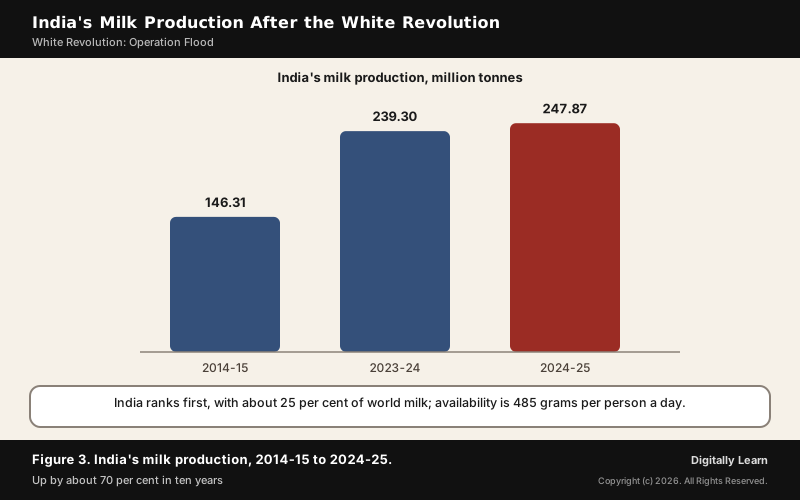
- Per capita availability: 485 grams a day in 2024-25, up from 319 grams in 2014-15; the world average was 328 grams in 2024.
- Top states: Uttar Pradesh (15.66 per cent), Rajasthan (14.82), Madhya Pradesh (9.12), Gujarat (7.78) and Maharashtra (6.71), together 54.09 per cent.
- Value of output: More than Rs 12.21 lakh crore in 2023-24, the largest agricultural commodity by value.
- Productivity: Up 27 per cent, from 1,648.17 kg per animal a year in 2013-14 to 2,079 kg in 2024-25.
Today's schemes build on the Operation Flood base. The National Programme for Dairy Development aims to improve milk quality, procurement, processing and marketing, and the Rashtriya Gokul Mission develops and conserves indigenous breeds; The National Dairy Plan and White Revolution 2.0 have an article of their own.
Livestock and Dairying in the Rural Economy: Income and Employment
Indian farmers follow a mixed crop-livestock system, with cattle, goats and fowl the most widely held. Livestock gives the family stability of income, food security, transport, fuel and nutrition without disturbing its other food-producing work.
- Livelihoods: The livestock sector alone provides alternative livelihoods to over 70 million small and marginal farmers, including landless labourers.
- Women’s share: A significant number of women find employment in the livestock sector.
- Share of output: Livestock’s share in agriculture and allied GVA rose from 24.38 per cent in 2014-15 to 30.87 per cent in 2023-24; it was 5.49 per cent of total GVA in 2023-24.
- Breeding reach: Artificial insemination coverage rose from 25 to 40 per cent of breedable bovine females under the nationwide programme.
Dairying is a primary sector activity. Milk, like cotton or minerals, is a natural product: it depends on the biological process of the animal and the fodder available. Turning natural products into other goods, such as weaving cloth from yarn, is secondary; transport, storage, communication, banking and trade are tertiary, because they produce services, not goods.
Operation Flood turned this household activity into a regular cash income. Because the village society buys milk every day and pays by quality, a family with one or two animals earns steadily, which is exactly the non-farm income that UPSC questions on livestock ask candidates to explain.
Limits of the Cooperative Model: Coverage, Links and Finance
The success was not uniform. NCERT notes that cooperatives have received a setback in recent years for three reasons:
- Coverage: Inadequate coverage of farmer members.
- Links: No proper link between marketing and processing cooperatives.
- Financial management: Inefficient financial management.
The regional pattern also shows the limits. The top five states produce more than half of India's milk, so the gains of the White Revolution are concentrated. The newer schemes, such as the approval of new dairy cooperative societies under the National Programme for Dairy Development, aim to widen coverage in states where the network is thin.
Previous Year UPSC-CSE Questions
Previous Year UPSC-CSE Questions By the end you will be able to draft model answers for the following UPSC questions. Each question carries a collapsible framework showing how to approach it in the exam.
- UPSC Mains 2015 GS-IIILivestock rearing has a big potential for providing non-farm employment and income in rural areas. Discuss suggesting suitable measures to promote this sector in India.
Answer outline: how to structure the answer
What the question asks, the main arguments, relevant examples and the direction of the conclusion. This is not a full model answer.
Introduction: Livestock, dairying above all, gives regular income to small and landless households; Operation Flood proved it at national scale.
Body (sub-themes to develop):
- Potential: dairying became India's largest self-sustainable rural employment generator; 16.9 million cooperative members.
- Model: the Anand pattern, farmer-owned societies, unions and federations, with professional management.
- Measures: extend cooperative coverage, veterinary care, feed and insemination, women's societies.
- Schemes: National Programme for Dairy Development, Rashtriya Gokul Mission for indigenous breeds.
Conclusion: Conclude that extending the Anand pattern to thinly covered states is the surest way to turn livestock into non-farm income.
- UPSC Prelims 2024 Prelims-GSWith reference to the sectors of the Indian economy, consider the following pairs: Economic activity – Sector
- Storage of agricultural produce – Secondary
- Dairy farm – Primary
- Mineral exploration – Tertiary
- Weaving cloth – Secondary
How many of the pairs given above are correctly matched?
How to approach this Prelims question
Approach: Place each activity in its sector. Storing agricultural produce is a service, so it is tertiary, not secondary. A dairy farm works directly with animals and their produce, so it is primary. Exploring for minerals is part of extraction, so it is primary, not tertiary. Weaving cloth turns raw material into a product, so it is secondary. Pairs 2 and 4 are correct.
Trap to watch: Storage produces a service, so it is tertiary; mineral exploration draws on a natural resource, so it is primary.
Key facts to recall:
- (a) Only one: wrong. Two pairs are correct: dairy farm with primary and weaving with secondary.
- (b) Only two: right. Dairying is primary and weaving secondary; storage is tertiary and mineral exploration primary.
- (c) Only three: wrong. Storage and mineral exploration are both placed in the wrong sector.
- (d) All four: wrong. Pairs 1 and 3 are mismatched.
Answer signal: Answer (b), only two: dairying is primary, the activity this page is about.
Sources and Further Reading
- NDDB: Operation Flood
- NDDB: Genesis
- NDDB: The Anand Pattern
- NCERT: Indian Economic Development (Class XI), Rural Development
- NCERT: Understanding Economic Development (Class X), Sectors of the Indian Economy
- PIB: National Milk Day, Honouring the White Revolution (25 November 2025)
- PIB: Release of Basic Animal Husbandry Statistics 2025 (26 November 2025)
- PIB: Year-end review 2025, Department of Animal Husbandry and Dairying (7 January 2026)
- Wikipedia: Operation Flood
- Wikipedia: Amul
- Wikipedia: Verghese Kurien
- Wikipedia: National Dairy Development Board
- UPSC: Previous year question papers
Editorial Disclaimer
This article is compiled from the reference materials listed in the Sources section. It is an explainer for UPSC preparation and is not a substitute for primary documents (NCERTs, GoI ministry releases, IMD bulletins, RBI / CEA / MoEFCC publications, and Standing-Committee reports).