


Overview
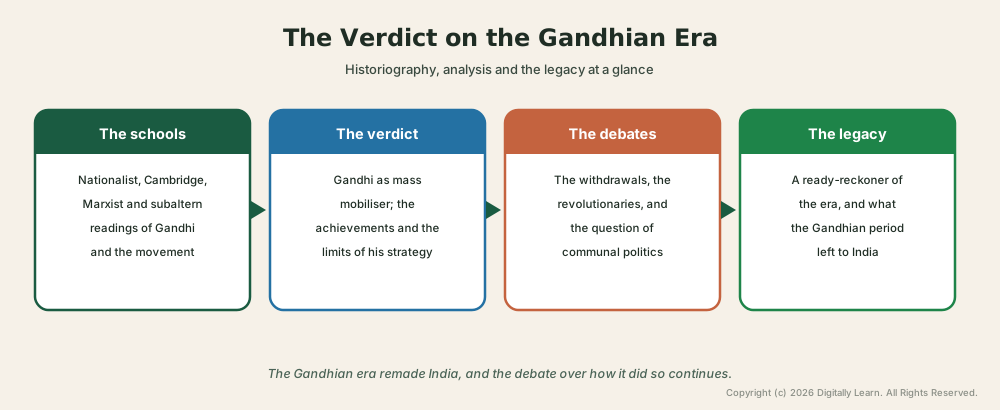
The Gandhian era, from 1917 to 1947, transformed the Indian national movement and the way it is remembered. This closing part weighs the period: the rival schools of interpretation, nationalist, Cambridge, Marxist and subaltern, that read Gandhi differently; the verdict on him as a mass mobiliser and the limits of his strategy; the debates over the withdrawal of the movements, the revolutionaries and communal politics; and a ready-reckoner of the sessions, Acts and pacts. It is the analytical summing-up of the whole series.
Introduction: The Closing Verdict on the Gandhian Era
Why the Final Reckoning Matters
Why this matters: having followed the Gandhian era from Champaran to Partition, it remains to weigh it as a whole. How should we judge Gandhi's leadership, and how have historians read the movement he led?
What is the significance of this reckoning: the verdict on the Gandhian era is itself a live question in the examination and in scholarship. This part sets out the rival interpretations and the analytical debates, and offers a ready-reckoner of the period as a study aid.
The Whole Arc of the Gandhian Era
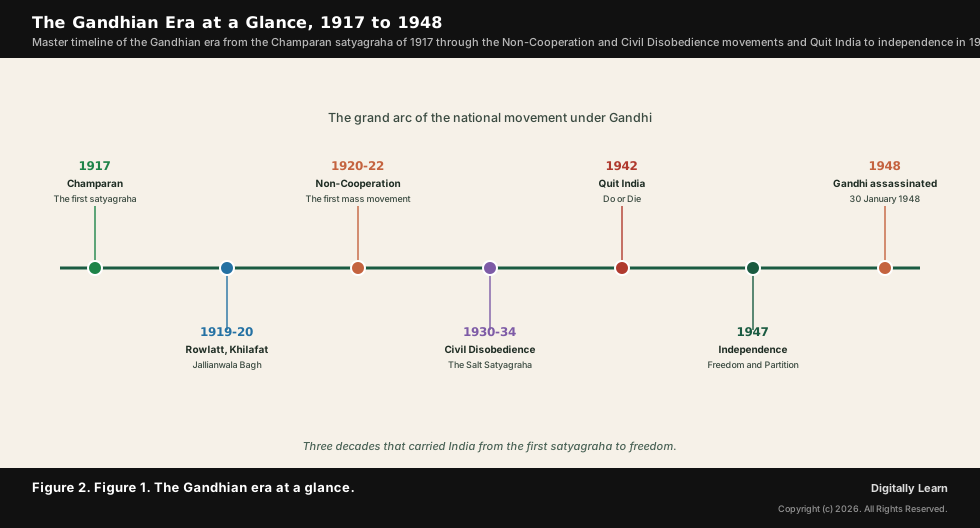
Distinguishing the arc of the era is the place to begin. From the first satyagraha at Champaran in 1917, through Non-Cooperation, Civil Disobedience and Quit India, to independence in 1947, the movement passed through distinct phases, each built on the last.
What the timeline shows is a single sweep of three decades, ending in freedom and in Gandhi's death in 1948, the grand arc that the whole series has traced, as set out below.
Schools of Interpretation: Nationalist, Marxist and Subaltern Readings of Gandhi
How Historians Have Read Gandhi
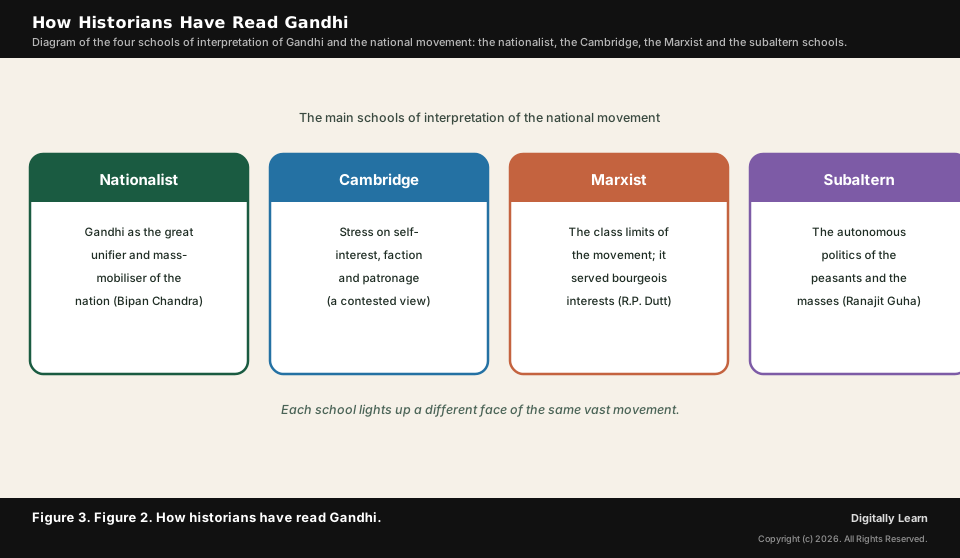
What is the significance of the historiography: how we judge Gandhi depends on which lens we use. The nationalist school, associated with historians such as Bipan Chandra, sees Gandhi as the great unifier who turned the movement into a mass struggle; the Cambridge school stresses self-interest and faction, a reading many in India contest.
Distinguishing the radical readings: the Marxist school, in the tradition of R.P. Dutt, emphasises the class limits of the movement and argues it served bourgeois interests; the subaltern school, led by Ranajit Guha, recovers the autonomous politics of the peasants and the masses. Each, set out below, illuminates a different aspect of the same movement.
Gandhi as Mass Mobiliser and the Limits of the Gandhian Strategy
What Gandhi Achieved, and Where He Fell Short
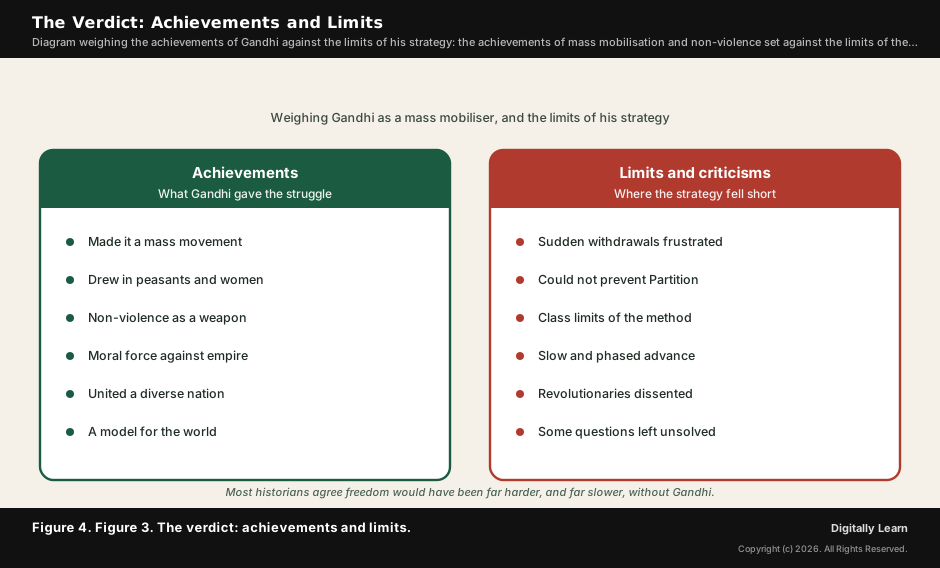
What is the significance of Gandhi's leadership: his great achievement was to turn a movement of the educated few into a mass movement of millions, drawing in peasants, women and the poor, and to forge in non-violent satyagraha a weapon that the empire found hard to answer.
Distinguishing the limits: critics point to the limits of the strategy, the sudden withdrawals that frustrated radicals, the class compromises, the slow and phased advance, and above all the failure to prevent Partition. The balance, weighed below, is the heart of the verdict on the era.
Why Did Gandhi Withdraw the Mass Movements?
Chauri Chaura, 1934 and a Contested Choice
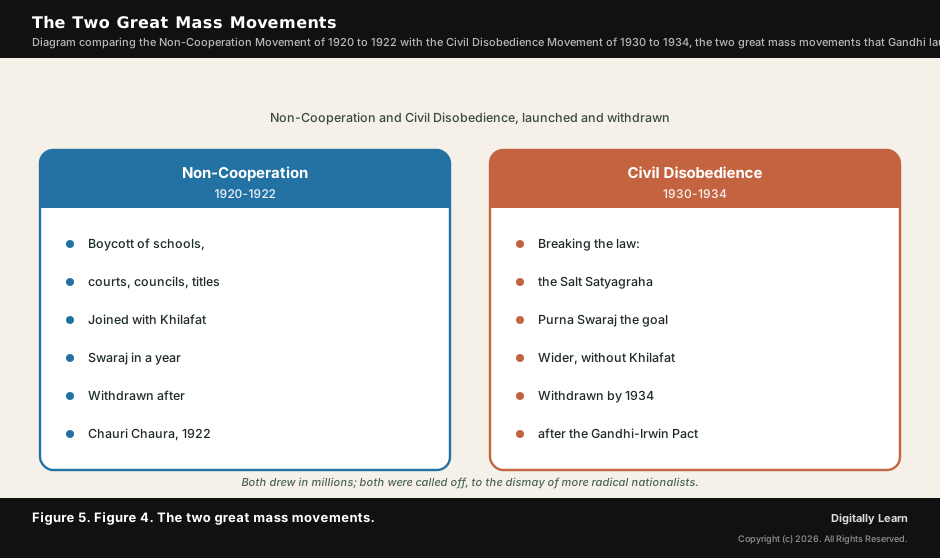
What is the significance of the withdrawals: Gandhi twice called off a mass movement at its height, the Non-Cooperation Movement after the violence at Chauri Chaura in 1922, and the Civil Disobedience Movement by 1934. These decisions remain among the most debated of his career.
Distinguishing the two views: for Gandhi, a movement that turned to violence betrayed its own principles and had to be stopped; for his critics, the withdrawals threw away momentum and frustrated more radical nationalists. The two great movements he led and withdrew are compared below.
Gandhian Strategy versus Revolutionary Nationalism
Non-Violence and the Armed Alternative
What is the significance of this contrast: the Gandhian mainstream was never the only path. Revolutionary nationalists, from Bhagat Singh and the HSRA to Subhas Bose and the Indian National Army, held that armed struggle might win freedom faster, and rejected what they saw as the slowness of non-violence.
Distinguishing the relationship: the two streams were rivals but also complementary. The revolutionaries kept the spirit of sacrifice alive and pressed the moderate leadership, while the Gandhian movement gave the struggle its mass base. Together, as the wider scholarship argues, both hastened the end of British rule.
The Gandhi-and-Communal-Politics Debate
Could Gandhi Have Stopped Partition?
What is the significance of the communal question: the deepest charge against the Gandhian era is that it ended in Partition. Some argue that Gandhi's use of religious idiom, however inclusive in intent, made it harder to keep politics secular; others hold that the communal divide had far deeper roots, set out earlier in this series.
Distinguishing a fair judgment: most historians conclude that no single leader could have prevented Partition, given the long growth of separate electorates and the failure of power-sharing, but that Gandhi's lifelong fight for Hindu-Muslim unity, to which he gave his life in 1948, was among the noblest strands of the movement.
A Ready-Reckoner: Sessions, Acts, Pacts and Reports of the Era
The Landmark Congress Gatherings
Observable outcomes of the era can be fixed by its landmarks. The Congress sessions mark the turning points: the founding at Bombay in 1885, the Lahore session of 1929 under Jawaharlal Nehru that declared Purna Swaraj, and the Karachi session of 1931 under Vallabhbhai Patel that adopted the Fundamental Rights resolution drafted by Nehru.
Distinguishing the key sessions at a glance helps fix the chronology, as the table below records, a study aid for the whole period.
| Year | Session | President and significance |
|---|---|---|
| 1885 | First session, Bombay | W.C. Bonnerjee; the Congress founded |
| 1929 | Lahore | Jawaharlal Nehru; the Purna Swaraj resolution |
| 1931 | Karachi | Vallabhbhai Patel; the Fundamental Rights resolution |
| 1938-39 | Haripura, Tripuri | Subhas Bose; the Tripuri crisis |
The Constitutional Landmarks
Observable outcomes on the constitutional side are equally important. From the Montagu-Chelmsford reforms of 1919 to the Indian Independence Act of 1947, a series of Acts, pacts and reports marked the slow transfer of power.
Distinguishing the milestones: the Nehru Report, the Poona Pact, the Government of India Act of 1935 and the Independence Act each shaped the road to freedom, as the table below sets out for ready reference.
| Year | Act, pact or report | Significance |
|---|---|---|
| 1919 | Government of India Act (Montagu-Chelmsford) | Dyarchy introduced in the provinces |
| 1928 | Nehru Report | Dominion status; joint electorates |
| 1932 | Poona Pact | Joint electorate with reserved seats |
| 1935 | Government of India Act | Provincial autonomy; a basis for the 1950 Constitution |
| 1947 | Indian Independence Act | The two dominions and the transfer of power |
Significance: The Gandhian Era's Contribution to Indian Independence and Its Legacy
What the Gandhian Era Left India
Contemporary linkages run from the Gandhian era into the India of today. It bequeathed a democratic, mass-based politics, the method of non-violent protest that inspired movements worldwide, and a constitutional order built on the institutions and ideas the movement forged.
The larger significance is that the Gandhian era won India its freedom and gave it a moral example that still resonates, even as the debates over its strategy and its failures, above all Partition, continue. This part closes a twenty-one-part journey from Gandhi's South African years to the verdict of history, as the points below sum up.
- Gandhi turned the freedom struggle into a mass movement of millions.
- Non-violent satyagraha became a model for movements across the world.
- The era ended in independence, but also in the trauma of Partition.
- Its sessions, Acts and pacts form the spine of modern Indian history.
- The debate over Gandhi’s strategy continues to shape how India sees its past.
Previous Year UPSC-CSE Questions
Previous Year UPSC-CSE Questions By the end you will be able to draft model answers for the following UPSC questions. Each question carries a collapsible framework showing how to approach it in the exam.
- UPSC Mains 2015 GS-IHow different would have been the achievement of Indian independence without Mahatma Gandhi? Discuss.
How to structure the answer in the exam
Introduction: Open with Gandhi as the central, but not the sole, force of the freedom struggle.
Body (sub-themes to develop):
- Indispensable: mass mobilisation, non-violence, unifying a diverse nation, moral force.
- Other forces: revolutionaries, the INA, the post-war crisis, British exhaustion.
- The limits: withdrawals, class compromises, Partition.
- Balance: independence likely, but far harder and slower, without Gandhi.
Conclusion: Conclude that Gandhi was the decisive, though not the only, factor in winning freedom.
- UPSC Mains 2020 GS-ISince the decade of the 1920s, the national movement acquired various ideological strands and thereby expanded its social base. Discuss.
How to structure the answer in the exam
Introduction: Open with the 1920s as the decade the movement diversified ideologically.
Body (sub-themes to develop):
- The Gandhian mass strand: peasants, women, workers drawn in.
- The revolutionary and the socialist strands.
- The communal and the constitutionalist strands.
- How each widened the social base of the movement.
Conclusion: Conclude that the many strands together made the movement broad-based and resilient.
- UPSC Prelims 2006 GS Paper IUnder whose presidency was the Lahore Session of the Indian National Congress held in the year 1929 wherein a resolution was adopted to gain complete independence from the British?
How to approach this Prelims question
Approach: Recall the president of Lahore 1929.
Trap to watch: Lahore 1929 (Purna Swaraj) was under Jawaharlal Nehru, not Motilal Nehru; Tilak and Gokhale were long dead.
Key facts to recall:
- Lahore 1929 = Purna Swaraj
- President Jawaharlal Nehru
- 26 January 1930 first Independence Day
Answer signal: Jawaharlal Nehru, so option (c).
- UPSC Prelims 2008 GS Paper IWhere was the First Session of the Indian National Congress held in December 1885?
How to approach this Prelims question
Approach: Recall the venue of the first INC session.
Trap to watch: The first session (1885) was at Bombay, under W.C. Bonnerjee, not Calcutta.
Key facts to recall:
- First INC session December 1885
- Bombay
- W.C. Bonnerjee president
Answer signal: Bombay, so option (b).
- UPSC Prelims 2010 GS Paper IFor the Karachi session of Indian National Congress in 1931 presided over by Sardar Patel, who drafted the Resolution on Fundamental Rights and Economic Programme ?
How to approach this Prelims question
Approach: Separate the president from the drafter.
Trap to watch: Patel presided over Karachi 1931, but the Fundamental Rights resolution was drafted by Nehru.
Key facts to recall:
- Karachi session 1931
- President Vallabhbhai Patel
- Fundamental Rights resolution drafted by Nehru
Answer signal: Pandit Jawaharlal Nehru, so option (b).
Sources and Further Reading
- Wikipedia: Indian independence movement
- Wikipedia: Subaltern Studies
- Wikipedia: Mahatma Gandhi
- Wikipedia: Indian National Congress
- NCERT, India's Struggle for Independence / Themes in Indian History III
- Ministry of Culture: Indian Culture Freedom Archive
- Azadi Ka Amrit Mahotsav (Freedom Movement portal)
- Press Information Bureau, Government of India
- National Portal of India
Editorial Disclaimer
This article is prepared for UPSC examination preparation. Verify key facts and interpretations against standard reference histories before relying on them.