


Overview
Farming Systems and Policy Architecture Together
Definition and Why the Framework Matters
The farming-system typology classifies Indian poultry operations into five tracks ranging from household backyard through semi-intensive and intensive commercial to integrated contract and specialty systems. The government framework is the layered policy stack of central schemes (National Livestock Mission, Poultry Venture Capital Fund, Animal Husbandry Infrastructure Development Fund), refinancing channels (NABARD), and state-level extension that targets each track separately.
The Silver Revolution did not arrive as a single national programme like Operation Flood. It was assembled over decades through a plural farming-system architecture matched by a multi-instrument policy stack. Understanding which scheme reaches which farming system is essential for any policy analysis, any Mains answer on allied agriculture, and any practical investment decision in poultry. Part 6 systematises this match across both dimensions.
Five-Track Farming System Typology
What Each Track Looks Like
What is the significance of the five-track typology. India operates the five tracks in parallel, with each track occupying a distinct economic niche, serving a distinct beneficiary group, and connecting to a distinct policy instrument. The architecture lets the same Silver Revolution support both marginal-farmer livelihoods and industrial-scale output without the two paths displacing each other.
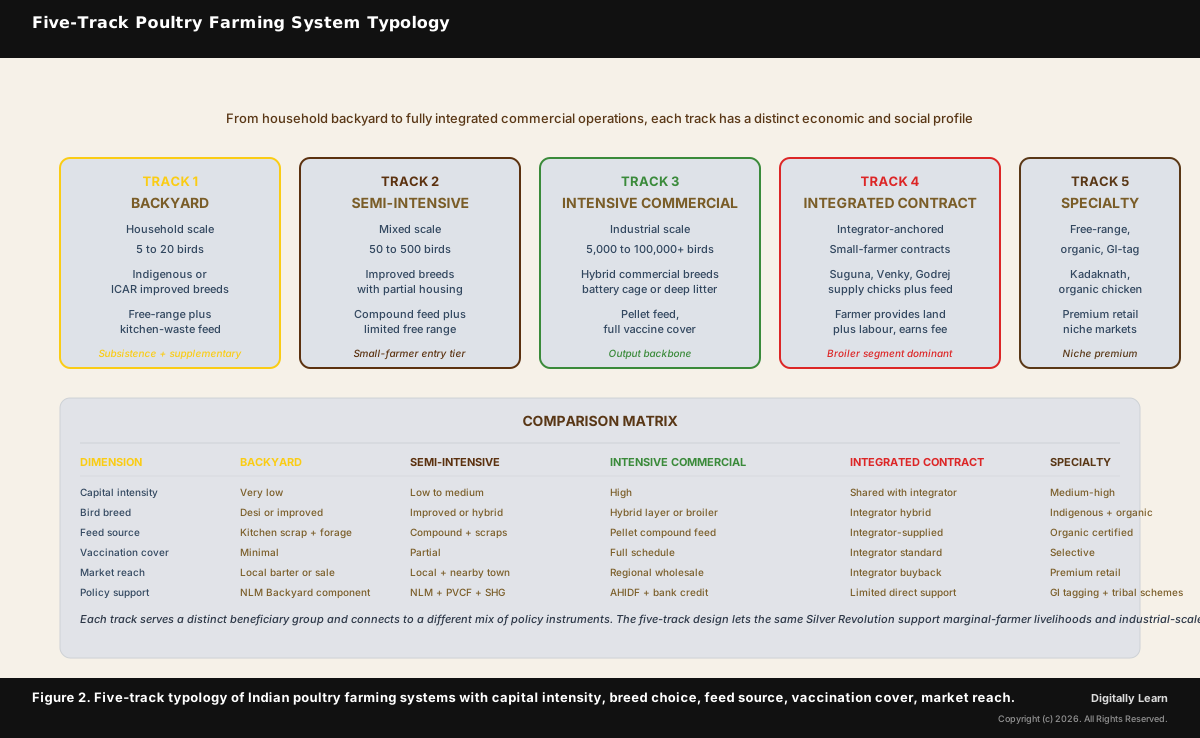
- Track 1 – Backyard: Household-scale activity with 5 to 20 indigenous or ICAR-improved birds, kitchen-waste plus forage feed, minimal vaccination, local barter or sale. Supports rural subsistence and supplementary income, particularly women-led.
- Track 2 – Semi-intensive: Mixed-scale entry tier with 50 to 500 improved-breed birds, partial housing, compound feed mixed with scraps. Local plus nearby-town market reach. Small-farmer commercial entry track.
- Track 3 – Intensive commercial: Industrial layer or broiler operations at 5,000 to over 100,000 birds, hybrid breeds, full vaccine cover, pellet feed, battery-cage or deep-litter housing. The output backbone of the modern industry.
- Track 4 – Integrated contract: Integrator-anchored model where Suguna, Venky, or Godrej Agrovet supply chicks, feed, and veterinary services to small farmers who provide land and labour. Broiler segment dominant.
- Track 5 – Specialty: Free-range, organic, and Geographical-Indication-tagged operations including Kadaknath. Premium retail and tribal-region niche markets.
National Livestock Mission: The Apex Scheme
Four Sub-Missions Covering the Livestock Sector
The National Livestock Mission is the apex central scheme covering poultry, sheep and goat, piggery, and feed-fodder. It was launched in 2014-15 under the Ministry of Fisheries, Animal Husbandry and Dairying, and was restructured in 2021-22 with a sharper focus on entrepreneurship and small-scale commercial entry.
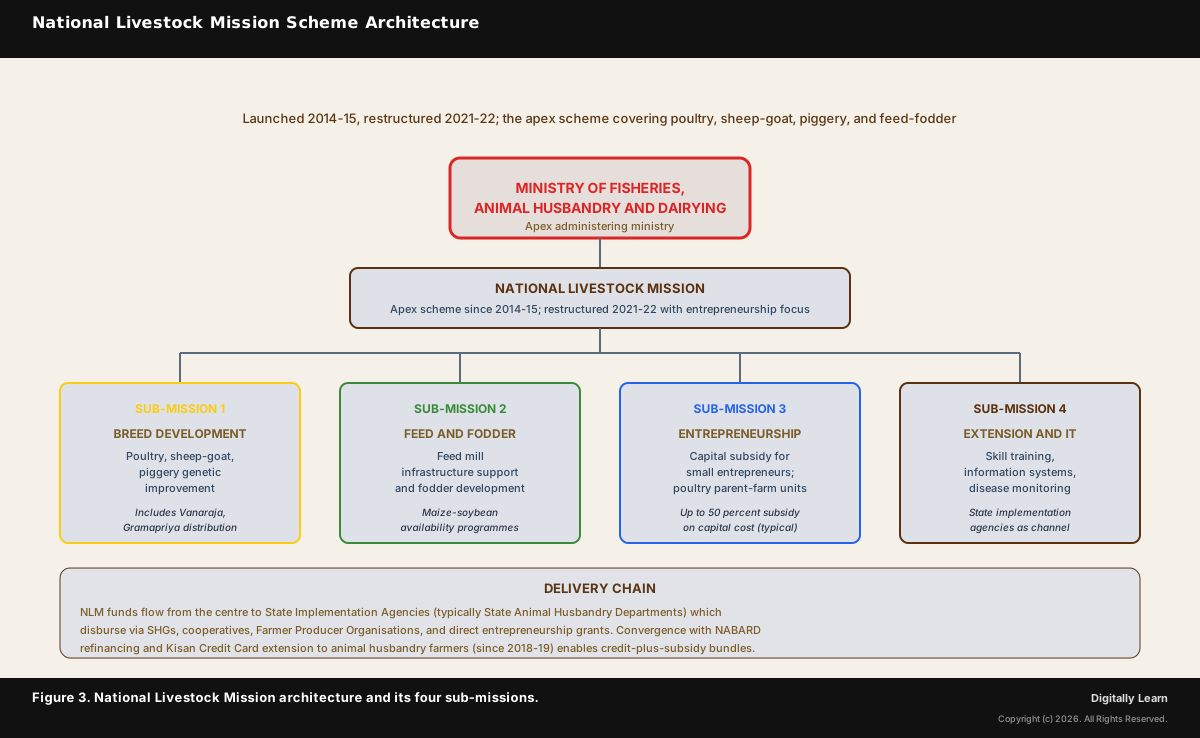
- Sub-Mission 1 – Breed Development: Poultry, sheep-goat, piggery genetic improvement; ICAR-developed Vanaraja and Gramapriya distribution to backyard households; central poultry development farm support.
- Sub-Mission 2 – Feed and Fodder: Feed mill infrastructure support, fodder development programmes, maize-soybean availability schemes that support the commercial-feed value chain.
- Sub-Mission 3 – Entrepreneurship: Capital subsidy for small entrepreneurs entering poultry, sheep-goat, piggery, or feed mill operations. The post-2021 restructuring emphasised this sub-mission.
- Sub-Mission 4 – Extension and Information Technology: Skill training, livestock information systems, disease monitoring and surveillance through state implementation agencies.
- Delivery chain: NLM funds flow from the centre to State Implementation Agencies (typically State Animal Husbandry Departments) which disburse via Self-Help Groups, cooperatives, Farmer Producer Organisations, and direct entrepreneurship grants.
Distinguishing Features of Other Policy Instruments
Three Complementary Funds and Refinancing Channels
Beyond the apex National Livestock Mission, three further instruments target different segments of the farming-system typology. Together they form a complete coverage from backyard households to industrial integrator scale.
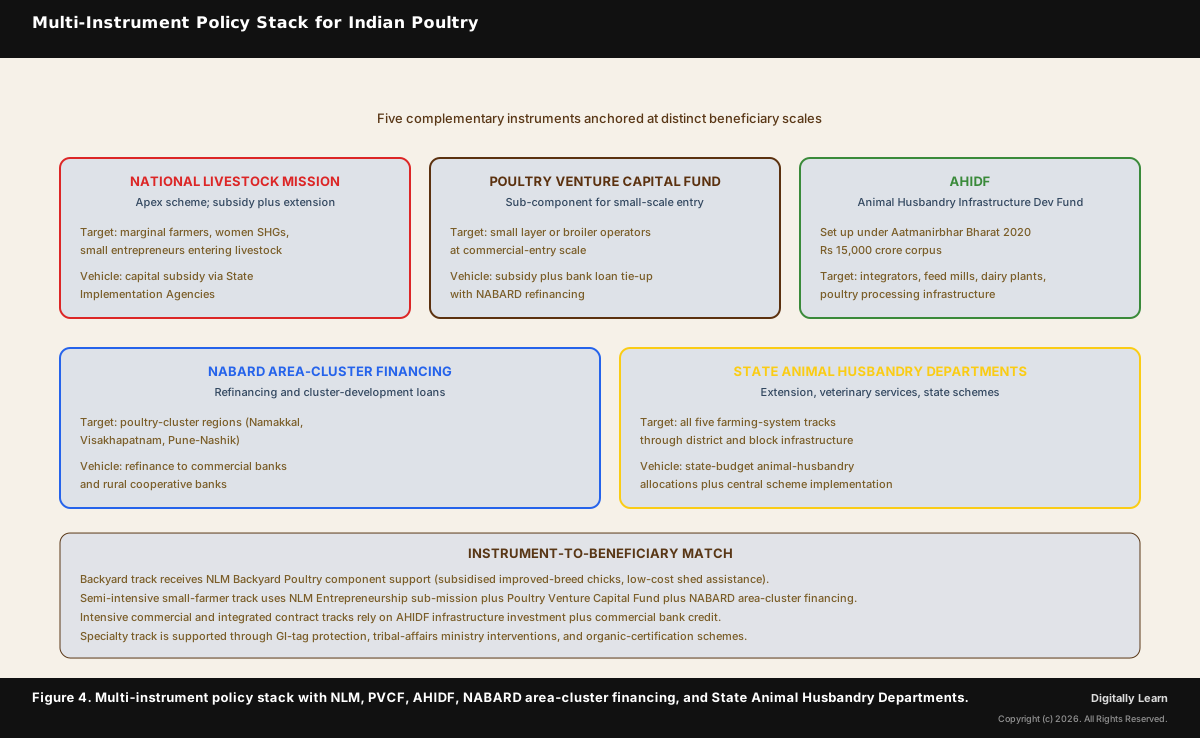
- Feature (i): Poultry Venture Capital Fund. A sub-component focused on small-scale commercial entry (semi-intensive Track 2 and small-end Track 3). Subsidy paired with bank loan tie-up and NABARD refinancing. Designed to bridge the household-to-commercial transition.
- Feature (ii): Animal Husbandry Infrastructure Development Fund (AHIDF). Set up under Aatmanirbhar Bharat in 2020 with a corpus of approximately Rs 15,000 crore. Targets integrators, feed mills, dairy plants, and poultry processing infrastructure. Concessional interest rates plus interest subvention from the central government.
- Feature (iii): NABARD area-cluster financing. Refinancing and cluster-development loans channelled through commercial banks and rural cooperative banks. Targets poultry-cluster regions such as Namakkal in Tamil Nadu, Visakhapatnam and Krishna belt in Andhra Pradesh, and Pune-Nashik in Maharashtra. Builds the infrastructure backbone of the commercial tracks.
State Animal Husbandry Departments and Veterinary Extension
The Last-Mile Delivery Layer
State Animal Husbandry Departments are the operational backbone of the entire framework. They implement central schemes, deliver veterinary services, run state-level animal-husbandry budgets, and connect the policy stack to the actual farmer.
- Veterinary extension: District veterinary hospitals, block-level veterinary dispensaries, and mobile veterinary units delivered through the state department network. The basic unit of disease prevention and animal-health response.
- State-implementation channel for central schemes: NLM funds, AHIDF concessional loans, and Poultry Venture Capital Fund subsidies are all routed through state implementation agencies that are typically the state Animal Husbandry Department.
- State-level animal-husbandry schemes: Tamil Nadu, Karnataka, Andhra Pradesh, Telangana, and Maharashtra run their own animal-husbandry budgets that supplement central schemes with state-specific targets including poultry-cluster development.
- Disease surveillance: State departments operate the front-line surveillance for Avian Influenza, Newcastle disease, and other notifiable poultry diseases. Co-ordination with central Department of Animal Husbandry and Dairying for outbreak response is anchored at this layer.
Observable Outcomes of the Framework
What the Policy Stack Has Delivered
The layered framework has delivered three first-order outcomes that shape the contemporary structure of Indian poultry.
- Outcome (a): backyard-track preservation alongside commercial scale-up. NLM Backyard Poultry plus ICAR Vanaraja and Gramapriya distribution kept the rural household track viable through the commercial scale-up of Tracks 3 and 4. The dual-track architecture is a direct policy outcome.
- Outcome (b): integrator-led commercial expansion. AHIDF concessional financing plus NABARD refinancing enabled the integrator-led broiler model (Suguna, Venky, Godrej) to expand contract-farming networks across the South India belt and into Maharashtra, Punjab, Haryana.
- Outcome (c): credit access widened. The 2018-19 extension of Kisan Credit Card to animal husbandry farmers including poultry brought formal short-term credit within reach of small commercial operators for working capital, post-harvest expenses, and consumption requirements.
Policy Convergence and Farmer Producer Organisations
How Multiple Schemes Combine in Practice
Indian agricultural policy increasingly converges multiple schemes for the same beneficiary cluster. Poultry is a useful illustration because it sits at the intersection of allied agriculture, rural livelihoods, nutritional security, and infrastructure investment.
| Beneficiary scale | Primary scheme | Secondary scheme | Refinancing or credit |
|---|---|---|---|
| Backyard household | NLM Backyard Poultry component | State AH Department programmes | Self-Help Group rotational fund |
| Small farmer semi-intensive entry | NLM Entrepreneurship sub-mission | Poultry Venture Capital Fund | NABARD-refinanced bank loan, KCC |
| Intensive commercial layer | AHIDF concessional loan | State AH Department subsidy | Commercial bank credit, KCC for working capital |
| Integrated contract broiler | AHIDF for integrator infrastructure | Contract farming Model Act framework | Commercial bank credit chain |
| Specialty GI-tagged | Tribal Affairs ministry schemes | GI registration, organic certification | Bank loans for specialty units |
Farmer Producer Organisations (FPOs) are a contemporary aggregation vehicle that bridges the policy stack with small-farmer beneficiaries. SFAC and NABARD support FPOs that include poultry-producer cooperatives, enabling bulk feed purchases, shared veterinary services, and collective egg sales at NECC benchmark prices.
Contemporary Linkages and UPSC Relevance
Framework Themes in the Examinations
The farming-system and government-framework material connects to four contemporary General Studies themes: Kisan Credit Card scope, Integrated Farming System sustainability, rural cooperative credit, and Farmer Producer Organisation aggregation.
- Kisan Credit Card scope and short-term credit: Recent Prelims questions test the specific purposes for which farmers can use KCC short-term credit. The 2018-19 extension to animal husbandry including poultry brought working-capital and post-harvest-expense coverage into the Silver Revolution farming-system stack.
- Integrated Farming System sustainability: Recent Mains questions on IFS sustaining agricultural production map directly to the Track 4 integrated and multi-enterprise farming systems in this framework. Poultry is one of the canonical enterprises that combines with crops, dairy, or fisheries in IFS designs.
- Rural cooperative credit: Classical Mains questions on cooperative-society credit and rural agricultural finance connect to the NABARD refinancing chain and the rural cooperative bank distribution channel for Poultry Venture Capital Fund and NLM disbursements.
- Farmer Producer Organisations: The contemporary FPO scheme architecture, supported through SFAC and NABARD, includes poultry producer cooperatives as a recognised vehicle. The aggregation model bridges household-track farmers with commercial-scale benefits.
Previous Year UPSC-CSE Questions
Previous Year Questions By the end of this article you will be able to draft model answers for the following UPSC questions. Each question carries a collapsible framework showing how to approach it in the exam.
- UPSC Prelims 2020: Under the Kisan Credit Card scheme, short-term credit support is given to farmers for which of the following purposes?
- Working capital for maintenance of farm assets
- Purchase of combine harvesters, tractors and mini trucks
- Consumption requirements of farm households
- Post-harvest expenses
- Construction of family house and setting up of village cold storage facility Select the correct answer using the code given below:
How to approach this Prelims question
Approach: Test each statement against the actual short-term credit purposes covered by Kisan Credit Card. KCC short-term credit covers working capital for crop production and allied activities, household consumption needs, and post-harvest expenses. It does NOT cover purchase of farm machinery (which is term loan) or house construction (which is housing loan, not KCC).
Trap to watch: Statements 2 (machinery purchase) and 5 (house construction plus cold storage) are NOT KCC short-term credit purposes. Machinery is funded through term loans separately; house construction is rural housing loans. Cold storage is infrastructure investment, also not short-term KCC.
Key facts to recall:
- KCC short-term credit covers working capital, consumption, post-harvest expenses
- Term loans for machinery are separate from KCC short-term credit
- KCC extended to animal husbandry farmers including poultry in 2018-19
- Per corpus key, option B (1, 3 and 4 only) is correct
Answer signal: Option B: 1, 3 and 4 only
- UPSC Mains 2019 GS-IIIHow far is Integrated Farming System (IFS) helpful in sustaining agricultural production?
How to structure the answer in the exam
Introduction: Define Integrated Farming System as a multi-enterprise approach where crop cultivation combines with poultry, dairy, fisheries, or apiculture so that one enterprise's output serves as another's input, reducing external dependence and improving farm-level resilience.
Body (sub-themes to develop):
- Sustaining production mechanisms: nutrient recycling via poultry manure as crop fertiliser; crop residue as poultry feed; biogas from animal waste as farm energy; fish pond receives livestock waste nutrients.
- Income stability: diversified output buffers commodity-price shocks; quick-return poultry (42-day broiler cycle) smooths cash flow; long-cycle layer income (80 weeks) anchors steady revenue.
- Soil and ecological sustainability: integrated systems reduce chemical fertiliser dependence; mixed enterprises support biodiversity; reduce monoculture vulnerability.
- Limitations: technical complexity rising with enterprise count; biosecurity risk when animals share farm space; small holdings constrain enterprise scale; market access concentrated in metro corridors.
Conclusion: IFS sustains agricultural production through nutrient cycling, income diversification, and ecological resilience. The Silver Revolution's farming-system typology, particularly Tracks 1 and 4, demonstrates the poultry-anchored IFS model. Sustained policy support through NLM, NABARD, and ICAR extension is essential to scale the approach for small and marginal farmers.
Sources
- Wikipedia: Poultry farming in India
- Department of Animal Husbandry and Dairying – National Livestock Mission scheme notifications
- Ministry of Fisheries Animal Husbandry and Dairying – Apex portal
- Press Information Bureau – Aatmanirbhar Bharat AHIDF cabinet approval
- NABARD – Poultry Venture Capital Fund Guidelines
- ICAR – Directorate of Poultry Research Hyderabad
- Reserve Bank of India – Kisan Credit Card Master Circular
- Ministry of Agriculture and Farmers Welfare – Farmer Producer Organisations Policy
- India.gov.in – Animal Husbandry Infrastructure Development Fund portal
- FAO – India Poultry Sector Profile
Editorial Disclaimer
This article is compiled from the reference materials listed in the Sources section. It is an explainer for UPSC preparation and is not a substitute for primary documents (NCERTs, GoI ministry releases, IMD bulletins, RBI / CEA / MoEFCC publications, and Standing-Committee reports).