


Overview
The problems of poultry farming in India are the costs and risks that squeeze the farmer who raises chickens: dear maize feed, swings in egg and broiler prices, disease and antibiotic misuse, dependence on one company's contract, thin access to credit and land, and production concentrated in a few southern states.
Problems of Poultry Farming in India: An Overview
Challenges of Poultry Farming at a Glance
India produced 149.11 billion eggs and 5.18 million tonnes of poultry meat in 2024-25, and the industry has grown by 7 to 10 per cent a year. Growth on this scale hides real strain on the farmer who raises the birds. The challenges of poultry farming fall into six groups, and each is explained below.
- Feed: Feed grain is the input the farmer buys for every batch, and its price follows the maize market.
- Prices and marketing: Egg and broiler prices rise and fall, and much chicken is still sold as live birds.
- Disease and antibiotics: An outbreak of bird flu can kill a flock and close markets; misuse of antibiotics breeds resistance.
- Contract terms: Small farmers who rear birds for a company depend on one buyer.
- Credit, land and recognition: Small and tenant farmers, and many women, find formal credit hard to reach.
- Regional gaps: A few states produce far more eggs per person than the rest of the country.
How the industry is organised, and why private companies rather than cooperatives built it, is explained in the poultry industry in India. This page looks at the same industry from the side of its problems and the measures that answer them.
Poultry Feed Cost: Maize, Soybean and the Ethanol Squeeze
Why Poultry Feed Cost Decides the Farmer's Margin
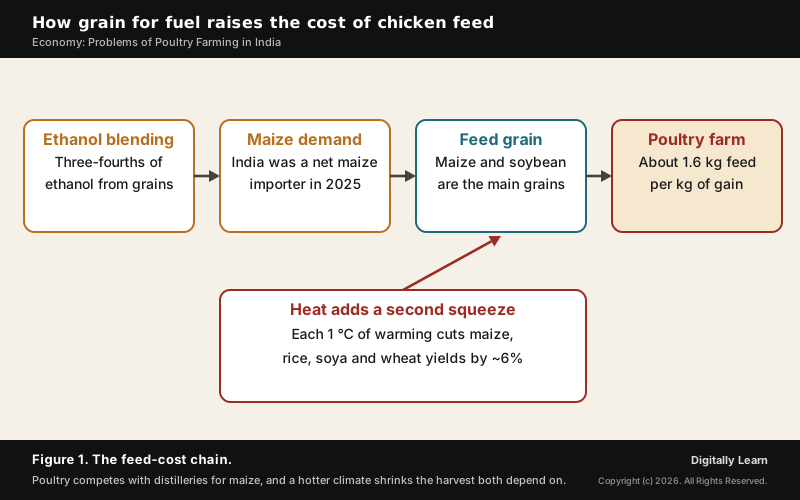
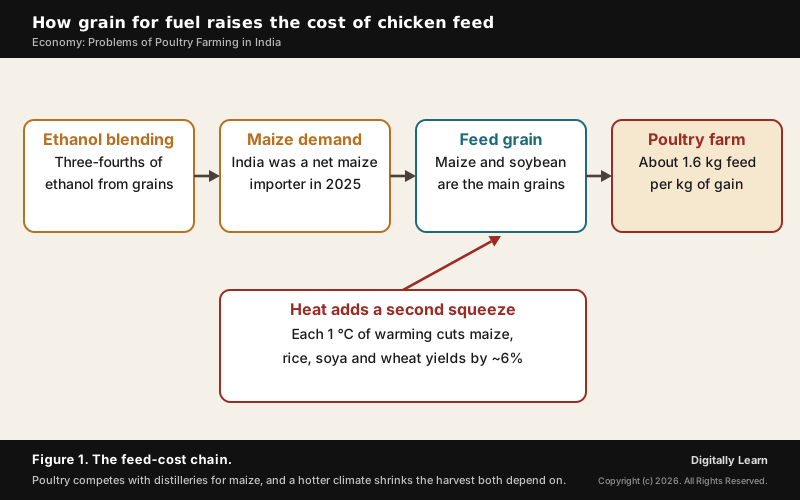
Poultry feed cost weighs on every batch a farmer raises, because a modern bird turns grain into meat and eggs at speed. A broiler reaches slaughter weight at four to six weeks of age and needs about 1.6 kg of feed for every kilogram of weight it gains. The feed conversion ratio (FCR) measures exactly this: kilograms of feed eaten per kilogram of weight gained, so a lower ratio means a more efficient bird.
The two most important feed grains are maize and soybean, and a commercial farm buys them as ready feed for every batch. A farmer can improve the conversion ratio through better birds, sheds and health care, but cannot control the price of maize. When maize becomes dear, the cost of every egg and every kilogram of chicken rises with it, while the selling price may not.
Ethanol Blending and Heat: Two Pressures on Maize
India's ethanol blending programme has turned maize into a fuel crop as well as a feed crop. E20 petrol, 20 per cent ethanol and 80 per cent petrol, went on sale on 6 February 2023. In August 2026 the government said that nearly three-fourths of the ethanol produced in India now comes from grains, and maize has taken a major share of the feedstock in place of sugarcane. Maize export earnings fell, and India was a net importer of maize in 2025.
Poultry farmers therefore compete with distilleries for the same grain. The diversion of food grains for fuel also has implications for food security, a point made in the debate over E20. A second pressure comes from climate: every one-degree rise in average global temperature cuts yields of maize, rice, soya and wheat by around 6 per cent.
Price Swings and Marketing Problems in Poultry Farming
Egg and Broiler Prices, Exports and Trade Pressures
Eggs and broilers are sold under different pressures. A broiler must be sold when it reaches slaughter weight, so the farmer cannot wait for a better price; eggs keep for a while and move between production centres. In the early 1980s egg prices fell below the cost of production, and farmers formed the National Egg Coordination Committee, which since 1982 has published daily and monthly egg prices that serve as indicative prices.
Prices also swing at the consumer's end. In July 2026 meat and eggs were among the items with double-digit inflation in the consumer price index. In September 2026 the cost of a home-cooked non-vegetarian thali rose 6 per cent over a year, less than the vegetarian thali, because broiler prices increased more slowly. A rising retail price does not mean the farmer earns more: when feed costs rise faster than the farm-gate price, the farmer's margin shrinks.
Exports offer a way out of a crowded home market, but they have been slow. India's exports of eggs and egg products stayed at ₹1,308 crore in 2024-25, a sign of stagnation, while buffalo meat remained the single largest livestock export. Trade can also bring competition. In June 2026 farm unions and poultry traders asked the government to stop free trade talks with the United States, arguing that subsidised American produce would destroy domestic producers. Exports from disease-free compartments, and the way bird flu shuts foreign markets, are explained in the poultry industry in India.
Transport and Marketing Constraints: Live Birds and the Cold Chain
Much of India's chicken still reaches the buyer as a live bird, and the shift from live birds to chilled and frozen chicken is one of the keys to the industry's future growth. A market that gathers live birds from many farms also gathers their diseases: viruses of avian influenza have been detected in backyard and commercial poultry and in live bird markets, and the movement of live birds may bring Ranikhet disease into a new area.
- Perishability: Chilled or frozen chicken needs refrigeration from processing plant to shop, and the informal food trade still has gaps in sanitation, refrigeration and enforcement.
- Movement restrictions: During a bird flu outbreak, infected and nearby birds are culled and movement is restricted, so sales stop.
- Market infrastructure: Delhi’s Ghazipur poultry market, being built at ₹193.29 crore, will have shops for 100 wholesale traders and 120 processing units.
Disease, Antibiotics and Food Safety in Poultry Farming
Disadvantages of Poultry Farming: Disease Losses and Antibiotic Misuse
Disease can wipe out a poultry business quickly. Highly pathogenic avian influenza can kill up to 100 per cent of a flock, and every outbreak brings lower production, more deaths and the cost of control. How bird flu, Ranikhet disease and the other poultry diseases spread, and how farms keep them out, is explained in poultry diseases and bird flu in India.
Antibiotics are the second health problem. They are sometimes mixed into livestock and poultry feed to check infection and to speed growth, although they are meant to treat disease, not to prevent it. Overuse in agriculture, as in medicine, drives antimicrobial resistance, the ability of microbes to survive the drugs meant to kill them. India launched the second National Action Plan on Antimicrobial Resistance, for 2025-29, in November 2025.
Food safety joins the two. Non-typhoidal Salmonella, which causes gastroenteritis, is often linked to poultry, eggs and other animal foods, and resistance to antibiotics is making serious infections harder to treat. Contamination can occur at many points from farm to plate, which is why cooking poultry and eggs thoroughly and keeping raw meat apart from cooked food matter. How residues travel from feed to manure to soil is explained in poultry manure and sustainable poultry farming.
Small Poultry Farmers: Contract Terms, Land and Credit
Is Poultry Farming Profitable in India? Contract Farming and Its Terms
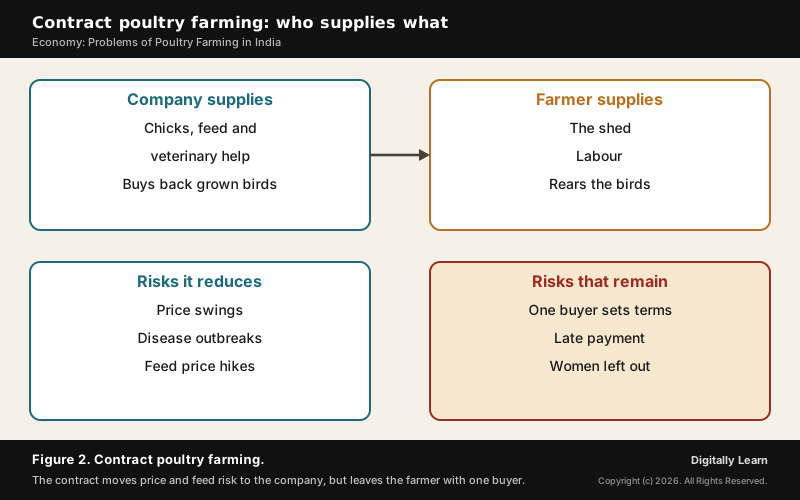
Contract farming is widespread in Indian poultry. Under contract farming a company supplies chicks, feed and veterinary help, the farmer supplies the shed and labour, and the company buys back the grown birds. The arrangement offers the farmer an assured market and production support, and it can reduce the risk from disease or weather.
Is poultry farming profitable in India? It can be, but the profit depends on three things the farmer does not control: the price of feed grain, disease and the selling price. Contract farming shifts much of this risk to the company. A 2023 study by the Asian Development Bank found that contract poultry farming boosted the livelihoods of small farmers producing for one of India's largest poultry companies, and reduced their exposure to price swings, disease outbreaks and feed price hikes.
- One buyer: A company sometimes fails to buy at the agreed price or quantity, or downgrades the produce.
- Late payment: Delays in payment break the farmer’s trust in the company.
- Women left out: Contracts are often in the man’s name, he receives the payment, and women who do the work get no training.
- No legal cover: A central law on contract farming, the Farmers (Empowerment and Protection) Agreement on Price Assurance and Farm Services Act, 2020, was repealed by Parliament on 29 November 2021.
Small Land Holdings and the Model Land Leasing Act
Most Indian farms are small: about 86 per cent of landholdings are under two hectares, and the average holding is about 1.1 hectares. A poultry shed needs little land, which is why poultry suits small farmers. But a farmer who rents land informally has no record of tenancy, and such informal tenants have no access to institutional credit, insurance and other support services.
An expert committee of NITI Aayog, under T. Haque, drafted the Model Agricultural Land Leasing Act in 2016. It proposes to legalise leasing so that landowners keep their ownership and tenants gain security for the agreed lease period, to let the two sides fix the terms themselves, and to give all tenants, including sharecroppers, access to insurance and bank credit. Land is a state subject, so each state decides whether to adopt it.
Credit for Poultry Farmers: Kisan Credit Card and Subsidies
The Kisan Credit Card (KCC) scheme, introduced in August 1998 on a model prepared by NABARD, was extended to animal husbandry and fisheries by 2019. Under the Reserve Bank of India's directions of 2026, which apply to loans sanctioned from 1 January 2027, a KCC is a composite facility with a tenure of six years, and rearing poultry birds is named among the allied activities it finances.
| Short-term credit (one limit) | Long-term investment credit |
|---|---|
| Crop cultivation and allied activities such as poultry | Land development and minor irrigation |
| Post-harvest or post-production expenses | Purchase of farm equipment |
| Consumption requirements of the farmer household | Construction of an animal or bird shed |
| Maintenance of farm and allied assets; insurance; marketing loans | Purchase of livestock |
The National Livestock Mission adds a one-time capital subsidy of 50 per cent, up to ₹25 lakh, for a rural poultry unit of low input technology birds. Recognition is the remaining gap. Since land ownership is often a condition for scheme benefits, women in livestock rearing and poultry farming are often not recognised as farmers, and Maharashtra's 2026 bill on women farmers was drafted to change that.
Regional Disparities in Poultry Farming in India
Eggs per Person by State: The South and the Rest
Poultry farming in India is concentrated in a few states. Andhra Pradesh, Tamil Nadu and Telangana together lay almost half of India's eggs, 46.98 per cent, and ten states hold about 78 per cent of all poultry birds. The clearest way to see the gap is to divide each state's egg output by its population.
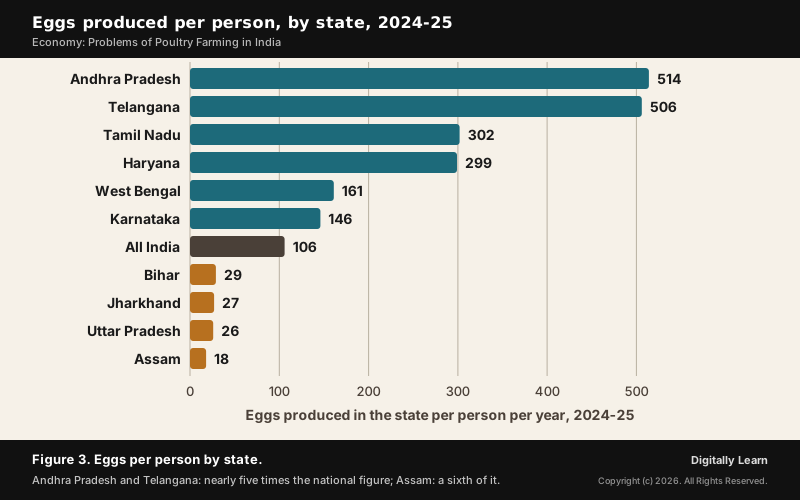
In 2024-25 Andhra Pradesh produced 514 eggs per person and Telangana 506, nearly five times the national figure of 106. Bihar produced 29, Uttar Pradesh 26 and Assam 18. These figures measure what each state produces, not what its people eat. A state low on the list may still have eggs on the table, but it has far less of the poultry farming that gives rural households work and income.
Measures to Solve the Problems of Poultry Farming
Policy Measures for Feed, Markets, Health and Small Farmers
The measures follow the problems one by one. None of them is new; what is missing is reach, so that a small farmer in Bihar has the same access as an integrator's contract grower in Andhra Pradesh.
- For feed, more maize and soybean output, and a watch on how much grain goes into ethanol, so that poultry and distilleries do not bid against each other.
- For markets, modern poultry markets with processing units, and cold chains, so that more chicken can be sold chilled rather than live.
- For health, the Poultry Disease Action Plan of 2024 asks for standard vaccination schedules, guidelines for responsible antibiotic use, rapid response to outbreaks, and biosecurity on every farm.
- For small farmers, clear contract terms with timely payment, legal leasing of land, Kisan Credit Cards for poultry, and recognition of women poultry farmers.
- For lagging regions, subsidised rural poultry units under the National Livestock Mission in states that produce few eggs.
Previous Year UPSC-CSE Questions
Previous Year UPSC-CSE Questions By the end you will be able to draft model answers for the following UPSC questions. Each question carries a collapsible framework showing how to approach it in the exam.
- UPSC Mains 2015 GS-IIILivestock rearing has a big potential for providing non-farm employment and income in rural areas. Discuss suggesting suitable measures to promote this sector in India.
Answer outline: how to structure the answer
What the question asks, the main arguments, relevant examples and the direction of the conclusion. This is not a full model answer.
Introduction: India produced 149.11 billion eggs and 5.18 million tonnes of poultry meat in 2024-25, and a poultry shed needs little land, which suits small and landless rural households.
Body (sub-themes to develop):
- Potential: little land needed, quick cycles (broilers sold at four to six weeks), contract farming gives inputs and a sure buyer.
- Constraints: feed grain cost as maize goes to ethanol, price swings, disease losses, one-buyer contracts, credit and tenancy gaps, women not recognised as farmers, regional concentration in the south.
- Measures on inputs and health: feed grain supply, vaccination schedules, responsible antibiotic use, biosecurity under the Poultry Disease Action Plan.
- Measures on markets and finance: modern markets and cold chains, Kisan Credit Card for poultry, National Livestock Mission subsidy, legal land leasing, fair contract terms.
- Measures on equity: rural poultry units in lagging states, recognition and training of women.
Conclusion: Conclude that livestock can absorb rural labour if small producers get inputs, credit, markets and protection from price and disease shocks.
- UPSC Mains 2020 GS-IIIWhat are the main constraints in transport and marketing of agricultural produce in India?
Answer outline: how to structure the answer
What the question asks, the main arguments, relevant examples and the direction of the conclusion. This is not a full model answer.
Introduction: Farm produce loses value between field and buyer when transport, storage and markets are weak, and perishable produce such as poultry shows this most sharply.
Body (sub-themes to develop):
- Transport: perishable produce, small loads, losses on the way; live birds lose weight and spread disease.
- Storage and cold chain: little refrigeration from processor to shop; gaps in the informal food trade.
- Market structure: few modern markets; much poultry still traded as live birds.
- Price risk: swings that the farm-gate price absorbs; indicative prices only where producers organise, as with the NECC for eggs.
- Shocks: movement controls during disease outbreaks halt sales.
Conclusion: Conclude with cold chains, modern markets with processing, producer organisations and price information as the reforms that answer these constraints.
- UPSC Prelims 2020 Prelims-GSUnder the Kisan Credit Card scheme, short-term credit support is given to farmers for which of the following purposes?
- 1. Working capital for maintenance of farm assets
- 2. Purchase of combine harvesters, tractors and mini trucks
- 3. Consumption requirements of farm households
- 4. Post-harvest expenses
- 5. Construction of family house and setting up of village cold storage facility
Select the correct answer using the code given below:
How to approach this Prelims question
Approach: Step 1: Under the KCC, the short-term limit covers cultivation and allied activities, post-harvest expenses, household consumption, maintenance of farm assets, insurance and marketing loans. Step 2: machinery and buildings are long-term investment credit. Step 3: so 1, 3 and 4 are short-term purposes; 2 is investment credit; 5 is not a short-term KCC purpose. Answer (b).
Trap to watch: Every item in the list is something a farmer might borrow for, and some can be financed under a KCC as investment credit. The question asks only about short-term credit support.
Key facts to recall:
- (a) 1, 2 and 5 only: wrong. Tractors and harvesters (2) are investment credit, and a house and cold storage (5) are not short-term purposes; it also leaves out 3 and 4.
- (b) 1, 3 and 4 only: right. Maintenance of farm assets, household consumption and post-harvest expenses are short-term KCC purposes.
- (c) 2, 3, 4 and 5 only: wrong. It includes 2 and 5 and leaves out 1.
- (d) 1, 2, 3, 4 and 5: wrong. Statements 2 and 5 are not short-term purposes.
Answer signal: Option (b): the short-term KCC limit covers working capital for farm assets, household consumption and post-harvest expenses; machinery is investment credit.
Sources
- Department of Animal Husbandry and Dairying: Basic Animal Husbandry Statistics 2025
- Department of Animal Husbandry and Dairying: Poultry Disease Action Plan 2024
- Department of Animal Husbandry and Dairying: National Livestock Mission guidelines
- Reserve Bank of India: Kisan Credit Card (KCC) Scheme Directions, 2026
- NITI Aayog: Report of the Expert Committee and Model Law on Agricultural Land Leasing
- All India Radio News: National Action Plan on Antimicrobial Resistance 2.0 launched
- APEDA: Poultry Products
- NCERT: Science, Class VIII, Chapter 2, Microorganisms: Friend and Foe
- Wikipedia: Compound feed
- Wikipedia: Feed conversion ratio
- Wikipedia: Broiler
- Wikipedia: National Egg Coordination Committee
- Wikipedia: Contract farming
- Wikipedia: 2020 Indian agriculture acts
- Wikipedia: Kisan Credit Card
- Wikipedia: Agriculture in India
- Wikipedia: Antimicrobial resistance
- Wikipedia: Avian influenza
- Wikipedia: Poultry farming in India
- The Hindu (Delhi), 23 April 2026: FAO and WMO report on extreme heat and farming
- The Hindu (Delhi), 13 June 2026: Maharashtra to bring a law recognising women farmers
- The Hindu (Delhi), 23 June 2026: Unions write to PM against free trade pact with U.S.
- The Hindu (Delhi), 4 August 2026: Delhi reviews mandi projects including the Ghazipur poultry market
- The Hindu (Delhi), 22 August 2026: Sugar price hike, Centre says ethanol not to blame
- The Hindu (Delhi), 26 August 2026: Retail inflation in July
- The Hindu (Delhi), 28 August 2026: Salmonella infections and antibiotic resistance
- The Hindu (Delhi), 9 September 2026: Sugar prices and ethanol diversion
- The Hindu (Delhi), 17 September 2026: What lies beyond India's E20 push
- The Hindu (Delhi), 9 October 2026: Cost of home-cooked thali in September
- UPSC: Civil Services Examination question papers
Editorial Disclaimer
This article draws on official statistics and the other sources listed on this page.