Overview

Previous Year Questions By the end of this article you will be able to draft model answers for the following UPSC questions. Each question carries a collapsible framework showing how to approach it in the exam.

  1. UPSC Prelims 2011: At present, scientists can determine the arrangement or relative positions of genes or DNA sequences on a chromosome. How does this knowledge benefit us?
    1. It is possible to know the pedigree of livestock.
    2. It is possible to understand the causes of all human diseases.
    3. It is possible to develop disease-resistant animal breeds.

    Which of the statements given above is/are correct?

    1. 1 and 2 only
    2. 2 only
    3. 1 and 3 only
    4. 1, 2 and 3
    How to approach this Prelims question

    Question type: Multi-statement application of biotechnology

    Approach: Test each statement against what genome arrangement knowledge actually enables. Statement 1 (livestock pedigree) and Statement 3 (disease-resistant breeds) are well-established applications; Statement 2 overreaches by claiming ALL human diseases can be understood from this knowledge alone.

    Trap to watch: Statement 2 uses the absolute 'causes of all human diseases', which is an overreach. Many diseases have complex multifactorial causes (environmental, lifestyle, infectious) that genome data alone cannot explain.

    Key facts to recall:

    • Genomic data enables pedigree verification in livestock (Statement 1 correct)
    • Marker-assisted selection enables disease-resistant breed development (Statement 3 correct)
    • Genome data alone cannot explain all human diseases (Statement 2 incorrect)
    • Indian poultry industry traces all commercial hybrids to four global pedigree-line breeders

    Answer signal: Option C: 1 and 3 only

  2. UPSC Mains 2022 GS-III: What is Integrated Farming System ? How is it helpful to small and marginal farmers in India ?
    How to structure the answer in the exam

    Directive verb: Define and discuss · Approach: Define IFS; explain mechanism; identify benefits for small and marginal farmers with poultry-anchored examples. · Word count: 250

    Introduction: Define Integrated Farming System as a multi-enterprise farm-management model that combines crop cultivation with allied activities such as poultry, dairy, fisheries, horticulture, and apiculture on the same small holding. The output of one enterprise serves as input to another, reducing external dependence and waste.

    Body (sub-themes to develop):

    • Mechanism: poultry droppings as biofertiliser for crops; crop residue as poultry feed input; biogas from poultry waste for household energy; fish ponds receive poultry waste nutrients.
    • Benefits for small and marginal farmers: diversified income smooths seasonal cash flow; low marginal capital requirement for backyard poultry; quick return from 42-day broiler cycles; women participation in egg and milk activities; risk reduction across enterprises.
    • Policy support: National Livestock Mission backyard component; Poultry Venture Capital Fund for small-scale commercial entry; NABARD area-cluster financing; ICAR Krishi Vigyan Kendras extension support; state animal husbandry department schemes.
    • Limitations: requires technical skill across multiple enterprises; biosecurity risk when poultry and other animals share farm space; market access still concentrated in metropolitan corridors.

    Conclusion: Integrated Farming Systems anchored by poultry, dairy, or fisheries offer small and marginal farmers a resilience-plus-income model that single-enterprise farming cannot match. The Silver Revolution component breakdown into layer and broiler segments expands the menu of IFS-compatible poultry activities.

Two Parallel Industries Under One Pyramid

What the Component Breakdown Means

The Silver Revolution components are the two product-specific industries inside Indian poultry: the layer industry (raising egg-laying hens) and the broiler industry (raising meat chickens). The two industries use different hybrid breeds, different housing systems, different feed formulations, and different market chains, yet both depend on the same four-tier breeding pyramid running from pedigree-line elite stock through grandparent and parent multiplier flocks down to commercial birds.

Treating poultry as a single industry obscures the real economic structure. The layer business earns from a long-cycle bird that produces eggs for over a year; the broiler business earns from a forty-two-day cycle that converts feed to flesh with the highest feed-conversion efficiency in livestock agriculture. Policy, biosecurity, contract-farming arrangements, and the National Livestock Mission interventions all differ between the two segments. Anyone modelling Indian poultry must model both.

Four-tier poultry breeding pyramidThe Four-Tier Poultry Breeding PyramidEach tier multiplies bird numbers roughly hundred-fold to produce commercial flocksTIER 1: PEDIGREE LINEElite genetic stock; thousands of birds globallyPEDIGREE LINE FACTSGenetic selection over 50+ generationsHeld by global breeders: Cobb-Vantress, Aviagen, Hubbard, LohmannINDIAN ACCESSImported by integrator-licensees (Venky, Suguna)India holds no pedigree-line stock domesticallyTIER 2: GRANDPARENT STOCKMultiplier flock; tens of thousands of birds in IndiaGRANDPARENT ROLEFirst multiplication tier; produces parent stockOperated by large integrators under licence from global breedersCAPACITYLocated in Pune, Hyderabad, CoimbatoreHighest biosecurity protocols in the industryTIER 3: PARENT STOCKSecond multiplier; hundreds of thousands in IndiaProduces commercial day-old chicksPARENT FLOCKSecond multiplication; produces commercial chicks.Held in dedicated parent farms; sold as hatching eggs to hatcheries.DAY-OLD-CHICK MARKETHatcheries supply commercial farmersDay-old-chick price 20-35 rupees per bird typical rangeTIER 4: COMMERCIAL FLOCKHundreds of millions of birds across IndiaProduces commercial eggs (layers) or meat (broilers)LAYER COMMERCIAL~200 million laying hensin battery-cage and deep-litterhousing systemsBROILER COMMERCIALOver 2 billion broilers raisedper year for meat marketin 42-day cyclesTHE MULTIPLICATION MATHEach tier multiplies bird numbers approximately hundred-fold. One pedigree hen produces grandparent stock that, three generationslater, becomes hundreds of thousands of commercial birds. The pyramid is the genetic supply chain of the entire industry.India is a tier-2 country: it operates grandparent and parent multiplier flocks under licence, but the pedigree stock is held byfour global breeders (Cobb-Vantress, Aviagen, Hubbard, Lohmann). All Indian commercial birds trace back to these four lines.Copyright (c) 2026 Digitally Learn. All Rights Reserved.
Four-tier breeding pyramid. Each tier multiplies bird numbers approximately hundred-fold. India operates tiers 2 to 4 under licence from four global pedigree breeders (Cobb-Vantress, Aviagen, Hubbard, Lohmann). All commercial Indian birds trace back to these four lines.

The Layer Industry: Eighty-Week Productive Cycle

How Egg Production Actually Works

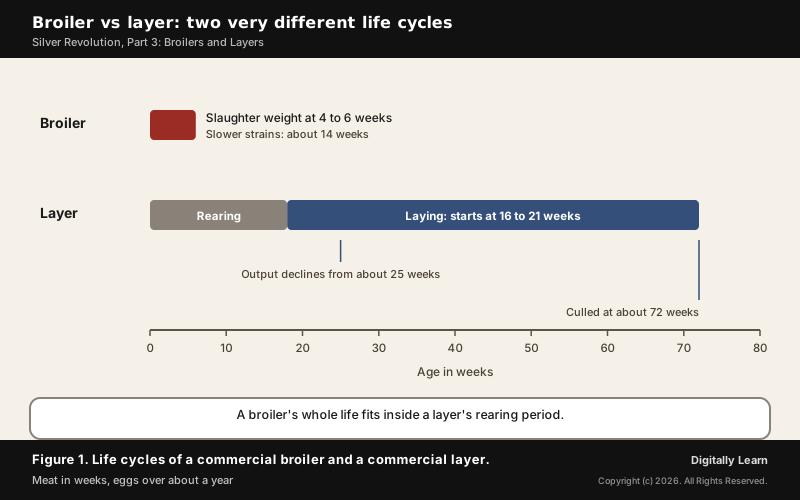
A commercial layer hen in India follows an eighty-week life cycle from day-old chick to spent-hen culling. The bird is reared as a pullet for 18 to 20 weeks, enters peak laying at week 22, sustains high productivity through week 72, and is then culled or sold as spent meat. The economics depend on hitting and holding the peak laying window.

  • Layer breeds in India: BV 300 (Venkateshwara Hatcheries hybrid, brown eggs), Hyline Brown (Hyline International USA), ILI 80 (ICAR-developed indigenous hybrid), Lohmann Brown (Lohmann Tierzucht Germany), and Babcock White (Hendrix Genetics, white-egg leghorn line) account for nearly all commercial layer stock.
  • Battery-cage housing: Approximately 200 million Indian layer hens are kept in battery cages per Wikipedia and DAHD figures. The cage system maximises space-use efficiency and simplifies egg collection, but is increasingly contested on welfare grounds.
  • Deep-litter alternative: A minority of commercial layers and most backyard birds use the deep-litter system on the floor of a covered shed. Productivity per bird is slightly lower but feed conversion and animal-welfare profiles differ.
  • Productive metrics: A peak commercial hen delivers 300 to 320 eggs per year. Feed conversion ratio (FCR) for layers is 2.0 to 2.2 kilograms of feed per kilogram of egg mass, with daily feed intake around 110 grams per bird.
  • NECC market structure: Eggs reach the market through the National Egg Coordination Committee daily-price-benchmark system, with wholesalers and retailers operating off the published rates. Part 1 of this series covers NECC in depth.

The Broiler Industry: Forty-Two-Day Conversion Cycle

Why Broilers Define Modern Industrial Poultry

The broiler chicken is the most efficient land-based protein-conversion system humans have engineered. A modern Cobb 500 or Vencob broiler reaches 1.8 to 2.0 kilograms live weight in 42 days on a feed-conversion ratio of 1.5 to 1.7 kilograms feed per kilogram body weight. No other commercial livestock approaches this conversion efficiency, which is why broilers are now the dominant meat-bird industry worldwide and the fastest-growing segment of Indian poultry.

  • Broiler breeds in India: Cobb 400 and Cobb 500 (Cobb-Vantress USA, global market leader), Vencob (Venkateshwara Hatcheries broiler line), Ross 308 (Aviagen Group UK), Hubbard (Hubbard SA France), and Krishibro (ICAR CARI Izatnagar indigenous broiler).
  • Cycle and growth: Day-old chick at 40 grams, brought to 1.8 to 2.0 kg in 42 days. Eight production cycles per shed per year typical, depending on cleanout and biosecurity downtime.
  • Housing: Deep-litter sheds with controlled ventilation. Modern integrator sheds add environmental control (cooling pads, exhaust fans) to maintain optimal temperature in the 22 to 28 degree Celsius range.
  • Feed-phase progression: Pre-starter (0-10 days), starter (11-21 days), grower (22-33 days), and finisher (34-42 days). Each phase has a distinct protein-energy formulation tuned to bird metabolic needs at that age.
  • Integrator-contract structure: Suguna, Venky and Godrej Agrovet dominate the broiler contract-farming model. The integrator supplies chicks, feed, medicines, and veterinary services; the farmer provides land, sheds, water, and labour. The farmer earns a per-kilogram growing fee.

Distinguishing Features Between Layer and Broiler

Why the Two Industries Diverge

The layer and broiler industries share the same breeding pyramid but diverge sharply at every operational dimension. Understanding the divergence is essential for both UPSC policy questions and any practical farming or investment decision.

Layer vs broiler comparisonLayer vs Broiler: Two Industries, One PyramidIndia runs both segments in parallel. The breeds, housing, feed, and market chains diverge sharply.LAYER INDUSTRYEggs as product; long-cycle birdPRODUCTTable eggs for retail and bulk marketBREEDSBV 300, Hyline Brown, ILI 80, Lohmann BrownPRODUCTIVE CYCLEPeak laying weeks 22 to 72; typically 80 weeksPEAK PRODUCTIVITY300 to 320 eggs per hen per yearHOUSINGBattery cage (predominant) or deep-litterFEEDLayer mash; ~110 grams per bird per dayFEED CONVERSION (FCR)2.0 to 2.2 kg feed per kg egg massMARKET STRUCTURENECC daily price benchmark; wholesaler retail chainNote: birds culled or sold as spent hens after 72-week peakBROILER INDUSTRYMeat as product; ultra-short cyclePRODUCTLive broilers for wet market; dressed for retailBREEDSCobb 400/500, Vencob, Hubbard, Ross 308PRODUCTIVE CYCLEDay-old-chick to slaughter in 42 daysPEAK LIVE WEIGHT1.8 to 2.0 kg at 42 days; 2.2-2.5 kg at 49 daysHOUSINGDeep-litter sheds with controlled ventilationFEEDPre-starter, starter, grower, finisher phasesFEED CONVERSION (FCR)1.5 to 1.7 kg feed per kg live weightMARKET STRUCTUREIntegrator-contract; wet-market live salesNote: typically eight production cycles per shed per yearCopyright (c) 2026 Digitally Learn. All Rights Reserved.
Layer vs broiler comparison across nine operational dimensions. The product, breed, cycle length, peak productivity metric, housing, feed formulation, feed-conversion ratio, market structure, and spent-bird treatment all diverge between the two segments.
  • Feature (i): product and revenue model. Layers sell table eggs through NECC-benchmarked wholesale channels; broilers sell live birds through integrator contracts plus dressed meat through retail. Revenue per bird per year is comparable but the cash-flow timing is radically different.
  • Feature (ii): cycle length and risk profile. Layers run 80-week cycles with revenue spread across a year; broilers run 42-day cycles with eight turnovers per year. A disease outbreak destroys a one-time broiler batch but a layer-flock infection wipes out a year of revenue.
  • Feature (iii): feed efficiency profile. Broiler FCR 1.5 to 1.7 beats every other land-based animal protein. Layer FCR 2.0 to 2.2 when measured against egg mass is still industry-leading but reflects the different biological task of producing reproductive output rather than muscle tissue.

Hybrid Breeds and the Indigenous Parallel Track

Genetic Stock of Indian Poultry

All Indian commercial poultry runs on hybrid breeds developed by four global breeder groups, with ICAR-developed indigenous hybrids and dual-purpose breeds providing a parallel track for backyard and improved-rural farming. The genetic structure of the industry follows a clear taxonomy.

Hybrid poultry breeds in IndiaHybrid Poultry Breeds Used in IndiaFour global breeder lines anchor all commercial Indian poultry; indigenous breeds dominate backyardLAYER BREEDS (eggs)All hybrid commercial layers in India trace to these linesBV 300Venkateshwara Hatcheries hybrid layer; brown eggsHyline BrownHyline International USA; widely used in IndiaILI 80Indian indigenous hybrid; ICAR-developedLohmann BrownLohmann Tierzucht Germany; brown eggsBabcock WhiteHendrix Genetics; white-egg leghorn lineBROILER BREEDS (meat)Engineered for ultra-fast growth and high feed conversionCobb 400/500Cobb-Vantress USA; global market leaderVencobVenkateshwara Hatcheries broiler line; India-developedRoss 308Aviagen Group UK; widely used by integratorsHubbardHubbard SA France; classic broiler lineKrishibroIndian indigenous broiler; CARI IzatnagarINDIGENOUS AND DUAL-PURPOSE BREEDS (backyard plus improved)India retains a parallel system of native breeds for backyard, rural, and niche commercial useAseelGame-fowl; Andhra Pradesh, Telangana origin; hardyKadaknathBlack-meat, black-bone breed; Madhya Pradesh; GI tagVanarajaICAR-developed dual-purpose; backyard improvedGramapriyaICAR dual-purpose for rural farmingNaked NeckTropical hardy; heat-tolerant backyard breedIndigenous breed productivity 60 to 150 eggs per year; commercial hybrid 300 to 320Copyright (c) 2026 Digitally Learn. All Rights Reserved.
Hybrid layer breeds (top left), hybrid broiler breeds (top right), and indigenous plus dual-purpose breeds (bottom). India holds no pedigree-line stock; all commercial hybrids trace to Cobb-Vantress, Aviagen, Hubbard, or Lohmann lines. ICAR-developed Vanaraja, Gramapriya, and Krishibro fill the indigenous-improved niche.

Observable Outcomes of Component-Level Productivity

What the Productivity Numbers Tell Us

The component-level productivity figures together explain how India reached third-largest egg producer status with 138 billion eggs in FY 2022-23. Three first-order outcomes anchor the story.

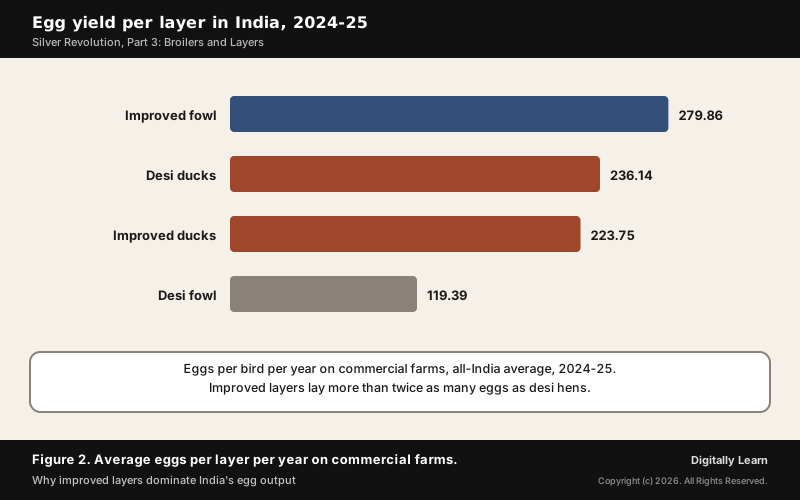
  • Outcome (a): four-fold layer productivity gain over backyard. Commercial hybrid layers deliver 300 to 320 eggs per year versus 60 to 80 from indigenous backyard birds. The Silver Revolution productivity surge sits squarely on this breed-housing-feed package.
  • Outcome (b): broiler-meat at scale. The 42-day cycle plus FCR 1.6 means that one square metre of broiler shed produces approximately 100 kilograms of chicken meat per year. Indian broiler output is now over 2 billion birds per year, supplying the dominant share of national chicken meat consumption.
  • Outcome (c): backyard productivity floor. Despite the commercial boom, ICAR-developed Vanaraja and Gramapriya dual-purpose breeds lift backyard productivity from 60 eggs to over 150 eggs per year in trials, anchoring a parallel rural-livelihood track that does not compete with commercial scale.

Integrated Poultry Production Systems

How Vertical Integration Reshapes the Components

The contemporary Indian poultry industry increasingly operates through integrated production systems in which a single corporate integrator (Suguna, Venky, Godrej Agrovet) owns or controls the breeding pyramid, the hatcheries, the feed mills, the contract farms, and the processing plants. This model has transformed the broiler segment and is spreading to layers.

  • Tier-by-tier control: The integrator imports pedigree licence from global breeders, operates grandparent and parent flocks, runs hatcheries that produce day-old chicks, supplies chicks plus feed plus veterinary services to contract farmers, and buys back the finished birds for slaughter and retail.
  • Integrated Farming System linkage: For small and marginal farmers, integrated poultry can be combined with allied agricultural activities (dairy, fisheries, horticulture) under the Integrated Farming System framework, which is the canonical case for the multi-enterprise small-holder model.
  • Risk transfer: The integrator-contract model transfers production risk to the small farmer (mortality, biosecurity, market timing) while concentrating commodity-price risk and brand value with the integrator. This is the structural trade-off that Part 8 of this series will examine in detail.
  • Productivity gain: Integrated systems achieve broiler FCR around 1.5 to 1.6 versus 1.8 to 2.0 in independent farming, primarily through standardised feed, controlled breeding, and biosecurity discipline.

Contemporary Linkages and UPSC Relevance

Component-Level Themes in the Examinations

Part 3 intersects three contemporary themes in agricultural policy and General Studies syllabuses: livestock genetic improvement, integrated farming systems, and value-chain economics of allied agriculture.

  • Livestock genetic improvement: Genetic-engineering knowledge enables livestock pedigree tracking and disease-resistant breed development. ICAR-developed Vanaraja, Gramapriya, Krishibro, and ILI 80 demonstrate the indigenous breed-improvement track. The four-tier pyramid structure remains the global standard.
  • Integrated Farming System: Combining poultry with dairy, fisheries, horticulture, or apiculture under one farm-management framework is the canonical IFS model. The 2022 Mains GS-III Q14 question on IFS for small and marginal farmers maps to this section directly.
  • Value-chain economics: The broiler integrator model exemplifies vertical integration in Indian agro-business. Suguna pioneered the contract-broiler model from Tamil Nadu in the 1980s; Venky’s, Godrej Agrovet, and others followed. The integrator-farmer relationship is the structural foundation of contemporary broiler production.
  • Biosecurity at component level: Layer biosecurity protects 80-week revenue streams; broiler biosecurity protects 42-day cycles plus rapid shed-turnover. Part 7 of this series treats biosecurity and disease in detail.

Sources

Editorial Disclaimer

This article is compiled from the reference materials listed in the Sources section. It is an explainer for UPSC preparation and is not a substitute for primary documents (NCERTs, GoI ministry releases, IMD bulletins, RBI / CEA / MoEFCC publications, and Standing-Committee reports).

Part 3 of 10 · Silver Revolution

All 10 parts in this cluster
  1. 1 Part 1: Concept, Evolution, and Features
  2. 2 Part 2: Spatial Distribution and State Geography
  3. 3 Part 3: Egg and Broiler Components (this article)
  4. 4 Part 4: Technology and Infrastructure
  5. 5 Part 5: Economic, Nutritional, and Social Importance
  6. 6 Part 6: Farming Systems and Government Framework
  7. 7 Part 7: Environment, Disease, and Biosecurity
  8. 8 Part 8: Challenges and Regional Disparities
  9. 9 Part 9: Agricultural Geography and Contemporary Trends
  10. 10 Part 10: Geography Optional and Sustainability Implications