


Overview
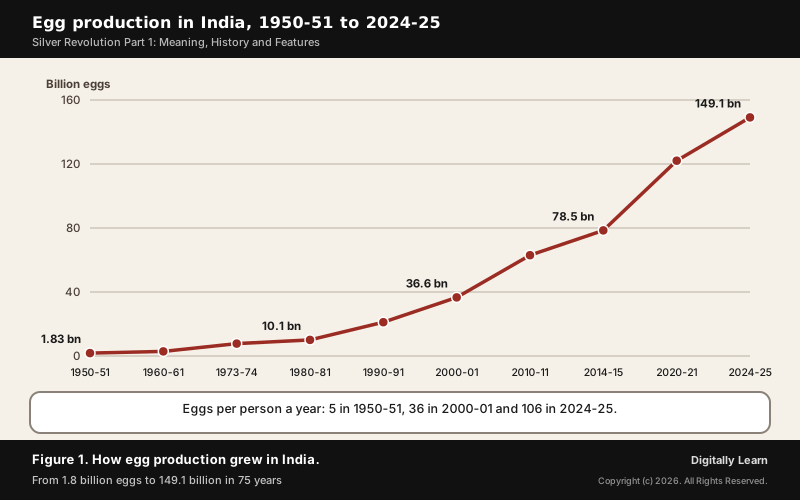
The Silver Revolution is the popular name for the rapid growth of egg and poultry production in India, which turned poultry from a backyard activity into a commercial industry. India produced 1,832 million eggs in 1950-51 and 149.11 billion in 2024-25, and it now ranks second in the world in egg production. Eggs per person a year rose from 5 to 106 over the same period.
Silver Revolution Meaning: Eggs, Poultry and India's Rank
What Is the Silver Revolution in India?
The Silver Revolution is related to eggs and poultry. It is the name given, in the lists of India's agricultural revolutions, to the fast rise in egg and chicken production that made poultry farming a commercial industry. Unlike the White Revolution, which grew out of Operation Flood, it was not launched by a single government programme; it grew over decades out of better birds, better feed, private hatcheries and a steady market for eggs.
The numbers show why it is called a revolution. India produced 1,832 million eggs in 1950-51, about 10 billion in 1980-81 and 149.11 billion in 2024-25. Eggs available per person rose from 5 a year to 106. India now ranks second in the world in egg production, behind China, and fourth in meat production, and poultry supplies about half of all the meat India produces.
Silver Revolution and India's Other Agricultural Revolutions
Examiners often test the Silver Revolution by setting it beside India's other agricultural revolutions. The useful comparison is not only the product but how each change happened: by a state-led technology package, by a cooperative programme or by private enterprise.
| Revolution | Related to | How it happened |
|---|---|---|
| Green Revolution | Foodgrains, mainly wheat and rice | High-yielding seeds, fertilisers and irrigation from the 1960s |
| White Revolution | Milk | Operation Flood from 13 January 1970, through dairy cooperatives |
| Blue Revolution | Fish and aquaculture | Scientific fish farming and fisheries policy |
| Pink Revolution | Meat | Growth of meat production and exports |
| Silver Revolution | Eggs and poultry | Hybrid birds, feed, hatcheries and private integrators |
The Green Revolution was led by agricultural scientist M. S. Swaminathan in India and drew on the high-yield wheat of the American agronomist Norman Borlaug. The White Revolution was planned by the National Dairy Development Board, and Operation Flood made India the world's largest milk producer; the full story is in White Revolution: Operation Flood and the AMUL model. The Silver Revolution had no single such programme, which is why its history runs through companies, research institutes and a farmers' price committee.
The other colour revolutions are covered together in Agriculture Part 12: revolutions and the rural economy, the Green Revolution's origins in Green Revolution Part 2, and a fuller comparison of the Silver and White Revolutions in Silver Revolution Part 9.
History of the Silver Revolution in India
Egg Production in India From 1950-51 to 2024-25
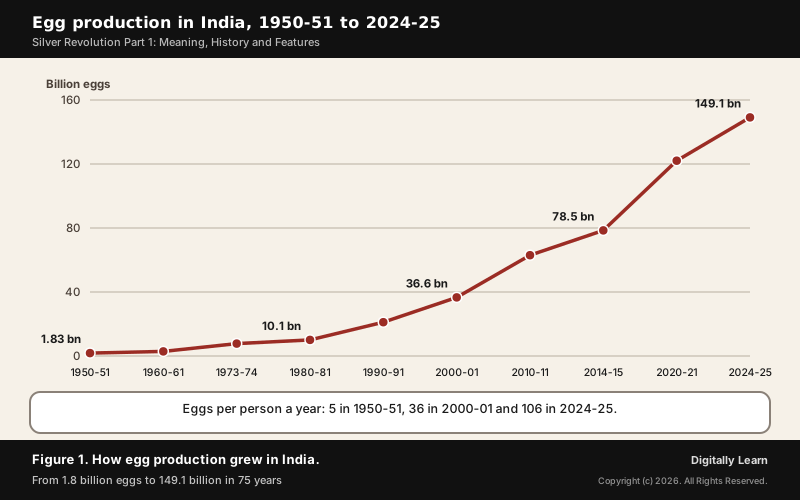
Egg production in India grew slowly for two decades after Independence and then kept accelerating. Figure 1 traces the whole curve, and the growth rates show when the change came.
| Period | Growth of egg production a year |
|---|---|
| 1950-51 to 1960-61 | 4.63 per cent |
| 1960-61 to 1973-74 | 7.91 per cent |
| 1973-74 to 1980-81 | 3.79 per cent |
| 1980-81 to 1990-91 | 7.69 per cent |
| 1990-91 to 2000-01 | 5.67 per cent |
| 2000-01 to 2010-11 | 5.58 per cent |
| 2010-11 to 2020-21 | 6.83 per cent |
| 2020-21 to 2024-25 | 5.13 per cent |
- Backyard era: In 1950-51 India produced 1.83 billion eggs, about 5 per person a year.
- First take-off: Growth reached 7.91 per cent a year between 1960-61 and 1973-74, and output crossed 10 billion eggs in 1980-81.
- The 1980s: After a price crisis early in the decade, growth recovered to 7.69 per cent a year and output doubled to 21.1 billion by 1990-91.
- Industry scale: Output reached 36.6 billion in 2000-01, 78.5 billion in 2014-15 and 149.1 billion in 2024-25.
- Slowing pace: Annual growth fell from 10.19 per cent in 2019-20 to 3.18 per cent in 2023-24, before 4.44 per cent in 2024-25.
India in World Egg Production: Second After China
India's place in the world shows how far the Silver Revolution has gone. By the data of the Food and Agriculture Organization for 2023, India produced about 7.85 million tonnes of eggs, second only to China, and ahead of Indonesia, the United States and Brazil.
| Country | Egg production, 2023 (million tonnes) |
|---|---|
| China | 36.00 |
| India | 7.85 |
| Indonesia | 6.89 |
| United States | 6.53 |
| Brazil | 3.45 |
| World | 97.41 |
India's output in tonnes rose from 4.56 million in 2016 to 7.85 million in 2023, while the United States stayed at about 6.5 million; that is how India moved past it. In meat, India ranks fourth in the world, and poultry supplies about half of the meat it produces.
Father of the Silver Revolution: B. V. Rao and Venky's
No government has named an official father of the Silver Revolution. The person most often given the credit is Dr Banda Vasudev Rao (1935 to 1996), considered by many the father of the poultry industry in India. His career shows how the industry was built by enterprise rather than by a state programme.
- Training: Born in Hyderabad in 1935, he took a short course in dairy and poultry farming at the agricultural university in Rajendranagar.
- First farm: He began with 500 birds entrusted to him by his teacher and started his own farm on a 7-acre plot, funded by selling his wife’s jewellery.
- Company: In 1971 he founded the V H Group, known for the Venky’s brand, which grew into a poultry conglomerate employing about 5,000 people by 1996.
- Farmers’ body: He founded the National Egg Coordination Committee in 1982 and was its first chairman.
- Honours: Padma Shri in 1990; inducted into the World Poultry Science Association’s Hall of Fame in 2004.
National Egg Coordination Committee (NECC), 1982
The National Egg Coordination Committee was the industry's answer to a crisis. In the early 1980s the price of eggs fell below the cost of producing them, and many poultry farmers shut down after heavy losses. A group of farmers travelled across the country and held more than 300 meetings to unite producers. In May 1982 the NECC was registered as a trust, and on 14 May 1982 it began setting egg prices.
- Fair prices: It sets egg prices meant to give farmers a fair return, middlemen a decent margin and consumers a reasonable cost.
- Daily benchmarks: It publishes daily and monthly average prices for production centres; these are indicative, not legally binding.
- Moving stocks: It monitors and moves eggs from surplus regions to deficit regions.
- Promotion: It promotes egg trade, farms and exports, and spreads technology to raise production.
A common price mattered more to eggs than to grain, because eggs are perishable and a farmer cannot hold them back when prices fall. The NECC, a charitable trust with more than 35,000 members, gave farmers a common reference price, and egg output doubled in the decade after it was founded.
Why the Silver Revolution Happened: Drivers of Poultry Growth
The Silver Revolution happened because several drivers arrived together and reinforced one another. Better birds raised output per hen, companies turned that into an industry, and a growing market bought the eggs. Each driver is easy to remember as one link in a chain:
- Improved birds: Improved fowl, not desi birds, now lay 86.35 per cent of India’s eggs.
- Private hatcheries and integrators: Firms such as the V H Group (1971) and Suguna (1984) supplied chicks and feed at scale and later ran whole production chains.
- A fair price: The NECC’s benchmark prices from 1982 gave farmers a reference price and moved eggs from surplus to deficit regions.
- Public research: CARI, the Directorate of Poultry Research and the Central Poultry Development Organisations bred birds suited to villages.
- Rising demand: Rising middle-class incomes, urbanisation and changing diets kept increasing the demand for eggs and meat.
- Contract farming: Small farmers could raise birds without buying chicks and feed themselves, which spread commercial poultry beyond big farms.
Research Institutions and Improved Poultry Breeds
Public research gave the Silver Revolution its birds for the countryside. The Central Avian Research Institute (CARI) was set up in 1979 at Izatnagar near Bareilly, Uttar Pradesh, under the Indian Council of Agricultural Research, to study poultry genetics, breeding, nutrition and feed technology. The Central Poultry Development Organisations of the Union government, at Bengaluru, Bhubaneswar, Chandigarh and Mumbai, serve rural backyard farmers and state farms.
| Institution | Low-input birds it supplies |
|---|---|
| ICAR Directorate of Poultry Research, Hyderabad | Vanaraja, Gramapriya |
| Central Avian Research Institute, Izatnagar | CARI Gold, Nirbheek, Hitcari, Upcari |
| Central Poultry Development Organisations | Kalinga Brown, Chabro, Kaveri |
| Karnataka Veterinary, Animal and Fisheries Sciences University, Bidar | Giriraja, Girirani, Swarnadhara |
These low-input technology birds can live on free range with little bought feed, which suits village households. India's own breeds matter too. The Kadaknath, a black-fleshed chicken from the Jhabua and Dhar districts of Madhya Pradesh, received a geographical indication tag on 30 July 2018. How hybrid breeds, hatcheries and feed mills work is covered in Part 4 on technology.
Features of the Silver Revolution
Commercial and Backyard Poultry: Two Systems Side by Side
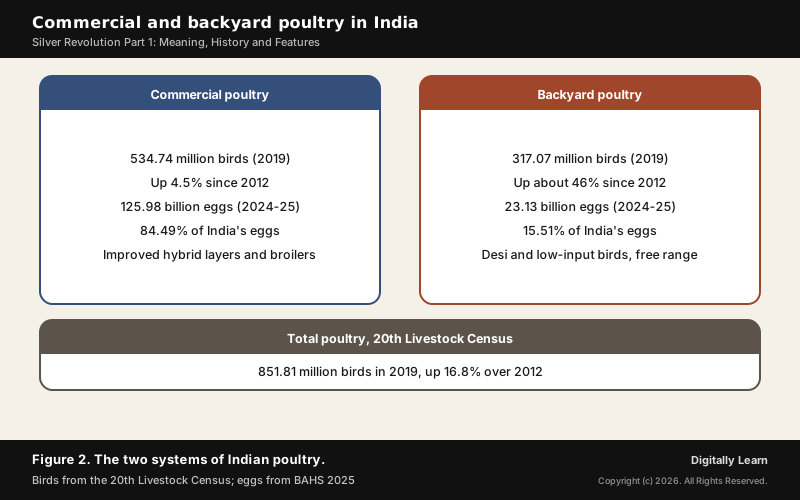
The most distinctive feature of the Silver Revolution is that the old system did not disappear. Commercial poultry now produces most of the eggs, but backyard poultry, kept by village households, is still growing, and in the 20th Livestock Census it grew much faster.
| Measure | Commercial | Backyard |
|---|---|---|
| Birds, 2019 census | 534.74 million | 317.07 million |
| Growth since 2012 | 4.5 per cent | About 46 per cent |
| Eggs, 2024-25 | 125.98 billion | 23.13 billion |
| Share of eggs | 84.49 per cent | 15.51 per cent |
Backyard poultry is a different kind of farming. A household keeps a small flock of desi or low-input birds that forage on free range and need little bought feed, and the eggs and meat feed the family or bring in cash. The National Livestock Mission aims to bring this unorganised rural poultry into the organised sector through breeding units and hatcheries that supply such birds to villages.
By type of bird, improved fowl lay 86.35 per cent of India's eggs and desi fowl 12.59 per cent; ducks add only about 1 per cent. Total poultry stood at 851.81 million birds in 2019, up 16.8 per cent on the 2012 census.
Hybrid Birds, Vertical Integration and Contract Farming
Commercial poultry in India runs as an industry, and four features set it apart from farming as it used to be:
- Intensive rearing: An estimated 200 million egg-laying hens are kept in battery cages, and more than half of the over two billion meat chickens raised each year are factory-farmed.
- Vertical integration: The same company often owns breeding, hatcheries, feed mills and processing, so a bird moves from egg to market inside one firm.
- Contract farming: Integrators supply chicks and feed to farmers who raise the birds for a fee; Suguna Foods, founded in Coimbatore in 1984, built its business on this model.
- Big companies: Suguna, Venky’s and the Amrit Group lead the industry and are increasing sales to other parts of Asia and the Middle East.
Meat has become as important as eggs. India produced 10.50 million tonnes of meat in 2024-25, and 5.18 million tonnes of it was poultry meat, about half. Within the meat group, poultry meat is the largest and fastest-growing segment. The broiler and layer chains are covered in Part 3.
Leading Egg-Producing States in India
The Silver Revolution is concentrated in the south. In 2024-25 Andhra Pradesh produced 18.37 per cent of India's eggs, Tamil Nadu 15.63 per cent and Telangana 12.98 per cent; these three together give almost half, 46.98 per cent. With West Bengal and Karnataka, the top five produce 64.37 per cent.
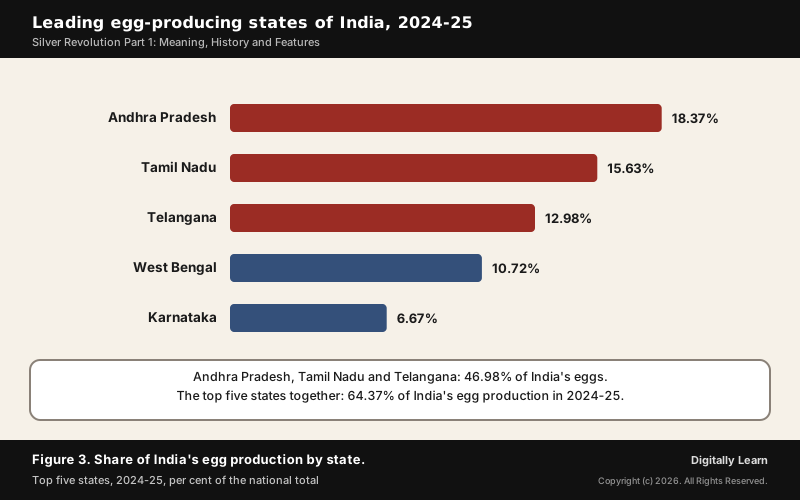
Output per person shows the same pattern. Andhra Pradesh had 514 eggs per person a year and Telangana 506 in 2024-25, against a national average of 106. In the north, Haryana stands out with 299 eggs per person, while its neighbour Punjab had 164.
Growth is now spreading. In 2024-25, eleven states grew faster than the national rate, among them Bihar, Gujarat, Punjab, Haryana, Maharashtra, Odisha and Rajasthan. Why production gathered in the south, including the Namakkal cluster of Tamil Nadu, is explained in Part 2 on spatial distribution.
Why the Silver Revolution Matters
Significance for Nutrition, Livelihoods and Rural Income
The Silver Revolution matters because livestock is now a main source of farm income. Livestock contributed 31 per cent of the gross value added of agriculture and allied sectors in 2023-24, up from about 24 per cent in 2014-15, and its value grew at 12.77 per cent a year over that decade, faster than crops.
Livestock also steadies rural life. It gives a household more stable income, food security, transport, fuel and nutrition without disturbing its other food production, and it offers another livelihood to more than 70 million small and marginal farmers, including landless labourers; many women work in it too. By number, poultry is the largest part of India's livestock, 61 per cent of the animals and birds counted in 2019.
- Quality protein: Eggs, like milk, meat and fish, give high-quality protein that supplies all the essential amino acids; eggs available per person rose from 62 a year in 2014-15 to 106 in 2024-25.
- Village income: Backyard poultry needs little land or capital, and it grew by about 46 per cent between the last two censuses.
- Jobs beyond the farm: Hatcheries, feed mills, transport, processing and retail employ people outside crop farming.
- Entrepreneurs: The National Livestock Mission aims at employment through entrepreneurship in poultry and gives a 50 per cent capital subsidy, up to Rs 25 lakh, for a rural parent farm, hatchery and mother unit of at least 1,000 parent layers.
The same mission lets individuals, self-help groups, farmer producer organisations and cooperatives apply, and it supplies low-input birds from public institutes to bring unorganised rural poultry into the organised sector.
The growth also has costs: disease, antibiotic use and waste from large farms, which are covered in Part 7 on environment and biosecurity. The economic, nutritional and social impact is examined in Part 5: importance of poultry farming, and the schemes in Part 6.
Limits of the Silver Revolution: Slowing Growth and Regional Gaps
The Silver Revolution has spread unevenly. In 2024-25 an average Indian had access to 106 eggs a year, but only 8 states were above that national average. The gap between the leading and lagging states is wide:
| State | Eggs per person a year, 2024-25 |
|---|---|
| Andhra Pradesh | 514 |
| Telangana | 506 |
| Tamil Nadu | 302 |
| Haryana | 299 |
| All India | 106 |
| Bihar | 29 |
| Uttar Pradesh | 26 |
| Assam | 18 |
- Regional concentration: Five states produce 64.37 per cent of the eggs, while large states such as Uttar Pradesh and Bihar have fewer than 30 eggs per person a year.
- Slowing growth: Annual growth fell to 3.18 per cent in 2023-24; the official statistics read this as a sign of potential challenges or saturation in the sector.
- Setbacks in some states: Punjab’s per capita availability fell from 205 eggs in 2022-23 to 153 in 2023-24.
- Disease and waste: Bird flu, antibiotic use and farm waste are the costs of intensive rearing.
These regional gaps are also opportunities: the eastern and northern states where eggs are scarce are where the National Livestock Mission's rural poultry units and backyard birds can add most. The challenges are examined in Part 8 on challenges and regional disparities.
Previous Year UPSC-CSE Questions
Previous Year UPSC-CSE Questions By the end you will be able to draft model answers for the following UPSC questions. Each question carries a collapsible framework showing how to approach it in the exam.
- UPSC Mains 2015 GS-IIILivestock rearing has a big potential for providing non-farm employment and income in rural areas. Discuss suggesting suitable measures to promote this sector in India.
How to structure the answer in the exam
Introduction: Livestock gave 31 per cent of agricultural GVA in 2023-24; poultry is its fastest-growing part.
Body (sub-themes to develop):
- Potential: backyard poultry needs little land or capital and grew about 46 per cent between censuses.
- Jobs beyond the farm: hatcheries, feed mills, transport, processing and retail.
- Measures: NLM 50 per cent capital subsidy for rural poultry units, low-input birds from CARI and CPDOs, SHG and FPO access.
- Market support: price discovery through bodies like the NECC; contract farming links small farmers to integrators.
Conclusion: Conclude that allied activities like poultry raise rural incomes without needing more land.
- UPSC Prelims 2005 Prelims-GSMatch List-I with List-II and select the correct answer using the codes given below the lists:
- List I (Distinguished Person) (A) B.V. Rao (B) C.K. Prahlad (C) John Kurien (D) Kiran Karnik
- List II (Area of Work) 1. Automobiles Manufacture 2. Fisheries Economy 3. Information Technology and Software 4. Poultry Farming 5. Management Science
How to approach this Prelims question
Approach: Match B. V. Rao first, then eliminate.
Trap to watch: B. V. Rao is poultry farming (4), not fisheries; that leaves options (b) and (d).
Key facts to recall:
- B. V. Rao founded the V H Group (Venky's) in 1971 and the NECC in 1982
- C. K. Prahalad: management science; Kiran Karnik: information technology
Answer signal: A-4, B-5, C-2, D-3: option (d).
- UPSC Prelims 2008 Prelims-GSNorman Ernest Borlaug who is regarded as the father of the Green Revolution in India is from which country?
How to approach this Prelims question
Approach: Recall Borlaug's nationality, not where he worked.
Trap to watch: Borlaug developed his wheat at CIMMYT in Mexico, but he was American.
Key facts to recall:
- Norman Borlaug: American agronomist, Nobel Peace Prize
Answer signal: United States of America: option (a).
Sources and Further Reading
- Department of Animal Husbandry and Dairying: Basic Animal Husbandry Statistics 2025
- PIB: Release of Basic Animal Husbandry Statistics 2025 (26 November 2025)
- PIB: 20th Livestock Census released (16 October 2019)
- Department of Animal Husbandry and Dairying: National Livestock Mission operational guidelines (January 2025)
- NCERT: Indian Economic Development (Class XI), Chapter 5, Rural Development
- ICMR-National Institute of Nutrition: Dietary Guidelines for Indians, 2024
- Wikipedia: National Egg Coordination Committee
- Wikipedia: B. V. Rao
- Wikipedia: Animal husbandry in India
- Wikipedia: Central Avian Research Institute
- Wikipedia: Kadaknath
- Wikipedia: Suguna Foods
- Wikipedia: Green Revolution in India
- Wikipedia: Operation Flood
- Wikipedia: Pink Revolution in India
- Wikipedia: Norman Borlaug
- UPSC: Previous year question papers
Editorial Disclaimer
This article uses the Basic Animal Husbandry Statistics of the Department of Animal Husbandry and Dairying, PIB releases and the other sources listed below. Production figures are official estimates and are revised each year.