


Overview
Indian Agriculture, Part 7
India's high-value allied agricultural sectors.
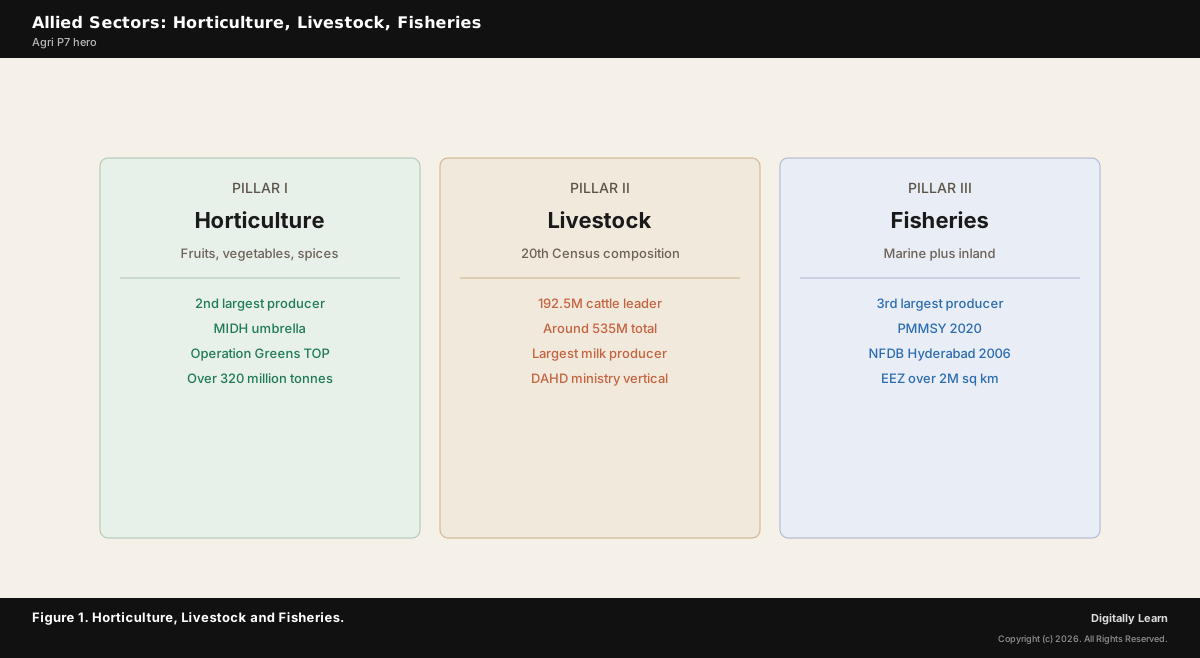
Horticulture, livestock, and fisheries are the three allied agricultural sectors that complement field-crop cultivation and now contribute a rising share of agricultural Gross Value Added in India. Horticulture covers fruits, vegetables, floriculture, plantation crops, spices, and medicinal-aromatic plants under the Mission for Integrated Development of Horticulture (MIDH); India is the world's second-largest producer of fruits and vegetables after China. Livestock includes cattle, buffaloes, sheep, goats, pigs, and poultry; the 20th Livestock Census recorded around 192.5 million cattle and 109.9 million buffaloes; India is the world's largest milk producer. Fisheries covers inland and marine production under the Pradhan Mantri Matsya Sampada Yojana (PMMSY) and the National Fisheries Development Board (NFDB) at Hyderabad; India is the third-largest fish producer and second-largest aquaculture producer globally. Together these allied sectors support rural employment, nutrition security, and export earnings beyond food-grain cultivation.
Background and Historical Context
Allied agricultural sectors now contribute a growing share of agricultural Gross Value Added and supply the nutrition-security gap that food-grain cultivation alone cannot fill. Horticulture supplies fruit-and-vegetable dietary diversity, livestock supplies protein and household income through dairy and poultry, and fisheries supplies coastal-state economic activity and exportable marine produce. UPSC Prelims has tested sector classification (2024 dairy-farm-as-primary-sector), livestock-environment interactions (2019 cattle-ammonia and poultry-reactive-nitrogen), and animal-husbandry biotechnology (2011 DNA pedigree determination).
What is the significance of the allied-sector cluster? Three operational dimensions follow. The nutrition-security contribution binds horticulture, livestock, and fisheries to dietary protein, vitamins, and micro-nutrients beyond cereal-supplied carbohydrates. The employment-support role distributes rural labour absorption across small-holder dairy units, peri-urban vegetable cultivation, marine-coast fishing communities, and inland aquaculture clusters. The institutional architecture sits across three separate verticals: horticulture under the Department of Agriculture and Farmers Welfare, livestock and dairy under the Department of Animal Husbandry and Dairying (DAHD) within the Ministry of Fisheries Animal Husbandry and Dairying, and fisheries under the Department of Fisheries within the same ministry.
Current policy threads include MIDH consolidating the National Horticulture Mission, the Horticulture Mission for North-East and Himalayan States, the National Bamboo Mission, and the Coconut Development Board; the Operation Greens TOP scheme stabilising Tomato-Onion-Potato value chains; the Pradhan Mantri Matsya Sampada Yojana (PMMSY) launched 2020 with around twenty thousand crore rupees outlay over five years; the National Livestock Mission and Rashtriya Gokul Mission for indigenous-breed conservation. The dairy sector itself is covered in depth by the White Revolution Part 1 (Anand pattern and AMUL cooperative) and the three subsequent White Revolution articles; this article references but does not re-author Operation Flood.
Introduction: Three Allied Agricultural Sectors
Why horticulture, livestock, and fisheries form an allied cluster
The three allied agricultural sectors share a structural feature: each complements field-crop cultivation by supplying dietary diversity (protein, vitamins, micro-nutrients) and by absorbing rural labour that cereal cultivation cannot accommodate. Horticulture supplies fruits and vegetables, the largest sub-sector by tonnage after food grains. Livestock supplies dairy, meat, and poultry, and stabilises small-holder rural income. Fisheries supplies marine and inland fish products and sustains the coastal-and-river economy.
The three sectors are governed by distinct institutional verticals. Horticulture sits under the Department of Agriculture and Farmers Welfare via the MIDH. Livestock and dairy sit under the Department of Animal Husbandry and Dairying (DAHD), and fisheries under the Department of Fisheries, both within the Ministry of Fisheries, Animal Husbandry and Dairying. The standalone ministry was created in 2019 to give livestock and fisheries dedicated administrative focus.
- (i) Nutrition-security contribution: Horticulture supplies fruit-vegetable dietary diversity; livestock supplies milk and meat protein; fisheries supplies fish protein and micro-nutrients.
- (ii) Rural employment support: Small-holder dairy units, peri-urban vegetable cultivation, marine-coast fishing communities, and inland aquaculture clusters absorb diverse rural labour.
- (iii) Export earnings: APEDA-managed horticulture exports (mangoes, grapes, onions), marine-fisheries exports (shrimp dominant), and processed dairy exports diversify the agricultural-export basket.
- (iv) Three-ministry architecture: Horticulture under Ministry of Agriculture and Farmers Welfare; livestock under DAHD; fisheries under Department of Fisheries; both DAHD and DoF sit under the Ministry of Fisheries, Animal Husbandry and Dairying created 2019.
- (v) Climate-resilience role: Horticulture, livestock, and fisheries diversify the agricultural risk profile beyond monsoon-dependent field-crop cultivation.
Horticulture: MIDH, Operation Greens, India as Second-Largest Producer
Production architecture, MIDH umbrella, and Operation Greens TOP value chain
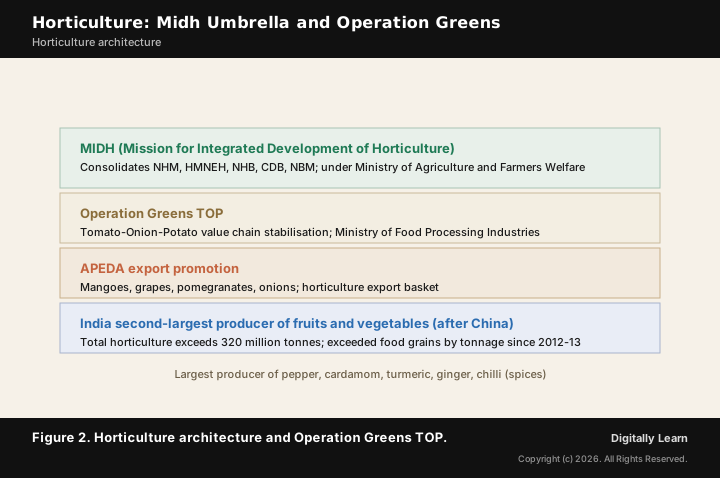
India is the world's second-largest producer of fruits and vegetables after China, with total horticulture output exceeding 320 million tonnes and surpassing food-grain production by tonnage since 2012-13. The sector spans fruits, vegetables, floriculture, plantation crops, spices, and medicinal-aromatic plants. Leading fruit states include Maharashtra, Andhra Pradesh, Karnataka, and Tamil Nadu; leading vegetable states include West Bengal, Uttar Pradesh, Bihar, and Madhya Pradesh.
- (i) MIDH umbrella: Mission for Integrated Development of Horticulture under the Department of Agriculture and Farmers Welfare; consolidates the National Horticulture Mission (NHM), Horticulture Mission for North-East and Himalayan States (HMNEH), National Horticulture Board (NHB), Coconut Development Board (CDB), and National Bamboo Mission (NBM).
- (ii) Operation Greens TOP: Scheme to stabilise the Tomato-Onion-Potato value chain via price-stabilisation and infrastructure support; Ministry of Food Processing Industries; launched 2018-19 and expanded subsequently.
- (iii) APEDA: Agricultural and Processed Food Products Export Development Authority promotes horticulture exports (mangoes, grapes, pomegranates, onions); cross-link to the agricultural-export basket.
- (iv) Sub-sector composition: Fruits, vegetables, floriculture, spices, plantation crops, medicinal-aromatic plants; spices alone make India the largest producer and exporter of pepper, cardamom, turmeric, ginger, and chilli globally.
- (v) Climate vulnerability: Heat stress affects fruit-set in mango and apple; rainfall variability affects vegetable supply chains; floriculture cold-chain disruptions raise post-harvest losses.
Livestock, Dairy, Poultry: 20th Census, DAHD, White Revolution Link
Census numbers, DAHD architecture, dairy and poultry sub-sectors
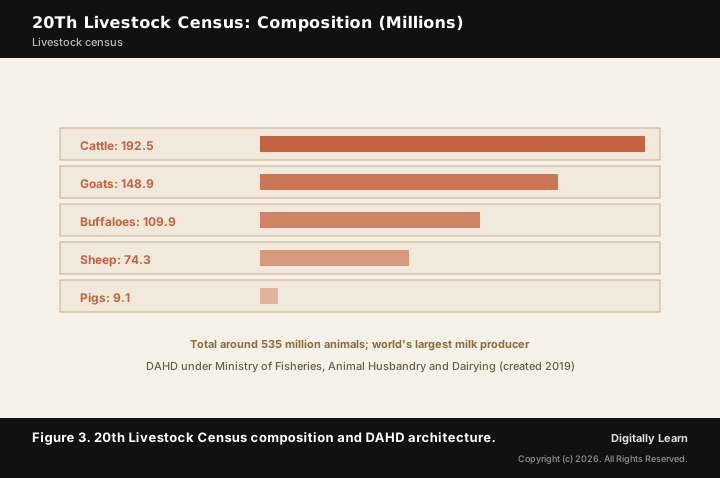
India holds the world's largest cattle-plus-buffalo population and the world's largest milk-production volume. The 20th Livestock Census recorded around 192.5 million cattle, 148.9 million goats, 109.9 million buffaloes, 74.3 million sheep, and 9.1 million pigs, a total near 535 million. The poultry sub-sector produced around 138 billion eggs in FY 2022-23. Dairy rests on the Operation Flood architecture launched 1970, covered in depth by the four-part White Revolution series.
- (i) 20th Livestock Census composition: Cattle 192.5 million (leader), goats 148.9 million, buffaloes 109.9 million, sheep 74.3 million, pigs 9.1 million; total around 535 million.
- (ii) DAHD architecture: Department of Animal Husbandry and Dairying under the Ministry of Fisheries, Animal Husbandry and Dairying (separated from Ministry of Agriculture in 2019); oversees livestock policy, breed conservation, disease control, dairy promotion.
- (iii) White Revolution cross-link: Operation Flood (launched 13 January 1970) transformed India into world’s largest milk producer; institutional architecture covered in depth in White Revolution Part 1 (Anand pattern and AMUL).
- (iv) National Livestock Mission and Rashtriya Gokul Mission: National Livestock Mission for sustainable livestock development; Rashtriya Gokul Mission for indigenous-cattle-breed conservation and improvement; both under DAHD.
- (v) Poultry sub-sector: Around 138 billion eggs in FY 2022-23; broiler chicken production a fast-growing protein-supply sub-sector; Andhra Pradesh, Tamil Nadu, Telangana, Karnataka lead.
- (vi) Animal-health architecture: National Animal Disease Control Programme covers foot-and-mouth disease and brucellosis; the Indian Council of Agricultural Research animal-science institutes coordinate research.
Fisheries: Blue Revolution, PMMSY, NFDB Hyderabad, EEZ
Marine vs inland split, PMMSY architecture, NFDB and the Exclusive Economic Zone
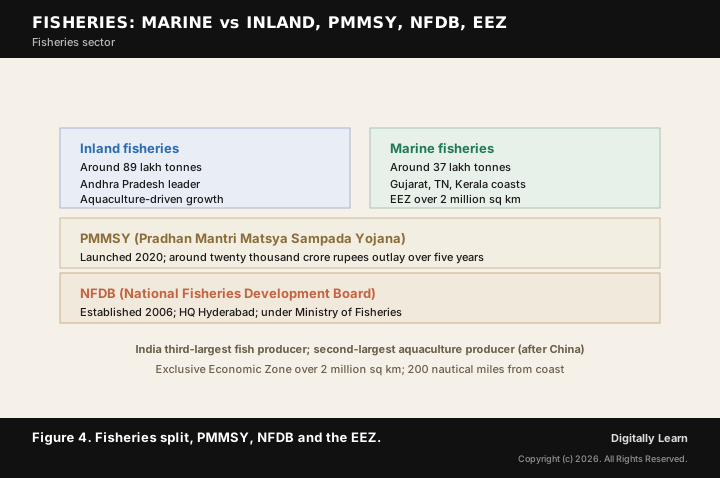
India is the world's third-largest fish-producing country (around 8 per cent of global output) and the second-largest aquaculture producer after China. Inland fisheries exceed marine fisheries by tonnage (around 89 versus 37 lakh tonnes). Andhra Pradesh leads overall fisheries output, followed by West Bengal, Gujarat, and Odisha. The Exclusive Economic Zone spans over 2 million square kilometres, 200 nautical miles into the Indian Ocean.
- (i) Marine vs inland split: Inland (89 lakh tonnes) exceeds marine (37 lakh tonnes) by tonnage in recent years; inland aquaculture has driven the bulk of recent growth.
- (ii) Top fisheries states: Andhra Pradesh leader (around 34.5 lakh tonnes), West Bengal, Gujarat, Odisha, Tamil Nadu; AP’s inland aquaculture boom drives its leadership.
- (iii) PMMSY (Pradhan Mantri Matsya Sampada Yojana): Launched 2020 with around twenty thousand crore rupees outlay over five years; flagship fisheries-sector scheme; under the Department of Fisheries.
- (iv) NFDB (National Fisheries Development Board): Established 2006, headquartered at Hyderabad; under the Ministry of Fisheries, Animal Husbandry and Dairying; coordinates fisheries development funding and technology transfer.
- (v) Blue Revolution and Neel Kranti Mission: Earlier umbrella fisheries-sector scheme; superseded by PMMSY in 2020.
- (vi) Exclusive Economic Zone: Over 2 million square kilometres covering 200 nautical miles from the Indian coast; supports marine-capture fisheries and emerging mariculture; cross-link to the Maritime India Vision.
Comparative Architecture and Contemporary Policy
Five points of comparison across the three allied sectors
The three allied agricultural sectors are governed by separate verticals but converge in their nutrition-security and rural-employment contributions. The cross-sector comparison clarifies how Indian allied-agricultural policy distributes administrative responsibility while pursuing common diversification objectives.
| Sector | India global rank | Administering department | Flagship mission |
|---|---|---|---|
| Horticulture | Second-largest producer of fruits and vegetables | Agriculture and Farmers Welfare | MIDH; Operation Greens TOP |
| Livestock and dairy | Largest milk producer; largest cattle-buffalo population | Animal Husbandry and Dairying (DAHD) | National Livestock Mission; Rashtriya Gokul Mission |
| Fisheries | Third-largest fish producer; second-largest in aquaculture | Fisheries (DoF) | PMMSY; NFDB at Hyderabad |
- (a) Ministerial architecture: Horticulture under Ministry of Agriculture and Farmers Welfare via MIDH; Livestock under DAHD; Fisheries under Department of Fisheries; both DAHD and DoF sit under the standalone Ministry of Fisheries, Animal Husbandry and Dairying created 2019.
- (b) Flagship missions: MIDH for horticulture; PMMSY for fisheries (launched 2020); National Livestock Mission and Rashtriya Gokul Mission for livestock; Operation Greens TOP under Ministry of Food Processing Industries.
- (c) India’s global rank: Second-largest fruit-and-vegetable producer (after China); largest milk producer; third-largest fish producer; second-largest aquaculture producer (after China).
- (d) Cross-cluster link: Dairy depth coverage sits in the four-part White Revolution series on this site; this article references but does not re-author Operation Flood.
- (e) Climate-resilience role: Allied sectors diversify the agricultural risk profile beyond monsoon-dependent field-crop cultivation; horticulture exposed to heat stress; livestock exposed to fodder-security stress; fisheries exposed to ocean-warming and fish-stock shifts.
Policy threads converge across the three sectors. Horticulture sees export promotion via APEDA and post-harvest infrastructure under Operation Greens. Livestock sees indigenous-breed conservation under the Rashtriya Gokul Mission. Fisheries sees inland-aquaculture expansion under PMMSY. The design lesson is that allied agriculture, once a residual sub-sector, now warrants standalone ministerial focus to deliver dietary-diversification and rural-employment goals that field-crop policy alone cannot meet.
Previous Year UPSC-CSE Questions
Previous Year UPSC-CSE Questions By the end you will be able to draft model answers for the following UPSC questions. Each question carries a collapsible framework showing how to approach it in the exam.
- UPSC Prelims 2024With reference to the sectors of the Indian economy, consider the following pairs: Economic activity – Sector
- Storage of agricultural produce – Secondary
- Dairy farm – Primary
- Mineral exploration – Tertiary
- Weaving cloth – Secondary
How many of the pairs given above are correctly matched?
How to approach this Prelims question
Approach: Primary sector covers direct extraction or cultivation (agriculture, dairy, mining); secondary covers manufacturing or processing (weaving, food processing); tertiary covers services (storage, marketing, transport). Apply this trichotomy to each pair.
Trap to watch: Mineral exploration appears to be a service-like investigation activity, but extractive primary-sector classification holds. Storage is a logistics service and sits in tertiary, not secondary manufacturing.
Key facts to recall:
- Primary: direct extraction or cultivation including agriculture, dairy, mining, fisheries
- Secondary: manufacturing or processing including weaving and food processing
- Tertiary: services including storage, marketing, transport
- Dairy farming is primary; weaving cloth is secondary
Answer signal: Correct answer is (b): only two pairs (2 and 4) correctly matched.
- UPSC Prelims 2019Consider the following statements :
- Agricultural soils release nitrogen oxides into environment.
- Cattle release ammonia into environment.
- Poultry industry releases reactive nitrogen compounds into environment.
Which of the statements given above is/are correct?
How to approach this Prelims question
Approach: All three statements describe documented agricultural nitrogen-emission pathways. Agricultural soils release nitrous oxide via microbial breakdown of nitrogen fertiliser; cattle release ammonia via urine and manure; poultry release reactive nitrogen via guano accumulation. The eliminate-by-exception trap fails here because all three are correct.
Trap to watch: Pre-elimination of any statement on the assumption that emissions are confined to one sector misses the cross-sector nitrogen cascade. The default elimination heuristic does not apply to this all-correct pattern.
Key facts to recall:
- Agricultural soils release nitrous oxide via fertiliser breakdown
- Cattle urine and manure release ammonia
- Poultry guano accumulation releases reactive nitrogen
- All three contribute to the agricultural nitrogen cascade
Answer signal: Correct answer is (d): 1, 2 and 3 (all correct).
- UPSC Prelims 2011At present, scientists can determine the arrangement or relative positions of genes or DNA sequences on a chromosome. How does this knowledge benefit us?
- It is possible to know the pedigree of livestock.
- It is possible to understand the causes of all human diseases.
- It is possible to develop disease-resistant animal breeds.
Which of the statements given above is/are correct?
How to approach this Prelims question
Approach: DNA-sequencing knowledge enables pedigree tracing (statement 1) and disease-resistant breed development (statement 3); these are direct applications of chromosome arrangement knowledge. The overreach trap in statement 2 (all human diseases) fails the test of universal claim.
Trap to watch: Statement 2 uses the universal quantifier 'all' which is the canonical overreach distractor. Many human diseases involve non-genetic factors that chromosome arrangement cannot identify.
Key facts to recall:
- DNA sequencing enables livestock pedigree tracing
- Chromosome-mapping enables disease-resistant breed development
- Not all human diseases have genetic causes that chromosome arrangement explains
- Indigenous-breed conservation under Rashtriya Gokul Mission uses these tools
Answer signal: Correct answer is (c): 1 and 3 only.
Sources
- NCERT Class 12 India People and Economy, Chapter 5 (Land Resources and Agriculture), pp 57-60
- Department of Animal Husbandry and Dairying (DAHD)
- Department of Fisheries (Ministry of Fisheries, Animal Husbandry and Dairying)
- National Fisheries Development Board (NFDB), Hyderabad
- Pradhan Mantri Matsya Sampada Yojana (PMMSY)
- Mission for Integrated Development of Horticulture (MIDH)
- Department of Agriculture and Farmers Welfare
- Agricultural and Processed Food Products Export Development Authority (APEDA)
- Wikipedia: Animal husbandry in India
- Wikipedia: Fishing in India
Disclaimer
This article is prepared for UPSC preparation by Digitally Learn's editorial team. It covers India's three allied agricultural sectors, horticulture, livestock, and fisheries, with their principal central-government missions and institutional architecture. Key figures are cross-verified with NCERT and the authoritative sources listed below.