Overview

Previous Year Questions By the end of this article you will be able to draft model answers for the following UPSC questions. Each question carries a collapsible framework showing how to approach it in the exam.

  1. UPSC Prelims 2019: Which of the following are the reasons for the occurrence of multi-drug resistance in microbial pathogens in India?
    1. Genetic predisposition of some people
    2. Taking incorrect doses of antibiotics to cure diseases
    3. Using antibiotics in livestock farming
    4. Multiple chronic diseases in some people

    Select the correct answer using the code given below.

    1. 1 and 2
    2. 2 and 3 only
    3. 1, 3 and 4
    4. 2, 3 and 4
    How to approach this Prelims question

    Question type: Multi-statement causal verification

    Approach: Test each statement against known reasons for microbial multi-drug resistance. Per the corpus answer key, statements 1 (genetic predisposition of people) and 2 (incorrect antibiotic doses) are flagged; livestock-farming antibiotic use is widely cited in broader AMR policy but the corpus key marks this as the official answer.

    Trap to watch: Multiple authoritative sources (WHO, ICMR) explicitly identify antibiotic use in livestock farming as an AMR driver. The official UPSC key per the corpus selects option A; aspirants should reproduce the corpus answer in the exam.

    Key facts to recall:

    • Incorrect antibiotic doses select for resistant bacterial strains
    • Livestock-farming antibiotic use is identified by WHO as an AMR concern
    • National Action Plan on Antimicrobial Resistance 2017 covers livestock and poultry
    • Per corpus key, options 1 and 2 marked correct

    Answer signal: Option A: 1 and 2

  2. UPSC Mains 2022 GS-III: Elaborate the scope and significance of the food processing industry in India.
    How to structure the answer in the exam

    Directive verb: Elaborate · Approach: Define food processing; identify scope across commodity verticals; establish significance through employment, value addition, exports, nutritional security. · Word count: 150

    Introduction: Define food processing as the transformation of agricultural raw materials into intermediate or finished consumable products through mechanical, chemical, or biological operations. India contributes a meaningful share of global agricultural raw material output but historically lagged on processing intensity, which the contemporary policy push targets.

    Body (sub-themes to develop):

    • Scope: Cereals, dairy, fruits and vegetables, meat and poultry (dressed broiler, egg products), fisheries, oil seeds, beverages and packaged foods. The poultry-processing segment includes dressed broiler plants, egg-grading lines, powdered-egg facilities, and ready-to-cook chicken processing.
    • Significance: Employment generation in semi-urban and rural areas; value addition reducing post-harvest losses; export earnings via processed meat and dairy; nutritional security through extended shelf life; backward linkage to small farmers via contract supply chains.
    • Policy support: National Mission on Food Processing; Mega Food Parks; cold-chain infrastructure schemes; Production Linked Incentive for food processing; Operation Greens for perishables; Animal Husbandry Infrastructure Development Fund for poultry processing.

    Conclusion: The food processing industry, anchored by cold-chain infrastructure and modern processing technology, is the value-capture layer for Indian agricultural and livestock output including poultry. Sustained policy investment is essential to bridge the gap between raw production scale and processing intensity.

The Industrial Technology Stack of Modern Poultry

Definition and Why Technology Drove the Surge

The technology and infrastructure layer of the Silver Revolution refers to the four-part industrial stack that distinguishes commercial Indian poultry from the backyard tradition: automated hatcheries for egg-to-chick conversion, computer-formulated pellet feed mills, environmental-controlled (EC) housing for production flocks, and a multi-vaccine biosecurity protocol. Each layer is a distinct industrial discipline; together they delivered the productivity surge documented in earlier parts of this series.

The leap from 60 to 80 eggs per backyard hen per year to 300 to 320 eggs per commercial layer, and from kitchen-waste-fed birds to 42-day broiler cycles with feed conversion ratio of 1.6, did not happen through breed selection alone. It required the parallel scaling of hatchery engineering, feed-mill industrial process, housing climate control, and vaccination science. Modern policy questions on antimicrobial resistance, food processing infrastructure, and IoT in agriculture all anchor to this technology stack.

Hatchery Engineering: The Twenty-One Day Industrial Process

How Programmable Incubators Replaced Brooding Hens

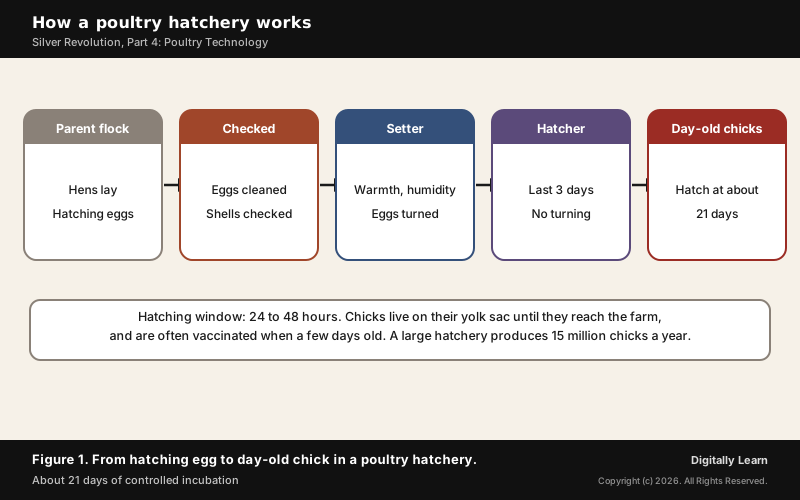
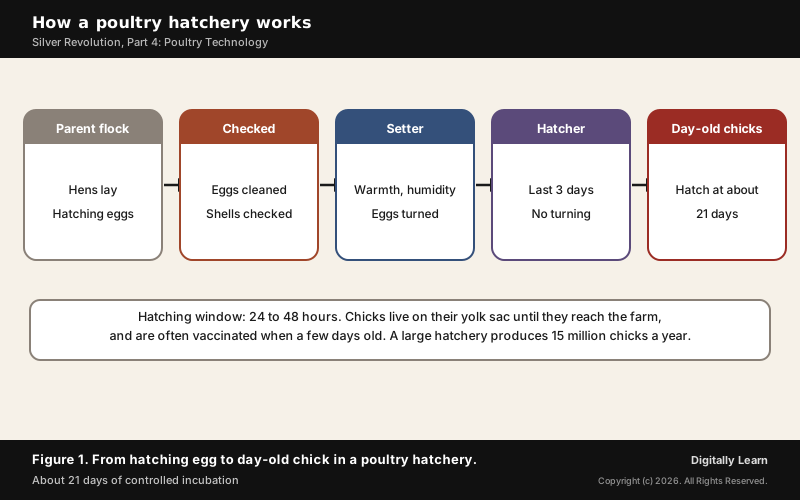
What is the significance of the hatchery in the modern poultry economy. The hatchery is the structural pivot between the four-tier breeding pyramid and the commercial flocks at the bottom. A modern integrator hatchery turns hatching eggs from parent farms into day-old chicks for commercial sale, processing tens of thousands of eggs through a five-stage industrial flow over twenty-one days under tightly controlled climate.

Hatchery process flowHatchery Process Flow: Egg to Day-Old ChickTwenty-one-day journey through programmable incubators with 37.5 C and 55 percent humidity targetsSTAGE 1Egg ReceivingHatching eggs fromparent farms; cooled storageSTAGE 2Setter CabinetDays 1-18: 37.5 C,55% humidity, auto-turningSTAGE 3CandlingDay 18 light-check; rejectinfertile and dead embryosSTAGE 4Hatcher CabinetDays 19-21: hatchingcabinet, no turningSTAGE 5Chick ProcessingVent-sexing, vaccination,beak conditioning, boxingINCUBATION SCIENCETemperature: 37.5 deg Celsius constantRelative humidity: 55 percent (rising to 65 on day 18-21)Egg turning: every 2-3 hours through day 18CO2 control: under 0.4 percent ambientHatchability rate: 80 to 90 percent of fertile eggsCHICK-PROCESSING STEPSVent sexing: separate male and female layersMarek vaccine: subcutaneous at day-oldNewcastle vaccine: spray or eye-dropBoxing: 100 chicks per ventilated boxTransport: cooled vehicles, 4-12 hour reach to commercial farmAUTOMATION AND IOT LAYERProgrammable setter and hatcher cabinetsClimate-control sensors with deviation alarmsAuto-turning trolleys driven by hatchery PLCRemote monitoring via cloud dashboardsModern integrator hatcheries: 100,000+ chick capacity per shiftWHY THE HATCHERY MATTERS TO THE WHOLE INDUSTRYDay-old-chick quality determines the entire downstream commercial flock outcome. A poor hatchery output cascadesthrough 80-week layer cycles or 42-day broiler runs as elevated mortality, slow growth, and reduced productivity.India operates roughly 200 large integrated hatcheries supplying day-old chicks to commercial farms nationwide.Copyright (c) 2026 Digitally Learn. All Rights Reserved.
Five-stage hatchery process. Egg receiving, setter cabinet (days 1-18), candling at day 18, hatcher cabinet (days 19-21), and chick processing with vent-sexing plus first vaccinations. Programmable climate control (37.5 degrees Celsius, 55 percent humidity) drives 80-90 percent hatchability rates on fertile eggs.
  • Setter cabinet (days 1-18): Programmable incubator with constant 37.5 degrees Celsius and 55 percent relative humidity. Auto-turning trolleys rotate eggs every 2 to 3 hours through this phase to prevent embryo adhesion. Carbon dioxide held below 0.4 percent ambient.
  • Candling at day 18: Light-transmission test identifies infertile eggs and dead embryos for removal before transfer. Modern hatcheries use machine-vision candling for speed and accuracy.
  • Hatcher cabinet (days 19-21): Higher humidity rising to 65 percent and no further turning, supporting the final hatch. Pip-and-zip phase culminates at day 21.
  • Chick processing: Vent-sexing separates male and female layers within hours of hatch. Day-old vaccination against Marek’s disease (subcutaneous) and Newcastle disease (eye-drop or spray) follows. Boxing in ventilated 100-chick containers for transport to commercial farms.
  • Automation and IoT layer: Modern integrator hatcheries operate at 100,000-plus chick capacity per shift, with cloud-dashboard climate monitoring and deviation alarms. India runs approximately 200 large integrated hatcheries supplying the commercial flock pipeline.

Feed Mill Engineering: From Grain to Bagged Pellet

Computer-Formulated Rations and Pelleting Science

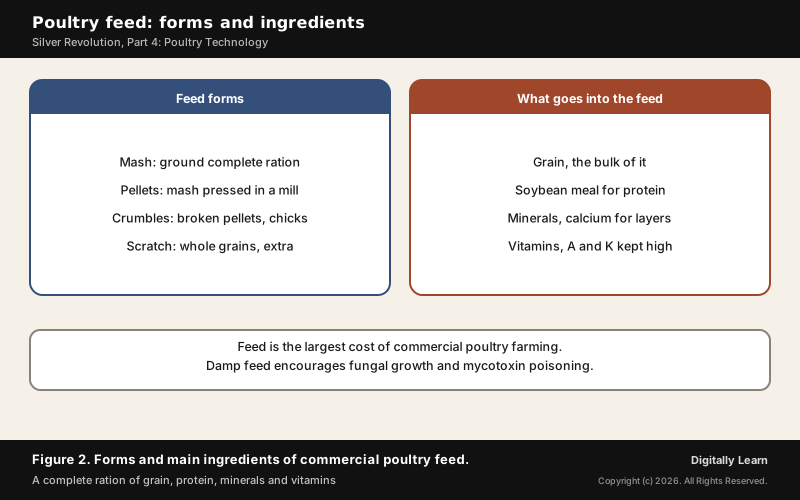
The commercial poultry industry consumes more than half of India's organised compound-feed output. A modern integrator feed mill takes raw grain inputs (maize, soybean meal, de-oiled rice bran) through a ten-step industrial process to a finished pelleted ration matched to bird age, breed, and product type. Computer formulation algorithms balance protein, energy, amino acids, vitamins, and minerals against ingredient prices in near real time.

Feed mill process flowFeed Mill Process Flow: Grain to Bagged PelletComputer-formulated rations matched to bird age, breed, and product type1. RECEIVINGMaize, soybean meal,de-oiled rice bran2. CLEANINGMagnet, sieve,stone separator3. GRINDINGHammer mill2-3 mm particle size4. WEIGHINGComputer-batchedper formulation5. MIXINGHorizontal ribbonmixer; 3-5 min cycle6. PREMIX ADDITIONVitamins, minerals,amino acids, enzymes7. CONDITIONINGSteam 75-85 deg Cmoisture activation8. PELLETINGRing die press;3-5 mm pellets9. COOLINGCounterflow coolermoisture < 12 percent10. BAGGING50 kg woven bags;bulk truck dispatchCOMPOUND FEED FORMULATIONLayer mash energy 2700-2800 kcal per kg, crude protein 16-18 percentBroiler starter energy 3000-3050 kcal per kg, crude protein 22-23 percentBroiler finisher energy 3100-3150 kcal per kg, crude protein 19-20 percentMaize 50-60 percent, soybean meal 20-25 percent, oil 2-5 percent, premix 0.5 percentPhase-feeding adjusts protein and energy as bird age progressesWHY THE PELLET MILL MATTERSSteam-conditioning gelatinises starch; bird digestion improves 5-8 percentHeat treatment kills Salmonella and other feed-borne pathogensUniform pellets reduce feed wastage and bird ingredient sortingBulk-handling efficiency: pellet-mill output handled mechanically end-to-endFCR improvement of 0.1 to 0.2 over mash form alone justifies the capital costINTEGRATOR FEED MILL SCALELarge integrator feed mills (Suguna, Venky, Godrej) operate at 30 to 60 tonnes per hour throughput.Mid-sized commercial mills run 5-15 tonnes per hour; village-level units operate 0.5-2 tonnes per hour for cluster supply.Copyright (c) 2026 Digitally Learn. All Rights Reserved.
Ten-step feed mill process from grain receiving to bagged pellet. Steam-conditioning at 75-85 degrees Celsius gelatinises starch and kills feed-borne Salmonella; pelleting through ring die press delivers 3-5 mm pellets; counterflow cooler brings moisture below 12 percent for storage.
  • Layer mash formulation: Energy 2700-2800 kilocalories per kilogram, crude protein 16-18 percent. Phase-fed across pre-lay, peak-lay, and post-peak phases.
  • Broiler starter formulation: Energy 3000-3050 kilocalories per kilogram, crude protein 22-23 percent. Highest-protein phase to support rapid early growth.
  • Broiler finisher formulation: Energy 3100-3150 kilocalories per kilogram, crude protein 19-20 percent. Energy-shifted formulation for final growth before slaughter.
  • Ingredient breakdown: Maize 50-60 percent, soybean meal 20-25 percent, oil 2-5 percent, premix 0.5 percent. De-oiled rice bran, fish meal, and groundnut cake fill the gap in specific formulations.
  • Pelleting science: Steam conditioning at 75-85 degrees Celsius gelatinises starch (improving digestibility 5-8 percent) and kills feed-borne pathogens. The ring die press extrudes 3-5 millimetre pellets. The counterflow cooler reduces moisture to under 12 percent for storage. FCR improves 0.1 to 0.2 over mash form alone.

Environmental-Controlled Housing and Automated Rearing

How Climate Control Maximises Bird Productivity

Environmental-controlled (EC) housing replaces the open-sided sheds of traditional commercial poultry with a sealed building that holds the bird-comfort temperature range of 22 to 28 degrees Celsius regardless of outside weather. The EC shed is a defining technology of modern Indian commercial poultry.

  • Feature (i): tunnel ventilation. Large exhaust fans at one end pull air through the length of the shed; cooling pads or evaporative coolers at the inlet humidify the incoming air. The result is a continuous airflow that simultaneously cools birds and removes ammonia and dust.
  • Feature (ii): automated feeding and watering. Chain feeders, pan feeders, or auger systems deliver feed to all birds on schedule. Nipple drinkers replace open water troughs, cutting water wastage and disease transmission. Both systems run on programmable timers and consumption sensors.
  • Feature (iii): lighting programmes. LED lighting on programmable timers controls day-length perceived by the birds, which directly drives laying onset and peak productivity in layers and growth uniformity in broilers. Modern EC sheds use intensity-dimmable LED arrays.

Vaccination Stack and Disease-Control Biotechnology

Six to Eight Routine Vaccinations Across the Layer Cycle

Modern commercial layer birds receive six to eight routine vaccinations from day-old to pre-laying age, covering the major viral diseases that historically devastated Indian flocks. Broilers receive a shorter protocol (typically three to four vaccinations) timed to their 42-day cycle. The vaccination stack combined with biosecurity protocols is what makes commercial poultry economically viable.

Vaccination schedule and disease controlLayer Bird Vaccination Schedule and Disease-Control StackSix to eight routine vaccinations from day-old to pre-laying age, plus biosecurity protocolsDay 1Day 7-10Week 4-5Week 8Week 12-14Week 16-18Week 22 lay-onsetDAY 1MAREKSub-cutaneousat hatcheryNEWCASTLE FEye-drop or sprayLentogenic strainDAY 7-10IBD (GUMBORO)Infectious bursaldisease vaccineDrinking waterMass administrationWEEK 4-5NEWCASTLE R2BMesogenic strainboosterFOWL POXWing-web punctureWEEK 8DEWORMINGAnti-parasiticprotocolIBH if neededInclusion-body hepatitisWEEK 12-14IB BOOSTERInfectious bronchitisstrain-specificEDS-76Egg-drop syndromeWEEK 16-18PRE-LAY BOOSTERNewcastle, IB, EDScombinationSALMONELLAin commercial flocksBIOSECURITY PROTOCOLSPerimeter fencing and controlled-access gate at every commercial farmFoot-dip and vehicle-tyre disinfection at all entry pointsAll-in all-out flock management for broilers; staggered for layersPest-bird and rodent control with monthly auditsAvian-influenza surveillance: random sample testing every 90 daysHatchery and parent-farm biosecurity is the highest tier; commercial farms follow integrator protocolsStrong protocols protect 80-week layer revenue and 42-day broiler-cycle continuityBIOTECH AND WASTE-MANAGEMENT TECHRecombinant vaccines for Newcastle and infectious bronchitisGenetic-marker-assisted breed selection at pedigree-line tierProbiotic and prebiotic feed additives reducing antibiotic dependenceLitter composting: layer manure as biofertiliser; broiler litter as fuelBiogas generation from poultry waste at integrator-scale farmsAntibiotic-residue testing increasingly mandated for retail meat exportsNational Action Plan on Antimicrobial Resistance covers poultry sectorCopyright (c) 2026 Digitally Learn. All Rights Reserved.
Layer-bird vaccination timeline from day 1 to pre-lay week 22, covering Marek, Newcastle (F and R2B strains), Infectious Bursal Disease (Gumboro), Fowl Pox, Infectious Bronchitis, Egg Drop Syndrome 76, and Salmonella. Biosecurity and biotech panels on the right summarise the supporting technologies.
  • Marek’s disease vaccine: Administered on day 1 at hatchery via subcutaneous injection. Single most important vaccine for layer flock survival.
  • Newcastle disease cover: F-strain (lentogenic) on day 1, R2B (mesogenic) booster at week 4-5, and combination booster pre-lay.
  • Infectious Bursal Disease (Gumboro): Administered at week 1-2 via drinking water mass administration.
  • Fowl pox vaccine: Wing-web puncture method at week 4-5.
  • Infectious bronchitis boosters: Administered at week 12-14 with strain-specific selection based on regional epidemiology.
  • Egg Drop Syndrome 76: Pre-lay administration at week 16-18 to protect early laying productivity.
  • Salmonella vaccination: Standard in commercial layer flocks under contemporary food-safety mandates.

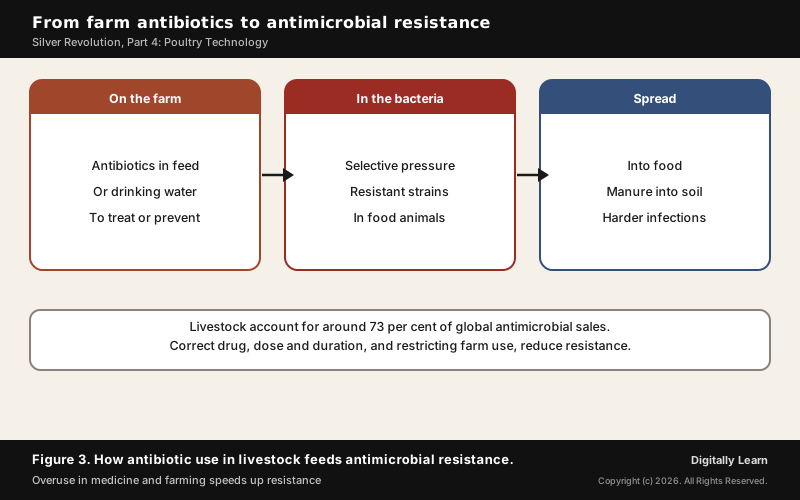
Biotechnology overlay on the vaccination stack includes recombinant vaccines for Newcastle and infectious bronchitis, genetic-marker-assisted breed selection at pedigree-line tier, and probiotic-prebiotic feed additives that reduce antibiotic dependence. The National Action Plan on Antimicrobial Resistance, adopted in 2017, includes the poultry sector explicitly because antibiotic use in livestock farming is one documented cause of microbial multi-drug resistance.

Waste Management Technology and Cold-Storage Infrastructure

From Litter to Biogas and Cold-Chain Processing

Poultry produces large volumes of organic waste, and the modern industry has developed several technology paths to convert this waste into value. Cold-storage infrastructure, separately, enables the processed-poultry value chain that lies downstream of the production technology stack.

Technology Input Output Application
Litter composting Layer manure plus carbon-rich bedding Biofertiliser for crops Standard at most commercial farms; soil-improvement value
Biogas digester Mixed poultry waste with water Methane fuel plus digestate Integrator-scale farms; offsets feed-mill or housing energy use
Litter-to-fuel briquetting Dried broiler litter Solid fuel briquettes Boiler fuel in feed mills and processing plants
Rendering plant Spent layers and slaughter by-products Meat-bone meal, feather meal Returned to feed mill as protein ingredient
Cold storage facility Dressed broiler carcasses, processed eggs Refrigerated stored product Enables 5-7 day shelf life retail; export packaging
Egg-grading and packing line Whole eggs from layer farms Graded, labelled, palletised eggs Retail-ready supply to organised retailers

Observable Outcomes of Technology Adoption

What the Industrial Stack Delivered

The technology stack delivered three measurable productivity gains that together explain how India scaled to 138 billion eggs and over 2 billion broilers annually.

  • Outcome (a): four-fold layer productivity gain. Commercial hybrid layers in EC housing on pellet feed with full vaccine cover deliver 300 to 320 eggs per year, against 60 to 80 from backyard birds. The differential is the technology stack, not the breed alone.
  • Outcome (b): broiler FCR improvement from 2.5 to 1.6. Modern broilers convert 1.6 kilograms of feed to 1 kilogram of body weight, against 2.5 to 3.0 for unimproved broiler strains on mash feed in open housing. Pellet feed and EC housing each contribute roughly 0.2 FCR improvement.
  • Outcome (c): chick mortality fall to under 5 percent. Day-old chick to slaughter mortality has fallen to under 5 percent for commercial broilers under full biosecurity and vaccination protocols, against 15 to 20 percent for unprotected backyard birds. The vaccination and biosecurity stack drives this outcome.

Contemporary Linkages and UPSC Relevance

Technology-Layer Themes in the Examinations

The technology stack of Indian poultry intersects four contemporary themes that recur in General Studies questions: food processing infrastructure, antimicrobial resistance, Industry 4.0 in agriculture, and waste-to-energy biotechnology.

  • Food processing scope and significance: Cold-storage facilities, egg-grading lines, dressed-broiler plants, and rendering operations are all food-processing infrastructure that the National Mission on Food Processing supports. Recent General Studies questions on food processing scope map directly to the cold-chain and processing dimension of Part 4.
  • Antimicrobial resistance and antibiotic use: Antibiotic use in livestock farming is one of the documented causes of microbial multi-drug resistance addressed by the National Action Plan on AMR (2017). Recent Prelims questions on multi-drug resistance touch the livestock-antibiotic linkage directly, with poultry as the canonical case.
  • Industry 4.0 and IoT in agriculture: Programmable hatcheries, cloud-dashboard climate monitoring, and machine-vision candling are concrete Industry 4.0 deployments in Indian agro-industry. The Digital India and Smart Agriculture frameworks map to this dimension.
  • Waste-to-energy biotechnology: Biogas from poultry waste, litter briquetting, and rendering all illustrate the circular-economy principle in livestock value chains. Renewable-energy policy frameworks and the Galvanizing Organic Bio-Agro Resources Dhan scheme touch this domain.

Sources

Editorial Disclaimer

This article is compiled from the reference materials listed in the Sources section. It is an explainer for UPSC preparation and is not a substitute for primary documents (NCERTs, GoI ministry releases, IMD bulletins, RBI / CEA / MoEFCC publications, and Standing-Committee reports).

Part 4 of 10 · Silver Revolution

All 10 parts in this cluster
  1. 1 Part 1: Concept, Evolution, and Features
  2. 2 Part 2: Spatial Distribution and State Geography
  3. 3 Part 3: Egg and Broiler Components
  4. 4 Part 4: Technology and Infrastructure (this article)
  5. 5 Part 5: Economic, Nutritional, and Social Importance
  6. 6 Part 6: Farming Systems and Government Framework
  7. 7 Part 7: Environment, Disease, and Biosecurity
  8. 8 Part 8: Challenges and Regional Disparities
  9. 9 Part 9: Agricultural Geography and Contemporary Trends
  10. 10 Part 10: Geography Optional and Sustainability Implications