


Overview
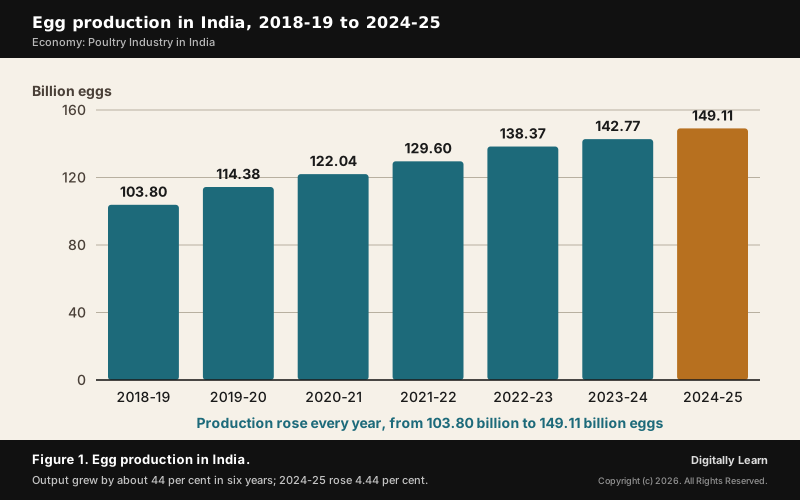
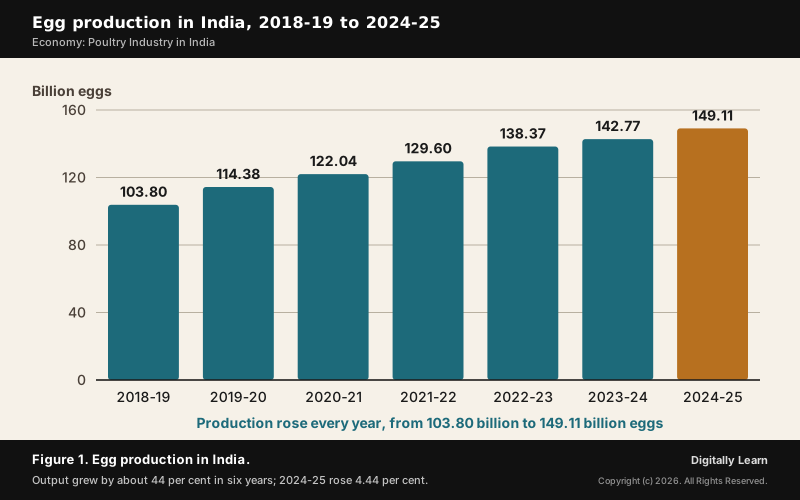
The poultry industry in India raises chickens and ducks for eggs and meat, with the hatcheries, feed mills and markets that serve them. It produced 149.11 billion eggs and 5.18 million tonnes of poultry meat in 2024-25, making India the second largest egg producer in the world, and it is organised mainly by private integrator companies through contract farming.
Poultry Industry in India: Size, Output and Value
Poultry Sector in India Today: Birds, Eggs and Chicken Meat
The poultry industry is the business of raising domestic birds, mainly chickens and some ducks, for eggs and meat, together with the hatcheries, feed mills, medicines and markets that serve it. Its size is counted in two ways: by the number of birds, measured every five years by the Livestock Census, and by what the birds produce, estimated every year by the Integrated Sample Survey of the Department of Animal Husbandry and Dairying.
- Birds: The 20th Livestock Census of 2019 counted 851.81 million poultry birds, 16.81 per cent more than the previous census. The 21st census was launched on 25 October 2024.
- Eggs: Production reached 149.11 billion in 2024-25, up 4.44 per cent in a year, which gives 106 eggs per person per year.
- Meat: Poultry meat reached 5.18 million tonnes in 2024-25, up 3.10 per cent, and made up about half of India’s 10.50 million tonnes of meat.
- Where: Andhra Pradesh, Tamil Nadu and Telangana lay almost half of India’s eggs, and ten states hold about 78 per cent of all poultry birds.
Growth over a longer span shows how recent this industry is. Egg production was about 37 billion in 2000-01 and about 70 billion in 2012-13; it nearly doubled again by 2022-23. Poultry meat rose from about 3.2 million tonnes in 2012-13 to 4.995 million tonnes in 2022-23. Over the past decade the sector has grown by 7 to 10 per cent a year. How the industry began, and the role of hybrid birds, is explained in the meaning and history of the silver revolution, and the state pattern in the highest egg producing states.
Poultry in the Livestock Economy: Value of Output
Livestock supplied 31 per cent of the gross value added of agriculture in 2023-24 and about 5.5 per cent of the national gross value added, and poultry is its fastest-moving part. In 2023-24, at current prices, poultry meat was worth ₹2,01,669 crore and eggs ₹65,808 crore. Milk remains far larger, at ₹12,20,986 crore and about 64 per cent of the value of all livestock output.
Inside the meat group, poultry meat is both the largest and the fastest-growing segment, with almost 42 per cent of the value of all meat. The meat group itself rose from about 20.7 per cent of livestock output in 2014-15 to 24.8 per cent in 2023-24, and much of that shift came from chicken, as rising incomes, cities and changing diets pushed up demand for animal protein. The Department of Animal Husbandry and Dairying puts the poultry sector's contribution to agricultural output at about ₹1.3 lakh crore a year.
How the Poultry Sector Is Organised: Farms, Integrators and Firms
Commercial and Backyard Poultry Compared
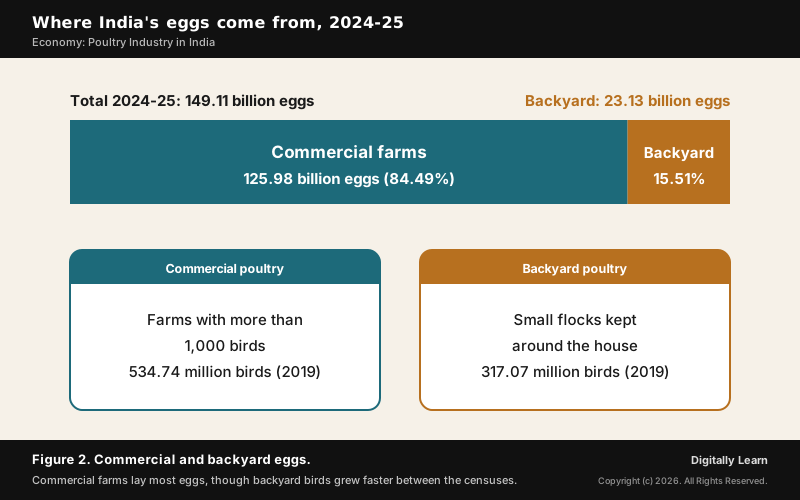
India's poultry is raised in two very different systems. Commercial poultry means farms with more than 1,000 birds, housed in sheds and fed on manufactured feed; backyard poultry means the small flocks a rural household keeps around the house. The first is a business, the second a source of extra income and food for poor families. Commercial farms keep improved breeds: layers bred for eggs and broilers for meat, developed by cross-breeding Indian breeds such as Aseel with foreign ones such as Leghorn.
| Measure | Commercial poultry | Backyard poultry |
|---|---|---|
| Birds, 2019 census | 534.74 million | 317.07 million |
| Growth since 2012 census | 4.50 per cent | 45.78 per cent |
| Eggs, 2024-25 | 125.98 billion (84.49 per cent) | 23.13 billion (15.51 per cent) |
| Share of eggs from improved fowl, all systems | 86.35 per cent | Desi fowl 12.59 per cent |
The two systems differ in pace as well as scale. Commercial farms lay most of the eggs, and improved fowl alone account for 86.35 per cent of eggs, against 12.59 per cent from desi fowl and about 1 per cent from ducks. Yet the number of backyard birds grew far faster between the 2012 and 2019 censuses. The National Livestock Mission backs this rural side with a one-time 50 per cent capital subsidy, up to ₹25 lakh, for a parent farm, rural hatchery and mother unit of low input technology birds suited to free-range rearing; the schemes are explained in the types of poultry farming and government schemes.
Chicken Industry in India: Integrators and Contract Farming
Contract farming and vertical integration are widespread in the chicken industry in India. In contract farming, a company supplies the inputs and buys back the output, while the farmer supplies the land, the shed and the labour. The company that runs the whole chain is called an integrator, and owning every stage from parent birds to processing is vertical integration.
- Breeder farms keep the parent birds and supply fertile eggs.
- Hatcheries incubate the eggs and send out day-old chicks.
- Feed mills grind maize and soybean meal into feed for every stage.
- Contract farmers rear the chicks in their own sheds with the company’s chicks, feed and veterinary help.
- The company collects the grown birds and sells them live or processes them into packed chicken.
Suguna Foods, set up in 1984 in Coimbatore, built this model in the 1980s, when farmers bought chicks, feed and other inputs separately. Under contract farming the farmer no longer has to buy chicks and feed in the open market, and earns from rearing the birds. The private sector now runs 8,123 poultry breeding farms against 235 run by government departments.
The model has a cost too. The farmer depends on one buyer, and the terms are set by the company. In the United States, where about 90 per cent of poultry is produced under such contracts, critics have argued that many contract growers earn very little. The same questions about fair terms arise in India, and they are discussed in the problems of poultry farming in India.
Indian Poultry Companies: Venky's, Suguna and Godrej
A handful of Indian poultry companies grew into national groups by doing every step of the chain themselves. Each began with a different strength, and together they explain how India's chicken industry was built by private firms rather than by cooperatives, as dairy was.
- Venkateshwara Hatcheries (VH Group): Founded in 1971 by Banda Vasudev Rao, often called the father of the Indian poultry industry. Its listed company, Venky’s (India) Limited of Pune, works in breeding, hatcheries, feed, specific-pathogen-free eggs, processed chicken and animal health.
- Suguna Foods: Founded in 1984 by B. Soundararajan and G. B. Sundararajan in Coimbatore. It spread contract farming across India and runs breeding, hatcheries, feed mills and processing, with operations in Bangladesh, Sri Lanka and Kenya.
- Godrej Agrovet: A feed and agribusiness company of the Godrej Group. Its joint venture with Tyson Foods of the United States, set up in 2008, runs automated farms and sells packaged chicken.
B. V. Rao also founded the National Egg Coordination Committee (NECC) in 1982, a farmers' trust that sets indicative egg prices, and received the Padma Shri in 1990. His career shows the industry's two halves: a company that sells chicks and feed, and a farmers' body that fights for a fair price for eggs.
Poultry Market in India: Egg Prices, Live Birds and Processing
Egg Prices and the National Egg Coordination Committee
The poultry market in India sells two products that behave differently: eggs, which keep for a while and travel between states, and broilers, which are sold as soon as they reach slaughter weight at four to six weeks of age. Egg prices therefore need a common reference across production centres, and that reference comes from a farmers' body.
In the early 1980s egg prices fell below the cost of production and many farmers shut down. Farmers' groups travelled the country, held more than 300 meetings and in May 1982 registered the NECC as a trust; it began announcing egg prices on 14 May 1982. Today it publishes daily and monthly average egg prices for production centres across India. These prices are benchmarks that traders follow, not binding orders, and the body has more than 35,000 members.
Live Bird Markets, Processed Chicken and the Cold Chain
Chicken in India reaches the buyer either as a live bird, traded through live bird markets and shops that slaughter on the spot, or as processed meat. The live trade needs no refrigeration. Its cost is hygiene and disease risk: the 2024 Poultry Disease Action Plan reports avian influenza viruses such as H9N2 in live bird markets, and sets biosecurity rules for them.
Cities are trying to modernise these markets. Delhi is building a new poultry market on nearly 15 acres at Ghazipur at a cost of ₹193.29 crore, with shops for 100 wholesale traders and 120 processing units; work began in March 2019 and was about 85 per cent complete in August 2026. Processed chicken, cleaned, cut and chilled or frozen, is the newer segment, sold under brands such as Venky's, Suguna's Delfrez and Godrej Tyson's packaged chicken.
- Cold chain: Chilled and frozen chicken needs refrigerated transport and storage at every step from plant to shop.
- Consumer habit: A buyer used to choosing a live bird has to be persuaded to trust a packet.
- Scattered supply: Lakhs of small farms make quality control and traceability hard.
- Digital sales: Online ordering and app-based delivery can link processors directly to city buyers, but only where the cold chain already exists.
Poultry Export from India and Global Comparison
Poultry Exports and Which Meat Is Exported from India
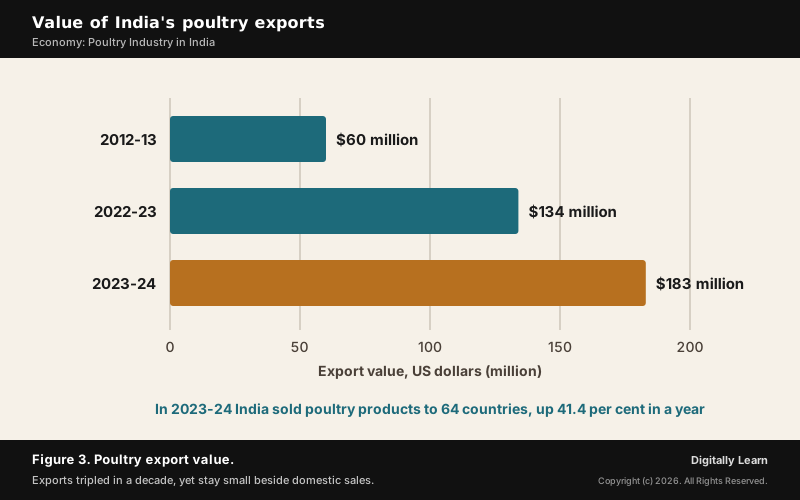
Poultry exports from India are small beside its home market, but they are growing. Their value rose from about 60 million US dollars in 2012-13 to 134 million in 2022-23 and 183 million in 2023-24, a rise of about 41 per cent in one year. In 2023-24 India sent poultry products to 64 countries, led by Oman, the United Arab Emirates, Indonesia, the Maldives and Japan. The main items were hatching eggs, table eggs and grandparent chicks.
Bird flu is a barrier, because an outbreak can close export markets. India answers this with compartmentalisation: a group of farms under one strict biosecurity system is declared free of avian influenza, so it can export even if the disease appears elsewhere in India. India had 32 such avian-influenza-free compartments, self-declared to the World Organisation for Animal Health.
Measured in rupees, eggs and egg products earned ₹1,308 crore in 2024-25, and the official statistics describe this as stagnation. Poultry meat exports were smaller still, about ₹112 crore. India's meat exports are led by a different animal altogether: frozen buffalo meat, its single largest livestock export, earned ₹31,074 crore in 2024-25. So if a question asks which meat is exported from India the most, the answer is buffalo meat, not chicken.
India Against China, the United States and Brazil
Poultry is the most numerous livestock on earth: the world's chickens number about 27 billion, nearly 78 per cent of all livestock, and the global poultry population grew 19.5 per cent between 2016 and 2023 to 29.12 billion birds. World egg output rose from 80.6 million tonnes in 2016 to 97.41 million tonnes in 2023.
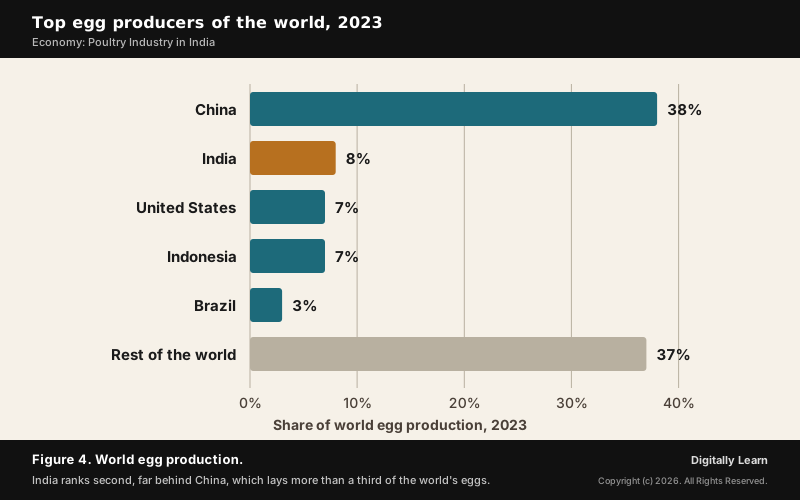
India's position is strong in eggs and modest in meat. In 2023 China laid 38 per cent of the world's eggs, India 8 per cent, the United States and Indonesia 7 per cent each and Brazil 3 per cent. Between 2016 and 2023 India's egg production rose by 72 per cent and Indonesia's by 275 per cent. In all meat, India ranks fourth with about 3 per cent of world output, behind China, the United States and Brazil.
Poultry vs Dairy Farming in India
Poultry and Dairy Farming Compared: Output, Organisation and Feed
Poultry and dairy are India's two great livestock industries, and they grew in opposite ways. Dairy grew through cooperatives of small farmers under Operation Flood and the Amul model; poultry grew through private companies and contract farming. The difference shapes who owns the industry and who carries its risks.
| Feature | Dairy farming | Poultry farming |
|---|---|---|
| World rank | First in milk | Second in eggs, fifth in poultry meat |
| Output, 2024-25 | 247.87 million tonnes of milk | 149.11 billion eggs, 5.18 million tonnes of meat |
| Per person | 485 grams of milk a day | 106 eggs a year |
| Value of output, 2023-24 | ₹12,20,986 crore (milk group) | ₹2,01,669 crore meat and ₹65,808 crore eggs |
| Organisation | Built around cooperatives (Operation Flood, Amul) | Private integrators and contract farms |
| Animals' feed | Mostly crop residues and by-products | Manufactured feed; maize and soybean are the main grains |
The feed line matters most for policy. Cattle and buffaloes eat what people cannot, such as straw and crop residues, so dairy competes little with food. Commercial poultry eats grain, so its costs rise whenever maize or soybean prices rise. In return, a broiler turns feed into meat far more efficiently than beef cattle and reaches slaughter weight in four to six weeks, which is why poultry could expand quickly once hybrid birds and feed mills arrived. The cooperative story of milk is told in the White Revolution in India.
Poultry Industry Challenges: Feed, Disease and Jobs
Feed Costs, Bird Flu and Employment in the Poultry Sector
Commercial poultry runs on bought feed, and maize and soybean are the two most important feed grains. Maize is now also a fuel crop: the government said in August 2026 that nearly three-fourths of the ethanol produced in India comes from grains, mainly maize, as the country blends ethanol into petrol. Maize exports have fallen and India recently became a net importer of maize, so poultry farmers compete with distilleries for the same grain.
Disease is the second pressure. An outbreak of highly pathogenic bird flu brings culling of infected and nearby birds and movement restrictions, and it can shut export markets; how outbreaks are controlled is explained in poultry diseases and bird flu in India. The third is the environmental footprint of large farms, from manure to ammonia, covered in poultry manure and sustainable poultry farming.
Against these pressures stands the industry's value as a source of work. A backyard flock needs little land and capital, so it suits landless and small households. Maharashtra's 2026 bill to recognise women farmers names women engaged in poultry farming among those to be counted, and some of the recent rise in rural women's work has come from older women taking up animal husbandry and poultry.
Previous Year UPSC-CSE Questions
Previous Year UPSC-CSE Questions By the end you will be able to draft model answers for the following UPSC questions. Each question carries a collapsible framework showing how to approach it in the exam.
- UPSC Mains 2015 GS-IIILivestock rearing has a big potential for providing non-farm employment and income in rural areas. Discuss suggesting suitable measures to promote this sector in India.
Answer outline: how to structure the answer
What the question asks, the main arguments, relevant examples and the direction of the conclusion. This is not a full model answer.
Introduction: Livestock supplied 31 per cent of agricultural gross value added in 2023-24; poultry, with 149.11 billion eggs and 5.18 million tonnes of meat in 2024-25, shows how a livestock activity can grow like an industry.
Body (sub-themes to develop):
- Why the potential is large: little land and capital needed, quick returns (a broiler reaches slaughter weight in four to six weeks), work for women; backyard birds grew 45.78 per cent between the 2012 and 2019 censuses.
- Forms of employment: backyard flocks, contract farming for integrators, hatcheries, feed mills, transport, processing and retail.
- Measures on inputs: improved birds for backyard flocks, feed grain supply as maize goes to ethanol, veterinary cover.
- Measures on markets: cold chains and processing, modern poultry markets, fair contract terms, exports through avian-influenza-free compartments.
- Measures on risk and institutions: insurance, credit, producer groups and cooperatives on the dairy model, recognition of women livestock farmers.
Conclusion: Conclude that livestock can absorb rural labour only if small producers get inputs, markets and protection from price and disease shocks, as poultry's mixed record shows.
- UPSC Prelims 2005 Prelims-GSMatch List I (Distinguished Person) with List II (Area of Work) and select the correct answer using the codes given below the lists. List II: 1. Automobiles Manufacture, 2. Fisheries Economy, 3. Information Technology and Software, 4. Poultry Farming, 5. Management Science.
- (A) B.V. Rao
- (B) C.K. Prahlad
- (C) John Kurien
- (D) Kiran Karnik
Select the correct answer using the codes given below the lists.
How to approach this Prelims question
Approach: Step 1: B. V. Rao founded the VH Group (Venky's) and the NECC, so A matches 4, poultry farming; only options (b) and (d) keep A with 4. Step 2: C. K. Prahalad was a professor of business at the University of Michigan and a management thinker, so B matches 5, management science. Step 3: that rules out (b), which gives B to information technology. Step 4: in (d) Kiran Karnik goes with information technology and software, the outsourcing industry he is known for, and John Kurien with fisheries economy.
Trap to watch: Kurien is a famous name in dairy (Verghese Kurien), so a hasty reader may look for a dairy option; the John Kurien of this question is a fisheries economist, and no dairy option is offered.
Key facts to recall:
- (a) A-2 B-5 C-1 D-3: wrong. B. V. Rao is poultry farming (4), not fisheries.
- (b) A-4 B-3 C-2 D-5: wrong. Prahalad is management science (5), not information technology.
- (c) A-2 B-3 C-1 D-5: wrong. Rao is poultry and Prahalad management; neither pairing here is right.
- (d) A-4 B-5 C-2 D-3: right. Rao poultry, Prahalad management science, Kurien fisheries, Karnik IT.
Answer signal: A-4 B-5 C-2 D-3: option (d), because B. V. Rao built the poultry industry and Prahalad was a management thinker.
- UPSC Mains 2015 GS-IIIWhat are the impediments in marketing and supply chain management in developing the food processing industry in India? Can e-commerce help in overcoming these bottlenecks?
Answer outline: how to structure the answer
What the question asks, the main arguments, relevant examples and the direction of the conclusion. This is not a full model answer.
Introduction: Food processing turns perishable farm output into products that keep and travel; its growth depends on the chain between farm and buyer.
Body (sub-themes to develop):
- Supply chain: gaps in cold chain and storage, so chilled or frozen products cannot travel far.
- Fragmented supply: lakhs of small producers make quality, grading and traceability hard.
- Market structure: live bird markets and many intermediaries; consumer preference for fresh, unprocessed food.
- Risk: disease outbreaks and perishability (broilers are sold at four to six weeks of age).
- E-commerce helps: direct link from processor to urban buyer, price discovery, brand building, fewer intermediaries.
- E-commerce cannot fix: physical logistics, refrigeration, rural internet gaps, food safety at source.
Conclusion: Conclude that e-commerce is a marketing tool that works on top of a cold chain and organised supply, so investment in logistics must come first.
Sources
- NCERT: Science, Class IX, Chapter 15, Improvement in Food Resources (poultry farming)
- Department of Animal Husbandry and Dairying: Basic Animal Husbandry Statistics 2025
- Department of Animal Husbandry and Dairying: Poultry Disease Action Plan 2024
- Department of Animal Husbandry and Dairying: 20th Livestock Census 2019, key results
- Press Information Bureau: 21st Livestock Census
- Wikipedia: Suguna Foods
- Wikipedia: Venky's
- Wikipedia: B. V. Rao
- Wikipedia: National Egg Coordination Committee
- Wikipedia: Godrej Agrovet
- Wikipedia: Compound feed
- Wikipedia: Broiler
- Wikipedia: Feed conversion ratio
- Department of Animal Husbandry and Dairying: National Livestock Mission guidelines
- Wikipedia: Vertical integration
- Wikipedia: Contract farming
- The Hindu (Delhi), 23 June 2026: Unions write to PM against free trade pact with U.S.
- The Hindu (Delhi), 3 July 2026: Maharashtra Bill to recognise women farmers
- The Hindu (Delhi), 25 July 2026: women's work participation and animal husbandry
- The Hindu (Delhi), 4 August 2026: Delhi reviews mandi projects including the Ghazipur poultry market
- The Hindu (Delhi), 18 August 2026: Decoding India's growth in merchandise exports
- The Hindu (Delhi), 22 August 2026: Sugar price hike, Centre says ethanol not to blame
- The Hindu (Delhi), 17 September 2026: What lies beyond India's E20 push
- Wikipedia: C. K. Prahalad
- Wikipedia: Verghese Kurien
- Wikipedia: Poultry farming in India
- Wikipedia: Avian influenza
- Wikipedia: Kiran Karnik
- UPSC: Civil Services Examination question papers
Editorial Disclaimer
This article draws on official statistics and the other sources listed on this page.