


Overview
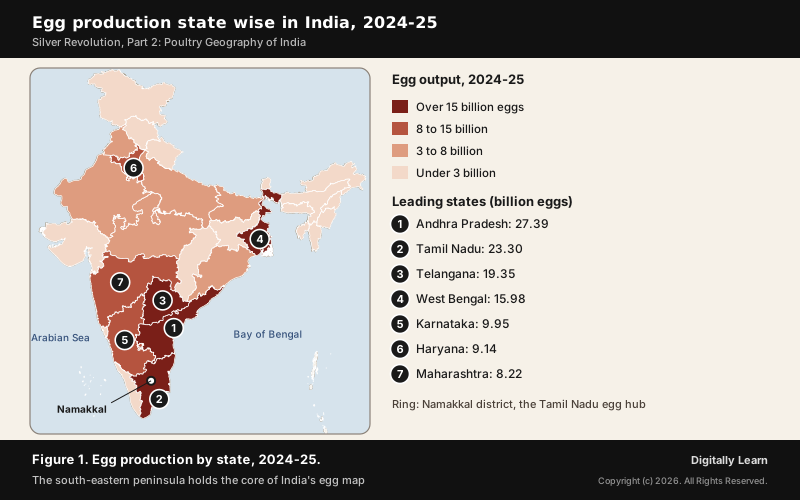
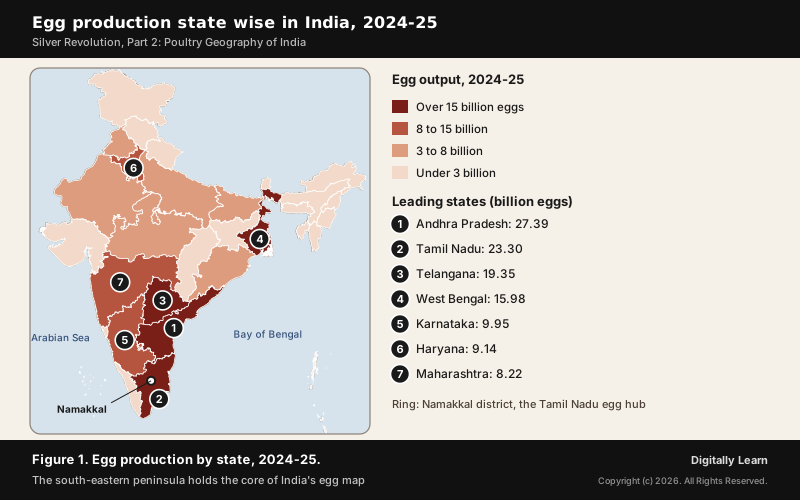
Andhra Pradesh is the highest egg producing state in India, with 18.37 per cent of national egg output in 2024-25, followed by Tamil Nadu, Telangana, West Bengal and Karnataka. Together these five states produce 64.37 per cent of India's 149.11 billion eggs. The poultry map of the Silver Revolution is uneven: eggs cluster in the south-east, broiler meat is spread wider, and backyard flocks matter most in the east.
Highest Egg Producing State in India: The Egg Map
Highest Egg Producing State in India: Andhra Pradesh and the Top Five
India's egg production is concentrated in a few states of the south-eastern peninsula. Andhra Pradesh, the largest egg producing state in India, has led throughout 2018-19 to 2024-25. With Tamil Nadu and Telangana, it produces almost half (46.98 per cent) of the country's eggs.
| State | Eggs, 2024-25 (billion) | Eggs per person a year |
|---|---|---|
| Andhra Pradesh | 27.39 | 514 |
| Tamil Nadu | 23.30 | 302 |
| Telangana | 19.35 | 506 |
| West Bengal | 15.98 | 161 |
| Karnataka | 9.95 | 146 |
| Haryana | 9.14 | 299 |
| Maharashtra | 8.22 | 65 |
| Uttar Pradesh | 6.11 | 26 |
| Punjab | 5.06 | 164 |
| Odisha | 3.90 | 84 |
The leaders are the States with the largest commercial layer flocks. In 2024-25 Andhra Pradesh had 93.66 million improved layers on commercial farms, Tamil Nadu 87.51 million and Telangana 55.55 million, far ahead of Haryana (32.60 million) and Karnataka (30.74 million). Beyond the top three, West Bengal, Karnataka, Haryana and Maharashtra each contribute more than 5 per cent of India's eggs.
State Wise Egg Production: Per Capita Availability and Growth
Output per person shows the concentration even more sharply. India's per capita availability was 106 eggs a year in 2024-25, up from 79 in 2018-19, and only eight States had more than the national average.
- Surplus states: Andhra Pradesh (514 eggs a person a year) and Telangana (506) lead, followed by Tamil Nadu (302) and Haryana (299).
- Low-output states: Large states such as Uttar Pradesh (26) and Bihar (29) produce far fewer eggs per person than the national figure.
- Growth: National output grew by 4.44 per cent in 2024-25; eleven States grew faster, among them Bihar, Gujarat, Punjab, Andhra Pradesh, Haryana and Maharashtra.
- Slowing pace: Output rose from 103.8 billion eggs in 2018-19 to 149.11 billion in 2024-25, nearly 44 per cent, but the annual growth rate fell from 10.19 per cent in 2019-20 to 3.18 per cent in 2023-24.
Regional Pattern of Egg Production: South, East, North, West and North-East
Grouping the States into regions shows how lopsided the egg map is. The five southern States and Puducherry produced 82.52 billion eggs in 2024-25, 55.3 per cent of the national total, while the eight north-eastern States together produced 1.41 billion, 0.9 per cent.
| Region | Eggs, 2024-25 (billion) | Share of India (%) |
|---|---|---|
| South | 82.52 | 55.3 |
| East | 24.75 | 16.6 |
| North | 21.23 | 14.2 |
| West and Central | 19.11 | 12.8 |
| North-East | 1.41 | 0.9 |
| Islands | 0.08 | 0.1 |
- East: West Bengal, Odisha, Bihar and Jharkhand together produced 24.75 billion eggs, led by West Bengal’s backyard flocks.
- North: Haryana and Punjab are the northern egg States; with Uttar Pradesh they make up most of the region’s 21.23 billion eggs.
- Rising States: Uttar Pradesh’s output grew from 2.61 billion eggs in 2018-19 to 6.11 billion in 2024-25, and Bihar’s from 1.76 to 3.78 billion.
- Falling: Punjab produced fewer eggs in 2024-25 (5.06 billion) than in 2018-19 (5.59 billion).
Poultry Population in India and Production Systems by State
Poultry Population in India State Wise: Backyard and Commercial Flocks
The Livestock Census, conducted every five years since 1919, counts the country's livestock and poultry. The 20th Livestock Census of 2019 counted 851.81 million poultry, up 16.8 per cent over the previous census; poultry is the largest share of India's livestock, at 61 per cent in 2019.
| State | Poultry, 2019 (million) | Change since 2012 (%) |
|---|---|---|
| Tamil Nadu | 120.8 | 2.92 |
| Andhra Pradesh | 107.9 | 33.85 |
| Telangana | 80.0 | -0.93 |
| West Bengal | 77.3 | 46.34 |
| Maharashtra | 74.3 | -4.49 |
| Karnataka | 59.5 | 11.33 |
| Assam | 46.7 | 71.63 |
| Haryana | 46.3 | 8.11 |
| Kerala | 29.8 | 22.61 |
| Odisha | 27.4 | 37.95 |
- Backyard boom: Backyard poultry rose 45.8 per cent to 317.07 million, while commercial poultry rose only 4.5 per cent to 534.74 million.
- Fastest growth: Assam (71.63 per cent) and West Bengal (46.34 per cent) grew fastest among the major states, both strongholds of backyard rearing.
- Next count: The 21st Livestock Census was announced on 25 October 2024.
Two production systems draw two different maps. Commercial farms produced 125.98 billion eggs, 84.49 per cent of the total in 2024-25, and are concentrated in the southern egg belt. Backyard poultry produced 23.13 billion eggs, 15.51 per cent, spread across the east, north-east and Kerala.
- By species: Improved fowl produced 86.35 per cent of eggs, desi fowl 12.59 per cent, desi ducks 0.85 per cent and improved ducks 0.22 per cent.
- West Bengal: The largest backyard egg producer by a wide margin; most of its eggs come from backyard fowl and ducks rather than commercial farms.
- Ducks: Duck eggs come mainly from West Bengal, Assam, Kerala and Tripura.
- Kerala: Leads in backyard eggs from improved fowl.
Poultry Meat Production by State in India
Largest Poultry Producing States for Meat: Maharashtra, West Bengal and Haryana
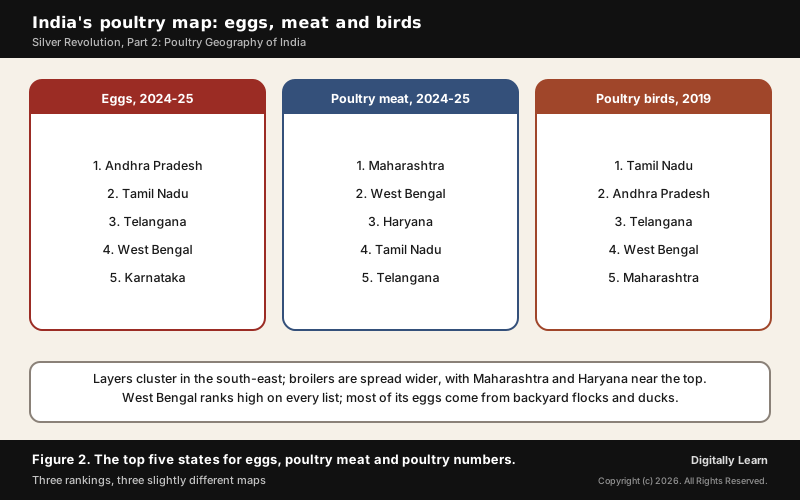
The broiler map differs from the egg map. India produced 5.18 million tonnes of poultry meat in 2024-25, 49.27 per cent of all meat, and poultry meat grew 3.10 per cent over the previous year. The leading poultry meat states are spread across the west, east and north as well as the south.
| State | Poultry meat, 2024-25 (thousand tonnes) |
|---|---|
| Maharashtra | 790 |
| West Bengal | 710 |
| Haryana | 673.39 |
| Tamil Nadu | 600 |
| Telangana | 489.77 |
| Andhra Pradesh | 420 |
| Uttar Pradesh | 370 |
| Kerala | 237.41 |
| Karnataka | 174.38 |
| Odisha | 137 |
- All meat: The top five meat states overall are West Bengal (12.46 per cent), Uttar Pradesh (12.20), Maharashtra (11.57), Andhra Pradesh (10.84) and Telangana (10.49).
- Haryana: Third in poultry meat but sixth in eggs, showing a broiler-led poultry economy in the north.
- Growth: Andhra Pradesh recorded the highest growth in total meat production in 2024-25, 6.53 per cent.
Per person, meat availability tells a similar story. India's per capita meat availability rose from 6.15 kg a year in 2018-19 to 7.50 kg in 2024-25. It is highest in Telangana (28.78 kg), Haryana (23.87 kg) and Andhra Pradesh (21.33 kg), the broiler States, and lowest in Gujarat (0.53 kg), Uttarakhand (2.18 kg) and Rajasthan (2.92 kg).
Poultry Clusters: Namakkal and the Integrated Companies
Poultry Clusters and Contract Farming: Namakkal and the Integrators
Poultry is concentrated not only by state but by district. Namakkal, a district of Tamil Nadu carved out of Salem district in 1996, is the clearest example: poultry plays an important role in its economy.
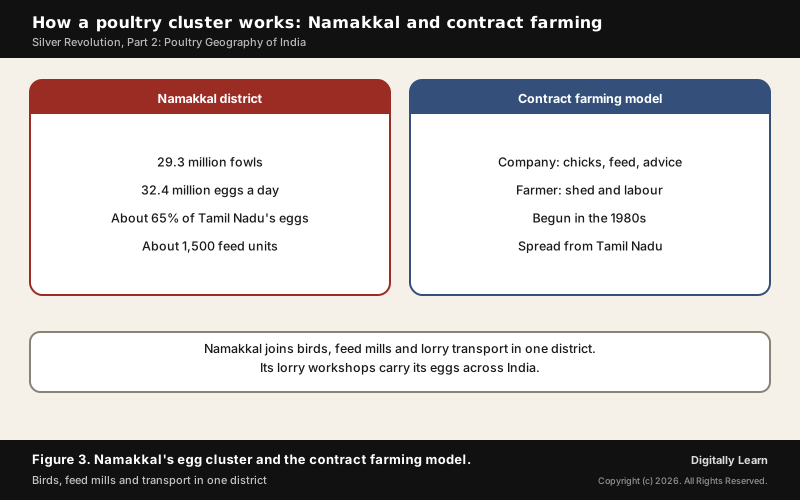
- Scale: The district has 29.3 million fowls and produces 32.4 million eggs every day, about 65 per cent of Tamil Nadu’s egg output.
- Feed: About 1,500 poultry and cattle feed manufacturing units operate in the district.
- Transport: More than 5,000 lorry workshops are located in Namakkal, and egg production is largely facilitated by lorry transport.
Much of India's commercial poultry is run by integrated companies that control breeding, hatcheries, feed and processing. Vertical integration and contract farming are widespread in poultry, and an estimated 200 million egg-laying hens are kept in battery cages.
- B.V. Rao: Considered by many the father of the poultry industry in India, he founded the VH Group in 1971 and was founder chairman of the National Egg Coordination Committee (NECC).
- Suguna Foods: Established in 1984 and headquartered in Coimbatore, Tamil Nadu, it built an integrated business of breeding, hatcheries, feed, contract farming and processing.
- The contract model: The company provides chicks, feed and technical support, and the farmer provides the shed and labour; the model spread from Tamil Nadu to other parts of India.
Spreading Poultry to Lagging States: Policy
National Livestock Mission: Rural Poultry Entrepreneurship
Policy also promotes rural poultry beyond the established belts. The livestock sector provides alternate livelihoods to over 70 million small and marginal farmers, including landless labourers, and a significant number of women work in it.
- Subsidy: The National Livestock Mission gives a one-time 50 per cent capital subsidy, up to Rs 25 lakh per unit, for a parent farm, rural hatchery and mother unit with at least 1,000 parent layers.
- Who can apply: Individuals, self-help groups, farmer producer organisations, farmer cooperatives, joint liability groups and Section 8 companies.
- Hub and spoke: Units produce hatching eggs and chicks and rear the chicks up to four weeks; preference goes to entrepreneurs who build forward and backward linkages, and the aim is to bring unorganised rural poultry into the organised sector.
- Low input birds: Units keep low input technology birds suited to free-range rearing, such as Vanaraja and Gramapriya from ICAR’s Directorate of Poultry Research in Hyderabad and CARI Gold from the Central Avian Research Institute at Izatnagar.
Previous Year UPSC-CSE Questions
Previous Year UPSC-CSE Questions By the end you will be able to draft model answers for the following UPSC questions. Each question carries a collapsible framework showing how to approach it in the exam.
- UPSC Mains 2015 GS-IIILivestock rearing has a big potential for providing non-farm employment and income in rural areas. Discuss suggesting suitable measures to promote this sector in India.
How to structure the answer in the exam
Introduction: Livestock provides alternate livelihoods to over 70 million small and marginal farmers.
Body (sub-themes to develop):
- Potential: poultry is 61 per cent of livestock; backyard flocks grew 45.8 per cent by 2019.
- Gaps: eggs concentrated in Andhra Pradesh, Tamil Nadu and Telangana; low output per person in Uttar Pradesh and Bihar.
- Measures: NLM 50 per cent capital subsidy for rural hatcheries, hub-and-spoke linkages, low input birds, contract farming.
Conclusion: Conclude that spreading poultry to lagging states turns the sector's potential into rural jobs.
Sources and Further Reading
- Department of Animal Husbandry and Dairying: Basic Animal Husbandry Statistics 2025
- PIB: Release of Basic Animal Husbandry Statistics 2025 (26 November 2025)
- Department of Animal Husbandry and Dairying: 20th Livestock Census, key results
- PIB: Livestock Census, empowering farmers and driving rural prosperity (28 October 2024)
- Department of Animal Husbandry and Dairying: National Livestock Mission operational guidelines (January 2025)
- NCERT: Indian Economic Development (Class XI), Chapter 5, Rural Development
- Wikipedia: Namakkal district
- Wikipedia: Suguna Foods
- Wikipedia: B. V. Rao
- Wikipedia: Animal husbandry in India
- UPSC: Previous year question papers
Editorial Disclaimer
This article explains the state geography of Indian poultry from the Department of Animal Husbandry and Dairying's statistics, the Livestock Census and the other sources listed below.