


Overview
Regions, Cropping Seasons, and Patterns
How agro-climatic regions, the monsoon-anchored cropping calendar, and the farming-system taxonomy together place every Indian crop.
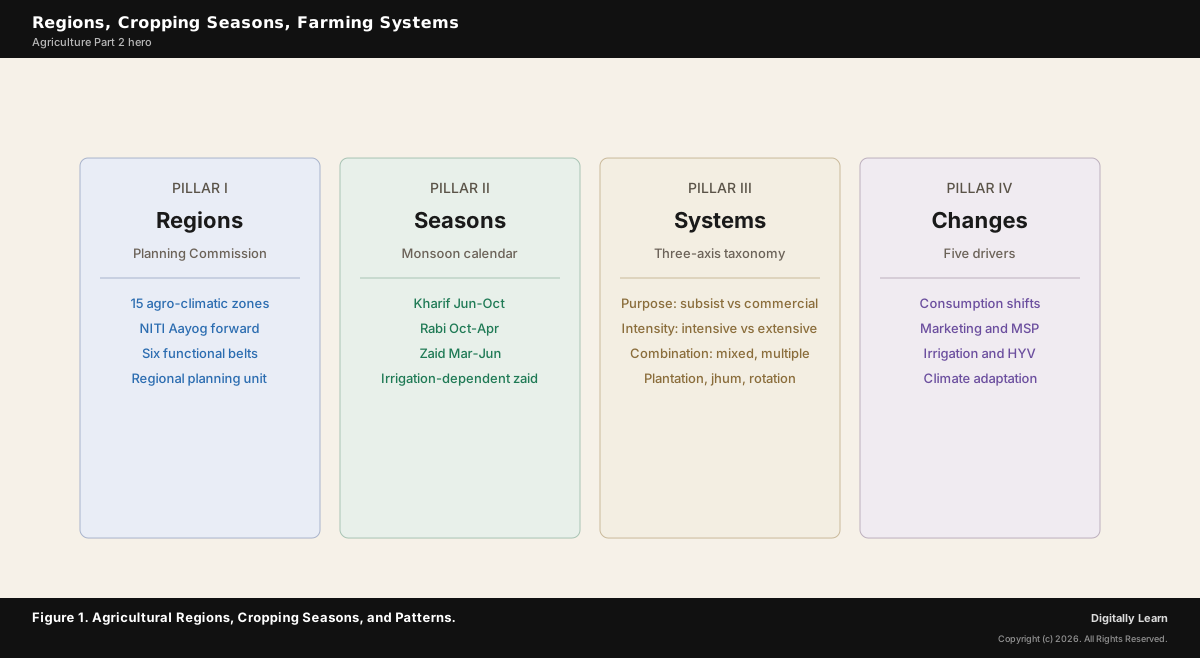
Indian agricultural geography is organised by three operational frameworks that together determine where each crop is grown, when it is sown, and how it interacts with other crops on the same field. The agro-climatic regionalisation of the country, developed by the Planning Commission and now under the NITI Aayog framework, identifies fifteen broad agro-climatic regions based on rainfall, temperature, soil, and water-resource endowment. The three-cropping-season calendar divides the agricultural year into Kharif (monsoon), Rabi (winter), and Zaid (summer) seasons. The farming-system taxonomy classifies production by purpose (subsistence versus commercial), intensity (intensive versus extensive), and combination (mixed, multiple cropping, intercropping, crop rotation, shifting cultivation, plantation).
Background and Historical Context
Every per-crop article in this Agriculture cluster (Parts 3 through 6 covering rice, wheat, millets, pulses, cotton, sugarcane, oilseeds, jute, tea, coffee, rubber) inherits a position in the cropping calendar and a placement on the agro-climatic map. UPSC Prelims tests cropping-season identification routinely; Mains GS-III tests cropping-pattern changes and the policy levers that drive them.
What is the significance of the three-framework system? Three operational dimensions follow. The agro-climatic regionalisation underwrites planning for irrigation, fertiliser distribution, and price-support logistics; the same region is treated as a planning unit for input subsidies. The cropping calendar sets the entire labour, irrigation, and credit cycle; Kharif sowing in June-July ties to monsoon arrival while Rabi sowing in October-November ties to monsoon retreat. The farming-system taxonomy distinguishes Punjab-Haryana commercial intensive rice-wheat from Bihar small-marginal subsistence mixed farming from north-eastern hill jhum from Western Ghats plantation, each requiring different policy responses.
NITI Aayog continues the Planning Commission's agro-climatic zoning architecture as the basis for regional agricultural planning. The National Rainfed Area Authority addresses dryland regions; the Mission for Integrated Development of Horticulture targets the horticulture sub-regions. Climate-change amplification of monsoon variability is reshaping the kharif sowing window in eastern India and the rabi water-availability outlook across the Indo-Gangetic belt; the National Innovations in Climate Resilient Agriculture programme is the canonical adaptation response.
Introduction: Agro-Climatic Regionalisation
The fifteen-region planning framework
Indian agricultural geography rests on the Planning Commission's agro-climatic regionalisation that grouped the country into fifteen broad regions in 1989. The criteria were rainfall pattern, temperature regime, soil endowment, and water-resource availability. NITI Aayog has carried the framework forward as the basis for regional agricultural planning.
The fifteen regions run from the Himalayan north to the peninsular south and the coasts. Each region carries a characteristic crop signature that the per-crop articles in Parts 3 through 6 build on.
- Himalayan belt: Western Himalayan region; Eastern Himalayan region.
- Gangetic plains: Lower, Middle, Upper, and Trans-Gangetic Plain.
- Plateau and hills: Eastern, Central, Western, and Southern Plateau and Hills.
- Coastal and western: East Coast Plains and Hills; West Coast Plains and Ghats; Gujarat Plains and Hills; Western Dry Region; the Islands.
Three Cropping Seasons: Kharif, Rabi, Zaid
How the monsoon defines the agricultural calendar
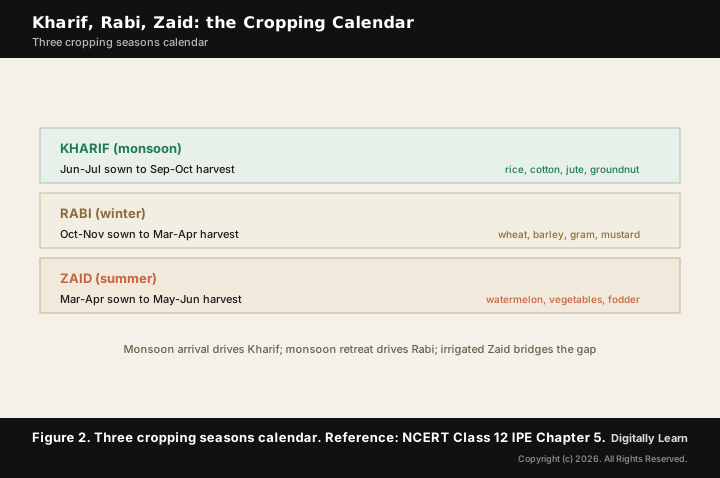
The Indian agricultural calendar is monsoon-anchored. The three cropping seasons follow the south-west monsoon arrival, retreat, and the dry interlude that follows. The calendar drives labour, irrigation, credit, and price-support timing across the country.
- (i) Kharif: Sown June-July with the south-west monsoon arrival; harvested September-October; the principal kharif crops are rice, cotton, jute, groundnut, sugarcane, soybean, jowar, bajra, ragi, and pulses such as tur and urad.
- (ii) Rabi: Sown October-November with the monsoon retreat; harvested March-April; the principal rabi crops are wheat, barley, gram, mustard, peas, and oats. The rabi crop depends on residual soil moisture plus winter rainfall plus irrigation.
- (iii) Zaid: Sown March-April between the rabi harvest and the kharif sowing; harvested May-June; short-duration summer crops including watermelon, muskmelon, cucumber, vegetables, and fodder. The zaid season requires irrigation.
Cotton straddles a long growing season from June to January across two seasons. Groundnut is a kharif crop in most regions but a rabi crop in southern India where the post-monsoon moisture supports a second cycle.
| Feature | Kharif | Rabi | Zaid |
|---|---|---|---|
| Sowing | June to July (monsoon arrival) | October to November (monsoon retreat) | March to April (post-rabi) |
| Harvest | September to October | March to April | May to June |
| Water source | South-west monsoon rainfall | Residual soil moisture, winter rain, irrigation | Irrigation (summer dry spell) |
| Signature crops | Rice, cotton, jute, groundnut, sugarcane, soybean, jowar, bajra | Wheat, barley, gram, mustard, peas | Watermelon, muskmelon, cucumber, vegetables, fodder |
Farming Systems: Purpose, Intensity, Combination
How farming systems classify by three axes
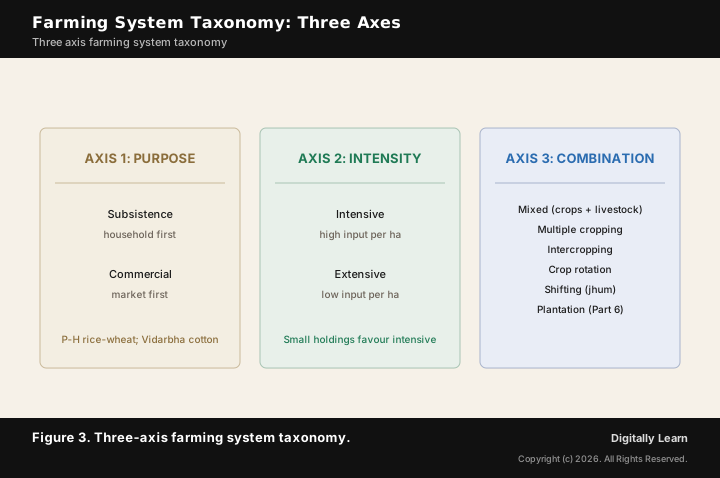
How the three-axis taxonomy organises the Indian system. Indian farming systems classify along three axes: the purpose of production (subsistence versus commercial), the intensity of input use (intensive versus extensive), and the combination of activities on the same holding (single-crop versus mixed versus integrated). Mains 2023 GS-III tested the changes in cropping pattern that follow shifts in consumption and marketing conditions.
- (i) Subsistence and commercial: Subsistence farming serves household consumption first and markets the surplus; the dominant mode across small and marginal Indian holdings. Commercial farming targets market sale with crops chosen for export or processing value.
- (ii) Intensive and extensive: Intensive farming applies high input per unit area for high yields; Indo-Gangetic alluvium is the canonical example. Extensive farming spreads inputs thinly over large holdings; less common in India given small average holding size.
- (iii) Mixed and integrated: Mixed farming combines crop cultivation with livestock rearing on the same holding. Integrated Farming Systems extend the concept to include fisheries, poultry, and agroforestry.
Several system patterns cross-cut the three axes, each defined by how crops share the field across space and time.
- Multiple cropping: two or more crops on the same field in the same year (rice-wheat in the Indo-Gangetic belt).
- Intercropping: two crops grown simultaneously on the same field with different row spacing (maize with pulses).
- Crop rotation: crops alternated across seasons to break pest cycles and rebuild fertility (rice-wheat-pulse rotation).
- Shifting cultivation (jhum): the historical mode in the north-eastern hills, now in transition under MOVCDNER.
- Plantation agriculture: the large-estate single-crop commercial mode covered in Agriculture Part 6.
Major Agricultural Regions: Six Functional Belts
How the country divides into six functional crop regions
Distinguishing features of the six functional belts. Beyond the fifteen agro-climatic regions, Indian agricultural geography reads more usefully as six functional belts defined by the dominant crop or cropping system. The functional geography simplifies the regional planning frame to a memorable six-way grid that maps directly onto the per-crop entries of Agriculture Parts 3 through 6.
- (a) Rice region: Eastern and southern India with high rainfall and irrigation; West Bengal, Odisha, Bihar, eastern Uttar Pradesh, Andhra Pradesh, Tamil Nadu, Kerala; covered in Agriculture Part 3.
- (b) Wheat region: Indo-Gangetic plain with canal-tube-well irrigation; Punjab, Haryana, western Uttar Pradesh; the Green Revolution heartland; covered in Agriculture Part 3.
- (c) Millet region: Rain-shadow Deccan and Rajasthan dryland; Maharashtra, Karnataka, Andhra Pradesh, Tamil Nadu, Rajasthan; covered in Agriculture Part 4.
- (d) Cotton region: Black-soil Deccan (Vertisols) plus irrigated tracts; Maharashtra, Gujarat, Madhya Pradesh, Telangana, Karnataka, Punjab; covered in Agriculture Part 5.
- (e) Plantation region: Western Ghats and north-eastern hills; Karnataka coffee, Kerala rubber and spices, Assam-Bengal-Nilgiri tea; covered in Agriculture Part 6.
- (f) Mixed farming region: Intermediate tracts blending crops and livestock; central India, transitional belts; the default Indian mode by area share.
Contemporary Changes in Cropping Pattern
Five drivers reshaping the Indian cropping pattern
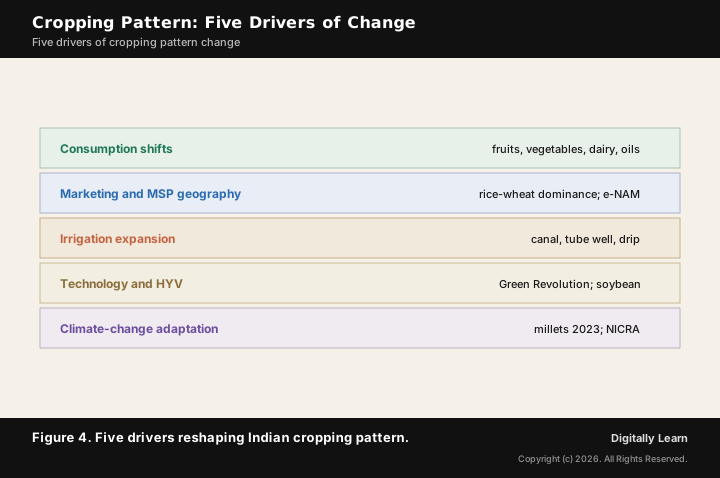
Mains GS-III has consistently tested the changes in Indian cropping pattern (Mains 2023 question on consumption-and-marketing drivers; Mains 2018 question on millets emphasis). The cropping geography is in active transition under five drivers.
- (a) Consumption shifts: Rising household demand for fruits, vegetables, poultry, dairy, and edible oil drives expansion of horticulture, livestock, and oilseed cropping at the expense of traditional staples in some regions.
- (b) Marketing and price-support architecture: Minimum Support Price geography concentrated in rice-wheat skews cropping toward those crops; reform-era expansion of MSP coverage and electronic markets (e-NAM) is reshaping incentives.
- (c) Irrigation expansion: Canal-and-tube-well irrigation enables rice-wheat in formerly rain-fed tracts; cross-link to Agriculture Part 8.
- (d) Technology and HYV adoption: The Green Revolution rice-wheat seed package shifted cropping toward those two cereals; the soybean revolution shifted Madhya Pradesh and Maharashtra dryland tracts. Cross-link to Agri Part 9.
- (e) Climate-change adaptation: International Year of Millets 2023 raised awareness of climate-resilient dryland cropping; NICRA coordinates adaptation research; monsoon-window shift is altering kharif sowing in eastern India.
Previous Year UPSC-CSE Questions
Previous Year UPSC-CSE Questions By the end you will be able to draft model answers for the following UPSC questions. Each question carries a collapsible framework showing how to approach it in the exam.
- UPSC Prelims 2013Consider the following crops :
- Cotton
- Groundnut
- Rice
- Wheat Which of these are Kharif crops?
How to approach this Prelims question
Approach: Apply the Kharif (June-July sowing, monsoon-fed) versus Rabi (October-November sowing, winter) distinction. Cotton, groundnut, rice are kharif; wheat is the canonical rabi crop.
Trap to watch: Wheat is the most prominent Indian crop but it is rabi, not kharif.
Key facts to recall:
- Kharif sown June-July with monsoon arrival; harvested September-October
- Rabi sown October-November with monsoon retreat; harvested March-April
- Rice, cotton, jute, groundnut, sugarcane, maize, jowar, bajra are kharif
- Wheat, barley, gram, mustard, peas are rabi
Answer signal: Correct answer is (c): 1, 2 and 3 (cotton, groundnut, rice).
- UPSC Prelims 2012Which of the following is the chief characteristic of 'mixed farming'?
How to approach this Prelims question
Approach: Recall the NCERT definition: mixed farming combines crops and livestock on the same holding. Distinguish from mixed cropping (multiple crops on same field) and from intercropping (two crops in alternating rows).
Trap to watch: Statement (b) describes mixed CROPPING not mixed FARMING; the distinction is crops-plus-livestock versus multiple-crops.
Key facts to recall:
- Mixed farming = crops PLUS livestock on same holding
- Mixed cropping = two or more crops on same field
- Intercropping = two crops alternating rows with different spacing
- Crop rotation = seasonal alternation across years
- Multiple cropping = two or more crops in same year on same field
Answer signal: Correct answer is (c): rearing animals and cultivating crops together.
- UPSC Mains 2023 GS-IIIExplain the changes in cropping pattern in India in the context of changes in consumption pattern and marketing conditions.
How to structure the answer in the exam
Introduction: Open by defining cropping pattern as the spatial and temporal arrangement of crops, then state that India's pattern has shifted in response to changing consumption demand and reformed marketing conditions.
Body (sub-themes to develop):
- Consumption shift: rising household demand for fruits, vegetables, poultry, dairy, and edible oil draws acreage toward horticulture, livestock feed, and oilseeds.
- Marketing and price-support geography: Minimum Support Price concentrated in rice and wheat distorts incentives, while e-NAM and APMC reform broaden market access and diversify choices.
- Irrigation and technology: canal and tube-well expansion plus the Green Revolution seed package entrenched rice-wheat, while the soybean revolution reshaped Madhya Pradesh and Maharashtra dryland.
- Climate adaptation: the International Year of Millets 2023 and NICRA research revive climate-resilient dryland cropping as monsoon variability rises.
Conclusion: Conclude that the cropping pattern is in active transition, and that aligning price support, market access, and climate-resilient research will determine whether the shift improves farmer income and nutritional security.
Sources
- NCERT Class 12 India People and Economy, Chapter 5 (Land Resources and Agriculture)
- NCERT Class 12 Fundamentals of Human Geography, Chapter 5 (Primary Activities)
- Indian Council of Agricultural Research (ICAR)
- NITI Aayog: Agricultural Planning
- Department of Agriculture and Farmers Welfare, Ministry of Agriculture
- Agricultural and Processed Food Products Export Development Authority (APEDA)
- Ministry of Statistics and Programme Implementation (MoSPI)
- United Nations Food and Agriculture Organization (FAO)
- Wikipedia: Agriculture in India
- Wikipedia: Cropping system
Disclaimer
This article covers India's agro-climatic regions, the three cropping seasons, the farming-system taxonomy, and contemporary cropping-pattern change. Concepts and named institutions are cross-checked against NCERT and the authoritative sources listed below. It is study material for UPSC preparation, not policy or investment advice.